

TL;DR
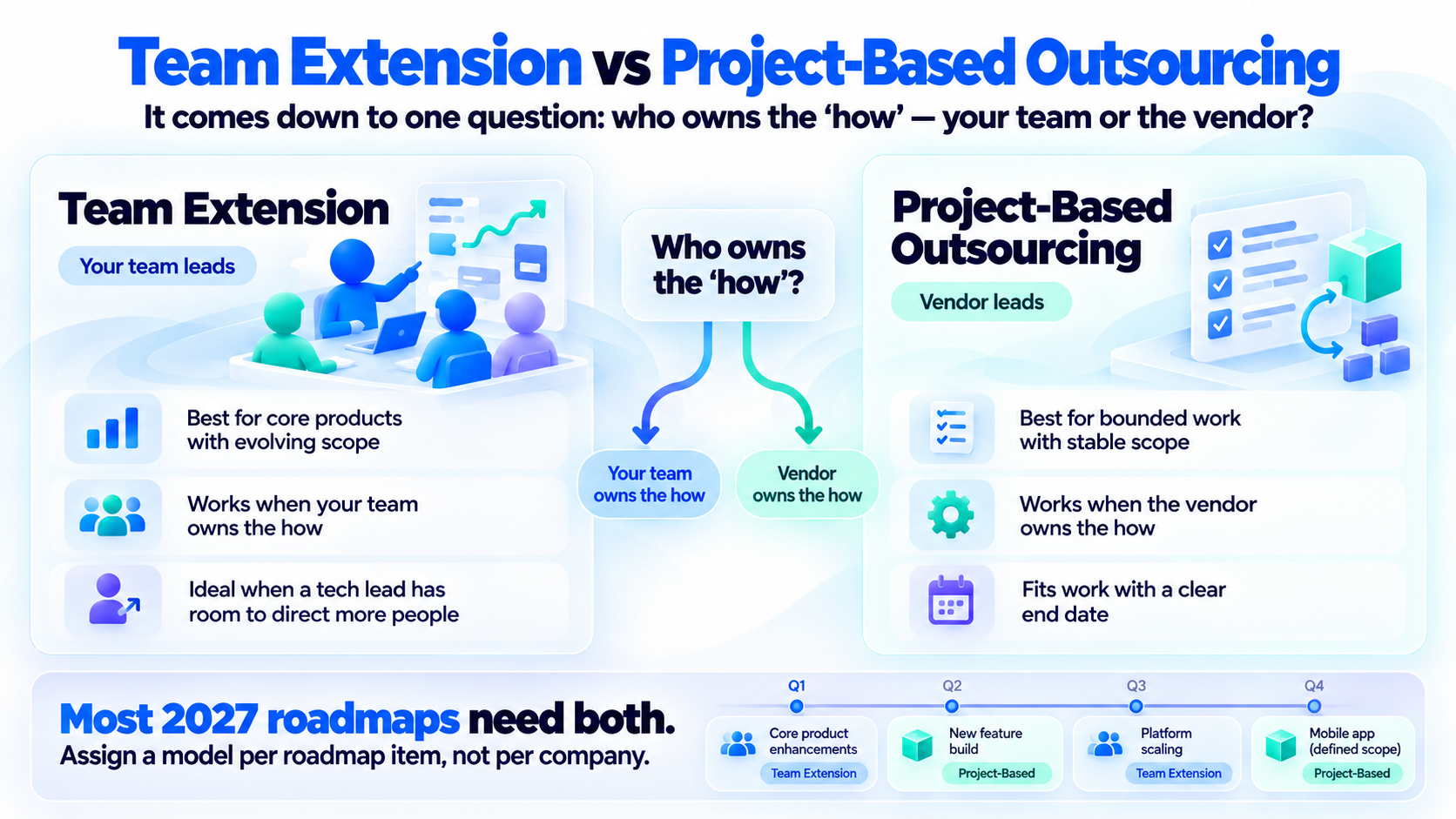
- Team extension vs project-based outsourcing comes down to one question: who owns the “how,” your team or the vendor.
- Team extension fits core products with evolving scope and a tech lead who has room to direct more people.
- Project-based outsourcing fits bounded work with a stable scope and a clear end date.
- Most 2027 roadmaps need both. Assign a model per roadmap item, not per company.
1. Introduction
It’s Q4. Your 2027 roadmap has more on it than your engineering team can ship, and finance wants to know how you’ll close the gap before the budget locks. The common shortcut is to pick one outsourcing model and apply it to everything. That’s usually where the trouble starts.
The choice between team extension and project-based outsourcing isn’t mainly about cost per developer. It’s about who makes delivery decisions, how stable your scope is, and what knowledge you want left in-house when the work ends. This guide breaks down both models, where each one fails, and a short test to assign every roadmap item to the right one.
2. Team Extension vs Project-Based Outsourcing: Who Owns the “How”
In team extension, external engineers join your team, follow your processes and take direction from your tech lead. You own the “how.” In project-based outsourcing, you define the “what” (scope, deliverables, deadline) and the vendor owns planning, execution and delivery. The real difference is control and accountability, not price.
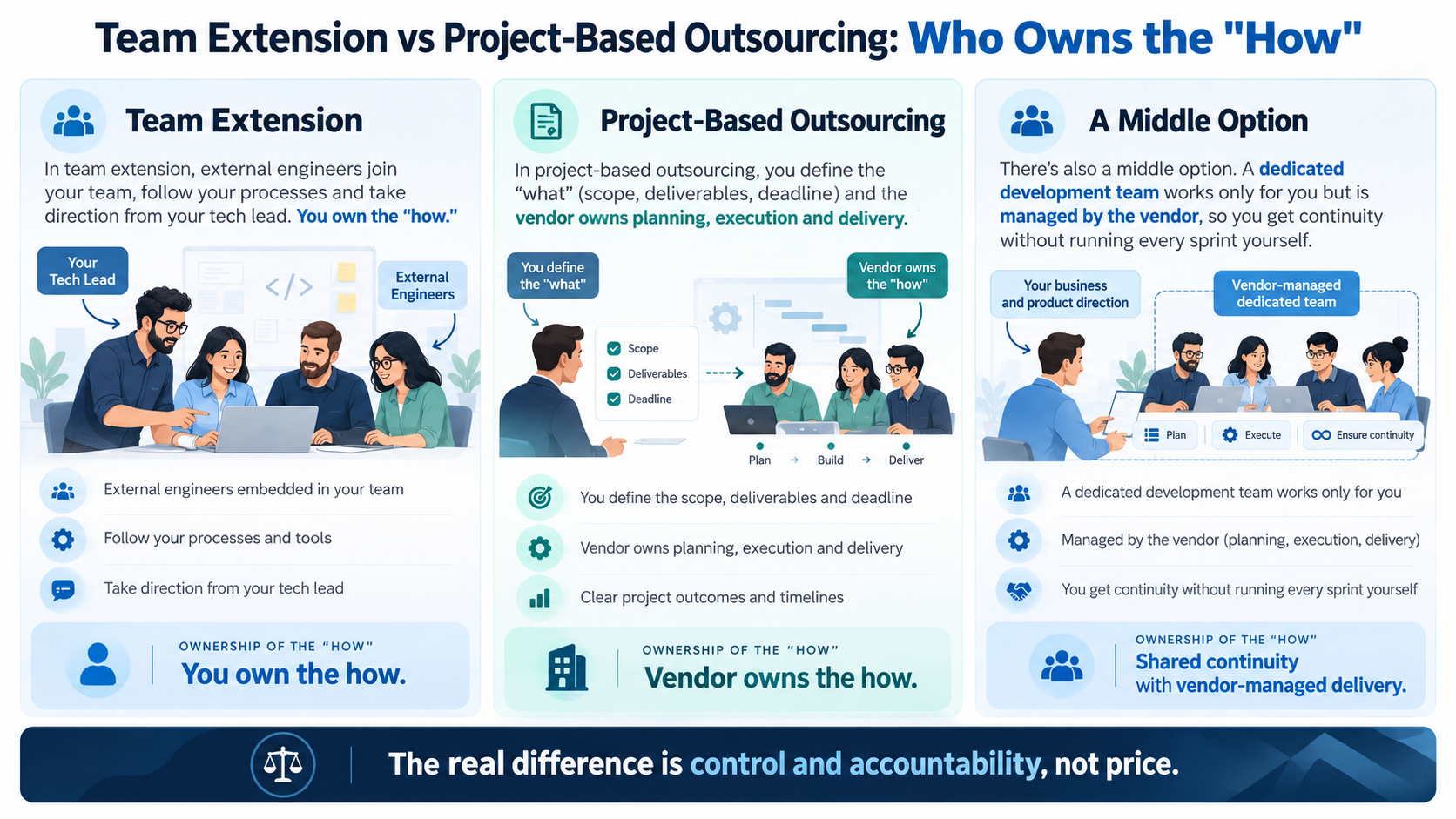
There’s also a middle option. A dedicated development team works only for you but is managed by the vendor, so you get continuity without running every sprint yourself.
| Team Extension | Project-Based Outsourcing | |
|---|---|---|
| Who runs day-to-day work | Your tech lead | Vendor’s project manager |
| Scope | Evolves sprint to sprint | Fixed upfront; changes go through change requests |
| Pricing | Monthly per engineer (time and materials) | Fixed price or milestone-based |
| Your management load | High | Low to medium |
| Where knowledge ends up | In your team | With the vendor, unless handover is planned |
| Best for | Core product, ongoing roadmap | Bounded build with a clear finish line |
3. When Engineering Team Extension Fits Your Roadmap
Team extension works when the work is close to your core and still moving. Four signals point to it:
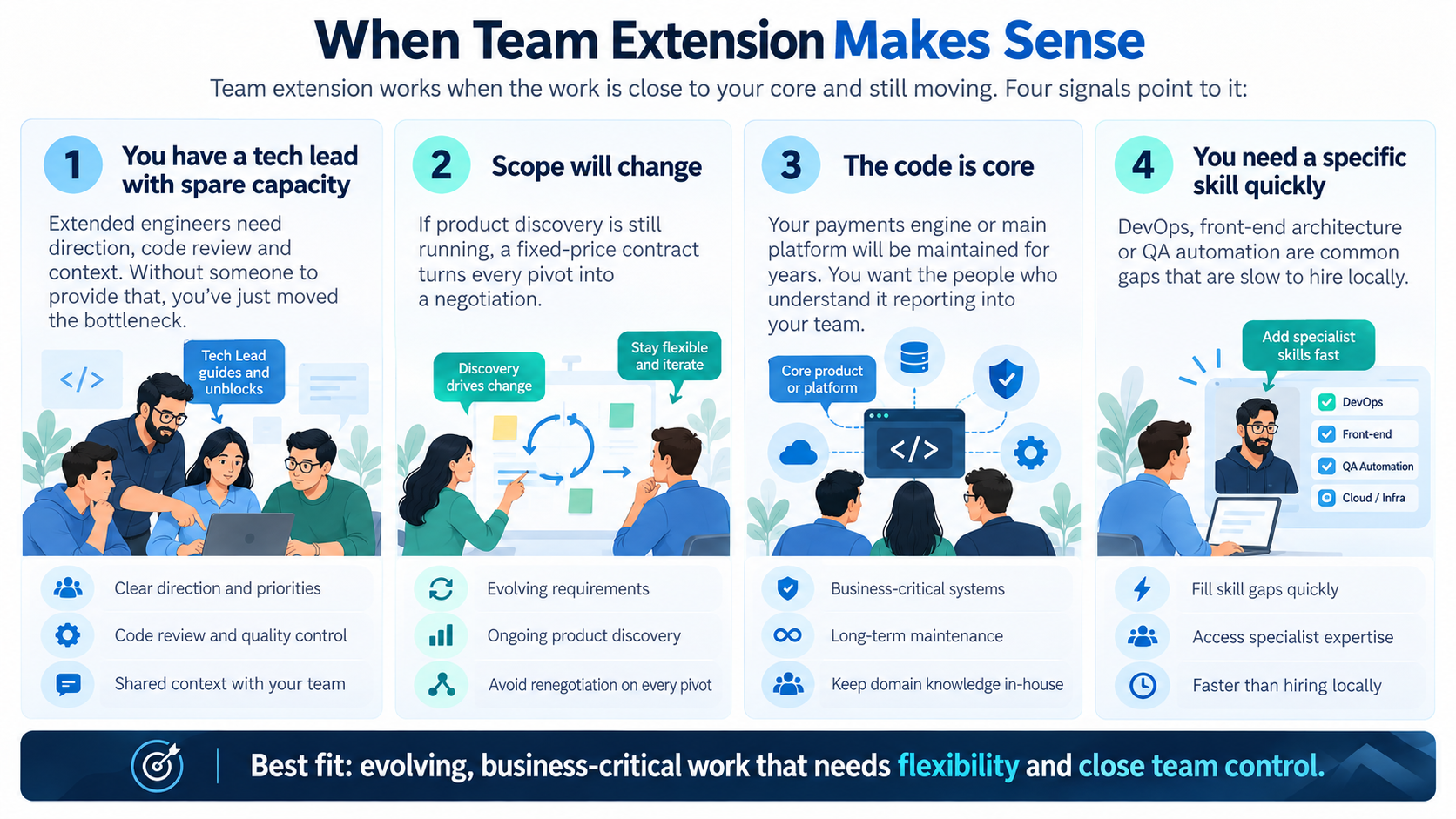
- You have a tech lead with spare capacity. Extended engineers need direction, code review and context. Without someone to provide that, you’ve just moved the bottleneck.
- Scope will change. If product discovery is still running, a fixed-price contract turns every pivot into a negotiation.
- The code is core. Your payments engine or main platform will be maintained for years. You want the people who understand it reporting into your team.
- You need a specific skill quickly. DevOps, front-end architecture or QA automation are common gaps that are slow to hire locally.
Picture a fintech with a six-person platform team planning open-banking integrations for 2027. Partner banks are still finalizing their APIs, so requirements will shift for months. That is a team extension candidate: the work is core, the scope is unstable, and the internal team needs to own the result.
4. When Project-Based Outsourcing Is the Better Call
Project-based outsourcing works when you can describe the finished thing today and it will still be true in six months. Look for these conditions:
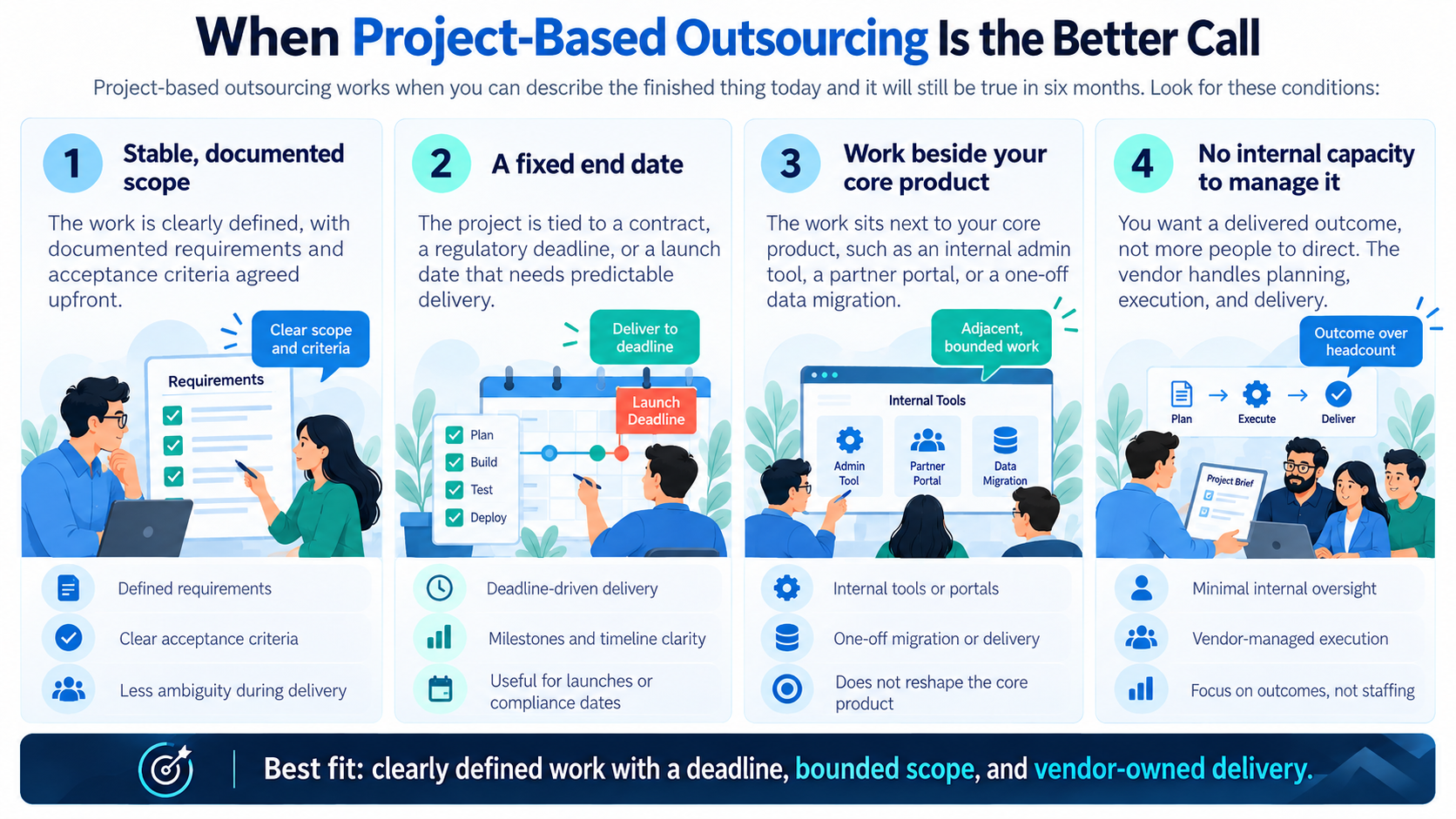
- Stable, documented scope with clear acceptance criteria.
- A fixed end date, often tied to a contract, a regulatory deadline or a launch.
- Work that sits beside your core product, such as an internal admin tool, a partner portal or a one-off data migration.
- No internal capacity to manage it. You want an outcome, not more people to direct.
Take a legacy reporting module that has to move to the cloud before a hosting contract expires. The spec is known, the deadline is fixed, and nobody on your team wants to spend 2027 on it. A vendor that owns delivery end to end is the sensible choice.
A useful rule of thumb: if you can write acceptance criteria now and expect them to survive kickoff, project-based outsourcing is worth pricing.
5. The Costs Neither Model Advertises
Both models look clean in a proposal. The costs show up later.
5.1 Where Team Extension Breaks Down
The biggest cost is your own management time. Rates often look lower because there’s no vendor project-management layer, but your tech lead is now running more people. If they were already at capacity, velocity drops instead of rising.
Onboarding also takes real effort: access, environment setup, codebase walkthroughs, review cycles. And when a release slips, there’s no vendor to hold accountable. It’s your process.
5.2 Where Project-Based Outsourcing Breaks Down
The classic failure is scope drift. One staffing firm’s rule of thumb is that outsourcing is cheaper when scope stays within 25% of the original, and staff augmentation is cheaper when it drifts further. Treat the exact figure as a heuristic, but the pattern is familiar: once change requests start, the fixed price stops being fixed.
The second failure is the handover. You receive a repository and documentation, and the people who understood the edge cases move to their next client. Then comes month seven, when a bug appears and nobody has priced who fixes it.
Before signing either model, ask one question: who owns this code after go-live? If the answer is vague, plan for it now.
6. What Changes in 2027: AI-Assisted Delivery and Team Sizing
AI coding tools are now standard. Google’s DORA 2025 State of AI-assisted Software Development report found that 90% of survey respondents use AI at work. The more useful finding for planning is that AI acts mainly as an amplifier, magnifying the strengths of high-performing organizations and the dysfunctions of struggling ones. The same report found AI is now associated with better delivery throughput but still increases delivery instability.
That matters for both models:
- For team extension: AI-assisted engineers amplify your process, good or bad. If your code review, testing and CI pipeline are weak, adding more people who ship faster will raise instability. Fix the pipeline before scaling headcount.
- For project-based outsourcing: Vendors using AI-assisted delivery may quote shorter timelines. Ask how they verify AI-generated code (test coverage, review gates, who signs off) and whether the estimate includes that work.
- For team shape: In our delivery work, the teams that benefit most from AI tooling tend to be smaller, more senior and strict about review. When you size a 2027 team, weigh review capacity as heavily as coding capacity.
7. How to Map Your 2027 Roadmap to the Right Model
Run each roadmap item through five questions:
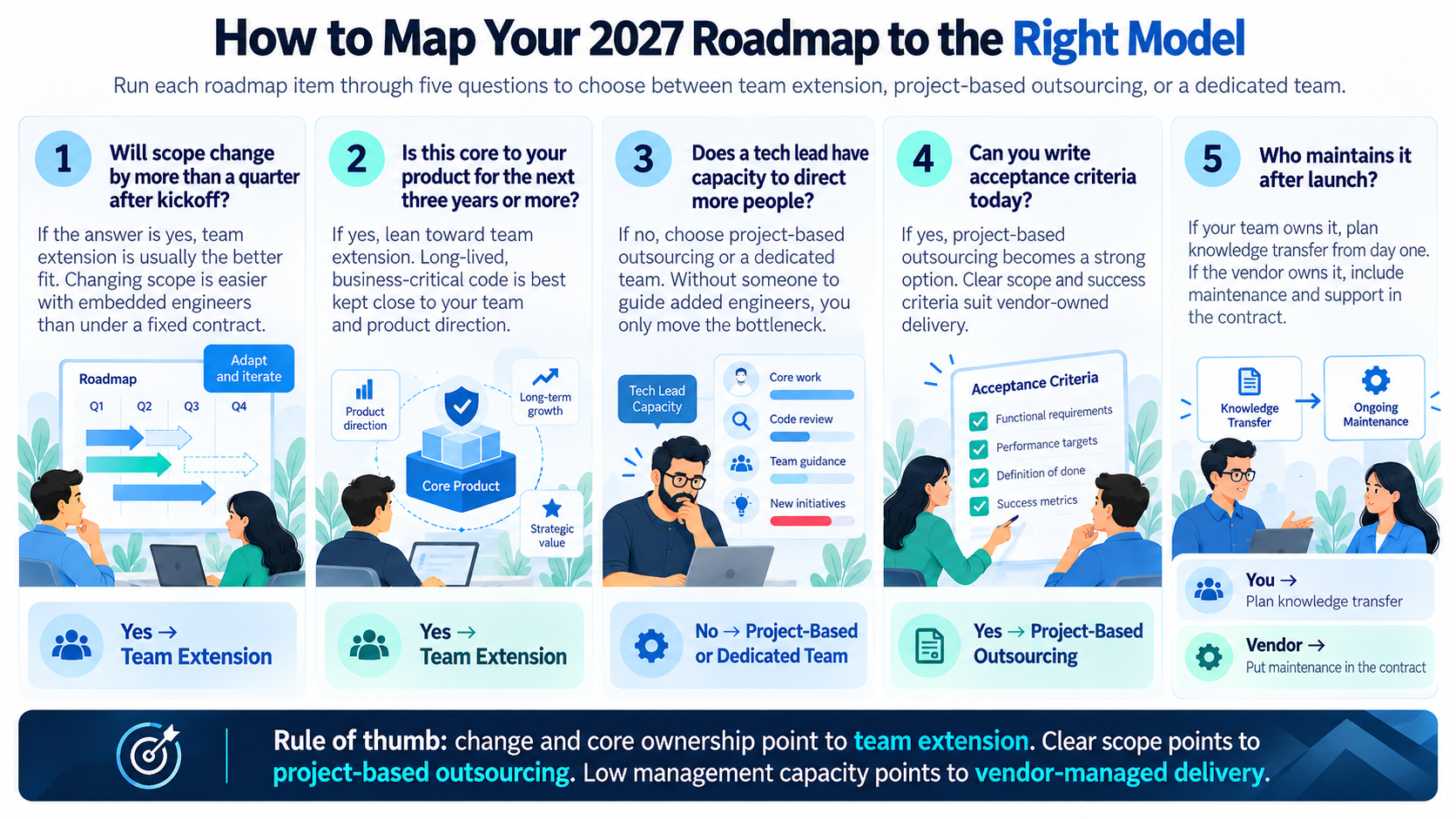
- Will scope change by more than a quarter after kickoff? Yes points to team extension.
- Is this core to your product for the next three years or more? Yes points to team extension.
- Does a tech lead have capacity to direct more people? No points to project-based outsourcing or a dedicated team.
- Can you write acceptance criteria today? Yes points to project-based outsourcing.
- Who maintains it after launch? If you, plan knowledge transfer from day one. If the vendor, put maintenance in the contract.
Here is how that might play out for a mid-size fintech:
| 2027 Roadmap Item | Likely Model | Why |
|---|---|---|
| Core payments platform enhancements | Team extension | Core, evolving, owned long-term |
| Partner reporting portal (fixed spec) | Project-based | Stable scope, clear end |
| Legacy module cloud migration | Project-based + maintenance clause | Bounded, but needs post-launch support |
| AI feature pilot | Team extension or small dedicated team | Scope uncertain, learning matters |
Most roadmaps end up with a mix. Common hybrid patterns include extending your development team for feature work while outsourcing QA, DevOps or security; keeping architects and tech leads extended for continuity while outsourcing project modules; and holding steady extended capacity while outsourcing discrete projects during peak demand.
If you’re comparing vendors for either model, our IT outsourcing due diligence checklist covers the questions worth asking before you sign.
8. How SmartDev Approaches Engagement Models
We run team extension, dedicated teams and vendor-owned delivery, so we don’t start from a contract type. We start from the roadmap item and ask who should own the “how.” Three examples show the range:
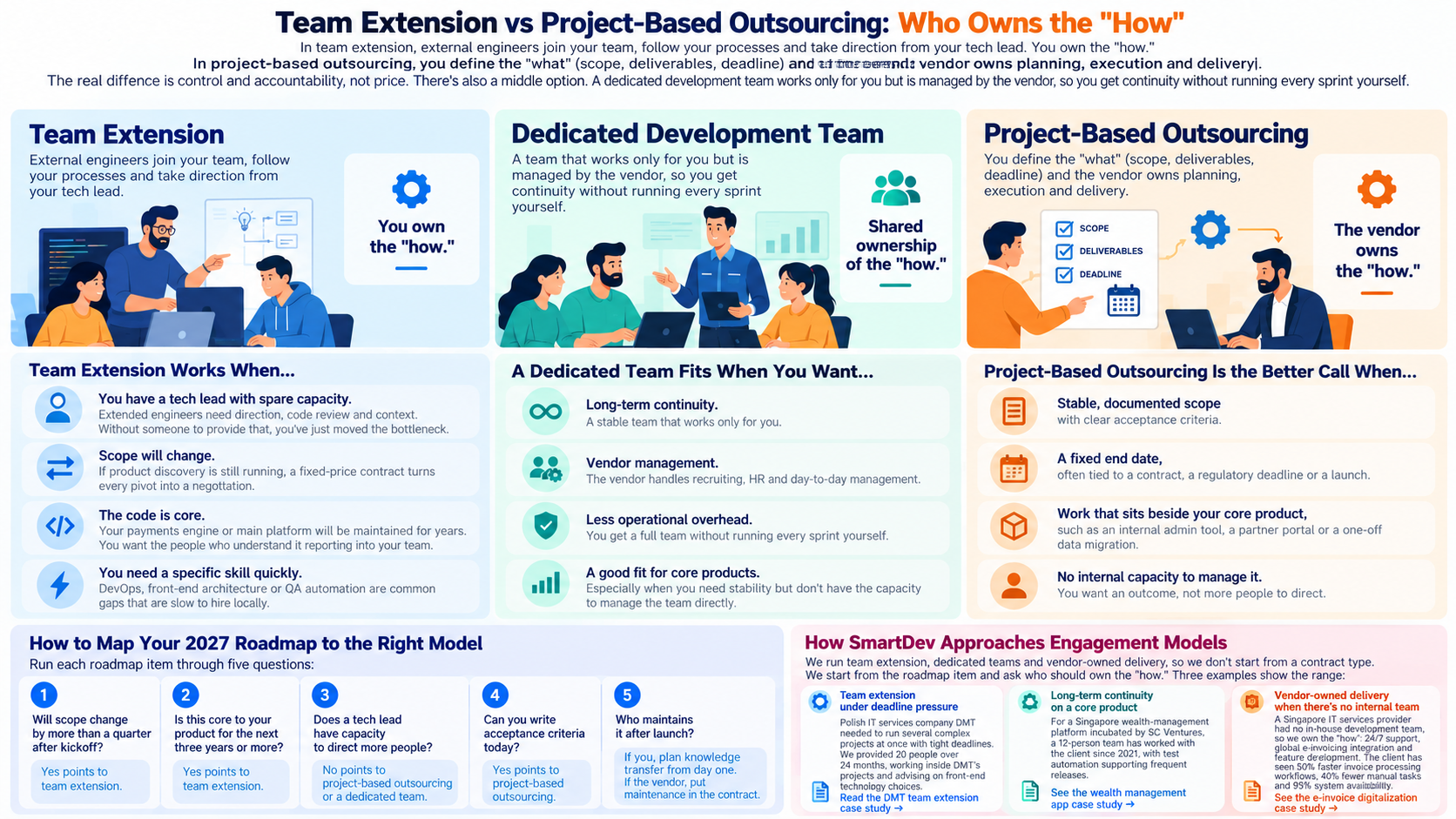
- Team extension under deadline pressure. Polish IT services company needed to run several complex projects at once with tight deadlines. We provided 20 people across developers, testers, back-end engineers, DevOps and PM support over 24 months, working inside the client’s projects and advising on front-end technology choices. Read the client’s case study!
- Long-term continuity on a core product. For a Singapore wealth-management platform incubated by SC Ventures, a 12-person team of developers, QAs, Scrum Masters and a Project Manager has worked with the client since 2021, with test automation supporting frequent releases. See the wealth management app case study.
- Vendor-owned delivery when there’s no internal team. A Singapore IT services provider had no in-house development team, so we own the “how”: 24/7 support, global e-invoicing integration and feature development. The client has seen 50% faster invoice processing workflows, 40% fewer manual financial tasks and 95% system availability. See the e-invoice digitalization case study.
As AI-assisted delivery becomes standard, we pair these models with AI-native software development practices, including review gates and testing built for AI-generated code.
9. Choosing Your Mix Before the Budget Locks
There’s no single right model for 2027. There’s a right model for each roadmap item. List your items, run the five questions, and decide where you need control and where you need an outcome.
If you’d like a second opinion, bring us your 2027 roadmap. We’ll help you sort which items need an extended team and which should be scoped as projects. Talk to us about your roadmap for free in just 30 minutes?
Frequently Asked Questions
What Is the Difference Between Team Extension and Project-Based Outsourcing?
Team extension adds external engineers to your team, managed by your tech lead and working in your processes, so you control how the work is done. Project-based outsourcing hands a defined scope to a vendor, who plans, builds and delivers it. The core difference is who owns delivery decisions and accountability.
When Should I Choose Team Extension Over Project-Based Outsourcing?
Choose team extension when the work is core to your product, scope is likely to change, and you have a tech lead with capacity to direct more engineers. It also suits situations where you need a specific skill quickly and want the knowledge to stay inside your team after the work ends.
Is Team Extension More Cost-Effective Than Outsourcing a Project?
It depends on scope stability. Team extension often has lower rates but costs you management time. Project-based outsourcing bundles management into the price but becomes expensive when scope drifts and change requests pile up. Compare total cost, including your team’s time and post-launch maintenance, not just the rate card.
How Fast Can an Extended Engineering Team Start?
Start time depends on the roles, seniority and how quickly you can provide access and onboarding. Vendors with an existing talent pool can usually propose candidates within days and have engineers working within weeks. Your own onboarding readiness often matters as much as the vendor’s speed.
Can You Combine Team Extension and Project-Based Outsourcing?
Yes, and most growing companies should. A common setup is to extend the core product team for ongoing work while outsourcing bounded builds, such as a migration or partner portal, as fixed-scope projects. Decide per roadmap item, and make sure both arrangements include a clear plan for maintenance after launch.