

MAS continues to issue regulatory updates across Notices, guidelines, consultations, FAQs, enforcement actions, and sector-specific communications.
TL, DR:
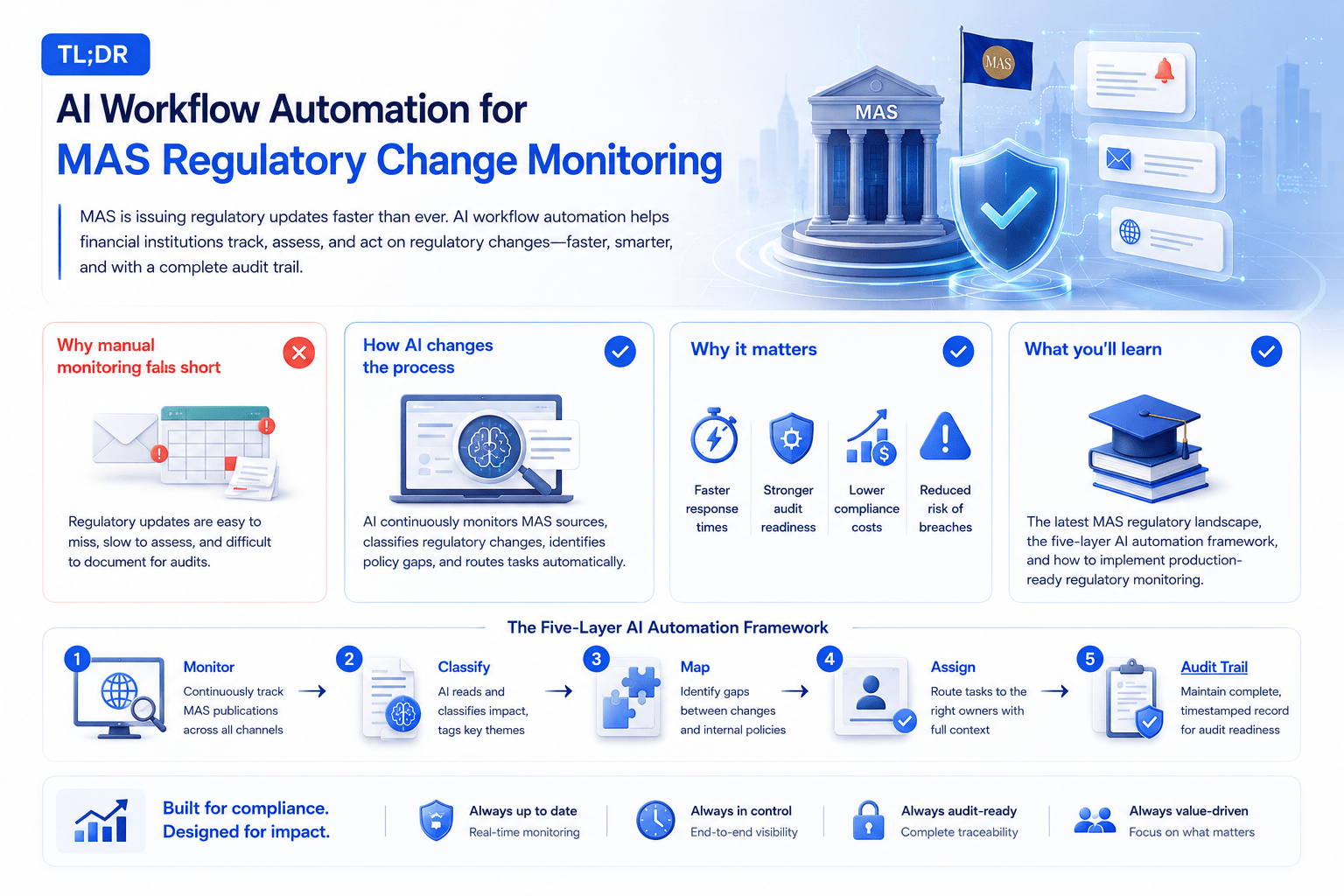
MAS is issuing regulatory updates faster than ever, making manual monitoring through emails and spreadsheets increasingly unreliable. AI workflow automation enables financial institutions to continuously track MAS publications, assess regulatory impact, map changes to internal policies, assign actions to the right stakeholders, and maintain an audit-ready compliance trail, helping teams reduce compliance risk while focusing on higher-value decision-making.
- Why manual monitoring falls short: Regulatory updates are easy to miss, slow to assess, and difficult to document for audits.
- How AI changes the process: AI continuously monitors MAS sources, classifies regulatory changes, identifies policy gaps, and routes tasks automatically.
- Why it matters: Faster response times, stronger audit readiness, lower compliance costs, and reduced risk of regulatory breaches.
- What you’ll learn: The latest MAS regulatory landscape, the five-layer AI automation framework, and how financial institutions can implement production-ready regulatory change monitoring.
Introduction, A Regulator That Does Not Slow Down
Financial institutions operating in Singapore wake up to a different kind of challenge today. The Monetary Authority of Singapore (MAS), the country’s central bank and chief financial regulator, does not issue rules in slow, predictable cycles. It issues guidance, consultation papers, binding Notices, and enforcement priorities in a continuous, overlapping stream. In 2024 alone, MAS enforced a new Technology Risk Management Notice, expanded its outsourcing rules for banks and merchant banks, and stood up a new Cyber and Technology Resilience Experts (CTREX) Panel. In January 2025, the second phase of the Financial Institutions (Miscellaneous Amendments) Act took effect, expanding MAS’s investigative and enforcement powers significantly.
Compliance teams at banks, fund managers, payment service providers, and insurers have one job: stay ahead of those changes, assess their impact, and update policies before deadlines hit. For years, that job relied on email alerts, manual document reviews, and spreadsheet trackers. Today, that approach puts institutions at genuine regulatory risk, and, increasingly, the most sophisticated firms have replaced it with AI workflow automation.
This article explains how that automation works, why the traditional approach fails, and what a structured transition to automated regulatory change monitoring looks like in practice.
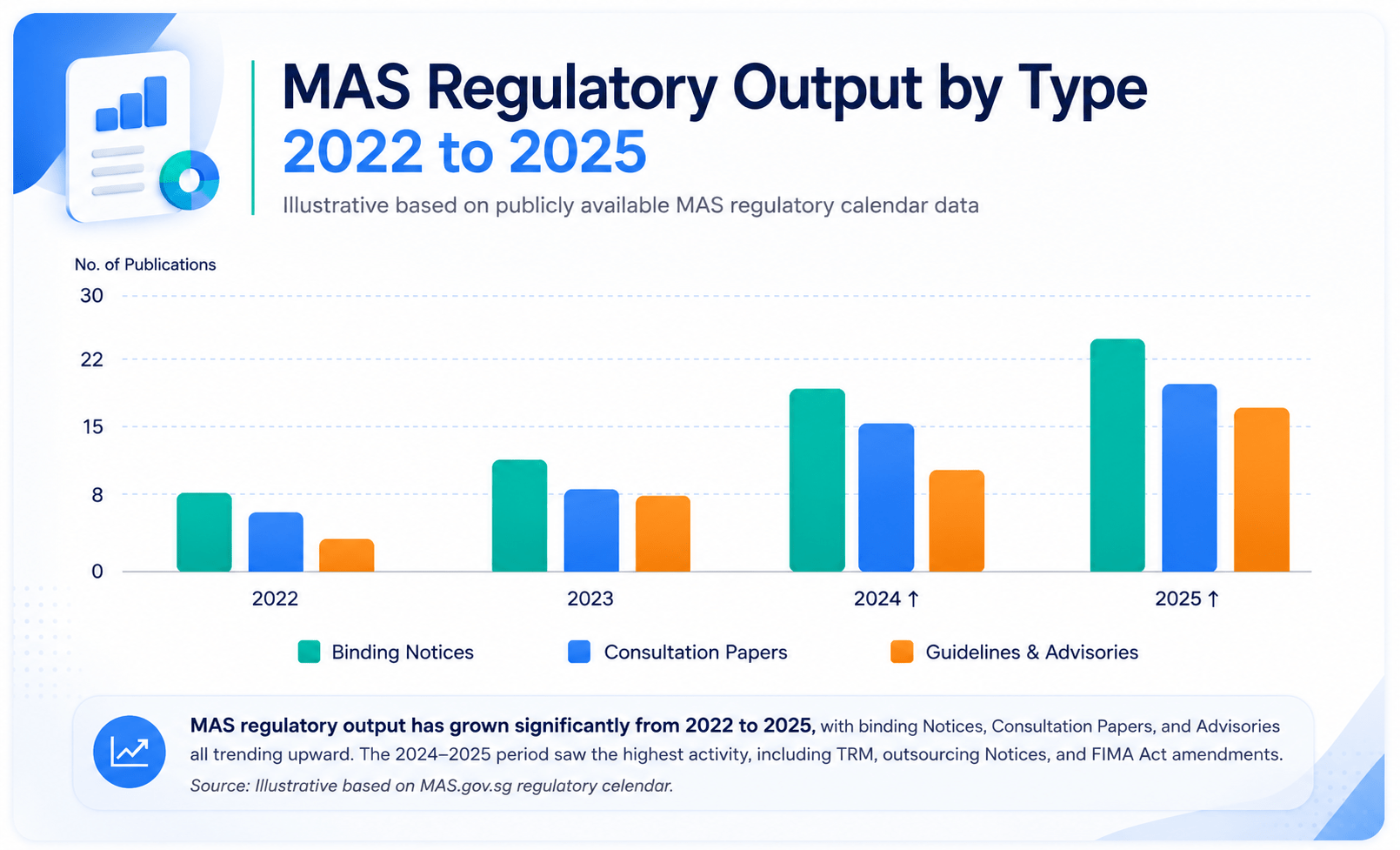
The MAS Regulatory Landscape in 2024–2025
What MAS published, and what it obligates
The pace of MAS rulemaking is not theoretical. The following timeline captures the binding regulatory changes that every MAS-regulated institution needed to track and implement across a 14-month window.
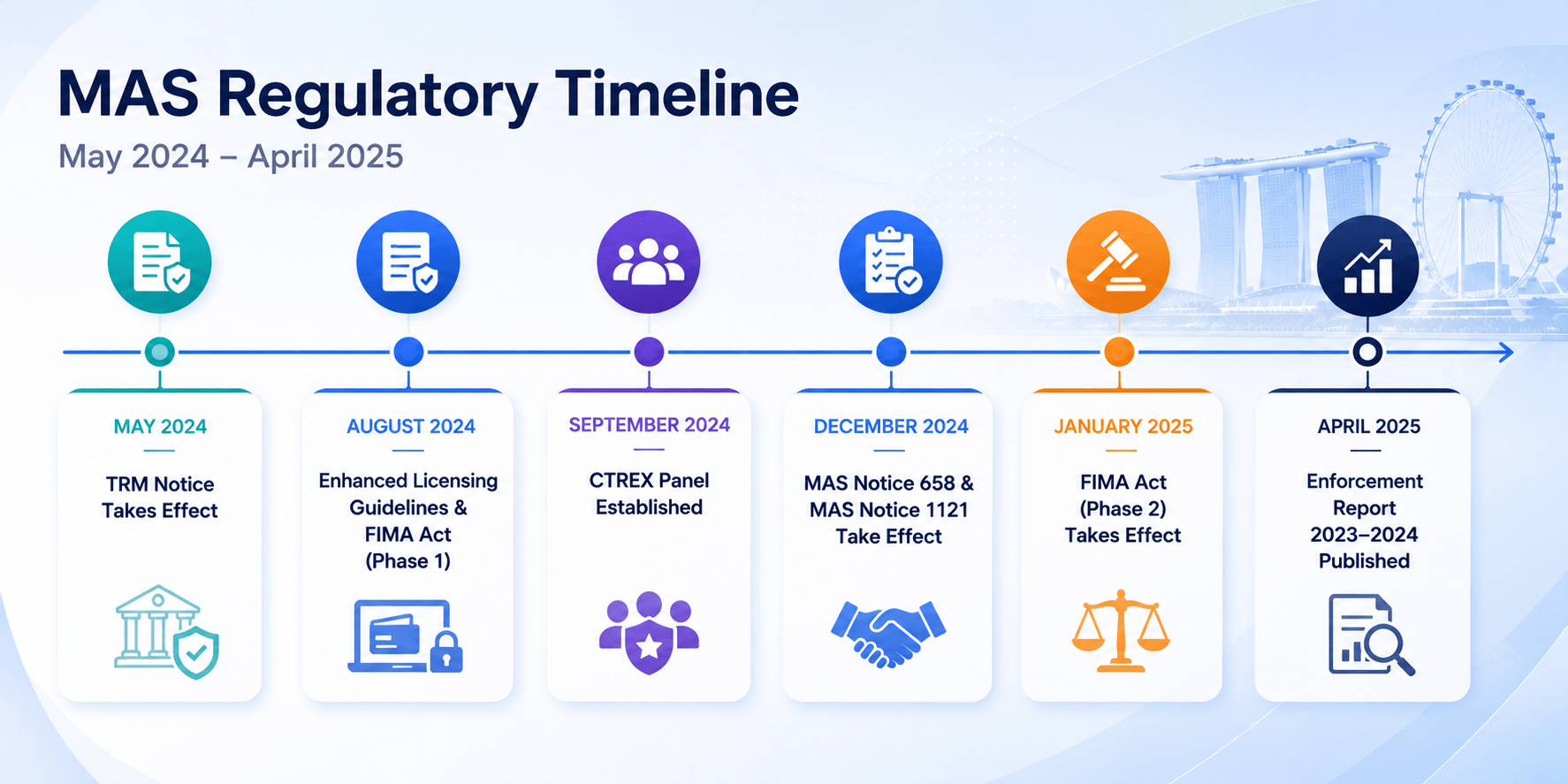
May 2024
MAS Notice on Technology Risk Management (TRM) Takes Effect
The Notice sets out legally binding requirements for identifying critical IT systems, ensuring reliability and availability, and protecting customer information from unauthorized access. It applies to all MAS-regulated financial institutions. Tripwire’s comprehensive MAS compliance guide documents the full scope of entities covered under this Notice.
August 2024
Enhanced Licensing Guidelines for Payment Service Providers
First Phase of FIMA Act Takes Effect
MAS expanded its powers to issue directions to Capital Markets Services licence holders and clarified its reprimand powers. Simultaneously, MAS updated licensing guidelines for payment service providers to include enhanced technology risk management assessments. Waystone Compliance’s detailed PSA timeline maps every phase of these changes from 2023 to 2025.
September 2024
CTREX Panel Established
MAS established the Cyber and Technology Resilience Experts Panel to bolster technology and cybersecurity best practices across the financial sector.
December 2024
MAS Notice 658 and MAS Notice 1121 Take Effect
Both Notices impose mandatory requirements on banks and merchant banks to assess, manage, and monitor risks arising from outsourced relevant services. The Notices replaced the 2016 Outsourcing Guidelines and introduced formal due diligence, materiality assessment, and ongoing review requirements.
January 2025
Second Phase of FIMA Act Takes Effect
MAS gained expanded investigative powers, including enhanced transfer of evidence provisions and new controls over changes in effective control of CMSL holders. Potential acquirers of Singapore fund managers now navigate a revised approval timeline under Section 97A of the Securities and Futures Act.
April 2025
MAS Publishes Enforcement Report 2023–2024
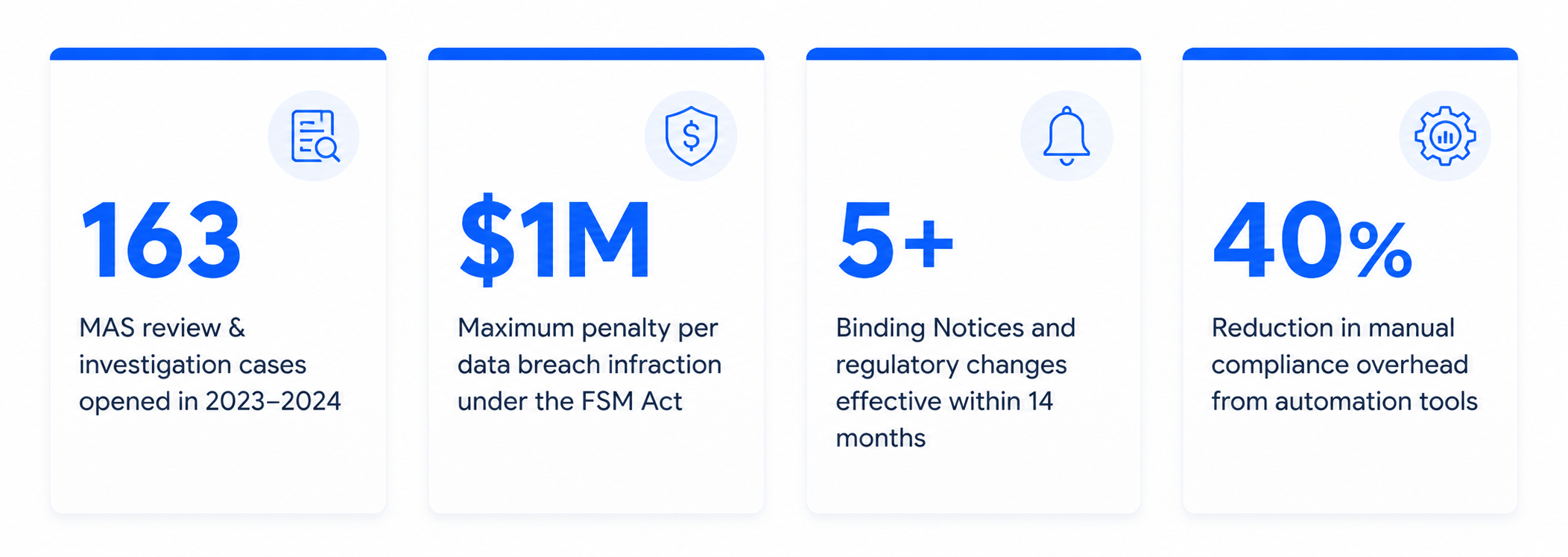
MAS opened 163 review and investigation cases during the reporting period. For 2025–2026, MAS declared AML/CFT enforcement and market misconduct as primary priorities, signaling intensified scrutiny of compliance frameworks.
AML/CFT remains MAS’s highest enforcement priority
The April 2025 Enforcement Report made MAS’s direction explicit. MAS stated it will take robust action against financial institutions that fail to comply with AML/CFT requirements, while also deepening data-sharing channels and reviewing penalty frameworks to ensure they remain dissuasive. Compliance teams cannot treat AML/CFT monitoring as a background process; it requires active, continuous surveillance that only AI and machine learning automation can deliver consistently. SmartDev’s fintech automation case studies demonstrate how this shift plays out in real institutions.
Why Manual Monitoring Keeps Failing
The structural weaknesses in spreadsheet-based compliance tracking
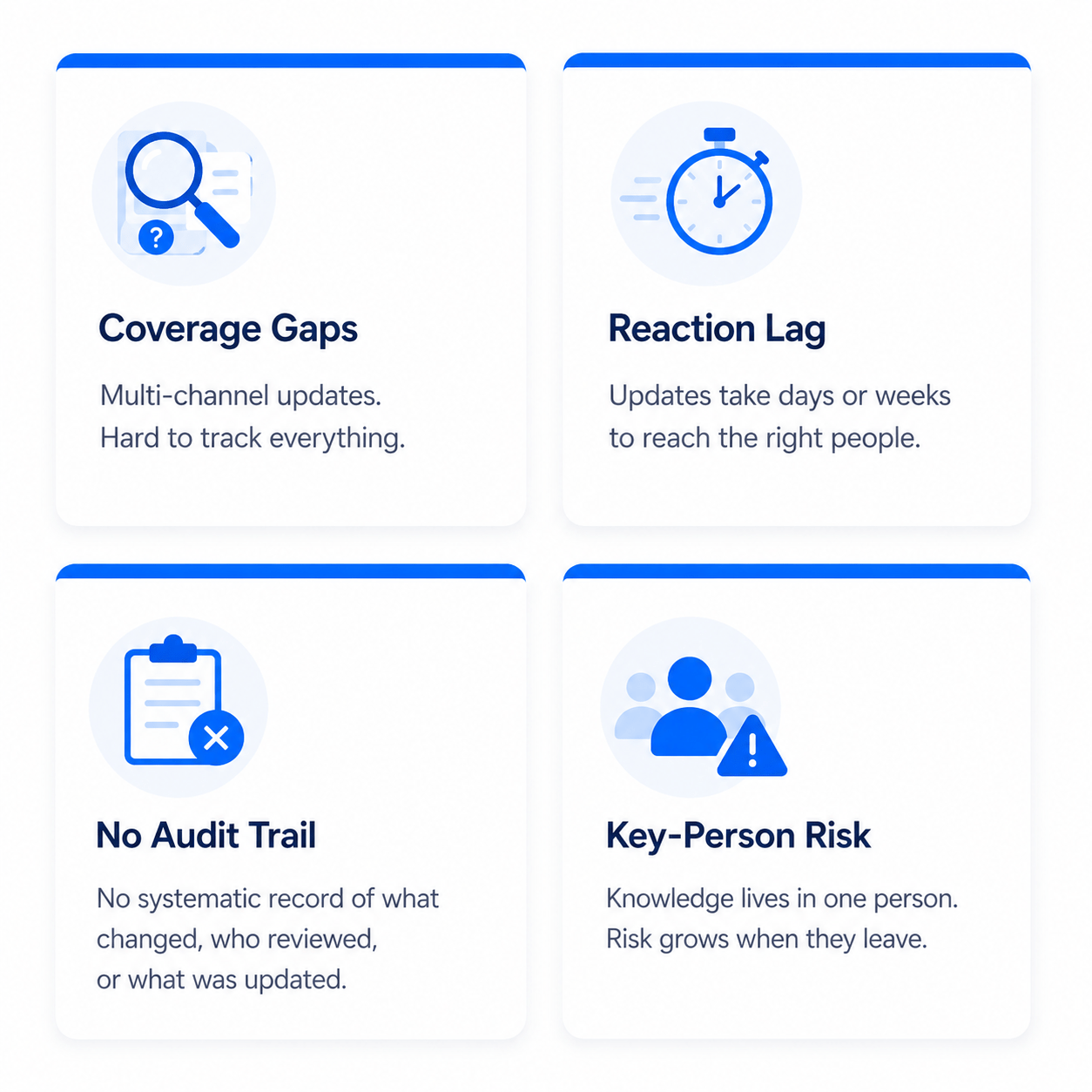
Most financial institutions in Singapore still rely on a compliance officer, or a small team, to monitor MAS’s website, subscribe to regulatory email bulletins, and manually assess each update’s impact on internal policies. That workflow has three structural failure modes.
Coverage Gaps
Manual monitoring covers a small slice of the regulatory landscape. When MAS issues guidance through multiple channels simultaneously, Notices, FAQs, consultation responses, advisory letters, teams miss updates published in formats they do not routinely check.
Reaction Lag
Human-reviewed updates typically take days or weeks to reach the right policy owner. Deadlines for compliance implementation arrive while updates still sit in shared inboxes. Institutions discover gaps during audits, not in advance.
No Audit Trail
Spreadsheet tracking creates no systematic record of who reviewed a regulatory change, what impact assessment they produced, or which policy they updated in response. Examiners cannot easily verify the process, and neither can the compliance team.
Key-Person Risk
Institutional knowledge about which MAS notices affects which product lines often live in one person’s head. When that person leaves or takes leave, the monitoring function weakens immediately, without any visible signal.
The compliance cost trajectory is unsustainable
The financial burden of manual compliance is measurable. Global compliance spending in financial services reached $270 billion annually in 2020, according to Accenture research. Regulatory changes now force quarterly budget reallocations, averaging $1 million per adjustment at enterprise scale. Institutions that lack structured governance frameworks carry 35% higher ongoing compliance costs compared to those that build AI automation into the process early. SmartDev’s AI Automation white paper on document and data processing covers the technical foundations of this cost reduction in detail.
The answer is not to hire more compliance officers. The answer is to change what compliance officers spend their time doing, by automating surveillance and routing, so professionals focus on judgment, not document hunting. A focused AI proof of concept with SmartDev can demonstrate exactly where this shift delivers the highest return for your team.
What AI Workflow Automation Actually Does
The shift from reactive to continuous compliance monitoring
AI workflow automation in the compliance context does not replace human judgment. It replaces human surveillance, the mechanical work of watching regulatory sources, flagging relevant updates, and passing them to the right person at the right time. When that surveillance runs continuously, compliance teams stop reacting to change and start anticipating it.
Modern AI compliance tools use natural language processing (NLP) to read regulatory text the way a senior legal analyst would, identifying which business lines an update affects, what the effective date is, and whether existing policies already address the requirement. This is a fundamentally different capability from keyword-alert systems, which generate noise rather than insight.
Key distinction:
AI workflow automation does not just alert teams that a new document exists. It reads the document, classifies its impact, maps it to existing policies, and routes a structured task, with context, to the right owner. That is the difference between a notification and an action.
Why this matters specifically for MAS-regulated institutions
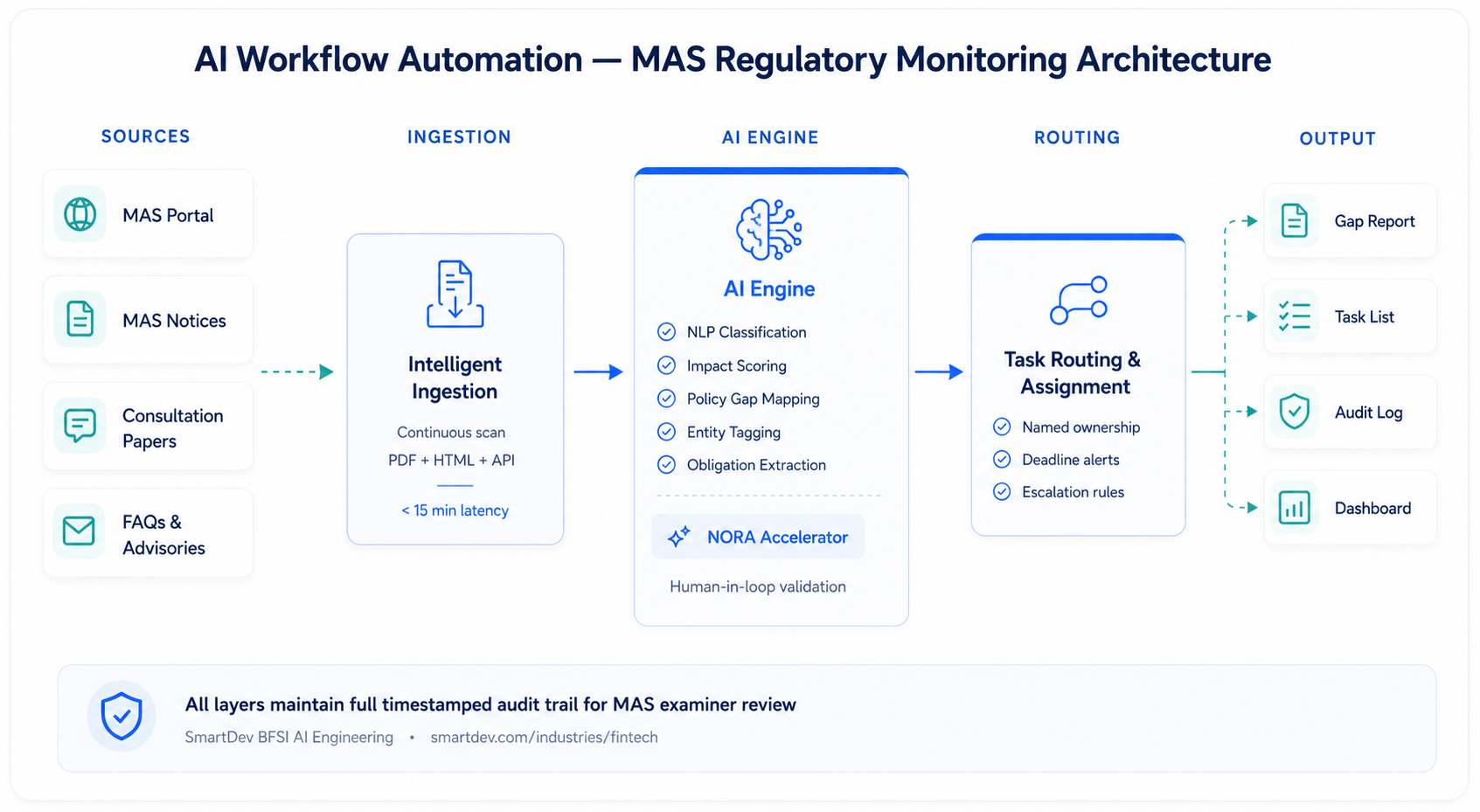
MAS publishes regulatory changes across multiple channels: the main Regulations and Guidance portal, industry-specific consultation responses, enforcement reports, FAQ updates, and advisory communications. A compliance team that monitors only one channel systematically misses what arrives through the others. AI ingestion pipelines watch all channels simultaneously, and they never have a bad week. SmartDev’s Data Analytics Services team builds these pipelines to integrate with existing compliance management systems, and our MLOps capabilities ensure models stay current as MAS regulatory language evolves.
The Five Automation Layers That Replace Manual Tracking
Building a production-grade monitoring system
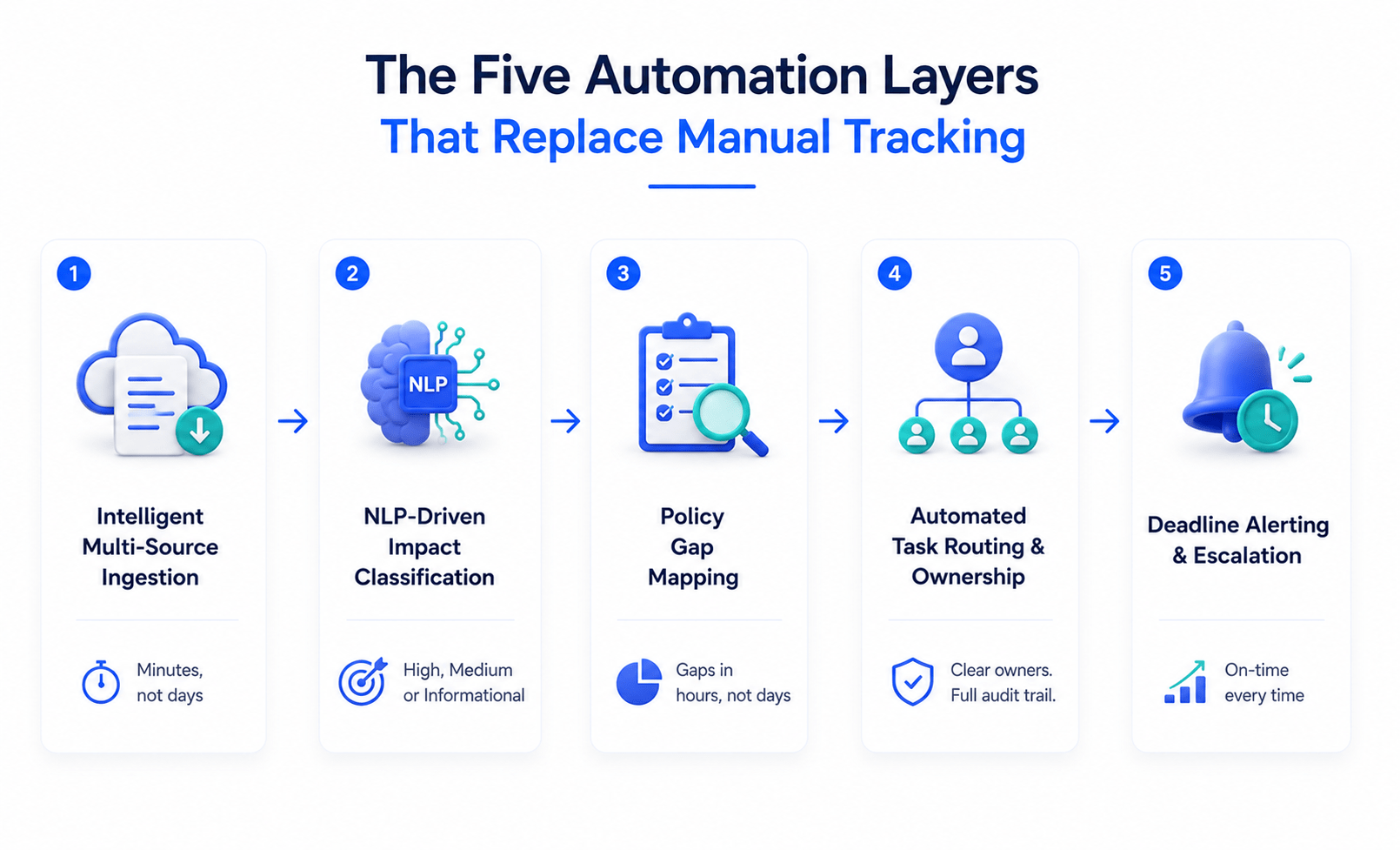
A well-architected AI compliance monitoring system has five distinct layers. Each layer adds a specific capability that the manual process cannot deliver at scale or speed.
Intelligent Multi-Source Ingestion
The system continuously monitors MAS’s regulatory portals, email bulletins, and official communications feeds. It ingests PDFs, HTML notices, and structured data without requiring human intervention. New documents enter the pipeline within minutes of publication, not days later when someone checks their inbox.
NLP-Driven Impact Classification
A fine-tuned language model reads each regulatory document and extracts key information: effective date, affected entity types, specific obligation changes, and penalty exposure. It classifies the update by business impact, high, medium, or informational, and tags the relevant product lines or departments. This removes the need for a compliance officer to read every document in full before deciding whether it matters.
Policy Gap Mapping
The system compares each classified regulatory change against the institution’s current policy library. It identifies where existing policies align, where gaps exist, and where potential conflicts arise. Compliance teams receive a structured gap report rather than a raw regulatory document, which reduces the assessment time from days to hours. Grant Thornton’s research confirms that AI tools can match regulatory guidance to existing compliance programs automatically, keeping CMS plans aligned with new or updated regulations in real time. SmartDev’s Generative AI Development Services bring this capability to production within defined delivery timelines.
Automated Task Routing with Ownership Assignment
Once a gap surfaces, the workflow engine routes a structured task to the named policy owner, not a generic compliance inbox. The task includes the regulatory reference, the affected policy, the effective date, and a suggested action. It records who received it, when they acknowledged it, and what action they took. This creates the audit trail that examiners require, and that spreadsheets cannot produce.
Deadline Alerting and Escalation
The system tracks implementation deadlines and sends escalating alerts as each deadline approaches. If an assigned owner does not respond within a defined window, the workflow escalates automatically to the compliance manager. Institutions maintain an always-current view of every open regulatory obligation and its implementation status, without anyone needing to build or maintain a manual calendar.
A Day in the Life: Automated vs. Manual
Comparing the two approaches on a concrete MAS scenario
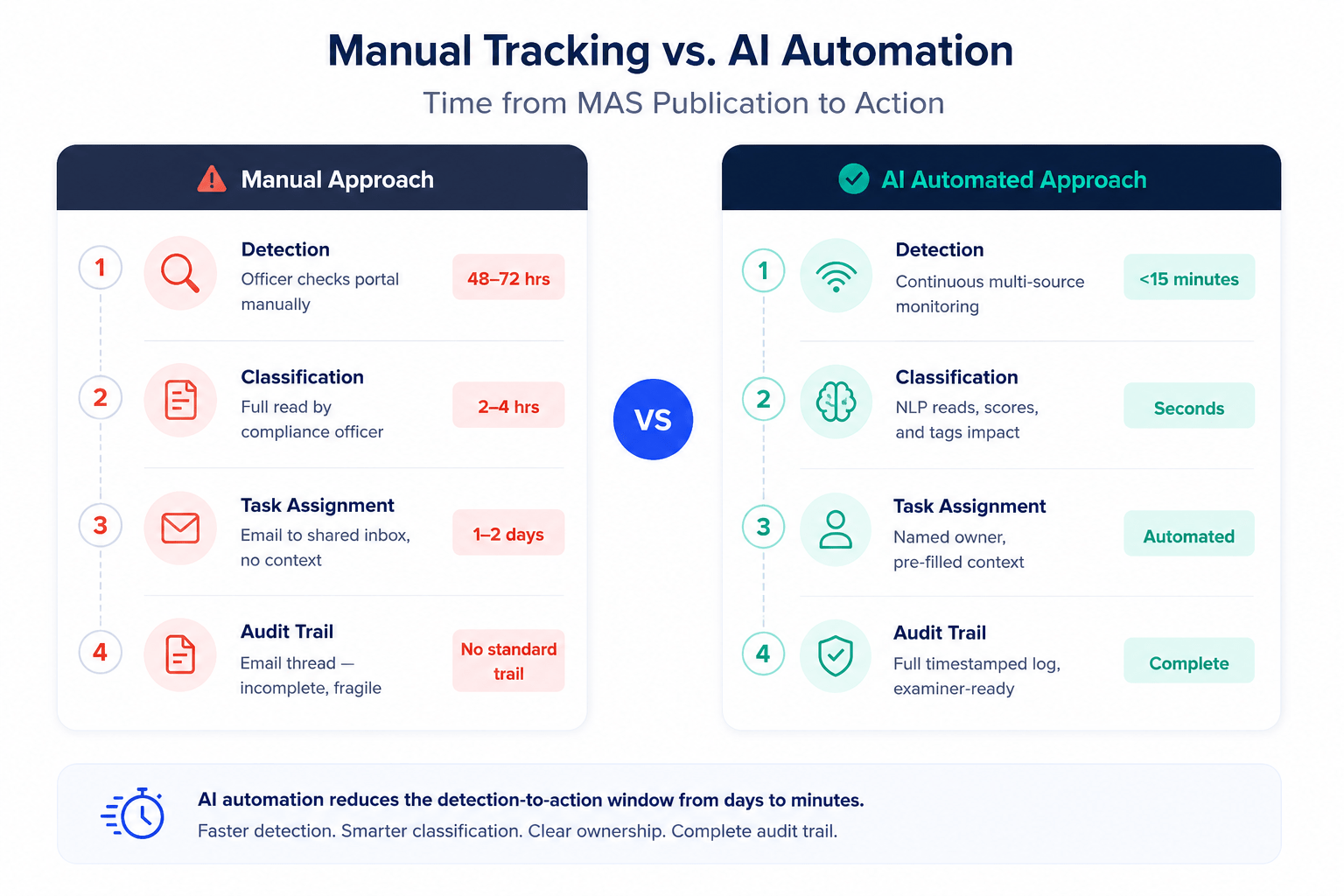
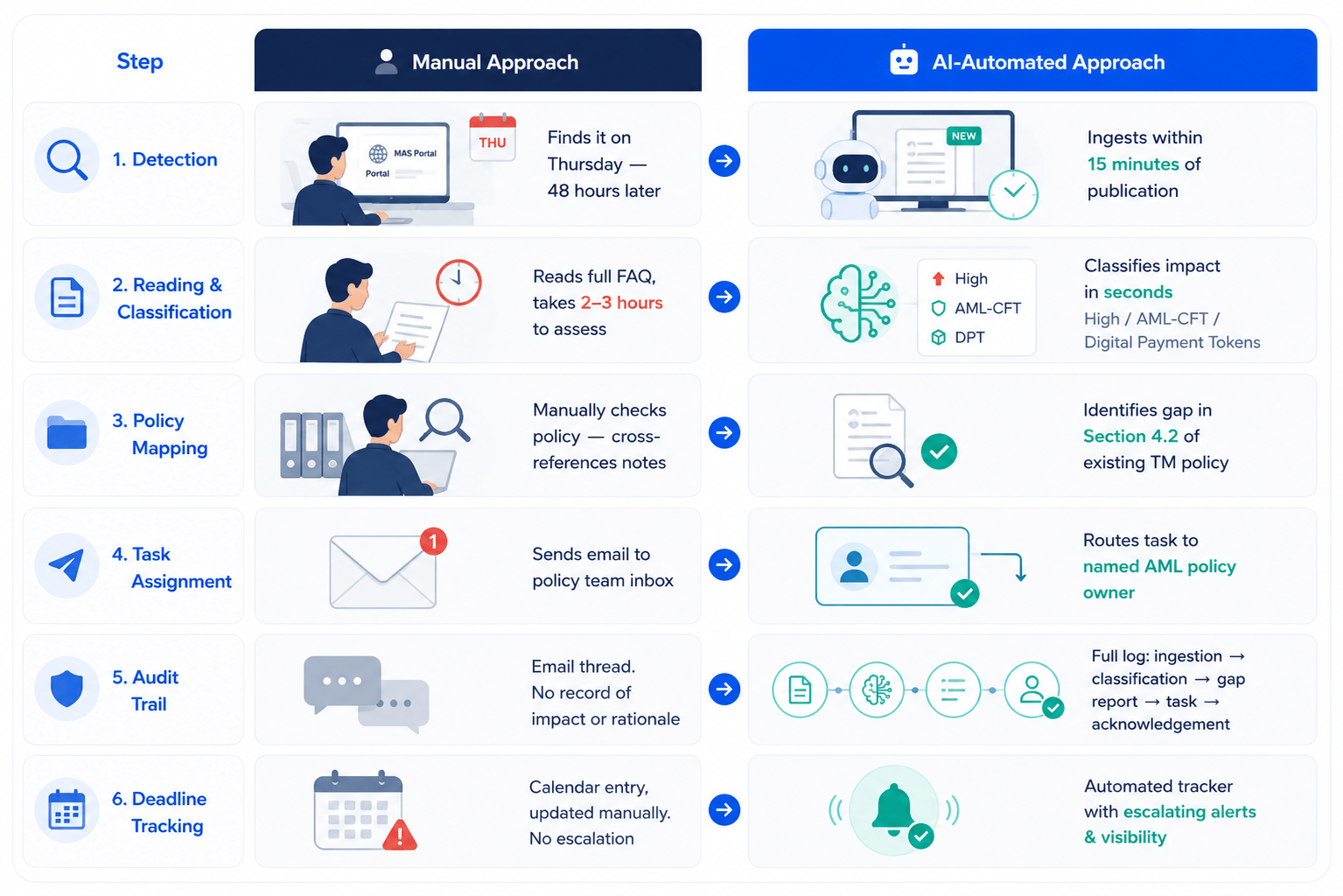
Consider what happens when MAS publishes an updated FAQ clarifying AML/CFT transaction monitoring obligations for digital payment token service providers. The update appears on the MAS portal on Tuesday morning. Here is how each approach handles it.
Why the gap compounds across multiple regulatory events
A single FAQ update is manageable even with a slow manual process. The real damage happens on scale. MAS does not publish one update per quarter; it publishes Notices, FAQs, consultation responses, and advisories overlapping timelines, often several in a single month. A compliance team running the manual workflow above for one update simply does not have the bandwidth to run it five or six times in parallel. Items queue up. Some get a cursory read instead of a full assessment. A few slips through entirely, surfacing only when an examiner asks about them directly. The automated workflow does not face this constraint, because each new regulatory item enters the same five-layer pipeline regardless of how many others are already in progress.
What this looks like from the policy owner’s seat
For the AML policy owner specifically, the difference is the contrast between an unexpected email demanding immediate context-gathering and a ready-made brief. In the automated version, that policy owner opens a task that already states which MAS clause changed, which internal policy section it touches, what the suggested revision looks like, and when the deadline falls. The owner’s actual work narrows down to judgment: deciding whether the suggested change is sufficient, adjusting language, and approving it for publication. That is a meaningfully different use of a compliance professional’s expertise than reading a 12-page FAQ from scratch under time pressure.
The examiner’s view
When a MAS examiner asks how an institution identified and responded to the updated FAQ, the automated approach produces a complete, timestamped record. The manual approach produces a remembered narrative and an email thread. BizTech Magazine’s analysis of AI compliance deployment confirms that institutions need to document inputs, outputs, and human overrides so they can reproduce results for auditors and regulators. Automated workflows produce that documentation as a natural byproduct of the process; no additional preparation required. SmartDev’s Application Management Services keep those automated systems performing reliably after deployment, with ongoing monitoring and model refresh support built into the engagement.
How SmartDev and NORA Deliver This for BFSI Teams
Why building this capability requires more than an off-the-shelf tool
MAS regulatory change monitoring is not a generic use case. The complexity lies in the specificity: which sections of which MAS Notice affect which product lines inside your institution, which existing policies those sections map to, and who owns those policies. Generic workflow tools do not carry that institutional context. Building effective automation requires a partner who understands both the BFSI regulatory environment and the AI engineering required to automate it correctly.
SmartDev brings both. Our BFSI/Fintech practice works with financial institutions across Southeast Asia on compliance-critical systems. Our engineering teams design AI-powered software that integrates with existing compliance management infrastructure rather than replacing it, which reduces implementation risk and accelerates deployment. We hold ISO 27001 and SOC 2 Type 2 certifications, which matters significantly when handling sensitive regulatory and policy data inside a financial institution.
NORA, SmartDev’s AI Adoption Accelerator
NORA is SmartDev’s AI Adoption Accelerator. It provides financial institutions with a structured, accelerated pathway to identify where AI automation will deliver the highest compliance ROI, design the workflow architecture, and move to production deployment without the months-long exploration cycles that typically slow AI projects down.
For regulatory change monitoring, NORA helps teams answer three specific questions:
- Where is the highest-value automation opportunity? Not every manual compliance process benefits equally from AI. NORA identifies the workflows where automation produces the largest reduction in risk and effort, for most MAS-regulated institutions; regulatory change monitoring ranks at the top.
- What does a production-ready architecture look like for our environment? NORA maps the ingestion of pipelines, classification models, policy integration points, and audit trail requirements specific to the institution’s technology landscape.
- How do we move from pilot to enterprise deployment quickly? NORA’s framework covers governance, human-in-the-loop design, model validation, and examiner-ready documentation, so the automation passes regulatory scrutiny from day one.
Human oversight is non-negotiable:
AI compliance monitoring requires a human in the loop at every consequential decision point. SmartDev designs all automation with named ownership, override capabilities, and governance structures that satisfy MAS’s expectations for model risk management and AI governance, consistent with the guidance in the BIS Financial Stability Institute’s AI in financial regulation paper.
What SmartDev builds for you
A production-grade MAS monitoring system is not one tool, it is four connected capabilities, each engineered for the specific demands of Singapore’s regulatory environment.
Capability 1: MAS Source Monitoring Pipeline
The first is a MAS source monitoring pipeline that continuously ingests content from MAS regulatory portals, binding Notices, consultation papers, and FAQ updates across every entity type your institution is licensed under. This pipeline does not stop at the obvious channels; it is configured against the full set of publication formats MAS uses, including PDF circulars, structured HTML notices, and enforcement bulletins, so nothing slips through because it arrived in an unfamiliar format.
Capability 2: Fine-Tuned Impact Classification
The second capability is fine-tuned impact classification. Generic language models can summarize a regulatory document, but they cannot reliably tell you whether a specific clause changes your obligations under the Securities and Futures Act versus the Payment Services Act. SmartDev’s Generative AI Development Services team fine-tunes NLP models on MAS regulatory language specifically, then calibrates that model against your institution’s actual product lines, licence types, and existing compliance framework. The result is a classification layer that understands your business, not just the English language.
Capability 3: Policy Gap Mapping Engine
The third capability is the policy gap mapping engine, which performs the comparison work that traditionally consumed hours of a compliance officer’s week. It automatically checks each classified regulatory change against your policy library, flags where existing language already satisfies the new requirement, and surfaces genuine gaps as structured, actionable findings rather than a wall of legal text. With our strong engine, validated through SmartDev’s AI Development Services practice and confirmed via dedicated Automation Testing Services before anything reaches production, institutions get a gap-detection layer they can trust at examination time, not just at deployment.
Capability 4: Examiner-Ready Audit Trail Generation
The fourth capability is examiner-ready audit trail generation. Every detection, classification, task assignment, and resolution is logged with a timestamp and a named owner, automatically, with no extra documentation effort required from your team. When a MAS examiner requests evidence of how a specific regulatory change was identified and addressed, the answer already exists in the system rather than needing to be reconstructed from memory and email archives.
Supporting Engagements: Discovery, Pilot, and Long-Term Reliability
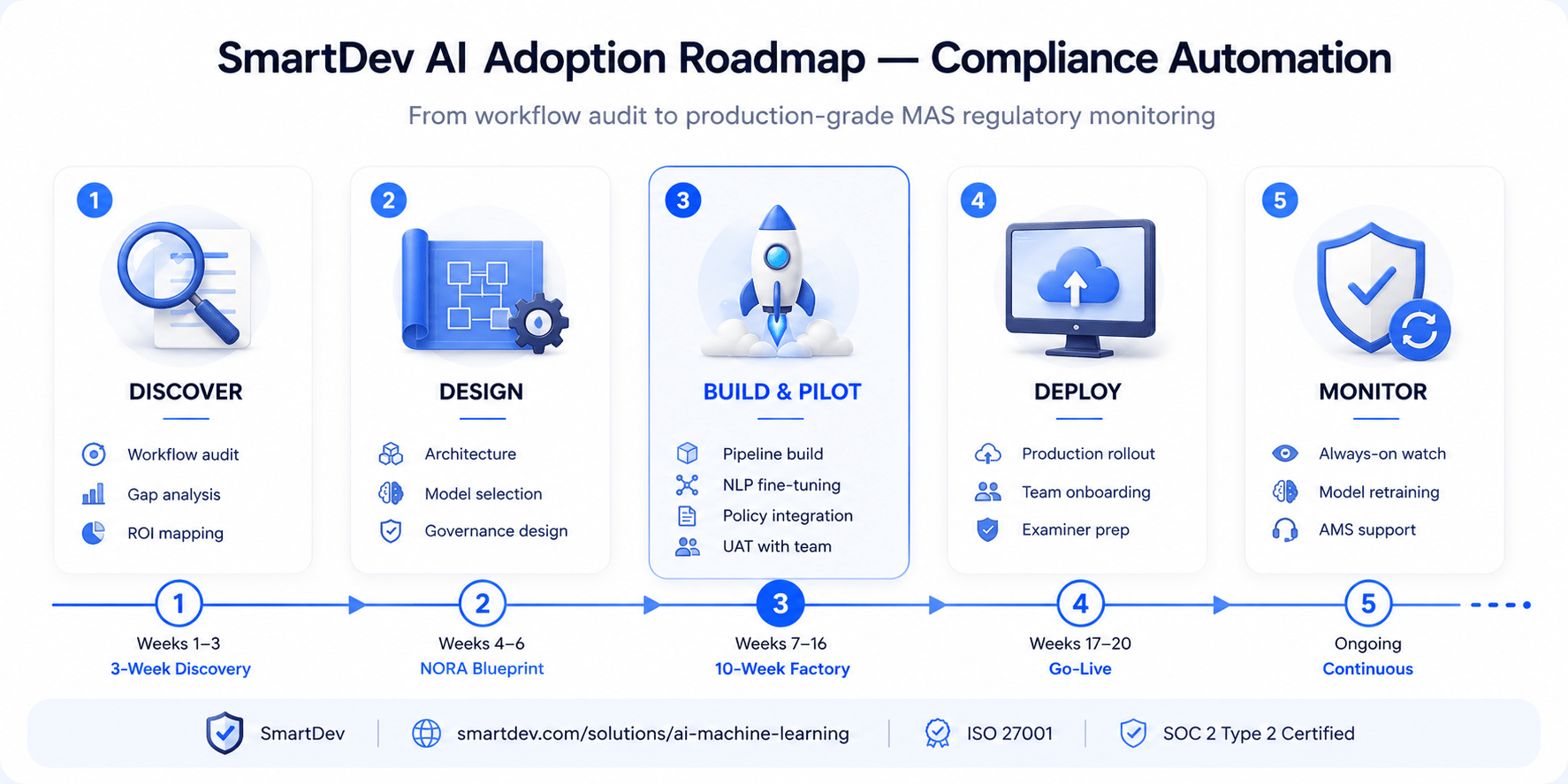
Beyond the four core capabilities, SmartDev supports the surrounding engineering work that keeps these systems reliable over time. Our MLOps Services manage model retraining as MAS regulatory language evolves, while our AI Proof of Concept engagement lets institutions validate the approach on a narrow scope before committing to full deployment. SmartDev also supports teams through our 3-Week AI Discovery Program, a rapid-assessment engagement that maps your current compliance workflow, identifies automation opportunities, and produces a prioritized implementation roadmap.
For teams that want to move faster, the 10-Week AI Product Factory delivers a production-ready compliance automation pilot within a defined timeline, and our case study on moving from manual support to intelligent automation in fintech documents how a comparable engagement played out for another BFSI client. For institutions that want the underlying technical detail before committing to a scope, our white paper on AI automation for document and data processing walks through the architecture in more depth.
Conclusion, The Case for Acting Before the Next Notice
Regulatory pace will not slow down. Monitoring capability must be caught up.
MAS has demonstrated a consistent pattern over the past three years: it issues binding Notices, updates guidelines, and expands enforcement powers at a pace that manual compliance processes cannot track reliably, as documented across MAS’s own Regulations and Guidance portal and in Tripwire’s compliance overview. The 14-month window from May 2024 to June 2025 produced five major binding regulatory changes affecting technology risk management, outsourcing, AML/CFT, and investigative powers, while Sidley Austin’s analysis of MAS’s enforcement priorities confirms AML/CFT enforcement as the top regulatory focus for 2025–2026.
Financial institutions that automate their regulatory change monitoring now gain three concrete advantages. First, they detect and assess MAS updates faster, reducing the window of unintentional non-compliance. Second, they generate audit trails that satisfy examiner requirements without additional preparation. Third, they free compliance professionals from surveillance work so those professionals can focus on judgment, policy design, and strategic risk management, the work that genuinely requires human expertise. Our AI-powered document processing case study and AI Readiness Gap article give concrete context for where automation delivers the highest ROI inside financial operations teams.
The tools and frameworks to build this capability exist today. The question is not whether to automate; it is how quickly the transition happens and how well it integrates existing workflows and governance structures. SmartDev’s AI Consulting Services and NORA offer a structured, risk-managed path to answer both questions. Explore our AI Delivery Blueprint and AI Development Sprint Audit white papers to understand the full implementation framework before engaging.
If your compliance team still relies on email alerts and spreadsheets to track MAS regulatory changes, the next Notice is already on its way. The time to build a better system is before it arrives. Contact us to start the conversation.
Frequently Asked Questions
Common questions about compliance and risk teams ask before adopting AI workflow automation for MAS regulatory change monitoring.
What is MAS regulatory change management?
MAS regulatory change management is the structured process financial institutions use to detect, assess, and respond to new or updated rules issued by the Monetary Authority of Singapore. It covers binding Notices, consultation papers, FAQ clarifications, and enforcement guidance, and typically includes impact assessment against existing policies, task assignment to policy owners, and documentation suitable for examiner review.
How can AI help financial institutions monitor MAS updates?
AI workflow automation continuously scans MAS’s regulatory channels, reads each new publication using natural language processing, and classifies its business impact within seconds. It then compares the update against the institution’s existing policy library to flag gaps, and routes a structured task to the relevant policy owner with full context attached. This replaces manual portal-checking and document review, cutting detection-to-action time from days to minutes.
Can AI replace compliance officers in regulatory change management?
No. AI automation replaces the mechanical surveillance work of watching regulatory sources and flagging relevant updates, not the judgment required to interpret obligations, weigh business impact, and approve policy changes. Effective implementations keep a human in the loop at every consequential decision point, with named ownership and override capability, consistent with MAS’s expectations for AI and model risk governance.
What evidence should institutions retain for MAS regulatory changes?
Institutions should retain a timestamped record covering when a regulatory change was detected, how it was classified, which internal policy it affected, who was assigned to review it, what action was taken, and when it was resolved. This audit trail needs to be reproducible on demand for MAS examiners, which is why automated logging, rather than email threads or informal notes, has become the practical standard.
How should AI-generated regulatory impact assessments be reviewed?
AI-generated impact assessments should be treated as a structured first draft, not a final determination. A named compliance professional reviews the suggested classification and policy gap, confirms or adjusts the assessment, and approves any resulting policy change before it takes effect. This review step should itself be logged, since MAS examiners typically expect to see evidence of human oversight over automated outputs.
Which MAS updates should financial institutions monitor?
Institutions should monitor binding Notices, Guidelines, Circulars, Consultation Papers, FAQ updates, and Enforcement Reports published through MAS’s official channels. Coverage should span every regulatory area relevant to the institution’s license type, including technology risk management, outsourcing, AML/CFT, and any sector-specific rules such as those for payment service providers or capital markets intermediaries.