

Financial platforms are becoming increasingly complex, integrating cloud infrastructure, APIs, real-time payments, and AI-driven analytics. This evolution makes selecting the right BFSI testing company a strategic business decision rather than a routine outsourcing task. Effective QA in financial services requires continuous security validation and intelligent automation, as detailed in Best Practices for Automated Security Testing in BFSI and reinforced by market trends highlighted in AI and Machine Learning in the BFSI Market.
At the same time, regulatory pressure and escalating cyber threats demand specialized expertise. Generic QA vendors often focus solely on functional testing, overlooking compliance validation and security automation. As explained in What Is Quality Assurance, QA ensures products meet defined standards. In the BFSI sector, those standards directly impact regulatory compliance, financial stability, and institutional reputation, making the right QA partner a long-term strategic investment.

What Defines a High-Quality BFSI Testing Company? Core Evaluation Criteria
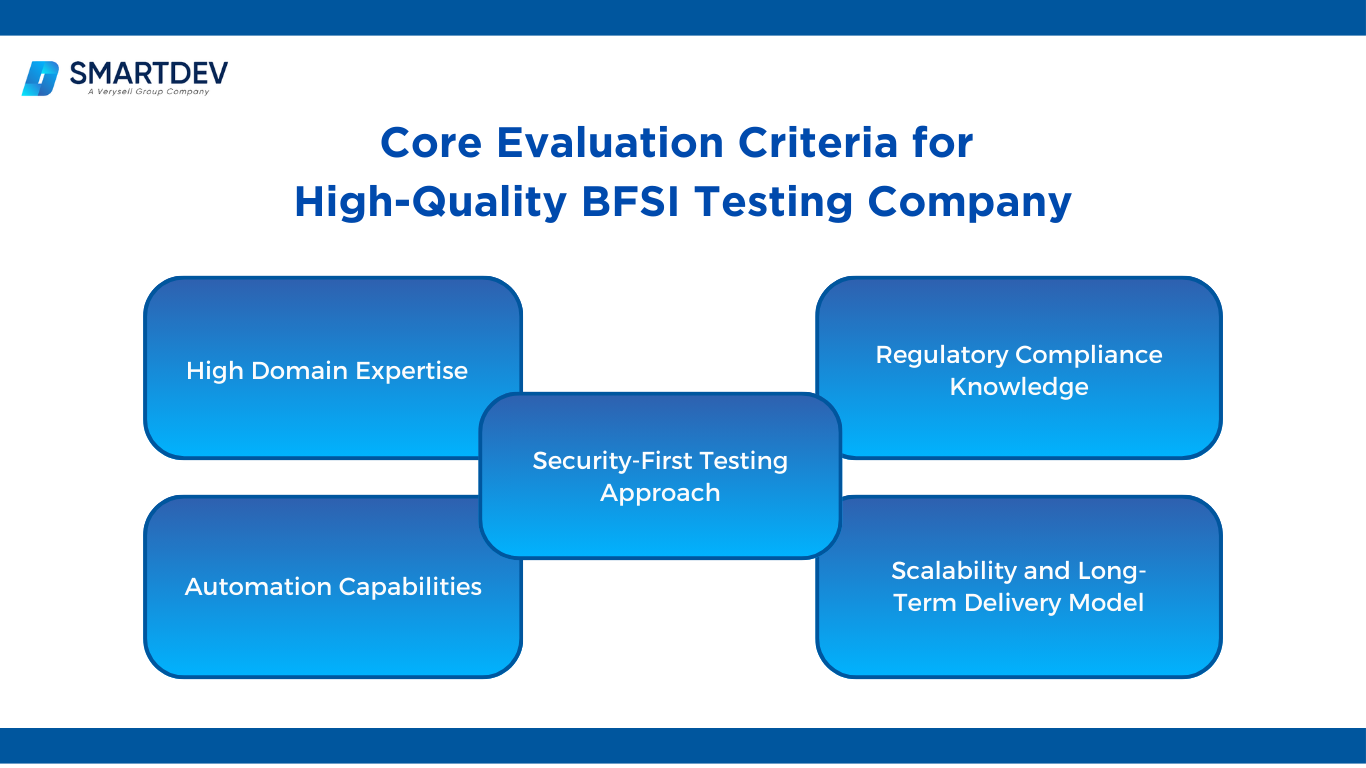
Selecting a reliable BFSI testing company requires more than reviewing portfolios or comparing hourly rates. Financial institutions operate in a highly regulated, security-sensitive, and technology-driven environment where system failures can result in regulatory penalties, reputational damage, and financial loss. A high-quality QA partner must demonstrate deep domain expertise, regulatory understanding, security-first methodologies, advanced automation capabilities, and long-term scalability. The following core evaluation criteria help decision-makers distinguish between general QA vendors and specialized BFSI testing providers.
 1. Domain Expertise in Banking, Financial Services, and Insurance
 1. Domain Expertise in Banking, Financial Services, and Insurance
Domain knowledge is the foundation of effective BFSI testing. A qualified testing partner must understand core banking systems, payment gateways, loan management platforms, trading systems, insurance policy administration, and fintech integrations. Without this expertise, QA efforts risk missing industry-specific edge cases such as transaction reconciliation errors, interest calculation discrepancies, or settlement delays.
A specialized BFSI testing company understands how financial workflows operate end-to-end. They are familiar with concepts such as KYC, AML, real-time payments, open banking APIs, and credit scoring engines. This knowledge allows them to design meaningful test cases rather than relying solely on generic functional scripts. According to What Is Quality Assurance, QA ensures products meet defined standards and prevent defects. In the BFSI sector, those standards are tightly connected to financial accuracy, audit trails, and operational continuity. Domain expertise ensures testing aligns with real-world banking risks rather than theoretical scenarios.
2. Regulatory Compliance Knowledge: PCI-DSS, GDPR, ISO, SOC 2
Regulatory compliance is non-negotiable in financial services. A high-quality BFSI testing company must demonstrate practical experience working within global regulatory frameworks such as PCI-DSS for payment security, GDPR for data protection, ISO standards for information security management, and SOC 2 for service organization controls.
Compliance testing is not limited to documentation review. It requires validation of encryption protocols, access controls, logging mechanisms, data retention policies, and vulnerability management processes. A knowledgeable QA partner proactively identifies compliance gaps during test cycles, reducing the risk of audit failures. Unlike general QA firms, specialized providers integrate compliance validation directly into their automated test pipelines, ensuring continuous monitoring rather than periodic checks.
3. Security-First Testing Approach in BFSI Environments
Cybersecurity threats in BFSI continue to evolve, targeting APIs, cloud environments, mobile banking apps, and digital payment systems. A strong BFSI testing company adopts a security-first mindset, embedding vulnerability assessments, penetration testing, and automated security scanning into the development lifecycle.
As outlined in Best Practices for Automated Security Testing in BFSI, continuous and automated security testing significantly improves risk detection across complex financial systems. Instead of performing security checks at the final stage of development, leading QA partners integrate testing into CI/CD pipelines. This shift-left approach enables early detection of vulnerabilities, reduces remediation costs, and enhances overall system resilience.
4. Automation Capabilities and AI-Driven Test Intelligence
Modern financial platforms release updates frequently. Manual testing alone cannot keep pace with rapid deployment cycles. Therefore, automation capabilities are essential when evaluating a BFSI testing company.
Advanced providers leverage AI-powered tools to improve test coverage, optimize regression suites, and predict high-risk areas. The growing role of artificial intelligence in financial services, highlighted in AI and Machine Learning in the BFSI Market, reinforces the need for intelligent QA solutions. AI-driven testing enables predictive defect detection, smart test case prioritization, and real-time analytics. This approach increases efficiency while maintaining high reliability standards required in banking and insurance environments.
5. Scalability and Long-Term Delivery Model
Finally, scalability distinguishes short-term vendors from long-term strategic partners. Financial institutions expand across regions, adopt new technologies, and adapt to changing regulatory landscapes. A reliable BFSI testing company must scale resources, testing environments, and automation frameworks without compromising quality.
Scalability includes flexible engagement models, dedicated QA teams, robust governance structures, and transparent communication channels. It also involves the ability to support multi-region compliance requirements and multilingual digital platforms. Organizations seeking sustainable growth should prioritize QA partners capable of evolving alongside their digital transformation journey rather than delivering isolated testing projects.
By evaluating domain expertise, regulatory knowledge, security-first methodology, automation maturity, and scalability, financial institutions can identify a BFSI testing company that strengthens operational resilience and supports long-term innovation.
General QA Vendor vs Specialized BFSI Testing Company. A Detailed Comparison
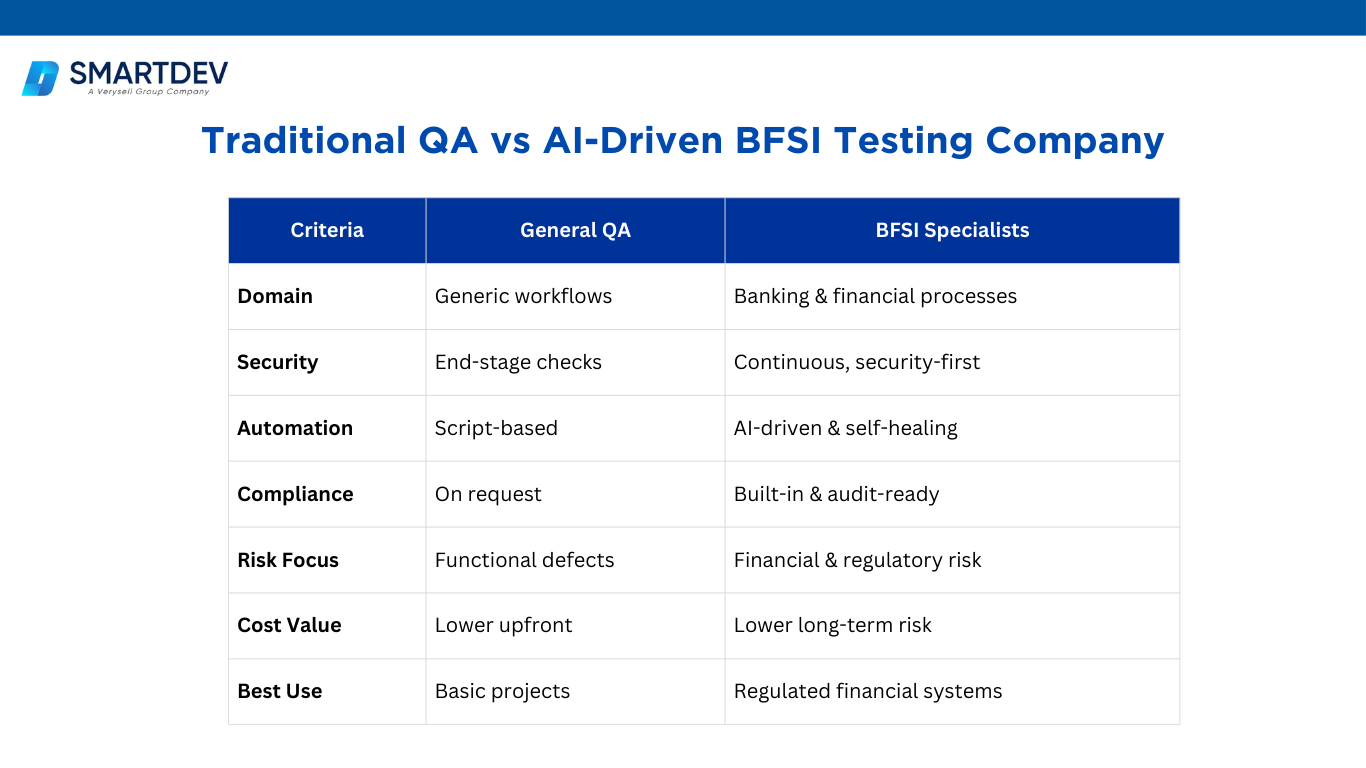
Choosing the right BFSI testing company requires a structured comparison between general QA vendors and specialized financial domain testing partners. At first glance, both may appear capable of delivering functional validation and regression testing. However, when financial data security, regulatory compliance, and system resilience are at stake, the differences become substantial. The following comparison outlines how each type of provider approaches industry knowledge, security, automation, compliance, and cost structure.
1. Industry Knowledge: Horizontal QA vs Financial Domain Specialists
 1. Industry Knowledge: Horizontal QA vs Financial Domain Specialists
General QA Vendors typically operate across multiple industries such as retail, healthcare, logistics, and eCommerce. Their strength lies in standardized testing methodologies that can be adapted to various systems. While this flexibility can be useful, it often results in limited understanding of financial-specific workflows. Complex processes such as loan origination cycles, trading executions, premium calculations, or payment settlement flows require contextual knowledge that cannot be improvised.
Specialized BFSI Testing Companies, in contrast, build their testing strategies around banking, financial services, and insurance environments. They are able design meaningful test scenarios aligned with real financial risk exposure. As described in What Is Quality Assurance, QA ensures that products meet defined standards and prevent defects.
SmartDev differentiates itself with strong BFSI domain expertise, designing risk-based test strategies aligned with real banking operations. Testing goes beyond functionality to ensure financial accuracy and regulatory integrity, as reinforced by the definition of quality assurance in What Is Quality Assurance.
2. Security Testing: Basic Coverage vs Automated Security at Scale
General QA Vendors often perform vulnerability scanning and security checks as a final validation stage. This reactive approach identifies defects after development is largely complete. While this may satisfy minimum requirements, it does not provide continuous protection across evolving digital infrastructures.
Specialized BFSI Testing Companies adopt a security-first mindset. According to Best Practices for Automated Security Testing in BFSI, continuous automated testing significantly improves risk detection across distributed financial systems. In an environment where cyber threats evolve rapidly, scalable security automation is no longer optional. It is essential.
SmartDev embeds automated security testing directly into CI/CD pipelines using a shift-left approach, following best practices outlined in Best Practices for Automated Security Testing in BFSI. Its AI-driven protection strategy aligns with insights from BFSI Security Automation: Scaling Protection with AI, ensuring continuous vulnerability detection and stronger platform resilience.
3. Automation Strategy: Script-Based Testing vs AI-Powered Test Automation
General QA Vendors frequently rely on traditional automation scripts that require manual updates whenever system changes occur. Regression cycles may be automated, but optimization and predictive analysis are limited. As systems scale, maintenance effort increases, reducing efficiency over time.
Specialized BFSI Testing Companies leverage AI-driven automation tools that enhance test coverage and reduce redundant effort. Intelligent test case prioritization, predictive defect analytics, and self-healing automation frameworks enable faster release cycles without compromising reliability.
SmartDev leverages AI-powered automation frameworks inspired by industry advancements discussed in Best AI Tools for Test Automation in BFSI. By integrating intelligent prioritization and predictive analytics aligned with trends from AI and Machine Learning in the BFSI Market, SmartDev enables faster releases while maintaining high reliability.
4. Compliance Readiness: Reactive vs Proactive Risk Mitigation
General QA Vendors may address compliance requirements only when explicitly instructed. Their focus is typically on executing predefined test cases rather than mapping test coverage to regulatory frameworks. Documentation support for audits may be limited or inconsistent.
Specialized BFSI Testing Companies incorporate compliance validation into automated testing workflows and maintain detailed traceability matrices to support audits. This proactive model reduces regulatory exposure and strengthens governance. In highly regulated financial markets, compliance readiness must be embedded, not retrofitted.
SmartDev proactively aligns testing frameworks with PCI-DSS, GDPR, ISO, and SOC 2 standards. This structured governance approach reflects key vendor evaluation principles highlighted in 6 Key Considerations in Choosing a Software QA Test Company. Audit readiness, traceability, and compliance validation are embedded throughout the lifecycle.
5. Cost Structure: Short-Term Savings vs Long-Term Risk Reduction
General QA Vendors may offer lower hourly rates and flexible short-term contracts. However, insufficient domain expertise or security coverage can lead to defect leakage, regulatory penalties, or reputational damage. These risks increase long-term operational costs.
Specialized BFSI Testing Companies may require higher upfront investment due to domain knowledge and advanced automation capabilities. However, early defect detection, compliance assurance, and security risk reduction generate long-term cost efficiency. By preventing production incidents and audit failures, specialized partners deliver stronger return on investment over time.
SmartDev positions itself as a strategic partner focused on measurable ROI and sustainable risk reduction. As emphasized in 6 Things to Check Before Hiring a QA Testing Company, selecting a QA partner should prioritize long-term quality and governance over short-term pricing. SmartDev’s automation maturity and security-first methodology reduce remediation costs and strengthen operational stability.
Traditional QA vs AI-Driven BFSI Testing Company. Which Delivers Future-Ready Results?
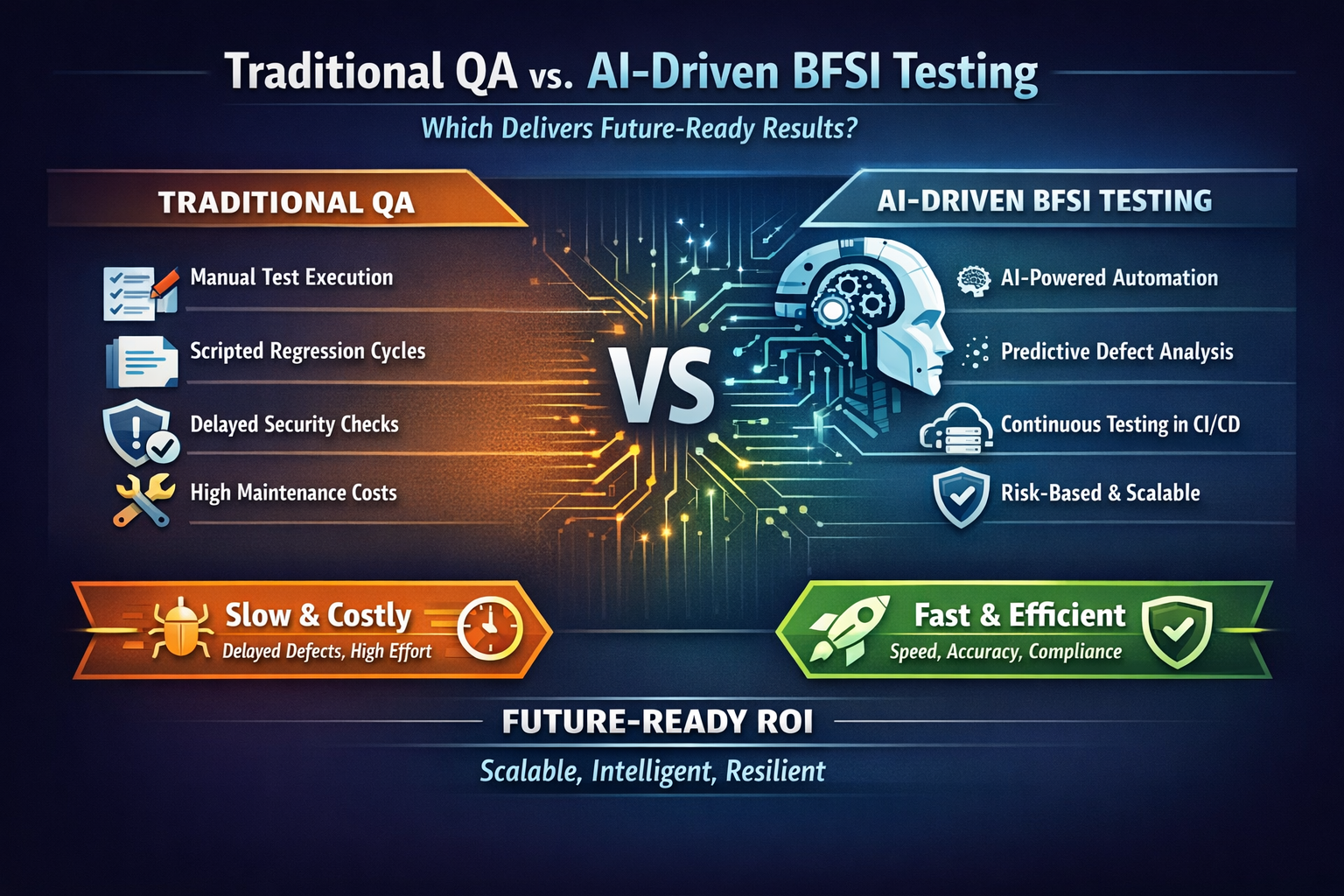
As financial institutions accelerate digital transformation, the debate between traditional QA approaches and AI-enabled testing models becomes increasingly relevant. A modern BFSI testing company must move beyond manual validation and conventional automation to support real-time systems, regulatory complexity, and AI-driven financial platforms. The following comparison outlines how traditional QA differs from AI-driven BFSI testing in delivering scalable, future-ready results.
Manual Testing Limitations in BFSI Systems
Traditional QA models rely heavily on manual test case execution, scripted regression cycles, and periodic validation phases. While manual testing remains useful for exploratory scenarios, it presents clear limitations in BFSI environments where systems are large, integrated, and continuously evolving.
Financial platforms process high transaction volumes, integrate third-party APIs, and operate across cloud and hybrid infrastructures. Manual testing struggles to keep pace with frequent releases and complex system dependencies. It also increases the risk of human error, inconsistent documentation, and delayed defect detection.
Moreover, manual security testing is insufficient for modern cyber risk exposure. As highlighted in Best Practices for Automated Security Testing in BFSI, automated and continuous security validation significantly improves vulnerability detection compared to late-stage manual reviews. In high-risk financial ecosystems, delayed detection directly translates into increased operational and regulatory exposure.
AI and Machine Learning in Test Automation
AI-driven QA represents a structural shift rather than an incremental improvement. An advanced BFSI testing company integrates artificial intelligence and machine learning algorithms into its automation frameworks to improve efficiency, coverage, and adaptability.
AI-powered tools can automatically generate test cases, identify redundant scripts, prioritize high-risk scenarios, and adapt to UI or workflow changes without requiring constant manual updates. This reduces maintenance overhead and enhances release speed.
The broader adoption of AI across financial services, discussed in AI and Machine Learning in the BFSI Market, reinforces the need for equally intelligent testing mechanisms. Additionally, SmartDev’s overview of Best AI Tools for Test Automation in BFSI highlights how AI-driven frameworks increase test efficiency while maintaining strict reliability standards required in regulated environments.
Predictive Defect Detection and Risk-Based Testing
One of the most significant advantages of AI-driven testing is predictive analytics. Traditional QA models focus on identifying defects after they occur. AI-enabled systems analyze historical defect data, system changes, and risk indicators to predict where failures are most likely to emerge.
This predictive defect detection allows teams to prioritize high-impact areas such as payment processing modules, authentication systems, and regulatory reporting functions. Risk-based testing ensures that limited QA resources are allocated strategically rather than uniformly.
Furthermore, as described in BFSI Security Automation. Scaling Protection with AI, AI can strengthen threat detection and automated risk assessment across distributed systems. By integrating risk intelligence into testing workflows, financial institutions improve resilience while optimizing resource allocation.
Continuous Testing in CI/CD Pipelines for Financial Platforms
Traditional QA often treats testing as a separate phase that follows development. This sequential model slows release cycles and delays feedback. In contrast, AI-driven BFSI testing companies embed continuous testing directly into CI/CD pipelines.
Continuous integration and delivery demand real-time validation of new code, security patches, and feature enhancements. Automated regression suites, API validation scripts, performance tests, and security scans are executed automatically with each deployment.
SmartDev’s insights in Best Practices for Automated Security Testing in BFSI emphasize the importance of integrating security testing early in the software development lifecycle. Continuous testing reduces production defects, shortens feedback loops, and enhances compliance traceability.
ROI Comparison. Conventional Testing vs Intelligent Automation
Traditional QA requires lower upfront cost but relies on manual regression and late-stage security testing. As AI adoption accelerates in financial services, highlighted in AI and Machine Learning in the BFSI Market, reactive testing increases long-term remediation costs and limits scalability. Over time, total cost of ownership rises due to defect leakage and slower release cycles.
AI-driven QA requires higher initial investment but delivers stronger long-term ROI. Continuous security validation, as outlined in Best Practices for Automated Security Testing in BFSI, and AI-powered automation tools discussed in Best AI Tools for Test Automation in BFSI reduce defect risk, improve release speed, and enhance compliance readiness. The result is scalable efficiency and sustainable cost optimization.

Explore how SmartDev partners with BFSI teams through a focused AI sprint to validate use cases, align stakeholders, and define a clear path forward before AI development begins.
SmartDev helps BFSI organizations clarify AI use cases and assess feasibility, enabling confident decisions and reducing risks before committing to AI development.
Learn how SmartDev accelerates AI initiatives, ensuring rapid deployment and reduced time to market.
Build Your AI Chatbot With UsAligning a BFSI Testing Company with the Right Buyer Persona
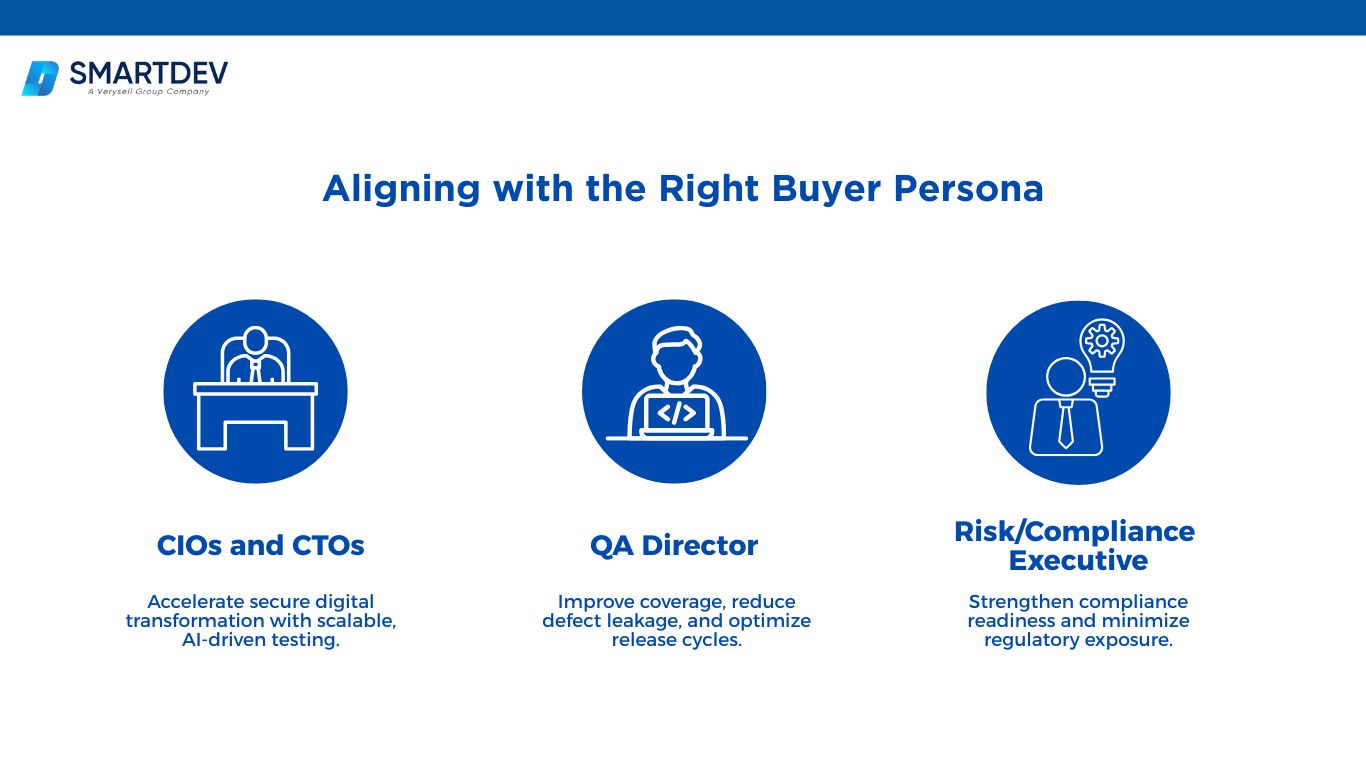
Selecting a BFSI testing company is rarely a single-person decision. In financial institutions, buying decisions involve multiple stakeholders, each with distinct priorities, risk tolerances, and success metrics. To position effectively, a testing partner must address what matters most to each role while demonstrating deep domain expertise and technological maturity.
For CIOs and CTOs: Enable Transformation, Not Just Testing
CIOs and CTOs see QA as a strategic enabler of digital transformation. Their focus is cloud scalability, AI adoption, DevSecOps integration, and long-term architectural resilience. They are not looking for manual test execution. They need a partner that accelerates modernization while reducing operational risk.
An AI-driven BFSI testing company must demonstrate how it embeds continuous testing and automated security validation into CI/CD pipelines, following best practices outlined in Best Practices for Automated Security Testing in BFSI. With AI increasingly shaping financial ecosystems, as discussed in AI and Machine Learning in the BFSI Market, the conversation becomes about scalability, resilience, and competitive advantage.
For QA Directors: Deliver Measurable Engineering Impact
QA leaders prioritize execution excellence. They measure success through automation coverage, regression optimization, defect leakage reduction, and reporting transparency.
A specialized BFSI testing company differentiates itself through AI-powered test optimization and intelligent automation frameworks, similar to those highlighted in Best AI Tools for Test Automation in BFSI. The value proposition is clear. Faster cycles, stronger coverage, and fewer production defects.
For Risk and Compliance Executives: Protect the Institution
Risk and Compliance leaders focus on regulatory alignment, audit readiness, and cyber resilience. They assess whether a testing partner understands PCI-DSS, GDPR, ISO, and financial audit frameworks.
A credible BFSI testing company must demonstrate proactive compliance mapping and automated security governance, reinforced by scalable protection strategies described in BFSI Security Automation. Scaling Protection with AI. The core message here is risk mitigation. Fewer audit findings, reduced regulatory exposure, and stronger institutional trust.
By aligning messaging with these buyer personas, a BFSI testing company evolves from a technical vendor into a strategic transformation and risk-management partner.
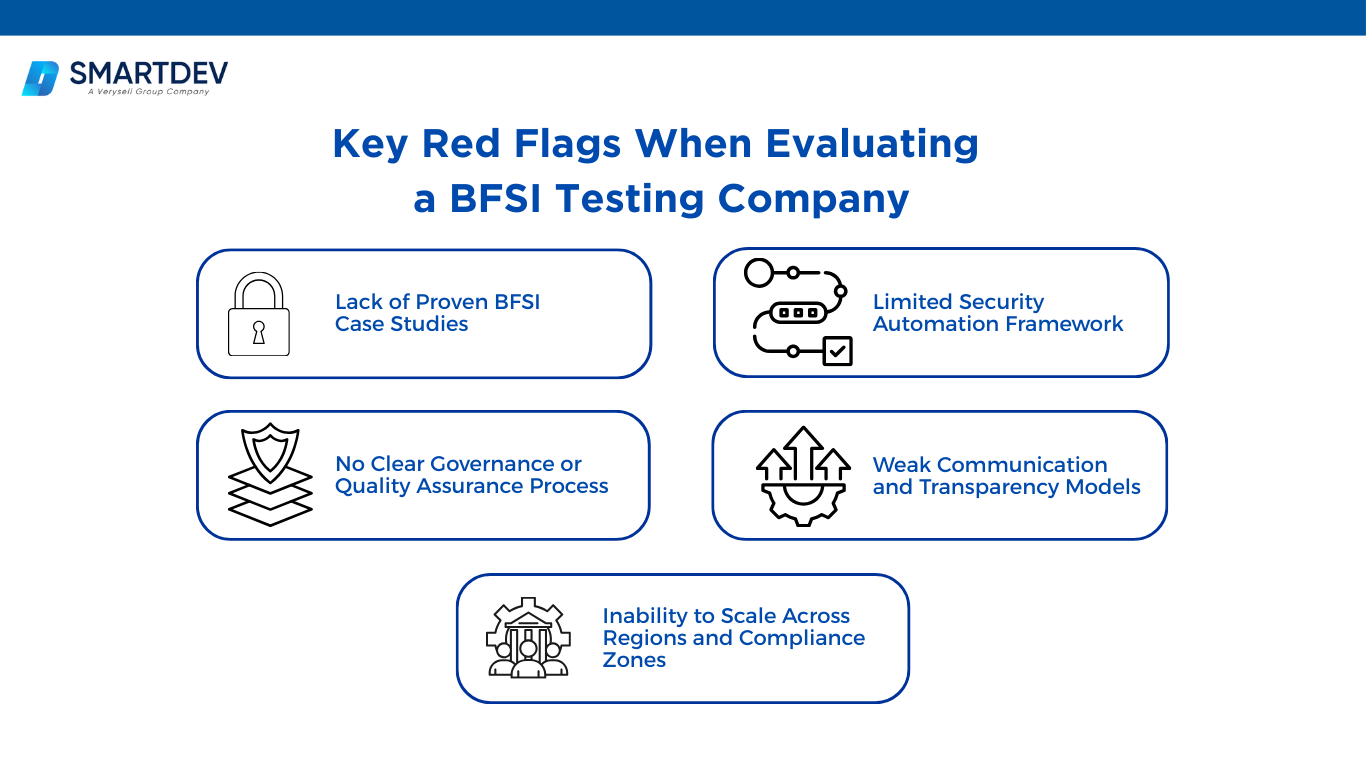
Key Red Flags When Evaluating a BFSI Testing Company
Selecting the right BFSI testing company requires careful due diligence. While many vendors claim industry expertise, certain warning signs indicate potential risks that could compromise security, compliance, and long-term stability. Identifying these red flags early helps financial institutions avoid costly missteps.
1. Lack of Proven BFSI Case Studies
 1. Lack of Proven BFSI Case Studies
A credible BFSI testing company should provide documented case studies demonstrating successful delivery within banking, financial services, or insurance environments. If a vendor’s portfolio primarily covers unrelated industries, it raises concerns about domain depth.
Financial ecosystems involve complex regulatory requirements, transaction logic, and risk controls that cannot be learned on the fly. As highlighted in 6 Key Considerations in Choosing a Software QA Test Company, proven experience within a specific industry significantly reduces project risk. Without relevant case studies, organizations face higher chances of missed compliance requirements or incomplete risk coverage.
2. Limited Security Automation Framework
Security cannot be treated as an optional add-on in BFSI testing. Vendors that rely solely on periodic manual security checks or third-party tools without integration into CI/CD pipelines may lack maturity.
According to Best Practices for Automated Security Testing in BFSI, continuous and automated security validation is critical for protecting sensitive financial systems. Additionally, scalable protection strategies discussed in BFSI Security Automation. Scaling Protection with AI demonstrate the importance of embedding security into the entire development lifecycle. A limited or reactive security model exposes institutions to regulatory penalties and cyber threats.
3. No Clear Governance or Quality Assurance Process
A reliable BFSI testing company should have structured governance models, standardized documentation, traceability matrices, and clear reporting frameworks. Vendors unable to explain their QA methodology or escalation process signal operational risk.
As outlined in 6 Things to Check Before Hiring a QA Testing Company, transparency in processes and defined quality metrics are essential for consistent outcomes. Without clear governance, testing becomes inconsistent and difficult to audit.
4. Weak Communication and Transparency Models
Financial projects require continuous coordination between compliance officers, developers, and QA teams. Poor communication leads to misunderstood requirements, delayed releases, and compliance gaps. A lack of regular reporting dashboards, KPI tracking, or structured review meetings should be treated as a warning sign.
5. Inability to Scale Across Regions and Compliance Zones
Financial institutions often operate across multiple countries with varying regulatory standards. A vendor that cannot scale resources, adapt to regional compliance frameworks, or support multilingual platforms may struggle to meet expansion needs. Scalability is not just about team size. It involves automation maturity, governance consistency, and compliance adaptability.
Recognizing these red flags enables organizations to select a BFSI testing company that strengthens resilience rather than introducing hidden operational risks.
Why Firms Choose SmartDev as Their BFSI Testing Company
Selecting the right BFSI testing company is not only about technical validation. It is about choosing a long-term partner capable of strengthening security, ensuring compliance, and accelerating innovation. Firms choose SmartDev because of its deep financial domain expertise, advanced automation capabilities, and strong positioning in AI-driven quality assurance for BFSI ecosystems.

1. Deep BFSI Domain Expertise and Security-Centric Mindset
SmartDev combines strong technical delivery with focused experience in banking, financial services, and insurance environments. Its teams understand the operational complexity of digital banking platforms, fintech integrations, payment systems, and regulatory reporting structures. This domain depth allows SmartDev to design risk-aligned test strategies rather than relying on generic validation templates.
Security is embedded into every stage of its QA methodology. As outlined in About SmartDev, the company emphasizes engineering excellence, structured governance, and long-term partnership models. For financial institutions operating in high-risk environments, this security-centric mindset ensures testing strategies align with real compliance and operational challenges.
2. Advanced Automated Security Testing Frameworks
Cyber threats targeting financial platforms continue to evolve in sophistication. SmartDev addresses this challenge through advanced automated security testing integrated into CI/CD pipelines.
Its approach follows the best practices detailed in Best Practices for Automated Security Testing in BFSI, where continuous vulnerability scanning, penetration testing, and compliance validation are embedded directly into development workflows. Rather than conducting security reviews at the end of the release cycle, SmartDev adopts a shift-left model that detects risks early and reduces remediation costs.
In addition, SmartDev applies scalable protection mechanisms powered by AI, as described in BFSI Security Automation. Scaling Protection with AI. This proactive security automation strengthens resilience across distributed cloud environments and complex financial infrastructures.
3. AI-Powered Test Automation for BFSI Platforms
Modern financial systems require intelligent automation to keep pace with rapid deployment cycles. SmartDev leverages AI-powered tools to optimize regression suites, prioritize high-risk test cases, and enhance predictive defect detection.
The company’s expertise aligns with insights presented in Best AI Tools for Test Automation in BFSI, demonstrating how AI-driven frameworks increase efficiency without compromising reliability. By combining automation with data-driven analytics, SmartDev transforms QA from a reactive validation function into a strategic enabler of digital transformation.
4. Scalable Delivery Model for Global Financial Institutions
Financial institutions often operate across multiple regions, regulatory frameworks, and technology stacks. SmartDev provides a scalable delivery model that supports distributed teams, structured governance, and transparent reporting systems.
Its engagement model emphasizes long-term collaboration, ensuring QA processes evolve alongside client growth. This scalability includes multi-region compliance support, flexible resource allocation, and automation frameworks that expand without compromising quality.
5. Proven Track Record in AI and Machine Learning in BFSI
SmartDev’s positioning as a forward-looking BFSI testing company is reinforced by its active involvement in AI and machine learning initiatives within financial services. As discussed in AI and Machine Learning in the BFSI Market, AI adoption continues to reshape how financial institutions operate and compete.
By combining BFSI expertise, automated security, AI-powered testing, and scalable delivery, SmartDev positions itself as a strategic QA partner capable of supporting future-ready financial ecosystems. For firms seeking resilience, compliance assurance, and innovation acceleration, SmartDev delivers measurable long-term value.
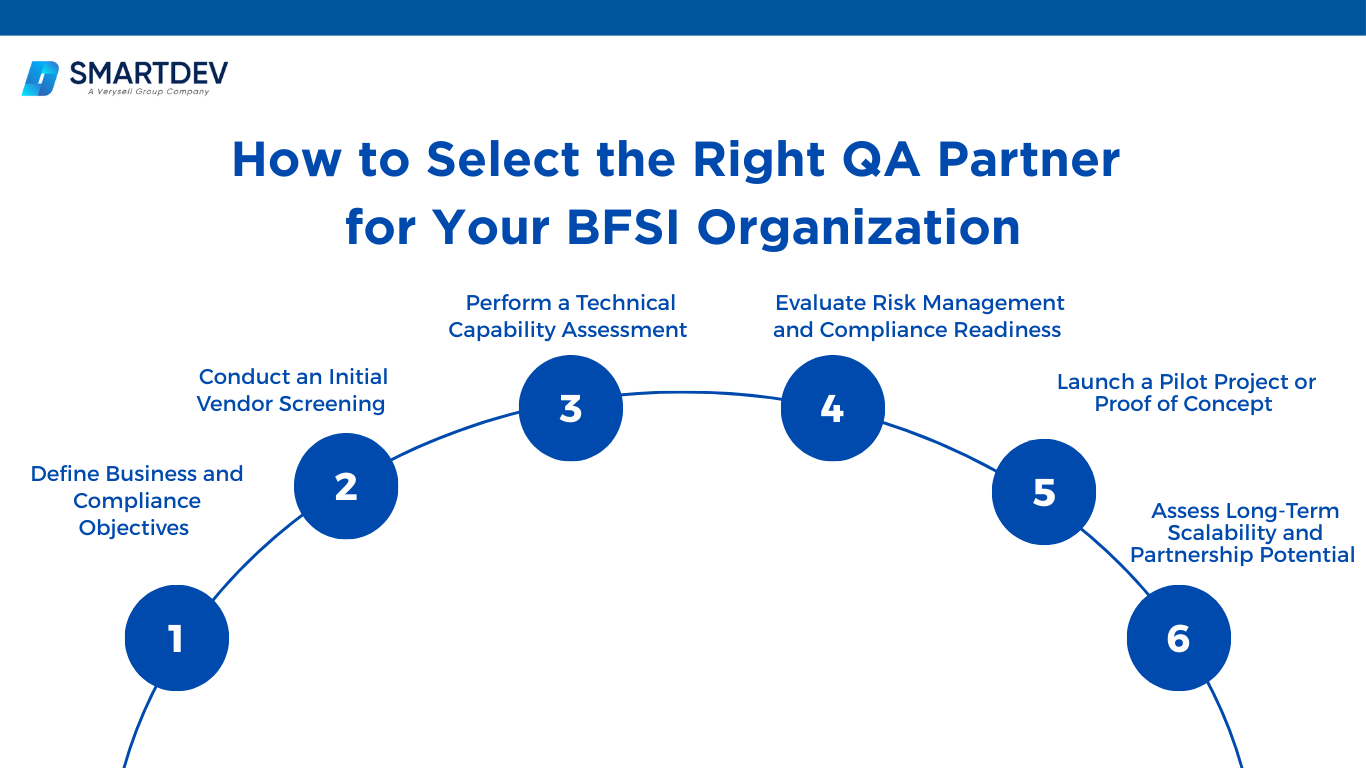
Decision Framework: How to Select the Right QA Partner for Your BFSI Organization
Selecting the right BFSI testing company requires a structured, step-by-step evaluation process. Below is a practical decision framework financial institutions can follow to reduce risk and ensure long-term value.
Step 1: Define Business and Compliance Objectives
 Step 1: Define Business and Compliance Objectives
Before approaching vendors, clearly define your organization’s priorities to ensure strategic alignment. Identify the key systems in scope, such as core banking, payments, lending, or insurance platforms, and outline the relevant regulatory requirements including PCI-DSS, GDPR, ISO, or SOC 2.
Next, determine whether your primary objective is security hardening, automation scaling, AI-driven testing, or a full QA transformation. Establishing this clarity upfront ensures that vendor capabilities align closely with your business goals, risk profile, and compliance needs.
Step 2: Conduct an Initial Vendor Screening
Step 3: Perform a Technical Capability Assessment
Move beyond marketing materials by conducting a deep technical validation of each vendor’s capabilities. Review their test automation architecture and tool stack, assess strength in API, microservices, performance, and security testing, and validate experience with DevSecOps and continuous testing pipelines. Request sample reports, dashboards, and traceability documentation to confirm visibility and audit readiness.
To finalize your assessment, run technical workshops or solution walkthroughs with the vendor’s delivery team. This provides a clear view of engineering standards, scalability, and how well their approach fits your BFSI environment.
Step 4: Evaluate Risk Management and Compliance Readiness
Map each vendor’s capabilities directly to your organization’s operational risk areas to ensure full alignment. Confirm that the provider follows a structured risk-based testing methodology, validates compliance mapping against relevant regulatory frameworks, and maintains thorough documentation practices to support audits. Additionally, assess their approach to data protection, access control, and incident response procedures.
A reliable BFSI testing company should proactively identify compliance gaps and risk exposures, rather than reacting only when audit triggers or regulatory reviews occur.
Step 5: Launch a Pilot Project or Proof of Concept
Step 6: Assess Long-Term Scalability and Partnership Potential
Finally, evaluate the vendor’s ability to scale alongside your organization’s growth. Determine whether they can expand resources across regions, adapt to evolving regulations and emerging technologies, and offer transparent long-term engagement models with clear cost structures.
By following these structured steps, financial institutions can confidently select a BFSI testing company that enhances security, ensures regulatory compliance, and supports sustainable digital transformation.
Conclusion
Choosing the right BFSI testing company is not a tactical outsourcing decision. It is a strategic investment in security, compliance, and long-term digital resilience. Financial institutions operate in complex, highly regulated environments where system failures can lead to regulatory penalties, financial losses, and reputational damage. A specialized QA partner with deep domain expertise, automated security capabilities, and AI-driven test intelligence provides far greater value than a general testing vendor focused only on functional validation.
As BFSI ecosystems continue to evolve through cloud adoption, open banking, and artificial intelligence, testing strategies must evolve in parallel. Organizations that prioritize automation maturity, proactive compliance validation, and scalable delivery models position themselves for sustainable growth.
If you are seeking a future-ready QA partner with proven expertise in security automation and AI-driven testing, explore how SmartDev can support your transformation journey. Contact SmartDev today to discuss how a specialized BFSI testing company can strengthen your compliance posture, enhance system resilience, and accelerate innovation with confidence.