

Introduction
Southeast Asia is experiencing rapid growth in conversational AI adoption, driven by the expansion of e-commerce, fintech, and digital services. Enterprises increasingly rely on chatbots to scale customer support, sales, and internal operations. Unlike English-dominant markets, however, multilingual chatbot Southeast Asia deployments operate in a highly fragmented linguistic environment, where users frequently switch between local languages and English within the same conversation. This makes language understanding and context management far more complex than simple translation.
As a result, building chatbots for Southeast Asian markets is fundamentally a technical challenge rather than a feature exercise. Vietnamese chatbot development must handle tonal markers and informal grammar, Thai language NLP must process text without explicit word boundaries, and Indonesian chatbot systems must interpret flexible sentence structures and slang. In this context, robust technical requirements such as NLP architecture, data quality, and scalability outweigh surface-level capabilities. For enterprises and technical leaders, mastering these complexities represents a strategic opportunity to build durable competitive advantage through deeply localized AI systems.
What Is an AI Chatbot
 An AI chatbot is a software application that can understand user input and respond in a natural, conversational way using machine learning models. Unlike rule-based chatbots, which depend on predefined scripts and decision trees, AI chatbots can interpret intent, handle language variation, and improve over time. This distinction is especially important for multilingual chatbot Southeast Asia deployments, where users frequently use informal language, mixed languages, and non-standard grammar. Rule-based chatbots struggle in these conditions, while AI chatbots are designed to operate under linguistic uncertainty and scale more effectively.
Technically, AI chatbots rely on three core components. Natural Language Processing (NLP) prepares text by cleaning and structuring user input. Natural Language Understanding (NLU) identifies user intent and extracts key entities. Dialogue management determines the next response or action based on context. In Vietnamese chatbot development, these layers must handle tonal markers and flexible sentence structures. Thai language NLP faces additional complexity because Thai text does not use whitespace to separate words, while Indonesian chatbot systems must process rich morphology and colloquial expressions.
Although the terms are often used interchangeably, chatbots and conversational AI are not the same. Chatbots are usually task-focused, such as answering FAQs or guiding users through simple workflows. Conversational AI systems support multi-turn conversations, context retention, and personalization across channels. In enterprise environments, common AI chatbot architectures include user interfaces, NLP engines, business logic layers, and integrations with CRM or ERP systems. These capabilities explain why AI chatbots are becoming critical in emerging markets like Southeast Asia, where rapid digital adoption and language diversity require scalable, intelligent automation.
Southeast Asia Language Landscape: Complexity Beyond Translation
 Linguistic Diversity and Market Fragmentation
 Linguistic Diversity and Market Fragmentation
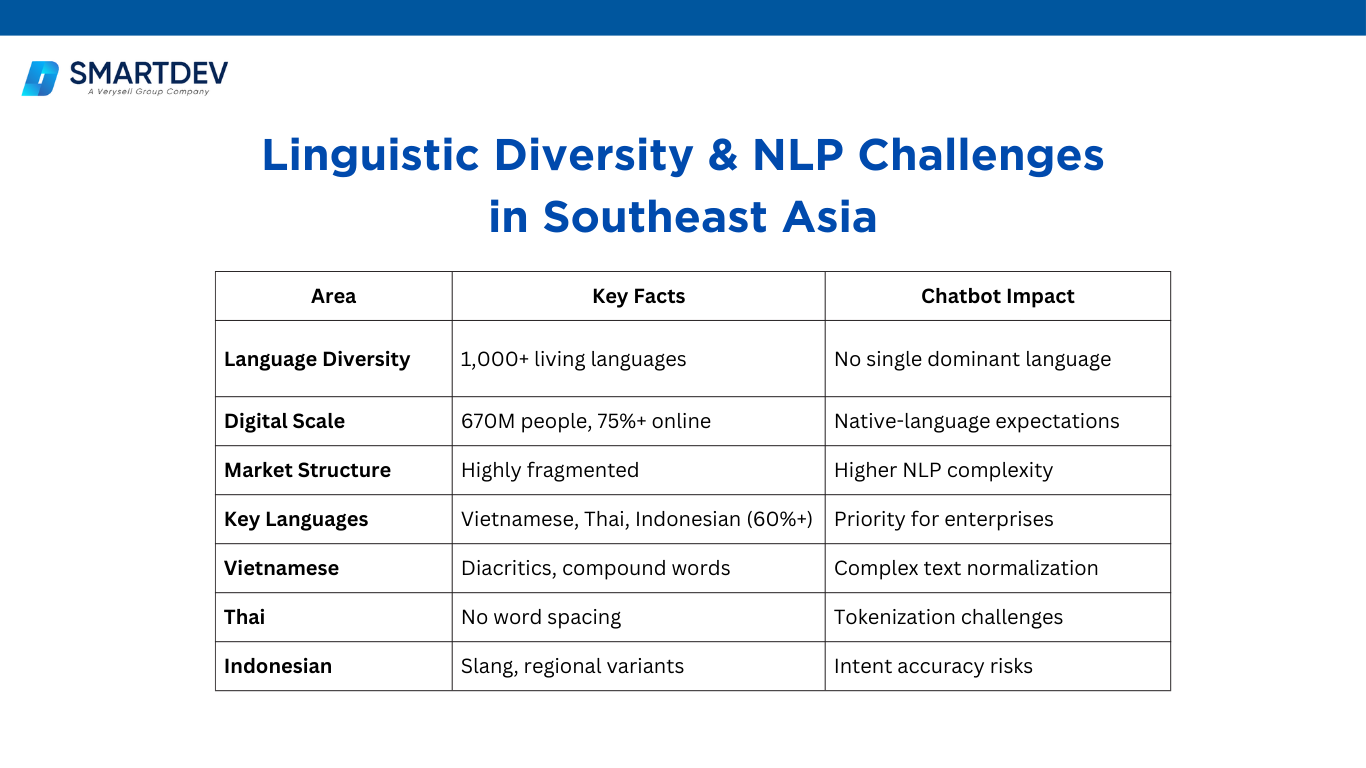
Southeast Asia is one of the most linguistically fragmented digital markets globally. Across the 10 ASEAN countries, there are more than 1,000 living languages, and a significant portion of them are actively used online rather than confined to offline or rural settings (Tech For Good Institute). The region has a total population of around 670 million people, with internet penetration exceeding 75 percent on average, meaning hundreds of millions of users interact with digital services in their native languages every day (Asia Tech Lens).
For multilingual chatbot Southeast Asia deployments, this fragmentation creates a fundamentally different problem from Western markets. In the United States or Western Europe, one or two dominant languages often cover more than 80 percent of users. In Southeast Asia, no single language covers the region. Chatbots must be designed to operate across multiple languages, dialects, and communication norms, significantly increasing technical complexity and long-term maintenance costs.
High-Impact Languages and Structural Language Complexity
Despite broad diversity, three languages dominate enterprise chatbot use cases. Vietnamese, Thai, and Indonesian collectively serve more than 400 million people, accounting for over 60 percent of Southeast Asia’s population. These languages are critical for e-commerce, banking, telecom, and public services, where chatbots are most commonly deployed.
Each language presents distinct NLP challenges. Vietnam has a population of over 100 million, yet Vietnamese remains significantly underrepresented in high-quality NLP datasets compared to English or Chinese. Vietnamese chatbot development must accurately process diacritics, compound words, and informal digital grammar. Thai language NLP faces even deeper structural issues. Thai does not use whitespace between words, making tokenization a probabilistic task. In Thailand, where internet penetration exceeds 85 percent, segmentation errors at scale directly impact chatbot usability and trust.
Indonesian chatbot systems operate in a different challenge space. Although Bahasa Indonesia is spoken by more than 270 million people, real-world chatbot inputs often include slang, abbreviations, and regional expressions that differ substantially from formal written Indonesian. This gap between formal language resources and informal usage reduces intent accuracy without targeted training data.
Code-Switching and SEA NLP Challenges Compared to Western Markets
Code-switching is a defining characteristic of Southeast Asian digital communication. In urban markets and professional contexts, users frequently mix English with local languages within a single sentence. Research indicates that mixed-language usage appears in more than 50 percent of online conversations in some Southeast Asian markets. Most Western-trained NLP models are not designed for this behavior and often misclassify intent when languages are mixed.
Data scarcity compounds the issue. Public English-language NLP datasets outnumber Southeast Asian language datasets by more than 10 to 1 in many benchmarks, resulting in consistently lower baseline model performance. As a result, SEA NLP challenges are structural rather than incremental. Building effective multilingual chatbot Southeast Asia solutions requires deep regional language expertise, localized data strategies, and custom NLP architectures rather than direct reuse of Western-centric models.
Core Technical Requirements for Multilingual Chatbots in Southeast Asia
Language Detection and Intent Routing at Scale
In Southeast Asia, accurate language detection is a foundational technical requirement, not an optional enhancement. Users frequently switch between languages or mix English with local languages within a single message. At scale, multilingual chatbot Southeast Asia systems must identify the dominant language, secondary language signals, and user intent simultaneously. In high-traffic environments such as e-commerce or banking, even a 5–10 percent drop in intent routing accuracy can significantly increase fallback rates and human handover costs. Effective systems rely on probabilistic language detection combined with intent confidence scoring, rather than single-language assumptions common in Western chatbot deployments.
Multilingual NLP Pipelines and Architecture Design
A single monolithic NLP pipeline rarely performs well across Southeast Asian languages. Instead, production-grade chatbots use modular architectures that route inputs through language-specific preprocessing, tokenization, and intent models. This approach is increasingly necessary as enterprises expand across ASEAN markets. According to regional AI adoption analyses, more than 60 percent of enterprise chatbot failures in Southeast Asia are linked to poor architectural decisions rather than model choice.
Typical architectures include a shared orchestration layer, language-specific NLP components, and a unified dialogue manager. This design allows teams to optimize Vietnamese chatbot development, Thai language NLP, and Indonesian chatbot logic independently while maintaining consistent business workflows and integrations.
Tokenization and Word Segmentation Challenges
Tokenization is one of the most underestimated challenges in SEA NLP. Vietnamese, Thai, and Indonesian each violate assumptions built into most Western NLP frameworks.
Language-specific challenges include:
- Vietnamese chatbot development. Spaces do not reliably indicate word boundaries. Compound words and informal spelling reduce intent accuracy without custom segmentation.
- Thai language NLP. Thai text does not use whitespace between words, forcing models to infer boundaries from context. In Thailand, where internet penetration exceeds 85 percent, segmentation errors quickly degrade chatbot usability.
- Indonesian chatbot systems. Indonesian is affix-heavy, with prefixes and suffixes that modify meaning and intent, especially in informal chat scenarios.
These constraints make language-specific tokenization pipelines mandatory for high-accuracy systems.
Context Handling Across Languages
Context management becomes significantly harder in multilingual environments. A chatbot may receive an initial query in English, follow-up clarification in Vietnamese, and confirmation in mixed language. Maintaining conversational state across languages requires normalized intent representations and language-agnostic dialogue logic. Research shows that context loss accounts for more than 30 percent of negative chatbot user feedback in multilingual deployments. Robust context handling is therefore a core requirement for enterprise-grade systems in Southeast Asia.
Model Performance Metrics for Multilingual Chatbots
Standard accuracy metrics are insufficient for evaluating multilingual chatbots in Southeast Asia. Teams must track language-specific intent accuracy, fallback rates, code-switch handling success, and end-to-end task completion. In practice, intent accuracy can vary by more than 15–20 percent between English and local SEA languages when using the same base model.
As a result, effective multilingual chatbot Southeast Asia solutions require continuous evaluation, localized benchmarks, and ongoing model retraining. Technical requirements extend beyond model selection to include architecture, data pipelines, and monitoring systems designed specifically for the region’s linguistic realities.
Data Challenges: Training AI for Vietnamese, Thai, and Indonesian Languages
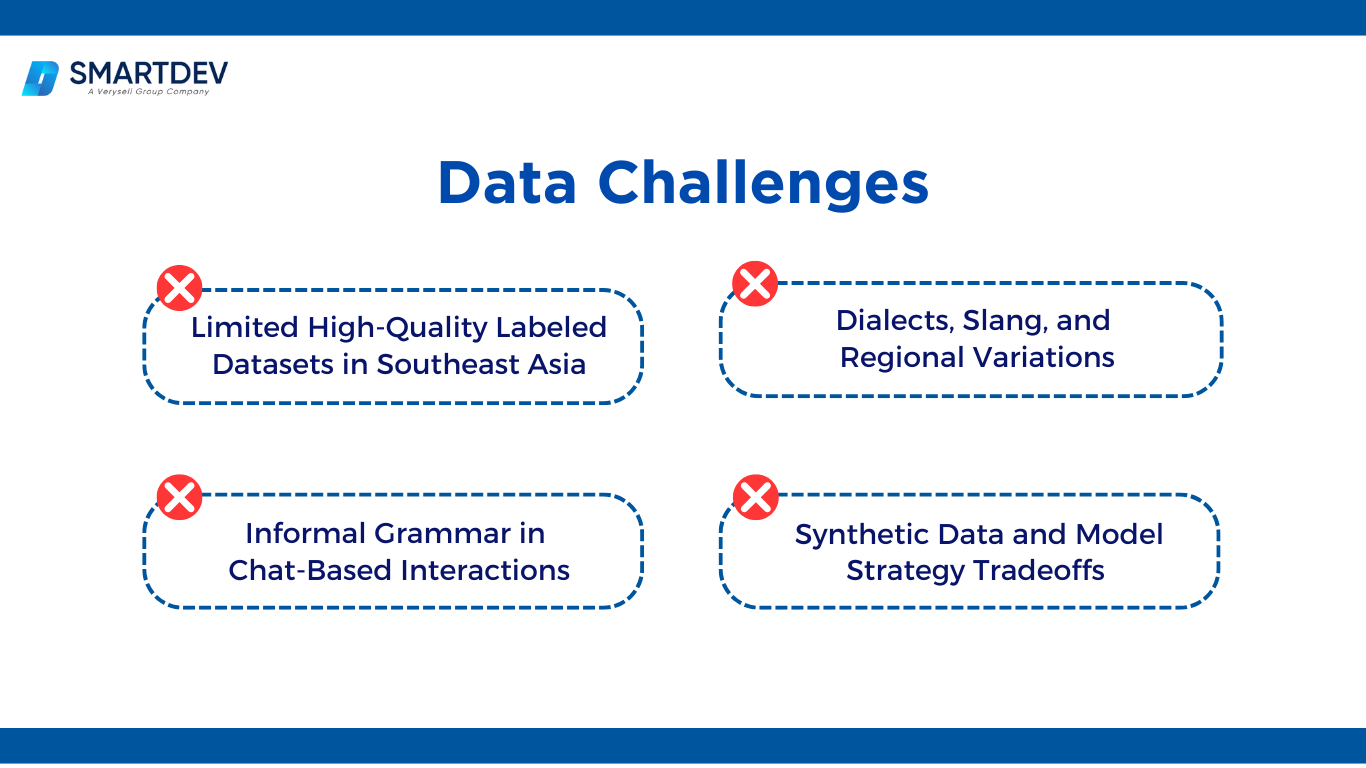
1. Limited High-Quality Labeled Datasets in Southeast Asia
Data availability is one of the most critical constraints in multilingual chatbot Southeast Asia development. While Southeast Asia has a population of approximately 670 million, high-quality labeled NLP datasets for local languages remain scarce. English-language datasets outnumber Southeast Asian language datasets by more than 10 to 1 in many public benchmarks, creating a persistent performance gap between global models and local use cases.
For Vietnamese chatbot development, this gap is especially visible. Despite Vietnam’s population exceeding 100 million, Vietnamese training data is fragmented across domains and often lacks conversational labels. Thai and Indonesian face similar issues, where available datasets skew toward formal or academic language rather than real-world chat interactions.
2. Dialects, Slang, and Regional Variations
Even when labeled data exists, it rarely captures the full linguistic diversity of Southeast Asian markets. Each target language includes multiple dialects and regional variations that influence vocabulary, sentence structure, and tone. Indonesian chatbot systems must account for differences between formal Bahasa Indonesia and regionally influenced slang used in daily messaging. Thai language NLP must handle variations in politeness levels and colloquial expressions.
These variations reduce model generalization. A chatbot trained on standardized language may perform well in testing but fail in production when exposed to real user input. In practice, intent accuracy can drop by more than 15 percent when dialectal variation is not represented in training data.
3. Informal Grammar in Chat-Based Interactions
Chatbot data differs fundamentally from traditional text corpora. Users omit punctuation, shorten words, and rely on context rather than grammatical completeness. This behavior is especially pronounced in mobile-first Southeast Asian markets, where messaging apps dominate digital interaction. In Thailand and Vietnam, over 90 percent of internet users access services primarily through mobile devices, amplifying informal language usage.
Without targeted conversational data, AI chatbots misclassify intent or default to fallback responses. Handling informal grammar therefore requires deliberate data collection from chat logs, customer support transcripts, and messaging platforms.
4. Synthetic Data and Model Strategy Tradeoffs
To compensate for data scarcity, teams increasingly rely on synthetic data generation and augmentation. These techniques expand coverage of intents, phrasing variations, and edge cases. However, synthetic data must be carefully validated. Overuse can introduce unnatural patterns that degrade real-world performance.
Balancing global large language models with local language models is another key consideration. Global LLMs offer broad language coverage but often underperform on Vietnamese, Thai, and Indonesian conversational nuances. Local models provide better linguistic accuracy but require higher upfront investment. Effective multilingual chatbot Southeast Asia strategies typically combine both, using global models for general reasoning and local models for intent detection and language understanding.
Explore how SmartDev partners with teams through a focused AI sprint to validate chatbot use cases, align stakeholders, and define a clear path forward before chatbot development begins in Southeast Asia.
SmartDev helps organizations clarify AI chatbot use cases and assess feasibility for Southeast Asian markets, enabling confident decisions and reducing risks before committing to chatbot development.
Learn how companies accelerate AI chatbot initiatives in Southeast Asia with SmartDev’s AI sprint, ensuring rapid deployment and reduced time to market.
Build Your AI Chatbot With UsInfrastructure and Architecture Considerations for SEA Chatbots
1. Cloud Deployment and Regional Architecture
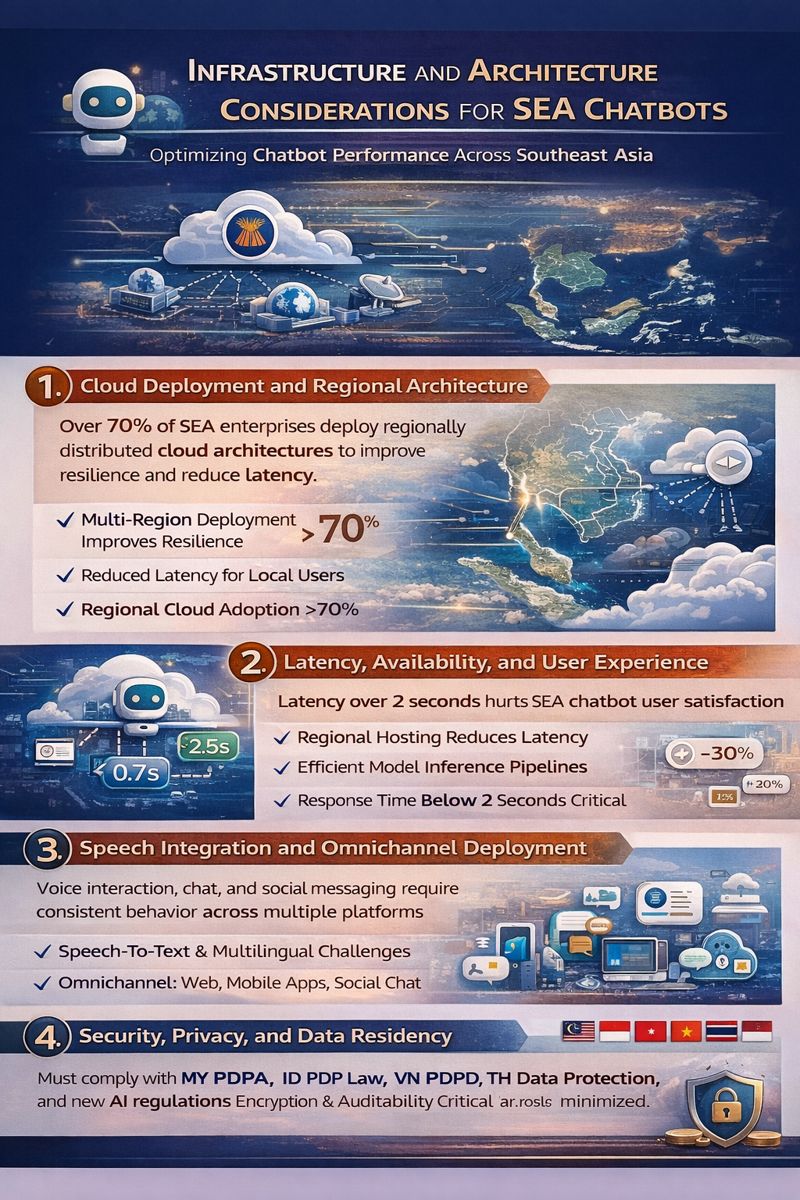
Infrastructure decisions play a major role in chatbot performance across Southeast Asia. The region spans multiple cloud availability zones with varying levels of maturity. Enterprises operating across ASEAN often deploy regionally distributed architectures rather than a single centralized instance. This approach improves resilience and reduces latency for end users.
According to regional cloud adoption data, more than 70 percent of Southeast Asian enterprises now use multi-region cloud strategies to support customer-facing applications.
2. Latency, Availability, and User Experience
Latency is a critical factor in conversational interfaces. Even small delays can break the illusion of real-time interaction. In chatbot systems, response times above 2 seconds significantly reduce user satisfaction and task completion rates. For SEA chatbots, latency optimization requires:
- Regional hosting close to users
- Efficient model inference pipelines
- Caching for common intents and responses
These requirements are more pronounced in multilingual systems, where additional routing and preprocessing steps add overhead.
3. Speech Integration and Omnichannel Deployment
Voice-based interaction is growing rapidly in Southeast Asia, particularly for customer support and accessibility use cases. Integrating speech-to-text and text-to-speech introduces additional language-specific challenges, especially for tonal languages like Vietnamese and Thai. Accuracy losses in speech recognition directly propagate into intent classification errors.
At the same time, SEA chatbots must operate across multiple channels. Users interact through web apps, mobile apps, and messaging platforms such as chat and social channels. Omnichannel deployment requires consistent NLP behavior while adapting responses to channel-specific constraints.
4. Security, Privacy, and Data Residency
Finally, infrastructure design must account for security and regulatory requirements. Several Southeast Asian countries are introducing stricter data protection and AI governance frameworks. Vietnam and Thailand have both emphasized data localization and user consent in digital services.
For enterprises, this means chatbot architectures must support regional data residency, encryption, and auditability. Infrastructure choices are therefore inseparable from compliance and long-term scalability in Southeast Asian markets.
Cultural and UX Challenges in Multilingual Chatbot Design

Conversational Tone and Politeness Expectations
One of the biggest cultural challenges in multilingual chatbot Southeast Asia deployments is conversational tone. In many Southeast Asian cultures, politeness, indirect expression, and respect are essential elements of everyday communication. Studies on digital inclusion and AI adoption show that more than 65 percent of users in ASEAN markets expect automated systems to communicate politely and respectfully, compared with under 45 percent in North America. When chatbots use direct, command-like phrasing that may be acceptable in English, they often feel rude or dismissive in Vietnamese or Thai. This mismatch leads to lower engagement and reduced trust, even when the chatbot’s answers are technically correct.
Cultural Expectations in Customer Support Automation
Customer support interactions in Southeast Asia are shaped by strong expectations around reassurance, guidance, and attentiveness. Unlike Western markets where speed and efficiency are often prioritized, Southeast Asian users frequently value how the interaction feels. Research on enterprise chatbot adoption indicates that up to 40 percent of users abandon chatbot sessions early when responses feel impersonal, especially in sectors such as banking, telecommunications, and public services. This creates a UX challenge where chatbots that move too quickly to problem resolution without acknowledging user concerns are perceived as unhelpful, increasing frustration and escalation rates.
Localization Versus Cultural Misinterpretation
Literal translation remains a major source of UX failure in multilingual chatbot design. Phrases that are neutral or friendly in English can sound abrupt, confusing, or even offensive when translated directly into Southeast Asian languages. Research shows that poor localization can reduce perceived response quality by more than 30 percent in non-English markets. This challenge goes beyond vocabulary and grammar. It includes how apologies are phrased, how refusals are delivered, and how uncertainty is communicated. Without deep cultural understanding, chatbots risk misinterpretation that erodes trust and credibility.
Regulatory and Ethical AI Requirements in Southeast Asia
As AI chatbot adoption accelerates across Southeast Asia, regulatory and ethical requirements are becoming a central consideration rather than a secondary compliance step. Governments in the region are actively shaping policies to guide responsible AI use, while users are becoming more aware of privacy, transparency, and fairness issues. For multilingual chatbot Southeast Asia deployments, regulatory readiness directly affects scalability, trust, and long-term viability. Insights from regional practitioners such as SmartDev show that enterprises that plan for compliance early move faster and face fewer deployment risks later.
AI Governance Trends in Vietnam and ASEAN
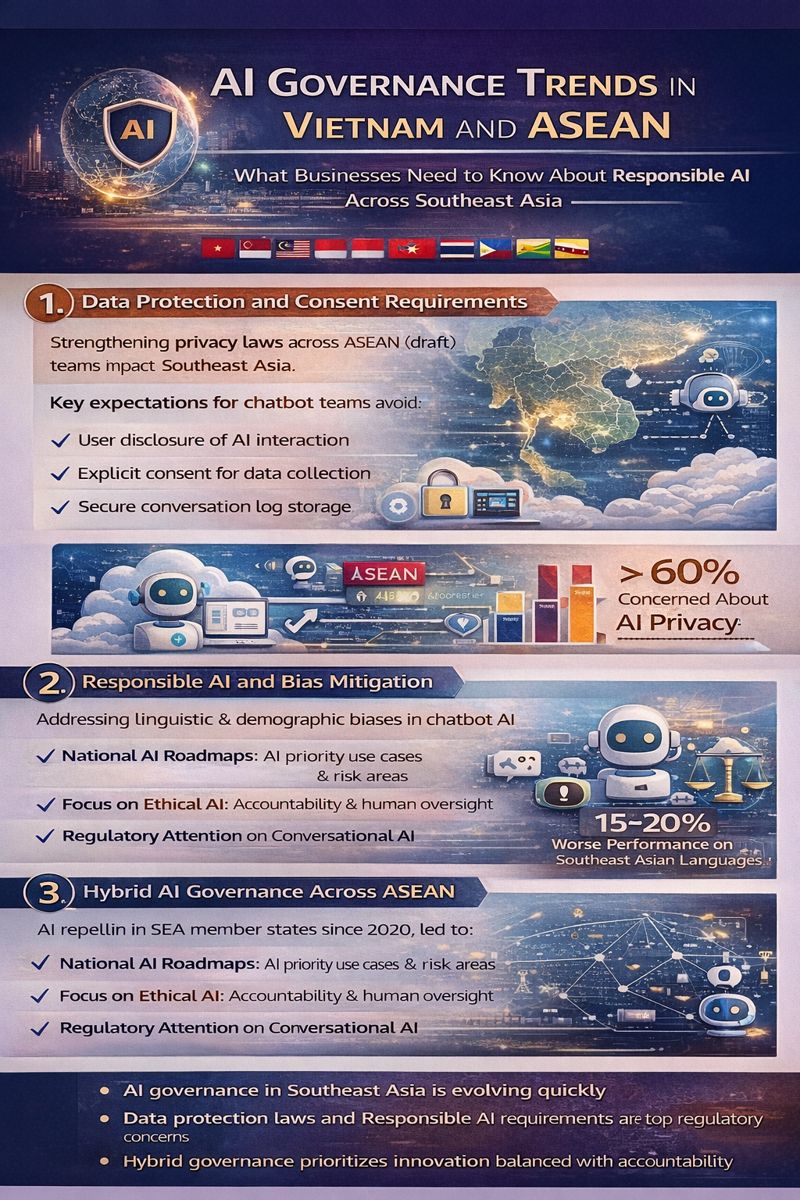
AI governance across Southeast Asia is evolving rapidly. Since 2020, more than 70 percent of ASEAN member states have released national AI strategies, draft regulations, or ethical guidelines, reflecting a clear regional push toward structured AI adoption. Vietnam, in particular, has positioned AI as a strategic growth pillar while emphasizing safety, transparency, and social responsibility.
According to SmartDev’s analysis of the regional AI ecosystem, Southeast Asia is moving toward a hybrid governance model. Innovation is encouraged, but AI systems used in customer-facing, financial, and public-sector contexts are subject to increasing oversight.
Key governance signals enterprises should track include:
- National AI roadmaps that define priority use cases and risk areas
- Ethical AI principles focused on accountability and human oversight
- Early regulatory attention on conversational AI and automated support systems
These trends mean chatbot initiatives must be designed with regulatory flexibility in mind, especially for cross-border deployments.
Data Protection and Consent Requirements
Data protection is one of the most immediate and impactful regulatory areas for chatbot systems. Countries such as Vietnam, Thailand, and Indonesia have introduced or strengthened personal data protection regulations that govern how conversational data is collected, stored, and processed. For multilingual chatbot Southeast Asia solutions, this directly affects architecture, data pipelines, and logging strategies.
SmartDev highlights that many chatbot failures occur not because of model quality, but because teams underestimate how quickly privacy requirements affect production systems.
Common regulatory expectations include:
- Clear disclosure that users are interacting with an AI chatbot
- Explicit user consent for collecting and processing personal data
- Secure storage, encryption, and controlled access to conversation logs
User expectations reinforce these requirements. Surveys show that more than 60 percent of Southeast Asian users are concerned about how AI systems use their personal information, making privacy compliance a trust issue as much as a legal one.
Responsible AI and Bias Mitigation
Responsible AI is increasingly tied to regulatory scrutiny and brand reputation. Language models trained primarily on English or Western-centric datasets often perform 15–20 percent worse on Southeast Asian languages, increasing the risk of misinterpretation, exclusion, or biased responses.
SmartDev emphasizes that this performance gap is not just a technical issue. It creates ethical risk when chatbots provide inconsistent or unfair experiences across different user groups.
Key ethical concerns regulators and enterprises focus on include:
- Linguistic bias against underrepresented local languages
- Uneven intent accuracy across markets and demographics
- Incorrect assumptions in sensitive customer interactions
As regulatory frameworks mature, bias mitigation is increasingly viewed as a baseline requirement rather than an optional best practice.
Transparency and Explainability in Chatbot Responses
Transparency plays a critical role in both compliance and user trust. Users increasingly expect to know whether they are interacting with a human or an AI system, especially in customer support and transactional contexts. Research shows that clearly identifying chatbot interactions can increase user trust by up to 20 percent compared to ambiguous interfaces.
SmartDev notes that transparency should be treated as a governance principle, not just a UI decision.
Common transparency expectations include:
- Explicit identification of AI-driven conversations
- Predictable and consistent response behavior
- Clear escalation paths to human agents
These measures reduce confusion, regulatory risk, and user frustration, even when full technical explainability is not feasible.
Long-Term Compliance Considerations for Enterprises
Regulatory compliance in Southeast Asia is not static. AI-related laws, enforcement mechanisms, and ethical expectations continue to evolve. SmartDev’s experience shows that enterprises that treat compliance as a one-time checklist struggle to scale chatbot systems across markets.
Long-term compliance typically involves:
- Continuous monitoring of AI and data protection regulations across ASEAN
- Maintaining audit trails, model documentation, and decision logs
- Updating chatbot models and data practices as policies change
For enterprises investing in multilingual chatbot Southeast Asia solutions, regulatory and ethical readiness is not a barrier to innovation. It is a foundation for building scalable, trusted, and sustainable AI systems in one of the world’s fastest-growing digital regions.
Common Mistakes in Multilingual Chatbot Development and How to Avoid Them
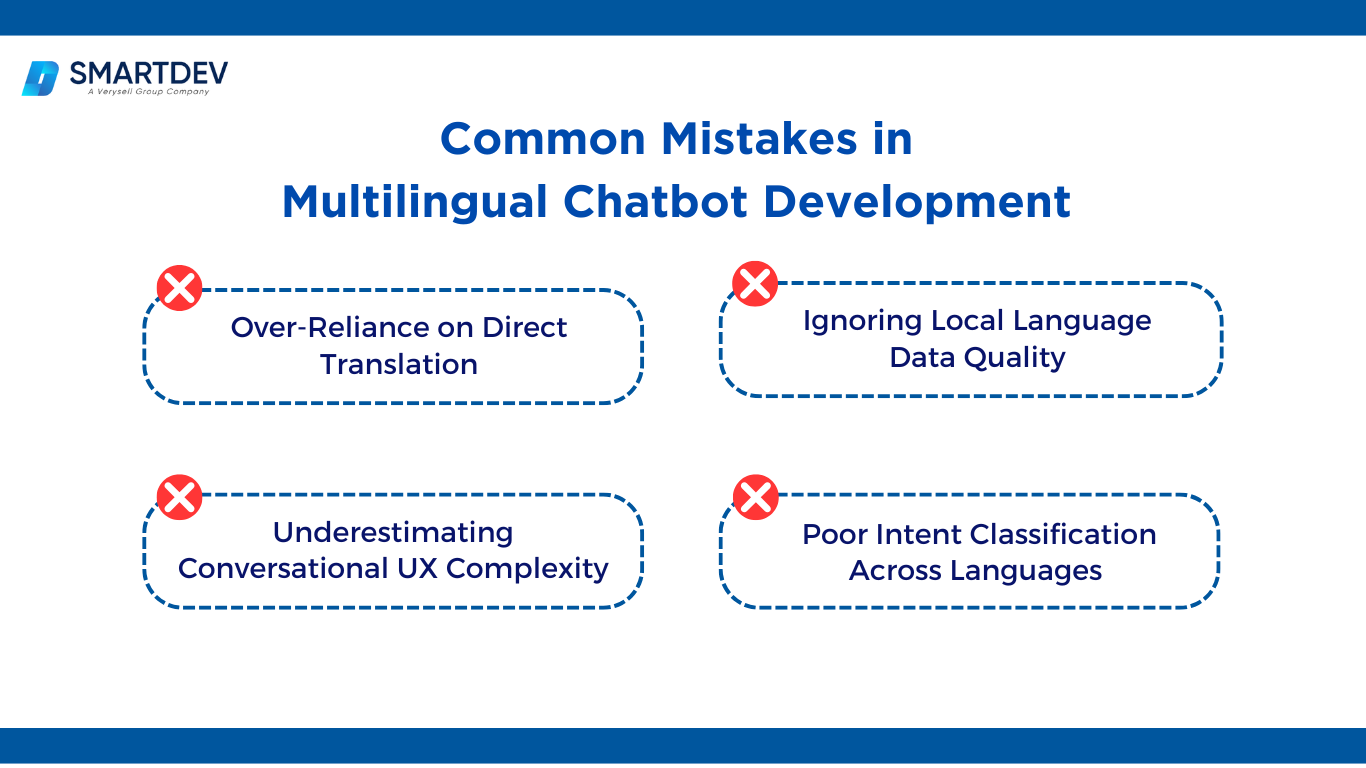
1. Over-Reliance on Direct Translation
 1. Over-Reliance on Direct Translation
One of the most common mistakes in multilingual chatbot Southeast Asia projects is treating chatbot development as a translation problem. Many teams design conversations in English and then translate responses into local languages. This approach ignores differences in sentence structure, politeness norms, and conversational flow. Research on AI localization shows that literal translation can reduce perceived response quality by more than 30 percent in non-English markets. In practice, translated chatbots often sound unnatural and fail to build user trust, even when intent recognition is accurate.
2. Ignoring Local Language Data Quality
Another frequent issue is underestimating the importance of local-language data. Many chatbot systems rely heavily on English or globally available datasets, assuming multilingual models will compensate for gaps. In Southeast Asia, this assumption rarely holds. Local languages are underrepresented in public NLP datasets, and available data often skews toward formal or academic text. Studies show that intent accuracy can drop by 15–20 percent when models are trained without sufficient conversational data in the target language. Poor data quality leads to high fallback rates and inconsistent performance in real-world usage.
3. Underestimating Conversational UX Complexity
Many organizations focus heavily on technical implementation while overlooking conversational UX design. Chatbots are not just technical systems but interactive products. In Southeast Asia, conversational UX must account for politeness, indirect communication, and cultural expectations around service interactions. According to enterprise chatbot adoption studies, up to 40 percent of chatbot failures are linked to poor UX design rather than model performance (IBM). When conversation flows feel abrupt or confusing, users disengage quickly, regardless of backend accuracy.
4. Poor Intent Classification Across Languages
Intent classification becomes significantly more complex in multilingual environments. Teams often assume that a single intent model can handle multiple languages equally well. In practice, intent definitions that work in English may not map cleanly to local languages. Differences in grammar, word order, and informal expression create ambiguity that reduces classification accuracy. In multilingual chatbot Southeast Asia deployments, intent performance often varies widely by language, leading to inconsistent user experiences. Without language-specific tuning and evaluation, these gaps remain hidden until production.
Lessons Learned from SEA NLP Challenges
Real-world deployments across Southeast Asia reveal a consistent pattern. Multilingual chatbot success depends less on choosing the most advanced model and more on addressing regional language realities. Key lessons include the need for language-aware design, high-quality local data, and continuous optimization. Teams that treat Southeast Asia as a simple extension of Western markets often struggle, while those that invest in regional expertise achieve more stable and scalable outcomes. Avoiding these common mistakes allows enterprises to build multilingual chatbots that are trusted, effective, and resilient in Southeast Asian markets.
How SmartDev Helps Businesses Build Multilingual Chatbots for Southeast Asia
SmartDev brings strong regional expertise that is essential for building effective multilingual chatbot Southeast Asia solutions. With engineering teams based in Vietnam and long-term experience supporting ASEAN enterprises, SmartDev understands the linguistic, cultural, and operational realities of the region. This is particularly important for Vietnamese chatbot development, where informal language, diacritics, and code-switching patterns require local knowledge to handle correctly. Instead of treating Southeast Asian languages as secondary add-ons to English-first systems, SmartDev designs chatbot solutions with regional language complexity as a core technical consideration from the outset.
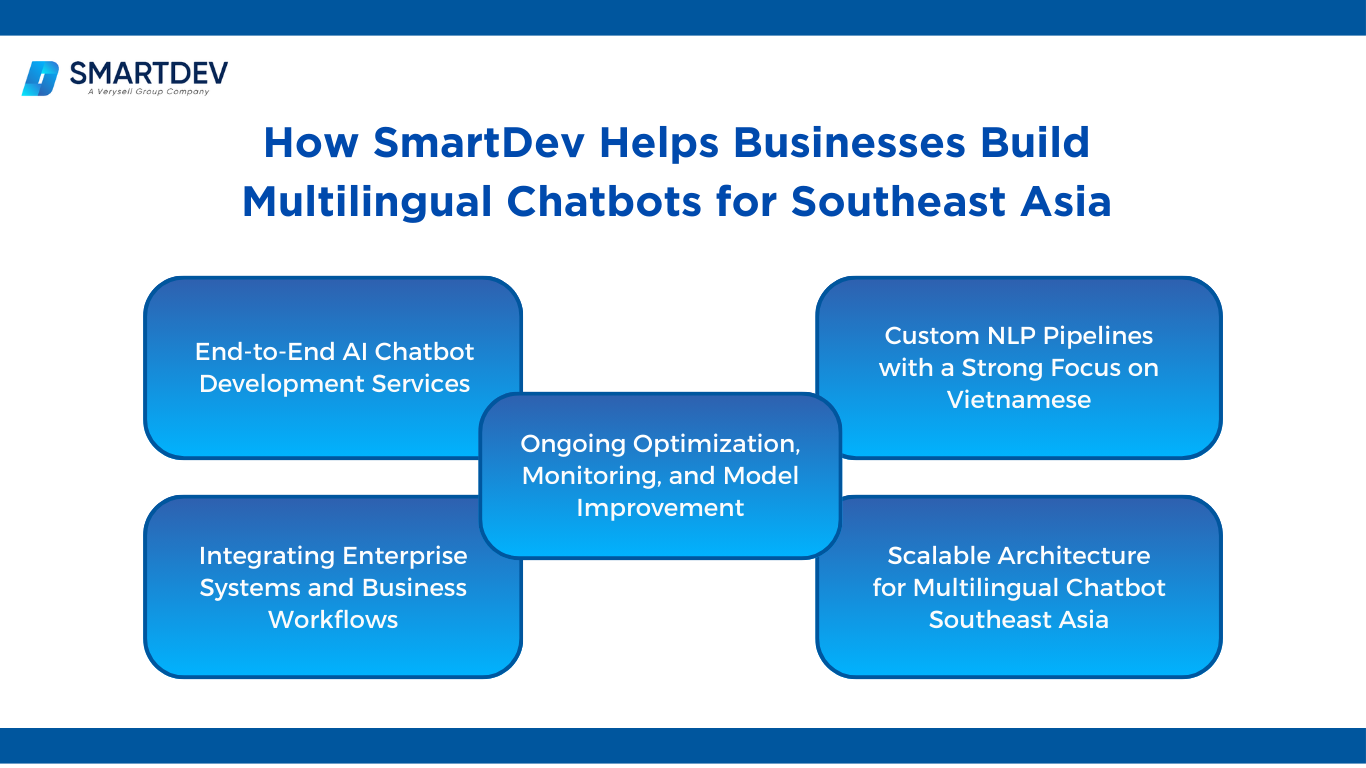
End-to-End AI Chatbot Development Services
SmartDev provides end-to-end AI chatbot development, covering the full lifecycle from strategy to production and optimization. Engagements typically begin with use-case definition and technical assessment, ensuring chatbot goals align with business outcomes such as customer support efficiency, lead generation, or internal automation. SmartDev then designs conversational flows, selects suitable AI models, and builds scalable systems ready for real-world deployment. This approach helps enterprises avoid common pitfalls such as stalled proof-of-concepts or chatbots that work in demos but fail under production traffic.
Custom NLP Pipelines with a Strong Focus on Vietnamese
A key differentiator in SmartDev’s approach is the development of custom NLP pipelines, especially for Vietnamese-language use cases. Vietnamese chatbot development requires careful handling of tone marks, compound words, informal grammar, and inconsistent user input. SmartDev builds language-aware preprocessing, normalization, and intent classification components that improve accuracy in real conversational environments. Rather than relying entirely on generic multilingual models, SmartDev fine-tunes pipelines using domain-specific and conversational data, resulting in lower fallback rates and more reliable intent detection in production.
Integrating Enterprise Systems and Business Workflows
SmartDev emphasizes deep integration between chatbots and enterprise systems to ensure real business impact. Chatbots are connected to CRM platforms, customer databases, internal tools, and backend services so they can perform meaningful actions, not just answer questions. This enables use cases such as order tracking, account inquiries, service requests, and internal process automation. For enterprises operating across Southeast Asia, SmartDev ensures that backend logic remains consistent while the chatbot interface adapts to language and market-specific requirements.
Scalable Architecture for Multilingual Chatbot Southeast Asia
Scalability is a critical requirement in fast-growing Southeast Asian markets. SmartDev designs modular, cloud-native architectures that support multiple languages and high conversation volumes without performance degradation. These architectures typically include centralized orchestration, shared dialogue management, and language-specific NLP components. This structure allows enterprises to expand chatbot coverage to new markets or languages incrementally while maintaining operational stability and predictable costs.
Ongoing Optimization, Monitoring, and Model Improvement
SmartDev views chatbot deployment as a long-term initiative rather than a one-time project. After launch, SmartDev supports continuous monitoring of conversation quality, intent accuracy, and user behavior. Models are retrained as language usage evolves, new expressions appear, or business requirements change. This continuous improvement cycle ensures that multilingual chatbot Southeast Asia solutions remain accurate, relevant, and trusted over time. By combining regional expertise, custom NLP engineering, and scalable system design, SmartDev helps businesses turn multilingual complexity into a sustainable competitive advantage.
Conclusion
Building multilingual chatbots for Southeast Asian markets goes far beyond language translation. As this article has shown, multilingual chatbot Southeast Asia initiatives involve complex technical requirements, fragmented language landscapes, cultural expectations, data limitations, and evolving regulatory frameworks. Success depends on how well these challenges are addressed together, not on model sophistication alone.
Southeast Asia’s rapid digital growth makes conversational AI a critical interface for enterprises. However, chatbots that ignore local language behavior, conversational norms, or compliance requirements often struggle to gain user trust. In contrast, systems designed with regional languages, scalable architecture, and responsible AI practices at their core are far more resilient and effective.
For enterprises and technical leaders, the opportunity is clear. By treating multilingual complexity as a design foundation rather than a constraint, organizations can build chatbots that scale across Southeast Asia and create durable competitive advantage in one of the world’s fastest-growing digital regions.