
Introduction
Global business no longer happens in one place. Companies hire talent across continents, work with suppliers in different regions, and serve customers from nearly anywhere. To keep everything running, money needs to move across borders just as smoothly as information or products. Cross border payments make this possible, yet many leaders still find them confusing because of the layers of banking systems, regulations, and currencies involved.
This guide breaks down the essentials in a simple, business-friendly way. You’ll learn what cross border payments are, why they matter, the main methods companies use, and the challenges that often create friction. We also include leadership insights shared by fintech executive Jan Lorenc on the Ctrl Shifter Podcast, offering a behind-the-scenes view of what it takes to operate a regulated global payments business.

What Are Cross Border Payments?
Cross border payments are transactions where the sender and the recipient are located in different countries. Although they look similar to domestic transfers, international payments involve several additional layers. Funds may pass through multiple banks, go through compliance checks in several jurisdictions, and be converted into another currency before reaching the final account.
These extra steps help ensure security and regulatory compliance, but they also explain why cross border payments sometimes take longer or cost more than local transactions.
Why Do Cross Border Payments Matter?
As business models become more global, moving money across borders becomes a core operational need. Companies rely on international payments to:
- Pay suppliers or partners
- Hire remote talent
- Support customers in new markets
- Transfer funds between global offices
- Maintain stable and predictable cash flow
When payments flow smoothly, companies gain confidence to expand and manage international operations. When they do not, delays and uncertainty can disrupt everything from payroll to supply chain planning.
Cross Border Payment Methods
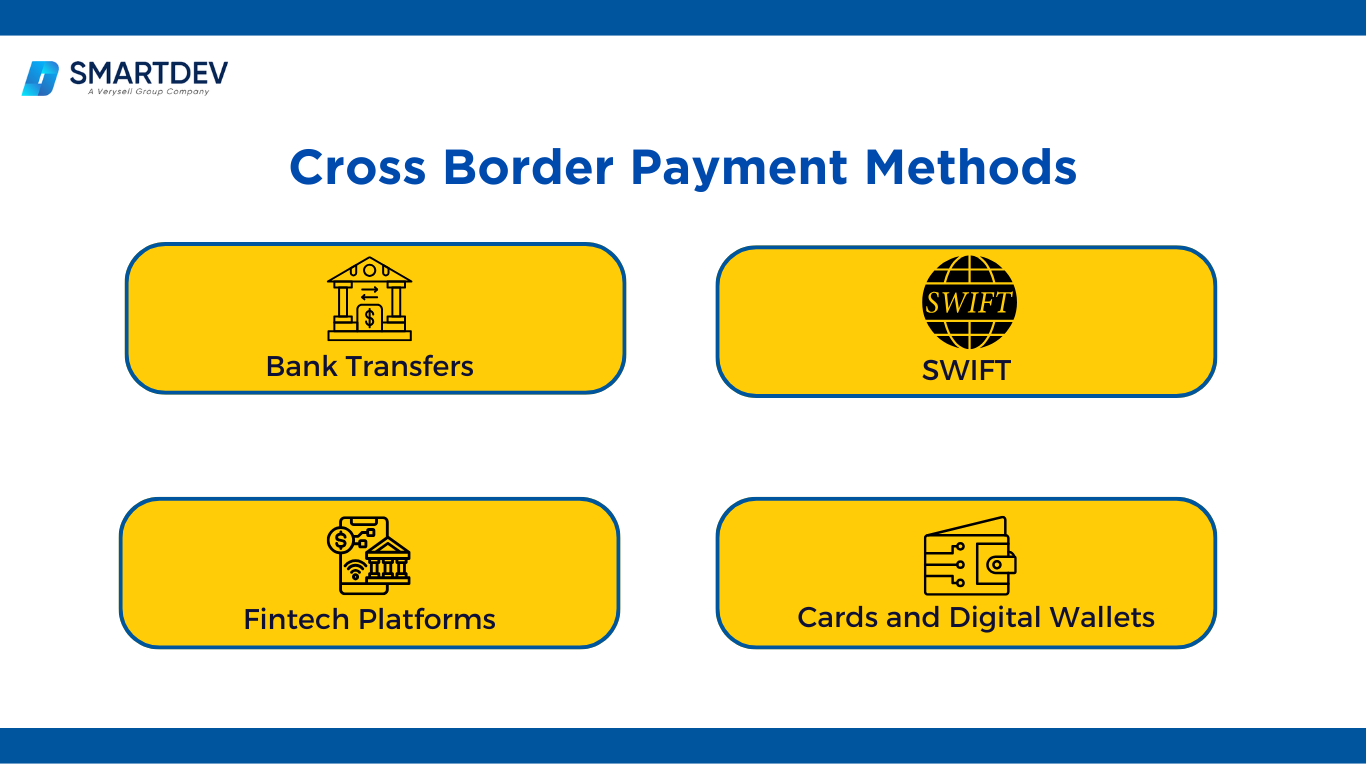
Businesses can move money internationally in several ways, depending on their priorities around speed, cost, and transparency.
Bank Transfers
Traditional banks send funds through correspondent partners connected across different countries. This method is secure and well established, though it can be slower because multiple institutions may handle the transfer before it reaches the recipient.
SWIFT
SWIFT powers the messaging behind most global transactions. It enables banks to communicate payment instructions securely. While reliable, it still depends on the underlying banking chain, which means processing times can vary from a few hours to several days.
Fintech Platforms
Fintech providers connect directly to local payment systems in multiple markets. This reduces the number of intermediaries and often results in faster settlement, clearer pricing, and real-time visibility. For growing companies, these advantages can simplify daily operations significantly.
Cards and Digital Wallets
These options work well for consumers and small online purchases. They are quick and convenient but not designed for larger business transfers that require more control and documentation.
What Are the Key Challenges for Cross Border Payments?
Even with rapid innovation, cross border payments continue to face obstacles that businesses must navigate carefully.
 1. Regulatory Differences
 1. Regulatory Differences
Each country has its own rules for verifying transactions, checking identity, and monitoring risks. Missing documents or unclear information can trigger reviews and slow down the payment. For businesses operating across multiple regions, staying compliant becomes an ongoing responsibility that requires strong internal processes.
2. Currency Fluctuations
Foreign exchange rates shift throughout the day, affecting how much the recipient ultimately receives. Without proper planning, businesses may face unexpected costs or loss in value. Many finance teams rely on hedging tools or scheduled transfers to reduce the impact of volatility.
3. Multiple Intermediaries
When a payment travels through several correspondent banks, each one adds time and potential fees. If any intermediary pauses the transaction for review, the entire process stalls. This makes it harder for finance teams to predict timelines and communicate status updates to internal stakeholders.
4. Operational Complexity
Cross border payments involve coordination across teams, time zones, and external partners. A missing detail, a delayed response, or a misunderstanding can slow the entire process. Companies that operate globally often invest heavily in clear communication and standardized workflows to reduce these bottlenecks.
Insights From the Ctrl Shifter Podcast
On the Ctrl Shifter Podcast, fintech leader Jan Lorence shared valuable lessons from building and scaling a regulated cross border payments business. His perspective highlights that global payments depend not only on technology but also on strong leadership and aligned teams.
He explained that teams today operate across different cultures and time zones, which makes clear communication essential. Leaders must express the company’s mission in simple, consistent terms so everyone understands the direction and feels connected to the work. This alignment becomes even more important when entering new markets or adapting to new regulations. As Jan noted, the real goal is ensuring everyone can “pull in the same direction.”
Jan also emphasized the importance of hiring flexible, curious, and adaptable people. Fintech moves quickly. Tasks shift, priorities change, and new challenges appear often. Team members need an entrepreneurial mindset — one that encourages initiative rather than waiting for detailed instructions.
Strong communication and a proactive culture not only help global teams stay aligned but also directly improve the reliability and quality of cross border payment operations.

How to Send a Cross Border Payment
With the right preparation, sending a cross border payment becomes a simpler and more predictable process.
1. Choose the Right Payment Provider
Decide whether a traditional bank, a SWIFT-connected partner, or a fintech platform fits your needs. Consider factors such as speed, cost, supported currencies, and the level of tracking offered. The provider you choose will shape the experience for both your team and your recipients.
2. Prepare Accurate Recipient Information
Make sure you have the correct account details, bank identifiers, and receiving currency. Even minor mistakes can cause delays or rejections. Accurate information helps avoid unnecessary back-and-forth communication with banks or support teams.
3. Confirm Required Documents
Some jurisdictions require invoices, contracts, or purpose-of-payment statements. Preparing these documents in advance ensures smooth compliance checks and reduces the chance of your payment being held for review, especially for high-value transactions.
4. Submit the Payment
Once everything is in place, submit the transfer through your chosen provider. The system will handle routing and currency conversion. Many companies choose providers that offer transparent fees and predictable timelines so finance teams can plan effectively.
5. Track the Progress
Most modern platforms provide real-time tracking. This visibility helps finance teams manage internal expectations, respond quickly to issues, and maintain accurate records for reconciliation or audit processes.
Final Thoughts
Cross border payments are a vital part of global business. Understanding how they work helps leaders reduce friction, support growth, and create more predictable operations. The insights from the Ctrl Shifter Podcast also remind us that behind every reliable payment system is a strong team that communicates well, adapts quickly, and stays aligned around a shared purpose.
Ready to learn more?
Listen to the full conversation with Jan Lorence on the Ctrl + Shifter Podcast for deeper insights into leadership alignment, global team communication, and what it really takes to scale a regulated cross border payments business.