
TL, DR:
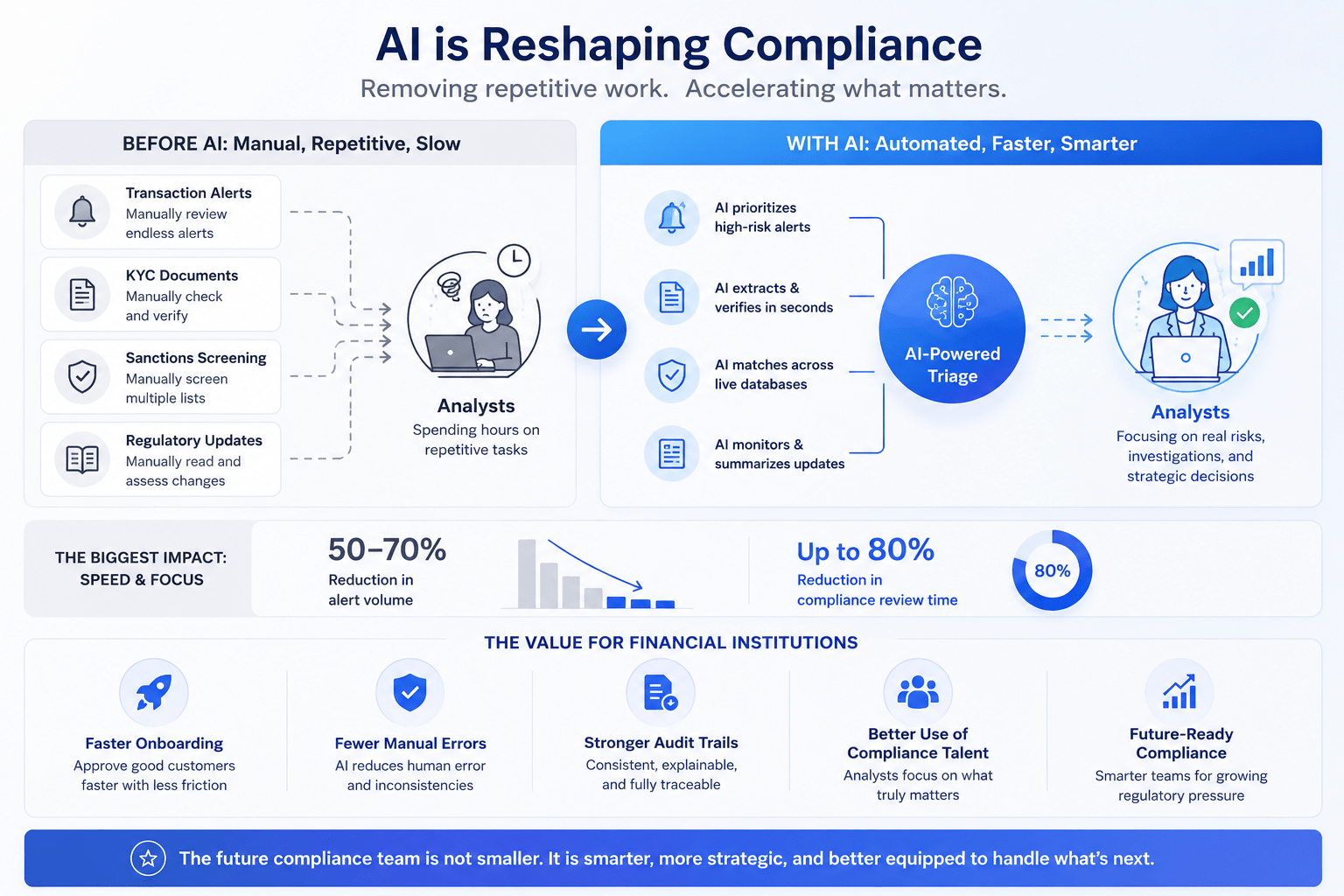
AI is reshaping compliance by removing the repetitive work that slows teams down. Instead of manually reviewing endless transaction alerts, checking KYC documents, screening sanctions lists, and reading regulatory updates, compliance teams can use AI to automate the first layer of review.
The biggest impact is speed and focus:
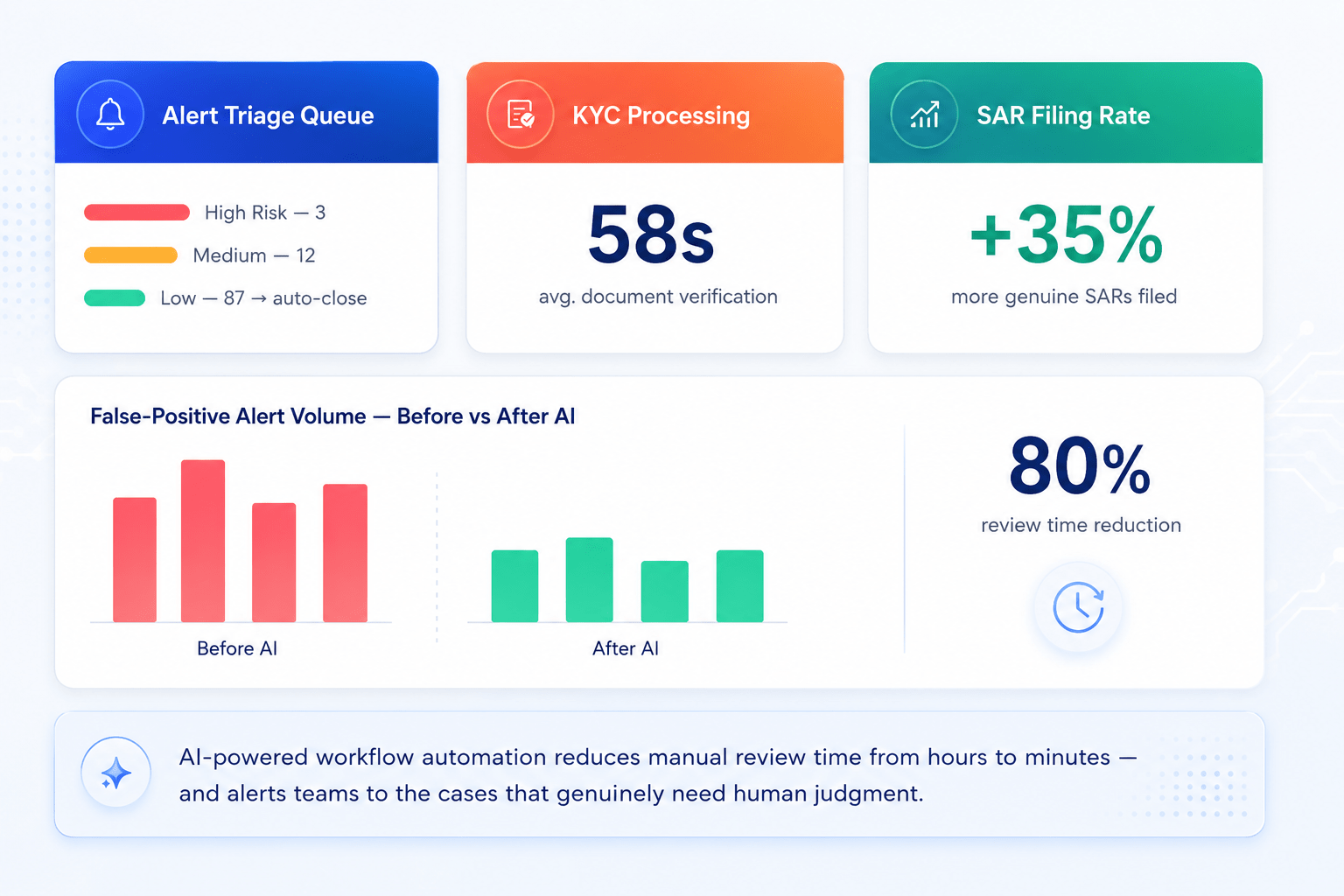
- AI-powered triage can reduce alert volume by 50–70%.
- Compliance review time can be cut by up to 80%.
- Analysts spend less time closing false positives and more time investigating real risks.
- Teams can build stronger cases, improve audit trails, and support regulatory decisions more effectively.
This does not mean replacing analysts. It means elevating their role. For financial institutions, the value is clear: faster onboarding, fewer manual errors, stronger governance, and better use of compliance talent. The future compliance team is not smaller. It is smarter, more strategic, and better equipped to handle growing regulatory pressure.
Introduction: The Compliance Bottleneck No One Talks About
A System Built for a Different Era
A Corporate Compliance Insights survey found that 59% of compliance officers report feeling burned out. In addition, 51% describe “a lot” or “extreme” job stress, and 56% say their mental health has been negatively affected by their role. Every day, analysts sift through hundreds of transaction alerts, review customer documents, and monitor regulatory updates, most of which produce no actionable findings. As a result, legacy rule-based systems generate enormous noise, and regulators keep adding requirements.
According to Thomson Reuters’ Cost of Compliance Survey, financial institutions spend an average of $10,000 per employee per year on compliance-related tasks. Large banks even dedicated entire floors of staff to processes that modern AI handles in milliseconds. This operational drag is not simply a headcount problem. Rather, it is a fundamental architecture problem.
Why “Just Hire More Analysts” No Longer Works
The regulatory environment grows faster than any team can realistically scale. For instance, frameworks like the EU’s Anti-Money Laundering Authority (AMLA), ongoing updates to FATF recommendations, and expanding ESG disclosure requirements all demand simultaneous attention. Hiring ten more analysts might solve today’s backlog, but it simultaneously creates tomorrow’s bottleneck. Therefore, modern organizations need a structural shift instead of a staffing patch.
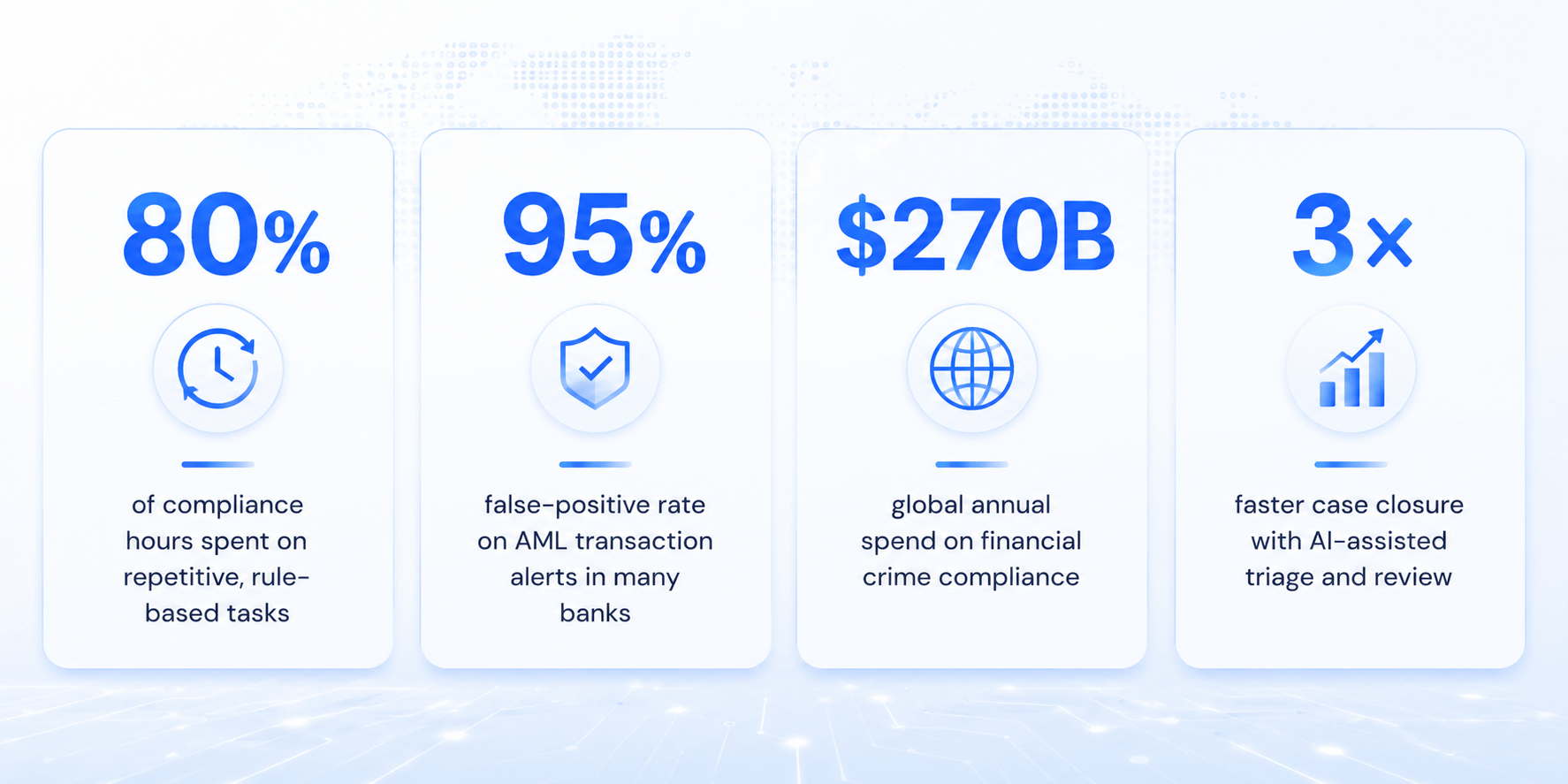
Currently, up to 80% of compliance hours are wasted on repetitive, rule-based tasks. Legacy systems trigger a false-positive rate above 95% on AML transaction alerts in many banks. This inefficiency contributes heavily to a staggering $270B global annual spend on financial crime compliance. However, introducing AI-assisted triage and review unlocks a 3x faster case closure rate.
What AI Actually Automates in Compliance
Transaction Monitoring and Alert Triage
The False-Positive Crisis
Transaction monitoring systems flag suspicious activity using fixed rules. Those rules cast a wide net, intentionally, but they generate catastrophic amounts of noise. In fact, some large institutions report false-positive rates above 95%. This means analysts manually review hundreds of alerts daily and close nearly all of them without escalation.
However, AI changes that equation entirely. Machine learning models train historical alert outcomes to learn which patterns genuinely precede financial crime. Consequently, they score each incoming alert with a risk of probability rather than a binary flag. As a result, analysts then review only the highest-probability cases. SmartDev has explored this false-positive crisis in depth, the AI-powered triage reduces alert volume by 50-70% without increasing the miss rate on genuine risks.
Continuous Learning from Analyst Decisions
Modern AI triage systems learn from every case an analyst closes. When an analyst marks an alert as a true negative and writes a rationale, the model immediately updates its understanding of that customer segment, transaction type, and risk pattern. Consequently, the system gets smarter with every decision your team makes. That creates a virtuous cycle: fewer false positives lead to faster reviews, which produce more training data, which subsequently improves the model further.
Document Review and KYC Processing
From Manual Extraction to Intelligent Parsing
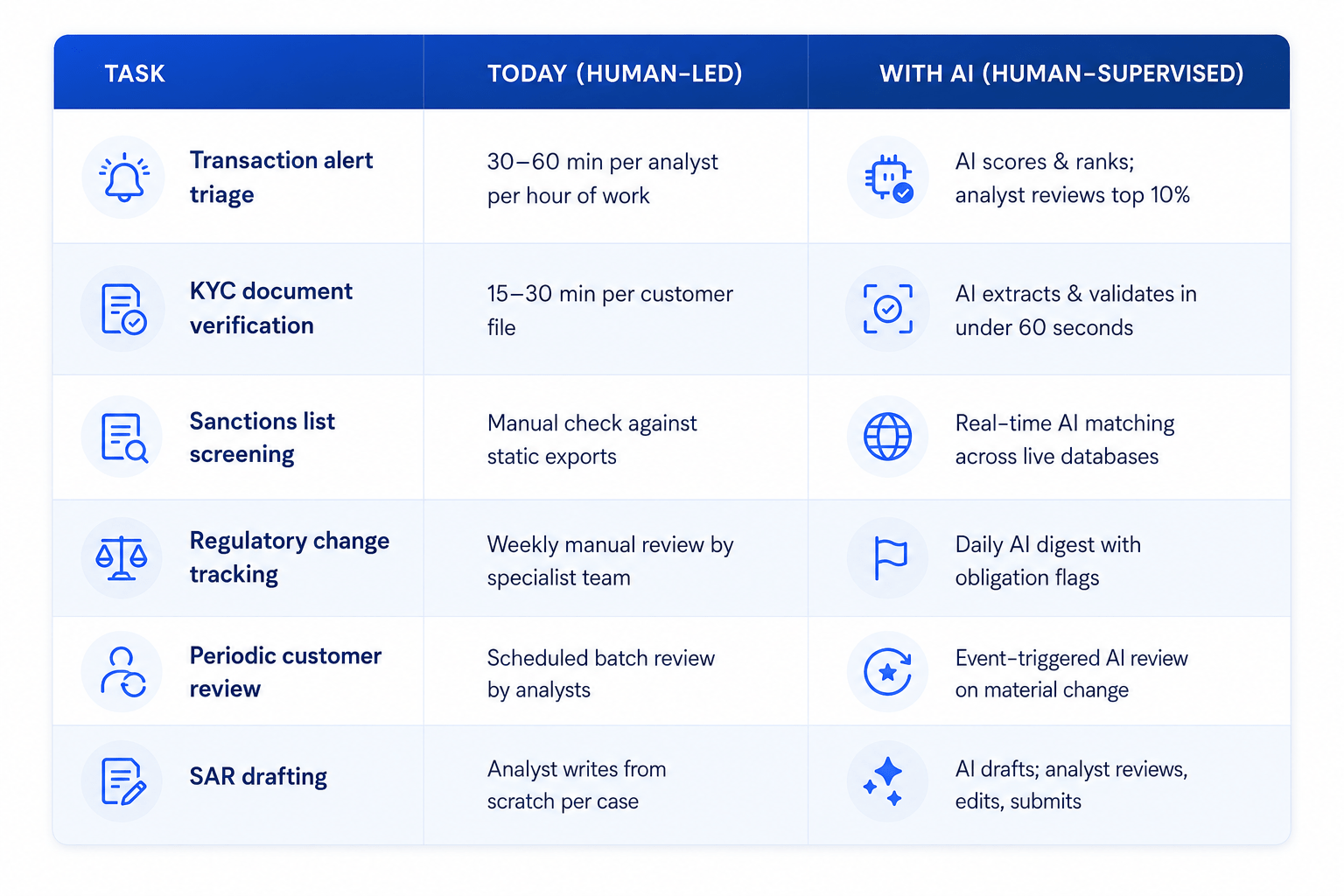
Know Your Customer (KYC) onboarding requires analysts to verify identity documents, extract data fields, cross-reference sanctions lists and assess PEP (Politically Exposed Person) status. As a result, each manual review typically takes 15–30 minutes. When multiplied across thousands of monthly onboardings, these checks create significant operational bottlenecks. Consequently, customers face delays while compliance teams experience growing workloads.
However, AI significantly streamlines this process. For example, document intelligence extracts data from passports, utility bills, bank statements, and corporate records within seconds. In addition, natural language processing identifies entity relationships across unstructured data sources. Meanwhile, automated sanctions screening continuously checks applicants against real-time watchlists. As a result, organizations can accelerate onboarding without sacrificing compliance standards. SmartDev’s work with insurance document processing demonstrates similar outcomes across regulated industries. Specifically, organizations improve accuracy while dramatically reducing processing times.
Ongoing Customer Due Diligence (CDD)
KYC does not end onboarding. In fact, regulations require firms to continuously monitor customer profiles and refresh due diligence at defined intervals. AI automates this refresh cycle. Specifically, the system monitors news feeds, corporate registry changes, and sanction list updates in real time. It flags only the customers whose profiles change materially, thereby eliminating the scheduled, blanket reviews that currently consume entire compliance teams.
Regulatory Change Management
Reading the Firehose of Regulatory Updates
Global regulators publish thousands of documents annually, including consultation papers, final rules, guidance notes, enforcement actions, and FAQ updates. As a result, compliance teams must monitor every relevant jurisdiction continuously. In addition, they must translate complex legal requirements into operational procedures. Consequently, large institutions often maintain dedicated regulatory intelligence functions to manage this workload.
However, AI can significantly reduce that burden. For example, modern models ingest regulatory texts, identify obligation clauses, map them to existing controls, and flag compliance gaps automatically. As a result, organizations can respond to regulatory changes much faster. SmartDev’s AI compliance readiness framework helps organizations evaluate whether their current systems can support this pace of change. Furthermore, solutions built on SmartDev’s AI and Machine Learning services apply large language models to legal text analysis. Consequently, tasks that require weeks of manual review can often be completed within a single day.
Automated Control Mapping and Gap Analysis
When a new regulation is published, the first question is always: “What do we already do, and what do we need to add?” AI performs this control mapping automatically. In doing so, it compares new obligations against the firm’s documented control library and outputs a prioritized gap list. Consequently, compliance managers spend their time reviewing AI outputs and making judgment calls, rather than reading 200-page PDF documents from scratch.
NORA: SmartDev’s AI Workflow Engine for Risk and Compliance
What Is NORA and Why Compliance Teams Need It Now
SmartDev’s AI Adoption Accelerator for Risk and Compliance
NORA is SmartDev’s AI workflow automation platform built specifically for risk and compliance teams in financial services. It automates risk assessments, compliance checks, and credit scoring workflows, replacing hours of manual analyst work with structured, auditable AI outputs. Rather than bolting AI onto existing processes, NORA is designed from the ground up to eliminate traditional scaling bottlenecks. These include inconsistent manual reviews, capacity limits at peak volume, and the heavy documentation burden from regulatory scrutiny.
Furthermore, where standard compliance tools generate alerts for analysts to triage, NORA shifts the workload upstream. The platform safely ingests borrower profiles, financial statements, and supporting documents via OCR. Next, it runs risk analysis using large language models and returns a classified risk tier with a plain-language rationale. The entire cycle for an individual lending assessment takes minutes, not hours. For business lending, NORA delivers a standardized credit risk report with recommendations in just 15-30 minutes. This dramatically reduces both analyst time and credit bureau dependency. Learn more at SmartDev’s NORA product page.
Why Manual and Rules-Based Processes Create Compliance Gaps
Manual risk and compliance workflows have four structural failure modes that grow worse as transaction volume scales. First, inconsistency: two analysts reviewing the same borrower profile will often reach different conclusions, creating audit risk and regulatory exposure. Second, speed: peak-period backlogs in loan applications, renewals, and compliance checks are a function of analyst headcount, a ceiling that cannot be raised fast enough. Third, documentation: manually produced assessment records are hard to standardize and harder to defend under regulatory examination. Fourth, cost: reliance on external credit bureau lookups adds per-transaction fees that eat directly into margin.
NORA addresses all four simultaneously. Its structured compliance scoring framework applies the same criteria to every assessment, removing analyst-to-analyst inconsistency. Its OCR-powered document ingestion processes applications in minutes rather than hours. Its audit-ready report output, timestamped, with full data lineage from input document to final decision, satisfies regulatory examination requirements by design. And by deriving risk signals directly from uploaded financial documents, it reduces bureau lookup dependency from the first deployment. SmartDev’s team detailed the broader false-positive and volume problem in Why Compliance Teams Are Drowning in False Positives, NORA is the operational answer to that structural challenge.
How NORA Works in a Modern AI Compliance Stack
Document Ingestion and AI-Assisted Risk Assessment
NORA’s workflow starts with document ingestion. Borrower-submitted PDFs and DOCX files, financial statements, identity documents, income records, are processed through Docling-powered OCR that extracts structured text including complex tables from scanned or formatted documents. The extracted data feeds directly into NORA’s risk assessment engine, which analyses borrower profiles, income patterns, and financial history to generate a preliminary risk score. This replaces hours of manual data extraction and review with a process that completes in minutes, with no manual re-keying of figures from uploaded documents.
Structured Compliance Scoring and Rationale Generation
Every NORA assessment follows a standardized compliance scoring framework aligned to the institution’s regulatory requirements. Rather than returning a binary pass/fail, compliance scoring gives a granular, tiered view of where each application sits across the risk spectrum, surfacing the specific signals that drove the result, not just the outcome. NORA classifies each application with a risk tier and generates a plain-language rationale explaining the key signals that drove the classification. That rationale is ready for direct use in analyst review, customer communication, or regulatory documentation. Consistency across every assessment matters here: as ncontracts notes, inconsistent risk assessment processes that produce varying definitions of risk across the organization directly increase regulatory exposure, exactly the audit vulnerability that standardized AI scoring is designed to close.
Human-in-the-Loop Review and Audit-Ready Output
NORA enforces a human-in-the-loop gate by design to ensure regulatory defensibility. Low-confidence or flagged assessments are automatically held in a review queue for analyst sign-off. This structure is vital because regulators strictly mandate human oversight. For example, GDPR Article 22 grants individuals the right to request a human review of automated decisions. Concurrently, the EU’s Digital Operational Resilience Act (DORA) adds stringent oversight obligations.
In the United States, the Federal Reserve and OCC’s SR 11-7 guidance requires complete documentation of data lineage and decision rationales for credit models. NORA satisfies these strict examination standards effortlessly. It automatically generates a timestamped, audit-ready report for every single assessment. Consequently, routine applications are handled end-to-end, allowing human analysts to focus exclusively on complex exceptions.
NORA Applications Across the Compliance Lifecycle
Individual and Business Lending
For individual lending, NORA analyses borrower data, identifies risk patterns, and generates preliminary credit assessments in minutes. For business lending, it reads uploaded financial statements, runs credit risk analysis using LLMs, and delivers a standardized report with recommendations in 15–30 minutes. Both workflows dramatically reduce credit bureau dependency by deriving risk signals directly from the documents borrowers submit, cutting per-transaction bureau costs while improving assessment consistency. NORA is built for mid-market enterprise lenders processing 500 or more applications per month who need scalable credit assessment without growing headcount. For a broader look at how AI is reshaping credit decisions, SmartDev’s guide to AI credit scoring in financial services covers the techniques underpinning automated risk models. Explore also how SmartDev approaches AI transformation in financial compliance for a deeper look at how these workflows integrate with existing systems.
Insurance and Financial Advisory Compliance
Organizations with strong compliance and audit trail requirements, particularly those operating under lending or financial crime compliance obligations, use NORA to standardize their assessment of documentation and accelerate regulatory reporting. The audit-ready report format and full data lineage output are designed explicitly for jurisdictions where examiners require evidence of consistent, documented decision-making. NORA’s structured scoring framework satisfies that requirement across every assessment, not just the ones that reach an examiner’s desk.
Microfinance and High-Volume Operations
High-volume, lower-value lending operations face a specific pressure: credit bureau fees that compound across thousands of monthly applications eat directly into margins, while analyst capacity limits growth ceilings. NORA addresses both. By reducing bureau lookup dependency and handling routine applications end-to-end, it allows microfinance operations to grow application volume without proportional headcount or bureau cost increases. SmartDev’s fintech AI use case guide and broader AI in finance use cases overview cover how real-time document processing and automated risk scoring integrate with high-volume onboarding workflows across the lending stack.
NORA, Privacy, and Responsible AI Governance
Data Minimization and Regulatory Defensibility
NORA processes borrower financial documents and profile data to generate risk assessments. That process creates genuine privacy obligations. Institutions deploying NORA must establish a clear legal basis for the data processing under GDPR and equivalent frameworks, implement data minimization principles that limit document retention to what compliance genuinely requires, and maintain the audit trails that NORA generates as part of every assessment. SmartDev builds every NORA deployment with privacy-by-design architecture, data residency controls, access logging, and minimization policies embedded from day one rather than retrofitted after deployment.
Explainability in NORA Outputs
When NORA classifies a borrower application or flags an assessment for review, the analyst, and potentially the regulator, needs to understand why. Every NORA output includes the plain-language rationale that explains which signals drove the risk classification and how the scoring framework weighted them. SmartDev builds this explainability into every NORA implementation from architecture design onward, ensuring that every assessment output satisfies both internal governance requirements and regulatory examination standards. Learn more about our approach to explainable AI compliance architecture.
Continuous Model Governance for NORA
NORA models require ongoing governance. Risk typologies shift, new document formats emerge, and the signals that predict default or compliance failure evolve with market conditions. SmartDev’s MLOps Services provide the continuous monitoring, drift detection, and retraining infrastructure that keeps NORA performing at production quality, not just at deployment, but throughout the operational lifecycle. For a practical framework on managing AI risk in financial services, SmartDev’s AI for risk management in fintech guide outlines the governance considerations that apply across automated decision workflows. Teams that want to validate NORA before committing to a full build can start with SmartDev’s AI Proof of Concept program, which delivers a working prototype and measurable accuracy benchmark within six weeks.
How the Compliance Analyst Role Actually Changes
From Volume Worker to Decision Architect
Implementing AI compliance automation does not mean shrinking your workforce. Rather, it elevates the analyst’s role from data processor to decision architect.
The Tasks That Disappear
AI absorbs the tasks that consume most of an analyst’s working hours today. Manual alert review, document extraction, list screening, scheduled report compilation, and routine customer communication all fall into this category. These tasks require attention and accuracy but demand almost no original judgment. AI executes them faster and more consistently than any human team.
The Tasks That Grow in Importance
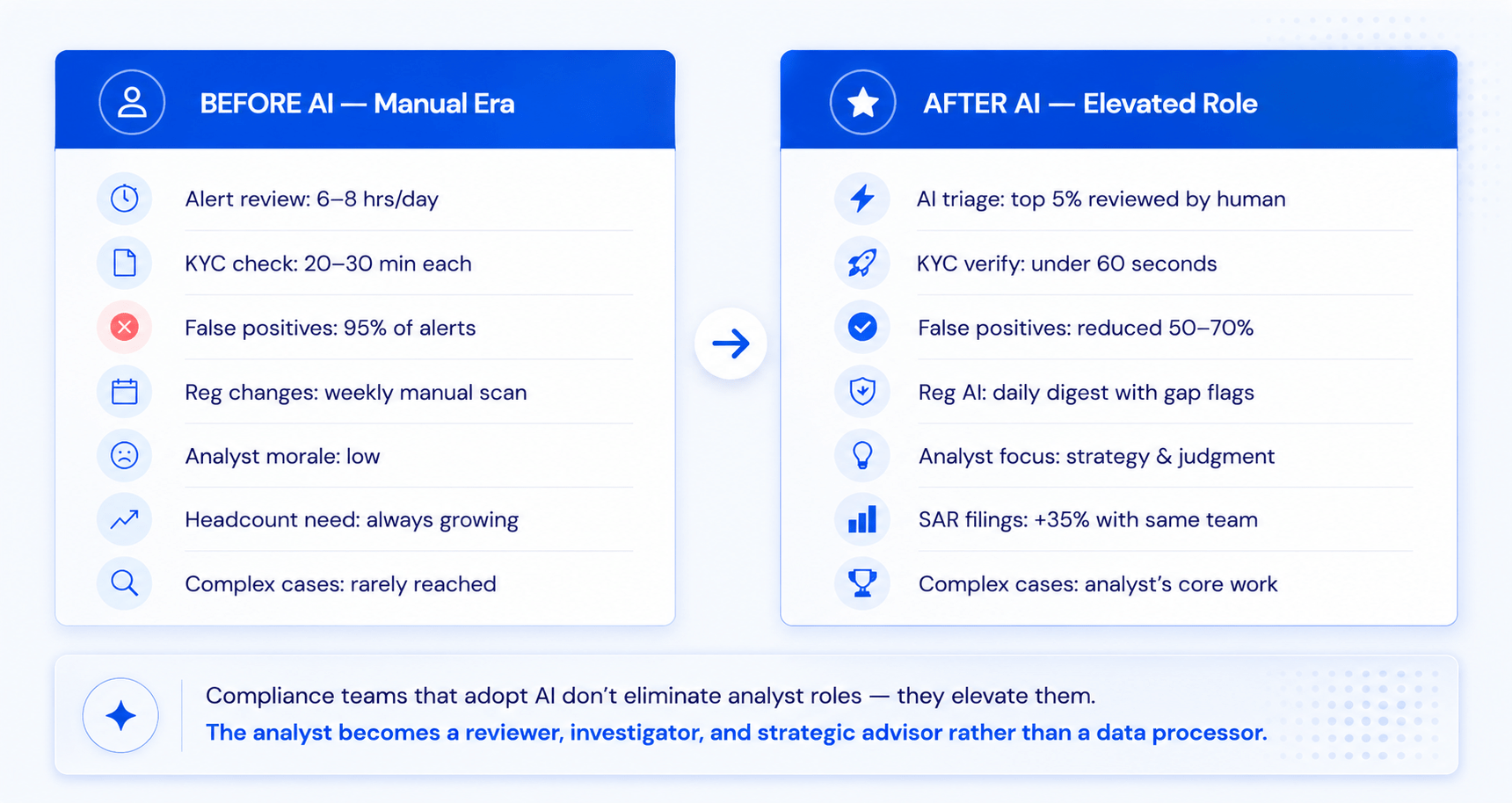
As AI absorbs routine work, genuinely complex tasks expand to fill the freed capacity. Consequently, analysts who previously spent 80% of their day on alert triage now dedicate that time to investigating complex typologies, building cases for law enforcement, designing risk appetite frameworks, and engaging directly with regulators. Ultimately, these tasks require contextual judgment, professional experience, and ethical reasoning; things AI cannot replicate.
New Skills the Modern Compliance Analyst Needs
AI Output Review and Quality Control
AI makes errors. For instance, it hallucinates entity names, misclassifies transaction patterns, and sometimes applies rules from the wrong jurisdiction. To mitigate this, the modern compliance analyst develops a critical eye for AI outputs, knowing when to trust a score, when to override it, and when to escalate an anomaly for model review. Ultimately, this skill requires both domain expertise and a working understanding of how the underlying models operate.
Data Literacy and Workflow Design
Analysts who understand data pipelines can improve the AI systems they use. They recognize when training data appears skewed, when a model’s confidence scores drift, and when alert thresholds need recalibration. SmartDev’s Data Analytics Services help compliance teams build the dashboards and monitoring tools that make this kind of oversight practical and systematic.
Stakeholder Communication and Regulatory Dialogue
With more time freed from data processing, senior analysts take on richer regulatory engagement roles. They explain AI methodologies to supervisors, respond to examiner questions about model explainability, and represent the firm in industry working groups. Communication skills and regulatory credibility become as important as technical proficiency.
Real-World Impact: What the Numbers Show
Compliance Workflow Automation in Financial Services
Review Time Cut by 80%
SmartDev’s recent analysis of compliance workflow automation documents how financial services firms cut compliance review times by up to 80% after deploying AI-powered triage and document processing tools. That figure does not come from reducing the quality of reviews; it comes from eliminating the time analysts spend on work that generates no investigative value.
Headcount Optimization Without Reduction
Most firms that implement AI compliance automation do not shrink their compliance teams. They redirect existing headcounts toward the work that actually reduces financial crime risk. One mid-sized European bank moved 60% of its alert-review analysts into typology investigation and case-building roles after deploying AI triage. Their SAR filing rate increased by 35%, meaning they found and reported more genuine crimes with the same number of people.
The ROI Calculation for AI Compliance
Direct Cost Savings
The direct savings come from reduced alert review hours, faster KYC onboarding (which accelerates revenue recognition), and lower costs per SAR filed. Most compliance AI deployments achieve positive ROI within 12-18 months, with payback accelerating as the model improves via analyst feedback. Furthermore, the Association of Certified Financial Crime Specialists (ACFCS) estimates that AI-powered compliance reduces the total cost of compliance by 20-30% in year two and beyond.
Indirect Benefits: Regulatory Credibility
Regulators increasingly expect firms to demonstrate risk-based compliance. In other words, organizations should focus human attention on genuine risks rather than treat every transaction identically. As a result, compliance programs must allocate resources more effectively. An AI-augmented compliance function can support this objective when organizations implement it with proper documentation and explainability. Consequently, it signals operational maturity to regulators and supervisors. Furthermore, firms with well-defined AI governance frameworks often experience shorter examination cycles and fewer corrective action requirements. Importantly, the FATF guidance on technology-enabled AML/CFT supports this direction. Specifically, it endorses risk-based compliance approaches enhanced by machine learning technologies.
How to Build an AI-Ready Compliance Function
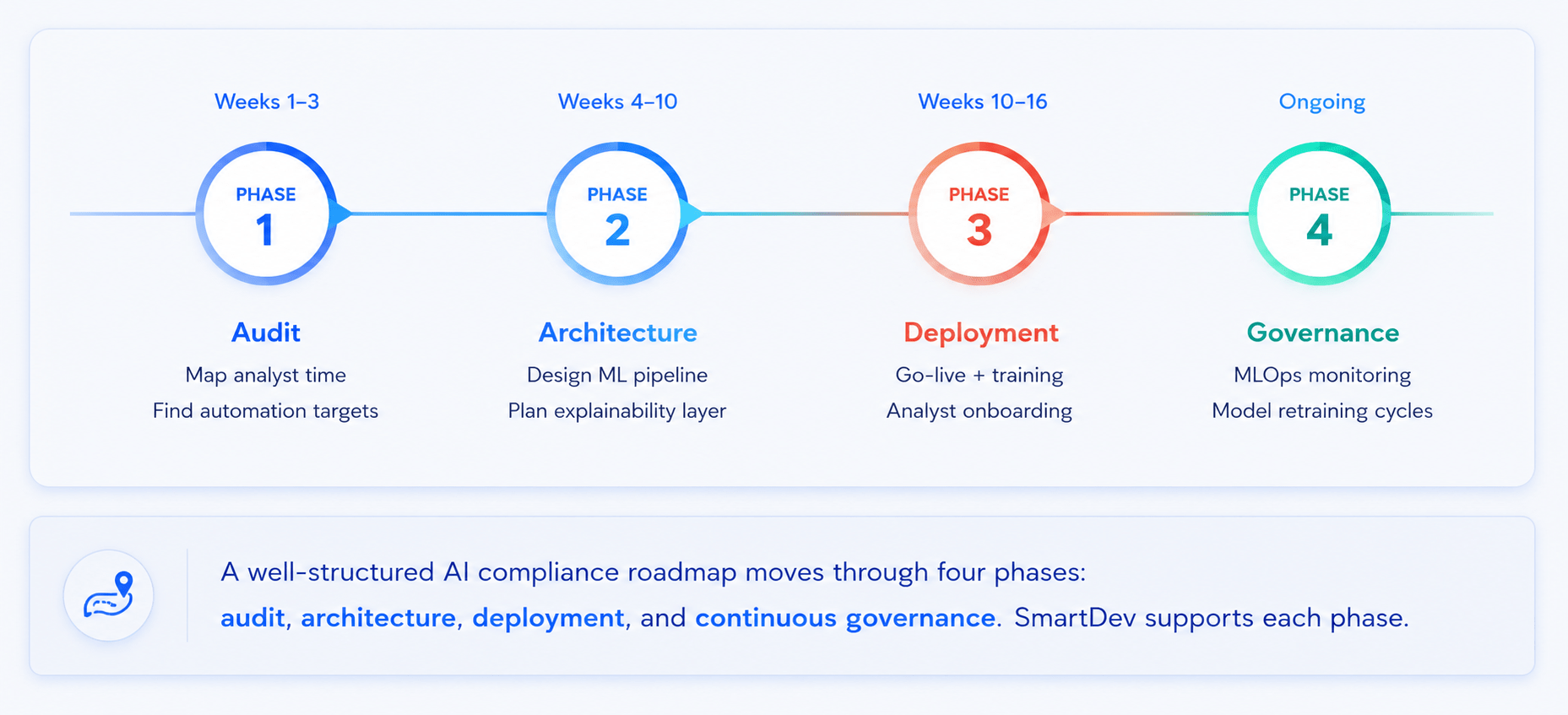
Step 1: Audit Where Analyst Time Actually Goes
Time-Motion Analysis Before Technology
The most common mistake in compliance with AI adoption is buying technology before understanding the problem. Before choosing any tool, map every task your analysts perform across a two-week period. Record how long each task takes, how often a human judgment call is necessary, and what percentage of completed tasks generate no actionable output. This audit typically reveals that 60–80% of analyst time goes to tasks with zero investigative value, and those are exactly the tasks AI should own.
Identifying the Highest-Value Automation Targets
Not every task delivers equal automation value. Prioritize tasks that combine high frequency, low required judgment, and high analyst time cost. Alert triage almost always tops this list. SmartDev’s AI Consulting Services help compliance leaders map this opportunity landscape and build a prioritized automation roadmap before any technology investment begins.
Step 2: Choose the Right Technical Architecture
Rule-Based Systems vs. Machine Learning vs. Hybrid
Not all compliance AI uses the same approach. Rule-based systems remain valuable for clear, binary obligations, sanctions screening against a defined list, for example. Machine learning excels at pattern recognition in ambiguous, high-volume environments like transaction monitoring. Hybrid architectures combine both: rules handle the deterministic layer, ML handles the probabilistic layer, and humans handle the residual judgment layer. SmartDev’s AI-Powered Software Development team designs these architectures from the ground up for regulated environments.
Explainability as a Non-Negotiable Requirement
Regulators in the EU (under the AI Act), UK (under FCA guidance), and US (under OCC model risk management guidelines) all require that compliance AI systems produce explainable outputs. A model that scores an alert at 0.87 risk probability must also show which features drove that score. Building explainability into the system architecture from day one, retrofitting it later is expensive and often technically impractical.
Step 3: Train Your Team on AI Collaboration
Change Management Is Half the Project
Compliance analysts often feel threatened by AI adoption, particularly when organizational communication focuses on efficiency and cost reduction rather than role enhancement. Reframe the narrative explicitly: AI removes the work nobody enjoys and creates space for the work that builds careers. Show analysts the new tasks they will own, investigations, regulatory strategy, AI oversight, and invest in training that builds genuine confidence with new tools.
Building Internal AI Governance Capability
Every compliance function that deploys AI needs internal governance: someone who owns model performance, monitors drift, manages retraining cycles, and documents model decisions for regulatory examination. SmartDev’s MLOps Services provide the technical infrastructure for this governance layer, while SmartDev’s compliance domain experts help teams build the policies and procedures that regulators expect to see.
What SmartDev Builds for Compliance Teams
Our AI Compliance Solution Portfolio
Custom Alert Triage and Scoring Engines
SmartDev builds machine learning models trained on your institution’s historical alert data, tuned to your specific customer base, product mix, and risk appetite. These models integrate with your existing transaction monitoring platform via API, you keep the tools you know, and AI adds the intelligence layer on top. Most clients achieve a 50–70% reduction in alert volume within 90 days of deployment.
Intelligent KYC and Document Processing
Our document intelligence systems extract structured data from identity documents, corporate filings, and supporting materials across 40+ languages and document formats. They extracted entities against live sanctions of databases, PEP lists, and adverse media feeds. The system returns a decision recommendation with a confidence score and a full audit trail, everything a regulator wants to see. Explore the AI-Powered Invoice Processing case study for a real example of how SmartDev applies document intelligence in financial workflows.
Regulatory Change Monitoring and Control Mapping
Our regulatory intelligence tools ingest content from official regulatory websites, public consultation portals, and enforcement databases across your jurisdictions. Large language models parse obligation language, compare it to your documented control library, and output a gap analysis ranked by materiality and implementation urgency. Your regulatory affairs team reviews AI-generated summaries instead of reading hundreds of source documents.
AI Governance and Model Risk Management Infrastructure
We build the MLOps pipelines, monitoring dashboards, and documentation frameworks that make your compliance AI auditable and regulatorily defensible. Every model decision logs to an immutable audit trail. Performance metrics update in real time. Drift alerts trigger retraining workflows automatically. Learn more about our MLOps Services and how they support ongoing model governance.
Why Financial Institutions Choose SmartDev
- BFSI Domain Expertise: SmartDev has deep roots in financial services. Our Fintech and BFSI practice includes engineers and advisors with direct compliance technology experience.
- Security-First Architecture: We hold ISO 27001 and SOC 2 Type 2 certifications. Every compliance AI system we build runs on security-hardened infrastructure with full data residency controls.
- Rapid Discovery: Our 3-Week AI Discovery Program gives compliance leaders provide a concrete AI roadmap, use-case prioritization, and ROI model in 21 days.
- End-to-End Delivery: From architecture to deployment to ongoing MLOps support, SmartDev owns the full delivery lifecycle. Explore our Application Management Services for post-deployment support options.
- Explainable AI by Design: Every model we build generates human-readable explanations for its outputs, meeting regulatory explainability requirements across all major jurisdictions.
- Proven Results: Our fintech AI case study on intelligent automation in financial crime compliance shows what is achievable when AI replaces manual support workflows.
Conclusion: Less Manual Work, More Meaningful Compliance
The compliance function does not disappear in an AI-augmented world. It transforms. Teams that embrace AI automation shed the repetitive, error-prone workloads that burn out talented analysts and drain operational budgets. They gain the capacity to pursue complex financial crime cases, engage more meaningfully with regulators, and build genuinely risk-based compliance programs that scale with the business.
The firms that resist this transformation do not keep the status quo; they fall behind. Regulatory expectations for technology-enabled compliance rise every year. Competitors that deploy AI triage and document automation process more cases with the same headcount and generate more actionable insights. As a result, the productivity gap continues to widen.
The analysts who thrive in this environment develop new skills: AI oversight, investigative reasoning, regulatory communication, and data literacy. Consequently, their work becomes more strategic and impactful. They spend less time processing alerts and more time making decisions that matter.
SmartDev helps compliance leaders design and deploy the AI systems that make this shift possible, from the first discovery workshop through production deployment and ongoing model governance. The next step starts with a conversation. Contact us to assess your current compliance workflows, identify high-impact automation opportunities, and build a roadmap for scalable, audit-ready compliance operations.