
TL;DR
- Agentic Engineering: Develops AI systems that operate autonomously, making decisions and executing actions with minimal human supervision.
- Key Capabilities: Includes goal-oriented behavior, context awareness, tool integration, adaptive learning, and autonomous execution.
- Business Benefits:
- Improves productivity by automating complex tasks.
- Reduces human error and operational costs.
- Scales with business growth, ensuring consistent performance.
- Enhances customer experiences with responsive AI systems.
- When to Adopt: Ideal for automating workflows, improving customer support, managing complex decision-making, and scaling operations.
What is Agentic Engineering?
Agentic engineering refers to the design and implementation of AI systems that act as autonomous agents capable of pursuing goals with limited human intervention. These agents can reason, make decisions, execute actions, and continuously improve based on feedback and changing conditions.
An AI agent typically combines several capabilities, including natural language understanding, machine learning models, orchestration logic, and external tool integrations. Instead of simply responding to prompts, agentic systems can break down complex objectives into smaller tasks, evaluate possible solutions, and execute workflows independently.
Agentic engineering focuses on building structured frameworks that enable AI agents to operate safely and effectively within defined boundaries. Engineers must design systems that balance autonomy with oversight, ensuring that AI-driven decisions remain aligned with business policies and regulatory requirements.
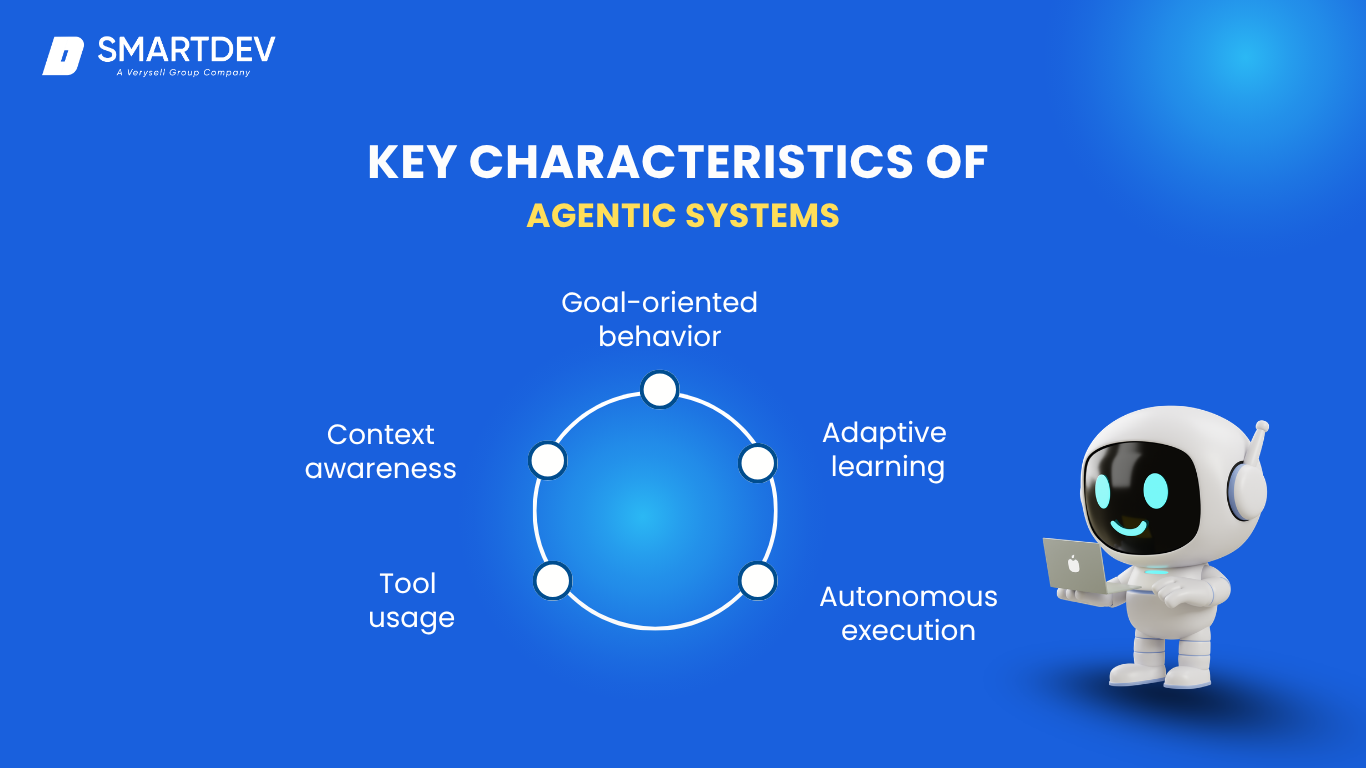
Key characteristics of agentic systems include:
- Goal-oriented behavior: Agents operate with defined objectives and measurable outcomes.
- Context awareness: Systems interpret dynamic inputs and adjust actions accordingly.
- Tool usage: Agents can interact with APIs, databases, or enterprise systems to perform tasks.
- Adaptive learning: Performance improves over time through feedback loops.
- Autonomous execution: Minimal human supervision is required for routine processes.
Examples of agentic engineering applications include intelligent virtual assistants, automated research agents, AI copilots for software development, and workflow automation tools capable of coordinating multiple systems simultaneously.
Why Agentic Engineering Matters for Businesses
Agentic engineering represents a significant advancement in enterprise AI adoption because it enables organizations to automate complex decision-making processes rather than simple repetitive tasks. Businesses can improve efficiency, reduce operational costs, and enhance service delivery by implementing AI agents capable of acting independently within structured environments.
One of the primary benefits of agentic engineering is productivity improvement. Autonomous AI agents can handle time-consuming activities such as document analysis, customer support interactions, workflow orchestration, and operational monitoring. This allows employees to focus on higher-value strategic initiatives.
Agentic engineering also supports scalability. As organizations grow, manual processes often become bottlenecks. AI agents can operate continuously, ensuring consistent performance regardless of workload fluctuations.
Risk management is another important factor. Properly engineered agentic systems include safeguards such as monitoring mechanisms, approval checkpoints, and compliance controls. These measures help organizations maintain transparency and accountability while benefiting from automation.
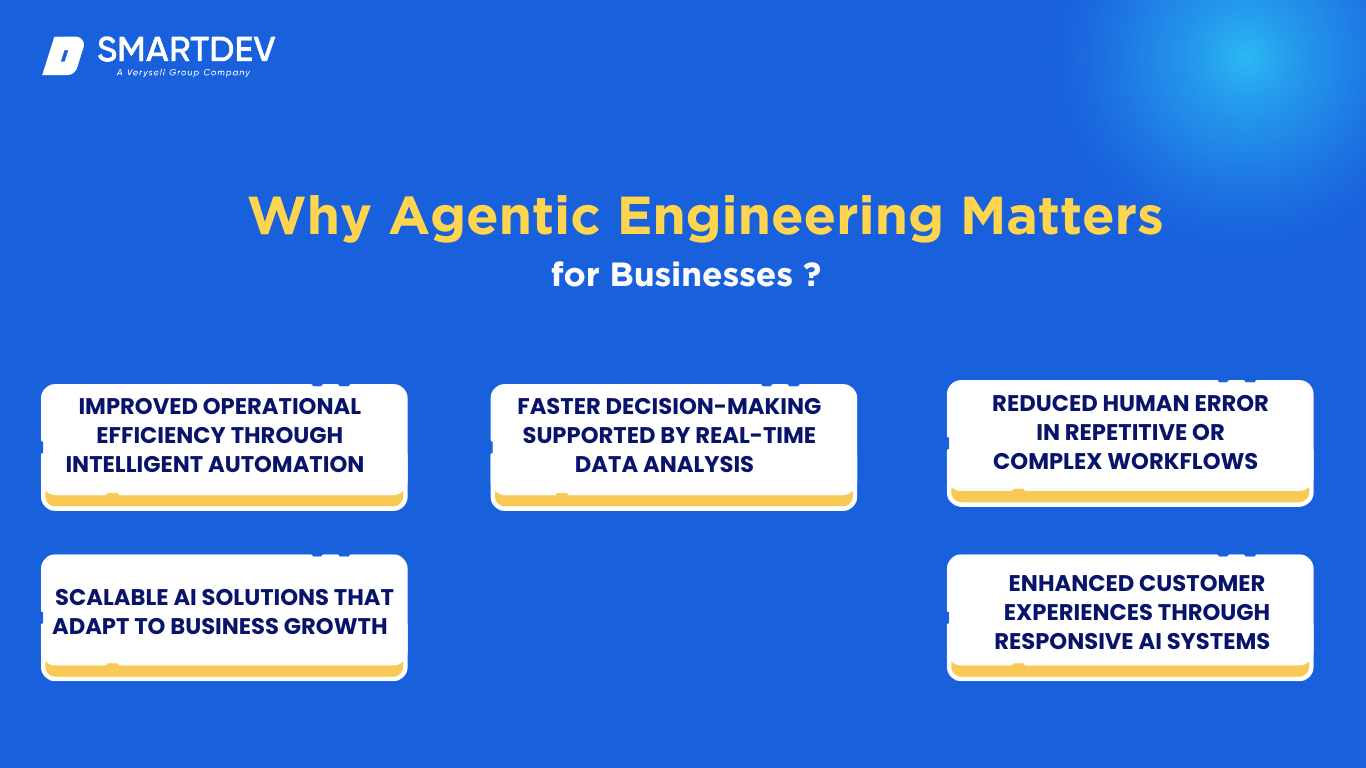
Key business advantages include:
- Improved operational efficiency through intelligent automation
- Faster decision-making supported by real-time data analysis
- Reduced human error in repetitive or complex workflows
- Scalable AI solutions that adapt to business growth
- Enhanced customer experiences through responsive AI systems
Companies that invest in agentic engineering can create more resilient digital ecosystems capable of responding quickly to changing market conditions.
How Agentic Engineering Works
Agentic engineering integrates multiple technical components to create AI systems capable of autonomous reasoning and execution. These systems rely on structured architectures that allow agents to interpret goals, access relevant tools, and perform actions while maintaining alignment with defined constraints.
A typical agentic engineering workflow includes several layers:
Goal Definition
Organizations define objectives that guide agent behavior. Goals may include automating internal workflows, supporting customer interactions, or optimizing resource allocation.
Planning and Reasoning
AI agents analyze tasks and determine appropriate strategies for execution. This may involve breaking down complex objectives into smaller subtasks or evaluating multiple solution paths.
Tool Integration
Agents connect with enterprise systems such as databases, APIs, CRM platforms, or analytics tools. These integrations allow agents to perform real-world actions beyond generating responses.
Memory and Context Management
Agentic systems maintain contextual awareness by storing relevant information across interactions. This enables more accurate decision-making and continuous improvement.
Monitoring and Governance
Human oversight remains critical. Monitoring frameworks track agent performance, detect anomalies, and ensure compliance with business policies and regulatory standards.
Effective agentic engineering requires collaboration between AI engineers, software developers, and business stakeholders. Teams must define operational boundaries and ensure that AI agents operate within ethical and regulatory guidelines.
When Should Businesses Adopt Agentic Engineering?
Organizations should consider adopting agentic engineering when they require scalable automation capable of handling complex decision-making processes.
- During digital transformation initiatives: Agentic systems support automation across multiple business functions.
- When managing complex workflows: AI agents can coordinate tasks across different systems.
- When scaling operations: Autonomous systems help maintain efficiency as workloads increase.
- When improving customer experience: Intelligent agents can provide faster and more consistent support.
- When optimizing internal productivity: AI agents reduce manual effort across operational processes.
Adoption typically begins with pilot projects that demonstrate measurable value. Organizations can gradually expand implementation as governance frameworks and technical capabilities mature.
Related Terms in Agentic Engineering
- AI Agent:
An AI agent is a system capable of perceiving its environment, making decisions, and executing actions to achieve specific goals with minimal human input. - AI Integration:
AI integration refers to embedding AI capabilities into existing business systems, allowing autonomous agents to interact with enterprise tools and workflows. - AI Governance:
AI governance involves policies and frameworks that ensure AI systems operate responsibly, transparently, and in compliance with regulatory requirements.