
Other Related Terms
Agent-to-Human Handoff: Agent-to-human handoff transfers a customer conversation from an AI system to a live human agent when the AI cannot resolve the issue. Effective handoffs preserve full conversation context so customers never have to repeat themselves.
Probabilistic Output: Probabilistic output means AI systems generate responses based on statistical likelihood rather than fixed rules, so the same input may produce slightly different answers each time.
Technical Debt: The accumulated cost of shortcuts, outdated code, and unresolved defects in a software system, which AI debugging tools help reduce by identifying and prioritizing issues for systematic remediation.
[/vc_column_text][/vc_column][/vc_row]
Integration with existing development pipelines is straightforward. Most AI debugging tools connect to version control systems, issue trackers, and continuous integration platforms, embedding quality checks directly into the workflows developers already use rather than requiring separate processes.
How Much Can AI Bug Fixing Save?
The cost of not fixing bugs early is well documented. Research from IBM consistently shows that defects caught in production cost 10 to 100 times more to fix than those caught during development. AI debugging shifts defect discovery to the earliest possible point in the development cycle, where corrections are cheapest and least disruptive.
Organizations running AI bug fixing tools in their development pipelines report a 42% decrease in post-deployment bug-fix costs. Combined with the 55% developer productivity improvement on debugging tasks, the total return on investment becomes positive within the first few months of adoption for most teams. For businesses managing multiple software projects or working with outsourced development teams across time zones, that cost reduction scales with the size of the portfolio.
There is also a risk-adjusted value to consider. Production bugs do not only cost developer time; they also carry reputational cost, potential regulatory exposure in certain industries, and customer churn. AI debugging reduces the frequency of production incidents, which translates into measurable improvements in service reliability metrics and client satisfaction scores.
Other Related Terms
Agent-to-Human Handoff: Agent-to-human handoff transfers a customer conversation from an AI system to a live human agent when the AI cannot resolve the issue. Effective handoffs preserve full conversation context so customers never have to repeat themselves.
Probabilistic Output: Probabilistic output means AI systems generate responses based on statistical likelihood rather than fixed rules, so the same input may produce slightly different answers each time.
Technical Debt: The accumulated cost of shortcuts, outdated code, and unresolved defects in a software system, which AI debugging tools help reduce by identifying and prioritizing issues for systematic remediation.
[/vc_column_text][/vc_column][/vc_row]For companies outsourcing software development, AI debugging capability is an increasingly important evaluation criterion. Outsourced teams equipped with AI debugging tools deliver higher-quality code faster, reducing the back-and-forth revision cycles that drive up project costs and erode client confidence.
How Does AI Bug Fixing Work?
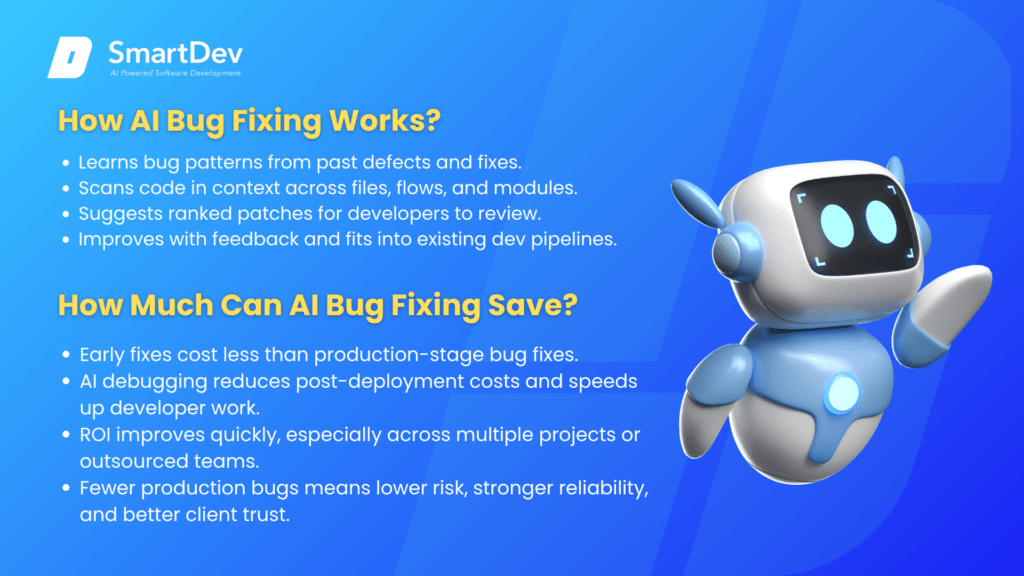
AI bug fixing tools operate through a combination of pattern recognition, large language models, and code analysis techniques. During an initial training phase, the AI learns from large datasets of known bugs and their corresponding fixes, building an internal model of what defective code looks like and how it is typically corrected. This model is then applied to new codebases to identify similar patterns.
When a developer submits code or triggers a scan, the AI analyzes the entire codebase in context, not just the most recently changed files. It traces data flow, checks function call chains, and evaluates the interaction between different modules. This holistic view allows it to catch bugs that only emerge from the combination of multiple components rather than any single piece of code in isolation.
For fixes, the AI generates candidate patches and ranks them by confidence level. The developer reviews the suggestion and accepts, modifies, or rejects it. Over time, as developers interact with the tool and provide feedback on which suggestions were accurate, the AI refines its recommendations for that specific codebase. This learning loop makes AI debugging tools more accurate the longer they are used within a project.
Integration with existing development pipelines is straightforward. Most AI debugging tools connect to version control systems, issue trackers, and continuous integration platforms, embedding quality checks directly into the workflows developers already use rather than requiring separate processes.
How Much Can AI Bug Fixing Save?
The cost of not fixing bugs early is well documented. Research from IBM consistently shows that defects caught in production cost 10 to 100 times more to fix than those caught during development. AI debugging shifts defect discovery to the earliest possible point in the development cycle, where corrections are cheapest and least disruptive.
Organizations running AI bug fixing tools in their development pipelines report a 42% decrease in post-deployment bug-fix costs. Combined with the 55% developer productivity improvement on debugging tasks, the total return on investment becomes positive within the first few months of adoption for most teams. For businesses managing multiple software projects or working with outsourced development teams across time zones, that cost reduction scales with the size of the portfolio.
There is also a risk-adjusted value to consider. Production bugs do not only cost developer time; they also carry reputational cost, potential regulatory exposure in certain industries, and customer churn. AI debugging reduces the frequency of production incidents, which translates into measurable improvements in service reliability metrics and client satisfaction scores.
Other Related Terms
Agent-to-Human Handoff: Agent-to-human handoff transfers a customer conversation from an AI system to a live human agent when the AI cannot resolve the issue. Effective handoffs preserve full conversation context so customers never have to repeat themselves.
Probabilistic Output: Probabilistic output means AI systems generate responses based on statistical likelihood rather than fixed rules, so the same input may produce slightly different answers each time.
Technical Debt: The accumulated cost of shortcuts, outdated code, and unresolved defects in a software system, which AI debugging tools help reduce by identifying and prioritizing issues for systematic remediation.
[/vc_column_text][/vc_column][/vc_row]
For companies outsourcing software development, AI debugging capability is an increasingly important evaluation criterion. Outsourced teams equipped with AI debugging tools deliver higher-quality code faster, reducing the back-and-forth revision cycles that drive up project costs and erode client confidence.
How Does AI Bug Fixing Work?
AI bug fixing tools operate through a combination of pattern recognition, large language models, and code analysis techniques. During an initial training phase, the AI learns from large datasets of known bugs and their corresponding fixes, building an internal model of what defective code looks like and how it is typically corrected. This model is then applied to new codebases to identify similar patterns.
When a developer submits code or triggers a scan, the AI analyzes the entire codebase in context, not just the most recently changed files. It traces data flow, checks function call chains, and evaluates the interaction between different modules. This holistic view allows it to catch bugs that only emerge from the combination of multiple components rather than any single piece of code in isolation.
For fixes, the AI generates candidate patches and ranks them by confidence level. The developer reviews the suggestion and accepts, modifies, or rejects it. Over time, as developers interact with the tool and provide feedback on which suggestions were accurate, the AI refines its recommendations for that specific codebase. This learning loop makes AI debugging tools more accurate the longer they are used within a project.
Integration with existing development pipelines is straightforward. Most AI debugging tools connect to version control systems, issue trackers, and continuous integration platforms, embedding quality checks directly into the workflows developers already use rather than requiring separate processes.
How Much Can AI Bug Fixing Save?
The cost of not fixing bugs early is well documented. Research from IBM consistently shows that defects caught in production cost 10 to 100 times more to fix than those caught during development. AI debugging shifts defect discovery to the earliest possible point in the development cycle, where corrections are cheapest and least disruptive.
Organizations running AI bug fixing tools in their development pipelines report a 42% decrease in post-deployment bug-fix costs. Combined with the 55% developer productivity improvement on debugging tasks, the total return on investment becomes positive within the first few months of adoption for most teams. For businesses managing multiple software projects or working with outsourced development teams across time zones, that cost reduction scales with the size of the portfolio.
There is also a risk-adjusted value to consider. Production bugs do not only cost developer time; they also carry reputational cost, potential regulatory exposure in certain industries, and customer churn. AI debugging reduces the frequency of production incidents, which translates into measurable improvements in service reliability metrics and client satisfaction scores.
Other Related Terms
Agent-to-Human Handoff: Agent-to-human handoff transfers a customer conversation from an AI system to a live human agent when the AI cannot resolve the issue. Effective handoffs preserve full conversation context so customers never have to repeat themselves.
Probabilistic Output: Probabilistic output means AI systems generate responses based on statistical likelihood rather than fixed rules, so the same input may produce slightly different answers each time.
Technical Debt: The accumulated cost of shortcuts, outdated code, and unresolved defects in a software system, which AI debugging tools help reduce by identifying and prioritizing issues for systematic remediation.
[/vc_column_text][/vc_column][/vc_row]
Modern AI debugging tools go beyond detection. They can generate suggested code patches, explain the root cause of an error in plain language, rank bugs by severity and likely impact, and even predict where new bugs are likely to appear based on recent code changes. This shifts debugging from a reactive activity to a proactive quality control discipline.
Why It Matters for Businesses?
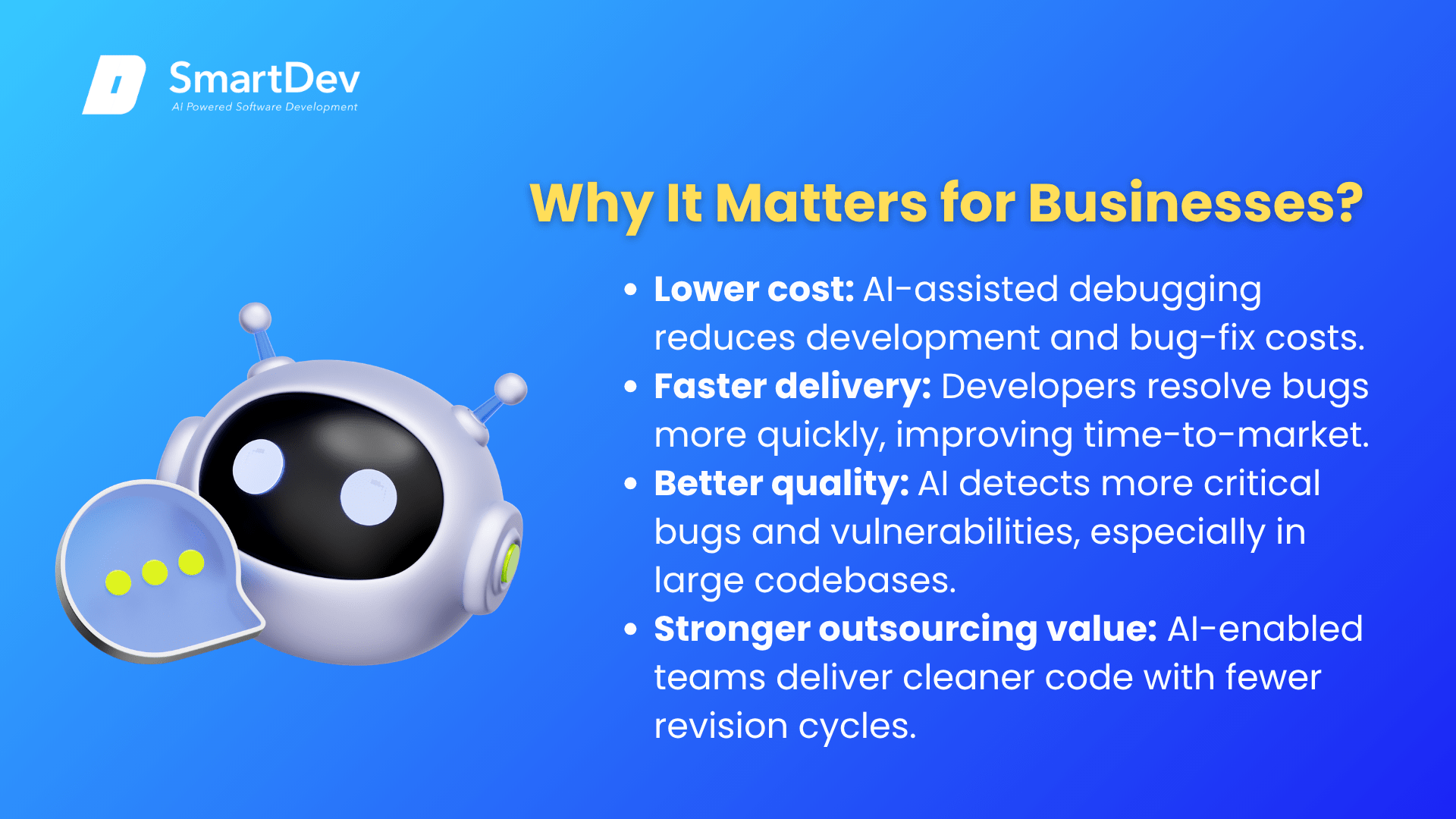
The business case for AI-assisted debugging is rooted in cost and speed. On average, organizations adopting AI debugging tools report a 32% reduction in total development costs and a 42% decrease in bug-fix expenses specifically. For software-intensive businesses, these savings translate directly into faster time-to-market and healthier project margins.
Speed improvements are equally significant. Developers using AI-assisted tools complete debugging tasks up to 55% faster than those working without AI support. A leading fintech company reported a 35% reduction in bug detection time and a 50% cut in production incidents after integrating AI tools into its continuous integration and deployment pipelines. These outcomes represent the kind of reliability improvements that matter to enterprise clients evaluating software vendors or outsourcing partners.
Quality improvements compound over time. AI tools are consistent, do not suffer from fatigue, and apply the same rigor to the tenth thousand line of code reviewed as to the first. This consistency is especially valuable in large codebases where manual review becomes impractical. AI-powered static analysis tools have been shown to detect 73% more critical bugs than traditional methods, catching vulnerabilities that might otherwise reach customers.
For companies outsourcing software development, AI debugging capability is an increasingly important evaluation criterion. Outsourced teams equipped with AI debugging tools deliver higher-quality code faster, reducing the back-and-forth revision cycles that drive up project costs and erode client confidence.
How Does AI Bug Fixing Work?
AI bug fixing tools operate through a combination of pattern recognition, large language models, and code analysis techniques. During an initial training phase, the AI learns from large datasets of known bugs and their corresponding fixes, building an internal model of what defective code looks like and how it is typically corrected. This model is then applied to new codebases to identify similar patterns.
When a developer submits code or triggers a scan, the AI analyzes the entire codebase in context, not just the most recently changed files. It traces data flow, checks function call chains, and evaluates the interaction between different modules. This holistic view allows it to catch bugs that only emerge from the combination of multiple components rather than any single piece of code in isolation.
For fixes, the AI generates candidate patches and ranks them by confidence level. The developer reviews the suggestion and accepts, modifies, or rejects it. Over time, as developers interact with the tool and provide feedback on which suggestions were accurate, the AI refines its recommendations for that specific codebase. This learning loop makes AI debugging tools more accurate the longer they are used within a project.
Integration with existing development pipelines is straightforward. Most AI debugging tools connect to version control systems, issue trackers, and continuous integration platforms, embedding quality checks directly into the workflows developers already use rather than requiring separate processes.
How Much Can AI Bug Fixing Save?
The cost of not fixing bugs early is well documented. Research from IBM consistently shows that defects caught in production cost 10 to 100 times more to fix than those caught during development. AI debugging shifts defect discovery to the earliest possible point in the development cycle, where corrections are cheapest and least disruptive.
Organizations running AI bug fixing tools in their development pipelines report a 42% decrease in post-deployment bug-fix costs. Combined with the 55% developer productivity improvement on debugging tasks, the total return on investment becomes positive within the first few months of adoption for most teams. For businesses managing multiple software projects or working with outsourced development teams across time zones, that cost reduction scales with the size of the portfolio.
There is also a risk-adjusted value to consider. Production bugs do not only cost developer time; they also carry reputational cost, potential regulatory exposure in certain industries, and customer churn. AI debugging reduces the frequency of production incidents, which translates into measurable improvements in service reliability metrics and client satisfaction scores.
Other Related Terms
Agent-to-Human Handoff: Agent-to-human handoff transfers a customer conversation from an AI system to a live human agent when the AI cannot resolve the issue. Effective handoffs preserve full conversation context so customers never have to repeat themselves.
Probabilistic Output: Probabilistic output means AI systems generate responses based on statistical likelihood rather than fixed rules, so the same input may produce slightly different answers each time.
Technical Debt: The accumulated cost of shortcuts, outdated code, and unresolved defects in a software system, which AI debugging tools help reduce by identifying and prioritizing issues for systematic remediation.
[/vc_column_text][/vc_column][/vc_row]
Software bugs are expensive. They delay releases, frustrate users, and consume developer hours that could be spent building new features. AI bug fixing changes that equation by putting automated intelligence to work on the most repetitive and time-consuming parts of the debugging process.
What is AI Bug Fixing / Debugging?
AI bug fixing, also referred to as AI debugging, is the use of artificial intelligence and machine learning techniques to automatically identify, diagnose, and correct errors in software code. Rather than relying entirely on developers to manually trace through code to find the source of a problem, AI tools analyze code patterns, execution logs, and test outputs to pinpoint defects and in many cases propose or apply fixes automatically.
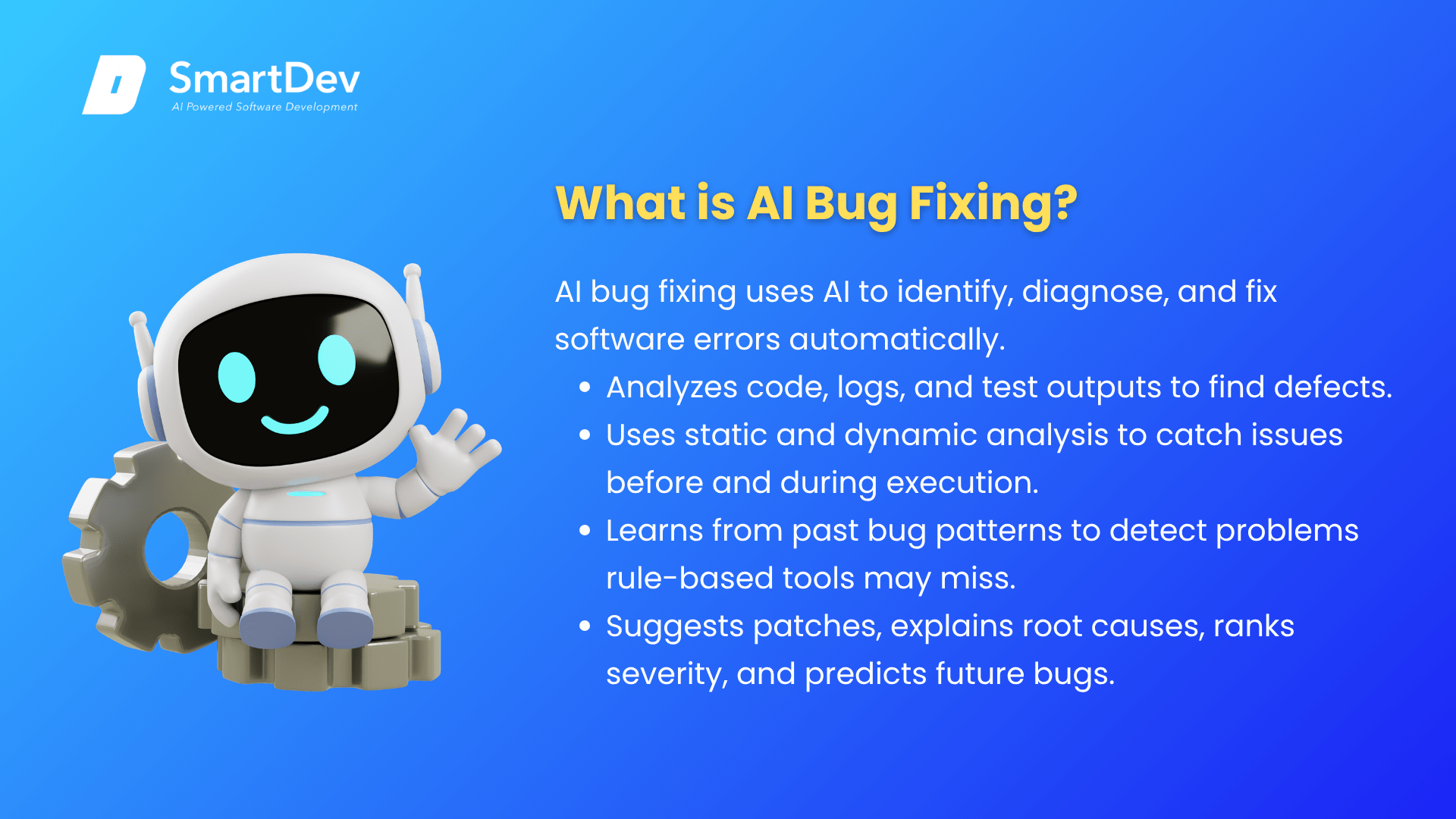
The process typically involves several layers of analysis. Static analysis examines code structure without executing it, flagging potential issues such as null pointer errors, memory leaks, or logic flaws before they reach production. Dynamic analysis monitors code during execution to catch runtime errors that only surface under specific conditions. AI layers on top of these techniques by learning from historical bug patterns, enabling it to recognize defect signatures that rules-based tools would miss.
Modern AI debugging tools go beyond detection. They can generate suggested code patches, explain the root cause of an error in plain language, rank bugs by severity and likely impact, and even predict where new bugs are likely to appear based on recent code changes. This shifts debugging from a reactive activity to a proactive quality control discipline.
Why It Matters for Businesses?
The business case for AI-assisted debugging is rooted in cost and speed. On average, organizations adopting AI debugging tools report a 32% reduction in total development costs and a 42% decrease in bug-fix expenses specifically. For software-intensive businesses, these savings translate directly into faster time-to-market and healthier project margins.
Speed improvements are equally significant. Developers using AI-assisted tools complete debugging tasks up to 55% faster than those working without AI support. A leading fintech company reported a 35% reduction in bug detection time and a 50% cut in production incidents after integrating AI tools into its continuous integration and deployment pipelines. These outcomes represent the kind of reliability improvements that matter to enterprise clients evaluating software vendors or outsourcing partners.
Quality improvements compound over time. AI tools are consistent, do not suffer from fatigue, and apply the same rigor to the tenth thousand line of code reviewed as to the first. This consistency is especially valuable in large codebases where manual review becomes impractical. AI-powered static analysis tools have been shown to detect 73% more critical bugs than traditional methods, catching vulnerabilities that might otherwise reach customers.
For companies outsourcing software development, AI debugging capability is an increasingly important evaluation criterion. Outsourced teams equipped with AI debugging tools deliver higher-quality code faster, reducing the back-and-forth revision cycles that drive up project costs and erode client confidence.
How Does AI Bug Fixing Work?
AI bug fixing tools operate through a combination of pattern recognition, large language models, and code analysis techniques. During an initial training phase, the AI learns from large datasets of known bugs and their corresponding fixes, building an internal model of what defective code looks like and how it is typically corrected. This model is then applied to new codebases to identify similar patterns.
When a developer submits code or triggers a scan, the AI analyzes the entire codebase in context, not just the most recently changed files. It traces data flow, checks function call chains, and evaluates the interaction between different modules. This holistic view allows it to catch bugs that only emerge from the combination of multiple components rather than any single piece of code in isolation.
For fixes, the AI generates candidate patches and ranks them by confidence level. The developer reviews the suggestion and accepts, modifies, or rejects it. Over time, as developers interact with the tool and provide feedback on which suggestions were accurate, the AI refines its recommendations for that specific codebase. This learning loop makes AI debugging tools more accurate the longer they are used within a project.
Integration with existing development pipelines is straightforward. Most AI debugging tools connect to version control systems, issue trackers, and continuous integration platforms, embedding quality checks directly into the workflows developers already use rather than requiring separate processes.
How Much Can AI Bug Fixing Save?
The cost of not fixing bugs early is well documented. Research from IBM consistently shows that defects caught in production cost 10 to 100 times more to fix than those caught during development. AI debugging shifts defect discovery to the earliest possible point in the development cycle, where corrections are cheapest and least disruptive.
Organizations running AI bug fixing tools in their development pipelines report a 42% decrease in post-deployment bug-fix costs. Combined with the 55% developer productivity improvement on debugging tasks, the total return on investment becomes positive within the first few months of adoption for most teams. For businesses managing multiple software projects or working with outsourced development teams across time zones, that cost reduction scales with the size of the portfolio.
There is also a risk-adjusted value to consider. Production bugs do not only cost developer time; they also carry reputational cost, potential regulatory exposure in certain industries, and customer churn. AI debugging reduces the frequency of production incidents, which translates into measurable improvements in service reliability metrics and client satisfaction scores.
Other Related Terms
Agent-to-Human Handoff: Agent-to-human handoff transfers a customer conversation from an AI system to a live human agent when the AI cannot resolve the issue. Effective handoffs preserve full conversation context so customers never have to repeat themselves.
Probabilistic Output: Probabilistic output means AI systems generate responses based on statistical likelihood rather than fixed rules, so the same input may produce slightly different answers each time.
Technical Debt: The accumulated cost of shortcuts, outdated code, and unresolved defects in a software system, which AI debugging tools help reduce by identifying and prioritizing issues for systematic remediation.
[/vc_column_text][/vc_column][/vc_row]
TL;DR:
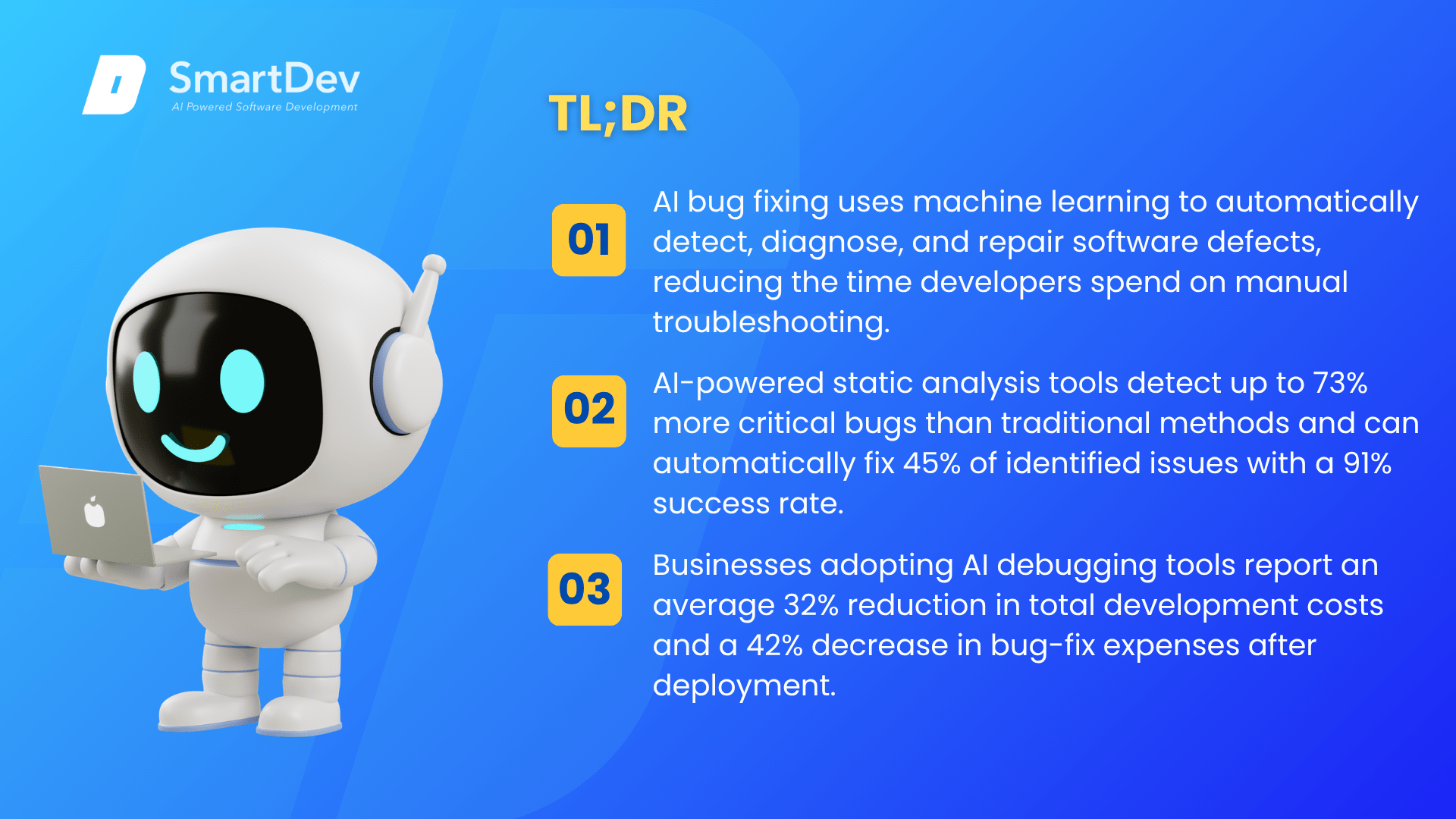
- AI bug fixing uses machine learning to automatically detect, diagnose, and repair software defects, reducing the time developers spend on manual troubleshooting.
- AI-powered static analysis tools detect up to 73% more critical bugs than traditional methods and can automatically fix 45% of identified issues with a 91% success rate.
- Businesses adopting AI debugging tools report an average 32% reduction in total development costs and a 42% decrease in bug-fix expenses after deployment.
Software bugs are expensive. They delay releases, frustrate users, and consume developer hours that could be spent building new features. AI bug fixing changes that equation by putting automated intelligence to work on the most repetitive and time-consuming parts of the debugging process.
What is AI Bug Fixing / Debugging?
AI bug fixing, also referred to as AI debugging, is the use of artificial intelligence and machine learning techniques to automatically identify, diagnose, and correct errors in software code. Rather than relying entirely on developers to manually trace through code to find the source of a problem, AI tools analyze code patterns, execution logs, and test outputs to pinpoint defects and in many cases propose or apply fixes automatically.
The process typically involves several layers of analysis. Static analysis examines code structure without executing it, flagging potential issues such as null pointer errors, memory leaks, or logic flaws before they reach production. Dynamic analysis monitors code during execution to catch runtime errors that only surface under specific conditions. AI layers on top of these techniques by learning from historical bug patterns, enabling it to recognize defect signatures that rules-based tools would miss.
Modern AI debugging tools go beyond detection. They can generate suggested code patches, explain the root cause of an error in plain language, rank bugs by severity and likely impact, and even predict where new bugs are likely to appear based on recent code changes. This shifts debugging from a reactive activity to a proactive quality control discipline.
Why It Matters for Businesses?
The business case for AI-assisted debugging is rooted in cost and speed. On average, organizations adopting AI debugging tools report a 32% reduction in total development costs and a 42% decrease in bug-fix expenses specifically. For software-intensive businesses, these savings translate directly into faster time-to-market and healthier project margins.
Speed improvements are equally significant. Developers using AI-assisted tools complete debugging tasks up to 55% faster than those working without AI support. A leading fintech company reported a 35% reduction in bug detection time and a 50% cut in production incidents after integrating AI tools into its continuous integration and deployment pipelines. These outcomes represent the kind of reliability improvements that matter to enterprise clients evaluating software vendors or outsourcing partners.
Quality improvements compound over time. AI tools are consistent, do not suffer from fatigue, and apply the same rigor to the tenth thousand line of code reviewed as to the first. This consistency is especially valuable in large codebases where manual review becomes impractical. AI-powered static analysis tools have been shown to detect 73% more critical bugs than traditional methods, catching vulnerabilities that might otherwise reach customers.
For companies outsourcing software development, AI debugging capability is an increasingly important evaluation criterion. Outsourced teams equipped with AI debugging tools deliver higher-quality code faster, reducing the back-and-forth revision cycles that drive up project costs and erode client confidence.
How Does AI Bug Fixing Work?
AI bug fixing tools operate through a combination of pattern recognition, large language models, and code analysis techniques. During an initial training phase, the AI learns from large datasets of known bugs and their corresponding fixes, building an internal model of what defective code looks like and how it is typically corrected. This model is then applied to new codebases to identify similar patterns.
When a developer submits code or triggers a scan, the AI analyzes the entire codebase in context, not just the most recently changed files. It traces data flow, checks function call chains, and evaluates the interaction between different modules. This holistic view allows it to catch bugs that only emerge from the combination of multiple components rather than any single piece of code in isolation.
For fixes, the AI generates candidate patches and ranks them by confidence level. The developer reviews the suggestion and accepts, modifies, or rejects it. Over time, as developers interact with the tool and provide feedback on which suggestions were accurate, the AI refines its recommendations for that specific codebase. This learning loop makes AI debugging tools more accurate the longer they are used within a project.
Integration with existing development pipelines is straightforward. Most AI debugging tools connect to version control systems, issue trackers, and continuous integration platforms, embedding quality checks directly into the workflows developers already use rather than requiring separate processes.
How Much Can AI Bug Fixing Save?
The cost of not fixing bugs early is well documented. Research from IBM consistently shows that defects caught in production cost 10 to 100 times more to fix than those caught during development. AI debugging shifts defect discovery to the earliest possible point in the development cycle, where corrections are cheapest and least disruptive.
Organizations running AI bug fixing tools in their development pipelines report a 42% decrease in post-deployment bug-fix costs. Combined with the 55% developer productivity improvement on debugging tasks, the total return on investment becomes positive within the first few months of adoption for most teams. For businesses managing multiple software projects or working with outsourced development teams across time zones, that cost reduction scales with the size of the portfolio.
There is also a risk-adjusted value to consider. Production bugs do not only cost developer time; they also carry reputational cost, potential regulatory exposure in certain industries, and customer churn. AI debugging reduces the frequency of production incidents, which translates into measurable improvements in service reliability metrics and client satisfaction scores.
Other Related Terms
Agent-to-Human Handoff: Agent-to-human handoff transfers a customer conversation from an AI system to a live human agent when the AI cannot resolve the issue. Effective handoffs preserve full conversation context so customers never have to repeat themselves.
Probabilistic Output: Probabilistic output means AI systems generate responses based on statistical likelihood rather than fixed rules, so the same input may produce slightly different answers each time.
Technical Debt: The accumulated cost of shortcuts, outdated code, and unresolved defects in a software system, which AI debugging tools help reduce by identifying and prioritizing issues for systematic remediation.