
TL;DR
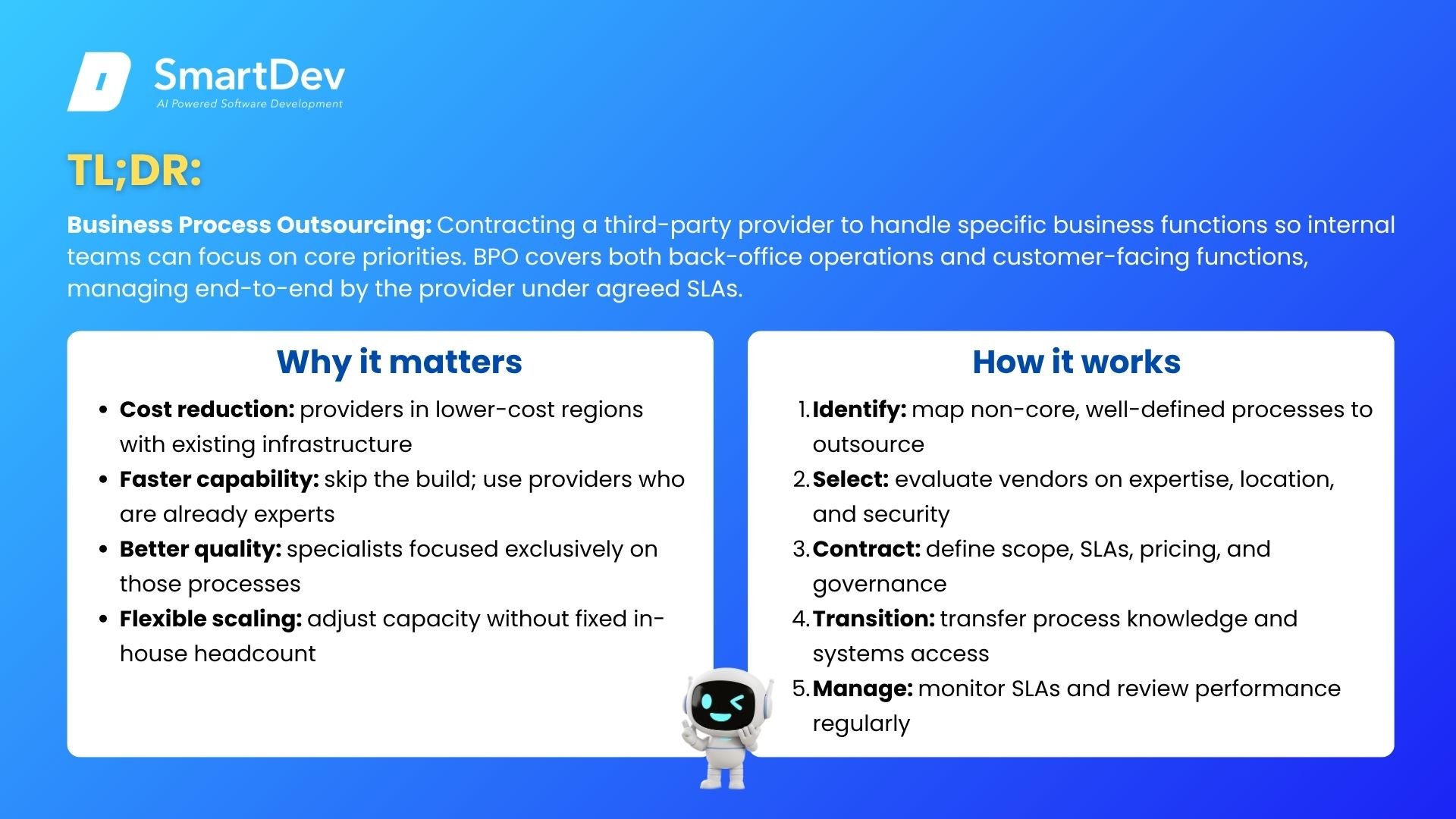
- Business Process Outsourcing (BPO) is the practice of hiring an external provider to handle specific business functions so your internal team can focus on core priorities.
- BPO can cover back-office functions like accounting and HR, or front-office functions like customer support and sales operations.
- The global BPO market is projected to grow from $436 billion in 2026 to over $623 billion by 2031, driven by cost efficiency, technology access, and digital transformation needs.
Business Process Outsourcing has evolved far beyond simple cost-cutting. Today, companies use BPO to access specialized capabilities, accelerate digital transformation, and scale operations without the overhead of building everything in-house. This article explains what BPO covers, why it matters, and what to expect on cost.
What is Business Process Outsourcing (BPO)?
Business Process Outsourcing (BPO) is the practice of contracting a third-party service provider to handle specific business functions or processes on behalf of your organization. Rather than staffing and managing every operational function internally, companies delegate defined tasks to specialized external partners who can deliver them more efficiently or cost-effectively.
BPO is typically divided into two categories:
- Back-office BPO: Internal business functions including accounting, payroll, human resources, procurement, IT services, data management, and quality assurance
- Front-office BPO: Customer-facing functions including customer support, sales operations, marketing services, and technical helpdesk
A subset of BPO called IT-enabled services (ITES) refers specifically to processes that rely on technology infrastructure, such as software development, cybersecurity, and IT helpdesk support.
なぜ企業にとって重要なのか
Every company has a finite amount of management attention and capital. BPO allows leadership to focus internal resources on the activities that drive competitive advantage, while trusted partners handle everything else. In today’s environment, it also provides access to specialized technology and talent that would be too costly or slow to build internally.
- Reduce operational costs by tapping into providers operating in lower-cost regions with existing infrastructure, tools, and trained teams
- Accelerate capability deployment by using a provider that already has the technology, processes, and expertise your business needs today
- Improve service quality in non-core functions by working with specialists who focus exclusively on those processes
- Increase flexibility by scaling outsourced capacity up or down as business demand changes, without the fixed cost of in-house headcount
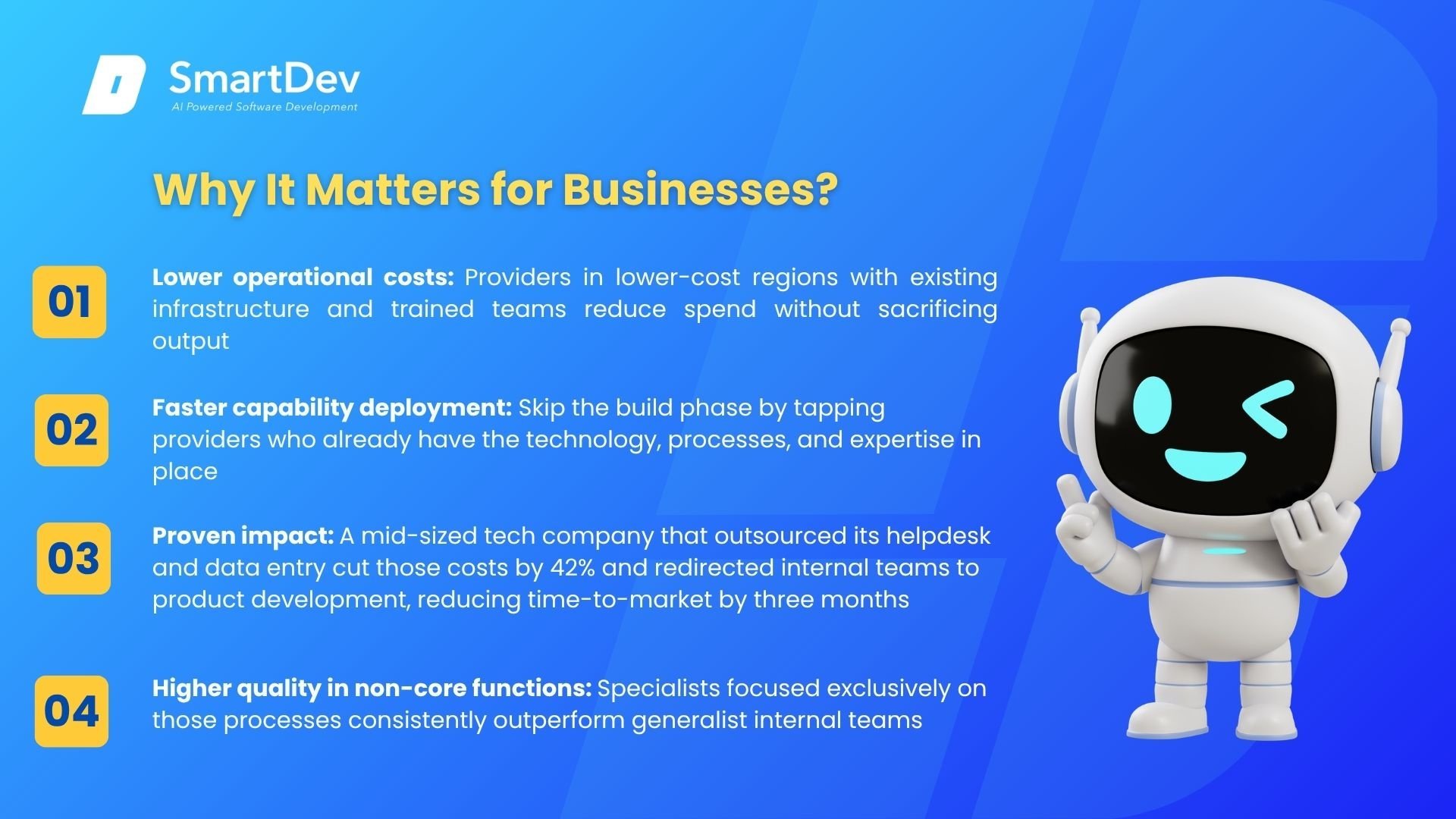
For example, a mid-sized technology company that outsourced its IT helpdesk and data entry operations to a BPO provider reduced those operating costs by 42% in the first year. The internal team redirected their time to product development, cutting time-to-market on two new product lines by over three months.
How Does Business Process Outsourcing Work?
- Identify processes to outsource: The company maps its operations and identifies which functions are non-core, well-defined, and suitable for external delivery without creating strategic risk.
- Select a provider: Vendors are evaluated on industry expertise, geographic location, technology capabilities, security standards, and cultural fit. A Request for Proposal (RFP) is commonly used.
- Define the service agreement: A detailed contract is established covering scope of work, SLAs (Service Level Agreements), pricing model, data security requirements, and governance procedures.
- Transition and onboarding: Knowledge transfer takes place to equip the provider’s team with the process knowledge, systems access, and context needed to deliver effectively from day one.
- Ongoing management: Performance is monitored against agreed SLAs, regular reviews are held with the provider, and the relationship is adjusted as business needs evolve.
The result is a leaner internal organization focused on strategy and growth, supported by external specialists handling defined operational functions with accountability.
How Much Does BPO Cost?
BPO pricing varies significantly depending on the type of process, location of the provider, and complexity of the engagement. As a general guide, IT-related BPO services in Southeast Asia or Eastern Europe typically cost 40 to 70% less than equivalent in-house teams in the US, UK, or Australia.
Three factors that determine BPO cost:
- Location of the provider: Nearshore providers (same or adjacent time zone) typically cost more than offshore providers but offer easier collaboration and communication
- Process complexity and specialization: High-skill processes such as software development or financial analysis command higher rates than routine data processing or customer support
- Contract structure: Fixed-price models offer cost predictability, while time-and-materials or outcome-based pricing can align costs more closely with business results
Building equivalent in-house teams including recruitment, salaries, management overhead, and tooling typically costs two to three times more than a well-managed BPO engagement for the same output.
その他の関連用語
Client Onboarding: The structured process of integrating a new client into an organization’s systems, workflows, and service delivery model. Client Onboarding is a defining moment in any BPO engagement. The quality of knowledge transfer during onboarding determines how quickly the provider’s team can deliver effectively and how much rework occurs in the early weeks of the contract.
SLA (Service Level Agreement): A formal agreement that defines the expected level of service between a vendor and client, including performance standards, response times, and resolution targets. SLAs are the contractual backbone of every BPO relationship. They translate the outsourcing scope into measurable delivery commitments, giving both parties a shared standard for evaluating whether the provider is performing as agreed.
Client Retention: The ability of an organization to keep existing clients engaged and satisfied over time. For BPO providers, Client Retention is the primary commercial measure of success. Contracts that renew and expand are the result of consistent SLA performance, proactive communication, and demonstrated value beyond the original scope of the engagement.