
TL;DR
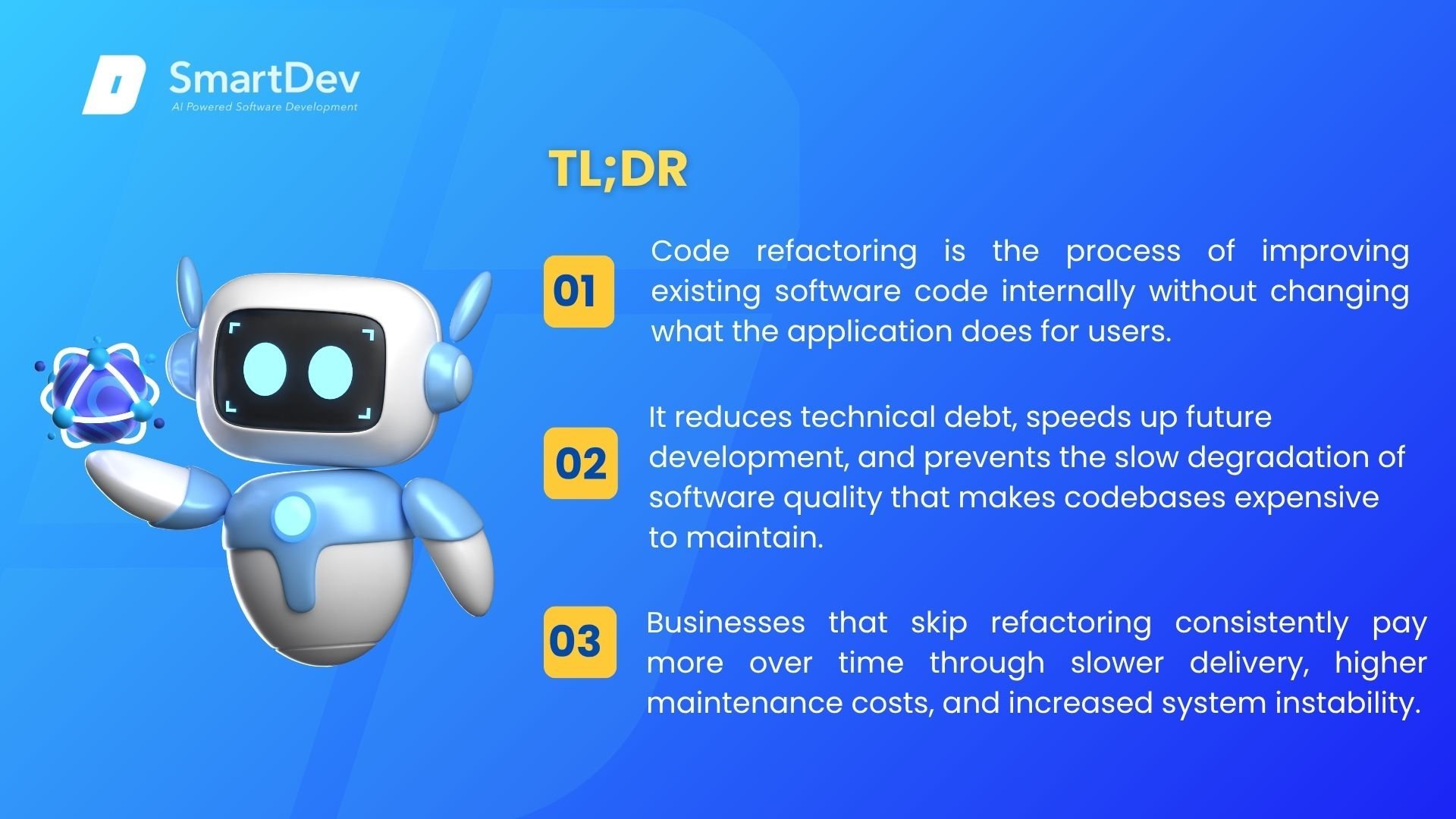
- Code refactoring is the process of improving existing software code internally without changing what the application does for users.
- It reduces technical debt, speeds up future development, and prevents the slow degradation of software quality that makes codebases expensive to maintain.
- Businesses that skip refactoring consistently pay more over time through slower delivery, higher maintenance costs, and increased system instability.
Code refactoring is how software teams prevent their applications from slowly becoming harder and more expensive to maintain. It is not adding features. It is not fixing bugs. It is improving the internal structure of code so your development team can keep building quickly and reliably over the long term. This article explains what code refactoring is, when you need it, and what it costs.
What is Code Refactoring?
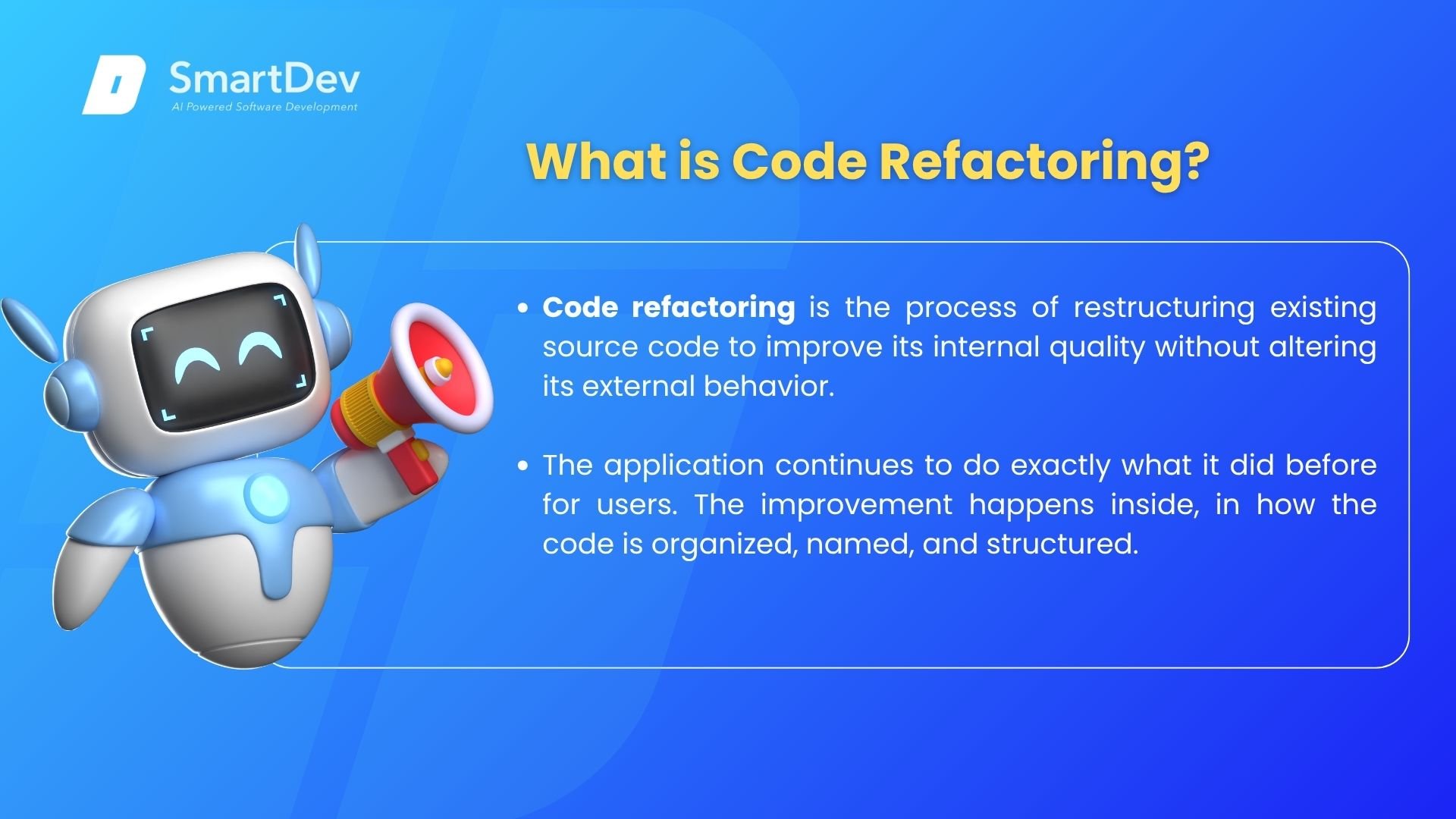
Code refactoring is the process of restructuring existing source code to improve its internal quality without altering its external behavior. The application continues to do exactly what it did before for users. The improvement happens inside, in how the code is organized, named, and structured.
Over time, software code accumulates what engineers call “technical debt.” Quick fixes, rushed deadlines, changing requirements, and team turnover leave behind code that works but is increasingly difficult to understand, modify, or extend. Refactoring pays down this debt by cleaning up the codebase so it remains maintainable as the product evolves.
Common types of code refactoring include:
- Simplification: Breaking large, complex functions into smaller, focused ones that are easier to understand, test, and maintain independently.
- Duplication removal: Consolidating repeated logic into reusable components to reduce the effort required to maintain the same logic in multiple places.
- Naming improvements: Renaming variables, functions, and classes to clearly communicate their purpose, making the code readable without requiring deep context.
- Performance optimization: Restructuring code to run faster or use less memory, improving responsiveness for end users without changing what the code does.
なぜ企業にとって重要なのか
From a business perspective, code refactoring is about protecting your software investment. Code that is never refactored degrades over time. Teams spend more hours navigating complex, poorly organized code to make simple changes. Bugs become harder to locate and fix. New features take progressively longer to add as the codebase grows more tangled.
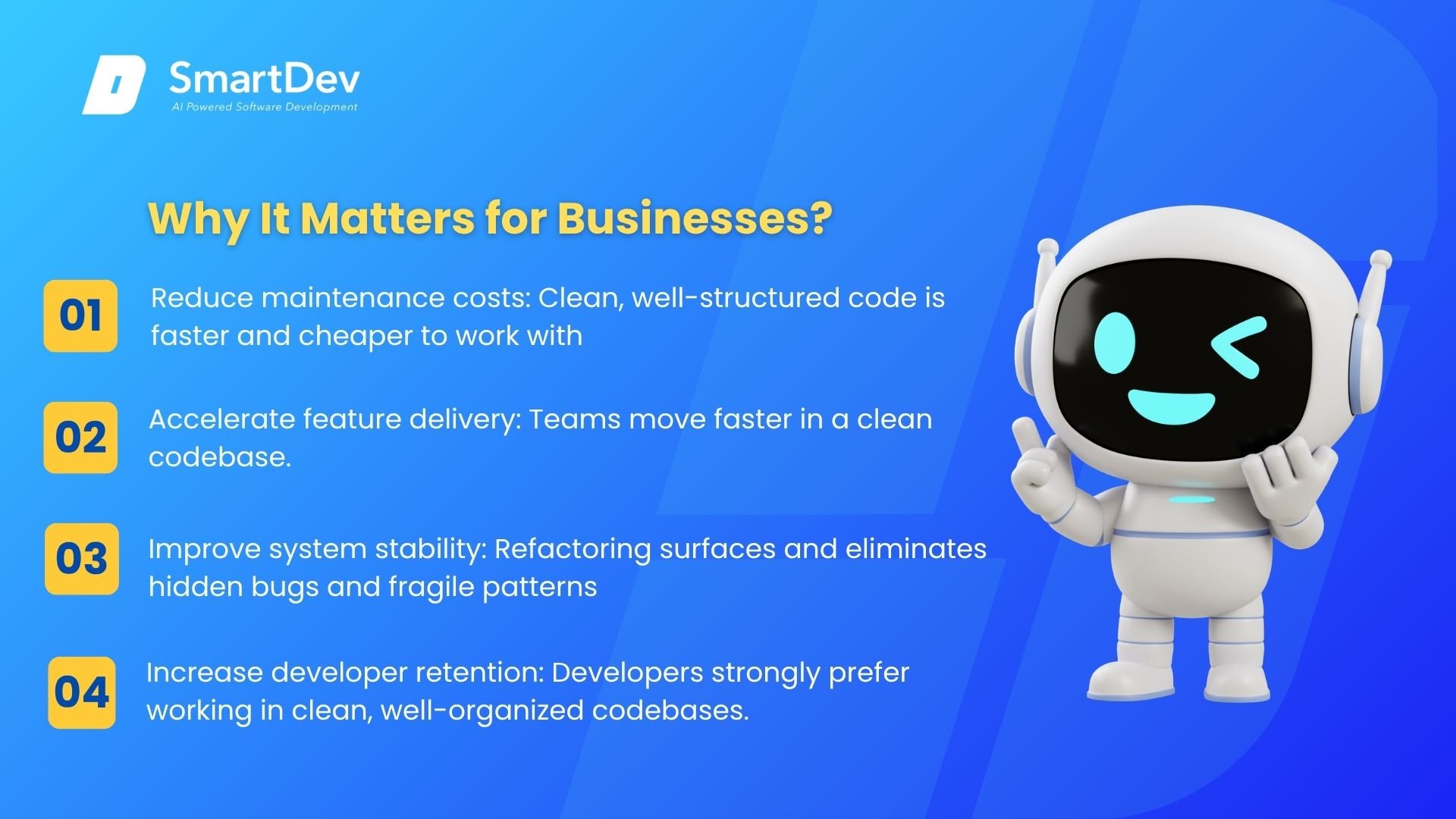
- Reduce maintenance costs: Clean, well-structured code is faster and cheaper to work with, reducing the developer hours required for every change or bug fix your business needs.
- Accelerate feature delivery: Teams move faster in a clean codebase. A feature that takes a week in disorganized code may take a day in a well-refactored one, compounding over hundreds of features.
- Improve system stability: Refactoring surfaces and eliminates hidden bugs and fragile patterns before they cause production failures that affect your customers and reputation.
- Increase developer retention: Developers strongly prefer working in clean, well-organized codebases. Poor code quality is a frequently cited reason for engineering team turnover, which is expensive to replace.
For example, a logistics company working with an outsourced development team noticed that simple feature requests were taking three to four times longer than expected. An assessment revealed years of accumulated technical debt in core modules. After a focused four-week refactoring sprint, development velocity nearly doubled and defects in new releases dropped significantly.
When to Use Code Refactoring?
Code refactoring is most effective when it becomes a regular practice rather than a crisis response. Key triggers include:
- Before adding a new feature: If the area of code you need to modify is complex or unclear, refactor it first. This preparatory approach makes the new feature far easier and faster to implement correctly.
- When development velocity slows unexpectedly: If your team is taking significantly longer than expected to complete work, technical debt in frequently touched code areas is often the root cause.
- After fixing a bug: When fixing a bug, the surrounding code often reveals deeper structural problems. Refactoring at this point prevents the same pattern from generating additional bugs elsewhere.
- During code review: Code reviewers who spot poorly structured code should flag it for refactoring before it enters the main codebase, preventing the debt from accumulating further.
When NOT to refactor:
- Do not refactor code that lacks automated tests. Without tests to confirm that behavior is unchanged, refactoring risks introducing regressions that break existing functionality silently.
- Avoid large-scale refactoring projects immediately before major product releases. The disruption risk is significant and the timing pressure reduces the quality of the work.
How Much Does Code Refactoring Cost?
The cost of code refactoring depends heavily on the size, age, and condition of the codebase being improved:
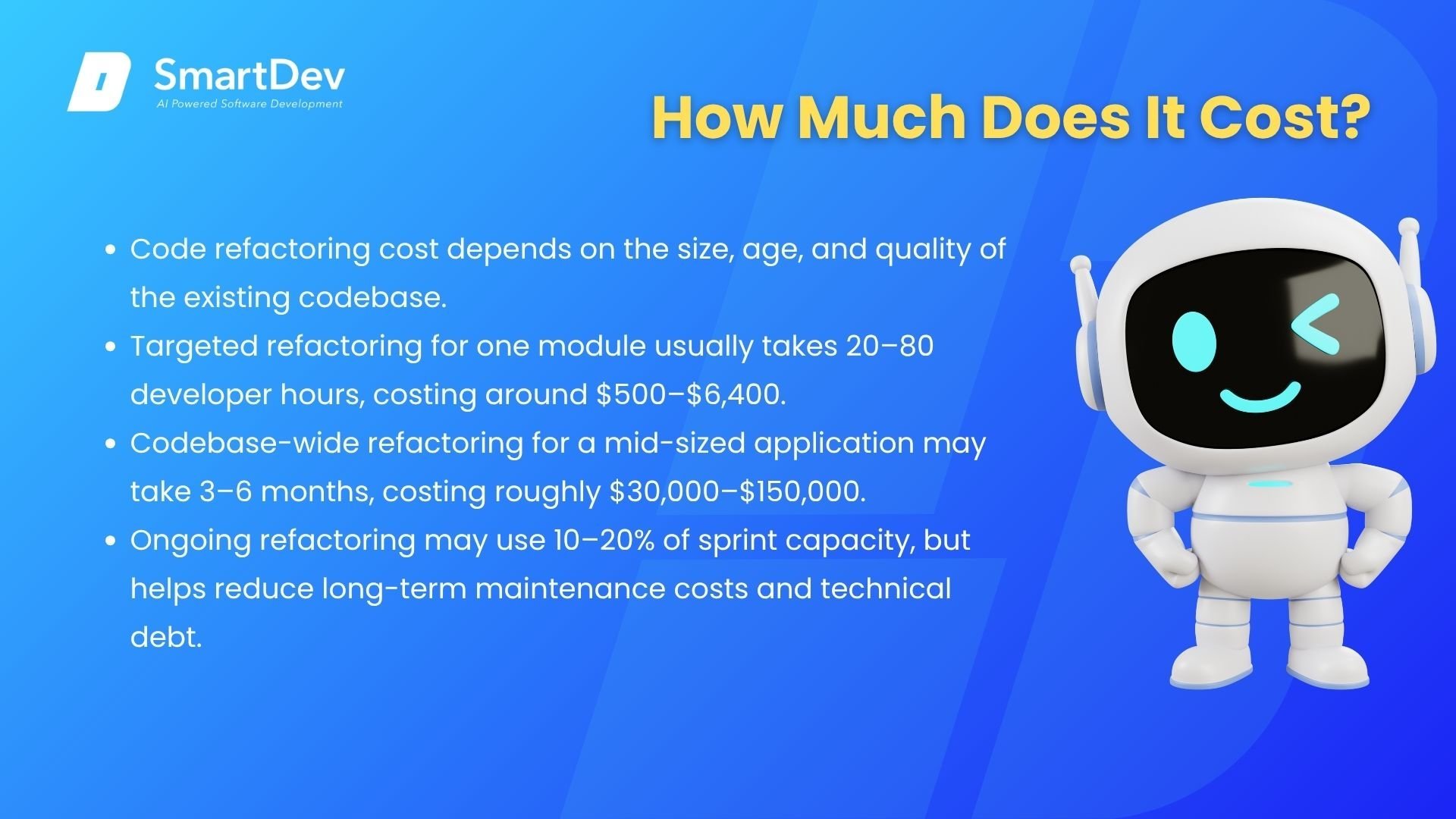
- Targeted refactoring: Cleaning up a single module or feature area typically takes 20 to 80 developer hours. At outsourced development rates of $25 to $80 per hour, this represents a $500 to $6,400 investment per module.
- Codebase-wide refactoring: A full refactoring engagement for a mid-sized application may take three to six months and cost $30,000 to $150,000 depending on team size, location, and the severity of existing technical debt.
- Ongoing maintenance: Embedding refactoring into the development process as a regular practice typically adds 10 to 20% to sprint capacity but significantly reduces long-term maintenance and feature development costs.
The cost of not refactoring is typically far higher. Research consistently shows that technical debt and poor code quality can reduce development team productivity by 20 to 40% over time. For businesses spending $500,000 or more per year on software development, that represents a substantial and preventable ongoing loss.
その他の関連用語
Technical Debt: The accumulated cost of shortcuts and poor coding decisions made in the past, which must eventually be addressed through refactoring or rewriting to maintain software quality and team productivity.
Code Review: The practice of having developers examine each other’s code before it is merged into the codebase, often identifying code that would benefit from refactoring before the debt accumulates further.
CI/CD Pipeline: An automated system for building, testing, and deploying code that supports safe, frequent refactoring by providing immediate feedback when changes break existing behavior in the application.