
 Data migration is the process of transferring data from one system, database, application, or infrastructure to another while ensuring accuracy, integrity, and minimal disruption.
It commonly occurs when organizations upgrade legacy systems, adopt cloud platforms, consolidate databases, or modernize applications. The process typically involves extracting, transforming, validating, and loading data into a new environment that better supports business scalability and performance.
なぜ企業にとって重要なのか
Data migration plays a critical role in enabling digital transformation, scalability, and data-driven decision-making. Without proper migration, companies risk losing valuable information, disrupting operations, and increasing security vulnerabilities.
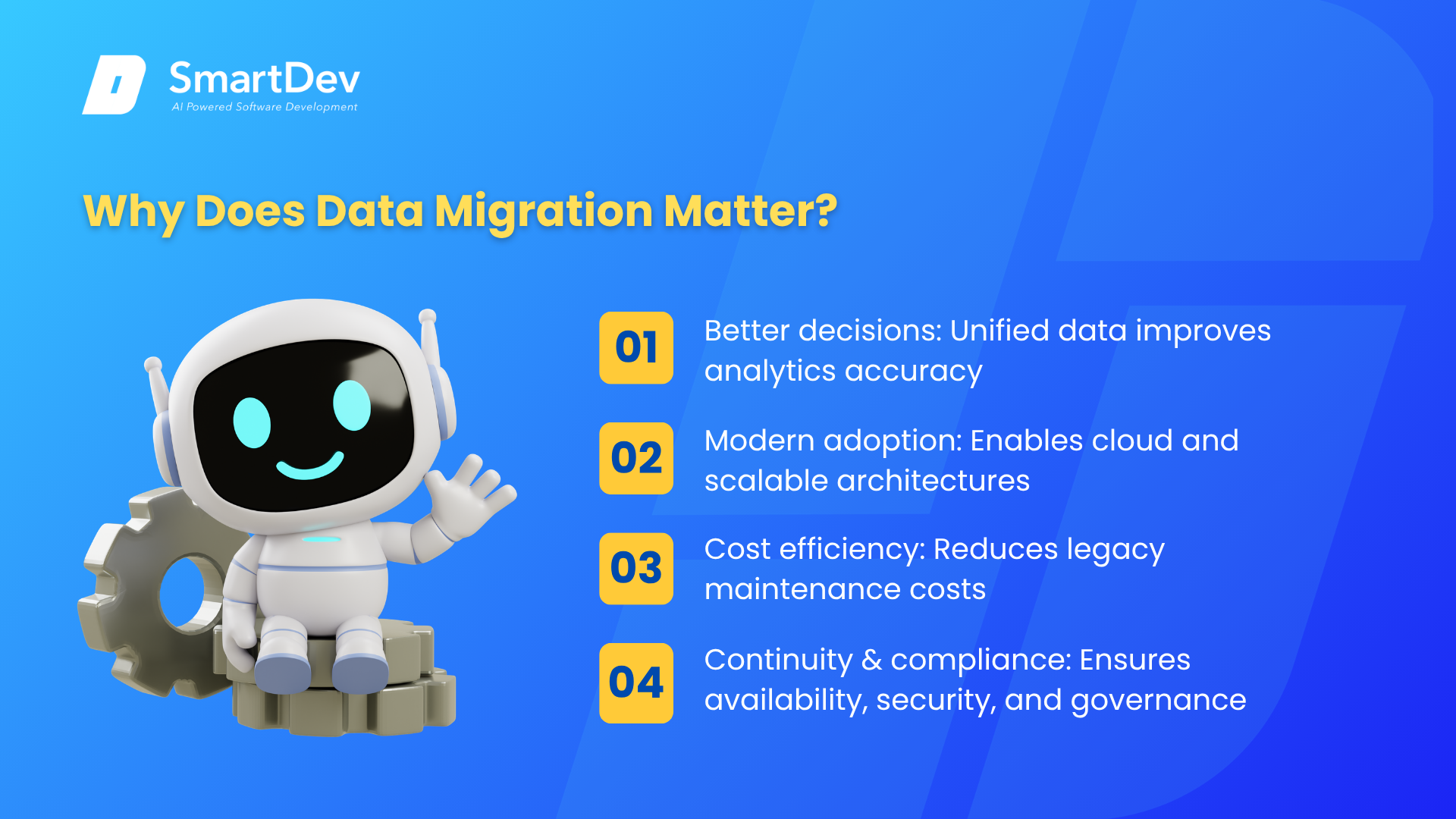 Key benefits include:
- Better decision-making: Clean, unified datasets improve analytics accuracy and insights.
- Modern technology adoption: Enables transition to cloud-native and scalable architectures.
- Cost efficiency: Reduces maintenance costs tied to legacy infrastructure.
- Business continuity: Ensures data availability during system transitions.
- Compliance & security: Supports stronger governance, privacy, and audit readiness.
Poor migration planning can lead to downtime, corrupted data, and operational delays, making structured processes essential.
When is Data Migration needed?
Data migration becomes necessary when organizations undergo significant technological or operational changes. Common scenarios include cloud adoption initiatives, where companies move data from on-premise infrastructure to cloud platforms to improve scalability and flexibility.
It is also required during system upgrades or replacements, such as implementing a new ERP, CRM, or data warehouse solution. Mergers and acquisitions often trigger migration as companies consolidate multiple databases into a unified environment. Additionally, migration supports application modernization efforts, enabling legacy systems to integrate with modern architectures such as microservices or API-driven ecosystems.
How does Data Migration work?
Data migration typically follows a structured workflow to ensure accuracy and minimize disruption. The process begins with data assessment, where teams analyze data sources, formats, dependencies, and potential risks.
Next, data is extracted from the original system and transformed into a format compatible with the target environment. This stage may include cleansing duplicate records, standardizing formats, and enriching incomplete data.
The transformed data is then loaded into the destination system, followed by validation and testing to confirm completeness, consistency, and functionality. Many organizations use automated ETL tools, data pipelines, and governance controls to ensure the migration process is efficient, secure, and auditable.
その他の関連用語
- Cloud Migration: The process of moving applications, data, and workloads from on-premise infrastructure to cloud environments to improve scalability and flexibility.
- Data Security: Practices and technologies used to protect data from unauthorized access, breaches, or corruption throughout storage, transfer, and usage.
- Application Modernization: Updating legacy applications using modern architectures, cloud infrastructure, or microservices to improve performance, scalability, and maintainability.