
TL;DR:
- A “diff” identifies the differences between two versions of a file or codebase; a “patch” packages those differences so they can be applied elsewhere.
- Diff/patch application is the process of taking identified changes and systematically applying them to a target system or file.
- For businesses, this process underpins reliable software updates, security fixes, and collaborative development across distributed teams.
Software never stays the same. Features are added, bugs are fixed, and security vulnerabilities are addressed. But how do those changes travel safely from one environment to another? The answer often comes down to a concept called diff/patch application, a foundational process in professional software development that keeps systems up to date without unnecessary risk.
What is Diff / Patch Application?
“Diff” is short for “difference.” In software, a diff is a structured record of exactly what changed between two versions of a file or set of files. It shows which lines were added, removed, or modified, and nothing else. Think of it as a precise before-and-after comparison, captured in a format that both humans and machines can read.
A “patch” is the file that contains this diff, formatted so it can be applied to the original file to produce the updated version. Patch application is the process of taking that patch file and replaying the recorded changes onto a target system.
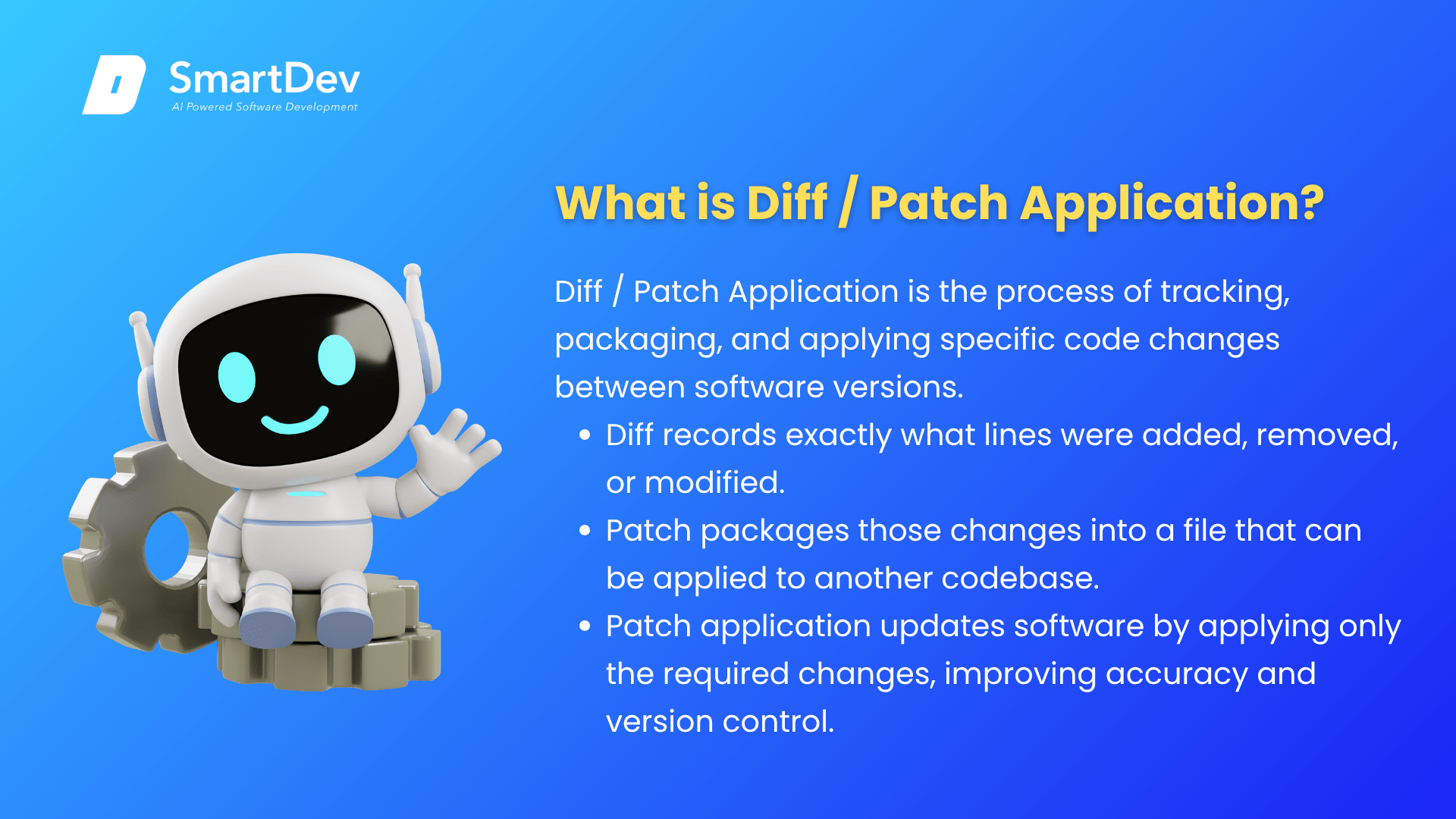
Together, diff and patch form a reliable mechanism for propagating changes. Instead of replacing entire files and risking accidental overwriting, teams can apply only the specific changes needed. This precision is what makes diff/patch application so valuable in professional software environments.
The concept originated in Unix-based development but is now universal. Modern version control systems like Git use diff and patch logic as their foundation. When developers submit a pull request, they are essentially proposing a patch. When a reviewer approves it, the patch is applied to the shared codebase.
なぜ企業にとって重要なのか
For software and IT teams, patch and diff application is not just a development workflow — it is a core security and operational practice.
From a security standpoint, unpatched systems are the leading cause of enterprise breaches. Patch application is how IT teams deliver fixes for known vulnerabilities directly to production systems, on schedule, without rebuilding entire codebases. A structured patch process reduces exposure windows and satisfies compliance requirements across frameworks like ISO 27001, SOC 2, and PCI-DSS.
From a development standpoint, diff/patch workflows enable teams to ship precise, traceable code changes with minimal risk. Every change is documented, reversible, and reviewable before it reaches production.
Key business benefits include:
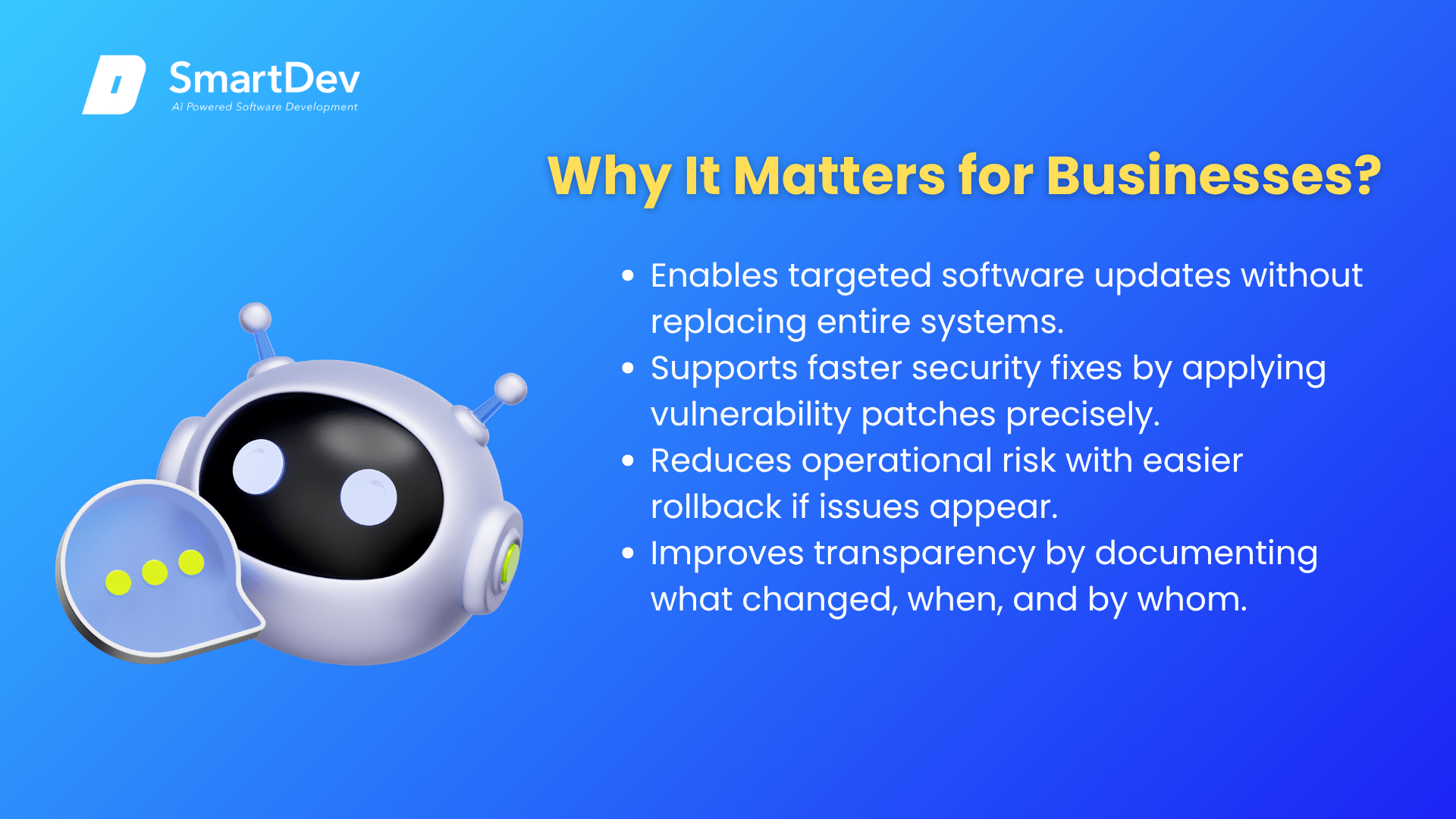
Close security vulnerabilities faster by applying targeted patches without full system redeployment — reducing mean time to remediation (MTTR).
Maintain audit trails as every diff is a documented, version-controlled record of what changed, when, and why.
Reduce deployment risk by isolating changes to only the affected lines of code rather than overwriting entire files.
Ensure compliance with enterprise security policies that require documented, repeatable patch processes across all environments.
Enable distributed teams to collaborate on the same codebase without overwriting each other’s work.
How Does Diff / Patch Application Work in Practice?
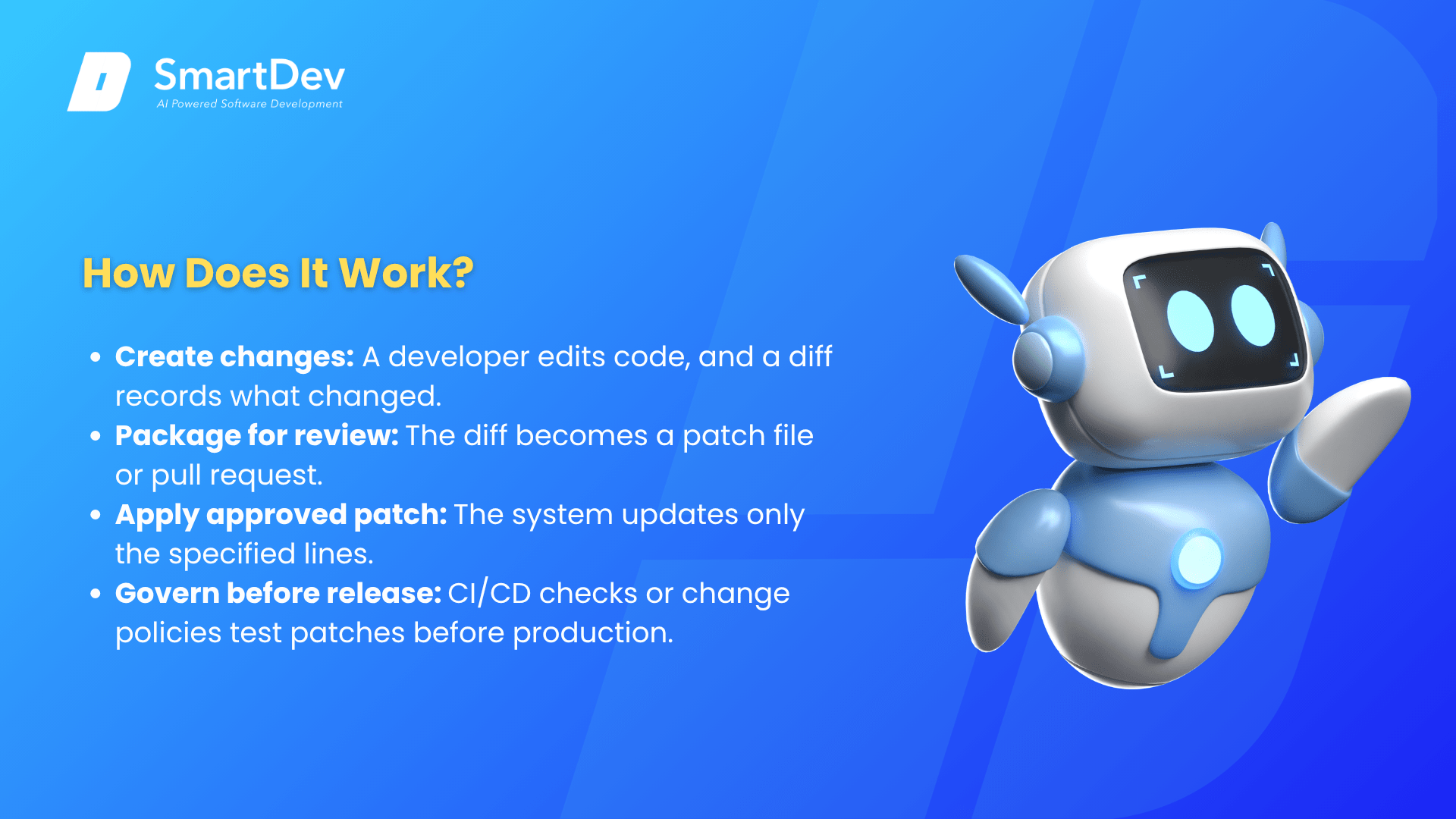
The workflow is straightforward. A developer modifies a file. The version control system, or a dedicated diff tool, compares the original and modified versions and generates a diff. This diff is saved as a patch file, which can then be shared or submitted for review.
When the patch is approved, it is applied to the target environment using a patch command or the equivalent function in the version control system. The system reads the diff, locates the exact lines specified in the patch, and makes the corresponding changes.
Modern platforms like GitHub and GitLab have abstracted much of this process into visual interfaces. But the underlying mechanism remains the same. Every merge, every pull request, every hotfix deployed to production relies on diff/patch logic.
For enterprise environments, this process is often governed by change management policies. Change advisory boards or automated CI/CD pipelines review and test patches before they are applied to production systems. This adds a layer of governance that reduces the risk of untested changes reaching business-critical systems.
Where is Diff / Patch Application Used?
Patch and diff application appears across the full software delivery and IT operations lifecycle:
Security patch management: IT and DevSecOps teams apply OS-level and application-level patches to fix CVEs and zero-day vulnerabilities across server fleets — often automated through patch management platforms like WSUS, Ansible, or AWS Systems Manager.
Version control and code review: Developers use Git diff/patch daily to review changes, resolve merge conflicts, and apply contributions from external collaborators without direct repository access.
Legacy system maintenance: Enterprise teams maintaining COBOL, C, or older Java codebases apply patches to update specific modules without disturbing surrounding systems — critical for banking, insurance, and government IT environments.
Open source contribution: Contributors submit patches as
.difffiles to maintainers who review and apply them to the main codebase — the standard workflow for Linux kernel development and many major OSS projects.CI/CD pipelines: Automated pipelines apply and validate patches as part of build and test stages, ensuring no regressions before changes reach production.
Hotfix deployment: When a critical bug or security issue is discovered in production, teams generate and apply a targeted patch without waiting for the next full release cycle.
その他の関連用語
Agentic Flow: Agentic flow is an AI-driven workflow where autonomous agents reason through goals, make decisions, take actions, and adapt across multi-step processes with minimal human intervention.
AI Code Explanation: AI code explanation uses artificial intelligence to automatically describe what code does in plain language, without requiring deep technical knowledge.
Code Migration: Code migration is the process of moving software applications from one platform, language, or infrastructure to another to improve performance, security, or maintainability.