TL;DR:

- Human-in-the-Loop (HITL) is an approach to AI where a human reviews, approves, or corrects AI outputs at defined points in the workflow before those outputs produce real consequences.
- HITL is essential for high-stakes decisions in areas like finance, legal, healthcare, and HR where errors carry legal, regulatory, or reputational risk.
- As AI systems become more autonomous, HITL design determines where human oversight adds value and where automation can safely proceed without interruption.
Artificial intelligence can process information and generate outputs far faster than any human. But speed alone is not always what a business needs. In many contexts, accuracy, accountability, and judgment matter more than throughput. That is the space where Human-in-the-Loop AI becomes essential: ensuring that human oversight is embedded in exactly the right points of an automated workflow.
What is Human-in-the-Loop?
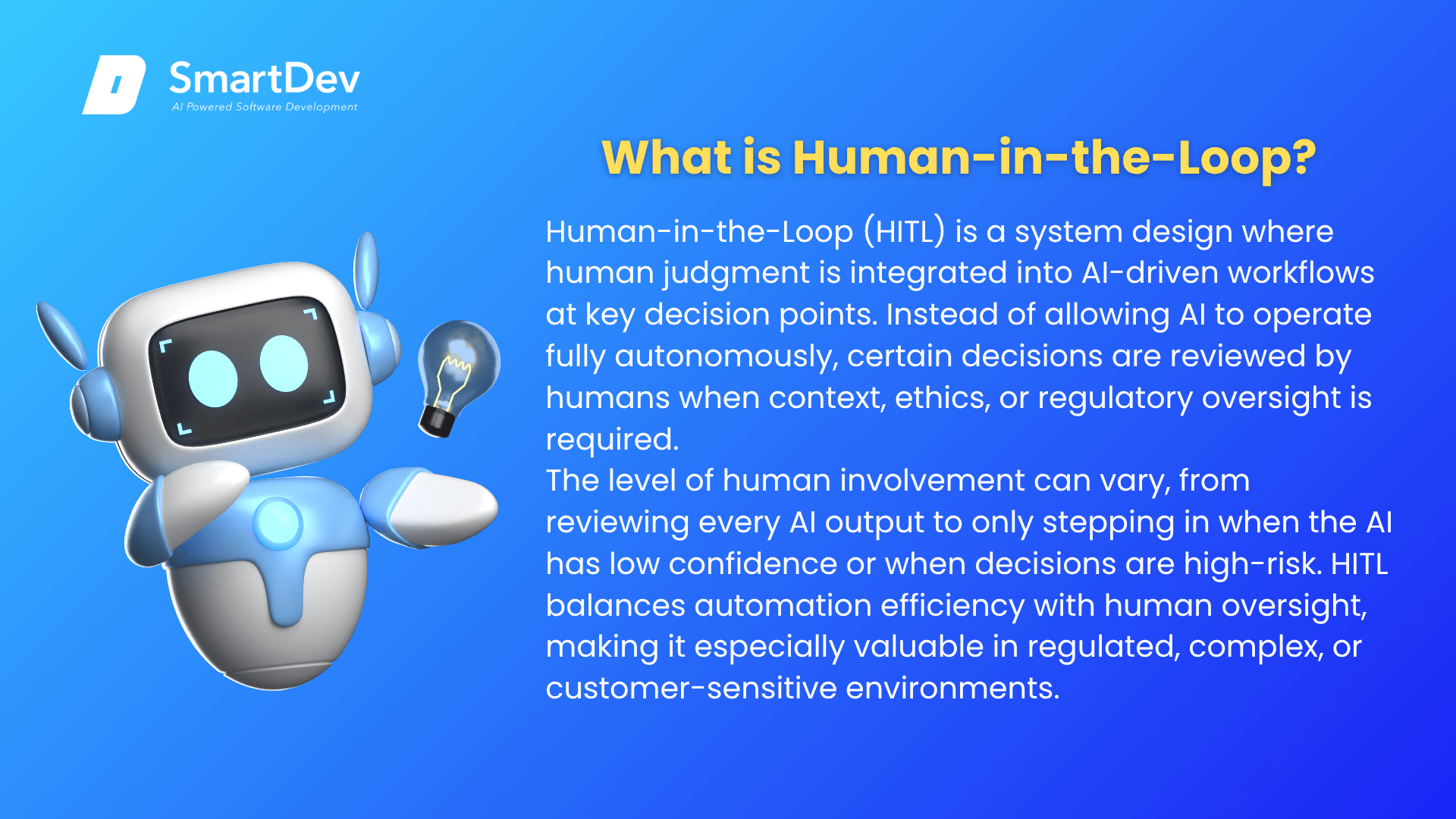
Human-in-the-Loop, commonly abbreviated as HITL, refers to any AI or automated system in which a human actively participates at one or more defined points in the process. In a HITL workflow, the AI suggests, generates, or classifies, and the human reviews, approves, edits, or rejects the output before it produces a downstream consequence. Nothing irreversible happens until a human has signed off.
This stands in contrast to fully automated systems, where AI outputs are acted upon directly without human review, and to Human-on-the-Loop systems, where humans monitor AI behavior at the system level rather than reviewing individual outputs. HITL places humans inside the process flow at specific decision points, not just observing from the outside.
The design of a HITL system requires defining precisely where human involvement adds value. Too much human involvement defeats the efficiency benefits of AI. Too little creates unacceptable risk. Effective HITL design is a deliberate exercise in identifying which decisions are routine enough to automate fully, which carry enough uncertainty or consequence to warrant review, and which must always involve human judgment regardless of AI confidence levels.
なぜ企業にとって重要なのか
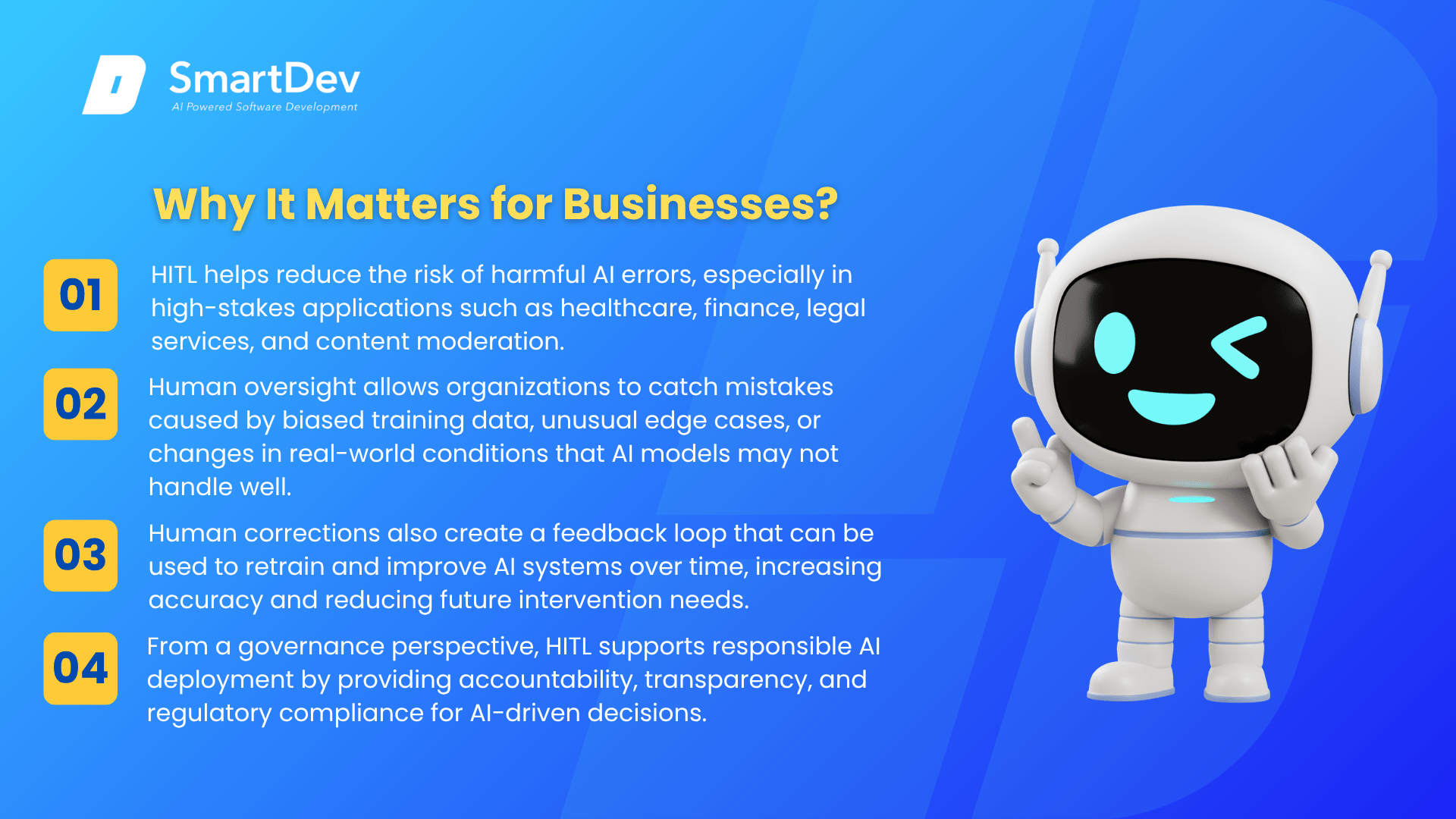
For business leaders, HITL is primarily a risk management and governance tool. AI systems, even highly accurate ones, make errors. When those errors occur in low-stakes contexts, such as a product recommendation or a content summary, the impact is limited. When they occur in high-stakes contexts, such as a credit decision, a hiring assessment, a medical diagnosis, or a legal compliance determination, the consequences can be severe.
HITL provides a structural safeguard that keeps humans accountable for consequential decisions while still capturing the efficiency gains of AI-assisted processing. In regulated industries, this structure is increasingly not optional. Financial services regulators, healthcare authorities, and emerging AI legislation in multiple jurisdictions are explicitly requiring that human oversight be embedded in AI systems making decisions that affect individuals or carry fiduciary or legal obligations.
Beyond compliance, HITL also improves AI system quality over time. When humans review AI outputs and provide corrections, that feedback can be used to retrain models, improving their accuracy and reducing the frequency of errors that require human intervention. Organizations that design effective HITL processes are effectively building a continuous improvement loop into their AI systems.
Who Needs Human-in-the-Loop Systems?
Any organization using AI to support decisions with significant consequences should consider where HITL applies. In financial services, HITL is relevant for loan approvals, fraud alerts, trade surveillance, and customer complaint handling. When AI flags a transaction as potentially fraudulent, a human reviews the case before the account is frozen or the customer is notified, preserving accuracy and customer experience simultaneously.
In human resources, employment decisions including compensation changes, performance assessments, disciplinary actions, and terminations typically require tighter human review because the legal exposure and bias risk are substantially higher than in routine administrative tasks. AI can assist by surfacing relevant information, identifying patterns, and drafting recommendations, but the decision itself remains a human responsibility.
In healthcare and life sciences, HITL is standard practice for AI systems that assist with diagnostic imaging, treatment recommendations, or clinical trial screening. The AI provides a recommendation; a qualified clinician reviews it before any clinical action is taken. This approach allows organizations to benefit from AI-assisted speed and pattern recognition while maintaining the accountability structures that patient safety and regulation require.
When Should Businesses Implement HITL?
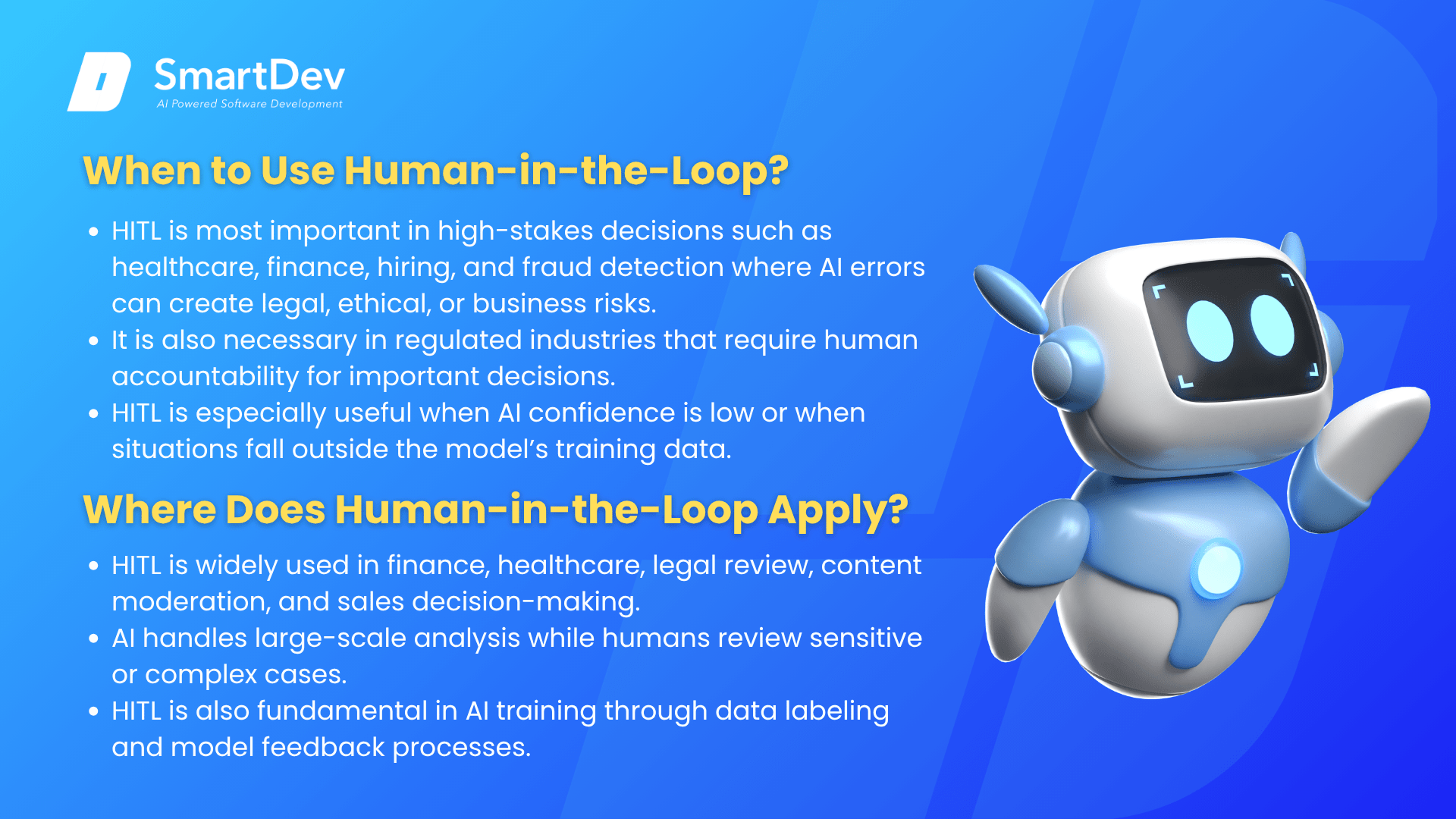
HITL should be designed into an AI system before deployment, not added as a retrofit when problems emerge. The decision about where to place human review points is a design choice that shapes the entire workflow architecture. Adding review steps after the fact disrupts processes that were built around automation and often results in poorly integrated oversight that teams work around rather than with.
The most important indicator that HITL is needed is the presence of irreversible consequences. Any AI-driven action that cannot easily be undone, that affects an individual’s rights or livelihood, that has regulatory implications, or that exposes the organization to legal liability should be reviewed by a human before execution. Organizations should map their AI workflows against these criteria and ensure that human review is built into the process wherever the answer is yes.
As AI systems mature and demonstrate consistent performance, it may be appropriate to reduce the scope of HITL for certain decisions. This evolution should be data-driven, based on demonstrated accuracy and the absence of systematic errors, and should involve legal and compliance teams to ensure that any reduction in human oversight remains within regulatory boundaries.
その他の関連用語
- Agent Orchestration: The coordination of multiple AI agents in complex workflows, where HITL design determines which agent actions require human approval before proceeding.
- Production-Grade AI Development: The practice of building AI systems for real business environments, which includes defining and implementing appropriate HITL checkpoints as part of the production architecture.
- Agentic Flow: AI-driven workflows where autonomous agents execute multi-step processes, making HITL design particularly important for managing the risk of automated action chains.