
TL;DR

- A milestone-based contract ties vendor payments to the completion of specific, pre-agreed project deliverables rather than time spent.
- Projects structured around milestones are 35% more likely to stay on budget and meet their overall objectives.
- It is best suited for fixed-scope IT projects where accountability, quality control, and budget protection are priorities.
A milestone-based contract is a project agreement where payments and progress are tied to the achievement of clearly defined deliverables rather than hours worked. In IT outsourcing, it gives businesses a structured way to hold vendors accountable while protecting their investment. This article covers how it works, what it costs, and when to use it.
What is a Milestone-Based Contract?
A milestone-based contract is a formal agreement between a client and a service provider where compensation is released only when specific, measurable project milestones are completed and accepted. Each milestone represents a defined phase of work, such as completing a design prototype, finishing a development sprint, or passing a user acceptance test. Payments are withheld until each deliverable meets the agreed acceptance criteria. This model is common in software development, IT infrastructure projects, and digital transformation engagements. It differs from a time-and-materials model, where the vendor is paid for hours logged regardless of outcomes. A milestone-based structure puts the focus on results, not effort, and creates clear checkpoints for quality review throughout the project.
なぜ企業にとって重要なのか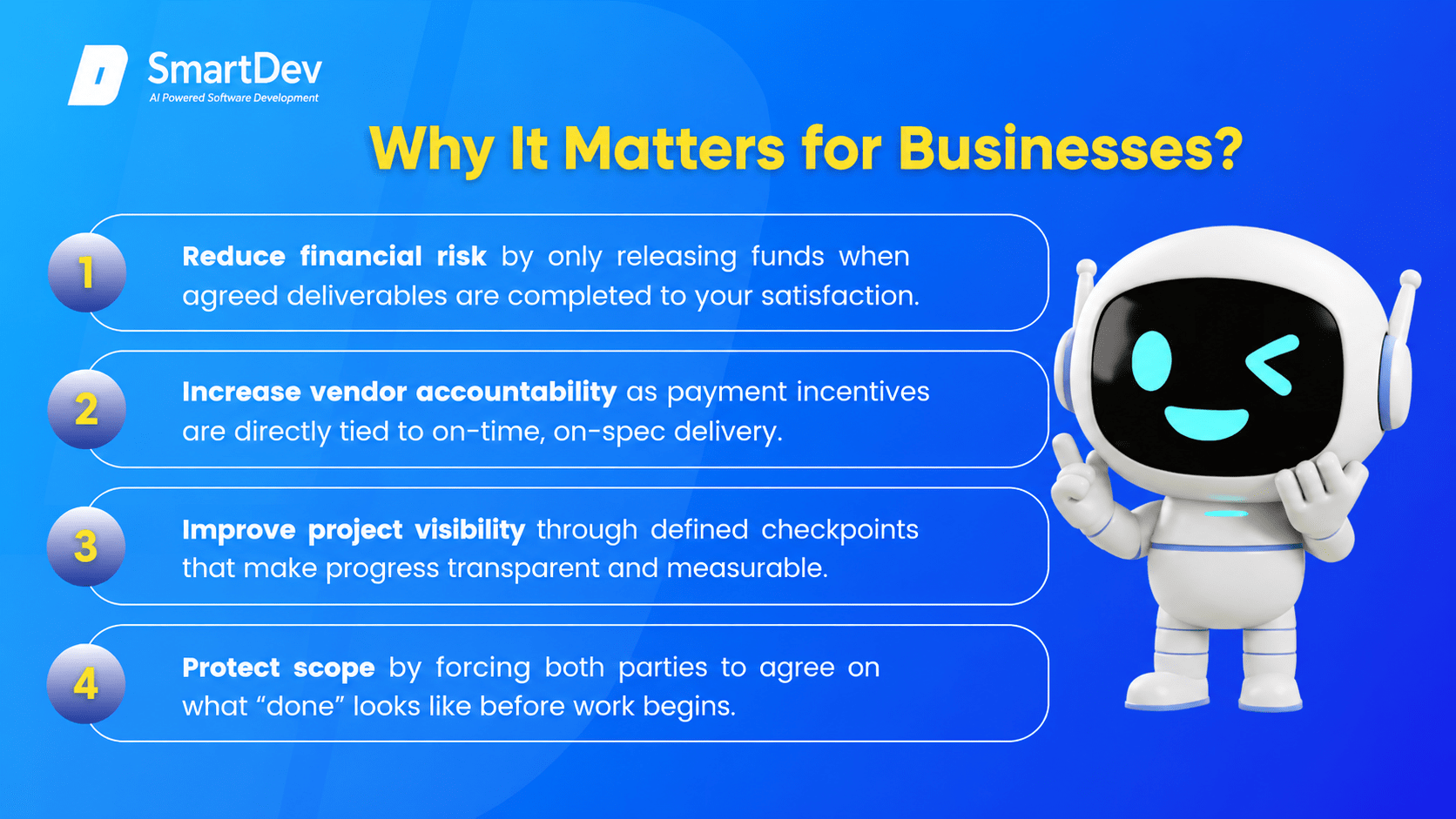
Budget overruns and missed deadlines are among the top risks in IT outsourcing. A milestone-based contract directly addresses both by building accountability into the payment structure.
- Reduce financial risk by only releasing funds when agreed deliverables are completed to your satisfaction.
- Increase vendor accountability as payment incentives are directly tied to on-time, on-spec delivery.
- Improve project visibility through defined checkpoints that make progress transparent and measurable.
- Protect scope by forcing both parties to agree on what “done” looks like before work begins.
For example, a retail company commissioning a custom e-commerce platform used a milestone-based contract with five payment phases: requirements sign-off, UI design approval, backend development completion, QA sign-off, and final deployment. When the vendor delivered a substandard QA phase, payment was withheld until deficiencies were corrected. The result was a higher-quality final product delivered within the original budget.
How Does It Work?
- Define scope and milestones — Both parties agree on a full project scope, then break it into phases with clear deliverables and acceptance criteria for each.
- Set payment schedule — Each milestone is assigned a percentage of the total contract value. A typical structure starts with a 15-30% upfront deposit, with the remainder split across delivery phases.
- Execute and review — The vendor completes each phase and submits deliverables for client review against the acceptance criteria.
- Approve and release payment — If the deliverable meets the agreed standard, payment is released and the next phase begins.
- Dispute and remediation — If the deliverable fails review, the vendor revises the work before payment is released. The contract should define revision limits and timelines.
The result is a project with built-in financial controls, regular checkpoints, and mutual accountability at every phase.
How Much Does It Cost?
The total cost of a milestone-based contract depends on the project scope, not the model itself. However, the payment structure is typically structured as follows:
- Upfront deposit: 15-30% of total contract value to initiate work.
- Mid-project milestones: 50-60% split across two to four delivery phases.
- Final payment: 10-20% released upon final delivery and acceptance.
Factors that affect total project cost include scope complexity, the number of defined milestones, required revision cycles, and the vendor’s location and seniority level. Compared to a time-and-materials model, a milestone-based contract often results in lower total spend because vendors are incentivized to work efficiently rather than extend billable hours.
その他の関連用語
Fixed-Price Contract: A pricing model where the total project cost is agreed upfront, often used alongside milestone structures to lock in both cost and deliverables.
Statement of Work (SOW): The document that defines the scope, deliverables, timelines, and acceptance criteria underpinning each milestone in the contract.
Commercial proposal: A formal written document submitted by an IT outsourcing vendor in response to a client’s request for services