
TL;DR:
- On-premise AI runs AI models on your own infrastructure, keeping data inside your organization’s boundaries.
- It gives enterprises full control over model behavior, data privacy, and long-term operational costs.
- Regulated industries such as healthcare, finance, and government increasingly choose self-hosted models to meet compliance requirements.
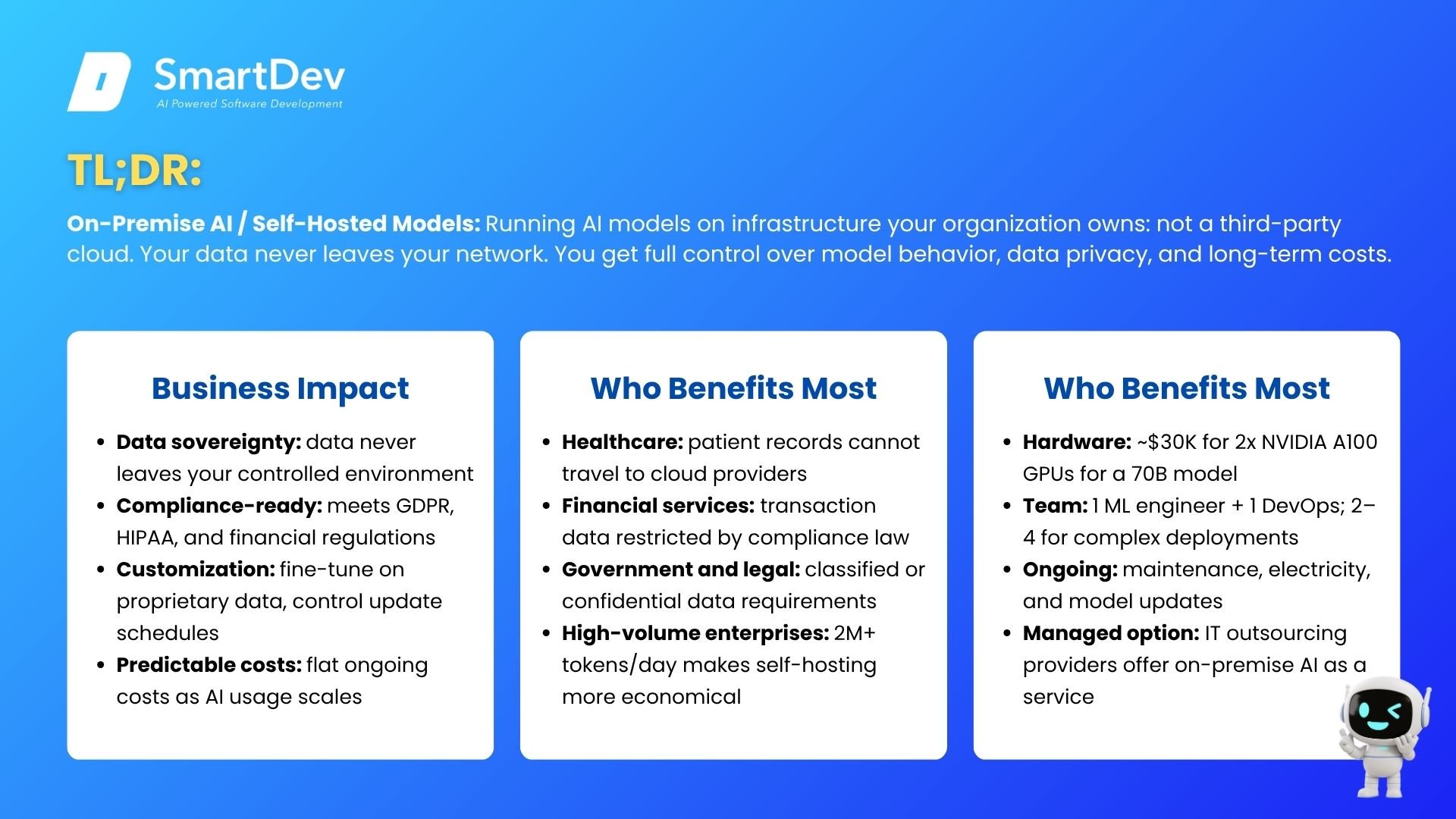
Businesses no longer have to send sensitive data to a cloud provider to use artificial intelligence. On-premise AI, also called self-hosted models, brings the intelligence directly into your own servers. The result is greater control, stronger data privacy, and predictable costs over time.
What Is On-Premise AI / Self-Hosted Models?
On-premise AI refers to the practice of running artificial intelligence models on infrastructure that your organization owns and operates, rather than accessing them through a third-party cloud API. Self-hosted models are AI systems deployed inside your own data center, private cloud, or virtual private cloud (VPC).
In practical terms, this means downloading an open-source model such as Meta’s Llama, Mistral, or Microsoft’s Phi and running it on servers your team controls. The model processes requests locally, and your data never leaves your network boundary.
This approach stands in direct contrast to API-based AI services, where you send queries to a provider’s server, receive a response, and pay per token consumed. With self-hosted models, you trade the convenience of managed cloud access for the benefits of ownership, including data sovereignty, customization, and long-term cost efficiency.
なぜ企業にとって重要なのか
The business case for on-premise AI has strengthened significantly. Open-source models such as Llama 3.3 70B now perform within 10 percent of leading proprietary models on most enterprise benchmarks, while costing up to 86 percent less per token when self-hosted at scale.
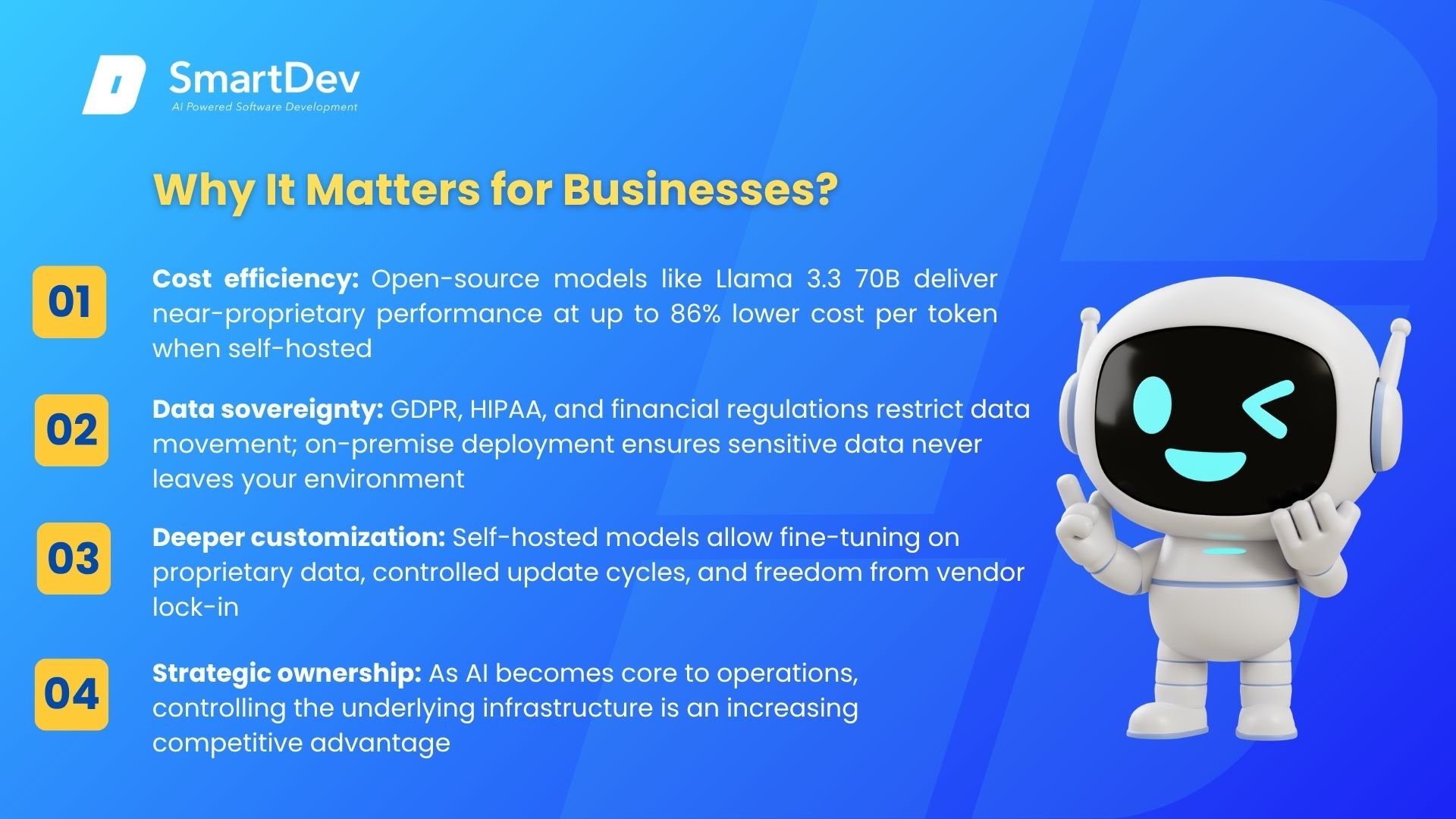
For regulated industries, data sovereignty is not optional. GDPR, HIPAA, and financial compliance regulations restrict where customer data may travel. Sending sensitive queries to a cloud AI provider can violate those restrictions. On-premise deployment eliminates the risk entirely because data never leaves your controlled environment.
Beyond compliance, self-hosted models enable deeper customization. Enterprises can fine-tune models on proprietary data, control model updates on their own schedule, and prevent vendor lock-in. As AI becomes central to business operations, ownership over the underlying infrastructure is increasingly seen as a strategic advantage.
Who Benefits Most?
Organizations in heavily regulated sectors are the clearest candidates for on-premise AI. Healthcare providers handling patient records, financial institutions processing transaction data, government agencies managing classified information, and legal firms dealing with confidential documents all have legal obligations that make cloud-based AI a significant liability.
Large enterprises with consistent, high-volume AI usage also benefit from self-hosting from a pure cost perspective. When an organization processes more than two million tokens per day, self-hosting typically becomes more economical than pay-per-token cloud APIs, with a typical payback period of six to twelve months on infrastructure investment.
IT outsourcing providers increasingly offer on-premise AI deployment as a managed service, handling model setup, infrastructure, and maintenance so that client organizations gain the benefits of self-hosted models without building internal ML engineering teams from scratch.
How Much Does It Cost?
The economics of on-premise AI have improved dramatically. A production-grade deployment of a 70-billion parameter model, sufficient for most enterprise use cases, can run on two NVIDIA A100 GPUs representing roughly a $30,000 hardware investment. This one-time cost can be recovered within a year for organizations with substantial AI workloads.
A minimum viable team typically requires one machine learning engineer and one DevOps engineer to operate a self-hosted deployment. For more complex, multi-region, or air-gapped environments, two to four specialists may be needed. IT outsourcing providers often supply these roles as part of a managed AI infrastructure service, making on-premise AI accessible to mid-sized organizations without large internal technology teams.
Ongoing costs include hardware maintenance, electricity, infrastructure support, and periodic model updates. Compared to scaling cloud API costs as AI usage grows, on-premise costs remain relatively flat, making total cost of ownership favorable for any organization planning to grow its AI usage over a multi-year horizon.
その他の関連用語
- AI Transformation: The organization-wide shift in how a business operates when AI becomes embedded in its core processes and decision-making. For enterprises in regulated sectors, on-premise AI is often the only viable path to full AI Transformation.
- AIの導入: The process by which an organization moves from experimenting with AI to embedding it meaningfully in day-to-day operations. On-premise AI removes the compliance and data sovereignty barriers that often stall AI Adoption in regulated industries.
- Technical Governance: The standards, processes, and oversight structures that ensure technical systems are built and operated consistently, securely, and in alignment with business requirements.