
TL;DR (Key Takeaways)
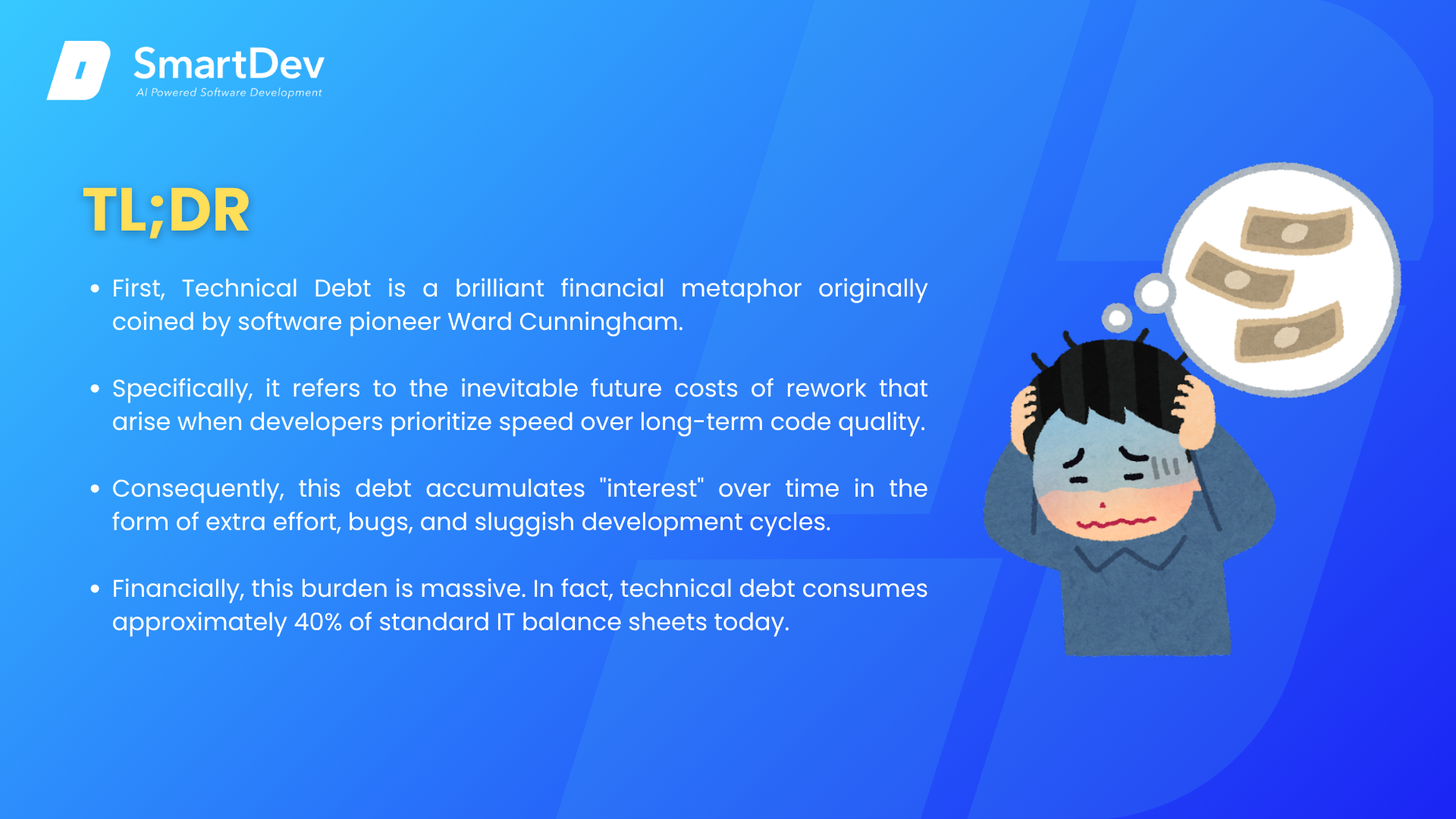
- First, Technical Debt is a brilliant financial metaphor originally coined by software pioneer Ward Cunningham.
- Specifically, it refers to the inevitable future costs of rework that arise when developers prioritize speed over long-term code quality.
- Consequently, this debt accumulates “interest” over time in the form of extra effort, bugs, and sluggish development cycles.
- Financially, this burden is massive. In fact, technical debt consumes approximately 40% of standard IT balance sheets today.Furthermore, fixing a bug late in the maintenance phase can cost 100 times more than addressing it early in the planning stage.
Ultimately, effective management requires a structured approach. For instance, companies like Shopify safely dedicate 25% of their engineering time purely to debt reduction.
What is Technical Debt?
Technical Debt, also known as code debt or design debt, is a fundamental concept in software engineering. Initially, Ward Cunningham coined this term to explain the long-term impact of rapid, imperfect coding to non-technical stakeholders. Specifically, the metaphor compares software shortcuts to taking out a financial loan.
Therefore, when a team writes quick, messy code to meet a strict deadline, they take on debt. As a result, they achieve a short-term speed advantage. However, they must eventually pay back the “principal” by refactoring the code. Meanwhile, they constantly pay “interest.” In this context, interest represents the extra hours developers waste navigating complex, fragile code to add new features.
Furthermore, Martin Fowler expanded on this concept by introducing the Technical Debt Quadrant. This framework categorizes debt into four main types. Namely, debt can be deliberate or inadvertent, and it can also be prudent or reckless. For example, a team might deliberately take on prudent debt to launch a product early.
Conversely, an inexperienced team might recklessly create inadvertent debt simply due to poor design knowledge. Ultimately, the longer you ignore the debt, the higher the interest rates climb.

なぜ企業にとって重要なのか
Undeniably, technical debt is not just an IT problem. Instead, it acts as a “silent killer” of enterprise modernization and overall business growth. Therefore, executives must recognize its severe financial impact.
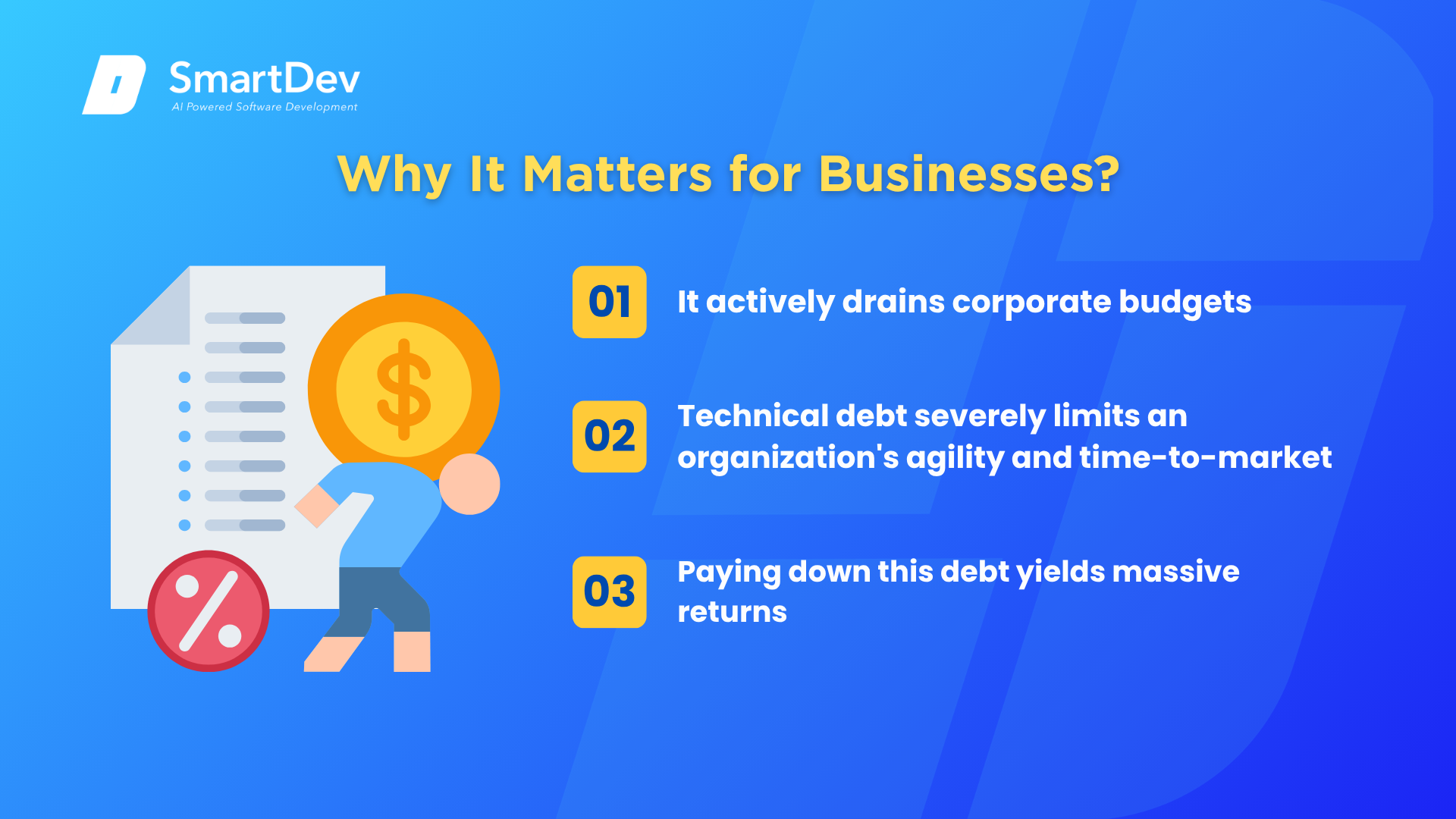
First, it actively drains corporate budgets. According to McKinsey, technical debt accounts for roughly 40% of IT balance sheets. Furthermore, organizations pay an additional 10% to 20% surcharge on every new project just to handle existing code complexities. Consequently, about 20% of the budget intended for exciting new products is diverted entirely to debt resolution.
In addition, technical debt severely limits an organization’s agility and time-to-market. As engineers become tangled in maintaining low-quality code, their capacity to deliver new features drops significantly. Moreover, failing to address this issue dramatically increases failure rates. For instance, companies with the highest severity of technical debt are 40% more likely to cancel their IT modernization projects.
Finally, paying down this debt yields massive returns. By actively remediating bad code, companies can free up their engineers to spend up to 50% more time on value-generating tasks. Ultimately, companies that successfully control their software debt achieve measurably superior business performance and higher revenue growth.
Auto-Picked Framework: Exploring the Who, How Much, and How
To truly master this concept, we must investigate who manages it, quantify its exact financial impact, and explore actionable reduction strategies.
Who is Responsible for Managing It?
Fundamentally, the engineering team holds the primary responsibility for managing codebase health. According to the official Scrum Guide, the Scrum Team never compromises on quality. Therefore, developers must actively identify and communicate code issues. Simultaneously, the Product Owner plays a vital role.
Specifically, the Product Owner must allow debt-reduction tasks to securely enter the Product Backlog. Consequently, both business and technical stakeholders must collaborate closely to balance feature delivery with code stability.
How Much Does Technical Debt Cost?
Startlingly, the financial metrics surrounding bad code are highly exponential. For example, an analysis of 160 organizations revealed that an average application carries roughly $3.61 of technical debt per line of code.
Furthermore, the cost to fix software bugs skyrockets over time. Specifically, if a team resolves a defect during the initial design phase, it might only cost $100.
However, if that same defect escapes into the maintenance phase, the repair cost surges to a staggering $10,000. Thus, catching errors late costs exactly 100 times more than early prevention. Additionally, CIOs estimate that technical debt makes up 20% to 40% of the value of their entire technology estate.
How to Mitigate and Control It?
Fortunately, businesses can adopt several proven strategies to reduce this burden effectively.
- Integrate Debt Sprints: First, organizations should embrace the “25 Percent Rule” championed by Shopify. By doing so, teams intentionally dedicate specific portions of their weekly sprints strictly to code cleanup and structural improvements.
- Strengthen the Definition of Done (DoD): Next, teams must enforce strict quality standards before marking any feature as complete. Specifically, this includes mandatory automated testing and thorough code reviews.
- Change the Conversation: Finally, developers must stop using technical jargon with executives. Instead of asking for time to do “code cleanup,” they should frame it financially. For instance, pitching a refactor as a “$120,000 investment that recovers $200,000 in capacity per year” immediately secures executive buy-in.
その他の関連用語
To fully understand this topic, you should familiarize yourself with several highly related software engineering concepts.
- Code Smells: Interestingly, this term was popularized by Martin Fowler. Basically, code smells are surface-level indicators of deeper technical debt. For example, a “Blob Class” or “Spaghetti Code” indicates that the software is poorly structured and highly prone to bugs.
- Refactoring: Crucially, this is the exact process used to pay back the technical debt. Specifically, refactoring involves restructuring existing computer code without altering its external behavior. Therefore, it successfully makes the code cleaner, simpler, and much easier to maintain.
- Legacy Code: Often, people confuse this term with technical debt. However, renowned expert Michael Feathers provides the most accurate definition. In his famous book, he defines legacy code simply as “code without tests”. Consequently, any code lacking automated testing, regardless of its age is incredibly dangerous and difficult to change.