

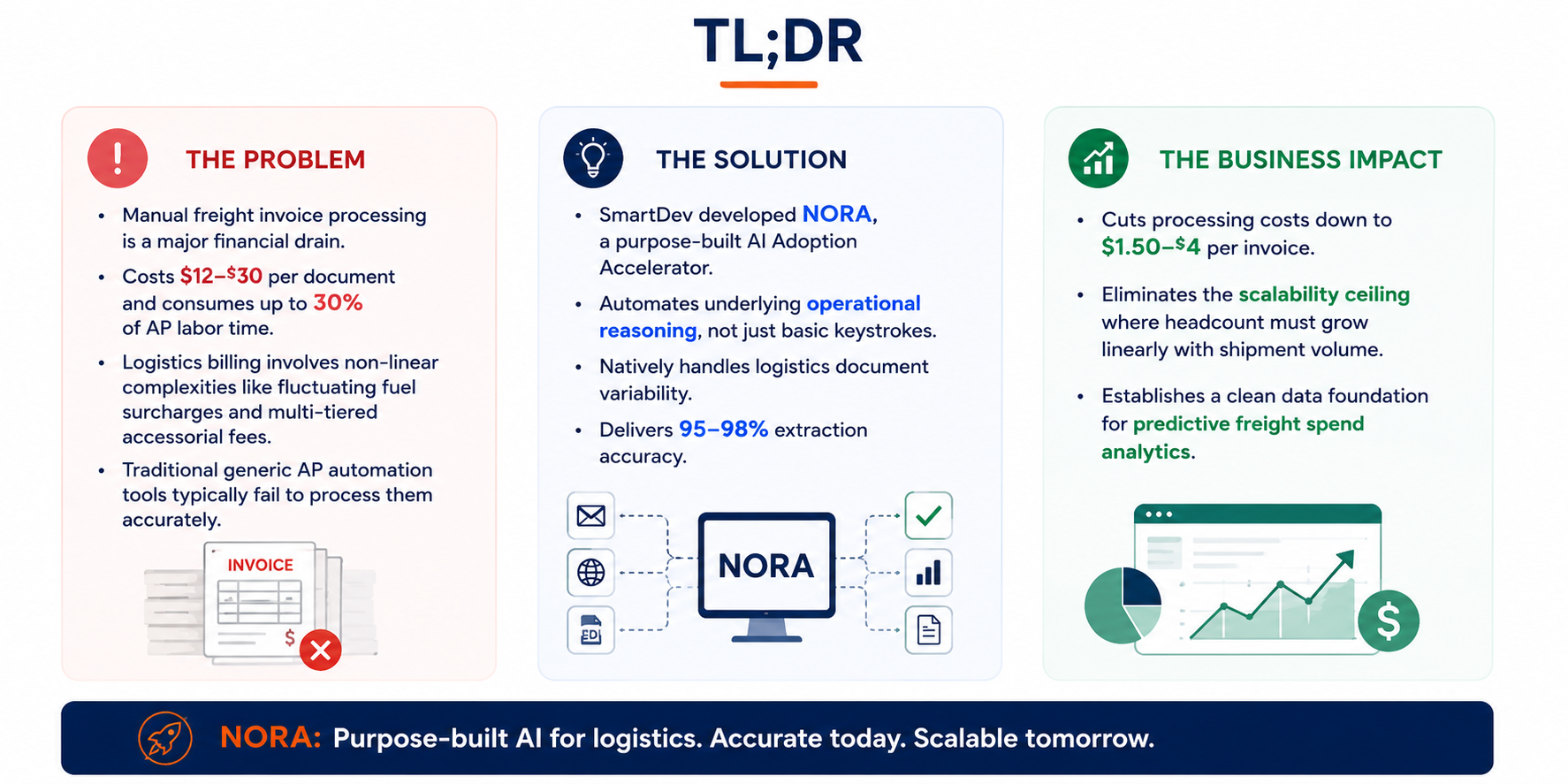
Every freight invoice carries two costs: the amount charged for the shipment, and the operational burden of processing that invoice manually. While most logistics operators focus on the freight cost itself, the hidden cost of back-office handling often goes unmeasured.
Introduction
Logistics operates on razor-thin margins, where every operational cost directly impacts profitability. Yet across freight, shipping, 3PL, and supply chain organizations, one costly inefficiency continues to persist: manual invoice processing.
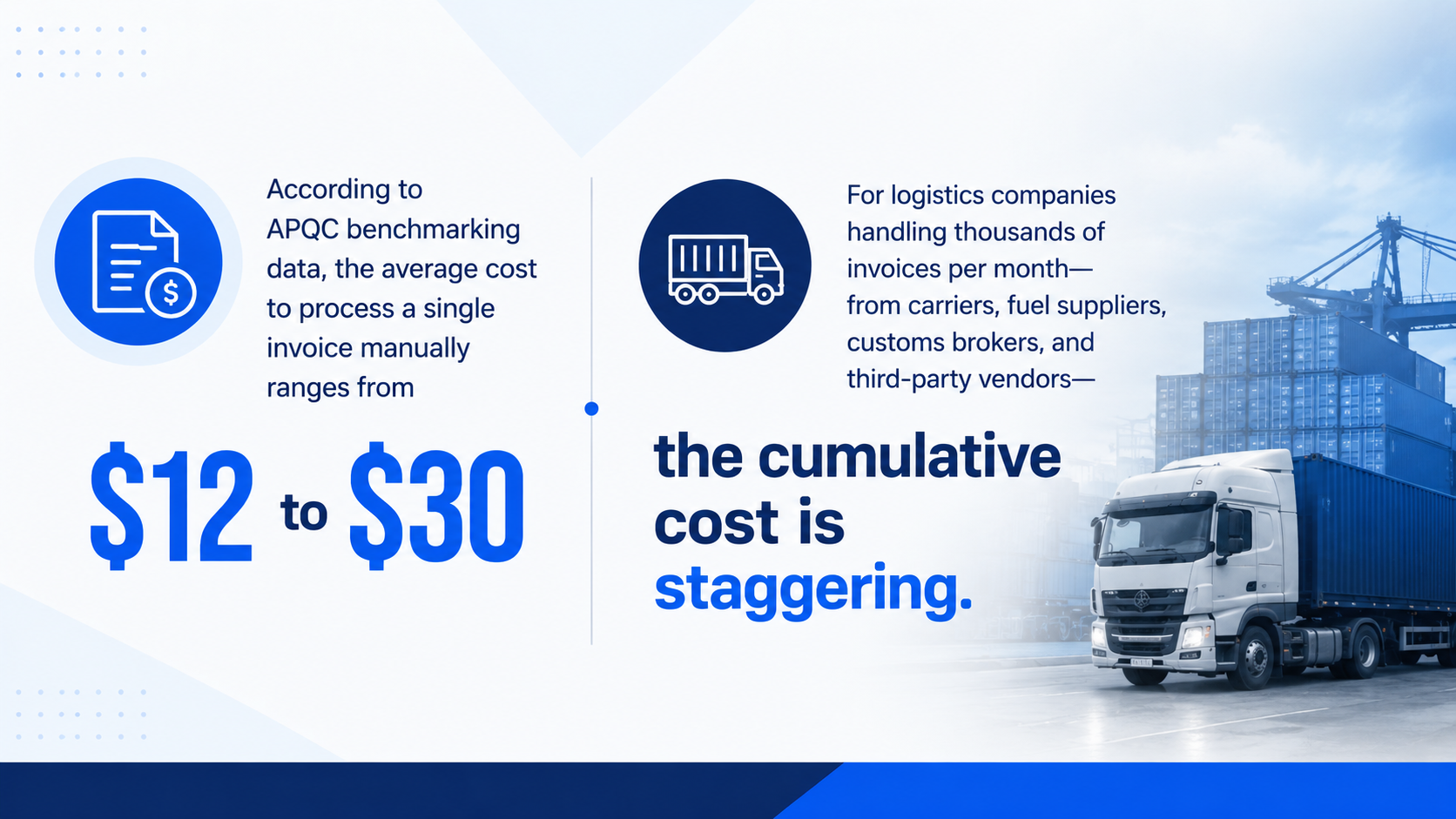
According to APQC benchmarking data, the average cost to process a single invoice manually ranges from $12 to $30. For logistics companies handling thousands of invoices per month, from carriers, fuel suppliers, customs brokers, and third-party vendors, the cumulative cost is staggering.
This article breaks down exactly where manual invoice processing bleeds money in logistics, quantifies the true cost, and outlines a practical path toward end-to-end automation. If you’re a logistics operations leader, CFO, or technology decision-maker, this is your roadmap.
What Manual Invoice Processing Looks Like in Logistics
The Manual Freight Invoice Processing Workflow
Before you can calculate the true cost of operational inefficiency, you need to map out what “manual” looks like on the ground. For logistics companies that haven’t modernized their accounts payable workflow, the daily routine is a time-consuming, error-prone obstacle course.
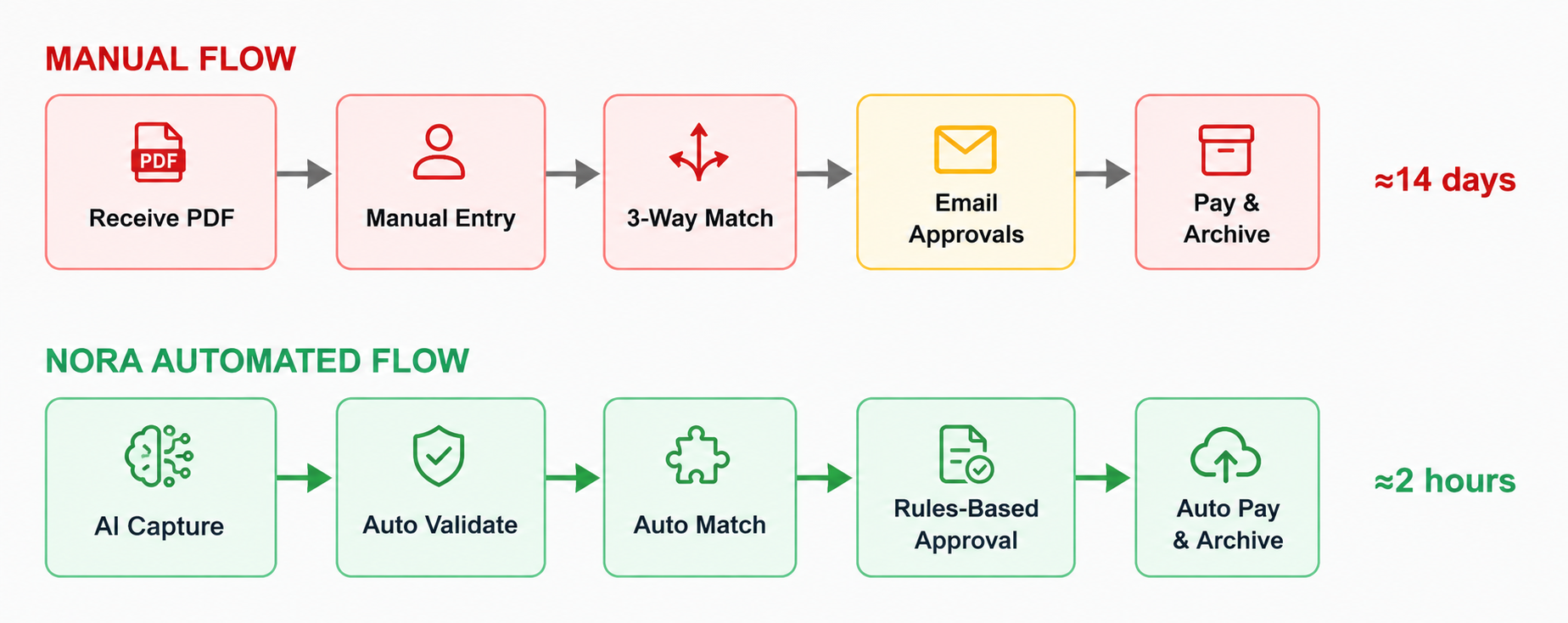
Here is the step-by-step breakdown of the typical manual invoicing process:
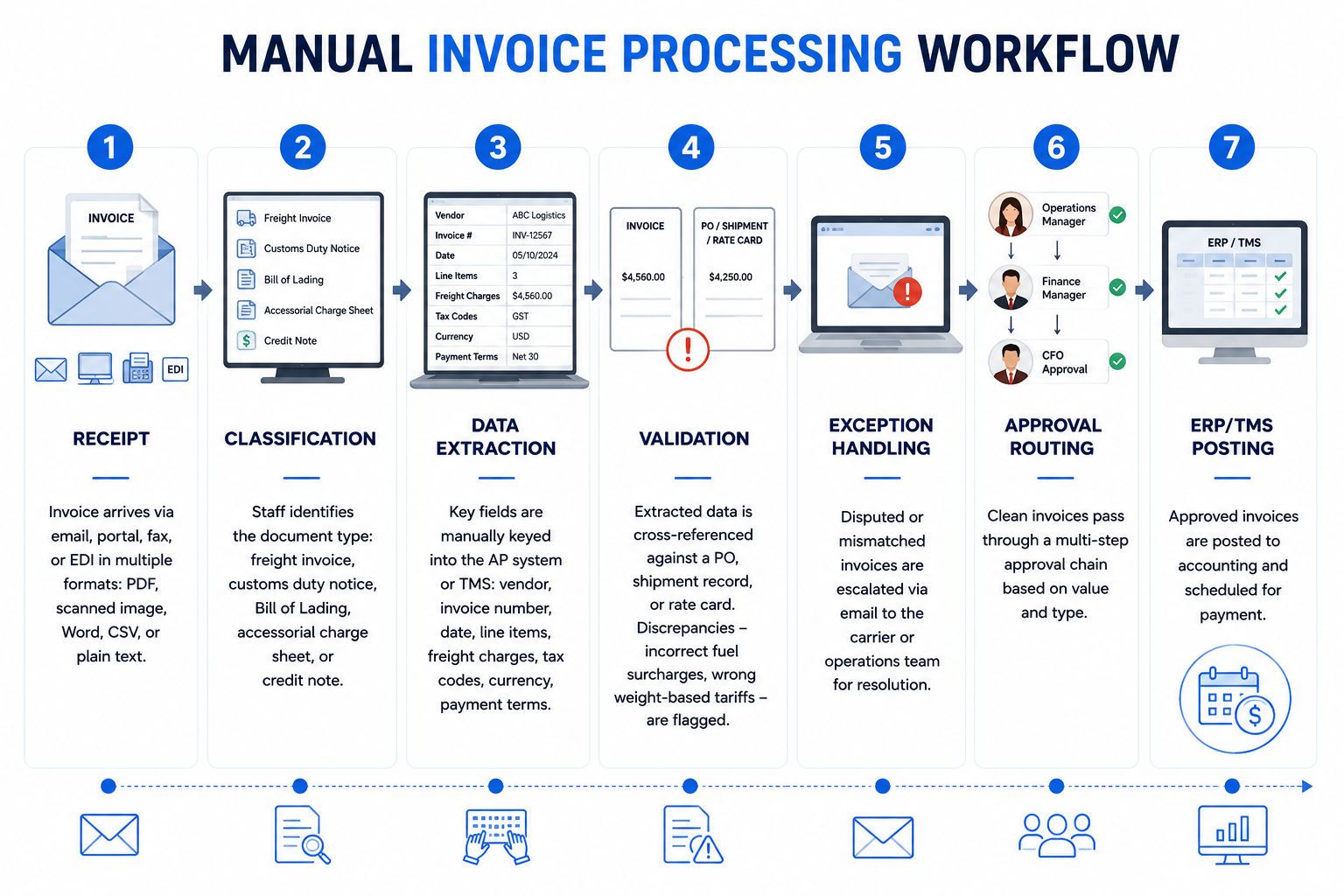
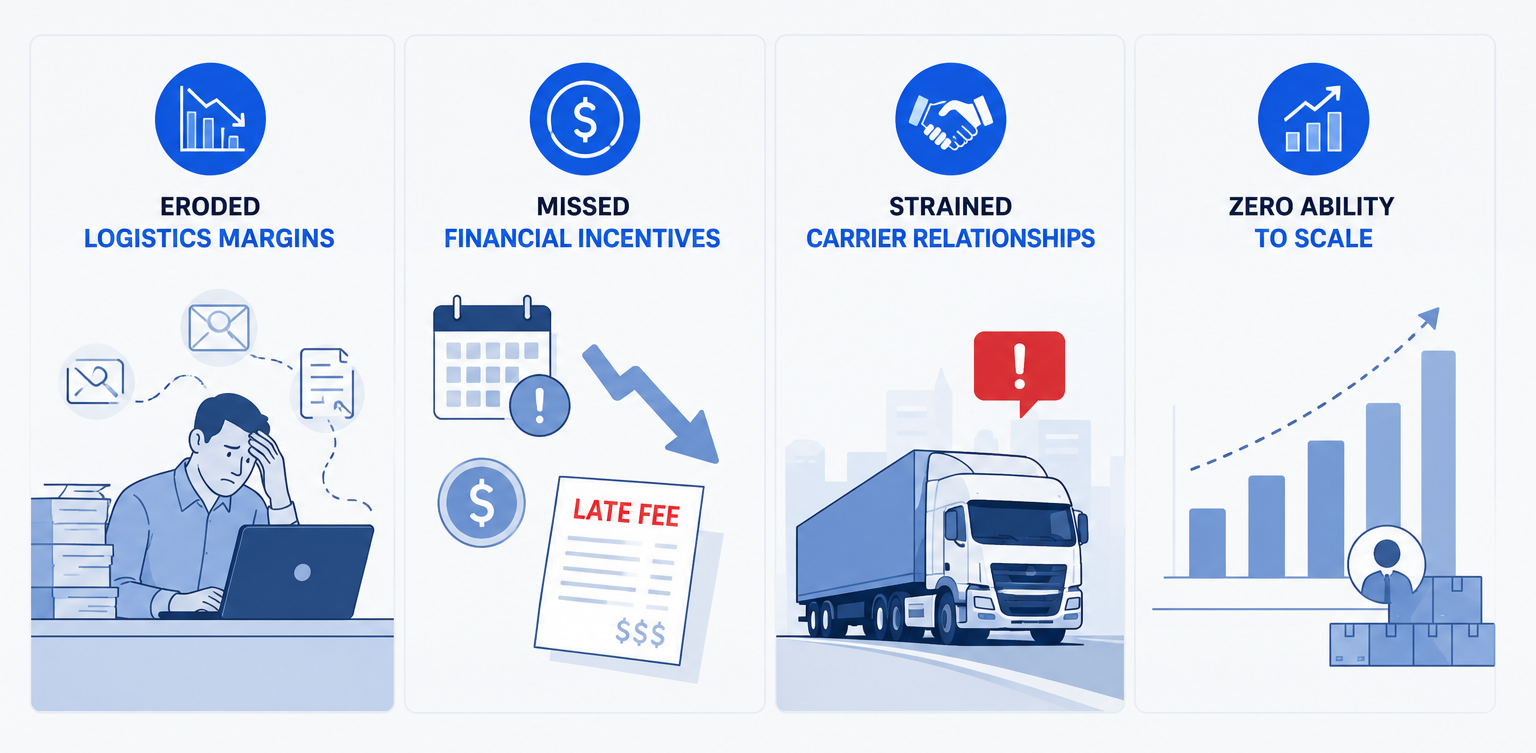
This fragmented, seven-step manual process isn’t just a minor daily headache for your finance team; it is a massive financial drain on your entire logistics operation. When you multiply the time spent on manual entry, the hours lost chasing down internal approvals, and the days wasted on carrier disputes across thousands of invoices per month, the hidden operational costs become staggering.
Left unchecked, this outdated approach impacts your business in four critical ways:
However, as painful as this sounds, it’s only half of the story.
While manual accounts payable (AP) is a universal headache for any business, the supply chain world doesn’t operate like standard retail or corporate offices. The sheer nature of freight, shipping, and global trade adds layers of chaos that standard software can’t handle.
Why Logistics Is Especially Vulnerable
A single shipment can generate four to seven separate invoices: freight, fuel surcharges, detention fees, accessorial charges, customs broker invoices, and port fees, each with its own format, vendor, currency, and approval path. According to McKinsey’s logistics practice, supply chain finance functions spend up to 30% of total AP labor time resolving invoice discrepancies alone.
Breaking Down the True Cost: A Numbers First Analysis
Direct Labor Costs: The True Burden of Manual Invoice Processing in Logistics
Many finance leaders underestimate back-office overhead, yet manual invoice processing in logistics tells a far more costly story. According to data from the Institute of Finance & Management (IOFM), manual invoice processing averages between $10 and $15 per document, while teams using invoice automation software reduce that cost to just $2.36.
For 3PLs and freight forwarders, freight invoice management becomes even more complex due to volatile fuel surcharges, accessorial charges, and detention fees. As a result, without logistics billing automation, invoice validation consumes significant administrative time and resources.
To put this into perspective, a mid-sized 3PL processing 5,000 invoices per month at the $15 manual rate faces approximately $75,000 in monthly processing costs, ultimately creating a staggering annual labor burden of $900,000 spent largely on manual paperwork.
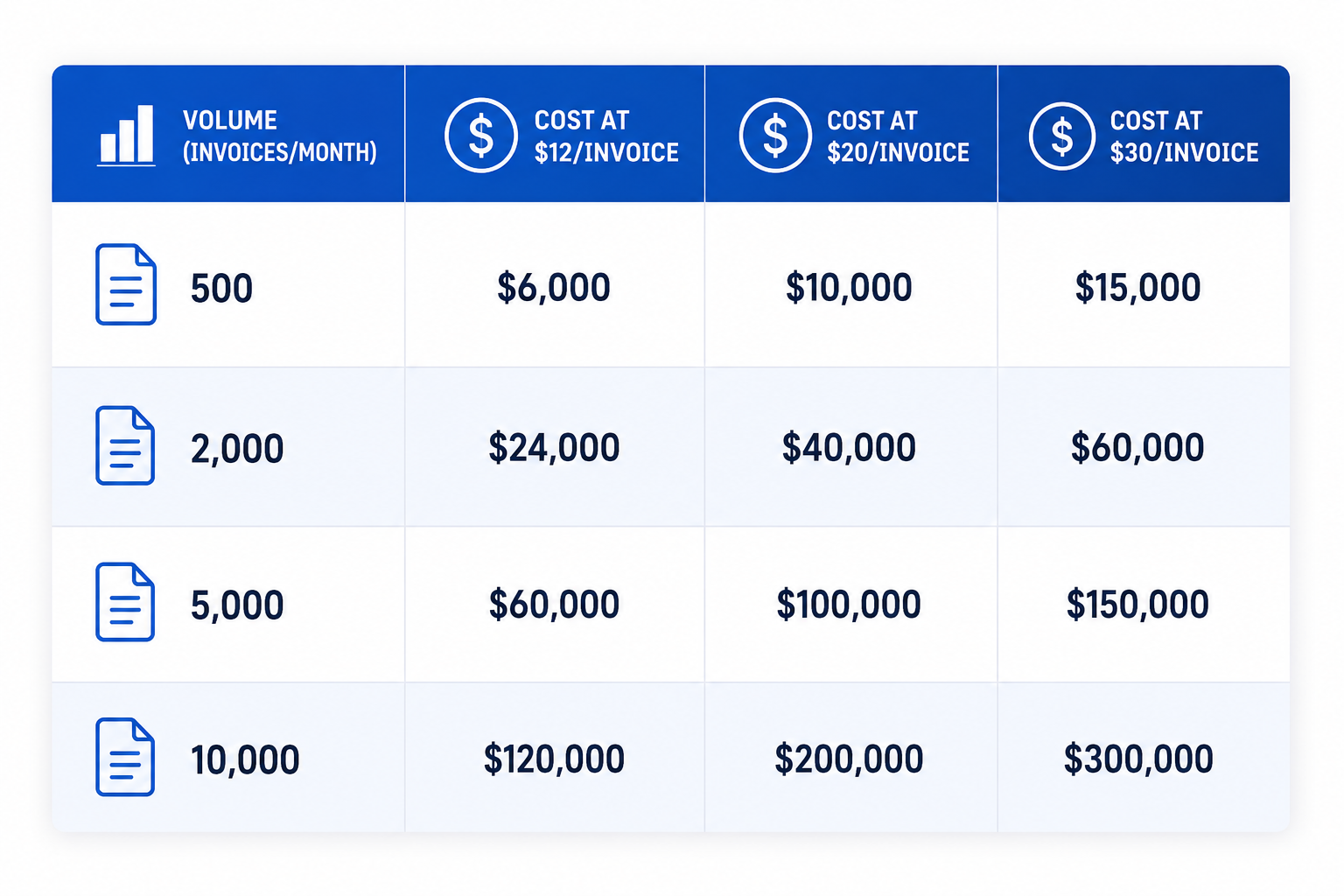 Source: IOFM 2024 AP Benchmarking Report. Costs include staff time, supervision, rework, and system overhead.
Error Rates and Their Downstream Cost
Manual data entry in logistics invoice processing carries a 1–3% error rate under normal conditions, rising to 5–8% during volume spikes. These errors manifest in four specific, measurable ways:
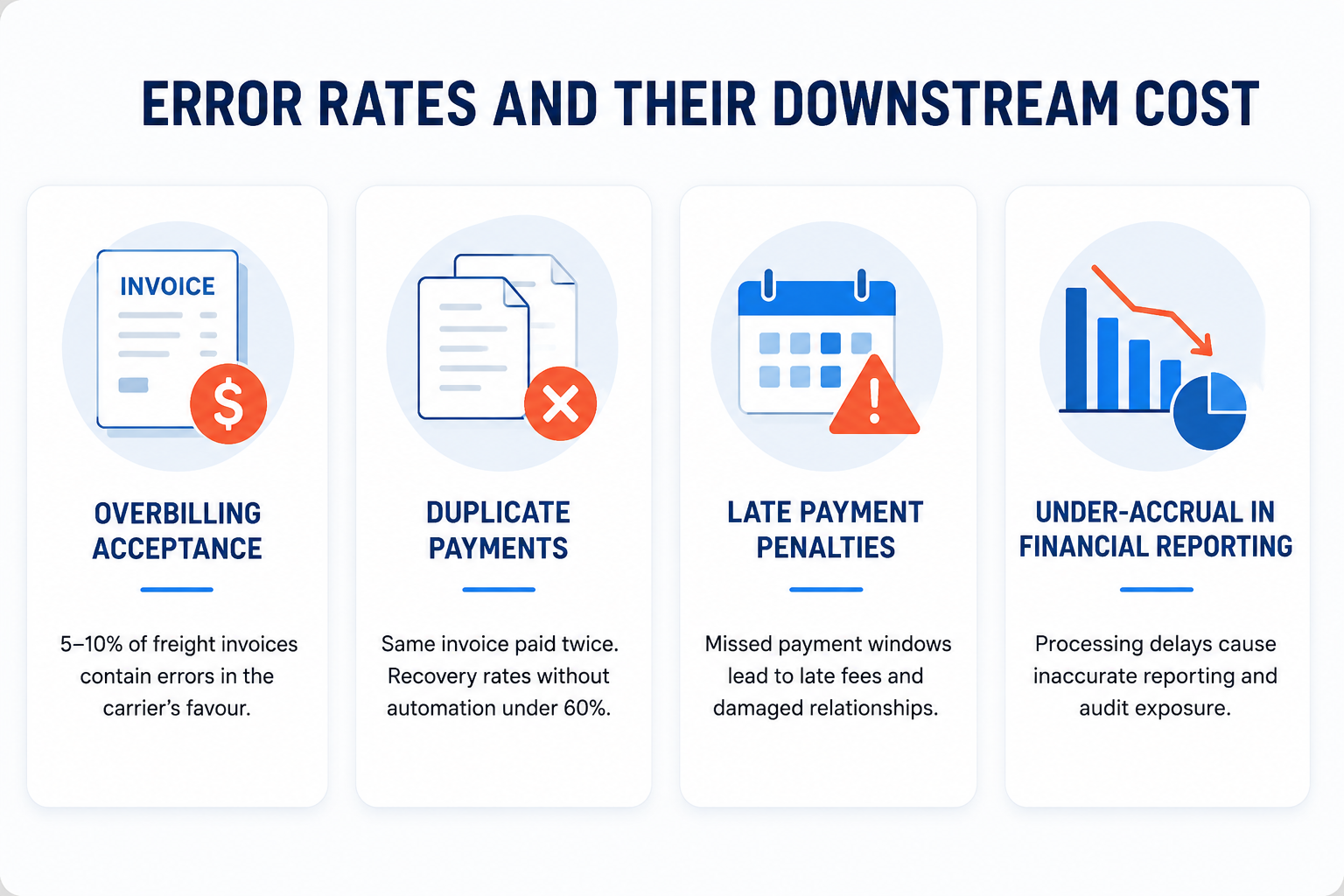
When aggregated, these systemic leakages, from unrecovered overbillings to compromised P&L accuracy, demonstrate that manual processing introduces unacceptable operational risk. For logistics enterprises operating in a high-volume, low-margin environment, eliminating these financial blind spots is critical. Transitioning to automated internal controls is no longer just about back-office efficiency; it is a fundamental strategy for margin preservation, working capital optimization, and corporate governance.
The Operational Opportunity Cost of Manual Invoice Processing
This is the cost that never appears in a budget, but compounds hardest over time. Skilled AP and operations staff spending 60–70% of their time on data entry and exception chasing are not:
- Analyzing carrier rate trends to negotiate better contracts
- Monitoring freight spends anomalies that signal operational inefficiency
- Building the vendor intelligence that improves payment terms
- Developing the forecasting capability that gives finance better cost visibility
Manual invoice processing does not just cost money. It structurally prevents the people closest to your freight to spend data from doing anything useful with it.
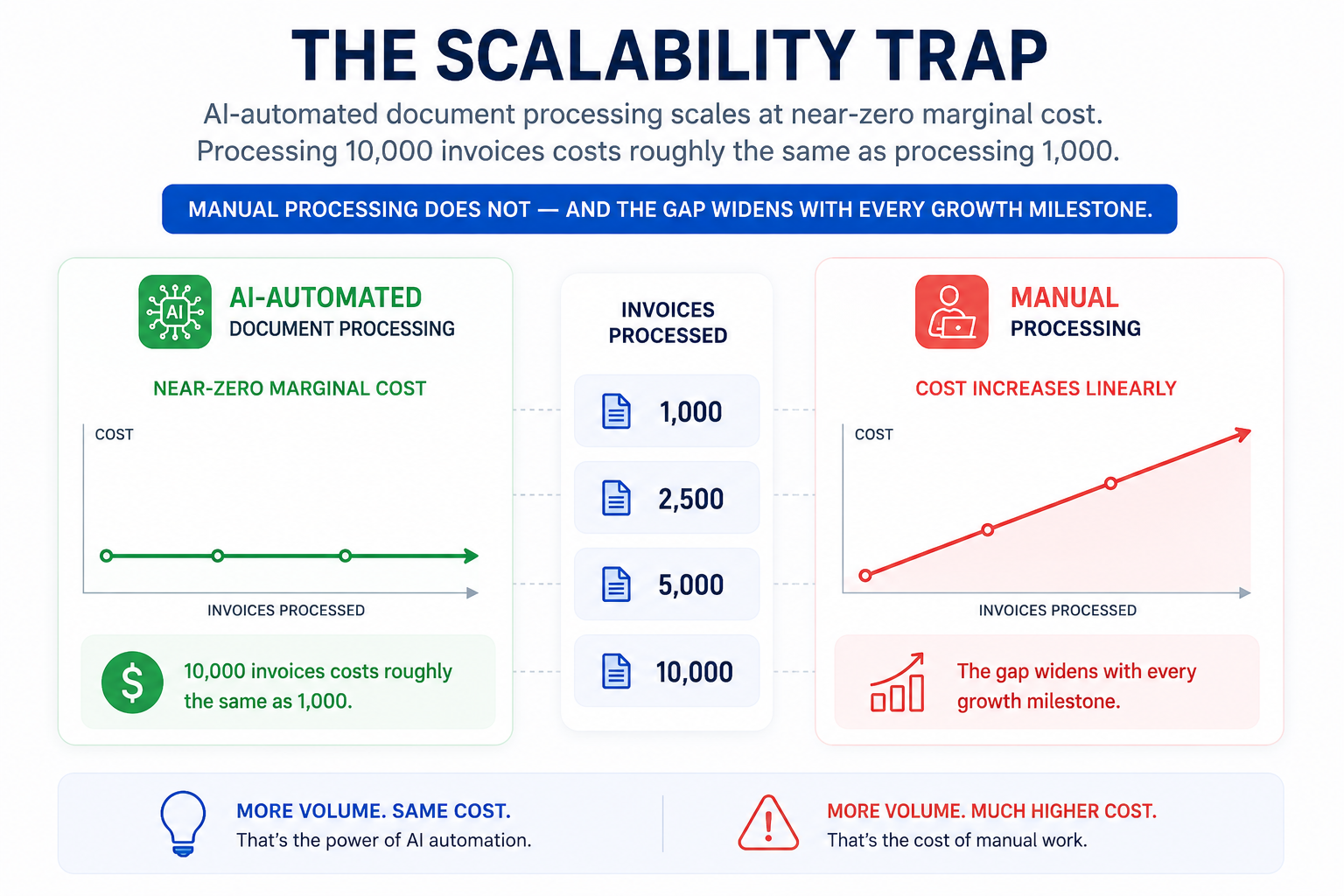
The Scalability Ceiling
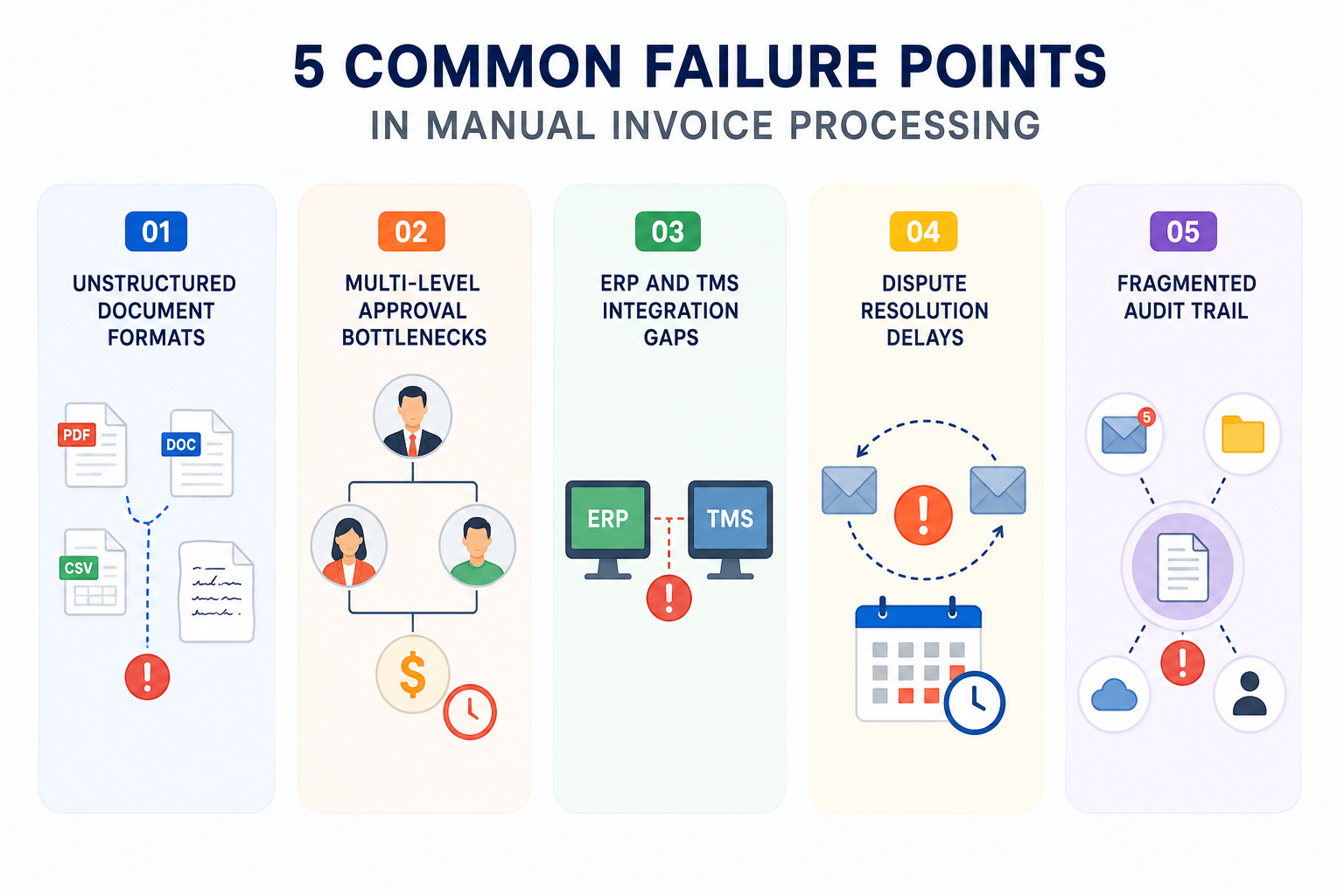
Where Manual Processing Breaks Down: Five Failure Points
This fragmented, seven-step manual process is not just a minor daily headache for your finance team; rather, it is a major financial drain on your entire logistics operation. As you multiply the time spent on manual entry, the hours lost chasing internal approvals, and the days wasted resolving carrier disputes across thousands of invoices each month, the hidden operational costs quickly become staggering.
Furthermore, when left unchecked, this outdated approach impacts your business in four critical ways:
The Blueprint for AI-Powered Invoice Processing in Logistics
These workflows bottlenecks often stem from excessive administrative hours spent on manual data extraction. Moreover, these repetitive tasks align closely with automated pattern recognition capabilities. For logistics operators managing narrow margins, cognitive automation provides a systematic way to stabilize operational costs.
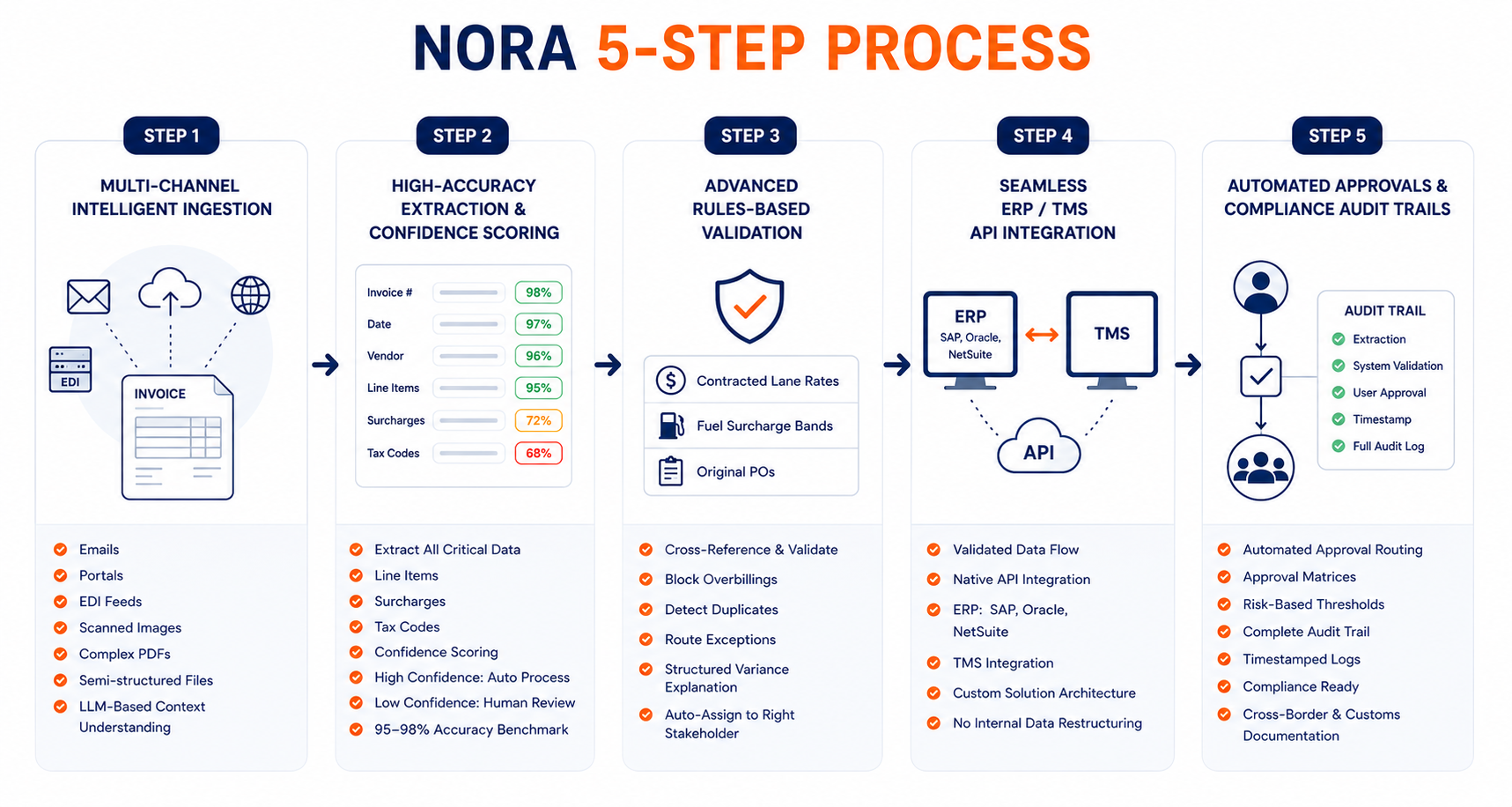
To address this challenge, SmartDev developed NORA, an AI Adoption Accelerator built to automate complex AI Automation: Document & Data Processing workflows across the logistics supply chain. Unlike generic OCR or rule-based RPA, NORA goes beyond simple data extraction. Instead, it applies operational reasoning across complex logistics processes. Furthermore, it validates logistics variables against carrier rate cards and contextualizes supply chain data. At the same time, confidence-based validation ensures only genuine anomalies are flagged for review.
Powered by SmartDev’s AI Development Services framework, NORA combines LLMs, computer vision, and rules-based validation. As a result, it can manage the document variability that makes logistics processing uniquely complex.
Inside an Intelligent Logistics AP Pipeline
To eliminate manual friction, this modern architecture replaces fragmented steps with a unified, automated pipeline. By combining LLM-powered data extraction (operating at 95–98% accuracy) with automated contract validation and native ERP/TMS integration, NORA systematically eliminates data entry errors, blocks financial leakage, and secures total compliance at scale.
Quantifying the Impact: Manual Baseline vs. AI Automation with NORA
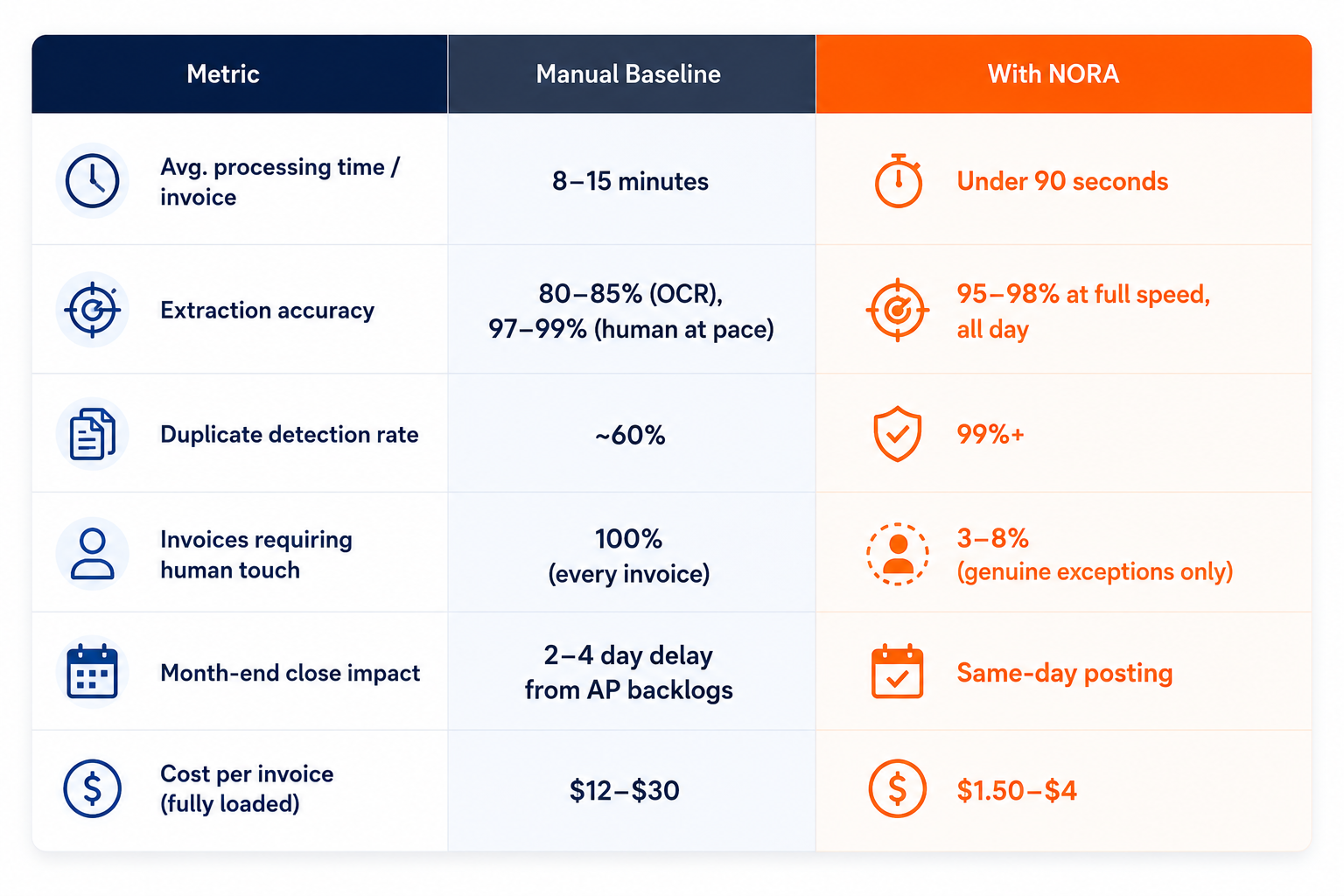
The ROI threshold is lower than most logistics teams expect. Organizations processing just 200+ invoices monthly often achieve positive ROI within the first billing cycle after deployment. Use the NORA ROI Calculator to estimate operational savings and efficiency gains based on your actual processing volume.
Beyond Invoices: The Full Document Automation Opportunity
NORA’s document intelligence extends beyond invoice processing across the entire logistics back-office ecosystem, from Bills of Lading and customs documents to Proof of Delivery and rate confirmations. Once the infrastructure is in place, expanding new document types becomes significantly faster. That’s why SmartDev positions NORA as an AI Adoption Accelerator: a scalable intelligence layer for end-to-end logistics operations
Connecting to the Wider Supply Chain AI Stack
Invoice automation does not exist in isolation. Once freight spend data flows cleanly and automatically into your systems, it becomes the foundation for a broader set of AI use cases in supply chain management:
- Freight spend analytics – Identify carriers charging above contracted rates, spot lane cost trends, benchmarks against market rates in real time.
- Cash flow forecasting – Accurate, real-time accruals enable treasury teams to forecast outflows with genuine precision.
- Carrier performance scoring – Combine invoice data with delivery performance data for a complete vendor scorecard.
- Anomaly detection – Flag statistically unusual charges automatically before payment.
SmartDev’s Data Analytics Services can layer these capabilities on top of the NORA document processing foundation – transforming your invoice workflow from a cost center into a source of operational intelligence. For a broader view of AI creating value across logistics, see SmartDev’s complete guide to AI Use Cases in Logistics.
The Blind Spot of Generic Automation: Why Logistics Demands Purpose-Built AI
Logistics-Specific Document Intelligence
Generic AP platforms are designed for standard B2B invoices with simple line items and fixed totals. However, freight invoices contain fuel surcharge tables and complex accessorial charge structures. In addition, they include lane-based tariffs and weight-break calculations that standard AP tools cannot validate. To solve this challenge, NORA uses configurable validation logic tailored to freight billing complexity.
Built on Proven AI Engineering, Not Off-the-Shelf OCR
SmartDev’s engineering teams have delivered AI-powered invoice processing at production scale across global logistics operations. Furthermore, NORA is powered by LLM-assisted extraction and validation architecture.
SmartDev also supports more than 300 global clients across multiple industries. In addition, the company holds ISO 27001 and SOC 2 Type 2 certifications. Backed by the Verysell Group, SmartDev delivers enterprise-grade security and support from day one.
The Entry Point to a Broader AI Adoption Journey
For logistics operators looking beyond invoice processing, NORA acts as a foundation for scalable AI adoption across back-office operations. SmartDev’s State of AI Adoption report found that only 1% of firms consider themselves mature in AI deployment, not because the technology is lacking, but because many initiatives never move beyond the pilot stage. NORA is designed to help enterprises bridge that gap and turn AI experimentation into measurable operational impact. Explore SmartDev’s full AI & Machine Learning capabilities to see how enterprises are building scalable AI-driven operations.
Conclusion: The Cost of Waiting Is Not Zero
Manual invoice processing in logistics is not merely a background inconvenience; rather, it is a quantifiable, compounding cost embedded within every finance team that has not yet automated. Labor costs are measurable, while error exposure is equally calculable. At the same time, the scalability ceiling is very real, and it tightens further with every new carrier, every additional lane, and every shipment a business adds to its network.
Meanwhile, the technology itself is no longer experimental. NORA processes logistics invoices with 95–98% extraction accuracy while validating against real business rules. In addition, it integrates seamlessly with existing ERP and TMS platforms, routing only true exceptions to operations teams. As a result, the challenge is no longer the maturity of the technology itself; instead, it is how quickly enterprises are willing to adopt AI-driven operations.
Furthermore, according to McKinsey, early adopters of AI-driven document processing in supply chain environments have reported logistics cost reductions of up to 15% alongside service-level improvements of as much as 65%. Similarly, Gartner estimates that 70% of logistics providers will have implemented AI-driven solutions by 2026. Consequently, the operators moving now are not simply saving money; they are actively building the operational infrastructure and institutional data advantages that late adopters will eventually struggle to catch up with.
Every month of continued manual processing is a month of quantifiable overspend, undetected billing errors, and a wider gap to close later. The NORA ROI Calculator puts a specific number on what that delay costs your business. The answer is rarely comfortable, but it is always clarifying.
Ready to Fix Your Invoice Processing?
At SmartDev, we help enterprises integrate NORA into existing logistics workflows. As a result, businesses can reduce manual processing overhead and improve document accuracy. In addition, NORA helps accelerate operational efficiency at a scale. For organizations moving beyond isolated AI use cases, NORA provides a scalable document intelligence layer. Furthermore, it connects and automates critical back-office operations across the logistics ecosystem. Contact us to explore how NORA can modernize invoice processing, strengthen operational visibility, and deliver measurable business impacts.