

Discover why 300+ Fortune 500 companies are shifting development operations to Vietnam and achieving 60-70% cost savings without sacrificing quality. This data-driven analysis reveals exact ROI projections, cost breakdowns, and proven best practices that transform offshore partnerships into competitive advantages.

The Vietnam Advantage: Financial Reality Over Speculation
The offshore software development market is saturated with promises but short on transparent financial data. US companies considering Vietnam development partnerships deserve concrete numbers, not marketing rhetoric. The financial case for Vietnam is compelling when examined through an ROI and cost-benefit framework that factors in total cost of ownership, quality metrics, and delivery velocity.
Vietnam’s competitive positioning stems from a fundamental economic advantage: senior software developers earn approximately $18,000–30,000 annually compared to $80,000–120,000 for equivalent roles in the United States, delivering a 60–70% cost advantage without engineering quality compromise. This gap widens significantly when calculating project-level costs and organizational profitability impacts.
For a US company operating 10 mid-level developers, the annual cost comparison demonstrates immediate financial impact. US-based development costs approximately $750,000–$1,000,000 annually (at $75,000–$100,000 per developer with benefits and overhead). Vietnam-based teams for equivalent capability cost $200,000–$350,000 annually. The financial delta—$400,000–$750,000 annually, represents capital that can accelerate product development, fund additional initiatives, or enhance margins. Learn more about Vietnam’s cost advantages and 60% savings potential.
Quantified ROI: Vietnam vs. Global Alternatives
SmartDev, a Swiss technology company with development operations centered in Vietnam, achieved 175% revenue growth after establishing Vietnamese development infrastructure. This metric transcends cost savings; it represents organizational acceleration enabled by more efficient capital deployment.
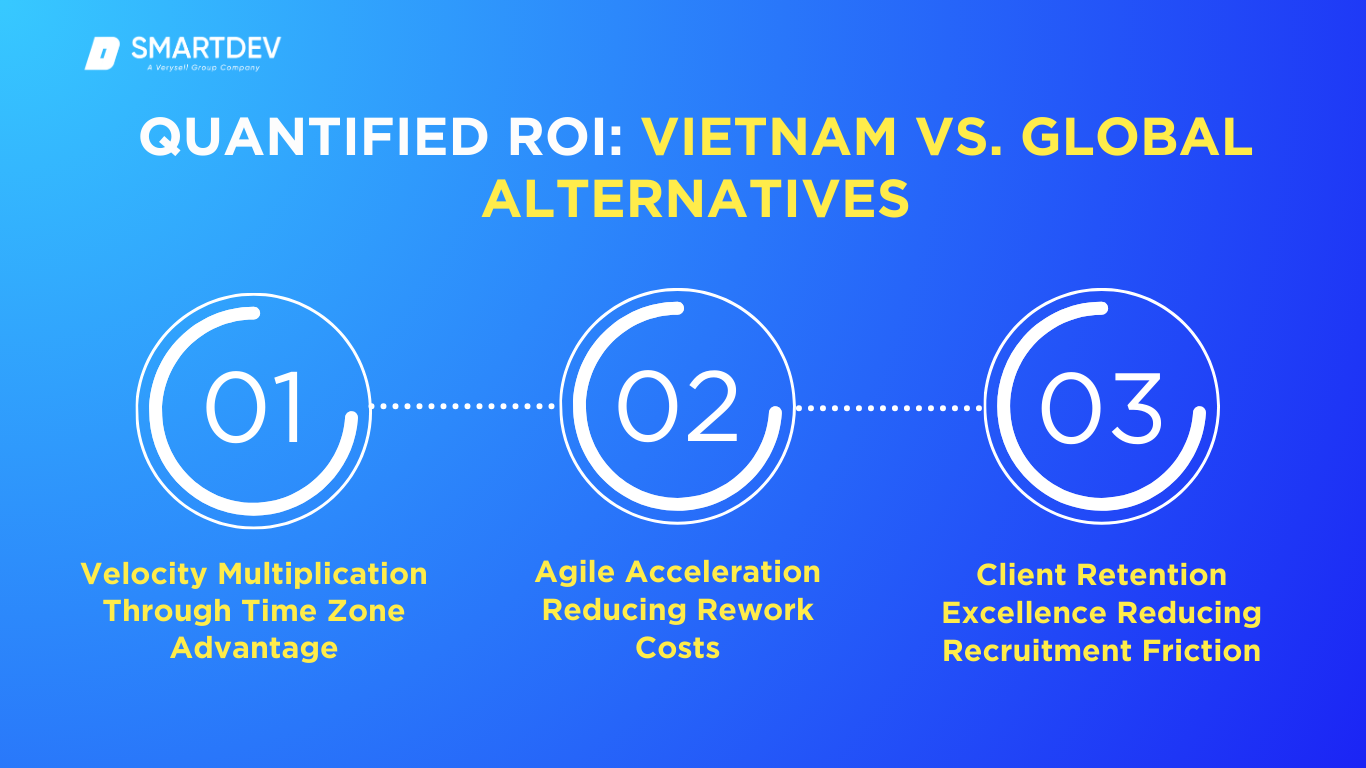
The mechanisms driving this ROI extend beyond hourly rate arbitrage:
1. Velocity Multiplication Through Time Zone Advantage
Vietnam operates UTC+7, creating 12–13 hours of offset from US Eastern Standard Time. This asynchronous advantage enables true 24/7 development cycles. When US teams conclude work (5:00 PM EST), Vietnamese teams begin their workday. Documentation completed by US teams provides Vietnamese developers immediate context for the subsequent 8-hour development cycle.
Organizations implementing structured handoff protocols report 30% reduction in delivery bottlenecks through optimized code review and scheduled overlap meetings. This operational efficiency translates into tangible project acceleration. A project estimated at 16 weeks with co-located teams may complete in 12–13 weeks with properly orchestrated Vietnam-US collaboration. Understand the best practices for managing offshore development teams in Vietnam to maximize this advantage.
For a $500,000 project, 3-week acceleration represents approximately $94,000 in carrying cost reduction (calculating at $6,000 weekly project burn), plus accelerated revenue realization from features reaching market faster.
2. Agile Acceleration Reducing Rework Costs
Over 70% of Vietnamese IT companies incorporate formal Agile practices, primarily Scrum and Kanban methodologies. This adoption isn’t aspirational—it’s embedded in organizational DNA. Vietnamese teams employ Jira, conduct daily stand-ups, and execute 2-week sprints as operational default, not corporate mandate.
Agile implementation in Vietnam reduces project timelines by up to 30%, with additional quality benefits. Iterative development cycles enable early course correction, preventing expensive rework cycles that plague traditional waterfall projects. When Agile teams identify requirements misalignment during sprint 2, correction costs $15,000. When waterfall teams identify the same issue at implementation, correction costs $120,000. Explore DevOps services in Vietnam to understand how continuous integration accelerates delivery.
3. Client Retention Excellence Reducing Recruitment Friction
Vietnamese outsourcing providers using Agile achieve higher client satisfaction, with 85% of projects meeting deadlines. Organizations maintaining long-term partnerships with Vietnamese development centers experience compounding efficiency gains.
First-project learning curves typically consume 15–20% of initial engagement overhead. By project three, teams have developed institutional knowledge of client architecture, business logic, and quality standards, operating at 95%+ efficiency. This retention economics creates perpetual gains: each retained project operates 10–15% more efficiently than acquisition-heavy models.
For organizations budgeting $2,000,000 annually for development, the 10–15% efficiency gain across retained partnerships equals $200,000–$300,000 in annual productivity multiplication.
Detailed Cost-Benefit Framework: From Theory to Deployment
Hourly Rate Transparency and Reality
Published hourly rates for Vietnamese developers range from $18–45 per hour, depending on experience level and specialization. This structure provides clarity for rate-based engagements but obscures total cost of ownership in project-based models.
Breaking down Vietnamese developer economics by capability tier:
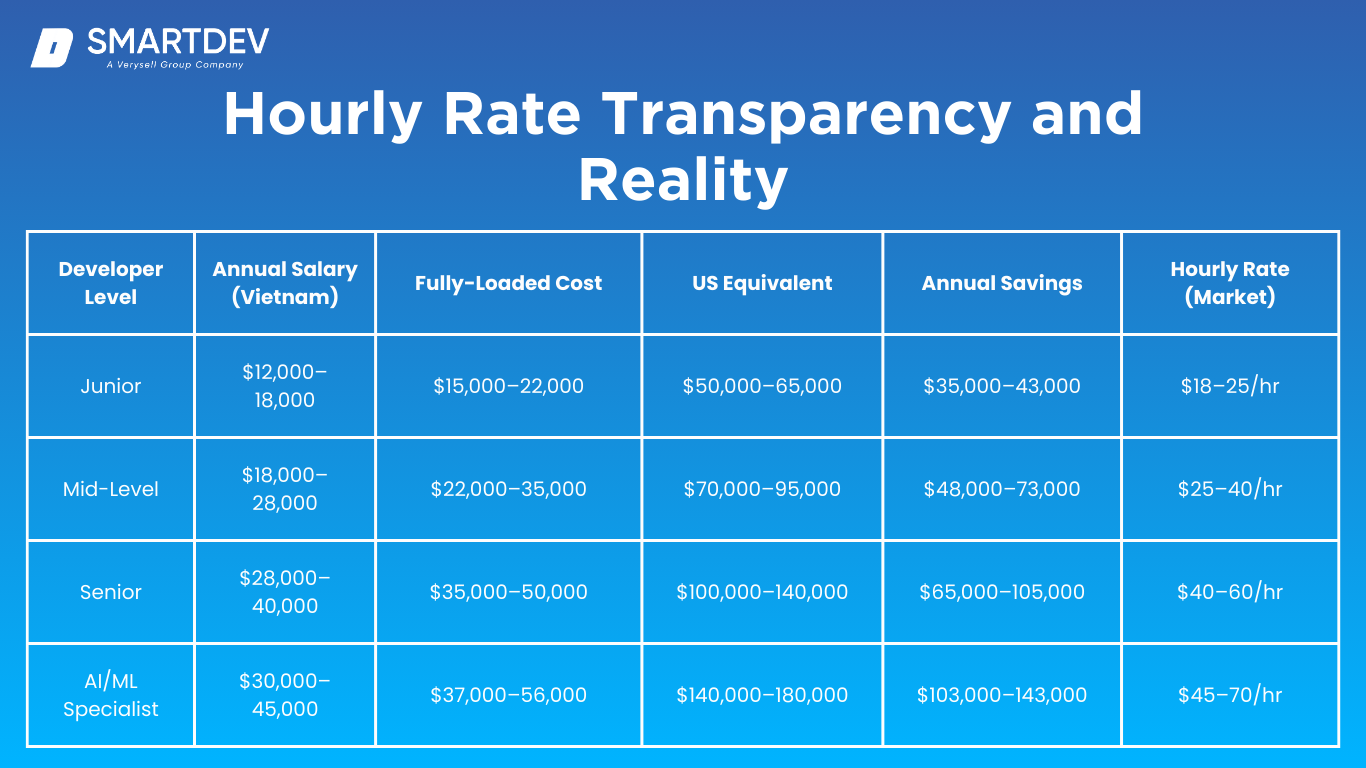
The fully-loaded cost in Vietnam includes salary, benefits, facilities, management overhead, and infrastructure. This calculation demonstrates that even comprehensive cost accounting produces 60–70% savings versus US employment.
Practical Project Cost Examples
Consider a US fintech startup requiring a custom loan origination platform with web and mobile interfaces. Project scope: 8,000 engineering hours across 6 months.
US-Based Development Estimate:
-
4 Senior developers at $120/hour blended rate = $30,720/week
-
26-week project = $798,720
-
Project infrastructure, testing, DevOps = $120,000
-
Total Project Cost: $918,720
Vietnam-Based Development:
-
4 Equivalent developers at $45/hour blended rate = $11,520/week
-
26-week project = $299,520
-
Project infrastructure, testing, DevOps = $40,000
-
Management and coordination overlay = $35,000
-
Total Project Cost: $374,520
Cost Differential: $544,200 (59% savings)
This savings enables strategic reallocation: the $544,200 funds additional feature development, accelerates market launch through parallel work streams, or enhances operating margin if project value is fixed.
5-Year ROI Analysis: Dedicated Vietnam Development Center vs. Hybrid US Model
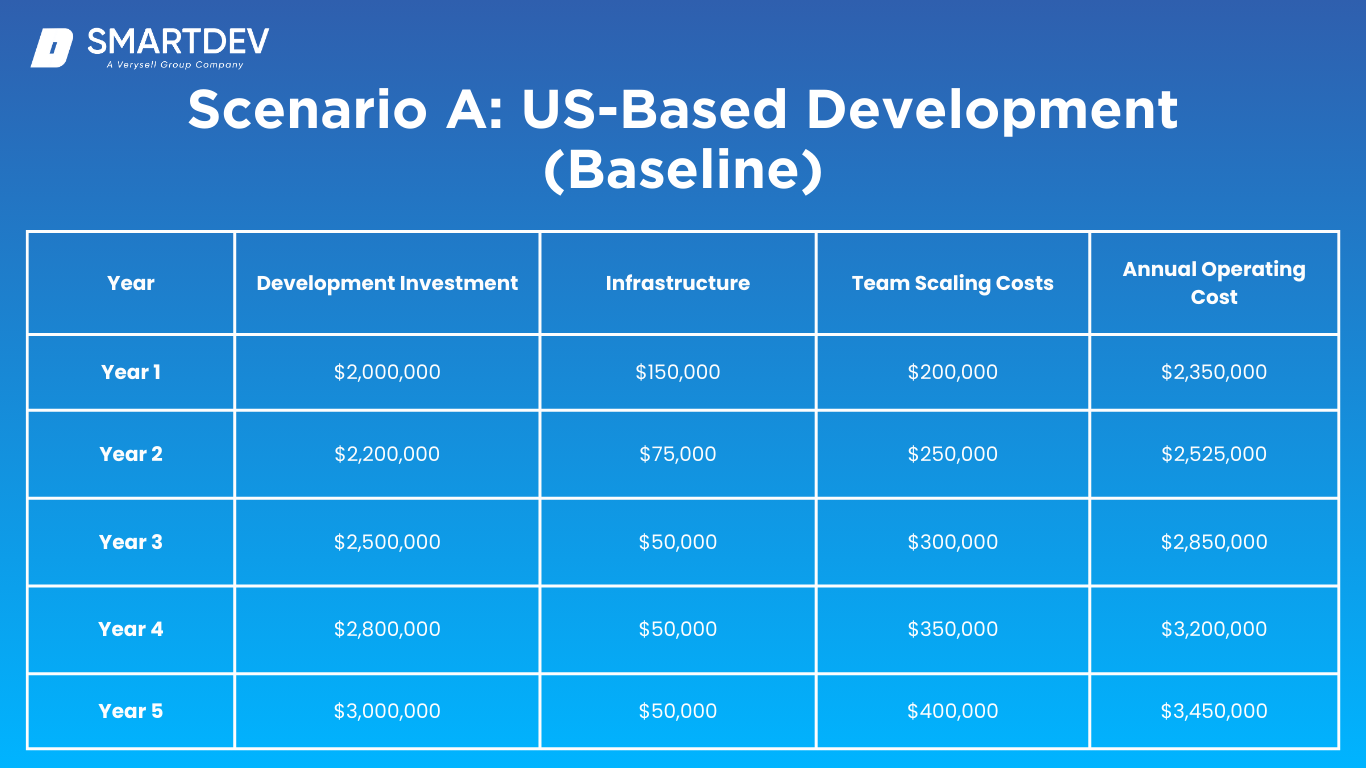
Establishing a dedicated Vietnam development center requires initial infrastructure investment but generates compounding returns. Consider a US B2B SaaS company planning $10,000,000 in five-year development investment.
Scenario A: US-Based Development (Baseline)
Scenario B: Vietnam Center with US Hybrid Coordination
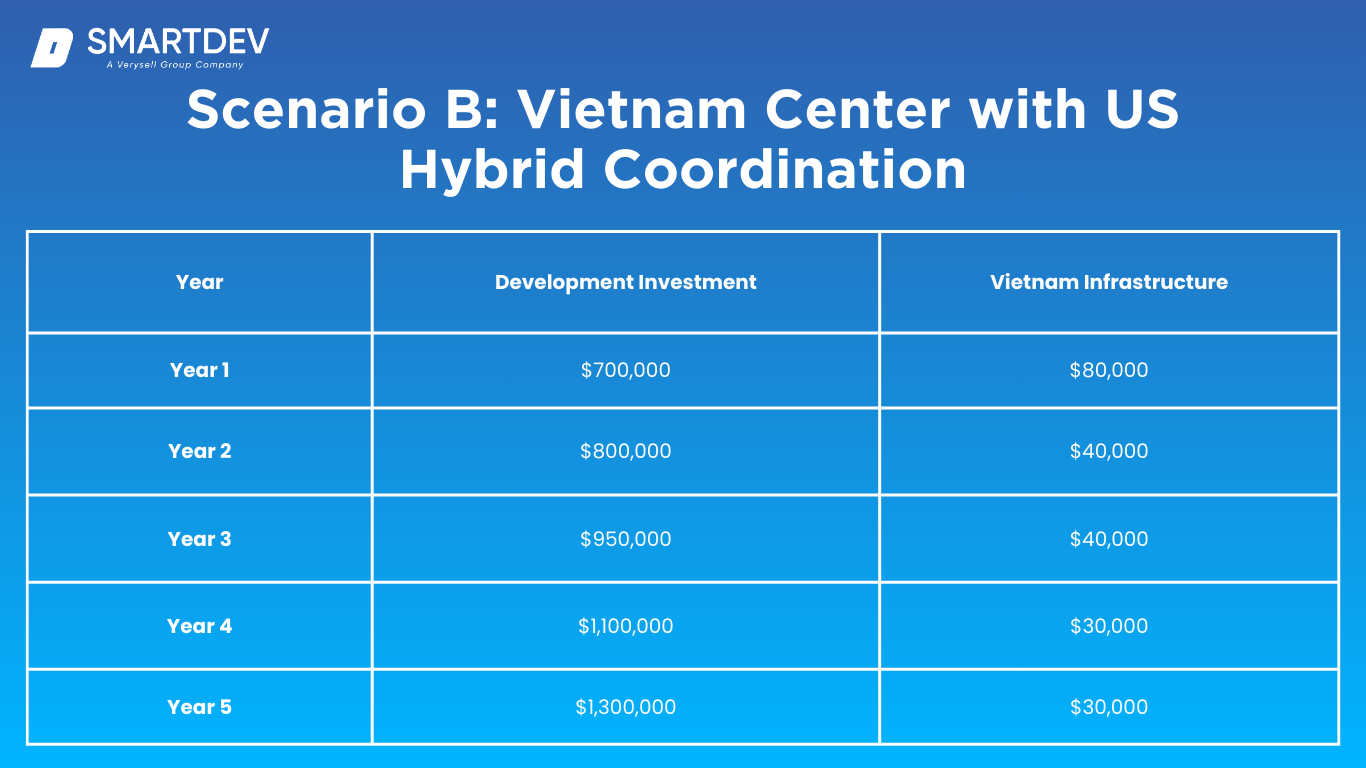
5-Year ROI Comparison:
-
US Model Total Investment: $14,375,000
-
Vietnam Hybrid Model Total Investment: $6,670,000
-
Cumulative Savings: $7,705,000 (53% cost reduction)
-
Available Capital for Acceleration: $7,705,000 deployed across product innovation, market expansion, or margin enhancement
With equivalent project completion velocity, the Vietnam model produces identical functionality at 47% the investment, creating material competitive advantage.
Best Practices: Maximizing Vietnam Development ROI
Cost savings alone represent opportunity capture, not optimization. Organizations achieving exceptional ROI implement practices that amplify delivery velocity, quality consistency, and strategic value extraction. Discover proven best practices for collaborating with offshore teams to maximize these advantages.
1. Structured Asynchronous Communication Protocols
Effective offshore development requires transitioning from real-time collaboration (synchronous) toward documented handoff processes (asynchronous). This counterintuitive approach accelerates delivery. Learn how to manage offshore development teams effectively with structured communication protocols that leverage the time zone advantage.
Implementation framework:
-
Daily standup recordings: Document daily progress in 10-minute video summaries rather than attempting live standup across 12-hour time gaps
-
End-of-day comprehensive handoffs: Outgoing teams document completed work, in-progress status, blockers, and decision requirements for incoming teams
-
4-hour response SLA: Critical questions receive answers within 4 business hours, enabling continuous momentum
-
Centralized knowledge management: Notion, Confluence, or GitHub Wikis maintain versioned documentation, reducing duplicate questions by up to 40%
Teams implementing these protocols report 30% improvement in deployment bottleneck reduction versus traditional real-time meeting models. The documented handoff creates institutional knowledge artifacts that reduce future friction.
2. Standardized Development Environments Reducing Setup Friction
92% of IT professionals employ Docker or VM-based environment standardization. Vietnam development teams adopt identical infrastructure-as-code practices that eliminate the “works on my machine” problem plaguing distributed teams. Explore DevOps services that implement standardized development environments.
GitFlow implementation benefits:
-
Automated deployment pipelines with transparent status visibility
-
Mandatory code review requirements preventing defect propagation
-
Environment consistency across development, staging, and production
-
New developer onboarding reduced from 3–5 days to under one day with Docker/VM standardization
Organizations implementing GitFlow and Docker reduced deployment errors by 44% while accelerating developer productivity. This operational excellence extends beyond cost; it reduces costly production incidents that damage customer trust and revenue.
3. Agile Ceremonies and Metrics-Driven Accountability
Agile frameworks provide structured feedback loops that prevent misalignment. Vietnamese development teams typically operate:
-
Sprint planning: 4-hour sessions defining 2-week work cycles with clear acceptance criteria
-
Daily standups: 15-minute synchronous sessions during peak overlap (usually early US morning, late Vietnam afternoon)
-
Sprint reviews: Demonstration of completed work to stakeholders, gathering feedback for subsequent cycles
-
Sprint retrospectives: Teams identify process improvements, eliminating friction systematically
Velocity tracking metrics create transparency: teams measure story points completed weekly, identifying acceleration opportunities. Typical velocity improvement follows this pattern:
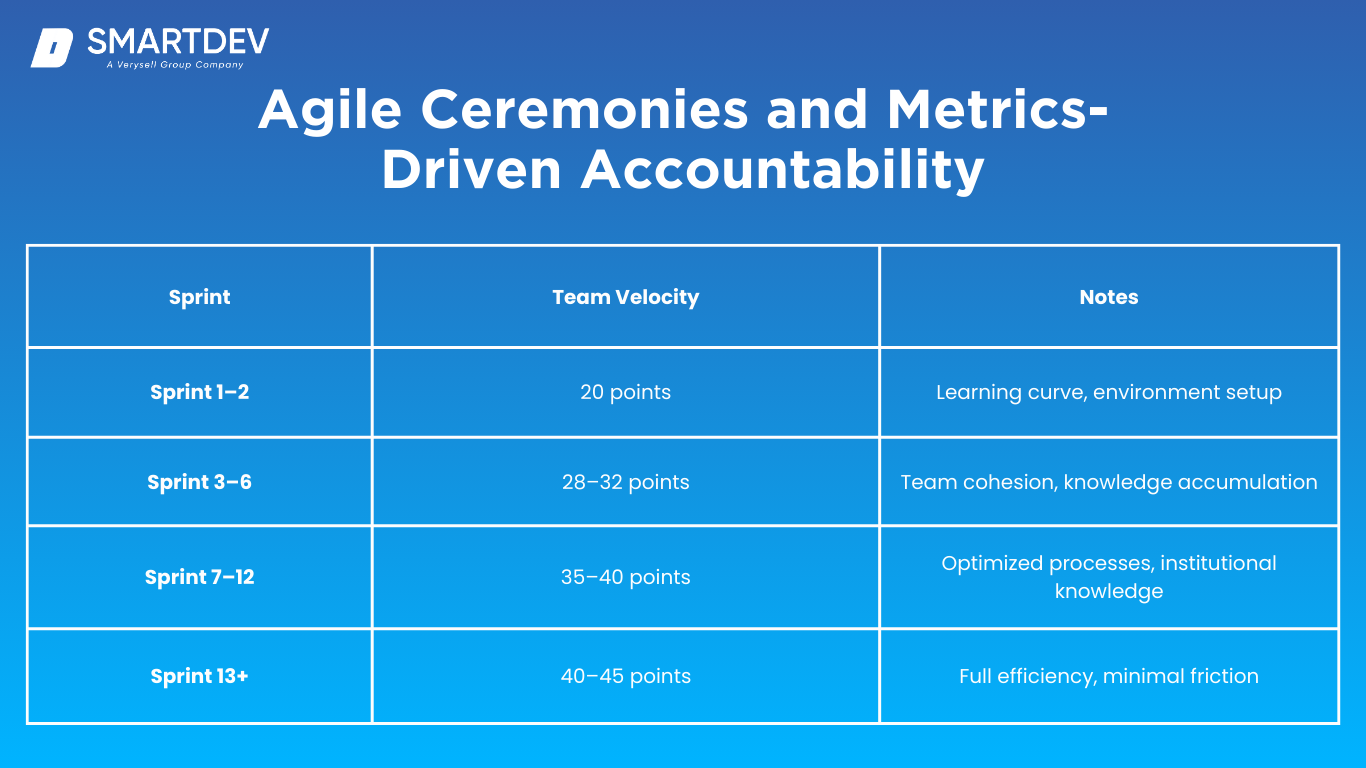
4. Quality Assurance Integration Preventing Downstream Costs
Vietnamese development teams increasingly integrate QA into development cycles rather than treating quality as a post-development phase. This shift reduces defect leakage and downstream correction costs. Advanced DevOps practices emphasizing automation and continuous testing are becoming standard.
Integrated QA best practices:
-
Unit testing requirements: Developers write tests alongside production code, achieving 85–95% code coverage
-
Automated testing pipelines: CI/CD systems execute test suites on every commit, preventing broken code from merging
-
Manual testing emphasis on edge cases: QA engineers focus on complex scenarios and user experience rather than basic functionality
-
Continuous monitoring: Production systems receive real-time monitoring, identifying issues hours versus weeks after deployment
Defects caught during development cost $500–$1,000 to fix. Defects reaching production cost $10,000–$50,000 when accounting for customer impact, reputation, and correction. Integrated QA reduces production defect rates by 60–80%, creating substantial risk mitigation alongside cost savings.
Ready to cut your software development costs by up to 60% without sacrificing quality or delivery speed?
SmartDev helps enterprises establish Vietnam-based development centers that deliver 60-70% cost savings, accelerated timelines, and world-class code quality - enabling you to reinvest capital into product innovation.
Evaluate your development spend, benchmark Vietnam rates, and design an offshore strategy that maximizes ROI.
Talk to a Development Cost ExpertVietnam’s Technical Ecosystem: Skills Mapping and Specialization
Vietnam’s technology sector supports 500,000+ skilled IT professionals with 55,000–60,000 new graduates annually. Vietnam ranks among the top 10 countries globally for developer skills, with strong STEM education focus ensuring graduates enter the workforce with solid technical foundations.
Core competency areas:
Web Development Stack (High Volume, Commodity Pricing)
-
Full-stack JavaScript (Node.js, React, NextJS): $25–40/hour
-
Python (Django, FastAPI): $25–40/hour
-
Java (Spring Boot): $30–45/hour
-
C# (.NET): $30–45/hour
-
DevOps/Infrastructure: $35–55/hour
Specialized Domains (Premium Pricing, Higher Scarcity)
-
AI and Machine Learning (General): $45–70/hour
-
Computer Vision: $55–80/hour
-
Natural Language Processing/LLM: $60–85/hour
-
Blockchain/Web3: $50–75/hour
-
Cybersecurity (Application & Infrastructure): $40–65/hour
Specialized expertise commands 15–25% premium over general development rates but remains substantially below Silicon Valley equivalents. A senior AI engineer costs $250,000–$400,000 annually in Silicon Valley; equivalent expertise costs $60,000–$90,000 in Vietnam, enabling organizations to access cutting-edge capabilities at sustainable cost.

Vietnam, vector 3d flag on blue background with hud interfaces
Risk Mitigation: Protecting ROI Through Operational Excellence
Organizations realizing projected Vietnam ROI navigate specific challenges that derail inexperienced outsourcing programs. Proactive mitigation transforms potential obstacles into managed variables.
Risk Category: Cultural Communication Misalignment
Problem: English fluency varies across the talent pool. While technical teams typically achieve professional English competency, nuance and idiom understanding create friction. Miscommunication during requirements gathering or issue discussions cascades into rework. Understanding how to collaborate well with offshore teams addresses these communication challenges directly.
Mitigation:
-
Require minimum TOEFL/IELTS scores (600+) for client-facing roles
-
Employ dedicated business analysts bridging technical and business domains
-
Record and document all requirements conversations, with written summaries
-
Implement weekly review sessions ensuring understanding alignment
Risk Category: Quality Consistency Across Team Expansion
Problem: Initial projects with senior developers proceed smoothly. As teams scale, junior developers join, and quality variability increases. Scaling that erodes profitability emerges suddenly.
Mitigation:
-
Implement robust code review standards with senior developer oversight
-
Establish automated testing requirements enforced in CI/CD pipelines
-
Conduct regular architecture reviews preventing technical debt accumulation
-
Pair junior developers with senior mentors, building capability while maintaining quality
Risk Category: Knowledge Retention and Continuity
Problem: Key developers transition to competing opportunities, taking project knowledge. Replacement developers require ramp-up time, introducing delays.
Mitigation:
-
Establish competitive compensation packages competitive with regional market (15–25% above commodity rates for senior roles)
-
Implement comprehensive documentation practices reducing individual dependency
-
Build team redundancy: ensure at least two developers understand critical systems
-
Create career development pathways enabling long-term tenure
Partner Selection: Evaluating Vietnam Development Providers
Selecting Vietnam development partners directly impacts ROI realization. Provider evaluation frameworks should emphasize alignment with your operational requirements and quality standards.
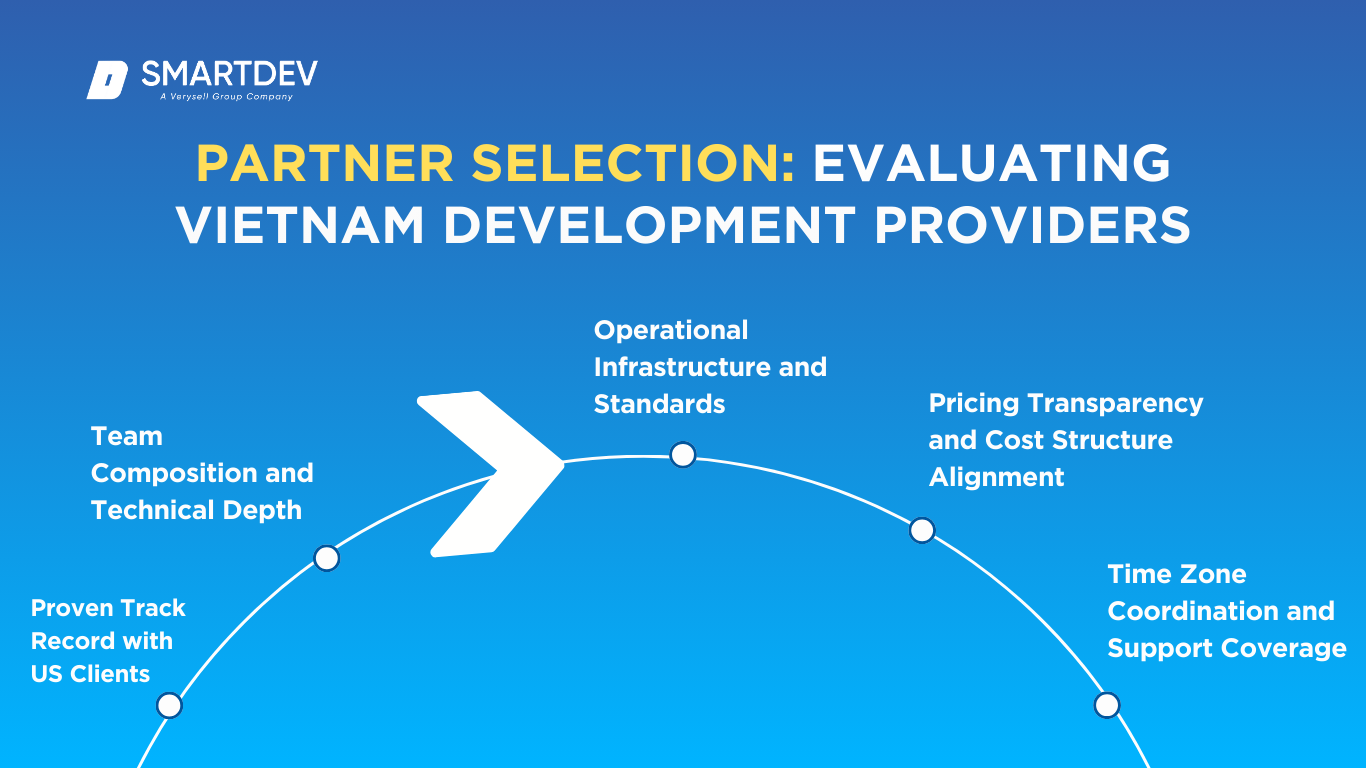
Critical evaluation criteria:
1. Proven Track Record with US Clients
-
Request case studies from similar US companies (same industry preferred)
-
Verify client retention rates (target 85%+ project completion on deadline)
-
Confirm references from recognizable companies in your domain
-
SmartDev demonstrates 90%+ client retention rates with 300+ global companies, including Fortune 500 enterprises
2. Team Composition and Technical Depth
-
Confirm senior developer availability (typically 30–40% of team should have 7+ years experience)
-
Verify specialization in technologies your project requires
-
Assess team stability: low turnover indicates healthy operational environment
-
Confirm dedicated project management and QA resources
3. Operational Infrastructure and Standards
-
Verify ISO 27001 certification (indicating security standard compliance)
-
Confirm CI/CD pipeline implementation and automated testing practices
-
Review incident response procedures and SLA commitments
-
Validate communication tools and documentation practices alignment with your standards
4. Pricing Transparency and Cost Structure Alignment
-
Request detailed rate cards by developer level
-
Clarify hidden costs: infrastructure, management overhead, DevOps support
-
Understand contract terms: minimum commitments, scaling flexibility, exit provisions
-
Evaluate engagement model options: dedicated teams, time-and-materials, fixed-price projects
5. Time Zone Coordination and Support Coverage
-
Confirm overlap hour availability for your team location
-
Validate on-call support procedures for production incidents
-
Assess documentation quality enabling asynchronous problem resolution
-
Verify round-the-clock availability for truly critical systems
Maximizing Strategic Value: Beyond Cost Reduction
Vietnam development partnerships enable organizations to move beyond cost arbitrage toward capability augmentation and strategic acceleration. Building effective offshore collaborations requires understanding cultural dimensions and establishing trust through transparent communication.
Innovation acceleration strategies:
- Parallel Development Workstreams: Double your effective development velocity by deploying US teams on strategic initiatives while Vietnam teams maintain existing systems and platforms. A startup scaling product features can dedicate US senior engineers to new product direction while Vietnam teams own backend scaling, DevOps modernization, and technical debt reduction.
- Specialized Capability Access: Access cutting-edge specializations without permanent headcount burden. Prototype AI features, blockchain infrastructure, or emerging technologies with dedicated Vietnam teams, validating market viability before committing US permanent resources.
- Market Expansion Velocity: Organizations entering new geographic markets can deploy Vietnam teams on localization, regional feature adaptation, and market-specific infrastructure, enabling launch velocity impossible with US-only teams.
A US B2B SaaS company expanded into Southeast Asian markets through dedicated Vietnam teams handling localization, compliance, and regional infrastructure. Market expansion that typically required 12 months accelerated to 6 months, capturing market share before competitors mobilized.
2025 Vietnam Development Landscape: Government Support and Infrastructure Evolution
The Vietnamese government actively invests in technology sector development, creating favorable conditions for offshore development expansion. The National Digital Transformation Program targets training 1 million tech workers by 2030, expanding available talent continuously.
Investment trends supporting ecosystem maturation:
-
35% increase in foreign direct investment in Vietnamese technology sector (2023)
-
Major cloud providers expanding Vietnamese data center operations
-
RCEP and CPTPP trade agreements enabling preferential technology export access to 50+ countries
These systemic improvements reduce operational risk: talent abundance eliminates supply constraints, infrastructure investments improve reliability, and regulatory clarity reduces compliance friction.

Conclusion: Vietnam as Strategic Competitive Advantage
The financial case for Vietnam offshore development extends far beyond simple cost arbitrage. Organizations capturing 60–70% cost savings while maintaining or exceeding quality standards, accelerating delivery through asynchronous time zone advantage, and accessing specialized capabilities at sustainable cost create material competitive positioning.
ROI realization depends on operational excellence: structured communication protocols, Agile adoption, quality integration, and deliberate team management practices transform potential savings into realized competitive advantage.
The question facing US companies in 2025 is not whether offshore Vietnam development makes financial sense—the data proves it decisively. The question is whether your organization will capture this advantage or cede market positioning to competitors who deploy it strategically.
Vietnam development partnerships, implemented thoughtfully through best-practice operational frameworks, represent one of the highest-ROI technology investments available to US software companies.