

1. Introduction: The Growing Complexity of Invoice Processing in Healthcare
The healthcare industry is an expansive ecosystem with complex operational needs and a significant reliance on invoice processing. Whether it’s medical claims, insurance reimbursements, or vendor payments, healthcare providers handle vast amounts of financial documents every day. With a growing demand for services, increasing numbers of patients, and evolving regulatory requirements, managing invoices manually has become a significant challenge.
In this section, we explore why manual invoice workflows in healthcare are no longer sustainable and how AI invoice processing can transform the way healthcare organizations manage their financial operations.
1.1 The Volume of Invoices in Healthcare
The volume of invoices in healthcare has been rising steadily in parallel with the growth of the healthcare services market. According to a report by Market Research Future, the global medical billing market was valued at $17.76 billion in 2024 and is projected to grow significantly in the coming years. This surge is primarily driven by the rising demand for medical services and the expansion of health IT systems.
This means that healthcare organizations, from small clinics to large hospitals, must handle an increasing number of invoices from medical providers, insurance claims, service vendors, and suppliers. Each of these invoices typically contains different types of data and comes in various formats – whether digital PDFs, scans, or even handwritten notes—compounding the complexity of processing them efficiently.
For example, a hospital might receive invoices for:
- Medical services (e.g., doctor visits, surgeries, lab tests)
- Medical supplies (e.g., medications, equipment)
- Insurance claims from multiple carriers, with differing coverage policies
Handling such a volume manually becomes a tedious, time-consuming task, requiring a high level of precision and attention to detail to avoid costly mistakes. As the number of patients increases, so does the number of invoices that need processing. Healthcare organizations need to process these invoices quickly and accurately to maintain cash flow, vendor relationships, and reimbursements from insurers.
1.2 The Challenges of Manual Invoice Processing in the Medical Sector
Healthcare organizations have long relied on manual processes to verify, validate, and approve invoices. This involves reviewing medical claims, matching them with patient records and treatment codes, and ensuring that all amounts are accurate before submitting payments or seeking reimbursement from insurers.
However, manual invoice processing is not without its challenges, especially in a fast-paced, heavily regulated environment like healthcare.
Key challenges include:
- Time-Consuming Data Entry: Manual data entry is not only labor-intensive but also prone to errors. A single error in invoice data – such as an incorrect medical code or vendor number – can delay payments and lead to disputes with vendors or insurers.
- High Risk of Human Errors: When invoices are processed manually, there is always the risk of errors, such as double payments, missed discounts, or incomplete documentation. According to iFveGlobal, the most obvious source of data entry errors is human error. Healthcare workers operate under intense pressure, and mistakes are inevitable when conditions are overwhelming.
- Slow Processing Times: Healthcare organizations often rely on manual review at every step – whether validating medical codes, verifying insurance coverage, or matching invoices with purchase orders. This slow pace can delay the approval and payment cycle, impacting the organization’s cash flow.
- Compliance Risks: Healthcare billing must comply with complex regulations such as HIPAA, Medicare/Medicaid rules, and insurance fraud prevention standards. Manual workflows introduce the risk of non-compliance due to errors in invoice handling, incorrect data entry, or failure to meet regulatory deadlines.
- Limited Transparency: Without automation, tracking the status of invoices or payments in real-time can be difficult. Finance teams struggle with fragmented data spread across systems, making it hard to get a unified view of outstanding liabilities and paid invoices.
These challenges underscore the need for a more effective, automated solution to handle the growing volume of invoices while maintaining accuracy, compliance, and operational efficiency.
1.3 The Need for Intelligent Invoice Automation in Healthcare
Given these operational pain points, many healthcare organizations are now turning to AI-powered invoice automation as a way to solve the inefficiencies and errors inherent in manual processes.
AI-powered invoice processing can address many of the challenges mentioned above by automating the following tasks:
- Data extraction: Using Optical Character Recognition (OCR), AI can extract key data from invoices in multiple formats (PDF, scanned documents, images) and convert it into structured digital data.
- Data validation: AI-driven systems can automatically validate invoice data by checking it against predefined business rules or comparing it with patient records, purchase orders, and insurance claims, reducing the risk of human error.
- Real-time processing: AI enables healthcare organizations to process invoices in real-time, drastically speeding up workflows and ensuring faster payments to vendors and timely reimbursements from insurers.
- Automated workflows: With intelligent routing, AI can automatically send invoices for approval based on specific rules (e.g., invoice amount thresholds, department, etc.), ensuring timely payments and reducing bottlenecks in the approval process.
By automating invoice data entry, validation, and approval workflows, AI provides a more scalable, efficient, and error-free solution for handling invoices in healthcare, enabling organizations to focus on providing quality care instead of getting bogged down in paperwork. 
2. What Is AI Invoice Processing and How It Works in Healthcare
In healthcare, AI invoice processing refers to the use of artificial intelligence, OCR technology, and machine learning algorithms to automate the extraction, validation, and processing of invoices. This process not only speeds up manual workflows but also reduces errors, ensures compliance, and provides real-time visibility into financial operations.
2.1 Understanding AI-Powered Invoice Processing in the Medical Industry
AI-powered invoice processing systems use OCR technology to extract key information from invoices and convert it into structured data. These systems can analyze various document types, including medical claims, insurance reimbursements, and vendor invoices, and pull out critical fields like: Provider name, invoice number, service details, patient ID and treatment codes (ICD-10, CPT) or even invoice amount.
AI systems use machine learning to identify patterns, check for inconsistencies, and validate the extracted data against predefined rules. This ensures that the data entered into healthcare financial systems is accurate, complete, and compliant with industry standards.
2.2 How AI Handles Medical Billing and Claims
Medical billing involves several steps, including coding medical treatments, verifying patient insurance information, and ensuring that the healthcare provider receives appropriate reimbursement for services rendered. AI enhances this process by:
- Automating billing codes: AI systems use Natural Language Processing (NLP) to analyze clinical notes and generate accurate billing codes (e.g., ICD-10 for diagnoses, CPT for procedures).
- Claim validation: AI cross-references insurance claims with patient records to ensure that all services are eligible for reimbursement and that the correct billing codes are applied. If discrepancies are found, the system flags the invoice for review.
- Fraud detection: AI models can also detect signs of fraudulent claims by analyzing patterns of suspicious behavior or billing anomalies, such as duplicate submissions or overbilling.
By automating these tasks, healthcare providers can reduce errors in claims processing, accelerate reimbursements, and ensure regulatory compliance.
2.3 Integrating AI Invoice Processing with Healthcare Financial Systems
For AI invoice processing to be truly effective, it must be seamlessly integrated with existing healthcare financial systems, including Electronic Health Records (EHRs), Hospital Information Systems (HIS), and Enterprise Resource Planning (ERP) platforms. This integration allows for the smooth transfer of validated data from invoices into the financial systems, ensuring:
- Accurate payment tracking
- Faster reconciliation
- Improved visibility into liabilities and financial commitments
AI-based invoice automation creates a continuous workflow that synchronizes invoice data, medical records, and payment processing, resulting in more efficient financial operations and better visibility across the entire healthcare organization.

3. Key Financial Challenges AI Invoice Processing Solves in Healthcare
Fintech companies and healthcare organizations share similar challenges when managing invoice workflows. In healthcare, the volume of invoices, regulatory complexities, and the need for fast, accurate payments make efficient invoice processing even more critical. AI invoice processing addresses several major pain points that healthcare providers face in their financial operations.
3.1 Handling High Volumes of Medical Claims and Invoices
Healthcare providers receive a massive volume of invoices every day from service providers, medical suppliers, insurance companies, and contractors. This includes:
- Medical claims (e.g., for hospital visits, surgeries, and prescriptions)
- Insurance reimbursements (e.g., claims submitted to insurance carriers for reimbursement)
- Vendor payments (e.g., for medical supplies and other operational expenses)
Each invoice is often unique and includes various data points, such as treatment codes, insurance details, and payment terms. Manually reviewing and matching these invoices to patient records, treatment codes, and insurance policies is time-consuming and prone to human error.
AI-powered invoice processing systems can automatically capture, extract, and validate data from medical invoices, helping healthcare providers process large volumes of invoices more efficiently. The automation of data entry, validation, and approval ensures that invoices are processed quickly and accurately, freeing up resources for other tasks.
3.2 Ensuring Compliance with Healthcare Regulations and Standards
In the healthcare industry, regulatory compliance is a top priority, especially when it comes to billing and reimbursement. Healthcare organizations must adhere to various regulations, including HIPAA (Health Insurance Portability and Accountability Act), Medicare/Medicaid guidelines, and insurance fraud prevention rules.
Invoice processing in healthcare is particularly complex due to the need to match treatments and services with insurance coverage while maintaining accurate billing codes and following strict regulatory guidelines. Failure to comply with these regulations can result in financial penalties, reimbursement issues, and even legal consequences.
AI-powered invoice validation systems automate the validation process by checking invoices for regulatory compliance, ensuring that:
- Billing codes (e.g., ICD-10, CPT) are accurate
- Insurance details match the patient’s policy
- Treatment records align with the provided services
AI systems can automatically flag potential compliance issues and anomalies (e.g., duplicate billing or inconsistent data), ensuring that all invoices meet required standards before they are submitted for payment or reimbursement.
3.3 Reducing Errors and Improving Invoice Accuracy
The accuracy of invoices is crucial in healthcare to prevent costly errors, missed payments, and disputes. Manual invoice verification is prone to human error, especially when dealing with large volumes of documents or complex medical coding.
AI invoice processing dramatically reduces these errors by automating data extraction, validation, and approval workflows. The system ensures that all fields are correctly filled, that billing codes are accurate, and that payment terms match the contract terms.
By eliminating manual errors, AI-powered systems not only reduce the risk of duplicate payments but also enhance the accuracy of financial records. This improved accuracy helps healthcare organizations maintain strong relationships with vendors, insurance companies, and patients, while ensuring that payments are made on time.

Explore how SmartDev partners with BFSI teams through a focused AI sprint to validate use cases, align stakeholders, and define a clear path forward before AI development begins.
SmartDev helps BFSI organizations clarify AI use cases and assess feasibility, enabling confident decisions and reducing risks before committing to AI development.
Learn how SmartDev accelerates AI initiatives, ensuring rapid deployment and reduced time to market.
Build Your AI Chatbot With Us4. How AI Invoice Processing Transforms Healthcare Financial Operations
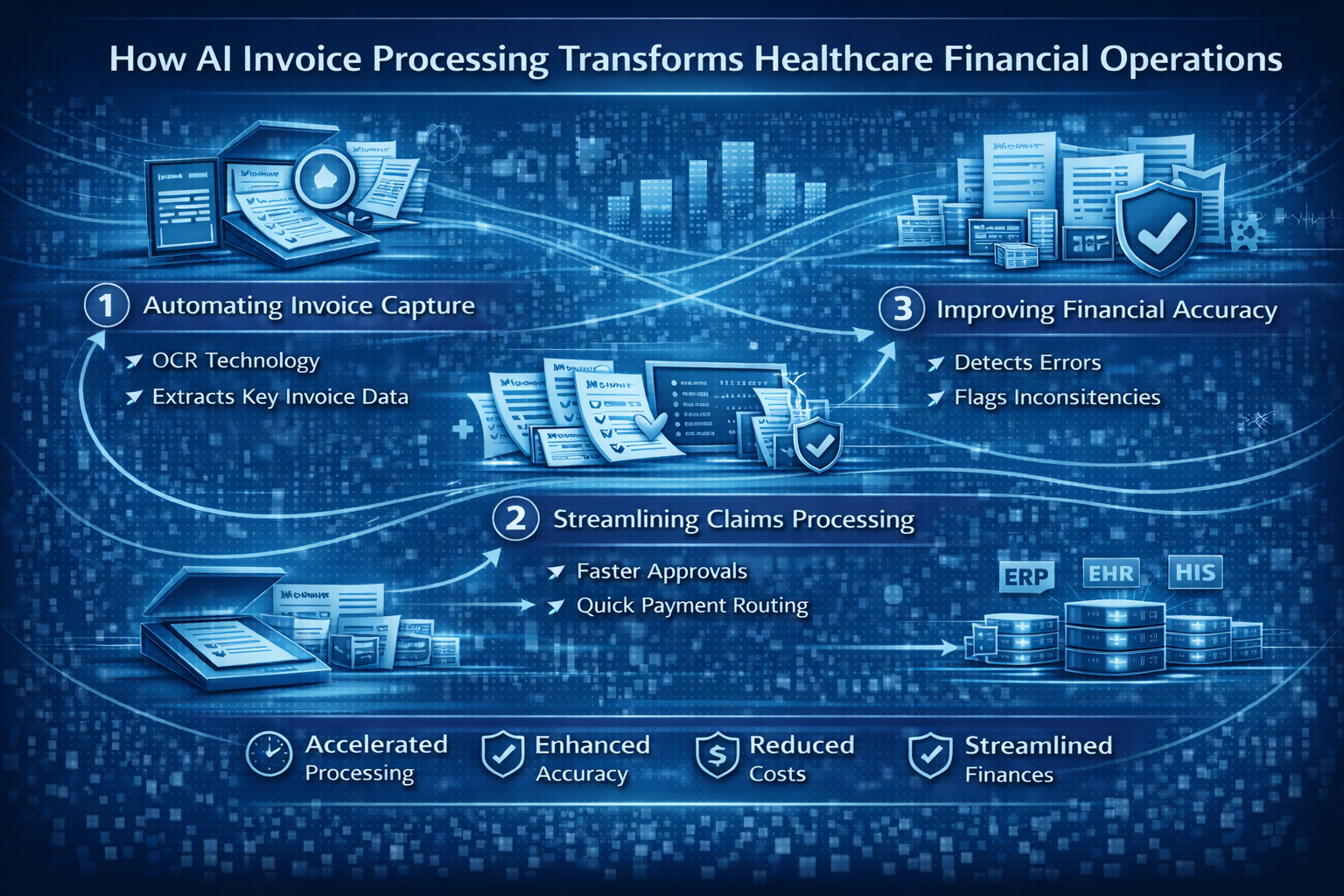
The adoption of AI invoice processing is transforming how healthcare organizations manage their financial workflows. By automating key tasks, AI systems can enhance operational efficiency, improve accuracy, and boost compliance across the entire invoicing process. Below are the key ways AI invoice processing can revolutionize financial operations in healthcare.
4.1 Automating Invoice Capture and Data Extraction
The first step in AI invoice automation is capturing data from incoming invoices. AI-powered Optical Character Recognition (OCR) technology extracts key data points from invoices, such as: Invoice number, vendor name, invoice total, billing codes, service dates.
Traditional manual entry methods are often slow and prone to error, while AI-driven systems can automatically extract data from scanned PDFs, emails, and other formats. By doing so, AI eliminates the need for manual data entry, speeding up the process and reducing human error.
AI invoice processing systems are also capable of extracting data from unstructured documents – such as handwritten forms or images—making them highly flexible and adaptable to different types of medical invoices.
4.2 Streamlining Claims Processing and Payment Approvals
Once the invoice data has been extracted, AI systems use predefined business rules and validation algorithms to ensure the invoice data aligns with existing records. For example, AI can match invoices with purchase orders and contracts, ensure that medical claims align with patient treatment records or verify that vendor payment terms are met before issuing payment.
If discrepancies are detected, the system flags the invoice for review by a human approver. Automated approval workflows ensure that invoices are routed to the correct department for approval based on predefined criteria, reducing delays and eliminating bottlenecks in the process.
By automating claims processing and payment approval workflows, AI invoice processing accelerates the entire financial cycle and allows healthcare organizations to process invoices much faster, improving cash flow and financial efficiency.
4.3 Improving Financial Accuracy and Operational Speed
AI-powered invoice processing not only speeds up the workflow but also improves the accuracy of financial operations. By using data validation rules and machine learning algorithms, AI can automatically detect and flag: Invoice duplicates, incorrect payment amounts or missing fields or invalid data.
As a result, the chances of payment errors or delays are minimized, and organizations can move toward automated reconciliation of financial records.
In healthcare, faster and more accurate invoice processing means that vendors and service providers are paid on time, reducing the risk of supply chain disruptions. Moreover, real-time visibility into financial data allows organizations to make informed decisions about budgets, cash flow, and operational costs.
For healthcare providers, these operational improvements translate directly into cost savings, faster reimbursements, and improved relationships with patients, insurance companies, and vendors.
5. How Healthcare Providers Can Successfully Implement AI Invoice Processing
While the benefits of AI invoice processing are clear, successful implementation requires thoughtful planning, integration with existing financial systems, and strategic scaling. Here’s a step-by-step guide for healthcare organizations to adopt AI for invoice automation effectively.
5.1 Starting with Claims Processing and Vendor Payments
Healthcare organizations should begin by prioritizing high-impact financial workflows for AI invoice processing. Key areas to focus on include:
- Claims processing: Automating claims and insurance invoice verification ensures faster reimbursements and fewer errors in payment processing.
- Vendor payments: AI automation speeds up the invoice-to-payment cycle and ensures that vendor invoices are processed quickly and accurately.
By starting with these high-volume workflows, healthcare providers can demonstrate quick wins and see tangible improvements in operational efficiency.
5.2 Integrating with Existing Healthcare Financial Systems
For AI invoice processing to deliver its full potential, it must integrate seamlessly with existing financial systems such as EHRs, HIS (Hospital Information Systems), and ERP platforms. Integrating AI with these systems allows for:
- Automated synchronization of invoice data with financial records
- Real-time invoice tracking and approval routing
- Financial reporting based on structured data
Integrating the AI system ensures that the entire invoice lifecycle, from capture and validation to payment and reporting, is automated and streamlined, with minimal disruption to daily operations.
5.3 Building a Scalable Invoice Processing Solution in Healthcare
One of the greatest advantages of AI invoice processing is scalability. As healthcare organizations grow and the volume of invoices increases, AI systems can easily scale to handle higher transaction volumes without requiring proportional increases in staff.
By automating the process from the beginning, healthcare providers can:
- Improve invoice throughput during peak periods (e.g., year-end billing)
- Handle larger claim volumes as they expand services or enter new markets
- Adopt AI-driven automation for new workflows or evolving healthcare billing systems
A scalable AI invoice processing system can continue to grow with the organization, maintaining efficiency, accuracy, and compliance as business demands evolve.
Conclusion
AI-powered invoice processing is revolutionizing how healthcare organizations manage financial documentation. By automating repetitive tasks such as data entry, validation, and approval workflows, AI reduces manual workloads, minimizes errors, and ensures regulatory compliance.
For healthcare providers, this technology is not just about saving time – it’s about building a scalable, accurate, and compliant financial infrastructure that supports growth. Whether dealing with medical claims, vendor payments, or insurance reimbursements, AI-driven automation provides a clear competitive advantage, improving financial transparency and accelerating cash flow.
By leveraging SmartDev’s AI-powered invoice processing system, healthcare organizations can future-proof their financial operations, enhance operational efficiency, and maintain regulatory compliance – all while improving their bottom line.
Ready to optimize your healthcare financial operations with AI? Contact SmartDev today to discover how our AI invoice processing system can transform your invoicing and claims processing workflows.