

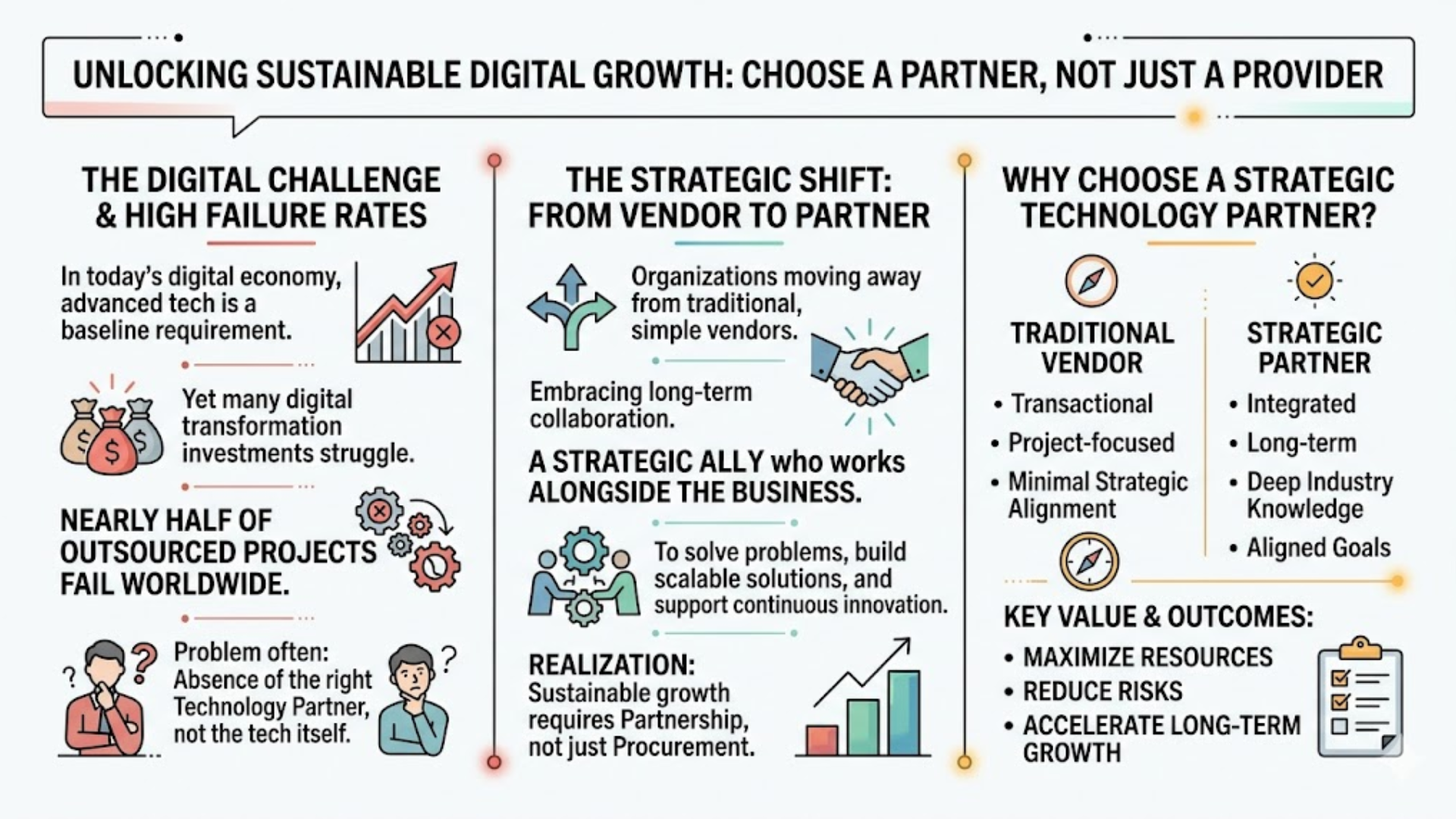
In today’s digital economy, adopting advanced technology is no longer optional-it has become a baseline requirement for businesses that want to remain competitive. Yet despite massive investments in digital transformation, nearly half of outsourced technology projects worldwide fail to deliver the expected outcomes. In many cases, the problem is not the technology itself, but the absence of the right technology partner.
Instead of treating technology providers as simple vendors, more organizations are shifting toward long-term collaboration with a trusted technology partner-a strategic ally that works alongside the business to solve problems, build scalable solutions, and support continuous innovation. This shift reflects a growing realization among executives: sustainable digital growth requires partnership, not just procurement.
So what exactly is a technology partner? How does this role differ from a traditional vendor, and why do industry experts consistently advise leaders to “choose a partner, not just a provider”? This comprehensive guide explores the meaning of a technology partner, explains its strategic value for modern businesses, and outlines how organizations can select the right partner to maximize resources, reduce risk, and accelerate long-term growth.
What is a Technology Partner?
In the context of strong digital transformation, the term “Technology Partner” represents a constructive shift in strategic management thinking. A Technology Partner is defined as an organization, company, or network of experts working closely with a client to provide, customize, integrate, and optimize technology solutions to perfectly fit the customer’s core objectives and workflows. This relationship is a continuous commitment where both parties establish a collaborative mechanism for risk-sharing, resource-sharing, and shared success.
To fully understand this concept, we need to distinguish a Technology Partner from a “Technology Vendor.” A vendor operates on a transactional mechanism; their primary goal is to sell off-the-shelf (one-size-fits-all) solutions, and their role usually ends immediately after the software is delivered. Meanwhile, a Technology Partner exists to fill the “Capability Transfer Gap”. They do not just hand over the software; they also consult, train, and build internal capacity so the business can confidently operate the new technology at scale.
| Evaluation Criteria | Technology Vendor Model | Technology Partner Model |
| Solution Orientation | Product-centric. Forces the customer’s needs and workflows to fit their existing solution. | Customer-centric. Flexibly adjusts and develops the solution to fit the practical needs of the business. |
| Nature of Commitment | Transactional and short-term. Responsibility ends after the project sign-off. | Holistic and long-term. The signed contract is just the beginning of continuous collaboration. |
| Knowledge Delivery | Delivers software but leaves a “Capability Transfer Gap,” leaving teams confused. | Transfers operational processes, provides management consulting, and trains staff. |
| Post-sale Support | Minimal support, typically via an automated ticketing system. | Proactive 24/7 monitoring, providing dedicated experts to solve the root causes of issues. |
Why It Matters for Businesses?
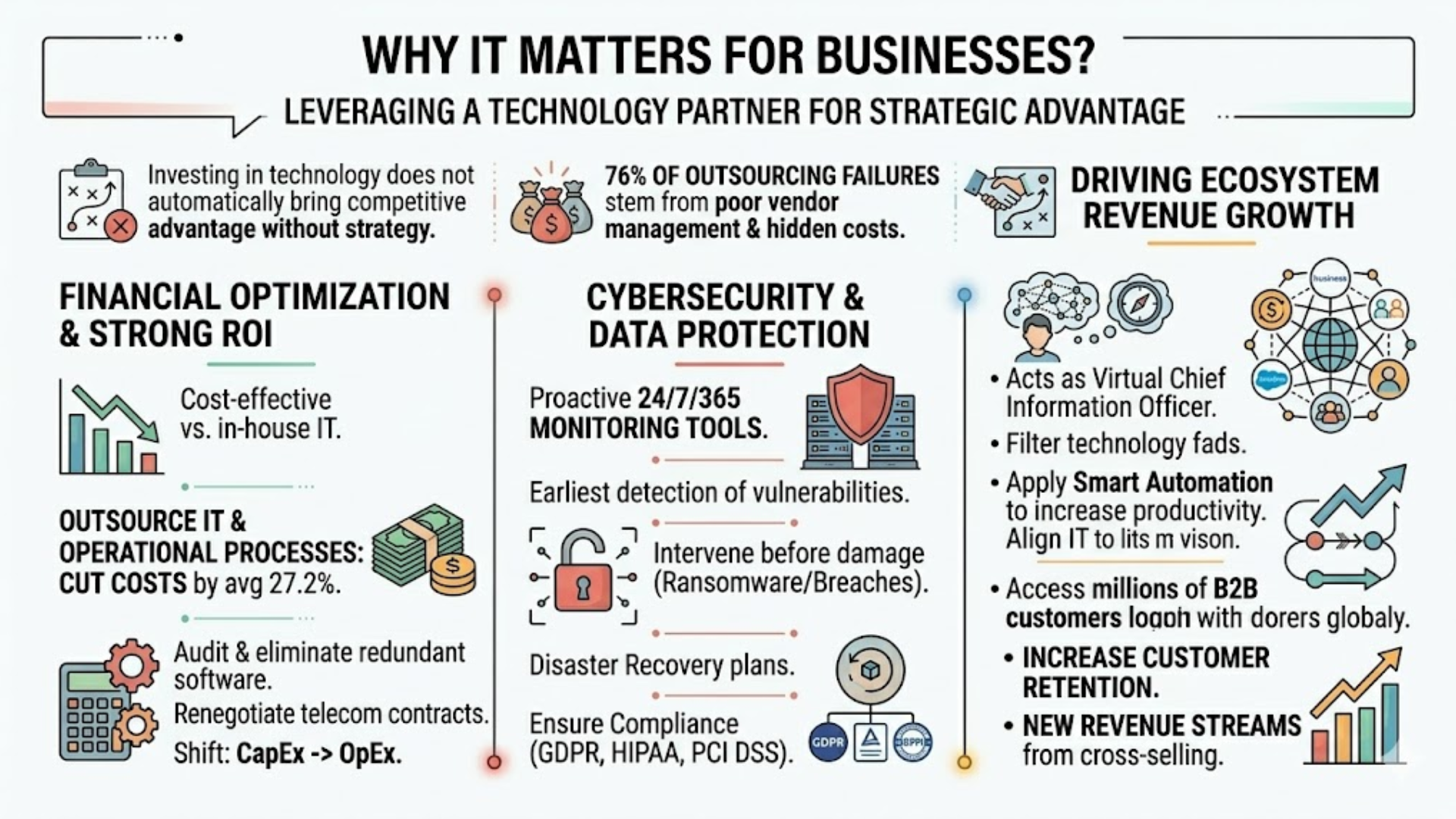
Investing in technology does not automatically bring a competitive advantage without a solid execution strategy. In fact, 76% of outsourcing failures stem from poor vendor management and uncontrolled hidden costs. Therefore, having an excellent Technology Partner brings the following vital strategic values:
1. Financial Optimization and Strong ROI
Maintaining a dedicated technology partner is often significantly more cost-effective than bearing the salaries, training, and benefits of a full-time in-house IT team. Companies applying the partner model to outsource specialized IT and operational processes can cut costs by an average of 27.2%.
Partners also help audit and eliminate redundant software, renegotiate telecom contracts, and flexibly shift your budget from heavy capital expenditures (CapEx) to agile operational expenditures (OpEx).
2. Cybersecurity and Data Protection
A technology partner provides proactive 24/7/365 monitoring tools, ensuring the earliest possible detection of security vulnerabilities and intervening before catastrophic damage (like ransomware or data breaches) occurs. They also implement disaster recovery plans and ensure your systems comply with strict federal and international data regulations (such as GDPR, HIPAA, PCI DSS), mitigating legal liabilities.
3. Strategic Direction (vCIO)
Despite continuous increases in tech budgets, many leaders struggle to align their tech stack with their business goals. A Technology Partner acts as a virtual Chief Information Officer (vCIO). They help your organization filter out short-lived technology fads, apply smart automation to increase productivity, and align your IT investments with the long-term strategic vision of the company.
4. Driving Ecosystem Revenue Growth
Technology alliances help integrate a business’s products deeply into the partner’s massive digital ecosystem (such as AWS Marketplace or Salesforce AppExchange), thereby opening access to millions of B2B customers globally. This seamless integration increases customer switching costs, improves retention rates, and drives entirely new revenue streams from cross-selling and partner referrals.
When & How to Choose a Technology Partner?
When Does a Business Need to Hire a Technology Partner?
Managers should not make this decision based on intuition but rather watch out for the following critical “triggers”:
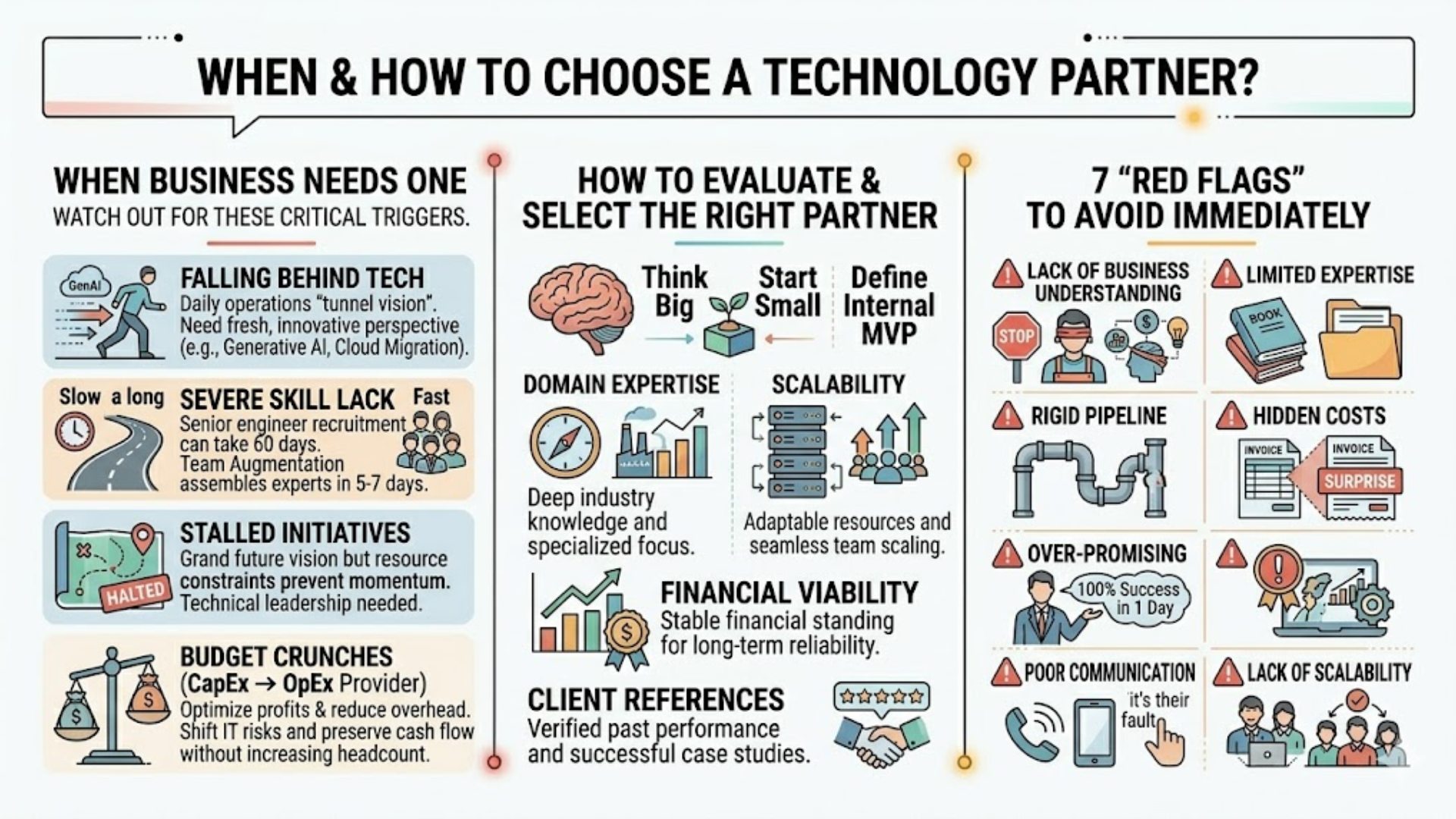
- Falling behind on emerging tech: When an organization is caught up in daily operations (“tunnel vision”) and cannot keep up with rapidly evolving technologies (like Generative AI or Cloud Migration), a partner brings a fresh, innovative perspective.
- Severe lack of specialized skills: Recruiting a senior IT engineer locally can take up to 60 days. With Team Augmentation services, a technology partner can assemble outstanding experts in just 5 to 7 days to tackle urgent, time-sensitive projects.
- Stalled strategic initiatives: When a business has a grand future roadmap but doesn’t know how to start due to resource constraints, a partner provides the necessary technical leadership to kickstart the momentum.
- Budget crunches: Under pressure to optimize profits and reduce overhead, transferring IT infrastructure risks to a Managed Service Provider (MSP) is the smartest way to preserve cash flow without increasing headcount.
How to Evaluate and Select the Right Technology Partner?
A smart selection process follows the “Think Big & Start Small” principle. Businesses shouldn’t rush to view product demos; instead, they must define their internal Minimum Viable Product (MVP) first by prioritizing core features. Then, evaluate the partner through four core competencies: Domain Expertise, Scalability, Financial Viability, and verified Client References.
In particular, you should immediately eliminate candidates if they exhibit any of the following 7 “Red Flags” :
- Lack of Business Understanding: Good technical skills but completely indifferent to your core business model and industry intricacies.
- Limited Expertise: Outdated knowledge and lack of practical, proven case studies in your specific industry.
- Rigid Pipeline: Strict adherence to unchangeable contracts and a lack of agility when project requirements change.
- Hidden Costs: Lack of transparency in the pricing structure, leading to budgets that spiral out of control.
- Over-Promising: Making unrealistic guarantees and impossible assurances just to win the bid.
- Poor Communication: Slow responsiveness, uncooperative behavior, or shifting the blame during critical project crises.
- Lack of Scalability: Struggling with resource allocation and failing to provide seamless team scaling when needed.
Other Related Terms in the Tech Partner Ecosystem
To successfully navigate and manage a partnership, business leaders need to master the following essential institutions and strategic terminology:
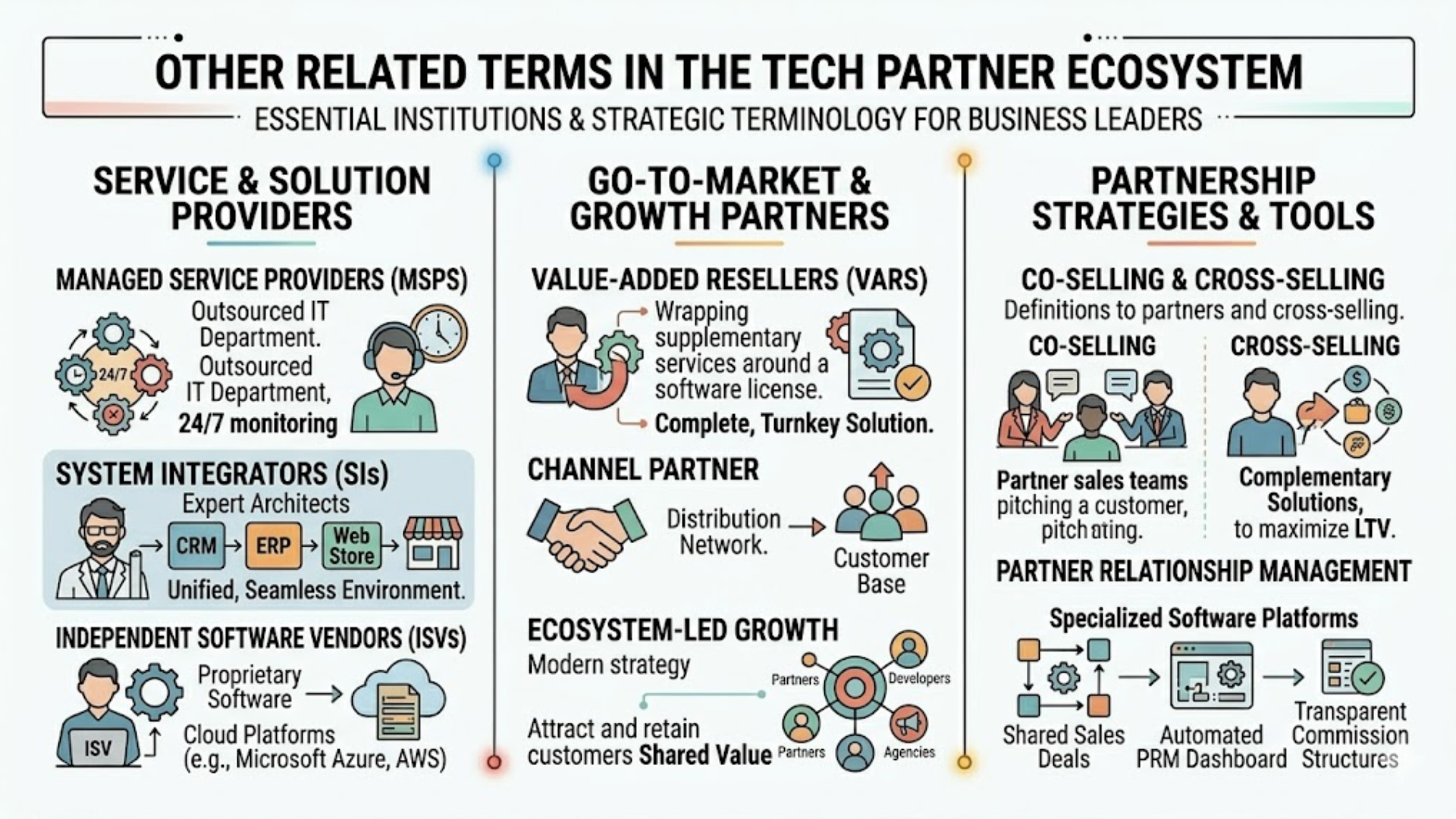
- Managed Service Providers (MSPs): Organizations acting as an outsourced IT department. They proactively monitor, secure, and maintain IT infrastructure 24/7, typically charging via a predictable subscription model.
- System Integrators (SIs): Expert “architects” capable of connecting disparate software applications and hardware systems into a unified, seamless environment, entirely eliminating isolated data silos.
- Independent Software Vendors (ISVs): Organizations that specialize in developing and commercializing proprietary software applications that run on the cloud infrastructure platforms of tech giants (like Microsoft or AWS).
- Value-Added Resellers (VARs): Resellers who do not just sell software licenses but also “wrap” additional supplementary services (such as installation, maintenance, and custom configurations) to provide a complete, turnkey solution.
- Channel Partner: A business or individual that collaborates with your company to expand your distribution network and sell your products through their established customer base.
- Ecosystem-Led Growth: A modern go-to-market strategy focused on nurturing a vast network of partners, developers, and agencies to attract and retain customers through shared value.
- Co-Selling & Cross-Selling: Co-selling occurs when two partner sales teams pitch a combined solution to a customer together. Cross-selling is the strategy of selling additional, complementary partner solutions to your existing customer base to maximize the Lifetime Value (LTV).
- Partner Relationship Management (PRM): Specialized software platforms used to automate the management of partner networks, track shared sales deals, and calculate transparent commission structures.
Conclusion
In a rapidly evolving digital landscape, settling for a traditional technology vendor is no longer sufficient. The complexities of modern IT infrastructure, combined with the pressing need for scalable security and strategic alignment, demand a more integrated and holistic approach. A true Technology Partner transcends the transactional boundaries of buying and selling; they become an extension of your internal team, deeply invested in your long-term operational success.
By bridging the capability transfer gap and driving ecosystem-led growth, the right partner not only protects your bottom line but also transforms your technology investments into a powerful engine for innovation and revenue generation. When evaluating your next technology initiative, remember the golden rule: seek a strategic partner, not just a service provider.