Every business leader today knows AI should be on their agenda. But knowing something matters and knowing how to do it are two very different things (McKinsey, 2024). The gap between “we need to adopt AI” and “we have AI running in production” is where most companies get stuck not because AI doesn’t work, but because the conventional paths to getting there are broken (Morales, 2025).
Hiring a big consultancy costs $150k–$500k and delivers a strategy document, not software. Building in-house requires AI engineering talent that’s expensive, scarce, and hard to retain. Buying an off-the-shelf point product means adapting your workflows to fit someone else’s tool. None of these options are designed for the mid-market business that needs real automation, delivered fast, at a predictable cost. That’s the gap an AI adoption accelerator fills.
What an AI Adoption Accelerator Actually is
An AI adoption accelerator combines pre-built, reusable AI components with a proven delivery methodology to help businesses move from a specific operational problem to a working AI solution in weeks instead of months.
The word “accelerator” matters because it describes a fundamentally different approach to AI implementation. Businesses do not buy a generic product and install it. They also do not spend months paying consultants to produce strategy documents and recommendations. Instead, companies use a structured implementation model that delivers AI faster, at lower cost, and with less risk because teams have already completed and validated the foundational work across previous deployments.
A useful comparison is a building contractor with a warehouse of prefabricated components. The contractor does not reinvent bricks, windows, plumbing, or electrical systems for every project. Instead, they assemble proven and standardized building blocks into a solution designed around the client’s specific requirements. The final result still fits the customer’s needs, but the team completes construction far more quickly and efficiently.
Four Layers of an AI Adoption Accelerator
A well-designed AI adoption accelerator is not a single tool, it is a layered capability stack. NORA, SmartDev’s AI adoption accelerator, is organised into four layers that work from the bottom up: understanding your data, reasoning about it, taking action on it, and eventually operating autonomously (McKinsey 2025).
1. Foundation Data Skills
Foundation data skills are the starting point of any AI adoption accelerator. At this layer, the system collects, extracts, screens, cleans, and indexes raw enterprise data from different sources such as invoices, emails, documents, alerts, spreadsheets, and operational systems. This step ensures that scattered and unstructured information becomes usable for AI processing. Without a strong data foundation, the AI cannot generate reliable outputs because it does not have clean, accessible, and well-organized information to work with.
This layer is especially important for businesses that handle high volumes of repetitive documents or operational data every day. For example, instead of asking employees to manually read invoices, check email attachments, or search through folders, the AI can automatically capture key fields, classify documents, remove duplicates, and prepare the data for the next stage. In simple terms, this is the “always first” layer because every intelligent action depends on the quality of the data entering the system.
2. Intelligence Skills
Once the data is prepared, intelligence skills allow the AI to understand, analyze, and reason with that information. At this layer, the system can search internal knowledge bases, summarize key findings, assess risks, recommend next steps, and connect different pieces of information into useful business insights. This is where raw data becomes decision-ready information (Microsoft 2025).
For example, in a financial compliance workflow, the AI can review customer documents, compare them against internal rules, identify missing information, and highlight potential risk factors. In logistics, it can analyze invoice details against purchase orders or carrier rate cards to detect mismatches. This layer does not simply retrieve information; it helps teams understand what the information means and what action should be taken next. That is why it acts as the reasoning layer of the accelerator.
3. Execution Skills
Execution skills enable the AI to take action across business systems after insights have been generated. Instead of only giving recommendations, the AI can support real workflow execution, such as drafting emails, creating reports, routing tasks, updating records, managing access requests, triggering notifications, and preparing documents for review or approval. This layer helps reduce manual handoffs and operational delays.
For example, after detecting an invoice exception, the AI can create a task for the finance team, notify the responsible manager, draft an email to the vendor, and update the status in the ERP system. In an IT helpdesk context, it can guide troubleshooting steps, prepare response messages, and escalate unresolved issues to the right team. The main value of this layer is that it turns AI insight into practical business action while keeping humans involved where review or approval is needed.
4. Autonomous Skills
Autonomous skills represent the most advanced layer of the AI adoption accelerator. At this stage, the AI can continuously monitor business conditions, detect changes, identify anomalies, and trigger workflows proactively without waiting for a user to ask. This does not mean removing human control. Instead, it means allowing the system to handle predictable, rule-based, or repetitive actions while escalating sensitive or complex cases to people.
For example, the AI can monitor stock levels through system data or computer vision, detect when inventory is running low, and automatically file a restock request. In security operations, it can monitor alerts, classify incidents, assign severity levels, and trigger predefined response playbooks. In finance, it can detect unusual transaction patterns and escalate high-risk cases for human review. This layer helps organizations move from reactive operations to proactive, always-on workflow management.
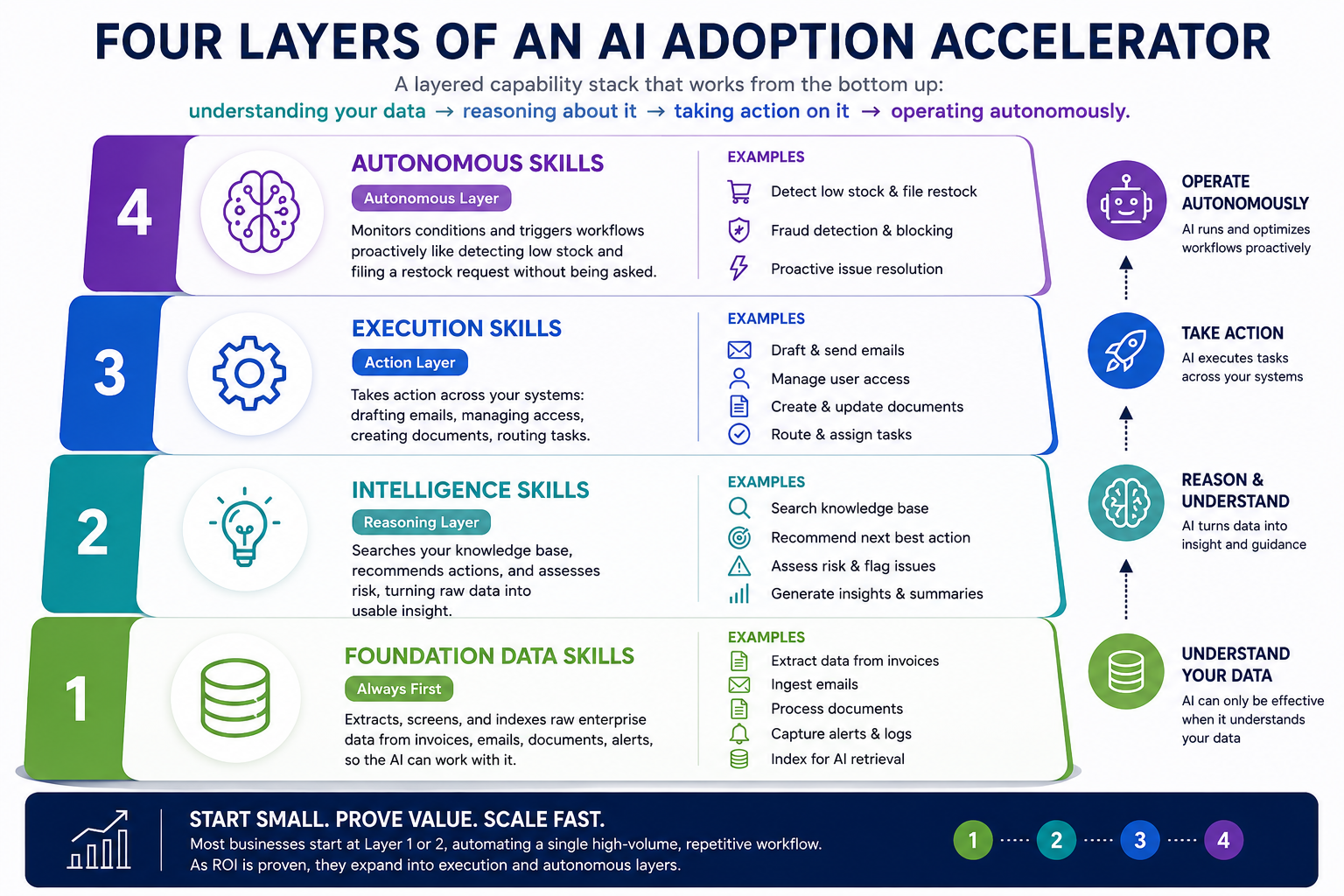
Most businesses start at layer one and two, automating a single high-volume, repetitive workflow. As they build confidence and prove ROI, they expand into execution and autonomous layers. The accelerator model makes that expansion faster because the underlying infrastructure such as data indexing, API connections, security framework that is already in place from the first deployment.
How It Differs From the Alternatives
An AI adoption accelerator has many aspects to understand what it is and what it is not.
| Aspect | Big Consultancy (Deloitte, Accenture, Boston Consulting Group) | NORA – AI Adoption Accelerator |
|---|---|---|
| Time to Production | 6–12 months before anything is in production | Working AI assistant live in 6–8 weeks |
| Commercial Model | $150k–$500k upfront, billed by time and materials | ~$35k fixed setup + ~$1,500/month managed service |
| Primary Deliverable | Strategy, roadmap, and recommendations | Working AI software tailored to your workflow |
| Implementation Focus | Heavy consulting and planning phase | Fast deployment with operational outcomes |
| Ownership After Delivery | Internal team maintains and operates the solution | Ongoing maintenance included in managed service |
| Risk to Client | High upfront investment before measurable value | Lower entry cost with faster ROI validation |
| Operational Support | Typically ends after project completion | Continuous monitoring, optimization, and support |
| Outcome | PowerPoint and transformation roadmap | AI assistant actively running in product |
Against an AI point product like UiPath or C3.ai, the difference is integration and ownership. Point products require your team to adapt your processes to fit their tool, handle the integration work themselves, and maintain it with an internal team after purchase. Licences and services typically run $50k–$200k before anything is automated, and the ongoing cost is variable per seat or per usage with no ceiling.
Against building in-house, the difference is time and risk. Hiring AI engineers costs $15k–$40k per month in team overheads, takes 6–18 months to ship anything, and creates a permanent internal dependency that must be staffed, managed, and retained. For most mid-market businesses, that’s not a viable model.
The “outcome-based” Difference
An AI adoption accelerator has the most important characteristic of is that it is priced and delivered on outcomes, not effort. This is a fundamental shift from every alternative.
A consultancy charges by the hour. There is no upper bound on cost, and there is no contractual link between what you pay and what you receive. A point product charges per seat or per usage that you pay whether the tool works well or not. An in-house build is essentially unlimited cost exposure with no external accountability.
An accelerator model says: here is a specific workflow, here is a fixed price to automate it, and here is a guaranteed delivery timeline. If it doesn’t work, we haven’t delivered the outcome. That accountability changes the entire relationship like the team building it is incentivised to deliver working software, not to extend the engagement.
Why “Managed Service” is Not Optional
One of the most common and most expensive mistakes in enterprise AI is treating implementation as a one-off project. A team builds something, hands it over, and disappears. Six months later, the AI that was saving four hours a day starts generating errors. Data has drifted. The model hasn’t been retrained. Nobody is watching.
An AI adoption accelerator includes ongoing managed service as a structural requirement, not an optional add-on. This is because AI systems are not like traditional software: they don’t just need bug fixes and security patches. They need continuous monitoring, drift detection, retraining as data changes, cost optimisation as usage scales, and an audit trail for compliance.
Without this, even a well-built AI solution degrades. With it, the system compounds in value when each retraining cycle makes it more accurate, and each new workflow added to the same infrastructure is cheaper and faster to build than the first.
What It Looks like in Practice
An AI adoption accelerator has the best way to make this concrete with a real example. One logistics company processed 200 invoices every day and spent nearly four hours daily entering data manually into its ERP system. Three employees managed a shared inbox, corrected repeated entry mistakes, and handled constant backlogs.
SmartDev started the NORA implementation with a one-week discovery phase to map how invoices arrived, identify the required extraction fields, and understand the ERP integration workflow. Over the next five weeks, SmartDev configured NORA’s document intake capability to extract purchase order numbers, invoice amounts, dates, and vendor information automatically. NORA then validated the extracted data against existing purchase orders before pushing verified entries directly into the ERP system. When the system detected unmatched records or inconsistencies, it routed those exceptions to a human review queue.
The company moved from kickoff to production in just six weeks. Invoice processing time dropped from four hours per day to twenty minutes. The operations team recorded zero manual entry errors during the first ninety days after deployment. Through its managed service model, SmartDev continues to monitor system accuracy, retrain extraction models when suppliers introduce new invoice formats, and deliver monthly performance reports.
Who an AI Adoption Accelerator is Right for
An AI adoption accelerator does not suit every organization. SmartDev designed this model specifically for companies that need to solve a measurable, repetitive, high-volume operational problem immediately, not for businesses exploring vague ambitions to “do something with AI.”
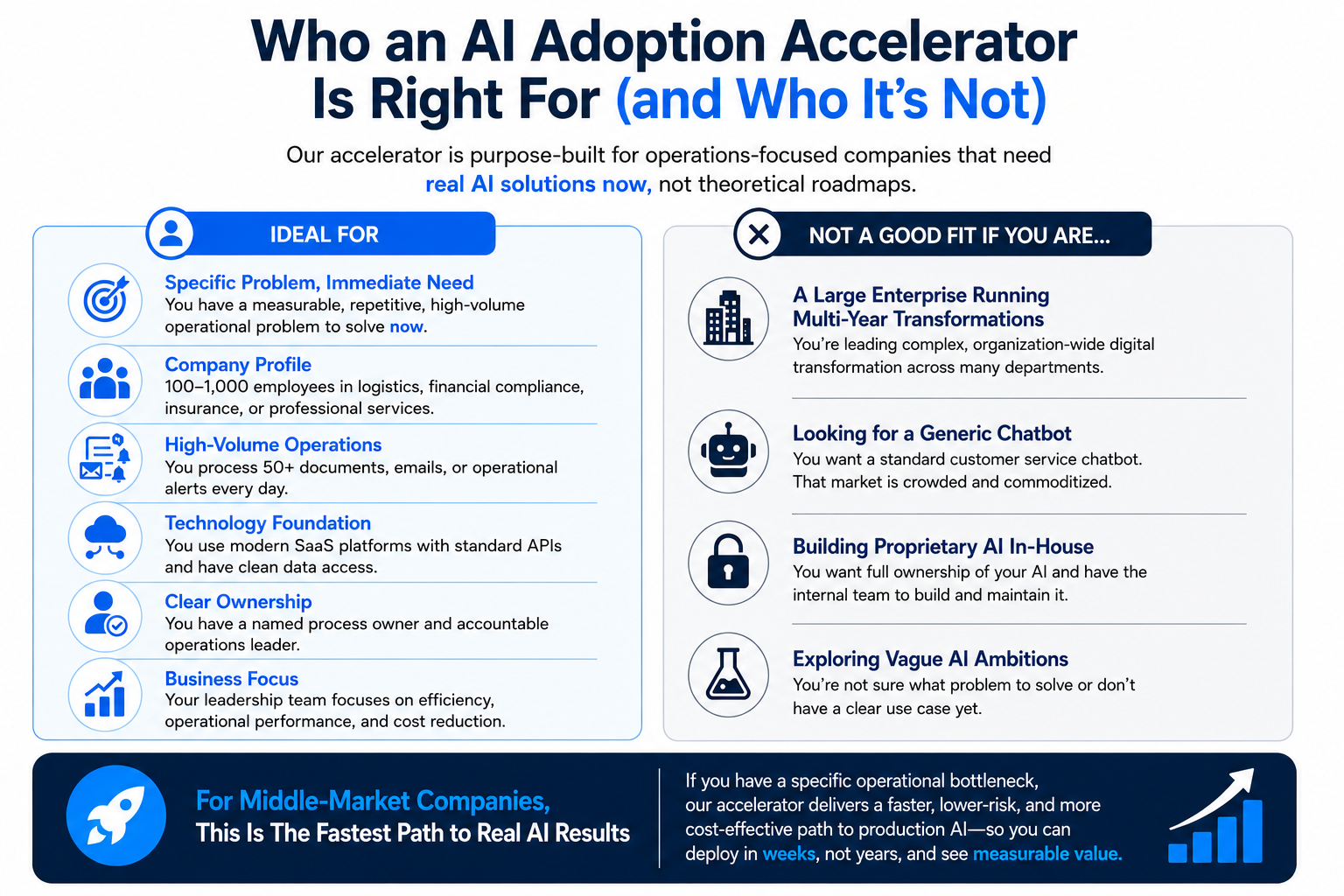
The ideal customer typically operates in logistics, financial compliance, insurance, or professional services with 100–1,000 employees. These organizations process more than 50 documents, emails, or operational alerts each day but lack an internal AI engineering team. Most already use modern SaaS platforms with standard APIs and assign clear ownership of operational workflows to a department lead or operations manager. Their leadership teams focus on efficiency, operational performance, and cost reduction rather than innovation theater.
This model does not target enterprises running multi-year digital transformation programs across dozens of business units because large consulting firms already serve that market well. It also does not target businesses looking for generic customer service chatbots because that segment has become highly commoditized. Companies that want to build proprietary AI systems internally and maintain full ownership through dedicated AI teams may also prefer a custom development approach.
For middle-market companies facing a specific operational bottleneck, however, the accelerator model offers a faster, lower-risk, and more cost-effective path to production AI. It gives operations leaders a practical way to deploy AI into real workflows and generate measurable business value within weeks rather than years.
Conclusion
The difference between traditional consulting approaches and modern AI adoption accelerators is no longer just about technology, it is about speed to value, operational impact, and long-term sustainability. While many large consulting firms focus heavily on strategy, roadmap planning, and lengthy transformation cycles, businesses today increasingly need AI solutions that can move quickly from concept to production and deliver measurable business outcomes in weeks, not years.
This is where SmartDev positions itself differently. Through NORA, its AI adoption accelerator, SmartDev focuses on practical AI implementation built around real operational workflows. Instead of stopping at recommendations, SmartDev delivers production-ready AI assistants tailored to specific business needs, whether in lending, compliance, inventory monitoring, or enterprise workflow automation. Combined with managed services, ongoing optimization, and strong domain expertise in regulated industries such as BFSI, connect SmartDev to see how we help organizations reduce adoption risk while accelerating ROI.