
Introduction
The keyword “what is BFSI in banking” attracts high search volume because it serves as the first step for fintech buyers researching digital transformation. BFSI, which stands for Banking, Financial Services, and Insurance, represents one of the most technology-driven sectors globally. Financial institutions are rapidly adopting AI, automation testing, and advanced API ecosystems to improve performance, compliance, and customer experience. Industry resources such as AI in BFSI Complete Technology Guide for Financial Leaders and AI in Banking Overview show how innovation is reshaping core financial infrastructure.
As the digital economy expands, BFSI continues to drive innovation across payments, lending, insurance, and risk management. Organizations increasingly invest in machine learning, generative AI, and scalable testing solutions to modernize legacy systems and support growth. Insights from Generative AI in BFSI Market Trends 2025 and AI in Financial Services highlight how intelligent automation improves decision accuracy and operational efficiency. SmartDev supports BFSI transformation through specialized QA, API optimization, and AI-powered development, as explored in Automation Testing in BFSI and Best BFSI Tech Solutions for Banks 2025.
What is BFSI in Banking?
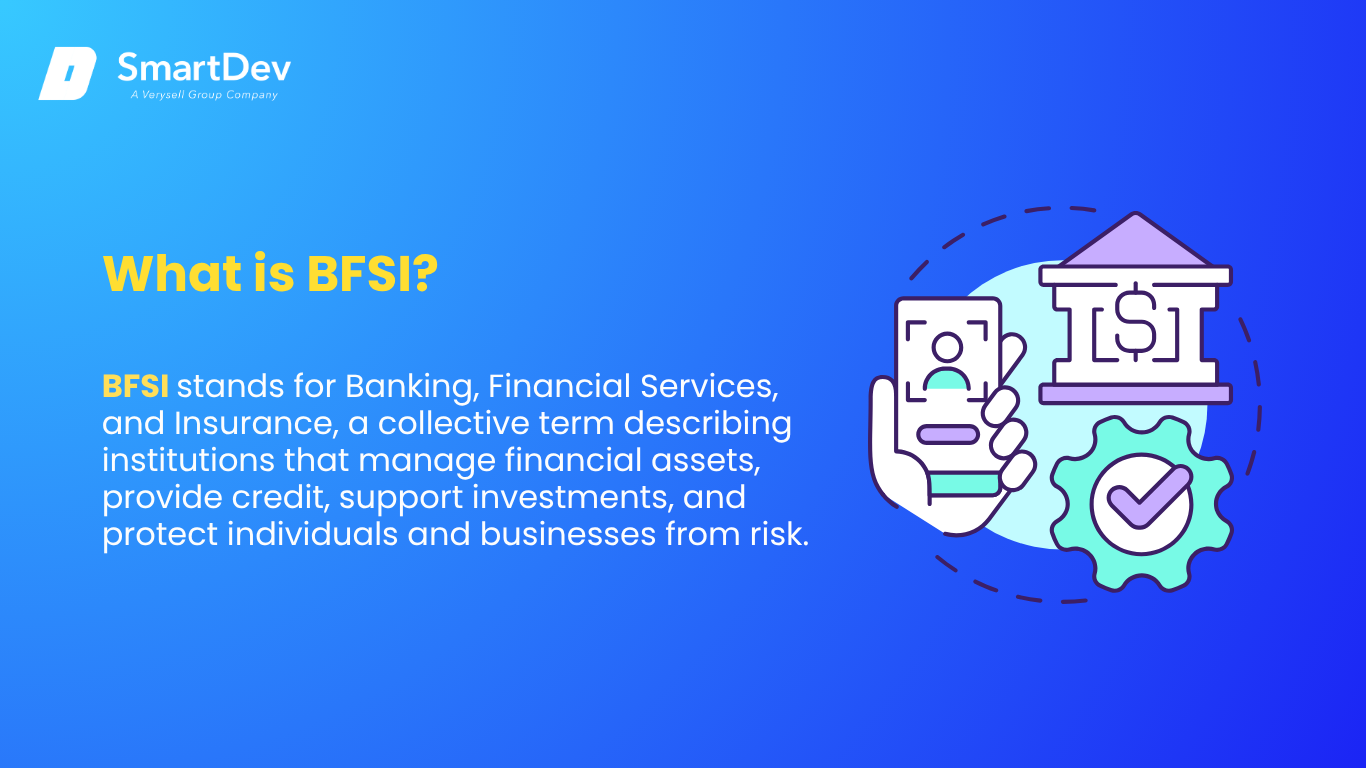 BFSI stands for Banking, Financial Services, and Insurance, a collective term describing institutions that manage financial assets, provide credit, support investments, and protect individuals and businesses from risk. When professionals search “what is BFSI in banking”, they typically want a comprehensive understanding of the broader financial ecosystem beyond traditional banking services. BFSI includes commercial banks, fintech companies, investment firms, payment providers, and insurance organizations working together to create a stable financial infrastructure.
Digital transformation continues to reshape the BFSI landscape through artificial intelligence, automation, and cloud computing. According to AI in BFSI Complete Technology Guide for Financial Leaders, financial institutions increasingly rely on intelligent systems to improve fraud detection accuracy, streamline operations, and personalize customer experiences. Global technology providers emphasize that AI-driven financial infrastructure improves decision-making speed and reduces operational risk, as explained in AI in Financial Services.
Core Components of the BFSI Sector

Banking
Banking forms the foundation of the BFSI sector by offering services such as deposits, lending, payments, and liquidity management. Retail banks, commercial banks, and digital banks enable capital movement across individuals, corporations, and governments. Many institutions now integrate machine learning and automation technologies to improve customer experience and operational efficiency.
Financial Services
Financial services include investment management, brokerage platforms, payment gateways, wealth advisory, and fintech innovation. This segment supports capital markets and business growth through funding and asset management solutions. Modern financial services rely heavily on API-based infrastructures to ensure seamless integration between digital platforms, as discussed in API Testing Platforms for BFSI.
Insurance
Insurance organizations help individuals and companies manage risk through policies covering health, life, travel, property, and liability. Insurers increasingly adopt predictive analytics and AI to automate underwriting processes, detect fraud, and improve claims management efficiency. This transformation is explored in AI Use Cases in Fintech.
Key Functions of BFSI Institutions
BFSI institutions perform critical financial activities that support economic growth and market stability. Core functions include:
- Deposit Management
Banks provide secure storage for funds while offering interest-bearing savings and checking accounts.
- Lending and Credit Services
Financial institutions provide personal loans, mortgages, and business financing to stimulate economic activity.
- Investment and Wealth Management
Firms help individuals and organizations grow assets through portfolio management, mutual funds, and advisory services.
- Payment Processing and Transactions
BFSI systems enable secure digital payments, cross-border transfers, and real-time financial transactions.
- Risk Management and Insurance Coverage
Insurance companies provide protection against financial losses caused by unexpected events.
- Regulatory Compliance and Security
Financial institutions must comply with strict regulations to ensure transparency, data protection, and financial integrity.
AI technologies continue to enhance these functions by improving decision-making speed and accuracy, as highlighted in AI in Banking Overview.
Evolution of the BFSI Sector in the Digital Era
The BFSI industry has evolved from traditional branch-based services into a digital-first ecosystem powered by cloud computing, big data, and artificial intelligence. Financial institutions now implement continuous integration pipelines and automated testing frameworks to maintain high software reliability. The article Automation Testing in BFSI demonstrates how automation improves product quality and accelerates deployment cycles.
Generative AI is also transforming customer support, compliance monitoring, and financial forecasting. According to Generative AI in BFSI Market Trends 2025, intelligent technologies help financial organizations reduce operational costs while improving service personalization.
Difference Between BFSI, Fintech, and Traditional Banking
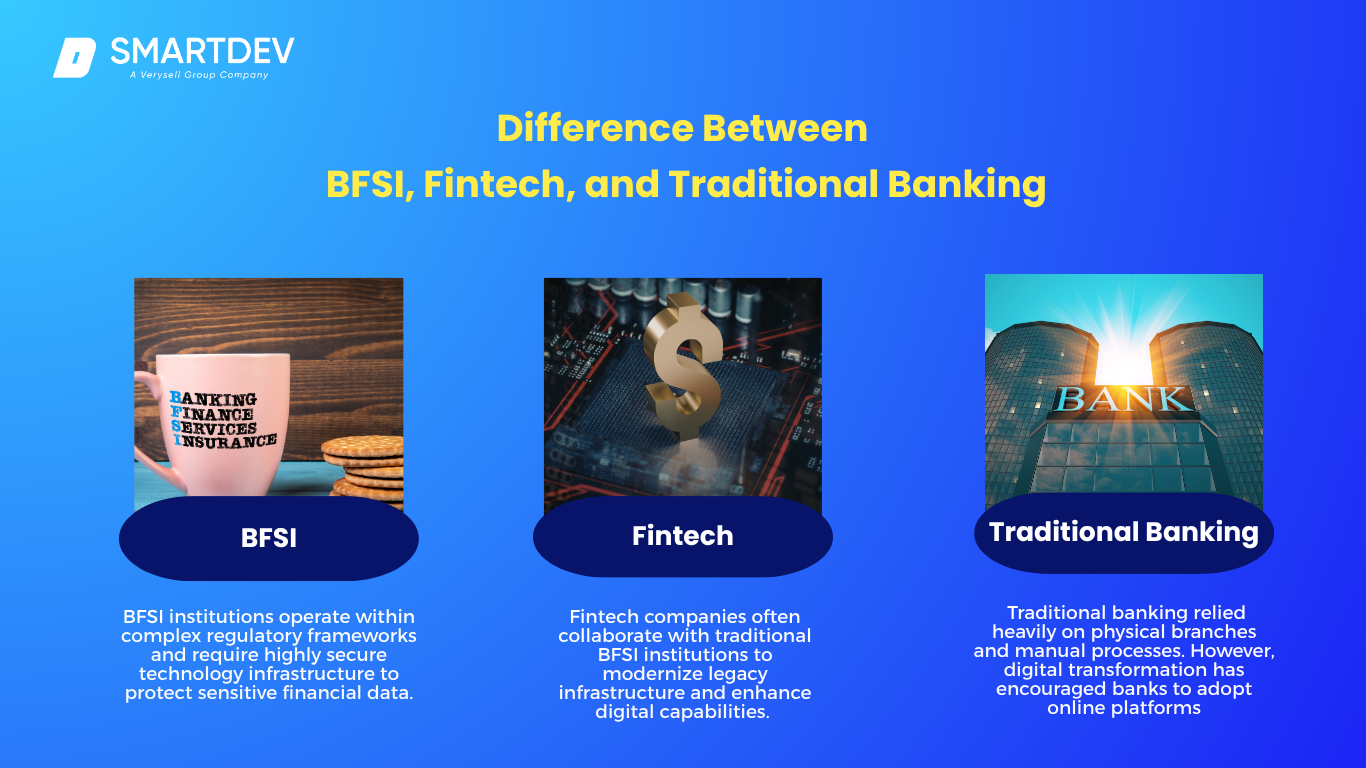
Understanding the differences between BFSI, fintech, and traditional banking helps clarify how modern financial ecosystems operate. While these terms are often used interchangeably, they represent different layers of the financial services landscape. BFSI is the broad industry category, traditional banking represents core financial institutions, and fintech focuses on innovation through technology. Together, they form an interconnected ecosystem that enables financial services to evolve in response to changing customer expectations and digital transformation trends.
 BFSI as the Umbrella Industry
BFSI, which stands for Banking, Financial Services, and Insurance, is the broadest category and includes all organizations involved in financial transactions, investments, risk management, and financial protection. The BFSI sector covers commercial banks, investment firms, insurance providers, payment processors, and asset management companies. It represents the full financial ecosystem that supports economic activity, capital flow, and wealth creation.
BFSI institutions operate within complex regulatory frameworks and require highly secure technology infrastructure to protect sensitive financial data. The sector increasingly adopts AI, cloud computing, and predictive analytics to improve operational efficiency and risk management. Insights from AI in BFSI Complete Technology Guide for Financial Leaders highlight how financial organizations leverage intelligent technologies to enhance decision-making accuracy and customer experience.
Traditional Banking as the Core Financial Foundation
Traditional banking refers specifically to institutions that provide fundamental financial services such as deposits, loans, payment processing, and savings products. Retail banks, commercial banks, and credit institutions form the backbone of financial systems by enabling individuals and businesses to store money securely and access credit.
Historically, traditional banking relied heavily on physical branches and manual processes. However, digital transformation has encouraged banks to adopt online platforms, mobile banking applications, and automated customer support tools. Many traditional banks now integrate AI-driven analytics and digital payment technologies to remain competitive in a technology-driven financial environment. According to AI in Banking, intelligent automation helps banks improve operational efficiency while delivering more personalized financial services.
Fintech as the Innovation Layer of Financial Services
Fintech refers to technology-driven companies that develop innovative solutions to improve financial services delivery. These companies leverage artificial intelligence, blockchain, big data analytics, and cloud computing to create faster, more accessible, and more user-friendly financial products.
Examples of fintech innovation include mobile payment platforms, robo-advisory investment tools, peer-to-peer lending platforms, and AI-powered credit scoring systems. Fintech companies often collaborate with traditional BFSI institutions to modernize legacy infrastructure and enhance digital capabilities. Real-world applications of AI in fintech are explored in AI Use Cases in Fintech.
As financial institutions continue to modernize their systems, the relationship between BFSI organizations and fintech providers becomes increasingly integrated. Fintech innovation enables BFSI institutions to improve customer experience, reduce operational costs, and deliver scalable digital financial services. Understanding these distinctions helps organizations identify strategic opportunities for technology adoption and digital transformation within the broader BFSI ecosystem.
Key Players in the BFSI Ecosystem
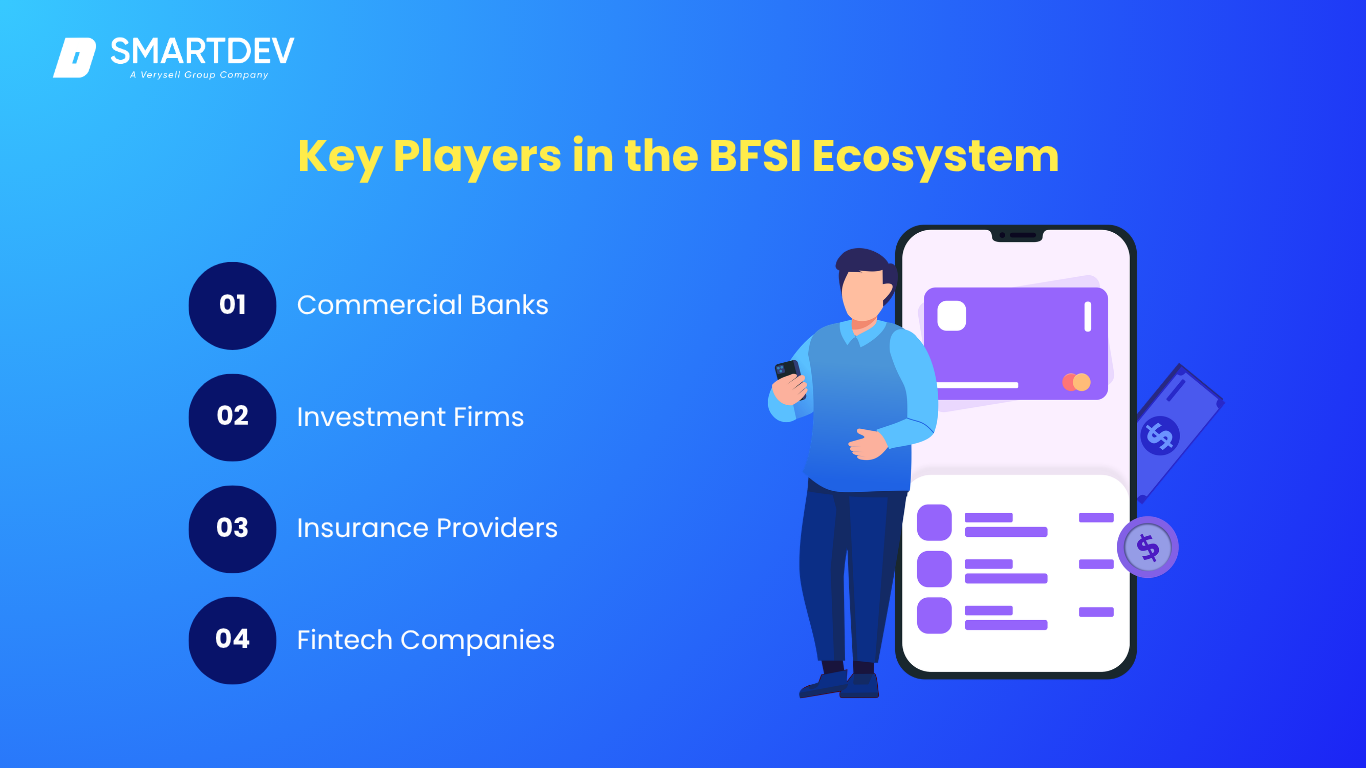
The BFSI ecosystem includes a diverse range of institutions working together to deliver financial stability, investment opportunities, and risk protection. Each participant plays a specialized role in supporting global economic activity and enabling digital innovation.
 1. Commercial Banks
Commercial banks form the backbone of the financial system by providing deposit accounts, loans, payment services, and liquidity management. They support individuals and businesses through credit financing, savings products, and transaction infrastructure. Digital banking platforms now integrate AI-powered chatbots, fraud detection systems, and predictive analytics to improve customer experience and security. The transformation of banking technology is highlighted in AI in Banking Overview.
2. Investment Firms
Investment firms help individuals, corporations, and institutions grow capital through asset management, securities trading, portfolio advisory, and wealth planning. These organizations rely heavily on advanced analytics, algorithmic trading, and AI-driven forecasting tools to improve financial decision-making accuracy. Machine learning models increasingly support market prediction and portfolio optimization, as discussed in AI in Financial Services.
3. Insurance Providers
Insurance companies provide financial protection against risks such as accidents, health issues, property damage, and liability exposure. Insurers use big data analytics and automation tools to improve underwriting precision and claims processing speed. AI-driven fraud detection systems help identify anomalies and reduce financial losses. Applications of AI in insurance are explored in AI Use Cases in Fintech.
4. Fintech Companies
Fintech companies focus on delivering technology-driven financial innovation through mobile payments, digital wallets, peer-to-peer lending, robo-advisory platforms, and blockchain-based services. These organizations often collaborate with traditional BFSI institutions to accelerate innovation and reduce operational costs. Modern fintech solutions rely heavily on scalable APIs and automation frameworks, as highlighted in Best BFSI Tech Solution for Banks 2025.
Technology, Regulation, and Digital Infrastructure in the BFSI Ecosystem
The BFSI ecosystem is shaped by rapid advances in technology, increasing regulatory requirements, and the expansion of digital financial infrastructure. Financial institutions must modernize systems while ensuring security, compliance, and scalability. The following components define how modern BFSI organizations operate and innovate.
1. Role of Technology Vendors in BFSI Transformation
Technology vendors help financial institutions upgrade legacy systems and deploy modern digital solutions. Their expertise supports secure software development, AI integration, cloud migration, and system interoperability.
Key contributions include:
- Secure digital banking platforms and mobile applications
- Automation testing frameworks improving reliability and compliance
- AI-driven analytics for fraud detection and risk prediction
Automation improves software quality and reduces deployment risks, as explained in Automation Testing in BFSI. AI adoption continues to improve decision-making accuracy across financial operations, as highlighted in AI and Machine Learning in BFSI Market.
Technology partners such as SmartDev help financial organizations accelerate digital transformation through scalable engineering solutions.
2. Regulatory Framework Governing BFSI
Regulation ensures stability, transparency, and consumer protection across the financial ecosystem. BFSI institutions must comply with strict legal requirements designed to reduce financial crime and maintain operational integrity.
Key regulatory priorities include:
- Data privacy and cybersecurity compliance
- Anti-money laundering (AML) and identity verification requirements
- Capital adequacy and risk management standards
AI-powered monitoring tools improve compliance accuracy and support fraud detection, as discussed in AI in Financial Services.
Strong compliance frameworks build trust and ensure long-term financial stability.
3. Emerging Digital Infrastructure in BFSI
Modern BFSI infrastructure relies on cloud computing, big data analytics, and intelligent automation to improve scalability and efficiency. These technologies enable financial institutions to process large volumes of transactions securely.
Important developments include:
- Cloud-native platforms supporting system flexibility
- Advanced analytics improving forecasting and decision-making
- Digital identity verification enhancing transaction security
AI-enabled infrastructure enhances operational performance, as explored in AI and Advanced Machine Learning in BFSI Market.
Digital infrastructure enables faster innovation and improved customer experience.

4. Open Banking and API Economy in BFSI
Open banking allows financial institutions to securely share data with third-party providers through APIs. This model promotes innovation and improves service accessibility across digital financial platforms.
Core API ecosystem components include:
- Secure API connectivity between financial platforms
- Third-party integrations enabling personalized services
- Customer-controlled data sharing capabilities
Reliable API performance ensures seamless integration between fintech and banking systems, as explained in API Testing Platforms for BFSI.
Open banking enables flexible and scalable financial ecosystems.
5. Digital Transformation Challenges in BFSI
Digital transformation introduces technical and regulatory challenges for financial institutions. Legacy systems, compliance requirements, and cybersecurity risks can slow modernization efforts.
Common challenges include:
- Integration complexity between legacy and modern platforms
- Maintaining compliance with evolving regulations
- Ensuring software quality across enterprise systems
Guidance on selecting qualified QA providers is available in BFSI Testing Company How to Select the Right QA Partner.
Strategic partnerships help organizations overcome these barriers and achieve sustainable digital growth.
Explore how SmartDev partners with BFSI teams through a focused AI sprint to validate use cases, align stakeholders, and define a clear path forward before AI development begins.
SmartDev helps BFSI organizations clarify AI use cases and assess feasibility, enabling confident decisions and reducing risks before committing to AI development.
Learn how SmartDev accelerates AI initiatives, ensuring rapid deployment and reduced time to market.
Strengthen Your BFSI Security Testing with UsRole of AI, Machine Learning, and Automation in BFSI
Artificial intelligence (AI), machine learning (ML), and automation are transforming how BFSI organizations operate, innovate, and compete in the digital economy. Financial institutions manage enormous volumes of sensitive data, making advanced analytics and intelligent automation essential for improving accuracy, security, and efficiency. AI-powered systems allow banks, insurers, and fintech companies to automate decision-making, enhance fraud detection, and deliver highly personalized customer experiences.
According to AI in BFSI Complete Technology Guide for Financial Leaders, AI adoption helps financial organizations reduce manual workload while improving service speed and scalability. Insights from AI in Banking also highlight how predictive analytics and intelligent automation improve customer engagement and operational performance.
 1. AI Adoption Driving Operational Intelligence in BFSI
AI improves operational intelligence by enabling financial institutions to analyze data more efficiently and automate repetitive processes. Traditional financial workflows often rely on manual review processes that limit speed and scalability. AI-powered systems provide real-time insights that support faster, more accurate decisions across financial operations.
Key improvements driven by AI include:
- Faster loan approvals through predictive analytics
- Improved customer insights using behavioral data
- Reduced operational costs through workflow automation
- Enhanced decision accuracy through real-time data processing
As discussed in AI in Financial Services, intelligent algorithms help organizations identify patterns in financial data and respond quickly to changing market conditions.
2. Core AI and Machine Learning Use Cases in Financial Services
Machine learning models continuously learn from financial data, enabling institutions to improve accuracy and efficiency across key business functions. AI-driven tools support multiple use cases that strengthen risk control and enhance customer experience.
Major AI applications include:
- Fraud detection systems identifying unusual transaction patterns
- Credit scoring models improving lending decisions
- Risk management tools predicting market volatility
- AI chatbots enhancing customer support and personalization
These capabilities help financial organizations reduce risk exposure while improving customer satisfaction. Real-world examples are presented in AI Use Cases in Fintech and AI in Finance Applications.
3. Generative AI and Intelligent Automation Trends in BFSI
Generative AI is expanding the potential of automation by enabling systems to create reports, generate insights, and support communication processes. Financial institutions use generative models to streamline document handling, improve knowledge management, and enhance digital interactions.
Key generative AI capabilities include:
- Automated document generation and financial reporting
- Conversational AI supporting customer service workflows
- Intelligent summarization of financial data
- Enhanced productivity through workflow automation
According to Generative AI in BFSI Market Trends 2025, financial institutions are increasing investment in generative AI to improve efficiency and maintain competitiveness in digital markets.
4. Automation Testing, API Integration, and AI-Driven Compliance
Automation ensures BFSI systems maintain reliability, scalability, and regulatory compliance in complex digital environments. Continuous testing frameworks help organizations identify issues early and improve software performance.
Important technology capabilities include:
- Automation testing improving system stability and deployment speed
- API integration enabling seamless communication between financial platforms
- AI-powered compliance monitoring detecting anomalies and security threats
- Scalable infrastructure supporting high transaction volumes
Best practices for QA implementation are discussed in Automation Testing in BFSI, while API integration optimization is covered in API Testing Platforms for BFSI. AI compliance tools also enhance monitoring accuracy, as highlighted in AI in Financial Services.
By combining AI, machine learning, and automation technologies, BFSI organizations can improve operational resilience, strengthen security frameworks, and deliver scalable digital financial services.
BFSI Technology Trends Shaping the Future of Banking
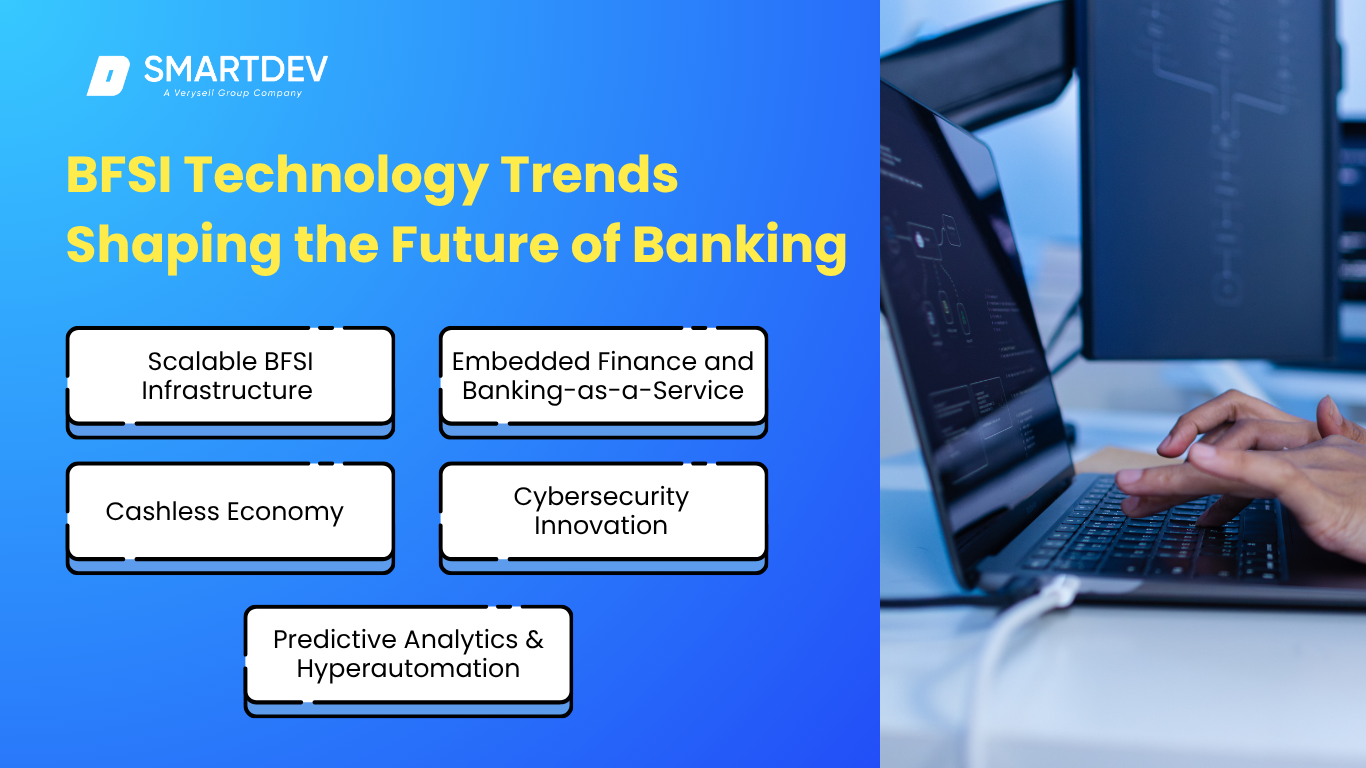
Technology investment in the BFSI sector is accelerating as financial institutions compete to deliver faster, more secure, and more personalized digital services. AI, cloud computing, and embedded financial platforms are reshaping how banks operate and how customers interact with financial products. According to AI in Financial Services, intelligent technologies allow institutions to process massive financial datasets while improving decision accuracy and operational efficiency. Market analysis also shows the AI in finance market is expected to grow from USD 38.36 billion in 2024 to USD 190.33 billion by 2030, highlighting rapid adoption of AI-driven financial infrastructure.
Below are five major technology trends shaping the future of BFSI:
1. Cloud Computing Enabling Scalable BFSI Infrastructure
Cloud computing enables financial institutions to scale digital services without relying on expensive legacy infrastructure. Cloud-native environments allow banks and fintech companies to deploy applications faster, improve system availability, and support real-time analytics. The flexibility of cloud architecture is particularly valuable as financial data volumes continue to grow rapidly.
Research indicates the global artificial intelligence market could reach USD 2.48 trillion by 2034, demonstrating how strongly organizations are investing in intelligent infrastructure. Cloud platforms also allow BFSI companies to integrate analytics tools more efficiently, improving fraud detection accuracy and customer insights. Modern infrastructure strategies are discussed in Best BFSI Tech Solution for Banks 2025.
2. Embedded Finance and Banking-as-a-Service Expanding Financial Ecosystems
Embedded finance allows companies to integrate financial services directly into digital platforms, enabling users to access payments, lending, or insurance services without leaving the application environment. This approach improves customer experience by reducing friction in financial transactions.
API-driven ecosystems are essential for enabling secure data exchange between financial providers and third-party platforms. As explained in API Testing Platforms for BFSI, stable API infrastructure ensures reliable communication between financial services and fintech applications. Embedded finance is expected to become a major revenue driver as organizations continue to integrate financial capabilities into digital ecosystems.
3. Digital Payments Accelerating the Cashless Economy
Digital payments are growing rapidly due to increased smartphone adoption and the expansion of mobile banking platforms. Real-time payment processing improves transaction speed and transparency, while AI technologies enhance security by identifying suspicious activity patterns.
Studies show AI-powered fraud detection tools can reduce false-positive alerts by up to 80%, improving both operational efficiency and customer trust. Financial institutions continue to invest in mobile-first payment technologies that support cross-border transactions and digital wallet adoption. Emerging fintech innovation trends are explored in AI Use Cases in Fintech.
4. Cybersecurity Innovation Strengthening Financial Data Protection
Cybersecurity remains a critical priority as financial institutions manage increasingly complex digital infrastructures. AI-powered threat detection systems analyze behavioral patterns to identify anomalies and prevent fraud attempts before significant damage occurs.
Recent research indicates 45% of financial organizations experienced AI-driven cyberattacks in the past year, highlighting the need for advanced cybersecurity frameworks. Machine learning technologies improve detection accuracy and strengthen data protection strategies across digital banking platforms. Advanced AI security strategies are discussed in AI and Machine Learning in BFSI Market.
5. Predictive Analytics and Hyperautomation Improving Financial Decision-Making
Predictive analytics helps financial institutions anticipate customer needs, evaluate investment opportunities, and optimize risk management strategies. Machine learning models analyze historical data to generate insights that improve forecasting accuracy and strategic planning.
Industry reports suggest more than 70% of financial institutions will use AI at scale by 2025, reflecting rapid adoption of intelligent automation technologies. Hyperautomation combines robotic process automation with AI-driven analytics to streamline workflows and reduce manual processing time. Insights into automation-driven innovation are explored in AI and Advanced Machine Learning in BFSI Market.
Why Firms Should Choose SmartDevfor BFSI Technology Solutions
 Selecting the right technology partner is critical for financial institutions operating in highly regulated and data-sensitive environments. BFSI organizations require scalable infrastructure, reliable software quality, and secure integration capabilities to support digital transformation initiatives. SmartDev provides specialized expertise in AI engineering, software testing, and API optimization, enabling banks, fintech companies, and insurers to deploy high-performance digital solutions. By combining technical excellence with domain-specific knowledge, SmartDev helps BFSI organizations improve operational resilience while maintaining compliance with evolving regulatory standards.
Below are four key reasons why firms choose SmartDev as a strategic BFSI technology partner:
1. Proven Expertise in BFSI Software Development and Quality Assurance
SmartDev delivers end-to-end software engineering services tailored to the needs of financial institutions. BFSI platforms require high reliability, strong security frameworks, and scalable architecture capable of handling large transaction volumes. SmartDev supports these requirements through advanced development methodologies and comprehensive quality assurance processes.
Modern testing frameworks improve system stability and reduce operational risks, as discussed in Automation Testing in BFSI. Financial organizations also benefit from specialized QA strategies that ensure compliance with industry regulations, as outlined in BFSI Testing Company How to Select the Right QA Partner.
By combining domain expertise with scalable engineering practices, SmartDev helps financial institutions maintain consistent performance across digital platforms.
2. AI-Powered Solutions Designed for Financial Institutions
Artificial intelligence plays a key role in enabling financial institutions to improve decision-making accuracy and operational efficiency. SmartDev develops AI-powered solutions that support fraud detection, predictive analytics, and intelligent automation across BFSI systems.
According to AI in BFSI Complete Technology Guide for Financial Leaders, AI technologies help financial organizations process large datasets and identify patterns that improve risk assessment accuracy. Emerging applications of intelligent automation are also explored in AI Use Cases in Fintech.
SmartDev enables financial institutions to implement scalable AI solutions that enhance customer experience while improving operational control.
3. Strong Capabilities in API Integration and Automation Testing
API infrastructure plays a central role in enabling open banking ecosystems and fintech collaboration. SmartDev provides specialized API testing solutions that ensure secure data exchange between financial platforms and third-party services.
Efficient API performance improves interoperability and system reliability, as explained in API Testing Platforms for BFSI. Automation testing frameworks also support continuous integration processes, helping organizations detect vulnerabilities early and reduce deployment risks.
By implementing scalable QA strategies, SmartDev enables BFSI organizations to maintain consistent system performance across complex digital ecosystems.
4. Scalable Digital Transformation Strategy for Long-Term Growth
SmartDev supports financial institutions throughout the entire digital transformation lifecycle, from system modernization to performance optimization. The company provides engineering expertise that enables organizations to integrate AI technologies, improve infrastructure scalability, and enhance software reliability.
Insights into digital innovation strategies are presented in Best BFSI Tech Solution for Banks 2025, which highlights the importance of selecting experienced technology partners. SmartDev’s case-driven approach ensures that BFSI organizations can scale digital services while maintaining strong compliance and security frameworks.
By aligning technical capabilities with business objectives, SmartDev helps financial institutions accelerate innovation and maintain competitive advantage in rapidly evolving financial markets.