
In the era of digital transformation, artificial intelligence (AI) is no longer a sci-fi concept but a core driver of innovation and growth. In fact, according to large-scale surveys, nearly 9 out of 10 organizations currently report using AI regularly in their operations. However, for this technology to deliver actual economic value rather than just being an experimental tool, businesses cannot apply it indiscriminately. Instead, they need to focus on specific “AI Use Cases.”
So, what does this term actually mean, why is it crucial for the future of businesses, and what does the implementation process require in terms of budget? Let’s decode the details in the article below.
What is AI Use Cases?
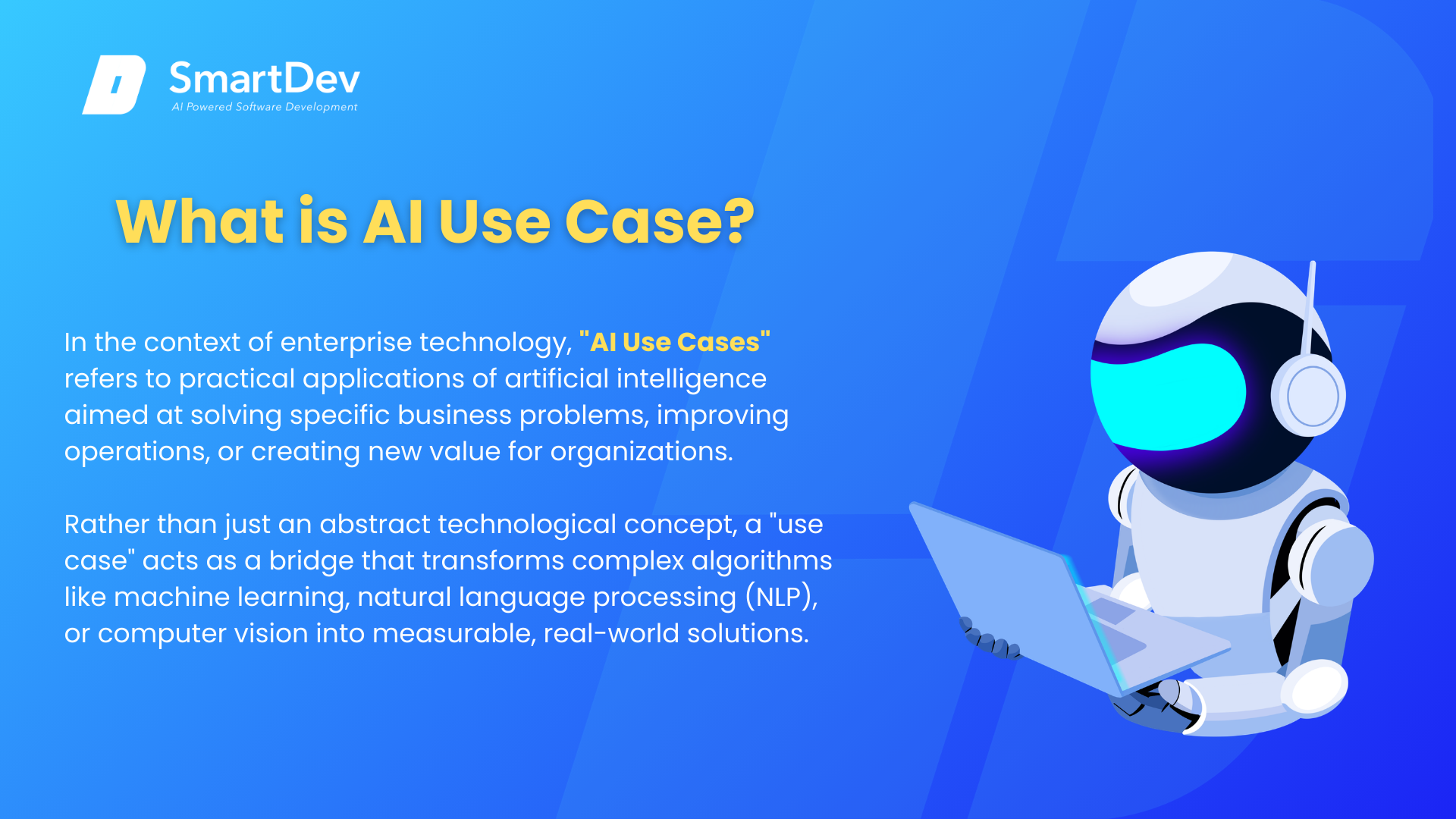
In the context of enterprise technology, “AI Use Cases” refers to practical applications of artificial intelligence aimed at solving specific business problems, improving operations, or creating new value for organizations. Rather than just an abstract technological concept, a “use case” acts as a bridge that transforms complex algorithms like machine learning, natural language processing (NLP), or computer vision into measurable, real-world solutions.
The development of AI Use Cases is most evident in how systems are customized for specific industries:
- Healthcare: AI analyzes unstructured medical data (such as X-rays) to support more accurate diagnoses, and generates new molecular structures to accelerate drug research.
- Banking & Finance: Predictive models assess credit risk by analyzing transaction histories and behavioral signals, while automatically monitoring to detect fraud and money laundering.
- Retail & E-commerce: Algorithms analyze hundreds of variables to provide hyper-personalized product recommendations (which account for up to 35% of revenue for major platforms like Amazon) and optimize real-time pricing.
- Manufacturing & Supply Chain: AI monitors equipment vibration and temperature to predict failures (predictive maintenance), helping reduce unplanned downtime by 20–30%, while optimizing logistics routing.
Why It Matters for Businesses?
The integration of AI Use Cases has become an essential requirement to ensure competitive advantage, bringing profound impacts on both operational and financial fronts.
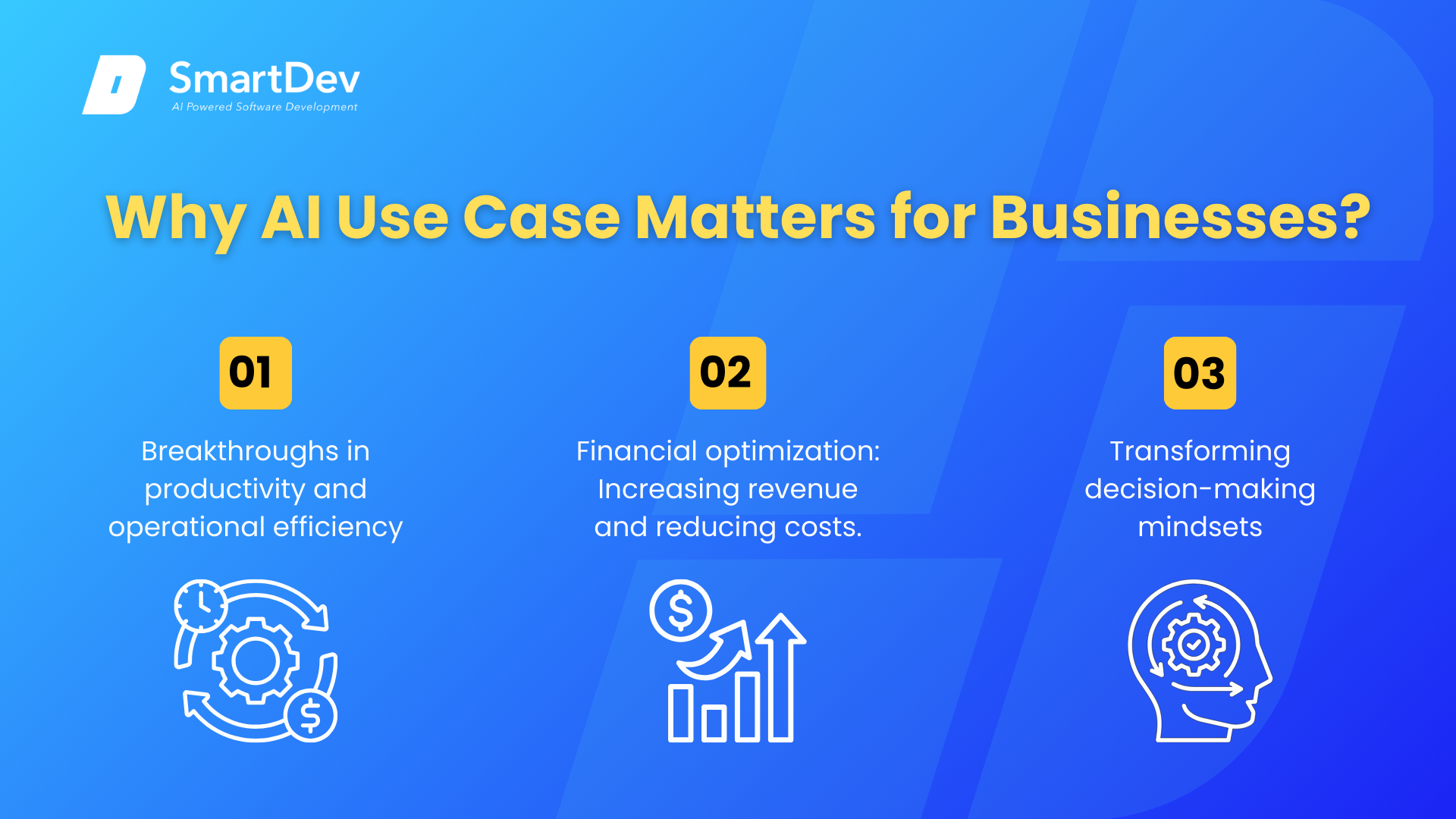
1. Breakthroughs in productivity and operational efficiency
By automating repetitive tasks, AI frees employees from mundane administrative work to focus on strategy. Organizations report that AI helps reduce processing time for routine transactions by 60% to 80% and decreases human error rates in data-intensive tasks by 40% to 60%.
2. Financial optimization: Increasing revenue and reducing costs
The impact of AI on the bottom line is very clear. According to a report from Nvidia, 88% of organizations using AI state that the technology has helped them increase their annual revenue, while 87% report significant cost reductions. Businesses leading in AI adoption achieve 1.5 times faster revenue growth and 1.4 times better return on investment compared to their slower-moving competitors.
3. Transforming decision-making mindsets
AI shifts business strategy from a reactive posture to a predictive one. Systems process massive amounts of data in real-time to provide insights for leadership, from forecasting macroeconomic trends to optimizing global logistics.
Accompanying Challenges: Although the potential is massive, 56% of CEOs say they have not seen a clear change in revenue or costs from AI in the past 12 months. The main reason is that companies measure the wrong metrics or only apply AI to isolated tasks without redesigning their entire workflow. To truly cut personnel costs, an organization needs to achieve an AI-driven productivity gain of at least 50% to 70%.
How to Implement & How Much?
The journey of bringing an AI idea to reality requires a rigorous roadmap and careful financial preparation.
Implementation Roadmap
Successful implementation does not happen by chance but follows 4 core phases:
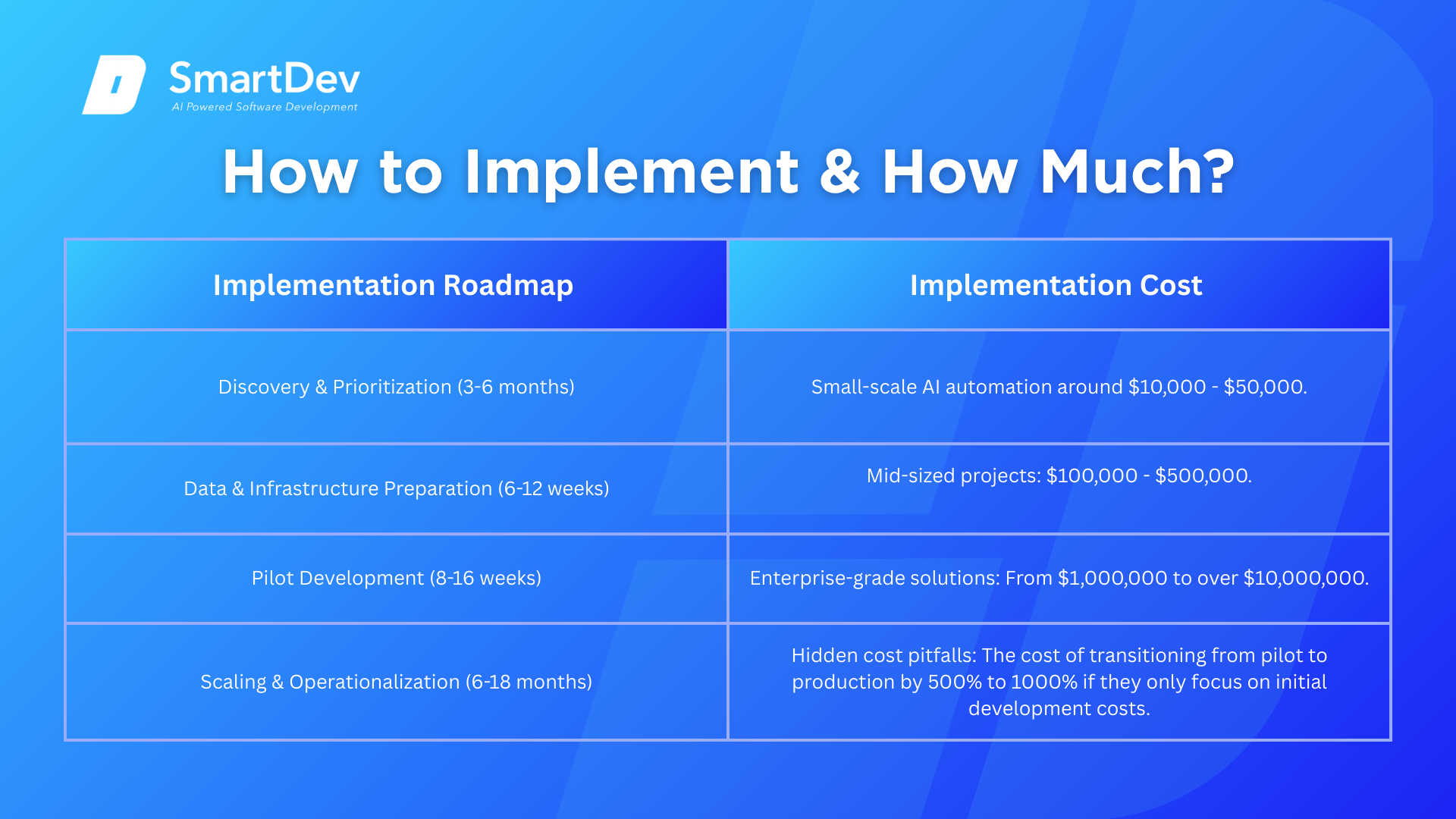
- Discovery & Prioritization (3-6 months): Identify “bottlenecks” in workflows. Businesses should prioritize Use Cases that offer high Impact but require low Effort.
- Data & Infrastructure Preparation (6-12 weeks): AI depends entirely on data. This phase focuses on data cleaning, upgrading cloud infrastructure, and establishing security protocols.
- Pilot Development (8-16 weeks): Deploy the Use Case in a controlled environment to validate assumptions, measure initial ROI, and gather feedback from real users.
- Scaling & Operationalization (6-18 months): After a successful pilot, the system is integrated enterprise-wide. This requires establishing robust MLOps processes to monitor and maintain model quality.
Implementation Cost
The cost is not just a one-time software investment (CapEx) but is similar to sustaining a long-term employee (OpEx).
- Small-scale AI automation (e.g., Internal chatbots, basic document processing): Around $10,000 – $50,000.
- Mid-sized projects (e.g., Predictive analytics, custom NLP): $100,000 – $500,000.
- Enterprise-grade solutions (e.g., Autonomous systems, deep learning networks): From $1,000,000 to over $10,000,000.
- Hidden cost pitfalls: Many businesses typically underestimate the cost of transitioning from pilot to production by 500% to 1000% if they only focus on initial development costs.
For a small to medium enterprise, an AI project with a first-year cost of $50,000 could consume $200,000 – $500,000 over 5 years. Surprisingly, 60% of the total cost over these 5 years goes towards maintenance, cloud computing costs, and retraining the model to prevent data drift.
Other Related Terms
To better navigate the AI Use Cases ecosystem, here are the foundational related terms:
- Artificial General Intelligence (AGI): A theoretical concept referring to an AI system with cognitive, learning, and information processing capabilities superior or equal to humans across all fields, capable of self-upgrading without human intervention.
- Narrow AI (Weak AI): The opposite of AGI, this is the most common type of AI today. They are highly trained to perform a single specific task (like facial recognition or product recommendations) and cannot apply skills outside that scope.
- AI Agents / Agentic AI: Software systems with a high degree of autonomy, capable of making their own decisions, interacting with other systems, and performing multi-step actions to achieve a goal without humans constantly providing prompts.
- Machine Learning (ML) & Deep Learning: ML is the foundation that allows systems to analyze historical data to find patterns on their own instead of being pre-programmed. Deep Learning is an advanced branch of ML that uses complex artificial neural networks (similar to the human brain) to process unstructured data like images and voice.
- Retrieval-Augmented Generation (RAG): An architectural technique that helps minimize AI “hallucinations.” RAG allows the AI model to actively retrieve information from a verified internal corporate database before generating an answer, ensuring accuracy and context-adherence.
- AI Ethics & Responsible AI: Governance frameworks and principles aimed at ensuring AI does not harm humans, controlling bias in algorithms (e.g., in recruitment or credit scoring), and protecting data privacy.
결론
In conclusion, AI Use Cases serve as a guiding compass for every enterprise’s artificial intelligence strategy. Correctly identifying the problem to solve, establishing a specific roadmap, and preparing a long-term budget will help organizations avoid wasted investments. When successfully deployed, these Use Cases not only automate mundane tasks but also unlock entirely new ways of interacting and doing business, laying a solid foundation for breakthrough growth in the future.