
Data engineering is a foundational pillar of modern businesses, ensuring data is efficiently collected, processed, and transformed into actionable insights. Traditionally, the Extract, Transform, Load (ETL) process has been at the heart of this effort, automating the movement and transformation of data across systems. However, the rapid evolution of artificial intelligence (AI) is reshaping the way ETL workflows are designed and executed. By integrating AI into the ETL pipeline, businesses can unlock enhanced automation, efficiency, and accuracy, drastically reducing manual intervention and errors.
In this blog, we explore how AI is transforming ETL processes, highlighting key use cases, business benefits, and the challenges organizations face when implementing AI in data engineering. Through real-world examples and practical insights, we will demonstrate how AI is revolutionizing ETL workflows, making them faster, smarter, and more scalable. By understanding these advancements, organizations can better position themselves to optimize their data pipeline processes and harness the full potential of AI for improved decision-making and operational efficiency.
What is AI and Why Does It Matter in ETL?
 Artificial Intelligence (AI) refers to the development of computer systems designed to simulate human intelligence. These systems are capable of learning from data, reasoning, solving problems, perceiving the environment, and understanding language. By simulating these human-like capabilities, AI enables machines to perform tasks autonomously, often with greater accuracy and efficiency than humans.
The core technologies of AI that contribute to ETL (Extract, Transform, Load) processes include:
1. Machine Learning (ML)
Machine Learning is a subset of AI that focuses on enabling computers to learn from data. Rather than following explicit instructions, machine learning algorithms detect patterns in data, improving performance over time as they are exposed to more information. In ETL, ML models can be used for automating data extraction, detecting anomalies, and optimizing transformations.
2. Natural Language Processing (NLP)
NLP is a field of AI focused on enabling machines to understand, interpret, and generate human language. It bridges the gap between human communication and machine processing. In ETL, NLP is used for extracting data from unstructured text, transforming it into a structured format, and classifying or categorizing text-based information, such as emails, documents, and web content.
3. Computer Vision
Computer Vision allows machines to interpret and analyze visual information from the world around them. It is used for extracting data from images, video streams, and visual documents. In ETL workflows, computer vision can automate the extraction of data from images or scanned documents, reducing the need for manual data entry and ensuring high-quality data transformation.
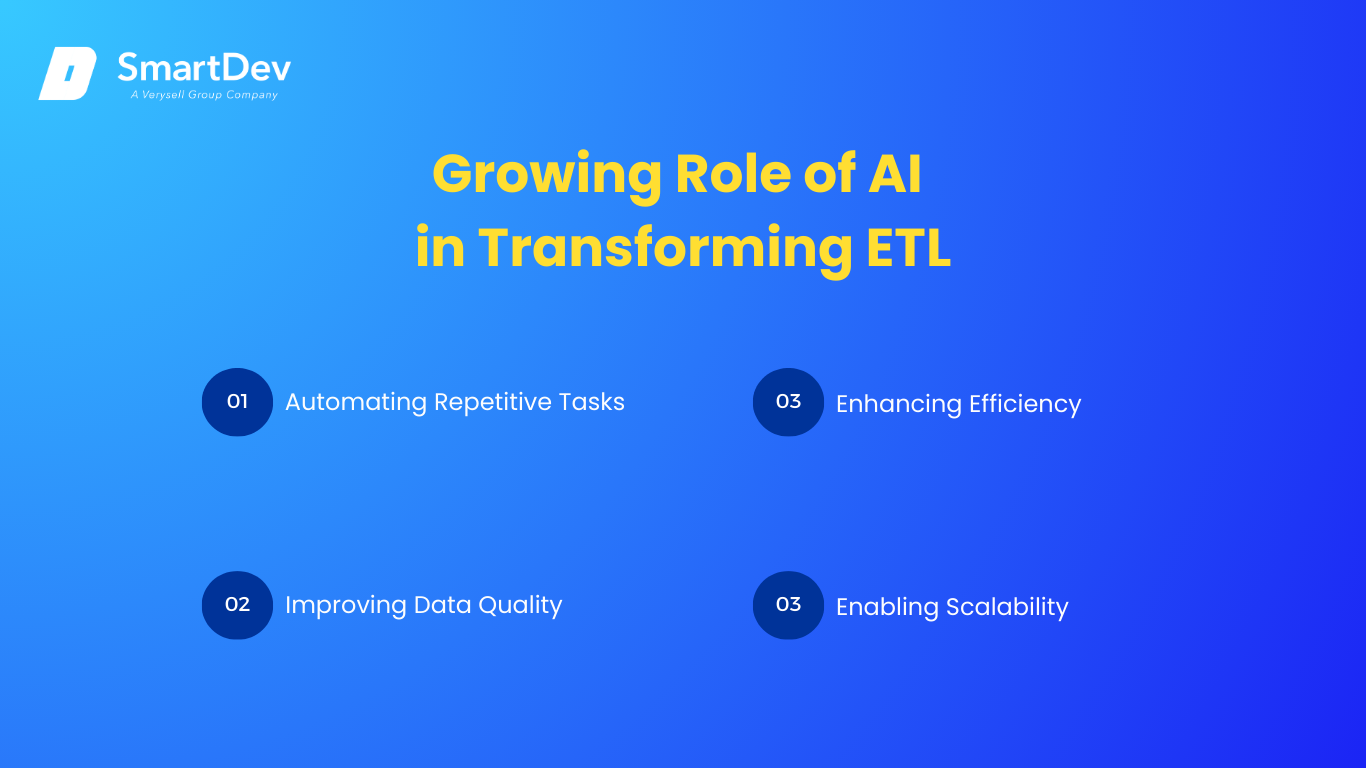
The Growing Role of AI in Transforming ETL
Historically, ETL processes have been manual and time-consuming, requiring significant resources to extract data from multiple sources, transform it into a uniform format, and load it into databases or data warehouses for analysis. These processes were prone to errors, delays, and inefficiencies. However, AI is rapidly transforming the ETL landscape by automating various stages of the process, making it faster, more accurate, and adaptable to new data sources and types.
 Automating Repetitive Tasks
One of the key advantages of AI is its ability to automate repetitive tasks in the ETL pipeline. For example, AI-powered systems can automate data extraction, identify and clean inconsistent data, and detect errors in real-time. This reduces the burden on human data engineers, allowing them to focus on higher-value tasks, such as strategic analysis and decision-making.
Improving Data Quality
AI technologies like machine learning and NLP are incredibly effective at detecting anomalies and errors in data. Whether it’s identifying missing values, inconsistencies, or duplicates, AI algorithms can automatically flag problematic data, ensuring that only high-quality information is loaded into the data warehouse. This leads to more reliable insights and better decision-making.
Enhancing Efficiency
AI-powered ETL processes are much faster than traditional methods. Machine learning algorithms can learn from patterns in data and optimize the transformation rules automatically, speeding up the entire ETL pipeline. This leads to faster access to actionable data, which is particularly important for organizations that need real-time analytics to stay competitive.
Enabling Scalability
AI’s ability to adapt to new data types, formats, and sources makes ETL systems highly scalable. As businesses grow and data volumes increase, AI-powered ETL systems can handle larger datasets and more complex data transformations without a significant increase in resource requirements. This scalability ensures that ETL processes remain efficient even as the organization expands.
Key Statistics or Trends Highlighting AI Adoption in ETL
AI’s role in ETL processes is expanding rapidly. According to a recent study by IBM, 79% of data engineers believe AI will play a crucial role in data integration over the next few years. In fact, 60% of organizations have already started implementing AI solutions to automate various aspects of their data pipelines, and the AI-powered ETL market is expected to grow by 30% year-over-year.
1. Growth in AI Adoption
As more organizations realize the value of AI in automating data workflows, adoption rates continue to rise. Businesses in sectors like finance, healthcare, and retail are increasingly relying on AI to streamline their ETL processes, improve data quality, and gain deeper insights into their operations.
2. AI as a Key Enabler of Digital Transformation
AI-powered ETL systems are essential for digital transformation. By automating and optimizing data workflows, AI allows businesses to handle the growing volume, variety, and velocity of data more efficiently. This has made AI a critical component of modern data engineering and business intelligence strategies.
3. Machine Learning and NLP Integration
Machine learning and natural language processing are becoming essential in the ETL pipeline. These technologies allow organizations to automatically classify and categorize data from different sources, such as customer feedback, documents, and social media. With AI’s help, ETL systems can extract actionable insights from previously unstructured data, making it easier for businesses to make data-driven decisions.
The Impact of AI on Traditional ETL Processes
 AI is not just transforming individual tasks within the ETL pipeline; it is fundamentally reshaping the entire process. Here’s how AI is making ETL smarter and more efficient:
1. Automated Data Extraction
Traditionally, data extraction from various sources, such as databases, files, and APIs, was a manual process. AI technologies like machine learning can now identify patterns in data and extract relevant information automatically. Additionally, NLP techniques enable data engineers to extract structured data from unstructured sources, such as text, emails, or social media posts.
2. Advanced Data Transformation
AI can significantly enhance the transformation stage by applying machine learning algorithms to identify the most optimal way to convert data. This includes detecting patterns, mapping data to predefined schemas, and ensuring that the transformed data meets quality standards. AI-driven data transformation not only speeds up the process but also minimizes the chances of human error.
3. Intelligent Data Loading
AI can also optimize the loading process by automating decisions about how data should be structured, partitioned, and indexed for faster querying. Machine learning models can predict which data formats will provide the best performance in downstream systems, leading to faster load times and better query performance.
4. Continuous Improvement and Learning
A key feature of AI in ETL is its ability to continuously improve over time. As AI systems are exposed to more data, they learn from past interactions and automatically adjust the ETL pipeline to optimize performance. This continuous learning loop ensures that the system remains up-to-date with changing data requirements and patterns.
Business Benefits of AI in ETL
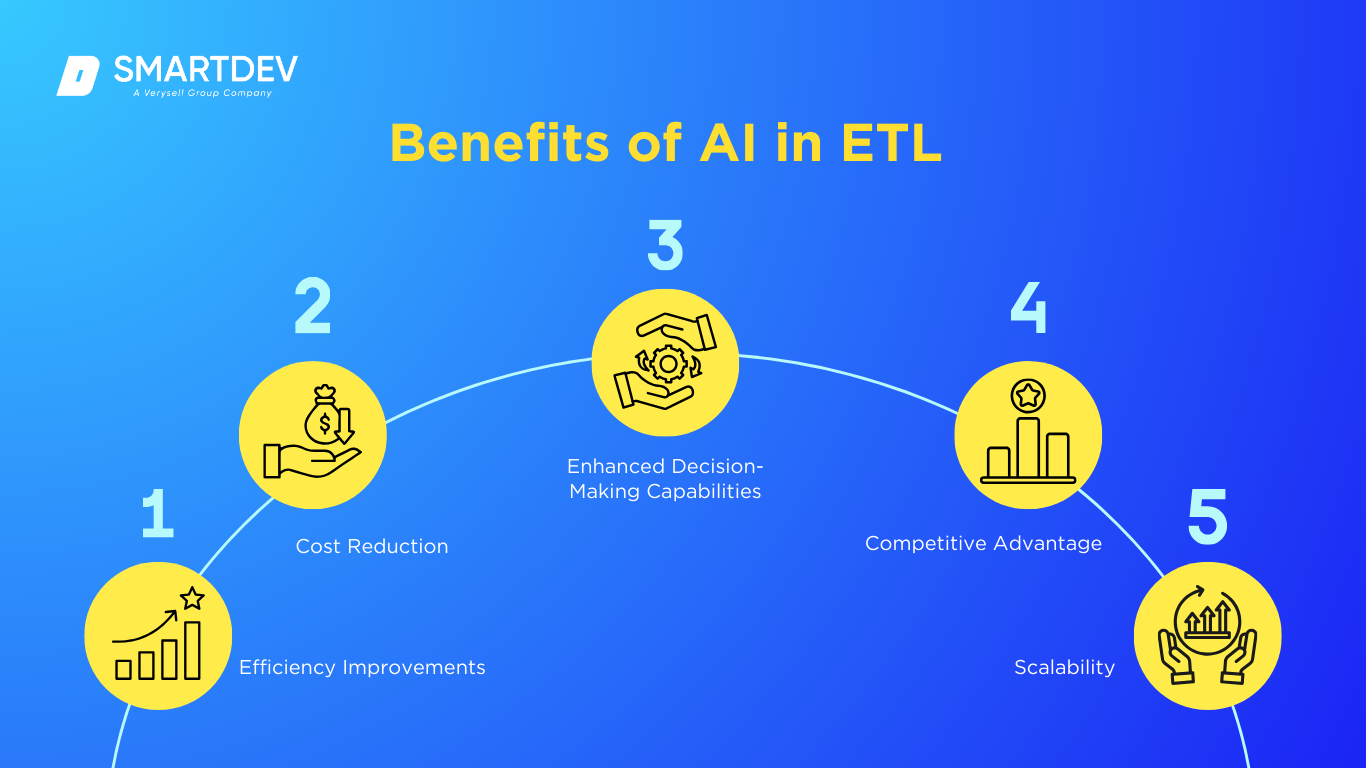 The integration of AI into ETL (Extract, Transform, Load) processes significantly enhances data management. Here are the key benefits businesses experience:
1. Efficiency Improvements
AI accelerates ETL by automating manual tasks like data cleaning and transformation. It allows businesses to process large datasets faster and identify patterns that would take humans longer to detect. This reduces processing time, enabling businesses to respond to market changes more quickly and improve overall productivity.
2. Cost Reduction
By automating data extraction, transformation, and loading, AI reduces labor costs and minimizes the need for manual interventions. It also reduces the risk of human error, saving costs related to reprocessing data or quality checks.
3. Enhanced Decision-Making Capabilities
AI enables real-time data processing and advanced analytics, offering valuable insights for faster and more informed decision-making. AI helps businesses anticipate trends, optimize supply chains, and forecast customer behavior, keeping them competitive in dynamic industries.
4. Competitive Advantage
AI-powered ETL allows businesses to process data in real-time, offering them a clear advantage over competitors relying on slower, traditional ETL methods. This enables faster responses to market conditions and customer needs, helping businesses capture market share.
5. Scalability
AI-based ETL systems scale seamlessly as data volumes increase, without needing manual intervention. This ensures businesses can grow without worrying about data infrastructure limitations, optimizing operations and maintaining high-quality data management.
Challenges Facing AI Adoption in ETL
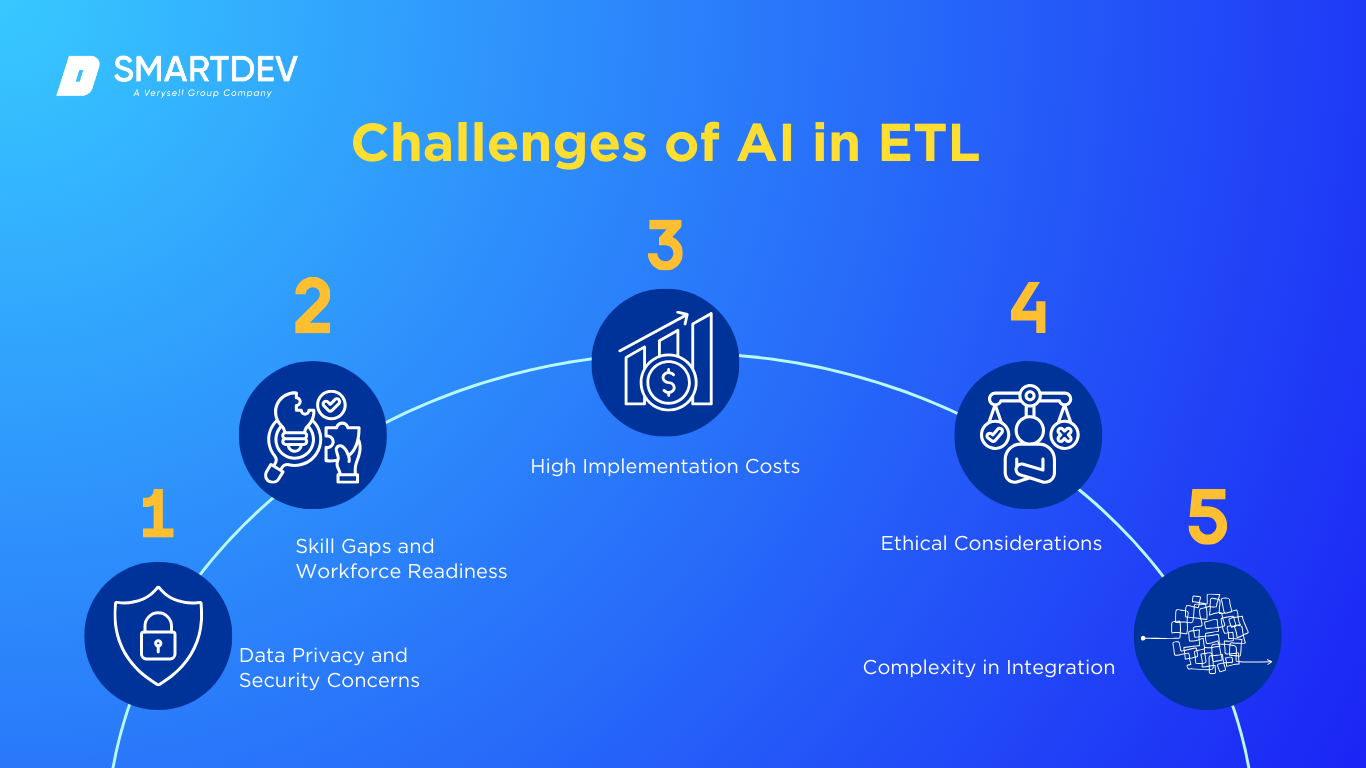 While AI offers major benefits, integrating AI into ETL processes presents several challenges:
1. Data Privacy and Security Concerns
AI systems require access to large volumes of data, including sensitive information. Ensuring data privacy and complying with regulations like GDPR and CCPA is essential. Businesses must implement robust security measures like encryption and access control to protect sensitive data.
2. Skill Gaps and Workforce Readiness
Many organizations face a shortage of skilled professionals who can build and maintain AI-driven ETL systems. Companies need to invest in training and upskilling their teams or hire AI experts to bridge this gap.
3. High Implementation Costs
The initial investment for AI technologies, infrastructure, and training can be high. While AI offers long-term cost savings, businesses must evaluate ROI before committing to implementation.
4. Ethical Considerations
AI systems can introduce biases if not properly managed. Ensuring transparency, fairness, and accountability in AI decisions is crucial for maintaining trust and avoiding unethical outcomes, especially in areas like hiring or healthcare.
5. Complexity in Integration
Integrating AI with existing ETL systems, especially legacy ones, can be complex and resource-intensive. Businesses need to ensure compatibility and scalability while managing the technical challenges of incorporating AI into their workflows.
Core AI Use Cases in ETL
AI is transforming ETL with automation and optimization, offering several use cases to improve efficiency:
1. Data Extraction Automation
AI, especially NLP, automates the extraction of unstructured data from emails, documents, and web sources. This reduces manual labor and ensures consistent, up-to-date data for processing.
2. Data Cleansing and Preprocessing
AI detects and fixes data quality issues like missing values, duplicates, and format inconsistencies, improving data accuracy and reliability before transformation and loading.
3. Data Transformation Optimization
AI automates complex data transformations, such as schema mapping and business rule application, ensuring faster and error-free transformations, improving the quality of data for analysis.
5. Real-time Data Processing
AI enables real-time ETL processing, ensuring businesses can respond quickly to market changes, customer interactions, or emerging events by processing data instantly for decision-making.
6. Predictive Analytics and Data Modeling
AI integrates predictive models into the ETL pipeline, helping businesses forecast future trends, customer behavior, and market conditions, enabling proactive decision-making and better strategic planning.
Need Expert Help Turning Ideas Into Scalable Products?
Partner with SmartDev to accelerate your software development journey — from MVPs to enterprise systems.
Book a free consultation with our tech experts today.
Let’s Build TogetherSpecific Applications of AI in ETL
AI is increasingly being integrated into the ETL process to enhance data extraction, transformation, and loading across various industries. Below are some specific applications of AI in ETL, showing how this technology is streamlining operations, improving decision-making, and creating value across different sectors.
1. AI in Financial Services for ETL Optimization
 In the financial services industry, AI is significantly enhancing the ETL process by automating data extraction, transformation, and analysis, which helps streamline critical operations such as transaction processing, fraud detection, and risk management. Given the massive volumes of data that financial institutions process daily, AI is crucial in efficiently handling and making sense of this information.
AI is particularly valuable in fraud detection and risk analysis. For example, AI can analyze transactional data in real time and flag unusual patterns or anomalies that may indicate fraudulent activity. Machine learning models can continuously improve by learning from past transaction data, helping to detect increasingly sophisticated fraud schemes. Similarly, AI can assess risk by analyzing large amounts of data from different sources, enabling more accurate credit scoring and risk assessment.
Key benefits include:
- Real-time fraud detection: AI can detect suspicious activities such as abnormal spending patterns or unauthorized account access by analyzing large volumes of transaction data.
- Automated risk management: AI models can assess credit risk and market risk by analyzing data from various sources, ensuring more accurate decision-making and timely interventions.
- Transaction processing automation: AI helps automate the extraction of data from transactional systems and transform it for further analysis, significantly reducing manual intervention and errors.
By automating these critical processes, financial institutions can improve operational efficiency, reduce errors, and enhance security in their data management systems.
2. AI in Healthcare for Data Integration
 The healthcare industry has an enormous amount of complex, sensitive data coming from diverse sources such as patient records, diagnostic images, medical devices, and sensor data. AI is transforming how healthcare providers handle this data, ensuring more efficient integration, real-time analysis, and ultimately, better patient outcomes.
AI technologies like natural language processing (NLP) and computer vision are extensively used to process unstructured data from sources like clinical notes, medical records, and diagnostic images. For instance, AI can extract relevant information from medical documents, such as patient history, symptoms, and test results, and then organize that data into structured formats that can be easily accessed and analyzed.
Key applications include:
- Clinical data integration: AI helps extract, clean, and standardize data from various sources like Electronic Health Records (EHR), diagnostic images, and wearable sensors, making it easier to access comprehensive patient information.
- Medical image analysis: AI-powered computer vision algorithms can analyze medical images such as X-rays, MRIs, and CT scans to identify patterns, anomalies, or early signs of diseases like cancer, which supports faster diagnosis and decision-making.
- Predictive analytics for patient outcomes: By using historical patient data and real-time monitoring, AI can predict patient outcomes, helping healthcare providers prioritize care and treatment plans for critical cases.
Through AI-driven data integration and real-time analytics, healthcare providers can ensure better care delivery, enhance operational efficiency, and make faster, more informed decisions.
3. AI in Retail for Real-time Analytics
 In the retail industry, AI-powered ETL systems are transforming how businesses handle and analyze customer data. Retailers are increasingly adopting AI to aggregate data from various sources—such as sales transactions, customer reviews, and social media—to generate real-time insights into customer preferences, inventory trends, and market dynamics.
By automating data extraction and transformation, AI helps retailers make sense of large, diverse datasets quickly and effectively. For example, AI models can process customer behavior data to identify purchasing patterns, helping businesses understand which products are in demand and which marketing strategies are most effective. Retailers can then adjust their stock levels or personalize offers based on these insights.
Key benefits include:
- Personalized customer experiences: AI allows businesses to process customer data from various touchpoints (e.g., website, mobile apps, social media) to deliver personalized recommendations, promotions, and product suggestions in real time.
- Inventory optimization: By analyzing sales data in real time, AI can help predict demand for specific products, enabling retailers to optimize stock levels and reduce overstocking or stockouts.
- Sentiment analysis: AI can analyze customer reviews, social media posts, and other feedback to gauge customer sentiment, providing businesses with valuable insights for improving customer satisfaction and adjusting marketing strategies.
AI’s ability to provide real-time data insights helps retailers remain agile in a competitive environment, respond quickly to customer needs, and deliver more personalized experiences.
4. AI in Manufacturing for Predictive Maintenance
 In the manufacturing sector, AI is being increasingly used to enhance ETL processes by enabling predictive maintenance. Traditionally, equipment failure in manufacturing could lead to significant downtime, which impacts productivity and incurs costs. By using AI, manufacturers can optimize ETL workflows by continuously monitoring equipment performance and predicting failures before they happen.
AI models can analyze data from various sensors embedded in machinery and compare it with historical performance data to identify patterns that indicate potential issues. For example, AI can detect anomalies in temperature, vibration, or pressure levels that may signal the need for maintenance. The integration of this predictive capability into the ETL process ensures that data about equipment health is continuously updated, allowing maintenance teams to take timely action and reduce unexpected downtime.
Key benefits include:
- Early fault detection: AI algorithms can predict when a piece of equipment is likely to fail, allowing for proactive maintenance that minimizes disruption and reduces repair costs.
- Optimized maintenance schedules: By using AI to analyze the usage patterns and performance data of machinery, manufacturers can schedule maintenance at the optimal time, reducing both downtime and unnecessary maintenance costs.
- Improved operational efficiency: With predictive maintenance in place, manufacturers can keep their production lines running smoothly, avoid costly interruptions, and improve overall equipment effectiveness (OEE).
By automating data collection, processing, and analysis for maintenance purposes, AI-driven ETL systems help manufacturers improve asset reliability and reduce operational costs.
5. AI in Supply Chain and Logistics for Data Synchronization
 In supply chain management and logistics, AI is being used to improve the ETL process by automating data synchronization across multiple systems and stakeholders. Supply chain operations involve a large number of moving parts—from suppliers and manufacturers to distributors and retailers—and ensuring all these systems are aligned can be a logistical challenge.
AI-powered ETL solutions can automatically extract and transform data from various systems (such as ERP systems, inventory management software, and transportation platforms) and synchronize it across the entire supply chain. By doing so, businesses can gain real-time visibility into their operations, optimize routes, and make data-driven decisions about inventory and shipping.
Key applications include:
- Automated data synchronization: AI helps to integrate data from multiple supply chain platforms, ensuring that all parties have access to the same up-to-date information for better decision-making.
- Real-time shipment tracking: AI-powered ETL can process data from GPS and sensor technologies to provide real-time tracking of shipments, ensuring that logistics teams can respond to any delays or issues as they arise.
- Supply chain optimization: By analyzing historical data and current trends, AI can suggest more efficient routes, predict demand fluctuations, and adjust inventories to minimize costs and maximize efficiency.
AI is making supply chain operations more efficient by ensuring that data is consistently updated and accessible, helping businesses make smarter decisions and respond swiftly to changes in demand or disruptions.
Real-World Case Studies of AI in ETL
1. Case Study 1: Financial Institution Using AI for Data Integration
Overview
 Overview
A leading financial institution sought to improve the efficiency and accuracy of their data processing and fraud detection systems. With millions of transactions processed daily, they needed an AI-driven solution that could streamline transaction data processing, enhance data accuracy, and improve their fraud detection capabilities. The solution had to handle complex financial data and operate at scale, ensuring real-time processing and accurate decision-making.
Client’s Challenges:
- Manual Data Processing: The institution was relying on traditional methods to process large volumes of transaction data, which was time-consuming and prone to human error.
- Inefficient Fraud Detection: Their existing fraud detection system was reactive, relying on predefined rules and manual review processes. This resulted in missed fraudulent activities and false positives, affecting operational efficiency.
- Slow Data Insights: Financial decision-making processes were slowed down due to delayed data analysis, preventing the institution from responding quickly to market changes or emerging risks.
SmartDev’s Solutions:
- AI-Powered ETL Pipeline: SmartDev implemented an AI-driven ETL pipeline that integrated machine learning algorithms for real-time data processing. This system automatically extracted, transformed, and loaded data from multiple sources, ensuring that all transaction data was processed seamlessly.
- Machine Learning for Fraud Detection: The AI system leveraged machine learning models to analyze transaction patterns and detect anomalies in real time, improving fraud detection accuracy and reducing false positives.
- Real-Time Data Insights: By automating data transformation and processing, the solution provided real-time insights, enabling faster decision-making and improved financial reporting.
Client’s Achievements:
- 40% Reduction in Data Processing Time: The automation of transaction data processing cut down the time spent on data handling by 40%, allowing the institution to allocate resources more effectively.
- 30% Improvement in Fraud Detection Accuracy: The AI-powered fraud detection system improved the accuracy of identifying suspicious activities, minimizing both false positives and missed fraud cases.
- Enhanced Decision-Making: With faster access to real-time, accurate data, the financial institution was able to make quicker and more informed decisions, enhancing operational efficiency and customer satisfaction.
2. Case Study 2: Retail Chain Implementing AI-Driven Analytics
Overview
 Overview
A global retail chain wanted to leverage AI to enhance their customer data analysis and inventory management systems. They needed a solution that would help them understand customer behavior, optimize stock levels, and improve sales forecasting. The goal was to increase sales and reduce operational inefficiencies by making data-driven decisions across their global stores.
Client’s Challenges:
- Fragmented Customer Data: The retail chain had multiple data sources (in-store, online, and social media) that were not effectively integrated, resulting in incomplete customer profiles and missed opportunities for personalization.
- Ineffective Inventory Management: The retailer struggled with stockouts and overstocking, leading to lost sales and wasted resources. Their manual inventory system lacked real-time insights into customer demand.
- Slow Reaction to Market Trends: Due to delayed data processing, the retailer could not quickly adjust to changes in customer preferences, leading to missed opportunities for promotions and product launches.
SmartDev’s Solutions:
- AI-Powered ETL for Customer Data Integration: SmartDev implemented an AI-driven ETL solution that integrated data from various customer touchpoints (sales data, social media, customer reviews) into a unified system. This allowed for a more comprehensive and accurate understanding of customer behavior.
- Predictive Analytics for Sales and Inventory: The solution included predictive analytics powered by machine learning to forecast customer demand, allowing the retailer to optimize stock levels and reduce waste.
- Real-Time Data Processing: With an AI-powered ETL pipeline, the retailer was able to process data in real-time, enabling them to respond quickly to shifts in customer preferences and market trends.
Client’s Achievements:
- 20% Increase in Sales: By leveraging AI for personalized recommendations and targeted promotions based on real-time customer data, the retailer saw a 20% increase in sales across their global network.
- 15% Improvement in Inventory Management: Predictive analytics allowed the retailer to optimize inventory levels, reducing stockouts and excess inventory, which led to a 15% improvement in inventory efficiency.
- Faster Response to Market Changes: With real-time insights into customer behavior and inventory trends, the retailer was able to react faster to market demands, optimizing product offerings and marketing strategies.
The results speak for themselves: faster data processing, better fraud detection, improved sales, and optimized inventory management. AI-powered ETL solutions not only streamline operations but also provide businesses with the agility to adapt quickly to market changes and customer needs.
AI-Driven Innovations Transforming ETL
Emerging Technologies in AI for ETL
AI is revolutionizing ETL (Extract, Transform, Load) processes by introducing innovations like Generative AI and Computer Vision, enhancing efficiency, scalability, and accuracy.
Generative AI for Synthetic Data Creation
Generative AI allows businesses to create synthetic data for testing, training, and validation, addressing concerns with real-world data such as privacy issues or biases. It generates diverse datasets that replicate real-world conditions without needing sensitive data. This ensures more controlled, efficient testing and faster machine learning model training.
Benefits:
- Improved data quality for ETL testing.
- Faster training for AI models.
- Data privacy without real user data.
Computer Vision for Document Processing
AI-powered computer vision automates data extraction from scanned documents, invoices, receipts, and forms. This technology reduces manual data entry, enhancing accuracy and processing speed in industries like finance, healthcare, and logistics.
Benefits:
- Automated extraction of data from visual sources.
- Reduced human error in data processing.
- Increased efficiency by automating document handling.
These innovations are transforming ETL, making data processing faster, more accurate, and more secure.
How to Implement AI in ETL
Assessing Readiness for AI Adoption
Before implementing AI in ETL, businesses must evaluate:
- Infrastructure: Ensure IT systems can support AI-driven data processing.
- Data Quality: Verify data cleanliness, structure, and accuracy.
- Employee Skills: Assess workforce readiness and provide necessary training.
Building a Strong Data Foundation
AI thrives on clean, structured data. Businesses must focus on:
- Data Collection: Gather comprehensive data from diverse sources.
- Data Cleaning: Remove duplicates and handle missing values.
- Data Governance: Ensure consistent, compliant, and secure data handling.
Choosing the Right Tools and Vendors
Select vendors based on:
- AI Capabilities: Ensure the platform offers relevant AI tools.
- Scalability: Choose solutions that can grow with business needs.
- Industry Expertise: Ensure the vendor understands specific industry requirements.
By assessing readiness, building a solid data foundation, and selecting the right tools, businesses can successfully implement AI in their ETL processes.
Measuring the ROI of AI in ETL
 Measuring the ROI of AI in ETL involves evaluating the tangible and intangible benefits that AI integration brings to the data pipeline. Businesses can track the impact of AI-driven ETL solutions through various key performance indicators (KPIs) like productivity improvements, cost savings, and enhanced data accuracy. One of the primary advantages of AI is the automation of repetitive, time-consuming tasks like data extraction, cleansing, and transformation. By reducing the need for manual intervention, businesses can significantly speed up data processing, leading to faster access to valuable insights and more efficient workflows.
In addition to productivity improvements, AI also offers substantial cost-saving potential. By automating the ETL pipeline, businesses reduce labor costs associated with data handling and management. Furthermore, AI’s ability to detect and correct data errors before they affect downstream processes leads to fewer mistakes, reducing the costs related to reprocessing and rectifying issues. Additionally, businesses benefit from enhanced decision-making capabilities, as AI enables more accurate, data-driven insights that support proactive, timely decisions. The combination of increased efficiency, cost reduction, and better decision-making makes measuring the ROI of AI-driven ETL a critical step toward realizing long-term value.
Future Trends of AI in ETL
The future of AI in ETL is promising, with significant advancements on the horizon. As AI continues to evolve, businesses can expect increased automation in ETL processes, allowing for faster, more efficient data handling without manual intervention. Real-time data processing is becoming crucial for industries that need up-to-the-minute insights, such as retail, healthcare, and finance, and AI will continue to play a central role in enabling this. Furthermore, AI-driven predictive analytics will be integrated into ETL systems to forecast trends, customer behaviors, and demand, empowering businesses to make proactive decisions.
Additionally, as AI technology matures, we’ll see more self-learning ETL systems that can automatically adapt and optimize based on incoming data. This will further reduce the need for human input and enhance the scalability and efficiency of data pipelines. At the same time, data privacy and security will remain a top priority, with AI tools evolving to include advanced encryption, anomaly detection, and privacy-preserving techniques to protect sensitive information. Embracing these trends will allow businesses to fully harness the power of AI in their data engineering workflows and stay ahead in a competitive landscape.
Conclusion
AI is revolutionizing the ETL space by automating and optimizing data processing workflows, offering businesses substantial benefits such as faster data processing, reduced operational costs, and improved decision-making capabilities. By integrating AI technologies into ETL, organizations can streamline their operations, reduce human error, and unlock valuable insights from their data. However, businesses must be mindful of challenges such as data privacy, skill gaps, and the complexity of integrating AI with existing systems. Addressing these challenges is key to ensuring the successful adoption of AI-driven ETL solutions.
To stay competitive and leverage the full potential of AI in ETL, organizations should prioritize building a strong data foundation, upskilling their workforce, and selecting the right AI tools for their needs. By embracing AI, businesses can not only drive innovation in their data engineering processes but also position themselves for long-term growth and success in an increasingly data-driven world. Now is the time for businesses to invest in AI for ETL and take the next step toward transforming their data operations.