

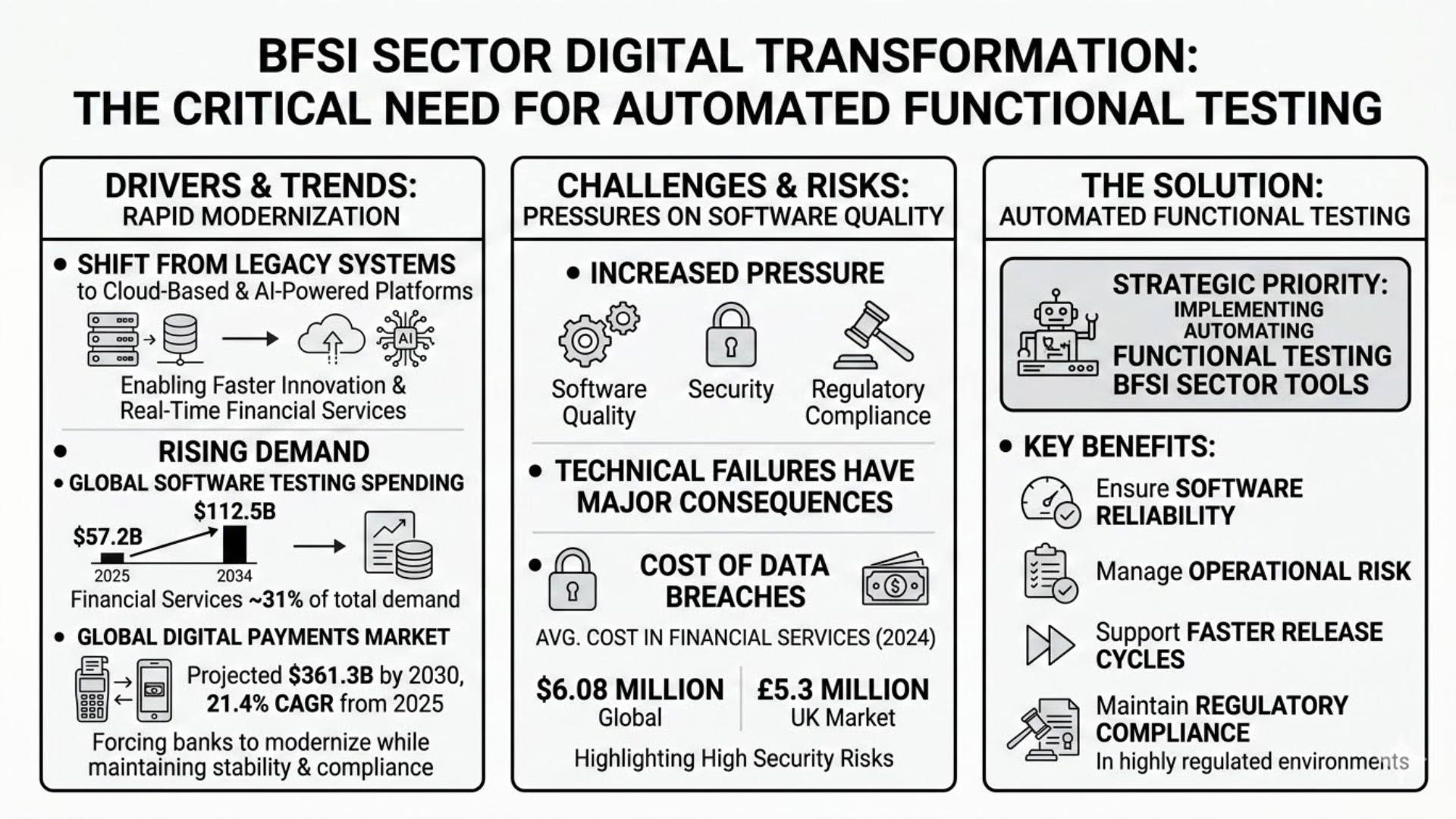
The rapid evolution of digital technology is transforming the Banking, Financial Services, and Insurance (BFSI) sector. Financial institutions are shifting from legacy systems to cloud-based and AI-powered platforms that enable faster innovation and real-time financial services.
However, this transformation also increases pressure to maintain software quality, security, and regulatory compliance. Global software testing spending reached $57.2 billion in 2025 and is projected to grow to $112.5 billion by 2034, with financial services accounting for around 31% of total testing demand.
In the financial industry, even small technical failures can have major consequences. The average cost of a data breach in financial services reached $6.08 million in 2024, while the UK market recorded £5.3 million per breach, highlighting the sector’s high security risks.
At the same time, digital transactions are expanding rapidly. The global digital payments market is expected to reach $361.3 billion by 2030, growing at a 21.4% CAGR from 2025. This growth forces banks and financial institutions to modernize their platforms while maintaining stability and compliance.
As a result, implementing automating functional testing bfsi sector tools has become a strategic priority. These solutions help organizations ensure software reliability, manage operational risk, and support faster release cycles in highly regulated financial environments.
The Harsh Reality and Technical Barriers in BFSI Systems
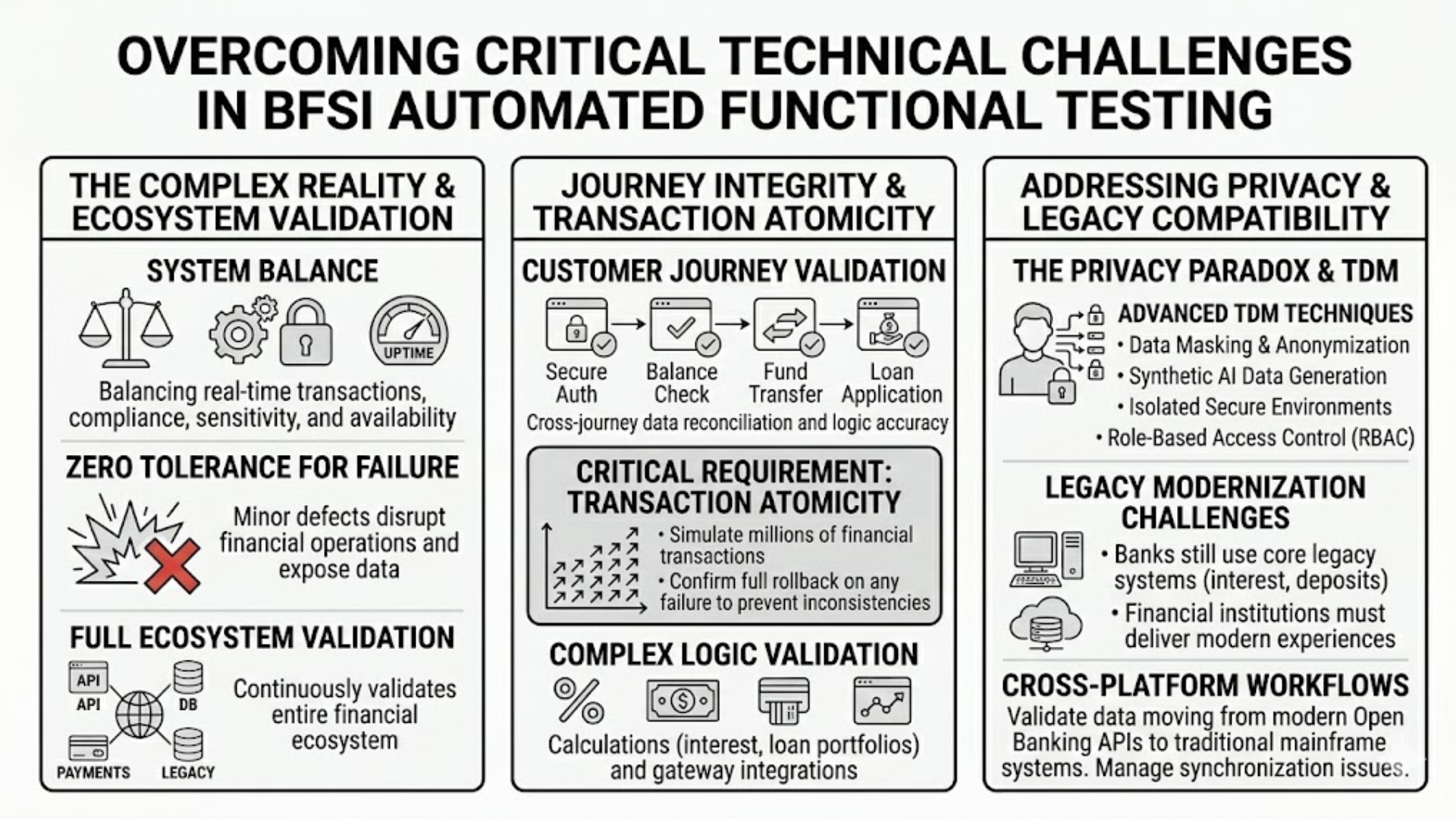
Applications in the Banking, Financial Services, and Insurance (BFSI) sector face far greater complexity than most digital platforms. These systems must balance real-time transaction processing, strict regulatory compliance, high data sensitivity, and uninterrupted availability.
Unlike typical e-commerce platforms, BFSI applications operate under zero tolerance for technical failure. Even a minor system defect can disrupt financial operations or expose sensitive customer data. As a result, organizations increasingly rely on automating functional testing bfsi sector tools to validate system reliability and reduce operational risk.
These tools enable continuous testing across the entire financial ecosystem, ensuring stability across APIs, payment platforms, databases, and legacy systems.
Customer Journey Integrity and Transaction Atomicity
In BFSI environments, functional testing goes far beyond validating interface behavior. Testing must ensure the accuracy and integrity of every financial transaction across the entire customer journey.
This includes validating processes such as:
- Secure authentication and account access
- Balance updates and transaction records
- Fund transfers and bill payments
- Loan applications and approval workflows
Each transaction must be correctly recorded in backend systems, reconciled between debit and credit accounts, and stored without duplication or data inconsistencies.
A critical testing requirement is transaction atomicity. Automated testing systems must simulate millions of financial transactions to confirm that any system interruption triggers a full rollback. This ensures that incomplete or partially executed financial operations never occur.
With the help of automating functional testing bfsi sector tools, financial institutions can also validate complex processes such as interest calculations, payment gateway integrations, and loan portfolio management. This reduces the risk of mathematical errors or flawed business logic that could lead to significant financial losses.
Test Data Management (TDM) and the Privacy Paradox
Testing financial systems introduces a major challenge: realistic data is required for accurate validation, yet privacy regulations prohibit exposing real customer data in test environments.
BFSI platforms store highly sensitive personal and financial information, making them prime targets for cyberattacks and fraud. Therefore, Test Data Management (TDM) has become a critical component of modern QA strategies.
To address this challenge, organizations adopt advanced techniques such as:
- Data masking and anonymization to hide personal identifiers
- Synthetic data generation using AI to simulate realistic financial scenarios
- Secure test environment isolation to prevent unauthorized data access
- Role-Based Access Control (RBAC) to limit internal exposure risks
These practices allow teams to maintain testing accuracy while fully complying with data protection regulations.
Legacy Complexity and Modernization Challenges
Many banks still operate legacy core banking systems that have been running for decades. These platforms handle essential functions such as interest calculation, transaction reconciliation, and deposit management.
At the same time, financial institutions must deliver modern digital experiences through mobile banking apps, APIs, and web platforms. Integrating these two worlds creates significant testing complexity.
Automated testing must validate workflows that move from modern Open Banking APIs to traditional mainframe systems. Without advanced automation frameworks and specialized automating functional testing bfsi sector tools, synchronization issues often lead to delayed releases and defects reaching production environments.
For this reason, financial institutions increasingly invest in comprehensive testing architectures capable of supporting both legacy infrastructure and modern digital banking platforms.
The Regulatory Compliance Matrix: The Core of Modern BFSI Testing
Testing banking software is fundamentally different from testing standard consumer applications. In the BFSI sector, a single system defect can trigger regulatory penalties, financial losses, or reputational damage.
Because of this risk, regulatory compliance is a core requirement in every banking QA strategy. Financial institutions must continuously validate their systems against strict global standards using automating functional testing bfsi sector tools.
Major regulatory frameworks include:
- PCI DSS – Protects payment card data and secure transaction processing
- SOX (Sarbanes-Oxley Act) – Ensures financial reporting accuracy and internal controls
- GDPR / CCPA – Enforces strict customer data privacy protection
- Basel III / Dodd-Frank – Focuses on risk management and financial stability
In addition, AML (Anti-Money Laundering) and KYC (Know Your Customer) systems require real-time monitoring of financial activities. Testing must simulate complex fraud scenarios, suspicious transaction patterns, and cross-platform identity verification flows.
Without robust automation, maintaining compliance across these frameworks becomes operationally impossible.
The Impact of Circular No. 77/2025/TT-NHNN in Vietnam
In Vietnam, regulatory requirements for digital banking have recently become stricter with Circular No. 77/2025/TT-NHNN, issued by the State Bank of Vietnam and effective March 1, 2026.
This regulation introduces stronger technical security requirements for mobile banking systems, significantly increasing testing workloads.
Under the circular, mobile banking applications must automatically suspend access in several situations, including when devices are rooted, jailbroken, or operating systems are modified. Systems must also prevent users from downgrading to older application versions, reducing malware and security risks.
Biometric authentication requirements have also been strengthened. Financial institutions must implement anti-spoofing mechanisms compliant with ISO 30107 Level 2 or equivalent standards, verified by FIDO Alliance-accredited laboratories.
For high-value financial transactions, businesses must adopt Secure Electronic Signatures, such as CA Token or HSM-based digital signatures, instead of relying solely on biometric authentication.
Additionally, PGP certificates have been recognized as valid transaction confirmation methods after recommendations from the Banking Working Group (BWG) of the Vietnam Business Forum.
To ensure compliance, financial institutions must conduct security testing at least once every three months, making automating functional testing bfsi sector tools essential for maintaining regulatory readiness.
Global Migration to the ISO 20022 Financial Messaging Standard
Another major transformation affecting BFSI testing strategies is the global shift to the ISO 20022 financial messaging standard.
ISO 20022 replaces legacy MT payment formats with structured XML-based messages that improve transparency, automation, and cross-border payment interoperability. However, the transition introduces significant testing complexity.
Automated testing for ISO 20022 must include several key validation processes:
- Schema Validation Testing: Automation verifies XML structures, namespaces, mandatory fields, and message compatibility. Common message types include pacs.008 (FI-to-FI credit transfers), pacs.002 (payment status reports), and camt.053 (bank statements).
- Data Mapping and Transformation Testing: Systems must accurately convert legacy MT messages such as MT103 into ISO 20022 MX messages without data loss or encoding errors.
- Business Rule Validation: Automation validates IBAN formats, currency codes, country codes, and other financial compliance rules.
- Performance and Load Testing: ISO 20022 messages are larger than legacy formats. Systems must handle high transaction volumes without impacting processing speed.
Modern automating functional testing bfsi sector tools allow banks to run MT and MX message formats simultaneously during migration. This dual-mode testing approach helps detect rejected transactions earlier, reducing migration risks by up to 60% and improving compliance accuracy by around 40%.
Key Compliance Requirements for BFSI Automated Testing
| Regulation / Standard | Compliance Focus | Requirements for Automated Testing |
| PCI DSS / SOX / GDPR | Payment security, financial reporting, personal data protection | Data anonymization, RBAC validation, synthetic data generation |
| AML / KYC | Fraud detection and customer identity verification | Automated identity workflows and fraud scenario simulations |
| Circular 77/2025/TT-NHNN | Mobile banking security in Vietnam | Root detection, app downgrade blocking, ISO 30107 biometric testing, quarterly security tests |
| ISO 20022 | Global financial messaging modernization | XML schema validation, MT-to-MX mapping, message integrity testing |
Ready to modernize your BFSI systems and accelerate digital transformation?
SmartDev helps banks, insurers, and fintech companies build secure, scalable platforms powered by cloud, AI, and automation.
Turn strategy into production-ready solutions with a trusted BFSI technology partner.
Talk to a BFSI ExpertComprehensive Review of Automating Functional Testing BFSI Sector Tools
Selecting automating functional testing bfsi sector tools is not simply a software purchase. For financial institutions, it is a strategic decision that protects critical digital assets and ensures regulatory compliance.
With more than 200 testing platforms available, organizations must choose between traditional script-based frameworks, low-code automation platforms, and emerging AI-native testing solutions. The following overview examines the most widely used tools in banking QA environments, focusing on enterprise scalability, regulatory compliance, and CI/CD integration.
Tricentis Tosca: Model-Based Automation for Enterprise Banking Systems
Tricentis Tosca is widely recognized as a leading enterprise testing solution for complex banking environments. Its main advantage lies in Model-Based Test Automation (MBTA).
Instead of relying on fragile scripts tied to UI elements, Tosca creates a centralized model of the application. When application changes occur, engineers update the model once and all related test cases automatically synchronize.
This approach significantly reduces maintenance overhead in large financial systems. For example, complex workflows such as loan origination, payment processing, or order-to-cash cycles can be modeled with multiple decision paths. Tosca automatically generates hundreds of test scenarios from a single workflow model.
The platform also supports enterprise systems including SAP, Mainframes, Finacle, Temenos, Avaloq, and nCino, making it well suited for large banking infrastructures.
However, Tosca requires a substantial initial setup and licensing investment. Enterprise pricing is typically around $3,000 per user annually, positioning it primarily for large banks and multinational financial institutions.
Katalon Studio: Fast Adoption for Scalable Financial QA
Katalon Studio is a flexible low-code automation platform built on engines such as Selenium and Appium. It has gained strong adoption in the BFSI sector because it balances automation power with usability.
Many retail banking teams use Katalon for common financial testing scenarios, including:
- KYC verification workflows
- Payment gateway validation
- Account balance and statement testing
The platform supports Record-and-Playback automation, enabling teams to quickly capture user actions and convert them into automated scripts. As testing complexity grows, teams can extend these scripts using custom code.
Katalon integrates seamlessly with Jenkins, Bamboo, and Azure DevOps, making it suitable for modern CI/CD pipelines. Compared to enterprise platforms like Tosca, Katalon offers a more flexible pricing model, including a free tier, which makes it attractive for mid-sized financial institutions and fintech startups.
Ranorex Studio and Micro Focus UFT: Legacy System Specialists
Many banks still rely on Windows-based thick client applications for teller systems and back-office operations. In these environments, tools such as Ranorex Studio and Micro Focus UFT remain highly relevant.
Ranorex specializes in desktop GUI automation, using a shared object repository and low-code scripting model. It performs particularly well when testing complex Windows interfaces. Similarly, Micro Focus UFT—now part of OpenText—supports a wide range of legacy and hybrid systems, often integrated with Application Lifecycle Management (ALM) environments.
However, these tools come with higher licensing costs and can struggle to keep pace with modern web technologies. Ranorex licenses, for example, are typically priced around $3,300 per user.
Selenium, Cypress, and Playwright: The Open-Source Testing Ecosystem
Organizations with strong engineering teams often rely on open-source frameworks such as Selenium, Cypress, and Playwright.
These tools provide full control over browser automation and allow teams to integrate testing deeply within development workflows.
- Selenium offers cross-browser automation and supports multiple programming languages.
- Cypress executes tests directly within the browser, delivering fast feedback for modern web applications.
- Playwright provides stable cross-browser testing across Chromium, Firefox, and WebKit environments.
While these frameworks are free to use, the hidden costs can be significant. Test scripts frequently break when UI changes occur, creating flaky tests that require constant maintenance.
In large BFSI platforms with thousands of test cases, maintaining custom Selenium frameworks can consume significant engineering resources.
AI-Native Testing Platforms: The Next Generation of BFSI Automation
A new generation of AI-driven testing platforms is transforming quality assurance in financial systems. Tools such as Virtuoso QA, Testim, Mabl, and Opkey use artificial intelligence to simplify automation.
These platforms allow teams to create tests using natural language commands instead of traditional scripts. For example, a tester can simply write “Click the Transfer button,” and the AI system automatically identifies the corresponding element in the application interface.
Another key innovation is self-healing automation. Machine learning algorithms automatically adjust test scripts when UI elements change, dramatically reducing maintenance work.
In financial system trials, AI-powered testing platforms have demonstrated impressive results:
- 96% reduction in transaction processing errors
- 73% faster regulatory validation cycles
- 89% reduction in security testing workload
These capabilities position AI-native platforms as the future of automating functional testing bfsi sector tools, particularly for organizations seeking large-scale automation with minimal technical debt.
Comparison of Leading BFSI Functional Testing Tools
| Tool | Architecture | Key Capabilities | BFSI Use Case | Price Segment |
| Tricentis Tosca | Model-Based Automation | Risk-based testing, SAP/Mainframe support | Large banking platforms | Enterprise (~$3k/user/year) |
| Katalon Studio | Low-code automation | CI/CD integration, rapid test creation | Retail banking & fintech | Free tier + flexible plans |
| Ranorex Studio | Desktop automation | Strong Windows GUI testing | Teller & back-office systems | ~ $3.3k/user |
| Selenium / Cypress / Playwright | Open-source frameworks | Full code control, cross-browser testing | Modern web banking apps | Free |
| Virtuoso / Opkey / Mabl | AI-native automation | Natural language testing, self-healing scripts | Large-scale financial automation | Enterprise licenses |
BFSI Test Automation Trends Shaping 2026
As financial institutions accelerate digital transformation, the testing landscape is rapidly evolving. In 2026, automating functional testing bfsi sector tools are shifting from simple support utilities to intelligent systems capable of autonomous decision-making and adaptive testing.
Several technology trends are now redefining how banks and financial platforms manage software quality.
The Rise of Agentic AI in Financial QA
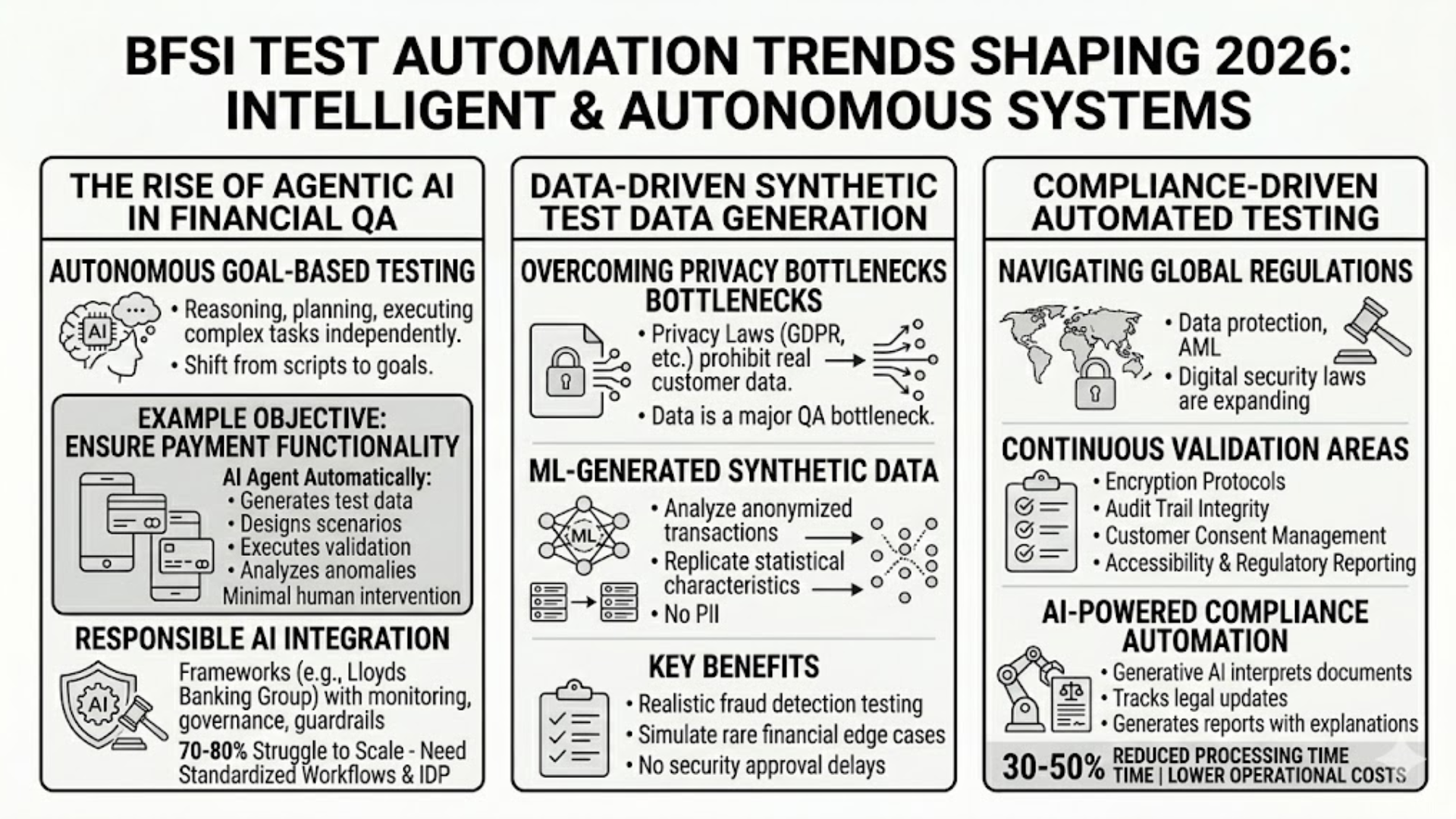
One of the most significant developments is the emergence of Agentic AI, a new class of AI systems capable of reasoning, planning, and executing complex tasks independently.
Unlike traditional automation tools that execute predefined scripts, Agentic AI systems operate based on high-level goals. For example, an AI agent may receive an objective such as:
“Ensure credit card payment functionality works correctly across all mobile devices.”
The agent can then automatically:
- generate test data
- design test scenarios
- execute validation workflows
- analyze anomalies and failures
This autonomous approach allows QA systems to continuously monitor financial platforms with minimal human intervention.
Major banks such as Lloyds Banking Group have begun integrating responsible AI frameworks to manage automated testing safely. These frameworks include monitoring systems, governance policies, and safety guardrails to ensure AI testing agents operate within regulatory boundaries.
The goal is to enable continuous CI/CD deployments without compromising financial reliability. However, research from Accenture and Wipro indicates that 70–80% of enterprise Agentic AI initiatives have not yet scaled successfully. Most organizations must first establish standardized workflows and integrate technologies such as Intelligent Document Processing (IDP) before deploying autonomous testing agents.
Data-Driven Synthetic Test Data Generation
Another major trend in financial QA is the rapid adoption of synthetic data generation.
In regulated environments, testing teams cannot use real customer data due to strict privacy laws such as GDPR and other financial data protection regulations. As a result, test data has become one of the biggest bottlenecks in QA processes.
Advanced machine learning models now analyze millions of anonymized transaction records to understand patterns in banking behavior. These models generate synthetic datasets that replicate the statistical characteristics of real financial data while containing no personally identifiable information (PII).
This approach offers several advantages:
- Enables realistic testing of fraud detection models
- Simulates rare financial edge cases
- Eliminates delays caused by security approval processes
When integrated with automating functional testing bfsi sector tools, synthetic datasets allow QA teams to run large-scale automated test scenarios without compromising privacy compliance.
Compliance-Driven Automated Testing
Regulatory complexity continues to increase across global financial markets. Laws related to data protection, anti-money laundering, and digital banking security are expanding rapidly.
As a result, compliance-driven automated testing is becoming a central pillar of financial QA strategies. Modern testing platforms must continuously validate:
encryption protocols and cryptographic algorithms
- audit trail integrity
- customer consent management workflows
- accessibility standards and regulatory reporting
Automating these validations ensures financial systems remain audit-ready at all times, significantly reducing the risk of regulatory penalties. Generative AI is also playing an increasing role in compliance automation. AI models can interpret new regulatory documents, track legal updates in real time, and generate compliance reports with natural-language explanations.
Studies show that AI-powered compliance automation can reduce regulatory processing time by 30–50%, while significantly lowering operational costs for financial institutions.
Beyond Tools: Why SmartDev’s Service Solution Is the Ultimate High-Intent Choice
Purchasing platforms such as Tricentis Tosca or Katalon Studio solves only part of the testing challenge. In reality, tools typically address around 20% of the automation journey. The remaining 80% depends on deployment architecture, integration capabilities, and domain expertise in financial systems.
Many general QA vendors compete mainly on low hourly rates. However, they often lack the specialized knowledge required for complex financial environments. Issues such as biometric authentication testing, data tokenization, and ISO 20022 schema validation demand deep BFSI expertise. Without this knowledge, organizations risk defect leakage, compliance failures, and security vulnerabilities.
For this reason, many banks are shifting from simply buying automating functional testing bfsi sector tools to building strategic partnerships with domain experts such as SmartDev. At SmartDev, test automation is not treated as a standalone engineering task but as a strategic enabler for digital banking transformation.
AI-Powered Delivery Toolkit
SmartDev differentiates itself through a structured approach to AI adoption. Instead of applying AI randomly, the company uses a proprietary AI-Powered Delivery Toolkit designed to accelerate engineering productivity while maintaining governance.
This framework includes:
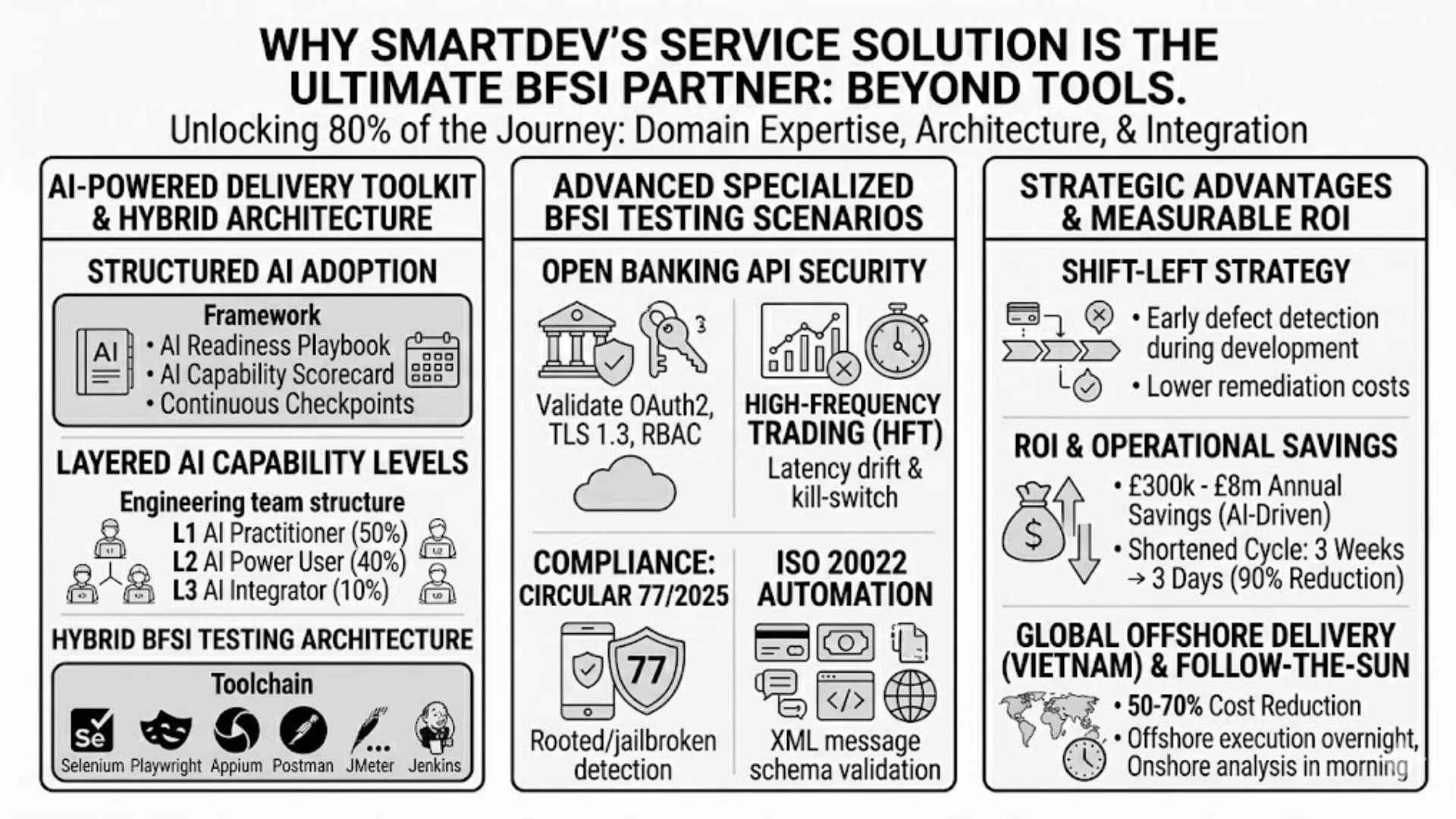
- AI Readiness Playbook for evaluating automation maturity
- AI Capability Scorecard based on 22 evaluation criteria
- Measurement across five domains: strategy, people, tools, processes, and culture
- Continuous progress checkpoints at 30, 60, and 90 days
The engineering team is structured into three AI capability levels to maximize automation efficiency:
- Level 1 – AI Practitioner (50% of engineers): Developers skilled in using tools such as GitHub Copilot and advanced prompt engineering techniques to build reliable automation scripts.
- Level 2 – AI Power User (40%): Engineers who integrate AI directly into development and testing workflows.
- Level 3 – AI Integrator (10%): Architect-level experts who design custom AI automation systems and internal copilots tailored for enterprise clients.
This layered structure enables SmartDev to scale automation rapidly while maintaining consistent quality across large BFSI projects.
Hybrid Toolchain Architecture for BFSI Testing
Instead of relying on a single testing platform, SmartDev implements a hybrid automation architecture combining multiple best-of-breed technologies.
Typical components include:
- Selenium and Playwright for modern web testing
- Appium for Android and iOS testing
- Postman for Open Banking API validation
- Apache JMeter for load and stress testing
- Jenkins for CI/CD pipeline integration
This architecture ensures comprehensive testing coverage across web, mobile, APIs, and backend services.
Advanced BFSI Testing Scenarios
SmartDev’s automation framework supports several highly specialized financial testing scenarios.
Open Banking API Security Testing: Automated validation of OAuth2 authorization flows, TLS 1.3 encryption standards, and role-based access control (RBAC). High-volume requests simulate Denial-of-Service (DoS) scenarios to evaluate API resilience.
- High-Frequency Trading (HFT) Validation: Testing frameworks monitor latency drift and verify automated “kill-switch” mechanisms in algorithmic trading systems where milliseconds determine profitability.
- Compliance with Circular 77/2025/TT-NHNN: Automation detects rooted or jailbroken devices, blocks unauthorized debugging tools, and prevents malicious installation of outdated mobile banking versions.
- ISO 20022 Testing Automation: Automated validation of XML-structured payment messages ensures schema compatibility and correct data mapping for cross-border financial transactions.
SmartDev Automation Solution Components
| Solution | Component Technology | Benefits for Financial Institutions |
| AI Delivery Toolkit | AI Capability Scorecard, GitHub Copilot integration | Provides measurable AI adoption roadmap and improves regression execution speed by up to 40% |
| Hybrid Automation | Toolchain Selenium, Playwright, Appium, JMeter, Postman, Jenkins | Enables continuous testing across web, mobile, and API platforms |
| Compliance-Driven | Security Tokenization, synthetic data generation, OAuth2 & TLS validation | Protects sensitive data and ensures regulatory compliance |
ROI and Strategic Outsourcing Advantages
Working with a specialized partner such as SmartDev may involve a higher initial investment compared to hiring freelancers. However, the long-term return on investment (ROI) is significantly higher. By applying Shift-Left testing strategies, defects are detected earlier during development instead of after deployment. This dramatically reduces remediation costs and production risks.
Industry ROI analyses show that AI-driven automation can generate annual operational savings ranging from £300,000 to £8 million for financial institutions. Regression testing cycles can also be shortened from three weeks to only three days, representing a 90% reduction in testing time.
Another key advantage is strategic offshore delivery. Leveraging SmartDev’s engineering teams in Vietnam enables organizations to reduce development and testing costs by 50–70% compared to onshore teams.
Using a Follow-the-Sun delivery model, offshore teams execute automated test suites overnight while onshore teams rest. By the next morning, engineers receive comprehensive defect reports and analytics dashboards, enabling faster decision-making and continuous product delivery.
This combination of deep BFSI expertise, advanced automation architecture, and global delivery capabilities positions SmartDev as a strategic partner for financial institutions implementing automating functional testing bfsi sector tools at enterprise scale.
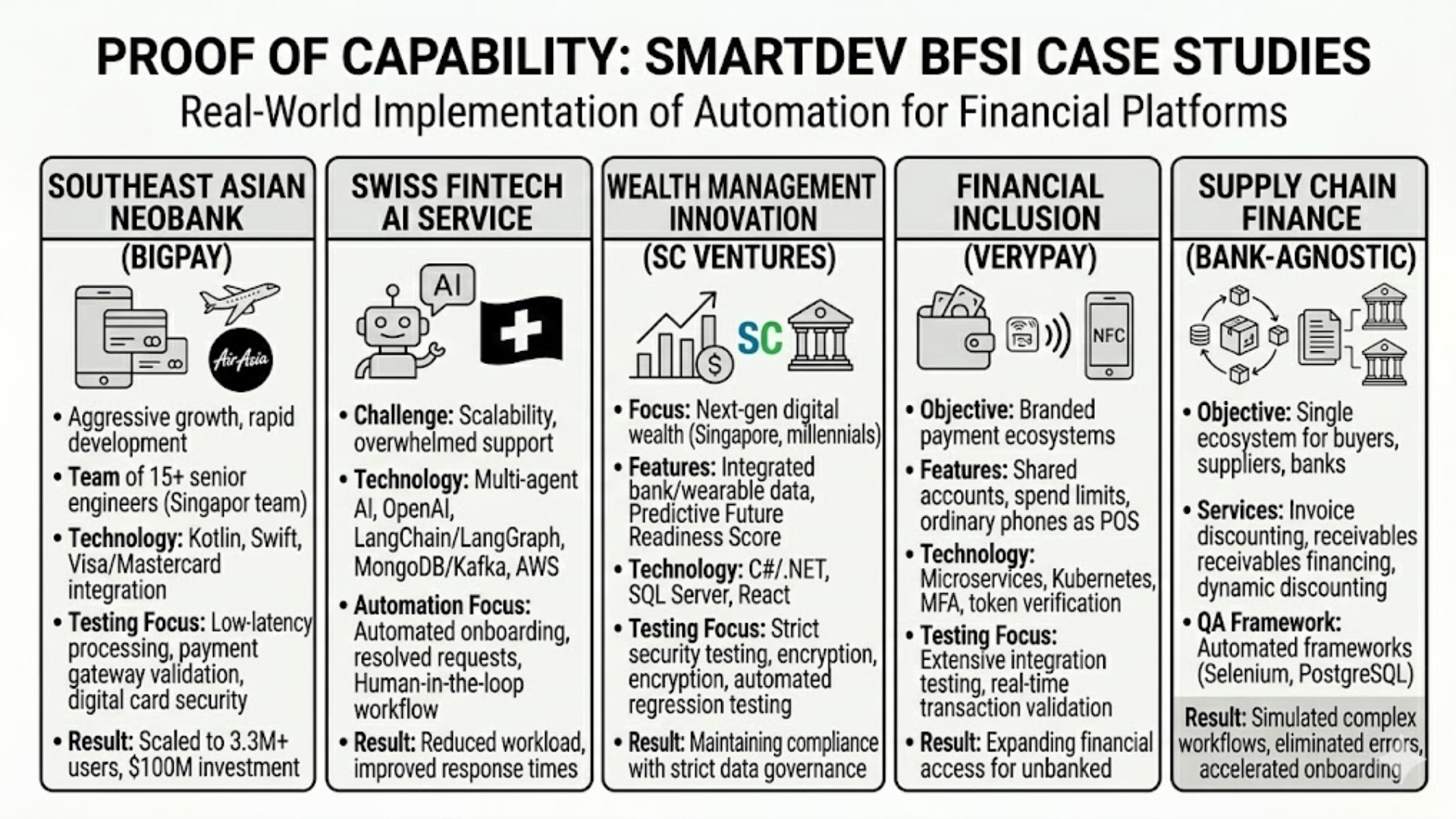
Proof of Capability: SmartDev BFSI Case Studies
For organizations evaluating automating functional testing bfsi sector tools, real-world implementation matters more than theoretical frameworks. Financial institutions must understand how automation strategies perform under real operational pressure.
SmartDev’s portfolio demonstrates deep expertise across digital banking, fintech platforms, and payment ecosystems.
1. Scaling a Southeast Asian Neobank: The BigPay Platform
BigPay, launched under AirAsia, aimed to accelerate the adoption of cashless payments across Southeast Asia. With an aggressive growth timeline, the platform required rapid development and highly reliable financial infrastructure.
SmartDev deployed a team of 15 senior engineers specializing in iOS, Android, and backend development, working closely with the client’s Singapore-based engineering team for over a year.
The platform architecture used:
- Kotlin and Swift for mobile development
- JavaScript-based services for web integrations
- Integration with Visa and Mastercard global payment networks
To ensure stable transactions across 40 million merchant acceptance points, SmartDev implemented extensive automated testing scenarios focusing on:
- low-latency transaction processing
- payment gateway validation
- digital card security features such as instant card lock
The platform successfully scaled to over 3.3 million users by 2021 and later secured $100 million in investment from SK Group.
2. AI Customer Service Automation for a Swiss Fintech
A Swiss fintech company operating a global digital payment ecosystem faced serious scalability challenges as its user base expanded. Customer support requests were increasing faster than the support team could handle.
SmartDev designed an AI-powered automation architecture combining modern data and AI technologies.
The system used:
- OpenAI models for natural language understanding
- LangChain and LangGraph for agent orchestration
- MongoDB and Apache Kafka for real-time data pipelines
- Deployment on Amazon Web Services
This multi-agent AI support layer automated customer onboarding, resolved repetitive support requests, and provided an internal knowledge assistant for staff.
Requests that required human intervention were automatically converted into structured tickets using a Human-in-the-loop workflow.
The system significantly reduced support workload while improving response times and service scalability.
3. Wealth Management Innovation with SC Ventures
SmartDev partnered with SC Ventures in Singapore to build a next-generation digital wealth management platform focused on millennials.
The platform integrated:
- distributed bank account data
- wearable health metrics
- long-term financial planning analytics
The backend was built using C#/.NET and SQL Server, while the frontend used React for a modern user interface.
A key feature was the Future Readiness Score, which used predictive models to forecast financial health based on lifestyle data and savings patterns.
Due to the sensitive nature of financial and personal health data, SmartDev implemented strict security testing, encryption mechanisms, and automated regression testing. This ensured frequent platform updates while maintaining compliance with Singapore’s strict data governance regulations.
4. VeryPay: Financial Inclusion Through Closed-Loop Payments
VeryPay was developed to support financial inclusion in emerging markets, particularly across Africa and developing economies. The system enables businesses to create branded payment ecosystems without relying on expensive traditional card networks.
SmartDev deployed a team of 25 specialists, including developers, QA engineers, and UX designers, working within a microservices architecture running on Kubernetes.
The platform supports multiple payment channels:
- mobile eWallet applications
- NFC devices
- RFID cards
A unique feature allows shared accounts, enabling a primary wallet to allocate spending limits to family members or groups through separate payment devices.
Extensive integration testing was required to validate:
- multi-factor authentication (MFA) workflows
- payment token verification
- real-time transaction processing
This solution allows ordinary Android smartphones to function as payment acceptance devices, expanding financial access for previously unbanked communities.
5. Bank-Agnostic Supply Chain Finance Platform
SmartDev also developed a bank-agnostic supply chain finance platform for a Singapore-based client. The platform integrates multiple financial participants—including buyers, suppliers, and banks—within a single digital ecosystem.
Key services supported include:
- invoice discounting
- receivables financing
- dynamic discounting
- API payment gateway integrations
SmartDev’s QA team implemented automated testing frameworks using:
- Selenium
- PostgreSQL
Automated regression testing simulated complex enterprise workflows involving multiple financial data sources. These automation processes helped eliminate transaction synchronization errors and significantly accelerated partner onboarding.
Conclusion: Strengthening BFSI Systems with Automated Testing
In the BFSI sector, software testing has evolved far beyond simple bug detection. It now plays a critical role in risk management, cybersecurity, and regulatory compliance. As financial institutions adapt to global changes such as ISO 20022 migration and stricter regulations like Circular No. 77/2025/TT-NHNN, the need for reliable automation continues to grow.
Today’s market offers many automating functional testing bfsi sector tools, including platforms like Tricentis Tosca, Katalon Studio, and frameworks such as Playwright. However, tools alone are not enough to ensure testing success.
Organizations must combine the right technologies with strong domain expertise and scalable QA strategies. By partnering with specialists like SmartDev, financial institutions can implement automation more effectively, accelerate release cycles, and maintain secure, compliant digital platforms.
Ultimately, investing in automating functional testing bfsi sector tools is a strategic step toward building resilient, future-ready financial systems.