

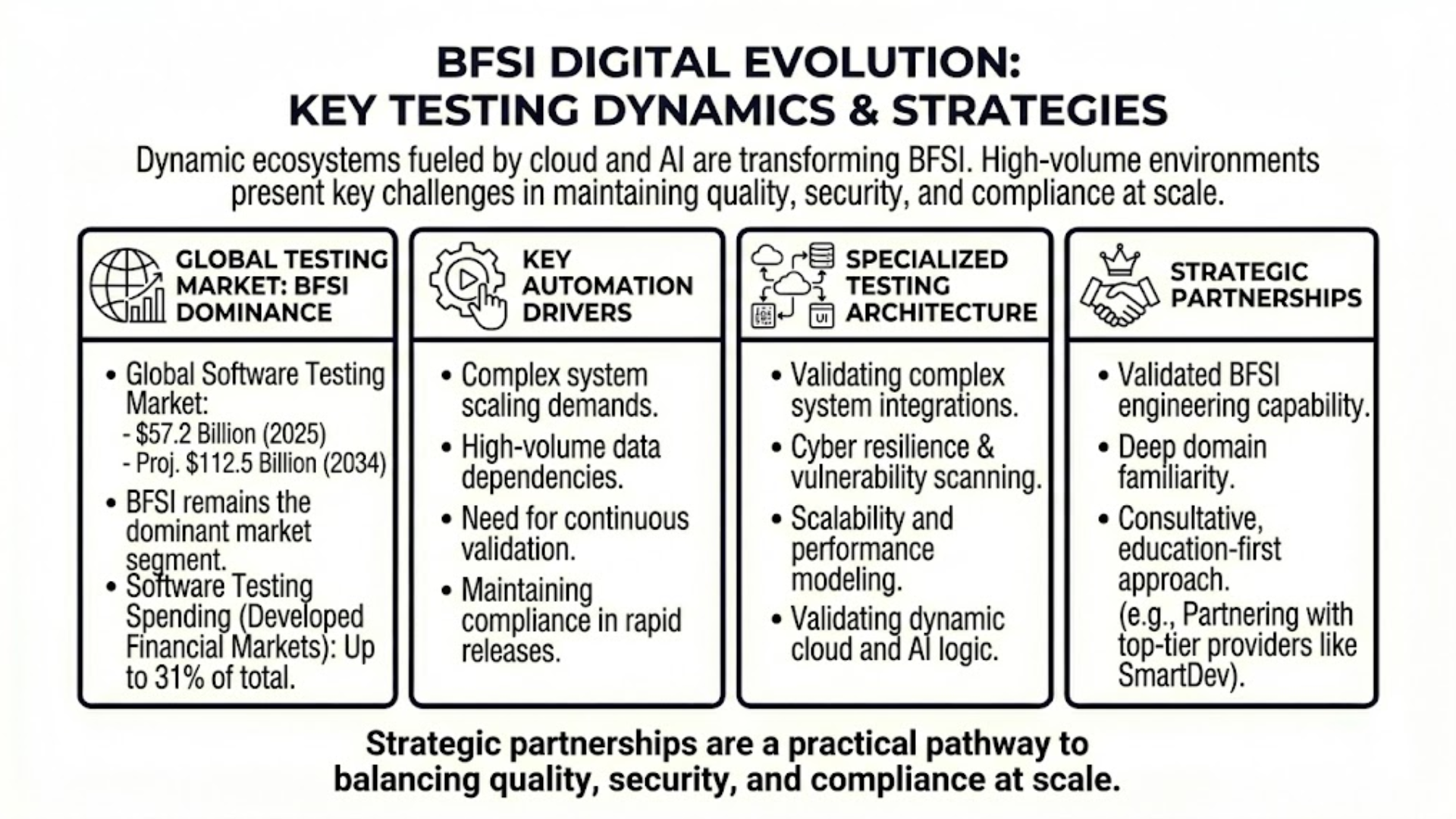
The rapid evolution of digital technology within the Banking, Financial Services, and Insurance (BFSI) industry is transforming its entire landscape. Over the last decade, financial institutions have shifted from traditional monolithic frameworks to dynamic, data-driven ecosystems fueled by cloud computing and artificial intelligence. However, this surge in innovation presents a significant challenge: how to maintain quality, security, and compliance at scale without slowing down product releases.
Market analysis reveals that the global software testing market reached $57.2 billion in 2025 and is expected to grow to $112.5 billion by 2034, with the BFSI sector continuing to hold a dominant share. In fact, software testing spending in the financial services sector in developed countries can account for up to 31% of the total market.
This Technology Explainer is tailored for Quality Assurance (QA) Managers, Chief Technology Officers (CTOs), and digital transformation leaders in the solution evaluation phase. It will delve into the key drivers behind automation, explore the specialized testing architecture of complex financial systems, compare leading frameworks. And highlight the importance of forming strategic partnerships with top-tier service providers – such as SmartDev.
Transformation Drivers: Why Automation Testing in BFSI Is a Strategic Imperative
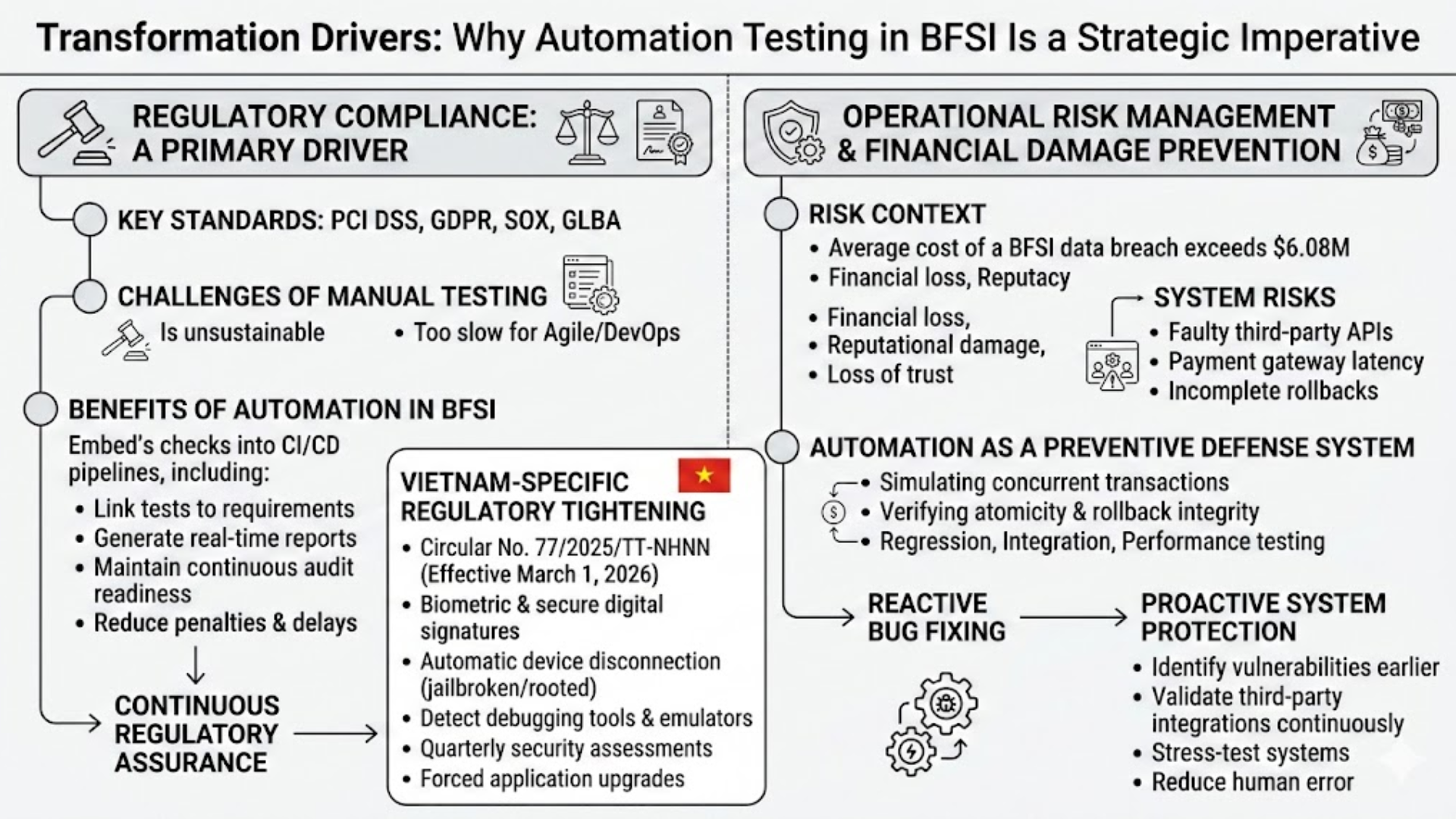
The shift from manual testing to enterprise-grade automation in the financial sector is driven by powerful structural forces. Automation testing in BFSI is no longer a technical upgrade. It is a direct response to increasing regulatory pressure, growing operational risk, and rising customer expectations for seamless digital experiences.
As banking platforms accelerate digital transformation, maintaining compliance, system stability, and release velocity simultaneously becomes a complex challenge. Without automation testing in BFSI, financial institutions face delays, audit risks, and significant exposure to security vulnerabilities.
Regulatory Compliance as the Primary Driver of Automation Testing in BFSI
The BFSI industry operates under some of the strictest global and regional regulatory frameworks. Standards such as PCI DSS, GDPR, SOX, and GLBA impose rigorous requirements for:
- End-to-end encryption of payment data
- Consent tracking and data erasure capabilities
- Transparent audit trails
- Strong internal control mechanisms
Validating these controls manually during every release cycle is no longer sustainable. As development teams adopt Agile and DevOps methodologies, compliance validation must operate at the same speed as deployment.
Automation testing in BFSI enables financial institutions to embed regulatory checks directly into CI/CD pipelines. This approach allows organizations to:
- Link automated test cases to specific regulatory requirements
- Generate real-time compliance reports
- Maintain continuous audit readiness
- Reduce the risk of penalties and release delays
- Instead of periodic compliance reviews, banks achieve continuous regulatory assurance.
Regulatory Tightening in Vietnam and the Need for Automation
In emerging digital markets, regulatory frameworks are evolving rapidly. In Vietnam, the State Bank of Vietnam introduced Circular No. 77/2025/TT-NHNN, effective March 1, 2026, establishing stricter cybersecurity and authentication requirements for banks and Mobile Money providers.
Key obligations include:
- Biometric verification combined with OTP or secure digital signatures when customers update identification or authentication information
- Automatic disconnection if a mobile device is detected as jailbroken on iOS or rooted on Android
- Detection of debugging tools and emulators
- Mandatory security assessments at least once every three months
- Forced upgrades to the latest application version, with downgrades prohibited
- Compliance with ISO 30107 Level 2 for Biometric Presentation Attack Detection, certified by laboratories recognized by the FIDO Alliance
These cross-platform and multi-device requirements cannot be reliably validated through manual testing. Automation testing in BFSI becomes essential to continuously verify biometric workflows, device integrity checks, and authentication scenarios before each release.
Integrating automation testing in BFSI within CI/CD pipelines ensures regulatory compliance while maintaining time-to-market competitiveness.
Operational Risk Management and Financial Damage Prevention
Operational resilience is another major catalyst for automation testing in BFSI. In 2024, the average cost of a data breach in the financial sector exceeded 6.08 million USD, significantly higher than many other industries. Beyond financial losses, institutions also face long-term reputational damage and erosion of customer trust.
Modern banking systems are highly interconnected. A minor technical failure can escalate quickly:
- A faulty API update from a third-party credit scoring provider can disrupt loan approvals
- Latency spikes in payment gateways can suspend thousands of transactions
- Incomplete rollback mechanisms can create inconsistent financial records
Automation testing in BFSI acts as a preventive defense system. By simulating millions of concurrent transactions, automated testing frameworks verify transaction atomicity and rollback integrity, ensuring no partial transactions or orphan records exist in the database.
Through automated regression, integration, and performance testing, banks can:
- Identify vulnerabilities before production release
- Continuously validate third-party integrations
- Stress-test systems under peak transaction loads
- Reduce human error in risk evaluation
Embedding automation testing in BFSI into DevSecOps workflows transforms risk management from reactive bug fixing into proactive system protection.
Automated Testing Architecture to Address BFSI-Specific Complexity
Automation testing in BFSI requires a significantly more sophisticated architecture than testing models used in retail or social media platforms. Financial ecosystems are deeply interconnected, highly regulated, and transaction-intensive. Each core module, from payments and open banking APIs to high-frequency trading and insurance systems, demands a specialized automation strategy.
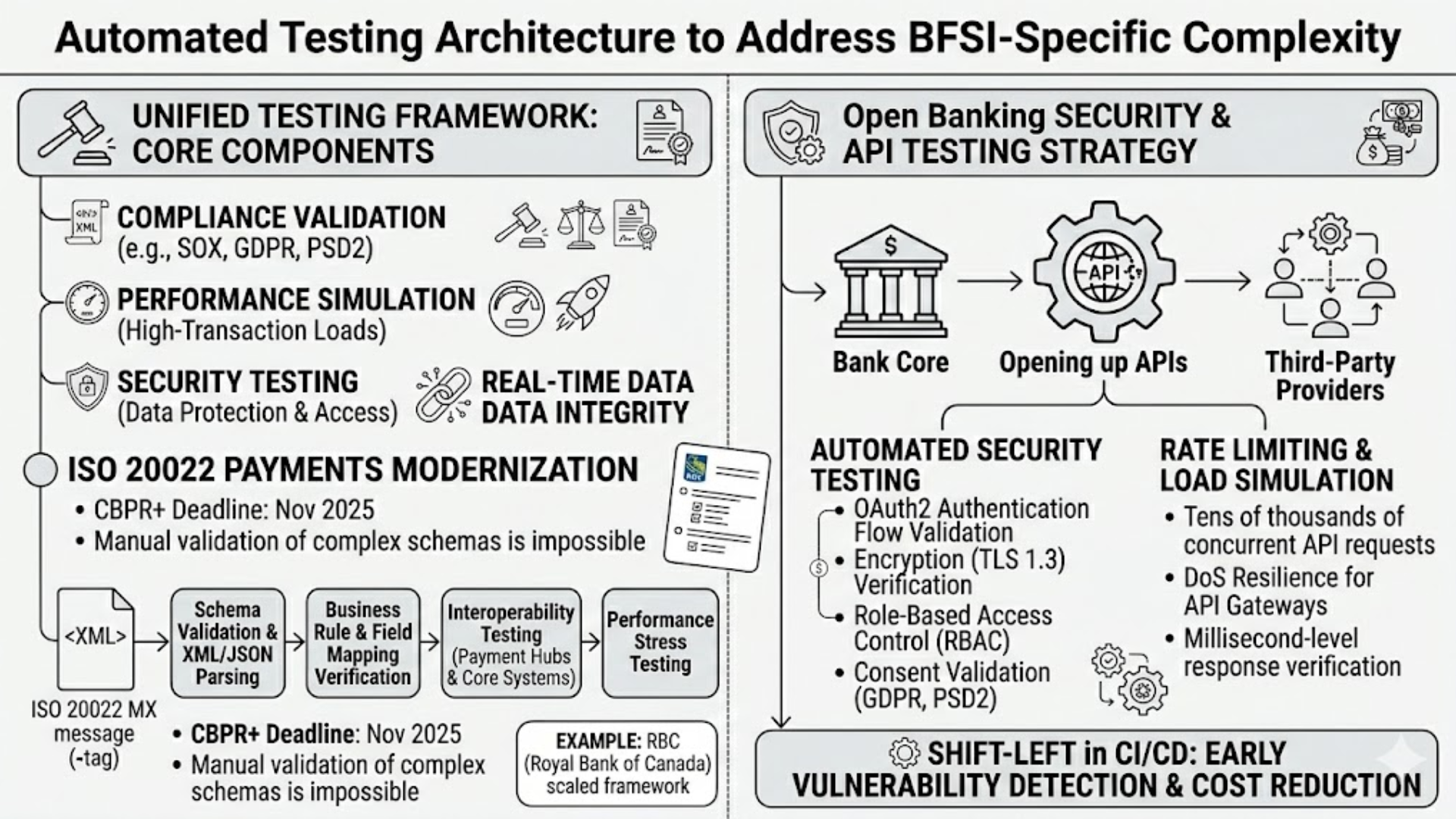
To deliver scalable quality assurance, automation testing in BFSI must integrate compliance validation, high-performance simulation, security testing, and real-time data integrity checks into a unified testing framework.
ISO 20022 Migration and Payment System Modernization
The global payments industry is undergoing its most significant transformation with the adoption of the ISO 20022 messaging standard. This framework replaces legacy MT formats with structured XML and JSON-based MX messages enriched with metadata for improved compliance screening, transparency, and analytics.
With the SWIFT CBPR+ coexistence period ending in November 2025, financial institutions must ensure their core systems can process and validate millions of ISO 20022 messages daily. Manual validation of complex XML schemas and business rules is not operationally feasible.
An effective automation testing in BFSI architecture for ISO 20022 should include:
- Automated schema validation and XML parsing
- Business rule verification and field mapping checks
- Interoperability testing across payment hubs and core systems
- Performance and stress testing under peak transaction loads
Leading institutions such as the Royal Bank of Canada have scaled automation frameworks to support ISO 20022 compliance. By leveraging AI-powered validation platforms, banks can automate message verification across digital wallets, cross-border gateways, and clearing systems.
Robust automation testing in BFSI ensures accurate message formatting, prevents transaction rejection, and safeguards cross-border payment continuity.
Open Banking Security and API Testing Strategy
Open Banking has redefined financial data accessibility by allowing Third-Party Providers to access banking services via APIs. While this model accelerates innovation, it also expands the cybersecurity attack surface.
Automation testing in BFSI must prioritize API security and performance testing to protect customer data and ensure regulatory compliance.
Key components of an automated Open Banking testing architecture include:
Automated Security Testing
- Continuous validation of OAuth2 authentication flows
- Encryption verification using strong protocols such as TLS 1.3
- Role-Based Access Control testing to enforce minimum data exposure
- Consent validation aligned with GDPR and PSD2 requirements
Rate Limiting and Load Simulation
- Simulation of tens of thousands of concurrent API requests
- Verification of API Gateway resilience against Denial-of-Service attacks
- Millisecond-level response time validation under stress conditions
By embedding API automation testing in BFSI into CI/CD pipelines, organizations adopt a shift-left testing approach, detecting vulnerabilities early and significantly reducing remediation costs.
High-Frequency Trading Platforms and Ultra-Low Latency Validation
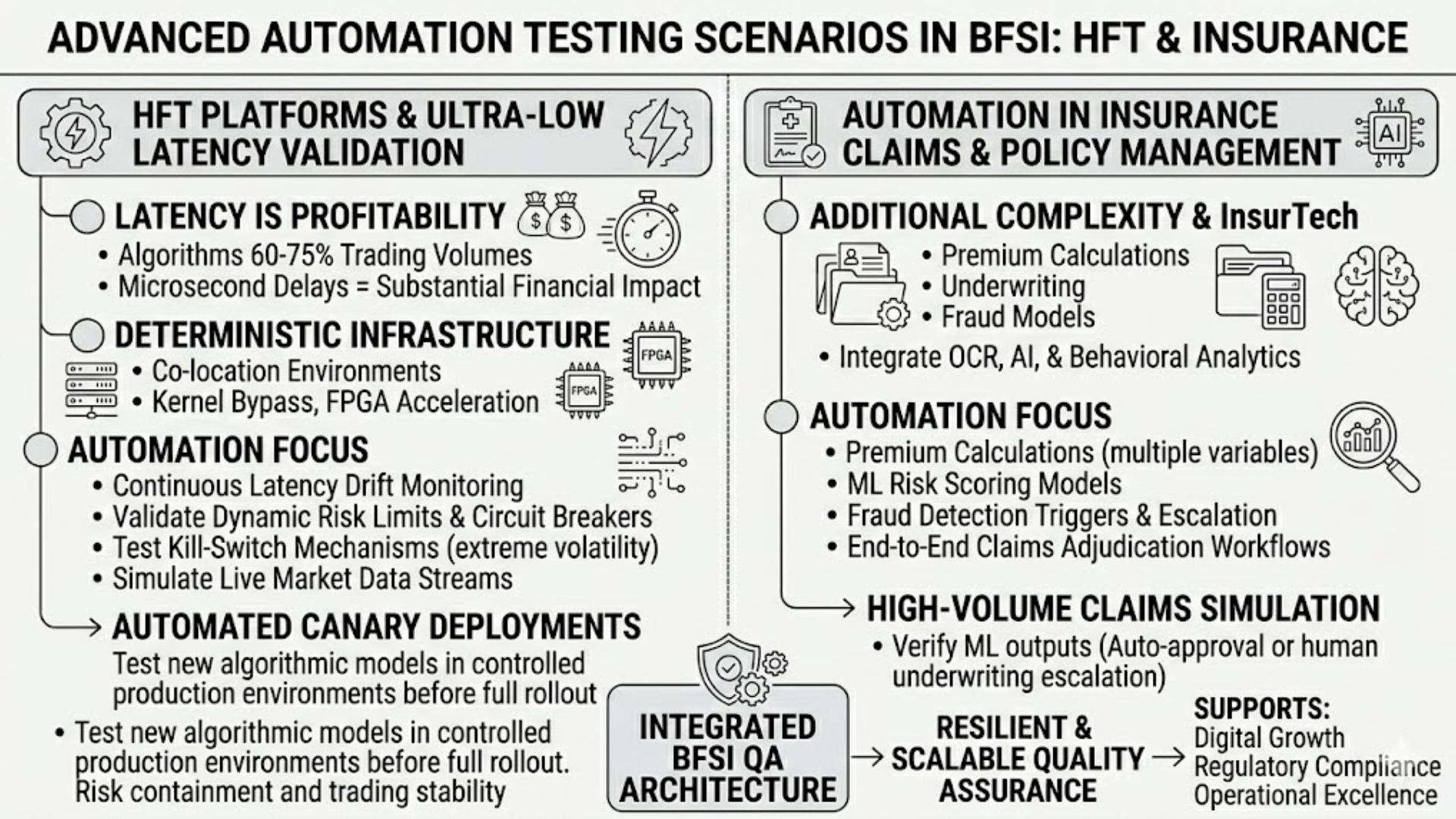
In algorithmic trading and high-frequency trading environments, latency directly impacts profitability. Algorithms account for 60 to 75 percent of trading volumes in developed markets. Even microsecond delays can result in substantial financial impact.
Testing HFT systems requires deterministic infrastructure leveraging co-location environments, kernel bypass technologies, and FPGA acceleration.
In this context, automation testing in BFSI focuses on:
- Continuous latency drift monitoring
- Validation of dynamic risk limits and circuit breakers
- Testing kill-switch mechanisms under extreme volatility
- Simulating live market data streams for algorithm validation
Automated canary deployments allow new algorithmic models to be tested in controlled production environments before full rollout. This ensures risk containment while maintaining trading performance stability.
Automation in Insurance Claims and Policy Management
The insurance sector introduces additional complexity through premium calculation engines, underwriting workflows, and fraud detection models. Modern InsurTech platforms integrate OCR, AI, and behavioral analytics to streamline policy issuance and claims processing.
Automation testing in BFSI for insurance systems must validate:
- Premium calculations across multiple demographic and actuarial variables
- Risk scoring models driven by machine learning
- Fraud detection triggers and escalation logic
- End-to-end claims adjudication workflows
Automated testing frameworks simulate high-volume claims scenarios to verify that machine learning outputs correctly trigger auto-approval processes or escalate suspicious cases to human underwriters.
By integrating automation testing in BFSI across banking, payments, trading, and insurance modules, financial institutions build a resilient and scalable quality assurance architecture capable of supporting digital growth, regulatory compliance, and operational excellence.
Strategy for Selecting the Optimal Testing Frameworks and Tools in Automation Testing in BFSI
To successfully implement complex validation scenarios across payments, open banking, trading, and insurance systems, QA leaders must design a scalable automation architecture and select the right toolchain. In automation testing in BFSI, this decision directly influences long-term maintainability, onboarding costs, regulatory alignment, and enterprise scalability.
At the Middle of Funnel evaluation stage, technology leaders must assess not only technical capabilities but also how frameworks support compliance validation, large data volumes, omnichannel platforms, and continuous integration pipelines.
Comparing Automation Framework Architectures for BFSI Projects
The architecture of a testing framework determines how test logic is structured, how data is managed, and how reporting integrates with governance systems. In automation testing in BFSI, choosing the right architecture is foundational to sustainable growth.
| Framework Architecture | Core Mechanism | Distinct Value for BFSI | Limitations to Consider |
| 1. Data-Driven Framework | Test scripts are separated from input datasets. Test data is stored externally in Excel, CSV, JSON, or databases, and the same logic runs iteratively across large datasets. | Highly effective for banking and ERP systems requiring validation of thousands of account combinations, exchange rates, transaction limits, and compliance thresholds. It reduces script duplication and supports bulk validation scenarios. | Requires strong programming capability within the QA team. Poor data governance can result in complex maintenance overhead. |
| 2. Keyword-Driven Framework | Test actions are abstracted into reusable keywords such as Login, Transfer_Funds, or Validate_Balance. These keywords map to backend functions and are arranged in structured test tables. | Enables Business Analysts and domain experts to design test scenarios without deep coding skills. This is particularly valuable in financial institutions where subject-matter expertise is critical for validating cash flow logic and regulatory rules. | Significant initial engineering effort is required to build and maintain the keyword function library. |
| 3. Page Object Model (POM) | Each web page or application screen is represented as a separate object repository. Page elements and actions are encapsulated within dedicated classes.
|
Enhances code reusability and simplifies UI maintenance. When interface changes occur in internet banking or trading dashboards, updates are centralized within one POM class instead of multiple scripts. | Complex single-page applications can lead to bulky object structures. Advanced architectural patterns such as dependency injection may be required for scalability. |
| 4. Hybrid Framework | Combines Data-Driven, Keyword-Driven, and POM principles into a unified architecture. | Provides maximum flexibility and scalability for omnichannel financial ecosystems. Supports collaboration between technical engineers and non-technical stakeholders while maintaining high automation coverage. | Requires substantial architectural planning and experienced QA architects. Initial setup investment is higher but justified for enterprise-scale BFSI environments. |
For most large financial institutions, a hybrid model represents the most sustainable approach to automation testing in BFSI due to its adaptability across multiple system layers.
Evaluating Leading Testing Tools for Automation Testing in BFSI
Selecting the right automation tools is equally critical. Budget allocation must consider long-term scalability, integration capability, and security compliance.
Below is a structured evaluation of leading platforms frequently adopted in automation testing in BFSI environments.
| Tool Platform | Application Segment | Breakthrough Features & Technical Specs | BFSI Suitability Assessment |
| Selenium | Web UI testing across multiple browsers. | Open-source and language-flexible, supporting Java, Python, and C#. Communicates through WebDriver to automate browser interactions.
|
Remains an industry standard for traditional online banking platforms. However, it requires strong framework design to avoid unstable test execution caused by static waits. Best used within a robust POM or hybrid architecture. |
| Playwright | Modern web UI and API testing. | Developed by Microsoft, supports auto-wait mechanisms that reduce flaky tests. Offers network interception, tracing capabilities, and cross-browser execution. | Highly effective for modern banking applications built with React or Angular. The ability to mock API failures without backend dependency significantly accelerates automation testing in BFSI CI/CD pipelines. |
| Appium | Mobile testing for native and hybrid applications. | Cross-platform support for iOS and Android without modifying application source code. | Essential for Mobile Banking and Mobile Money applications. When combined with real device farms, Appium enables scalable validation of biometric authentication, device integrity checks, and cross-device compatibility. |
| Tricentis Tosca | Enterprise end-to-end and codeless testing. | Model-based test automation with risk-based testing integration. When UI changes occur, only the model layer requires updating. | Particularly suitable for large banks running complex ERP ecosystems such as SAP or Oracle integrated with satellite financial applications. Optimizes test coverage while reducing redundant cases. |
| JMeter and Postman | Performance and API testing. | JMeter specializes in high-load simulation. Postman provides intuitive API design, validation, and automation capabilities. | JMeter ensures transaction stability during peak financial events. Postman supports smooth data exchange validation between banking systems and third-party partners within Open Banking ecosystems. |
Building a Sustainable Toolchain for Automation Testing in BFSI
No single tool solves every requirement. A successful automation testing in BFSI strategy typically combines:
- A hybrid framework architecture
- UI automation tools such as Playwright or Selenium
- Mobile automation through Appium
- API validation via Postman
- Performance testing with JMeter
- Enterprise orchestration tools when operating complex ERP systems
For QA leaders in the MoFU evaluation stage, the decision should prioritize long-term scalability, regulatory compatibility, and CI/CD integration capability.
Automation testing in BFSI is not about selecting the most popular tool. It is about constructing a cohesive automation ecosystem capable of supporting compliance, operational resilience, and digital innovation at scale.
Ready to modernize your BFSI systems and accelerate digital transformation?
SmartDev helps banks, insurers, and fintech companies build secure, scalable platforms powered by cloud, AI, and automation.
Turn strategy into production-ready solutions with a trusted BFSI technology partner.
Talk to a BFSI ExpertTest Data Management: Resolving the Data Security Challenge in Automation Testing in BFSI
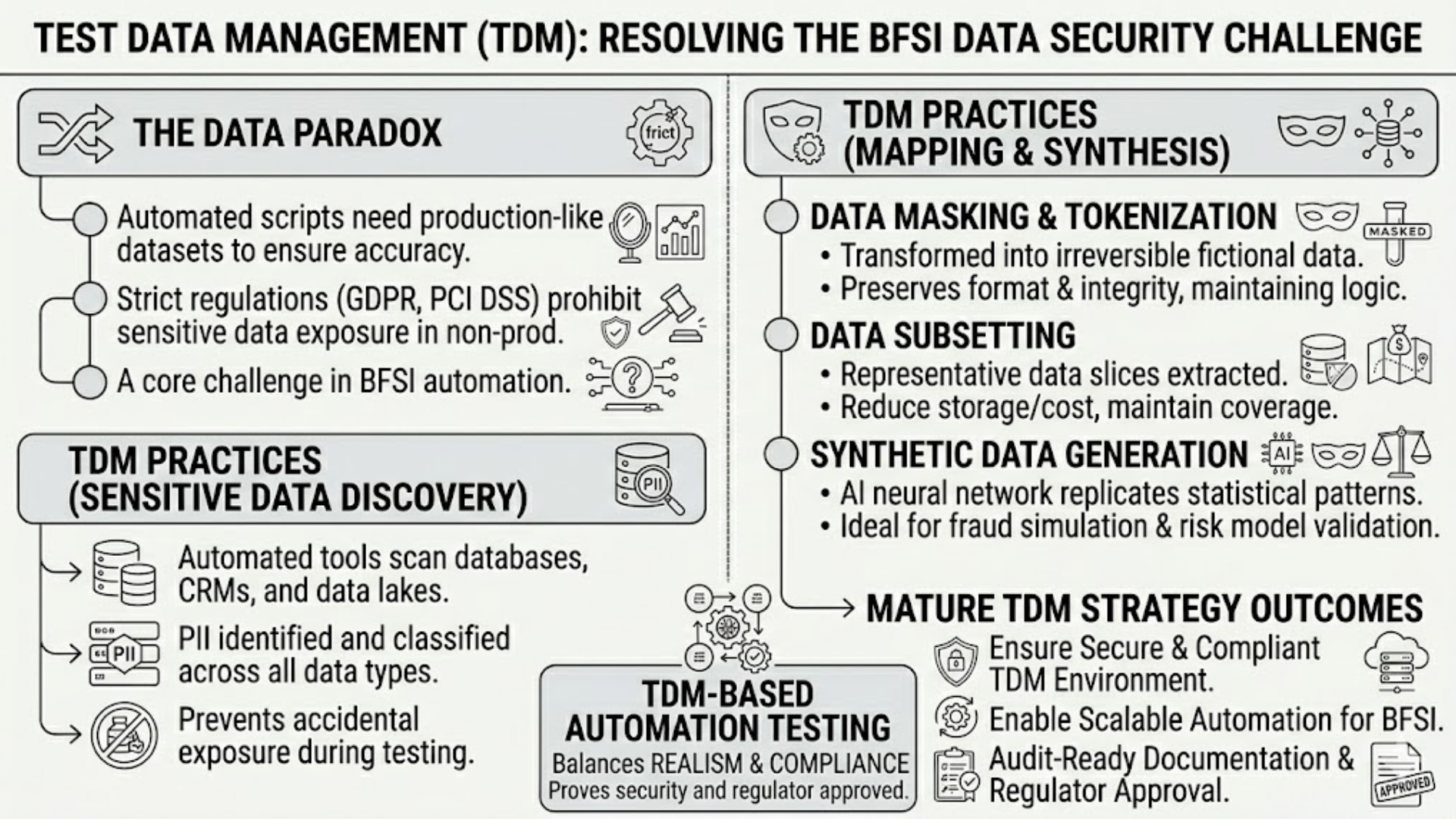
One of the biggest challenges in automation testing in BFSI is the data paradox. Automated test scripts require production-like datasets to ensure accuracy, yet strict regulations such as GDPR and PCI DSS prohibit exposing sensitive customer information in non-production environments.
To balance realism and compliance, Test Data Management (TDM) has become a core component of automation testing in BFSI.
Key TDM practices include:
- Sensitive Data Discovery and Classification: Automated tools scan and identify personally identifiable information across databases, CRM systems, and data lakes to prevent accidental exposure during testing.
- Data Masking and Tokenization: Sensitive fields are transformed into irreversible fictional data while preserving format and integrity, ensuring compliance without breaking test logic.
- Data Subsetting: Instead of duplicating entire banking databases, representative data slices are extracted to maintain coverage while reducing storage and cost.
- Synthetic Data Generation: AI-generated datasets replicate real statistical patterns without containing actual customer data, making them ideal for fraud simulation and risk model validation.
A mature TDM strategy also produces audit-ready documentation, proving that automation testing in BFSI environments remains secure, compliant, and regulator-approved.
ROI of Automation Testing in BFSI: From Cost Center to Profit Driver
For C-level executives, automation testing in BFSI must deliver measurable financial impact. Although initial investments in automation tools, CI/CD pipelines, and Test Data Management infrastructure can be significant, the long-term Return on Investment is substantial.
ROI is typically calculated as: ROI = (Net Benefit / Total Investment) x 100
Industry benchmarks clearly demonstrate the economic value of automation testing in BFSI.
For example, JPMorgan Chase reduced its regression testing cycle from three weeks to three days through automation, achieving a 90 percent time reduction. This acceleration not only saved engineering hours but also enabled faster product launches and earlier revenue capture.
Large financial institutions implementing AI-driven automation report annual operational savings ranging from £300,000 to £8 million, depending on scale. Benefits include:
- Over 95 percent accuracy improvement in automated processing
- Up to 75 percent reduction in operational turnaround time
- 25 percent higher returns from cloud-based deployments compared to on-premises setups
Additionally, automation testing in BFSI reduces post-release defects by up to 40 percent, lowering maintenance costs, minimizing compliance risks, and protecting brand reputation.
According to the McKinsey Global Institute, Generative AI and automation technologies could generate between 200 billion and 340 billion USD annually for the global banking sector, representing a 9 to 15 percent increase in operating profits.
Future Outlook: Agentic AI and Self-Healing Automation in BFSI
Entering 2025 and 2026, automation testing in BFSI is evolving from static, script-based execution toward intelligent, autonomous systems powered by Agentic AI.
Traditional automation executes predefined instructions and fails when application elements change. In contrast, Agentic AI systems can reason, plan, and adapt. By analyzing historical transaction data and system behavior, these systems:
- Prioritize high-risk test cases dynamically
- Reallocate testing resources in real time
- Detect fraud-prone scenarios before production release
- Optimize test coverage based on business impact
This shift enables risk-based test prioritization instead of exhaustive but inefficient full-system testing.
Alongside Agentic AI, self-healing automation frameworks are gaining traction. Powered by computer vision, natural language processing, and behavioral modeling, these frameworks can:
- Detect UI changes such as renamed labels or altered DOM structures
- Automatically update locators during runtime
- Prevent script failures caused by minor interface updates
For automation testing in BFSI, this means reduced maintenance overhead, higher CI/CD stability, and continuous delivery resilience even as applications evolve rapidly. The future of automation testing in BFSI is not just faster execution. It is intelligent, adaptive, and self-optimizing quality assurance aligned with business risk and profitability.
The Strategic Dilemma: In-House vs Outsourcing in Automation Testing in BFSI
Even the most advanced automation frameworks cannot operate without skilled experts. For banks and financial institutions, the real strategic question is not whether to invest in automation testing in BFSI, but how to build and sustain the right talent model.
Should organizations develop internal capabilities or partner with an outsourcing provider? To optimize cost, scalability, and delivery speed, outsourcing models are typically evaluated across three geographical approaches.
| Model | Definition & Characteristics | Cost Analysis & Competitive Advantage |
| Onshore | Partner team located in the same country. 100% cultural alignment, same working hours, easy real-time communication. | Extremely expensive (ranging from $100,000 – $200,000/year/engineer or more). Best suited for national security projects where offshore data transfer is prohibited. Not optimal for scaling budgets. |
| Nearshore | Partnering with neighboring countries or regions with minimal time differences (1-3 hours). Medium to high cultural alignment. | Mid-range costs (around $30 – $60/hour). Offers flexibility for Agile models, allowing for same-day communication and rapid bug fixing. Ideal for balancing cost and collaboration speed. |
| Offshore | Teams located in geographically distant countries, typically in Asia (India, Vietnam). Significant time zone differences. | Deepest cost savings (around $15 – $25/hour, cutting 50-70% of costs compared to Onshore). Time zone differences become a “Follow the Sun” advantage: the Offshore team runs automation and finds bugs overnight, delivering reports just as the Onshore team starts their day. Requires rigorous project governance. |
Why SmartDev Is a Strategic Leader in Automation Testing in BFSI
In a saturated outsourcing market, selecting a QA partner for automation testing in BFSI is no longer about cost comparison. It is a strategic decision tied to risk mitigation, regulatory compliance, and long-term scalability.
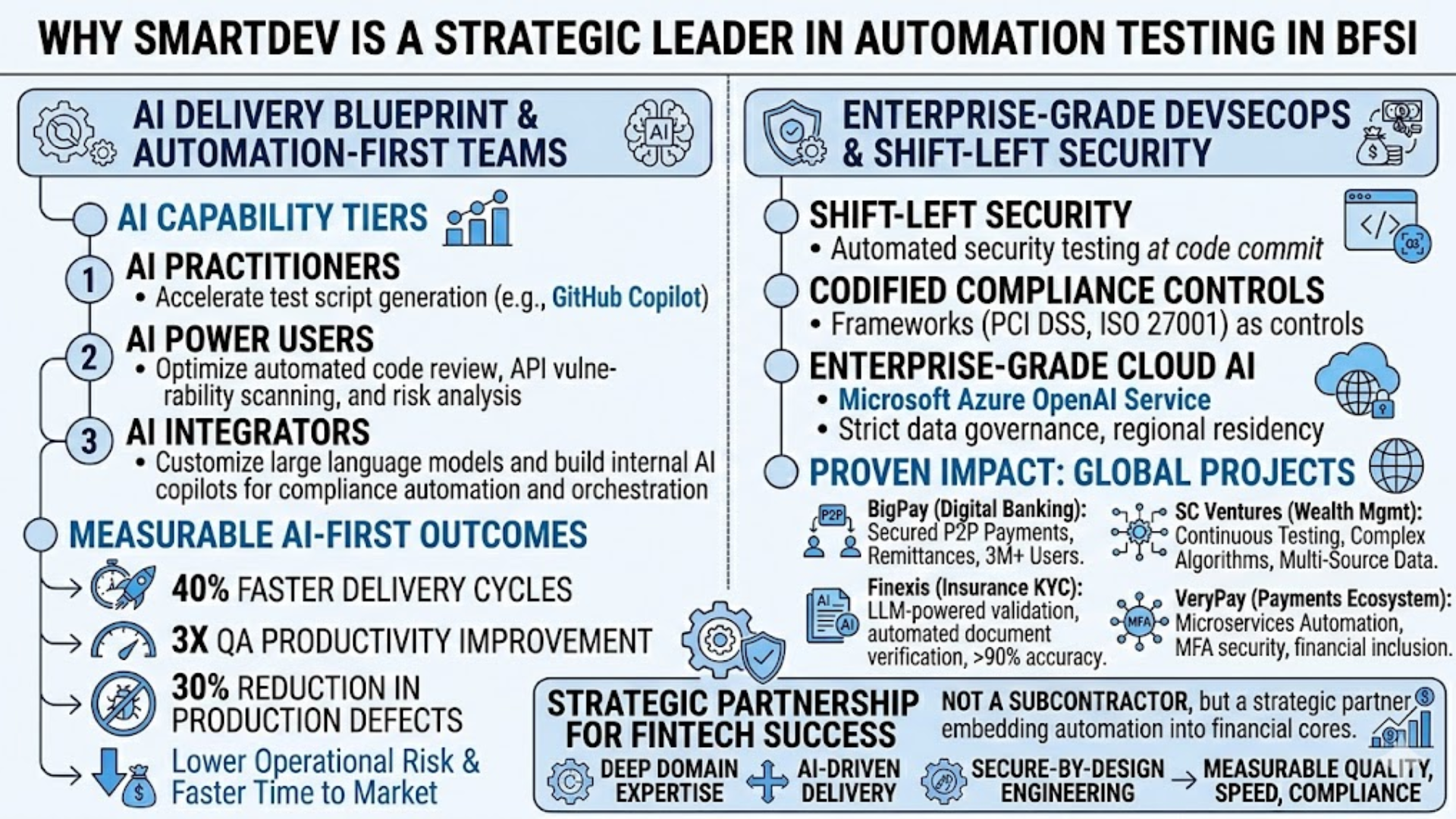
SmartDev positions itself not as a subcontractor, but as a strategic advisory and execution partner that embeds automation into the core of financial systems. By combining deep domain expertise in banking and fintech with AI-driven delivery and secure-by-design engineering, SmartDev delivers measurable outcomes in quality, speed, and compliance.
AI Delivery Blueprint and Automation-First Mindset
SmartDev’s differentiation in automation testing in BFSI comes from its AI Delivery Blueprint, a structured methodology that integrates AI into every phase of the Software Development Life Cycle.
Instead of using AI as an add-on, SmartDev builds automation-first engineering teams structured across three AI capability tiers:
- AI Practitioners who accelerate test script generation using tools such as GitHub Copilot
- AI Power Users who optimize automated code review, API vulnerability scanning, and risk analysis
- AI Integrators who customize large language models and build internal AI copilots for compliance automation and system-level test orchestration
This AI-first ecosystem enables:
- 40 percent faster delivery cycles
- 3x QA productivity improvement
- 30 percent reduction in production defects
For financial institutions investing in automation testing in BFSI, this directly translates into lower operational risk and faster time to market.
Enterprise-Grade DevSecOps and Shift-Left Security
Security is non-negotiable in automation testing in BFSI. SmartDev applies a Shift-Left approach by embedding automated security testing directly into CI/CD pipelines.
Vulnerability scanning, compliance validation, and security checks are triggered at code commit level rather than post-deployment. Regulatory frameworks such as PCI DSS and ISO 27001 are codified into automated compliance controls, reducing audit risk.
To safeguard sensitive financial data, SmartDev leverages enterprise-grade cloud AI environments such as Microsoft Azure OpenAI Service, ensuring strict data governance, regional residency, and alignment with global security certifications.
Proven Impact Across Global BFSI Projects
SmartDev’s strength in automation testing in BFSI is validated through large-scale international fintech programs.
BigPay Digital Banking Platform
SmartDev supported BigPay, the digital banking arm backed by AirAsia, by delivering full-stack engineering and automated testing frameworks for mobile and backend systems. Automation ensured secure P2P payments, international remittances, and scalable transaction processing, contributing to platform growth beyond 3 million users.
SC Ventures Wealth Management Platform
In partnership with a fintech incubated by SC Ventures, SmartDev implemented continuous automation testing to validate complex financial algorithms and multi-source data integration. This ensured both performance stability and regulatory compliance in a high-sensitivity wealth management environment.
AI-Driven Insurance Automation for Finexis
SmartDev integrated LLM-powered validation into insurance KYC workflows, automating document verification and compliance checks. The system achieved over 90 percent accuracy and significantly reduced manual review time, accelerating product launch timelines.
VeryPay Closed-Loop Payment Ecosystem
For VeryPay’s payment infrastructure in Africa, SmartDev automated regression and performance testing across a microservices architecture powered by Kubernetes and CI/CD pipelines. This ensured system stability, MFA security, and scalable financial inclusion capabilities.
Conclusion: Quality at Scale with Automation Testing in BFSI
The growing complexity of financial systems and tightening regulations have transformed automation testing in BFSI into a strategic necessity. It no longer simply accelerates release cycles. It ensures end-to-end quality, security, and compliance across APIs, payment infrastructures, and global transaction standards.
As AI-driven and self-healing technologies mature, automation testing in BFSI is evolving toward intelligent, autonomous quality ecosystems that proactively manage risk and strengthen system resilience.
For financial institutions, investing in automation testing in BFSI is not just about reducing costs. It is a long-term strategy to achieve scalability, regulatory confidence, and sustainable competitive advantage in the digital economy.