

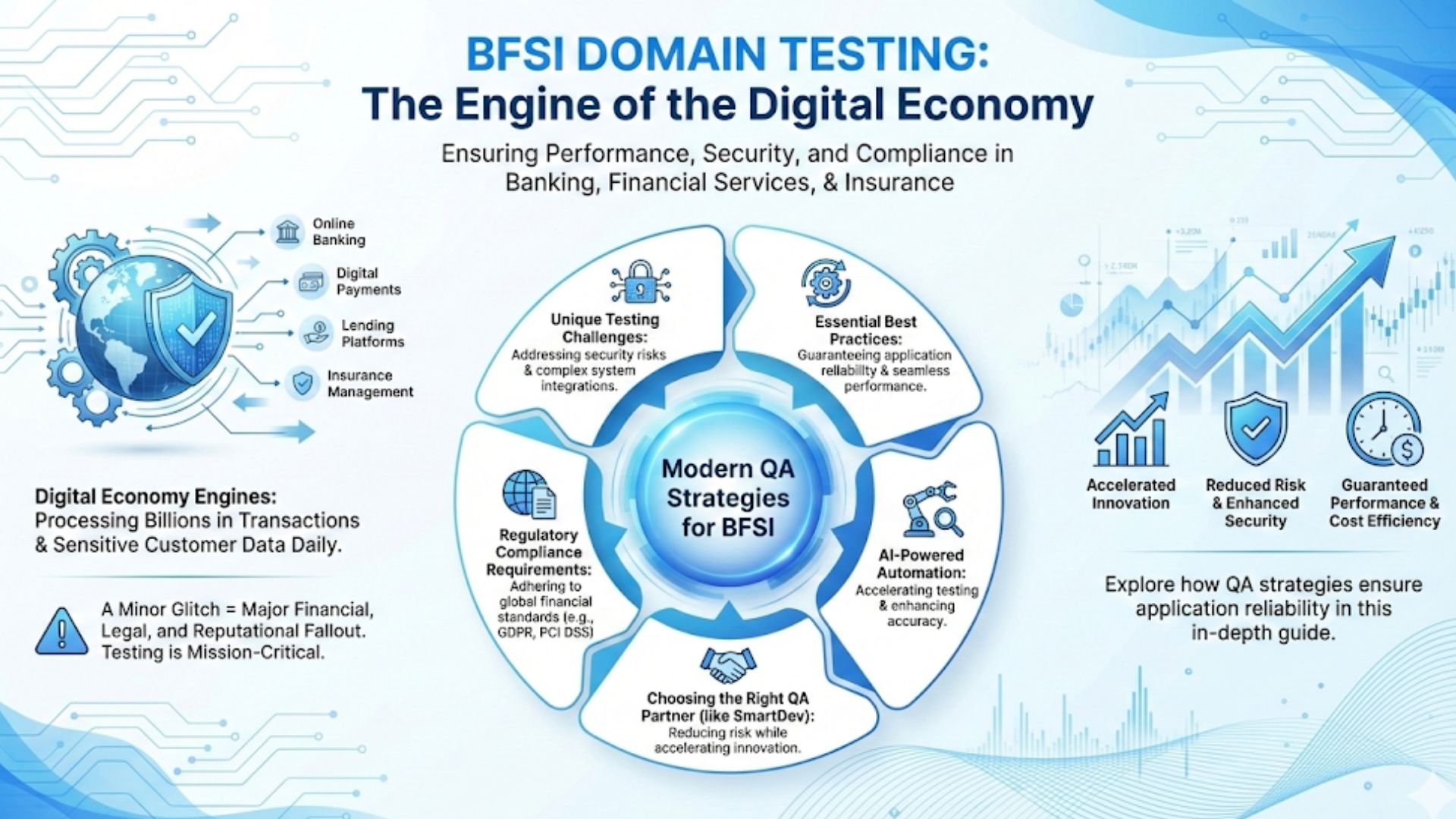
In today’s digital economy, Banking, Financial Services, and Insurance (BFSI) applications are the engines behind online banking, digital payments, lending platforms, and insurance management. These systems process billions in transactions and sensitive customer data daily, meaning even a minor glitch can trigger major financial, legal, and reputational fallout. That’s why BFSI domain testing is no longer optional; it’s a mission-critical function to guarantee the performance, security, and compliance of financial applications.
In this in-depth guide, we explore how modern QA strategies for BFSI ensure application reliability. You’ll learn about the unique testing challenges in BFSI, essential best practices for financial application testing, the role of AI-powered automation, regulatory compliance requirements, and how choosing the right QA partner (like SmartDev) can significantly reduce risk while accelerating innovation.
The Importance of QA in Financial Applications
Quality Assurance is mission-critical in BFSI because financial apps handle highly sensitive data and vital transactions. Even a single software glitch or security flaw can lead to severe consequences – from financial loss to reputational damage and legal penalties. For example, a minor error in a banking app’s transaction logic or a vulnerability in an insurance portal could erode customer trust overnight. QA acts as the safety net, identifying and fixing bugs before they cause harm. In short, rigorous testing is essential to uphold accuracy, security, and reliability in every release.
Moreover, QA plays a crucial role in regulatory compliance. Financial software must align with standards like the Payment Card Industry Data Security Standard (PCI DSS) and data privacy laws such as GDPR. Thorough testing verifies that compliance requirements are met, ensuring the application not only works well but also meets industry standards and protects customer data. In an industry built on trust, comprehensive QA is the gatekeeper that helps financial institutions avoid costly breaches and maintain customer confidence.
Additional Testing Complexities in BFSI Software Projects
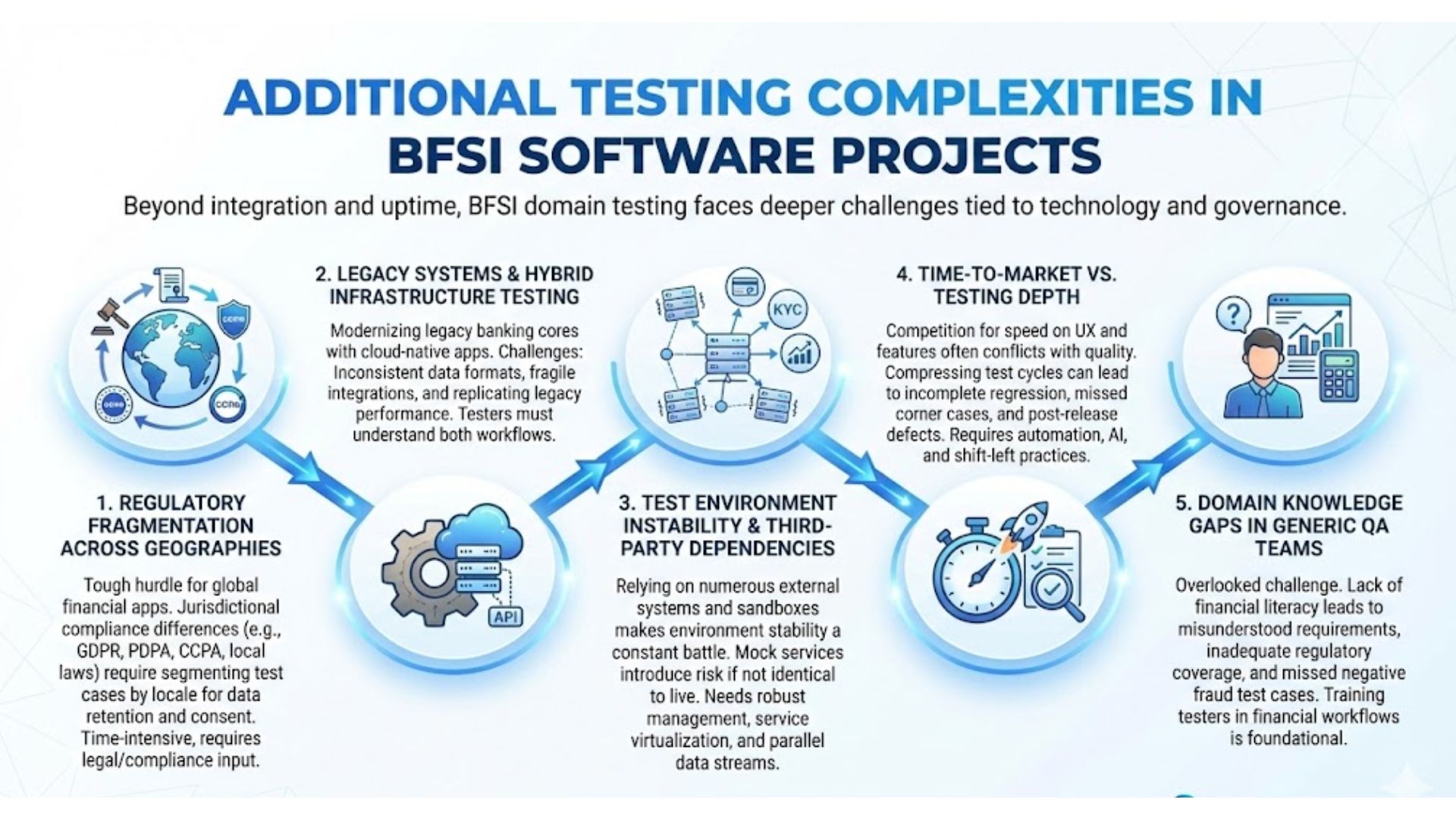
Beyond the obvious integration and uptime demands, BFSI domain testing faces deeper challenges tied to both technology and governance.
1. Regulatory Fragmentation Across Geographies
One of the toughest hurdles for QA in global financial applications is dealing with jurisdictional compliance differences. A bank operating across the EU, Southeast Asia, and North America may need to simultaneously comply with GDPR, PDPA, CCPA, and local fintech regulations. QA teams must not only verify that user flows conform to each region’s laws but also segment test cases by locale, ensuring the right rules trigger in the right scenarios.
For instance, user data retention or consent prompts in a European insurance app may need to differ significantly from an equivalent flow in Singapore. This makes regulatory testing highly specialized and time-intensive, often requiring legal input or compliance SMEs during test case design.
2. Legacy Systems and Hybrid Infrastructure Testing
Many established BFSI institutions are in the midst of digital transformation, attempting to modernize legacy core banking systems while rolling out cloud-native applications. These hybrid environments pose unique QA challenges:
- Inconsistent data formats across old COBOL-based cores and new RESTful APIs
- Fragile integrations using outdated middleware or file-based transfers
- Difficulties replicating legacy performance behavior in modern test environments
Testers must be fluent in both legacy workflows and modern APIs to effectively run integration tests, data reconciliation checks, and migration validation between systems. Without specialized tooling and seasoned QA engineers, these transitions become high-risk.
3. Test Environment Instability and Third-Party Dependencies
Because BFSI applications rely on dozens of external systems, credit bureaus, KYC verification services, stock exchanges, maintaining a stable end-to-end test environment is a constant battle. Some third-party services don’t offer robust sandboxes, making it hard to simulate edge cases or test failure scenarios.
As a workaround, teams often use mock services and virtual test assets, but this introduces risk: if mocks are not behaviorally identical to the live services, bugs can slip through. Hence, BFSI QA needs a solid environment management strategy, backed by service virtualization, version control, and parallel test data streams to maintain realism and reliability.
4. Time-to-Market vs. Testing Depth
In an increasingly digital-first financial world, banks and insurers compete on UX, feature velocity, and mobile innovation. But speed often clashes with quality. Compressing test cycles to meet aggressive product release timelines can lead to:
- Incomplete regression coverage
- Missed corner cases under high load
- Post-release defect spikes damaging brand trust
This is where test automation frameworks, AI-assisted testing, and shift-left QA practices become essential. They empower teams to maintain test depth without slowing delivery, especially when integrated into CI/CD pipelines for early defect detection.
5. Domain Knowledge Gaps in Generic QA Teams
Perhaps the most overlooked challenge in BFSI domain testing is the talent gap. Many QA teams lack financial literacy, leading to:
- Misunderstood requirements (e.g., floating vs. fixed interest logic)
- Inadequate test coverage for regulatory processes
- Missed negative test cases related to fraud detection or compliance edge flows
Training testers in financial workflows, compliance frameworks, and business rules isn’t optional, it’s foundational. QA engineers must evolve into domain-aware quality advocates, capable of asking the right questions and validating systems against real-world usage and risk scenarios.
Best Practices and Proven Strategies for BFSI Domain Testing
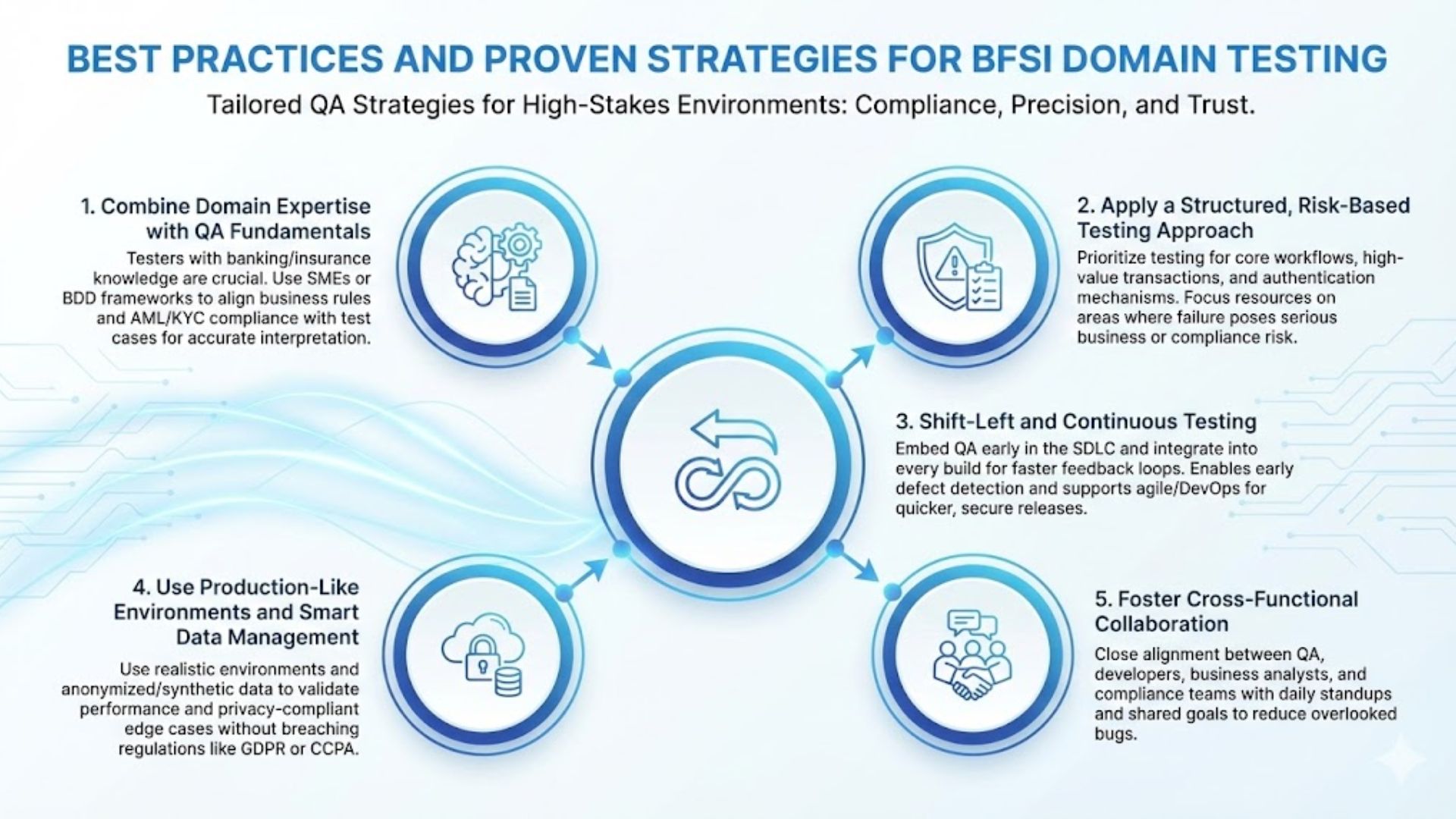
To overcome the complexities of financial systems, organizations must apply robust QA strategies tailored specifically for BFSI domain testing. Generic testing approaches fall short in a high-stakes environment where compliance, precision, and customer trust are paramount. Below are key methodologies that define world-class financial software quality assurance:
1. Combine Domain Expertise with QA Fundamentals
Effective BFSI testing starts with testers who possess not just technical QA skills, but also deep understanding of banking and insurance workflows. This includes knowledge of transaction lifecycles, interest computations, premium schedules, and claims processing. Without this, critical edge cases and compliance-sensitive scenarios may go untested.
Many top-performing financial QA teams integrate Subject Matter Experts (SMEs) or use Behavior-Driven Development (BDD) frameworks to align business rules, like AML/KYC compliance with test cases. This ensures requirements are correctly interpreted and translated into executable scenarios early in the SDLC.
2. Apply a Structured, Risk-Based Testing Approach
A disciplined Software Testing Life Cycle (STLC) is critical for BFSI applications. Start with a thorough test plan that defines:
- Test objectives and scope
- Key test types (functional, performance, usability, security, etc.)
- Regulatory coverage (e.g. PCI DSS, PSD2, SOC 2)
- Ownership and timelines
In BFSI domain testing, risk-based testing is a must. Prioritize test coverage for core banking workflows, high-value transactions, loan approval flows, and authentication mechanisms any area where failure poses serious risk to business or compliance. This strategic prioritization helps allocate resources efficiently and catch impactful bugs before production.
3. Shift-Left and Continuous Testing
Modern QA demands early and continuous testing, not a final-phase quality check. Leading BFSI teams adopt shift-left practices, embedding QA from the very first sprint. This enables early defect detection, reduces rework, and improves time-to-market.
Integrating testing into every build ensures faster feedback loops. Combined with automated regression suites, this approach supports agile and DevOps teams in releasing secure and reliable financial apps on shorter cycles.
4. Use Production-Like Environments and Smart Data Management
To produce meaningful test results, BFSI QA teams must operate in realistic test environments that replicate production configurations, user roles, data loads, and external API integrations. This enables accurate performance testing and exposes integration issues that would otherwise surface post-launch.
Equally important is test data management. Since BFSI scenarios are data-intensive, covering interest rate variants, credit risk scores, or policy limits, teams must prepare comprehensive and privacy-compliant datasets. Use anonymized or synthetic data that mimics real-world inputs while respecting regulations like GDPR or CCPA. This ensures critical edge cases are thoroughly validated without breaching privacy rules.
5. Foster Cross-Functional Collaboration
High-quality BFSI software is a result of close alignment between QA, developers, business analysts, and compliance teams. Establish daily standups, shared defect triage sessions, and collaborative documentation to eliminate communication gaps and ensure everyone works toward shared quality goals.
Encouraging a “quality-first” culture, where every team understands the mission-critical nature of financial software can dramatically reduce overlooked bugs and mismatched expectations.
Conclusion: Quality Assurance is the Backbone of Digital BFSI Success
As digital transformation accelerates across banking, insurance, and fintech, quality assurance plays a central role in ensuring stability, security, and compliance. BFSI domain testing goes beyond bug fixing, it safeguards customer trust, regulatory alignment, and seamless user experiences.
By combining early QA involvement, domain-specific expertise, and intelligent automation, financial organizations can reduce risk, accelerate delivery, and maintain the highest standards of software quality.
SmartDev empowers BFSI companies with the tools, people, and processes to deliver secure, compliant, and high-performing applications. In a sector where every transaction matters, quality is your strongest competitive advantage and SmartDev is your trusted QA partner to help you achieve it.
Ready to modernize your BFSI systems and accelerate digital transformation?
SmartDev helps banks, insurers, and fintech companies build secure, scalable platforms powered by cloud, AI, and automation.
Turn strategy into production-ready solutions with a trusted BFSI technology partner.
Talk to a BFSI ExpertAI and Test Automation in BFSI: Smarter, Faster Quality Assurance
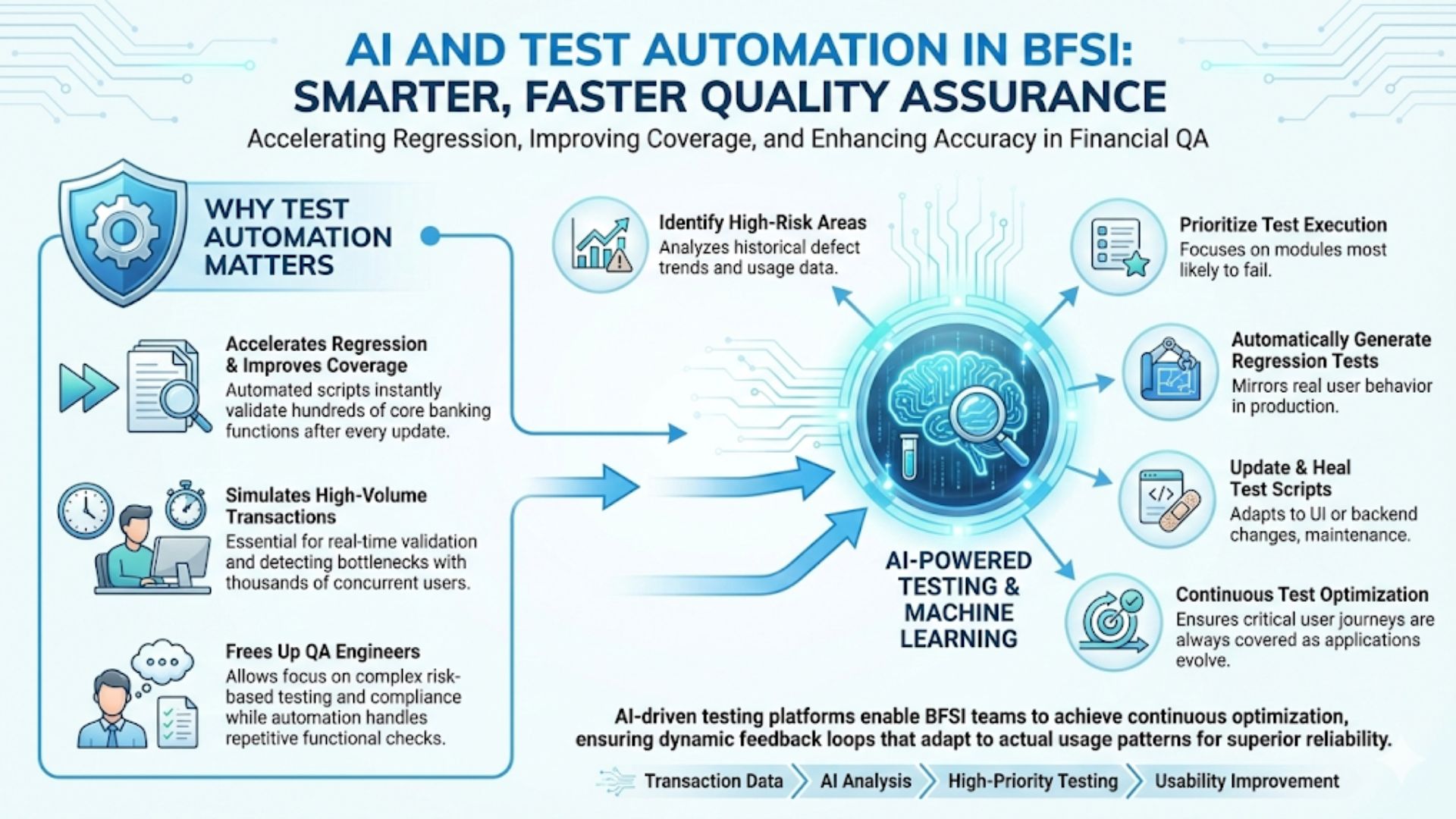
In the fast-paced world of banking and financial services, where systems are updated frequently and user expectations are sky-high, test automation has become a cornerstone of modern BFSI domain testing. Manual testing alone can’t keep up with the pace of change, especially when financial applications demand speed, accuracy, and 24/7 reliability.
Why Test Automation Matters in Financial QA
Test automation in BFSI dramatically accelerates regression testing, improves coverage, and reduces the risk of human error. For example, automated test scripts can instantly validate hundreds of core banking functions every time a new software build is deployed. This ensures that essential workflows, such as balance calculations, payment processing, and interest accrual continue working as expected after every update.
In scenarios requiring real-time transaction validation or simulating thousands of concurrent users, automation is not just helpful, it’s essential. By replicating high-volume transaction scenarios, automation enables teams to detect bottlenecks or data discrepancies that would be impossible to uncover manually.
Moreover, automation frees up QA engineers to focus on complex risk-based testing and compliance validation, while scripts handle repetitive functional checks. For BFSI institutions, this means faster releases without compromising accuracy or compliance.
Elevating BFSI Testing with AI and Machine Learning
While automation streamlines test execution, AI-powered testing takes it further by introducing intelligence and adaptability into the QA process. In modern BFSI QA strategies, AI is now being used to:
- Identify high-risk areas by analyzing historical defect trends and usage data
- Prioritize test execution based on modules most likely to fail
- Automatically generate regression tests that mirror real user behavior in production
- Update and heal test scripts in response to UI or backend changes
These innovations dramatically reduce test maintenance, especially in rapidly evolving fintech environments. With AI-driven testing platforms, BFSI teams can achieve continuous test optimization, ensuring that the most critical user journeys are always covered, even as applications evolve.
For example, if transaction flow data shows users consistently getting stuck at a KYC form, AI can flag that path as high priority for regression and usability testing. This type of dynamic feedback loop ensures testing adapts to actual usage patterns, not just theoretical requirements.
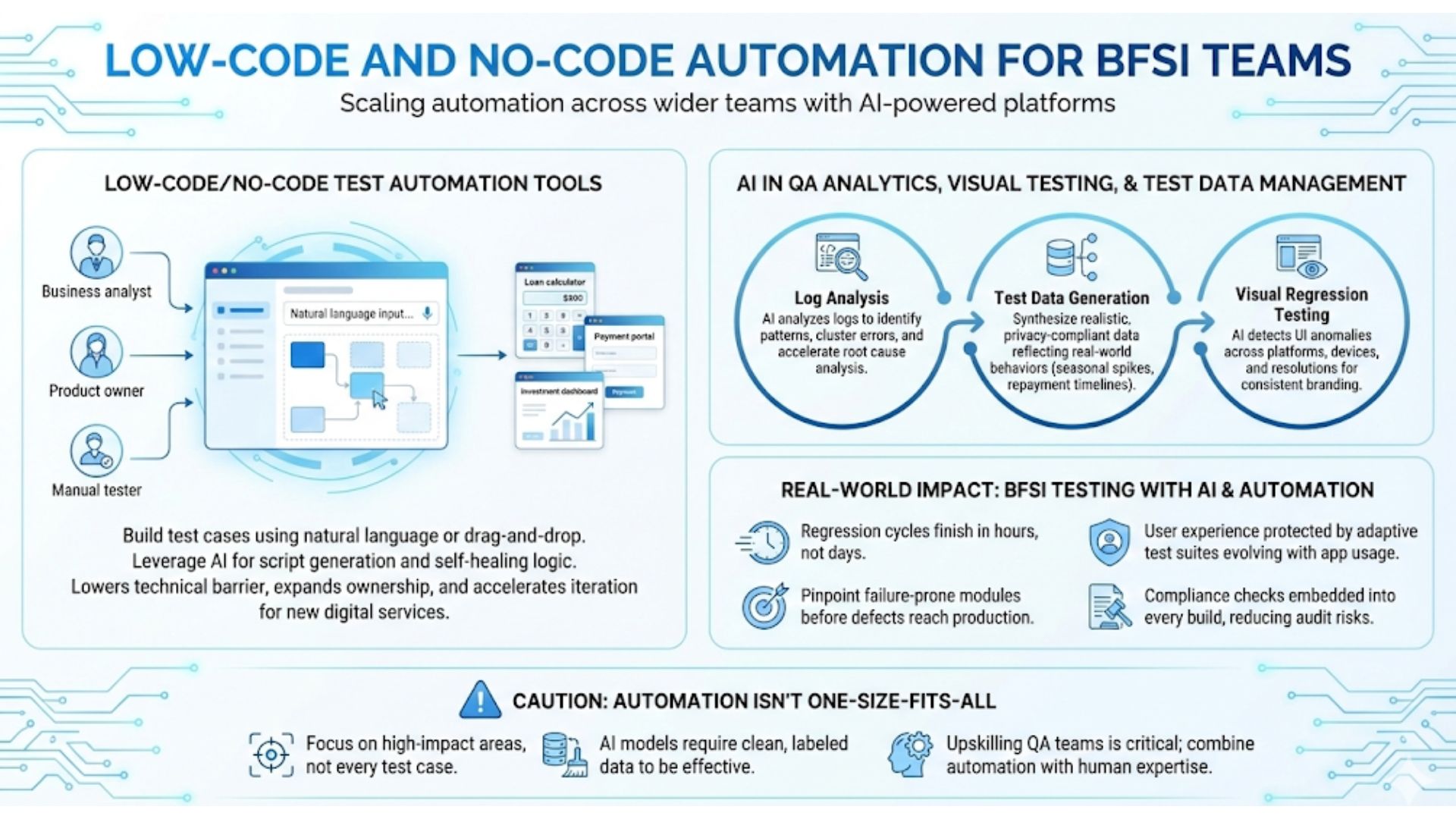
Low-Code and No-Code Automation for BFSI Teams
As QA complexity grows, low-code/no-code test automation tools, many powered by AI are helping BFSI organizations scale automation across wider teams. These platforms allow business analysts, product owners, or manual testers to:
- Build test cases using natural language or drag-and-drop interfaces
- Leverage AI to interpret test intents and generate scripts
- Automatically adapt to UI changes with self-healing test logic
For banks or insurance firms lacking deep test automation expertise, this lowers the technical barrier while expanding test ownership. More stakeholders can participate in QA, leading to broader coverage and faster iteration—especially important when launching new digital services like loan calculators, payment portals, or investment dashboards.
AI in QA Analytics, Visual Testing, and Test Data Management
Beyond scripting, AI is revolutionizing QA operations in BFSI through intelligent analytics and automation at multiple levels:
- Log Analysis: AI tools analyze execution logs to identify patterns, cluster errors, and accelerate root cause analysis.
- Test Data Generation: Machine learning models can synthesize realistic, privacy-compliant test data that reflects real-world financial behaviors, such as seasonal transaction spikes or unusual loan repayment timelines.
- Visual Regression Testing: Visual AI detects UI anomalies across platforms, devices, and resolutions, ensuring consistent branding and accessibility crucial for customer-facing banking apps.
These AI capabilities allow QA teams to test smarter, debug faster, and ensure full compliance without manual effort.
Real-World Impact: BFSI Testing with AI and Automation
The combined power of AI and automation in financial software testing results in measurable ROI:
- Regression cycles that once took days now finish in hours
- QA teams can pinpoint failure-prone modules before defects reach production
- User experience is protected by adaptive test suites that evolve with app usage
- Compliance checks are embedded into every build, reducing audit risks
In an industry where quality and trust directly impact brand reputation, these improvements are not just operationally beneficial, they’re strategic.
Caution: Automation Isn’t One-Size-Fits-All
Despite its advantages, test automation and AI in BFSI QA must be implemented thoughtfully:
- Not every test case is worth automating, focus on high-impact areas
- AI models require clean, labeled data to be effective
- Tools are only as powerful as the people using them upskilling QA teams is critical
Forward-looking financial institutions combine intelligent automation platforms with domain-trained QA experts to get the best of both worlds: speed and precision, scalability and context-awareness.
Building a Security First and Compliance Ready QA Culture
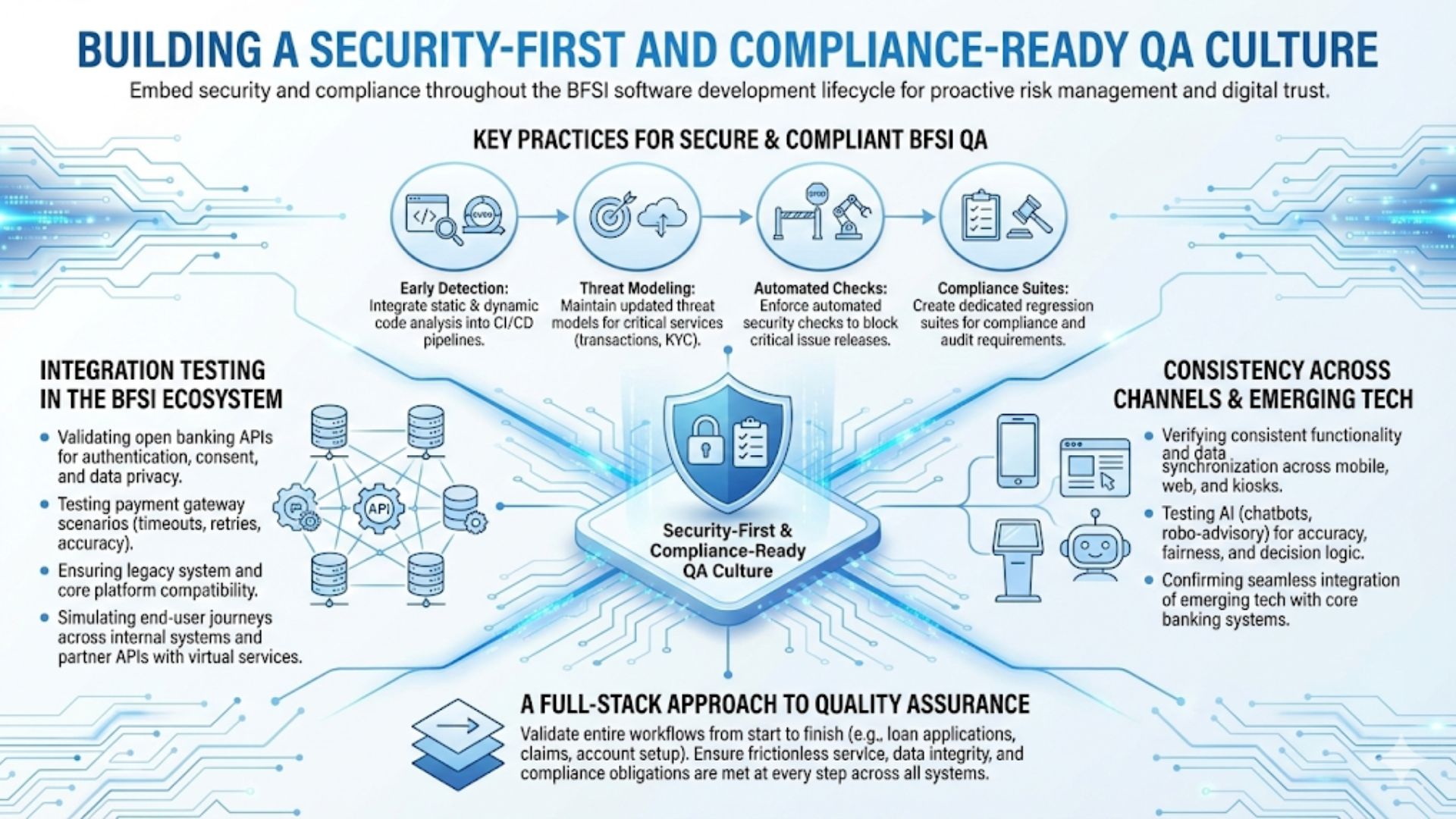
To effectively implement security and compliance testing in BFSI, QA teams must embed security practices throughout the entire software development lifecycle. This requires a proactive approach that combines collaboration between development, DevOps, legal, and compliance teams with modern security tooling and clear testing protocols.
Some key practices include:
- Integrating static and dynamic code analysis into CI/CD pipelines to detect vulnerabilities early
- Maintaining updated threat models for critical services such as transactions, KYC, or onboarding
- Enforcing automated security checks that block releases containing critical issues
- Establishing release-specific QA checklists to validate encryption, authentication flows, and access controls
- Creating dedicated regression test suites focused on compliance and audit requirements
By adopting a security focused mindset from the beginning, BFSI organizations can prevent breaches, reduce regulatory exposure, and build digital trust with users.
Integration Testing in the BFSI Ecosystem
Modern banking and financial applications are built on a network of internal services and third party systems. From core banking platforms and payment processors to external APIs and fintech integrations, ensuring smooth interoperability is a critical part of BFSI domain testing.
QA teams must focus on:
- Validating open banking APIs for authentication flows, consent handling, and data privacy
- Testing payment gateway scenarios including timeouts, retries, and transactional accuracy
- Ensuring legacy systems and core platforms are compatible with newer digital services
- Simulating end user journeys that span across internal systems and partner APIs
Staging environments should be equipped with virtual services or realistic stubs that can mimic both success and failure conditions. This helps identify weak links before they reach production.
Ensuring Consistency Across Channels and Emerging Technologies
Today’s customers interact with BFSI products across multiple touchpoints including mobile apps, websites, kiosks, and virtual assistants. QA must verify consistent functionality and data synchronization across these platforms.
As BFSI institutions adopt technologies such as AI powered chatbots, robo advisory tools, and blockchain components, QA processes must evolve accordingly. This means testing AI for accuracy and fairness, validating decision logic, and confirming seamless integration with core banking systems.
A Full Stack Approach to Quality Assurance
Successful BFSI QA goes beyond checking individual modules. It requires validating entire workflows from start to finish. Whether it is loan applications, insurance claims, or investment account setup, each flow involves several systems, each with its own risk profile.
End to end testing across these workflows ensures that users experience frictionless service, data integrity is maintained, and compliance obligations are met at every step.
Why SmartDev is the Trusted Partner for BFSI Domain Testing
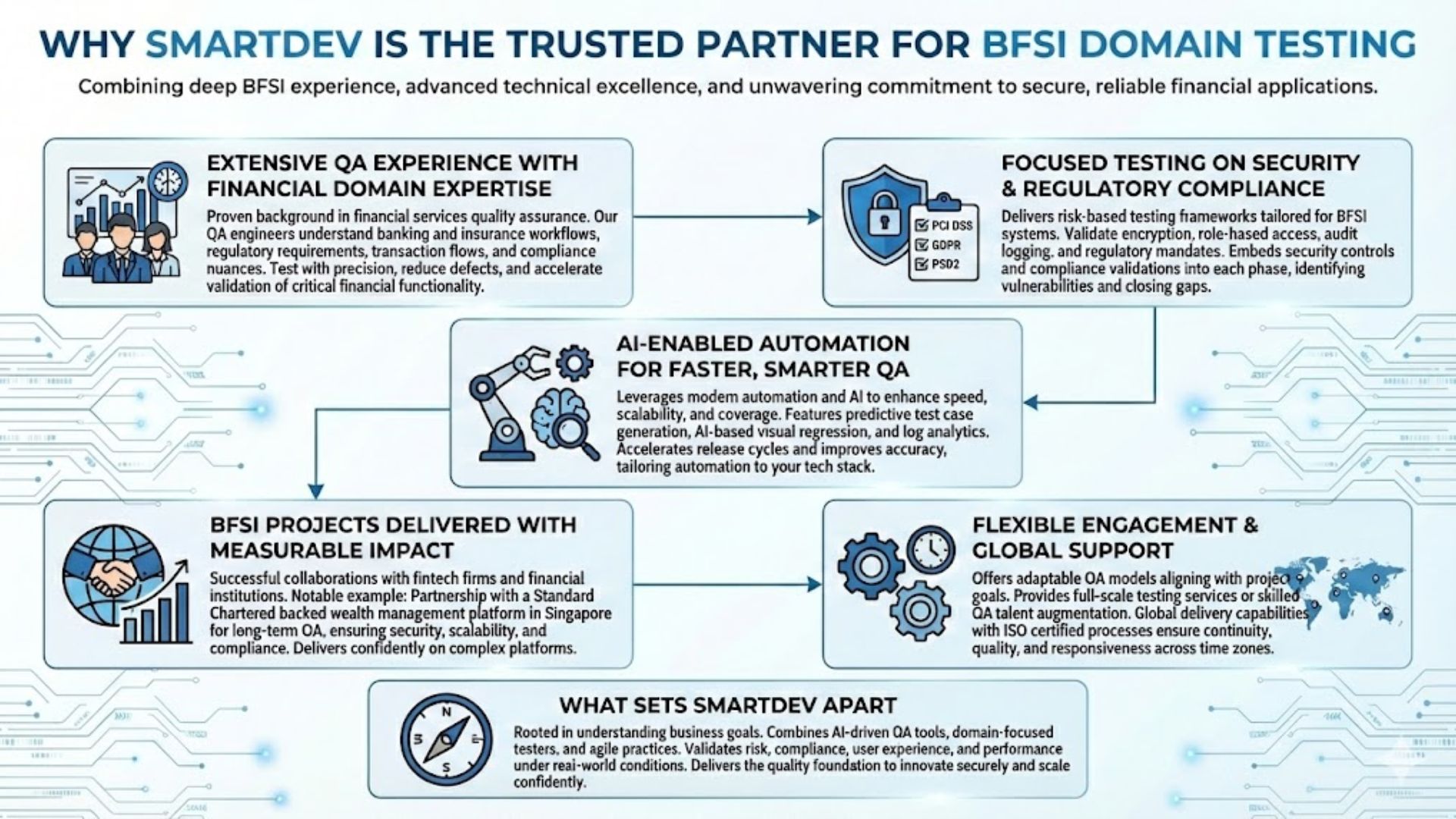
Selecting the right quality assurance partner can significantly impact the success of any financial software initiative. SmartDev is recognized for its strong foundation in BFSI domain testing, combining deep industry experience, technical excellence, and a commitment to delivering secure, reliable applications tailored to the financial sector.
Extensive QA Experience with Financial Domain Expertise
SmartDev brings a proven background in software quality assurance, backed by a team of testing professionals who specialize in financial services. Our QA engineers understand the intricacies of banking and insurance workflows, including regulatory requirements, transaction flows, and compliance nuances. This allows us to test with precision, reduce defects in production, and accelerate validation of critical financial functionality.
Focused Testing on Security and Regulatory Compliance
In a landscape where cybersecurity and compliance cannot be compromised, SmartDev delivers risk-based testing frameworks tailored for BFSI systems. We validate encryption standards, role-based access, audit logging, and regulatory mandates such as PCI DSS, GDPR, and PSD2. Through both automated and manual assessments, our team helps financial institutions identify vulnerabilities and close compliance gaps before deployment.
Clients trust SmartDev because we go beyond generic testing. We embed security controls and compliance validations into each phase of the testing cycle, ensuring your product meets both customer expectations and regulatory obligations.
AI Enabled Automation for Faster, Smarter QA
We leverage modern automation frameworks and artificial intelligence to enhance speed, scalability, and test coverage. From predictive test case generation to AI based visual regression and log analytics, our QA practice reduces execution time while improving accuracy.
SmartDev tailors its automation strategy to each client’s tech stack and QA maturity level. Our AI powered testing accelerates release cycles and empowers teams to deliver more with less, all while maintaining exceptional quality standards.
BFSI Projects Delivered with Measurable Impact
Our track record includes successful collaborations with fintech firms and financial institutions across regions. One notable example is our partnership with a Standard Chartered backed wealth management platform in Singapore, where we provided a long term QA team that ensured security, scalability, and compliance for over two years.
Whether building a next generation banking app, a digital insurance portal, or a complex data integration platform, SmartDev brings the BFSI domain understanding and technical precision needed to deliver confidently.
Flexible Engagement and Global Support
We offer adaptable QA engagement models that align with your project goals and timelines. Whether you need full scale testing services or skilled QA talent to augment your in house team, SmartDev provides solutions that scale.
With global delivery capabilities and ISO certified processes, we ensure continuity, quality, and responsiveness for every BFSI engagement. Our global presence allows us to support clients across time zones with speed and reliability.
What Sets SmartDev Apart
SmartDev’s approach is rooted in understanding your business goals and aligning testing strategies accordingly. We combine AI driven QA tools, domain focused testers, and agile delivery practices to ensure your software is not only functional but future ready.
We do not just validate features, we validate risk, compliance, user experience, and performance under real world conditions. For BFSI companies seeking to innovate securely and scale confidently, SmartDev delivers the quality foundation you need.
Conclusion: Quality Assurance is the Backbone of Digital BFSI Success
As digital transformation accelerates across banking, insurance, and fintech, quality assurance plays a central role in ensuring stability, security, and compliance. BFSI domain testing goes beyond bug fixing, it safeguards customer trust, regulatory alignment, and seamless user experiences.
By combining early QA involvement, domain-specific expertise, and intelligent automation, financial organizations can reduce risk, accelerate delivery, and maintain the highest standards of software quality.
SmartDev empowers BFSI companies with the tools, people, and processes to deliver secure, compliant, and high-performing applications. In a sector where every transaction matters, quality is your strongest competitive advantage and SmartDev is your trusted QA partner to help you achieve it.