Introduction: Why Business Readiness Defines Modern Success
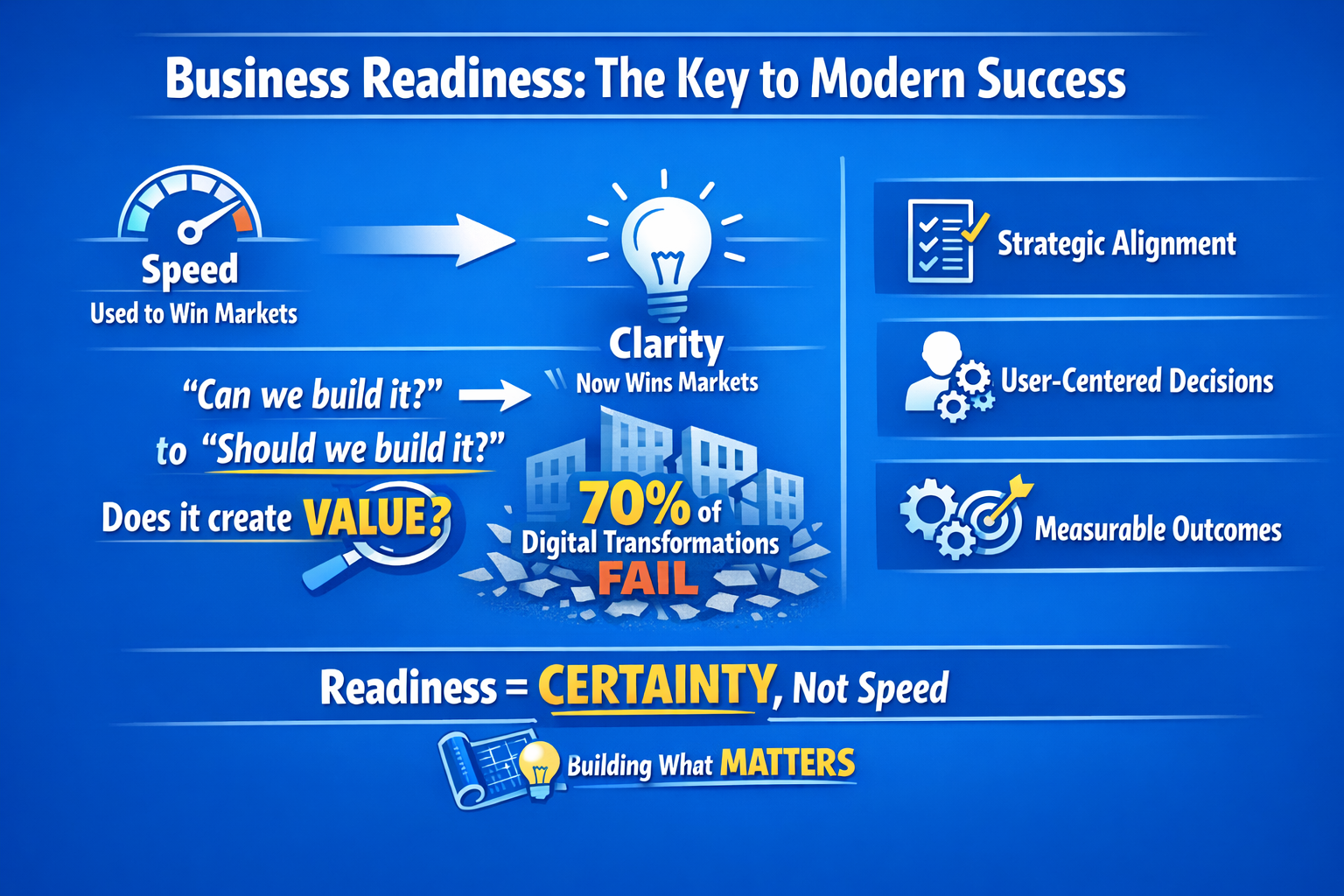
“Speed used to win markets. Today, clarity does.”
In an age where AI, automation, and rapid iteration dominate every industry, the question has shifted from “Can we build it?” to “Should we build it – and does it create value for the user?”
According to Boston Consulting Group, over 70% of digital transformation projects still fail to meet their business objectives. The core issue isn’t technology. It’s readiness. Specifically, the lack of a structured, measurable way to ensure that every business decision – from discovery to delivery – is aligned with end-user value.
This is where business readiness becomes a differentiator. It’s not about digital maturity or agile speed both focus on how teams work. Readiness focuses on whether the business is structurally, strategically, and culturally prepared to deliver sustained value to users.
Unlike digital maturity, which measures adoption of tools and practices, or product-market fit, which looks at post-launch traction, business readiness operates before and during execution. It ensures that what is being built connects directly to validated user outcomes and strategic intent before capital, time, and talent are committed.
In short, readiness isn’t about speed; it’s about certainty. It’s the discipline of aligning every strategic and technical decision with measurable end-user value ensuring that innovation scales, not just starts.
What “Business Readiness” Really Means
Readiness as Strategic Alignment
True business readiness emerges when three forces work in harmony: business strategy (why we build), technical feasibility (what we can build), and user desirability (what people actually need). When all three align, organizations move with clarity and confidence. But when even one is misaligned, risk compounds exponentially.
- Strategy + Technology without Desirability: The result is a technically sound product no one wants — innovation without adoption. Many AI pilots fail here: they scale capability before confirming user relevance.
- Desirability + Technology without Strategy: Teams build experiences that delight users but lack a sustainable business model or strategic focus. This leads to fragmented innovation that doesn’t advance enterprise goals.
- Strategy + Desirability without Feasibility: This is the PowerPoint problem – the business case and user story look perfect on paper, but delivery stalls because of technical debt or unrealistic timelines.
A readiness mindset doesn’t just celebrate alignment; it diagnoses where alignment breaks. It helps leadership identify early which pillar needs reinforcement before committing full-scale investment. In this sense, readiness isn’t a static state – it’s a continuous balancing act between ambition, feasibility, and reality.
From Opinions to Evidence
In most organizations, failure doesn’t stem from bad intentions – it stems from untested assumptions masquerading as facts. “Evidence-based decision-making” is therefore not a slogan at SmartDev; it’s a gating mechanism.
SmartDev replaces opinions with structured validation.
- Qualitative evidence – user interviews, contextual inquiries, stakeholder workshops – is used to validate problem definition and desirability.
- Quantitative evidence – prototype analytics, performance data, ROI modeling – is used to validate feasibility and business impact.
Crucially, SmartDev treats some evidence as non-negotiable before progressing to build:
- There must be validated user needs captured through first-hand research, not internal conjecture.
- There must be a clear success metric agreed upon between business and delivery teams.
- And there must be technical feasibility confirmation, ensuring proposed architectures or integrations can actually scale.
This multi-tier evidence framework turns readiness into an operational discipline, not an aspirational principle. It ensures that each decision milestone has a defined threshold of proof before moving forward – transforming alignment from a meeting outcome into a measurable process.
The End-User as the Anchor
Every successful digital initiative shares one constant: alignment with end-user value. But readiness requires more than empathy – it demands arbitration when user value conflicts with business or technical constraints.
In practice, such tensions are inevitable:
- A feature that maximizes usability may also increase compliance cost.
- A technically elegant architecture may slow time-to-market.
- A user-requested capability may stretch budget or scalability thresholds.
SmartDev manages these trade-offs through value-based prioritization. Each decision is filtered through three lenses:
- User impact – Does it meaningfully improve the experience or solve a pain point?
- Business leverage – Does it drive measurable outcomes aligned with strategic KPIs?
- Operational viability – Can it be delivered sustainably under current constraints?
When trade-offs arise, SmartDev facilitates structured alignment workshops where stakeholders from product, compliance, and engineering converge on a transparent decision matrix. The outcome isn’t compromised; it’s clarity – ensuring that what gets built first delivers the highest shared value across both users and the business.
SmartDev’s Business Readiness Framework
SmartDev’s business readiness framework is an integrated system that bridges vision, validation, and velocity. It is built on two proprietary pillars – the 3-Week Discovery Phase and the 10-Week Product Factory – designed to move from conceptual uncertainty to measurable business and user alignment.
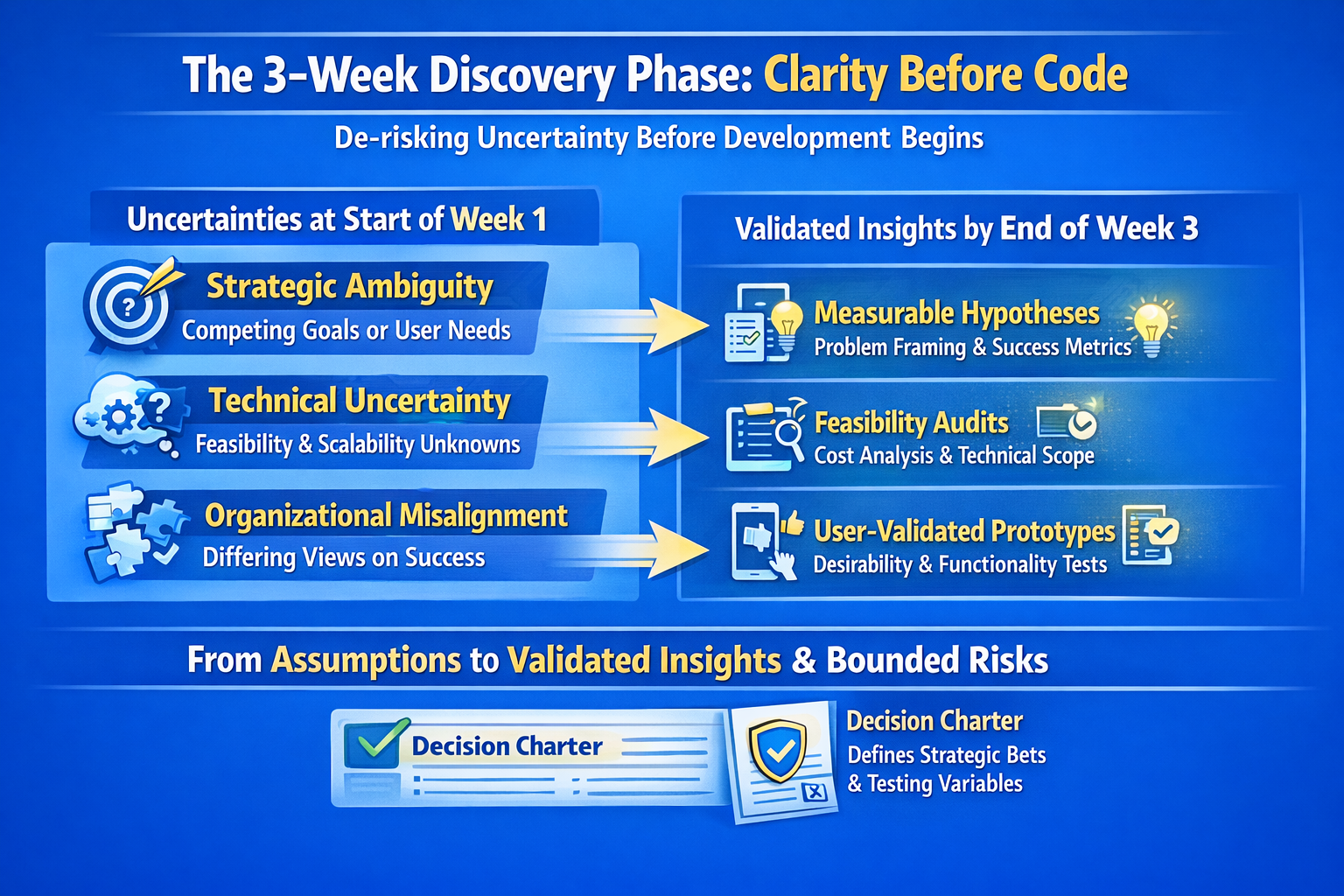
The 3-Week Discovery Phase -Clarity Before Code
The purpose of Discovery isn’t documentation – it’s de-risking.
At the start of Week 1, uncertainty typically manifests in three ways:
- Strategic ambiguity – stakeholders hold competing assumptions about goals or user needs.
- Technical uncertainty – the feasibility, integration effort, and scalability are not yet quantified.
- Organizational misalignment – different functions interpret “success” differently, leading to rework later.
By Week 3, these uncertainties are systematically reduced through a structured series of validation sprints:
- Problem definition workshops convert opinions into measurable hypotheses.
- Feasibility audits identify integration blockers and cost drivers.
- Rapid user validation tests desirability through early prototypes.
The shift is tangible. What begins as a landscape of assumptions ends as a portfolio of validated insights and bounded risks. Stakeholders leave with a decision charter that codifies:
- Which strategic bets are now “locked in” (problem framing, success metrics, user personas).
- Which variables remain open for testing (feature priorities, UX variations, technology options).
By defining these thresholds, Discovery becomes a decision system, not a research exercise.
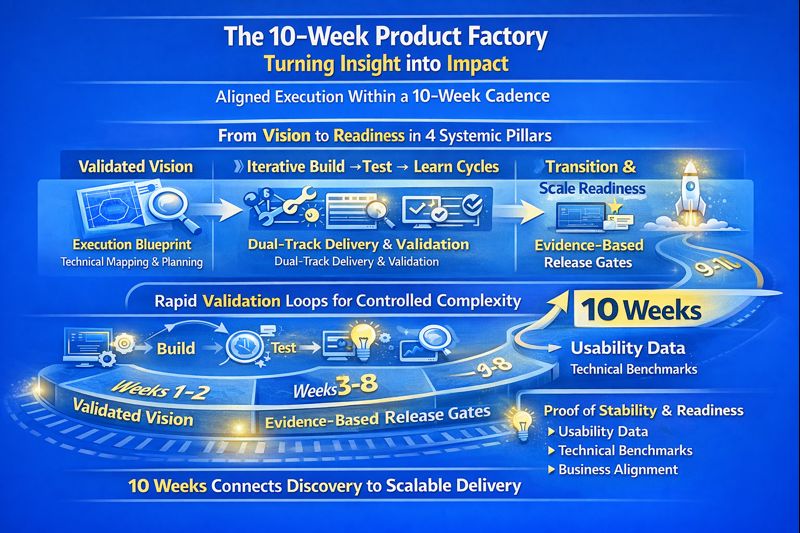
The 10-Week Product Factory -Turning Insight into Impact
If the Discovery phase defines what is worth building, the Product Factory defines how to build it without losing alignment.
The 10-week cadence is not arbitrary. It reflects SmartDev’s experience optimizing the trade-off between speed and complexity in product development. Within this window, a team can complete three full validation loops – hypothesis, prototype, and insight – while maintaining stakeholder visibility and engineering integrity.
Shorter cycles often compress learning; longer cycles dilute focus. Ten weeks is the equilibrium where learning velocity and delivery discipline reinforce one another.
A Cadence Designed for Complexity Control
Traditional development models tend to expand complexity exponentially as new features, data flows, and dependencies accumulate. By structuring work into a 10-week readiness cadence, SmartDev constrains complexity before it metastasizes.
Each 10-week Product Factory engagement is organized around four systemic pillars derived from the Product Factory framework:
- Validated Vision → Execution Blueprint :
- The first two weeks transform Discovery outputs into technical blueprints.
- Architecture, APIs, and data flows are mapped against validated user journeys, ensuring no disconnect between desirability and feasibility.
- Iterative Build → Test → Learn Cycles
- Weeks 3–8 operate as dual tracks: engineering sprints (Track A) and evidence sprints (Track B).
- Every build increment is accompanied by rapid validation — usability tests, analytics reviews, and stakeholder feedback loops.
- This dual-track rhythm converts delivery into a continuous learning system.
- Evidence-Based Release Gates
- Progression is never time-based alone; it is proof-based.
- Before moving each release milestone, the team must present evidence of user validation, technical stability, and business alignment.
- This “evidence gate” approach replaces subjective confidence with measurable readiness.
- Transition and Scale Readiness
- Weeks 9-10 focus on operationalizing the MVP – documentation, performance benchmarking, and production handover.
- These steps prepare the organization for investor review, compliance audits, or pilot deployment – converting prototype learning into enterprise-grade readiness.
Why Ten Weeks Is Optimal
SmartDev’s methodology evolved from analyzing over 50 projects where delivery speed, quality, and alignment were tracked concurrently. The data revealed a clear inflection point:
- Projects running shorter than 8 weeks often skipped validation, creating rework downstream.
- Projects exceeding 12 weeks faced context drift — goals shifted, stakeholder attention waned, and team momentum dissipated.
Ten weeks proved to be the optimal cadence — long enough to achieve validated outcomes, short enough to maintain strategic intensity.
This timebox also mirrors organizational attention spans. For most enterprises, a 10-week horizon fits quarterly OKR cycles, allowing leadership to tie product progress directly to business metrics.
Boundaries of Applicability
Like any disciplined system, the Product Factory model has its limits.
It excels in environments where:
- Product goals can be modularized into testable hypotheses.
- Decision-makers are available for iterative review cycles.
- The organization values fast feedback over exhaustive documentation.
However, the model is less suited to projects demanding:
- Heavy regulatory certification (e.g., medical devices, defense software).
- Monolithic architecture changes requiring multi-year dependencies.
- Extensive stakeholder layers where approval chains exceed the iteration cadence.
In such contexts, SmartDev adapts the model into a phased readiness approach — applying the same principles of validation, feedback, and alignment but expanding cadence from weeks to months.
Turning Delivery into Learning Infrastructure
Perhaps the most overlooked strength of the Product Factory is its epistemic function – it turns product delivery into a learning infrastructure.
Every sprint generates structured data: user feedback, usability metrics, and technical performance benchmarks. These data points flow back into the Discovery artifacts, creating a closed information loop. What begins as hypotheses in Week 1 becomes measurable insight by Week 10 – insight that can directly inform scaling decisions, pricing models, and future feature prioritization.
In this way, the 10-week Product Factory doesn’t just build products faster; it builds organizational intelligence. It transforms uncertainty into evidence and evidence into scalable confidence.
Why the Two-Phase System Works
The power of SmartDev’s framework doesn’t lie in its speed – it lies in its continuity.
When Discovery and Delivery are treated as separate projects, several predictable breakdowns occur:
- Artifacts lose meaning. Discovery insights are captured in slide decks but never re-interpreted by developers, leading to gaps between intent and implementation.
- Ownership fragments. The team that discovered the problem isn’t the one solving it, so context erodes with each handoff.
- Metrics reset. Success indicators defined in Discovery are forgotten or replaced, breaking the feedback chain between hypothesis and outcome.
SmartDev’s two-phase model avoids these pitfalls through artifact continuity and team continuity.
The same multidisciplinary team that validates the problem in Discovery also builds the solution in Product Factory. All artifacts – user journeys, risk maps, KPI frameworks – remain in live documents, not static outputs. This continuity preserves decision context, accelerates learning transfer, and sustains alignment long after the kickoff.
In essence, the framework operationalizes readiness as a closed loop:
- Discovery reduces uncertainty.
- Factory executes with evidence.
- Feedback from use refines both strategy and delivery in real time.
That is why the system works – not because it is faster, but because it makes progress measurable, knowledge cumulative, and alignment durable.
Explore how SmartDev partners with teams through a focused AI discovery sprint to validate business problems, align stakeholders, and define a clear path forward before development begins.
SmartDev helps organizations clarify AI use cases and feasibility through a structured discovery process, enabling confident decisions and reduced risk before committing to build.
Learn how companies accelerate AI initiatives with SmartDev’s discovery sprint.
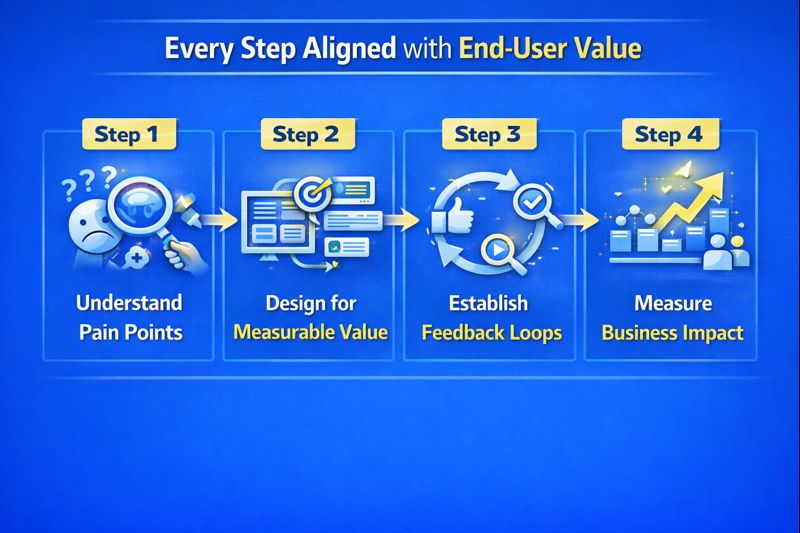
Start Your 3-Week Discovery Program NowEvery Step Aligned with End-User Value
Step 1: Understanding Pain Points Before Building
End-user alignment starts long before design begins. The challenge is not identifying what to build – it’s identifying what not to build.
In one public case, SmartDev partnered with a European wealth management platform that initially assumed its users wanted complex financial simulations. Early user testing invalidated this: clients valued simplicity and progress tracking far more than model sophistication.
- Before Discovery: investment was planned around heavy analytics dashboards.
- After Validation: evidence showed that users dropped off after two screens; 80% of value came from fast onboarding and visual clarity.
By reframing from the problem, SmartDev redirected resources from advanced modeling to UX flow optimization and mobile responsiveness – reducing development effort by months while improving retention.
The takeaway: readiness prevents waste by validating assumptions early, before the cost of being wrong multiplies.
Step 2: Designing Around Measurable Value
Building for users means designing measurable outcomes – not intuition. Each product metric becomes a design decision.
At SmartDev, every Discovery phase defines a Value-Metric Map:
- Experience metrics (task completion rate, time-to-value) shape interface design.
- Business metrics (activation, retention, cost-to-serve) guide for feature prioritization.
- Technical metrics (response time, scalability) drive architecture trade-offs.
To avoid vanity metrics – numbers that look good but don’t drive value – each metric must meet three criteria:
- Traceable: linked to validated user behavior.
- Actionable: able to trigger a decision or change.
- Comparable: benchmarked over time or against alternatives.
When metrics conflict, SmartDev applies decision weighting – user value carries precedence unless business viability is at risk. This ensures every design iteration optimizes what truly matters: the intersection of utility, efficiency, and adoption.
Step 3: Continuous Feedback Loops
Feedback without focus creates noise. Most agile systems collect input endlessly but rarely discriminate between signals that matter and those that distract.
SmartDev’s approach filters feedback through three layers:
- Source credibility: weighting insights from validated users higher than ad-hoc suggestions.
- Frequency vs. impact: prioritizing recurring issues that affect core workflows.
- Evidence synthesis: cross-checking qualitative reports with behavioral data (e.g., drop-off rates, heatmaps).
This turns feedback into strategy, not chatter. Each sprint cycle ends with a feedback synthesis workshop, where design and product leads translate validated insights into roadmap actions. Irrelevant noise – one-off complaints, unverified ideas – is logged but not allowed to derail the build.
The result: adaptation without volatility. The product evolves continuously but coherently, staying tethered to end-user value rather than opinion volume.
Step 4: Measuring Business Impact Through Adoption Metrics
Adoption is not an afterthought; it’s a design constraint. From the first sprint, SmartDev teams embed adoption of metrics into architecture decisions.
Two categories guide this approach:
- Leading indicators – signal early behavior change (e.g., onboarding completion rate, repeat session frequency, feature discoverability).
- Lagging indicators – confirm sustained business impact (e.g., monthly active users, churn reduction, customer lifetime value).
By monitoring leading metrics early, teams detect friction before scale magnifies it. For example, low activation within the first two weeks often predicts future churn – a warning sign that triggers design or onboarding refinement long before costly remediation.
This readiness-driven discovery process transforms measurement into foresight. Every adoption metric becomes both a diagnostic and a design instrument, ensuring that business outcomes are engineered – not post-rationalized.
Operationalizing Readiness Across the Lifecycle
Readiness isn’t an event; it’s a discipline sustained through governance, feedback, and measurement. SmartDev operationalizes it across every phase – from roadmap planning to post-launch optimization – ensuring decisions remain evidence-driven and user-aligned.
Evidence-Driven Roadmaps
A roadmap is only as strong as the evidence that updates it. At SmartDev, roadmaps are living documents, revalidated through structured governance every two to four weeks, depending on project velocity.
- Cadence: Each sprint cycle ends with an Evidence Review Session – a structured checkpoint where new data (user metrics, technical insights, cost variations) is reviewed against roadmap assumptions.
- Authority: Changes are authorized only when supported by evidence thresholds – user validation data, performance metrics, or risk escalation indicators. Product Owners propose, but a triad of business, design, and technical leads must ratify the adjustment to maintain balance between opportunity and stability.
- Governance: Decisions are logged in a Change Journal, capturing rationale and data source. This ensures transparency and traceability across distributed teams.
By treating the roadmap as a decision system rather than a static plan, SmartDev prevents drift between intent and execution. The result: fewer reactive pivots, more proactive alignment.
Reducing Bias and Strengthening Collaboration
Every organization struggles with cognitive bias – the subtle distortions that turn data into confirmation of preexisting beliefs. SmartDev explicitly designs its collaboration model to counter these structural biases:
- Anchoring Bias: Prevented through blind estimation rounds, were teams independently sized, effort and risk before discussion.
- Confirmation Bias: Reduced by mandatory contrarian reviews, where a non-core team member challenges assumptions behind each major decision.
- Recency Bias: Mitigated by weighted scoring matrices that track issue frequency over time, ensuring decisions favor patterns, not anecdotes.
- Groupthink: Avoided via cross-functional workshops where design, engineering, and business leads must each present dissenting views before convergence.
Artifacts such as evidence of dashboards and decision logs institutionalize critical thinking, turning bias reduction into process, not personality.
This inclusivity is more than culture – it’s economics. Projects that involve users and stakeholders early are 50% more likely to hit market success targets.
User-Centered Metrics as a Health Indicator
Metrics drive focus, but unchecked metrics create noise. SmartDev treats measurement as a health system, not a scoreboard.
Each product defines three tiers of metrics:
- Outcome metrics – business success (e.g., revenue lift, cost-to-serve).
- Behavioral metrics – user adoption and engagement (e.g., activation rate, frequency of key actions).
- Operational metrics – delivery and quality performance (e.g., cycle time, defect density).
To avoid metric overload, SmartDev applies the Rule of Five – no team tracks more than five active metrics per tier. Every metric must be actionable, traceable, and time bounded. When a metric ceases to inform decisions, it’s archived, not accumulated.
The health of readiness is thus visible: when behavioral metrics stagnate while operational ones improve, SmartDev flags misaligned value delivery – a signal for immediate recalibration.
Proof in Action: Readiness That Scales
Case Study: Building Business Readiness in Education Technology
A Singapore-based EdTech company approached SmartDev with an ambitious goal – to transform how primary school students learn Mandarin by creating an interactive, gamified platform that strengthens vocabulary retention. The concept was promising, but the existing system faced multiple barriers: scattered documentation, unclear workflows, and inconsistent communication across technical and business teams.
To overcome these readiness challenges, SmartDev began with a structured discovery engagement focused on aligning vision, feasibility, and user needs. Through a series of application assessments, workflow audits, and collaborative workshops, the team uncovered critical process gaps that were slowing delivery and increasing operational risk.
Instead of jumping straight into coding, SmartDev prioritized rebuilding clarity and structure:
- Documentation and process alignment reduced misunderstanding between stakeholders.
- Clear communication channels were established between technical and business teams.
- Iterative testing and feedback loops ensured the product reflected real classroom needs.
This focuses on readiness reshaped in the entire trajectory of the project. Within a few weeks, the team not only resolved the technical blockers but also established a product roadmap fully grounded in end-user value – teachers and students who would ultimately use the app every day.
The results were measurable: development velocity increased, delivery risks decreased, and the product reached a successful launch phase with a more stable architecture and stronger market positioning.
This case illustrates how readiness – when applied consistently from discovery through delivery – can turn operational chaos into strategic momentum. It’s a clear example of how a readiness-driven discovery process transforms alignment into measurable performance.
Cross-Industry Success Examples
Across industries, readiness-focused digital transformation has delivered measurable impact by aligning product decisions with user value:
Healthcare: A comprehensive care management platform optimized real-time patient workflows and secure access to critical data, enhancing responsiveness and user satisfaction across multiple caregiver groups.
Retail: Enhancing UI and performance for a complex commerce solution led to a more seamless and engaging shopping experience, helping customers navigate multi-store operations without friction.
Insurance: A unified end-to-end insurance platform enabled rapid product launches and integrated policy workflows, improving operational transparency and accelerating value delivery for policyholders and administrators alike.
Each outcome shows the same core pattern: solutions designed, validated, and iteratively refined with end-user value in mind, leading to better adoption and measurable business impact.
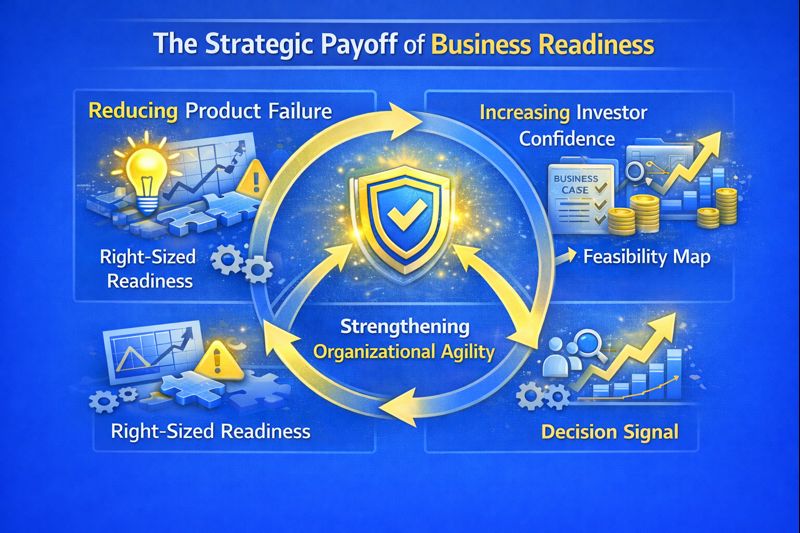
The Strategic Payoff of Business Readiness
Reducing Product Failure
Business readiness reduces waste by forcing alignment early – but it’s not a silver bullet. There are moments when readiness, if over-applied, can slow innovation.
Excessive analysis can delay experimentation; endless validation can freeze creativity. SmartDev’s approach balances speed with certainty by applying different readiness intensities:
- High readiness rigor for strategic, high-stakes products – e.g., compliance-heavy or investor-facing systems.
- Lean readiness for exploratory pilots or proofs of concept, where fast feedback outweighs full certainty.
The goal is right-sized readiness – enough structure to prevent failure, not so much that it prevents learning. This equilibrium keeps SmartDev teams moving fast but with purpose, ensuring velocity does not become volatility.
Increasing Investor and Board Confidence
For investors and boards, uncertainty equals risk. Readiness reduces that risk by transforming subjective optimism into objective data. Each SmartDev discovery cycle produces three investor-facing deliverables:
- A validated business case supported by real user evidence.
- A feasibility map that quantifies delivery risk and cost exposure.
- A proof-of-value narrative demonstrating measurable traction.
When readiness precedes fundraising or scale decisions, it reframes board conversations – from “Can this be built?” to “Should this be scaled now, or later?” That shift builds confidence. Investors fund with clarity, not guesswork; executives allocate with evidence, not instinct.
Strengthening Organizational Agility
Business readiness strengthens agility by giving leaders clarity, not just speed. Through structured feedback and continuous validation, organizations learn where to adapt – and just as importantly, when not to.
In practice, readiness turns operational noise into decision signal. During one retail engagement, SmartDev’s product team discovered that friction in account setup – not in the purchase flow – was the main cause of user drop-offs. This finding, surfaced through readiness analytics and user testing, prompted the executive team to shift design priorities toward onboarding optimization instead of checkout enhancement.
The result was a faster, smoother experience that improved activation without adding unnecessary features – a clear example of agility grounded in evidence, not assumption.
This principle defines SmartDev’s approach: agility is not the speed of execution, but the speed of understanding. Readiness gives leadership the visibility to act on the right information at the right time, ensuring that every adaptation serves both the business and its users.
Conclusion: Readiness Is the New Speed
In an environment defined by constant change, business readiness is not an advantage – it’s a prerequisite. It ensures that vision, execution, and user value move in unison. SmartDev’s business readiness framework – anchored by the 3-Week Discovery Phase and the 10-Week Product Factory giving organizations a repeatable way to de-risk innovation and accelerate results.
Every deliverable, sprint, and prototype is measured against one question: Does this create value for the end user? When the answer is yes, business readiness isn’t just achieved – it’s proven. Contact SmartDev to explore what we can transform your insights with our top AI services.