
TL;DR: Key Takeaways on AI Adoption
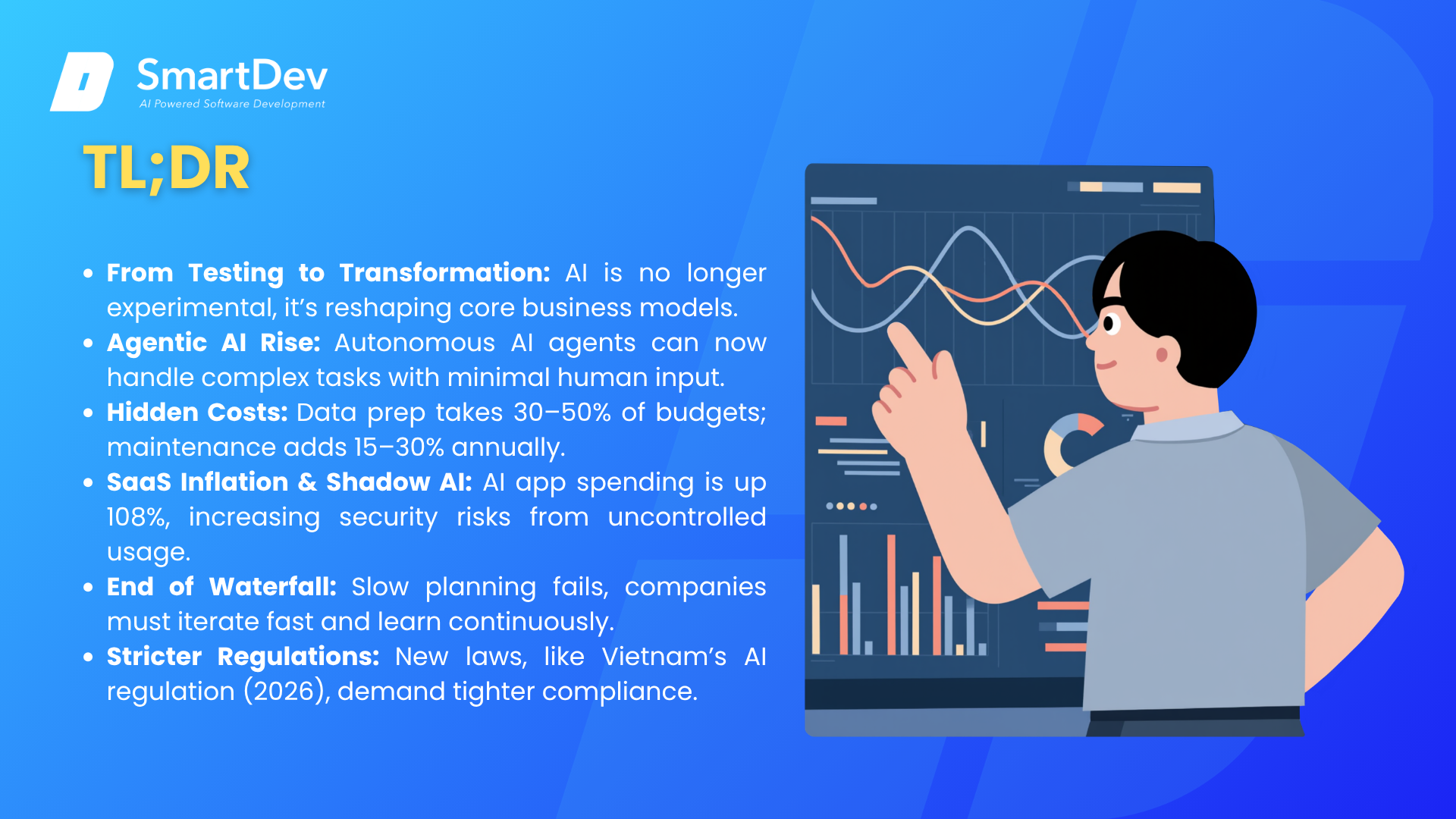
- From Experimentation to Transformation: Specifically, while 2024 was about testing the waters, 2025 and 2026 represent the years of fundamental transformation. Therefore, AI adoption now requires rebuilding core business models rather than just applying localized productivity tools.
- The Rise of Agentic AI: Currently, the focus is aggressively shifting toward autonomous AI agents. Consequently, these digital workers can execute complex, multi-step processes with strategic precision and without continuous human intervention.
- Hidden and Heavy Post-Launch Costs: Surprisingly, the true financial burden of AI adoption does not lie in the initial model development. In fact, data preparation consumes 30–50% of the total budget, while ongoing maintenance requires 15–30% of the original build cost every single year.
- SaaS Inflation and Shadow AI Risks: Furthermore, driven by opaque token-based pricing models and unchecked employee usage, enterprise spending on AI-native applications has surged by 108% year-over-year. As a result, “Shadow AI” creates massive security gaps.
- The Death of the Waterfall Strategy: Importantly, traditional 9-month planning cycles fail miserably in the fast-paced AI landscape. Instead, successful companies treat AI as an “experiential capability,” starting small, learning from rapid failures, and iterating continuously.
- Strict Regulatory Frameworks: Globally, governments enforce strict rules. For instance, Vietnam’s new AI Law (effective March 1, 2026) imposes rigorous compliance demands on high-risk AI systems, profoundly impacting data governance strategies.
What is AI Adoption?
In the modern business landscape, the concept of AI Adoption extends far beyond simply purchasing a new software license. Fundamentally, it represents the ongoing process of integrating, scaling, and operationalizing artificial intelligence technologies, ranging from machine learning and natural language processing to autonomous agents, deep into the core operations, products, and services of an organization.
Historically, leaders viewed AI as an isolated technical experiment. However, the definition of AI adoption has evolved rapidly. If 2024 served as the year of cautious optimism and sandbox testing, 2025 officially became the year of transformation. Consequently, true AI adoption now implies a profound structural shift where technology acts as the foundational engine for creating business value and establishing competitive moats.
Furthermore, this modern era is characterized by the democratization of AI. Previously, only highly specialized data scientists could build algorithmic models. Now, through low-code and no-code platforms, diverse teams across various business functions can create tailored AI applications.
Ultimately, this widespread access fosters an environment where continuous innovation flourishes at every level. Rather than treating AI as a one-time IT project, forward-thinking organizations now view AI adoption as an experiential capability.
Why It Matters for Businesses?
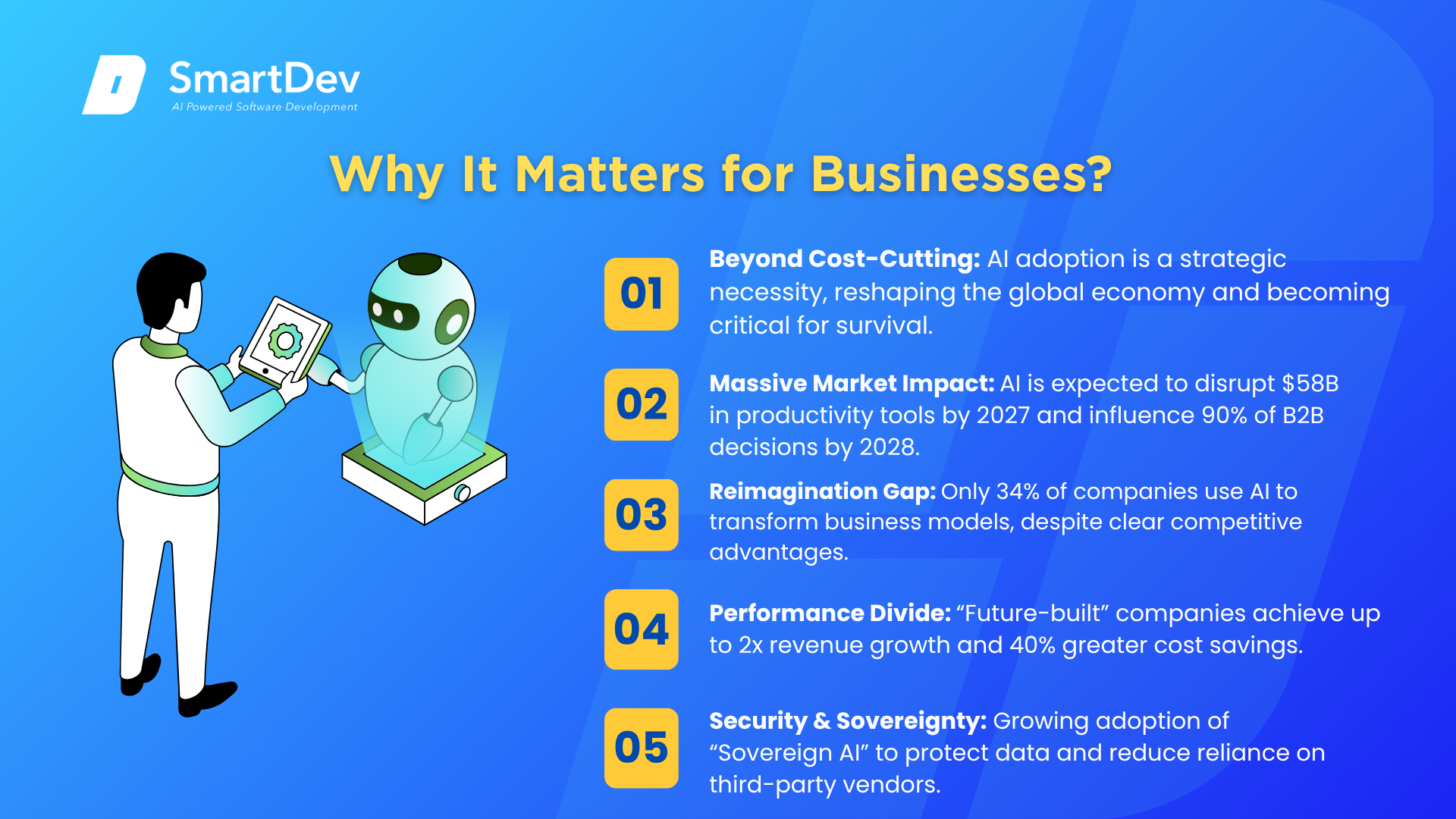
Undoubtedly, the urgency surrounding AI adoption goes far beyond basic cost-cutting. In reality, it represents a systemic restructuring of the global economy. Specifically, industry forecasts suggest that AI agents will disrupt $58 billion worth of productivity tools by 2027, and by 2028, AI will intermediate 90% of all B2B purchasing decisions. Therefore, adopting AI is no longer optional; it is a matter of corporate survival.
Despite these staggering numbers, a massive “reimagination gap” persists. While AI successfully delivers efficiency gains, only 34% of organizations currently use AI to genuinely reimagine their core business models or invent entirely new product lines. However, the companies that successfully bridge this gap reap incredible rewards. For instance, high-performing “future-built” organizations expect to achieve twice the revenue increases and 40% greater cost reductions compared to laggards.
Moreover, the impact varies significantly across different sectors:
- Financial Services: Notably, institutions build agentic workflows to automatically capture action items from meetings, draft communications, and streamline KYC verification processes.
- Manufacturing and Logistics: Meanwhile, 58% of companies report using “physical AI,” such as collaborative robots (cobots), inspection drones, and autonomous forklifts, to optimize supply chains.
- Transportation: Additionally, airlines deploy AI agents to handle complex customer service transactions like rebooking flights or rerouting lost luggage automatically.
- Finally, AI adoption matters deeply for corporate security. Driven by the concept of “Sovereign AI,” companies and nations increasingly deploy AI within their own proprietary infrastructure and local laws to protect sensitive data from third-party vendor risks.
How: The Strategic Framework for Implementation
Interestingly, many organizations still struggle to transition AI from pilot programs to production. Usually, this failure stems from relying on the outdated “waterfall” approach. When leaders spend nine months drafting a theoretical strategy, the technology outpaces their plans before they even begin. Instead, businesses must adopt an agile, experiential framework.
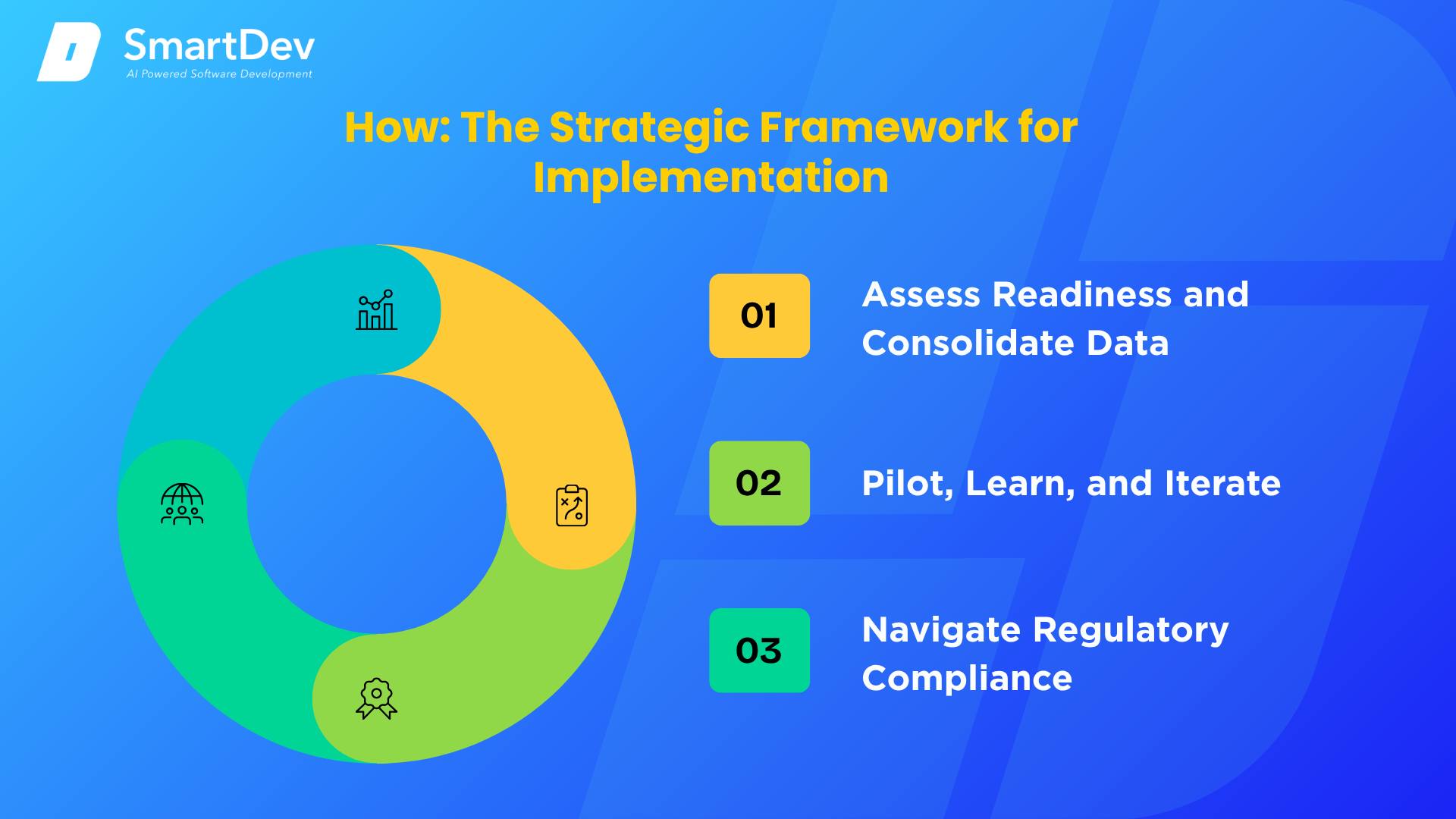
1. Assess Readiness and Consolidate Data
First and foremost, AI is only as intelligent as the data that feeds it. Consequently, leaders must prioritize data governance before buying advanced models.
- Unify Data Sources: Specifically, organizations must consolidate fragmented data from various CRMs and ERPs into centralized data lakes to provide seamless access for algorithms.
- Enforce Zero Trust: Furthermore, companies must apply strict encryption and Zero Trust security controls to prevent data breaches during AI analysis.
2. Pilot, Learn, and Iterate
Subsequently, organizations should discard massive, company-wide rollouts. Instead, they must focus on agile experimentation.
- Define Clear Objectives: Start by setting precise goals, such as decreasing customer response times by 40%.
- Build Cross-Functional Teams: Additionally, assemble teams that include IT experts, data scientists, and core business unit leaders to ensure the technology solves real-world problems.
- Embrace Feedback Loops: Ultimately, companies must deploy small, low-risk pilots, learn rapidly from the failures, and continually refine the models before scaling them.
3. Navigate Regulatory Compliance
As models move into production, compliance becomes the biggest hurdle. Surprisingly, only one in five companies currently possesses a mature governance model for autonomous AI.
- Implement Frameworks: Therefore, businesses should adapt established frameworks, like the NIST AI RMF, to track model inventory and monitor performance.
- Adapt to Local Laws: For example, organizations operating in Southeast Asia must prepare for Vietnam’s new AI Law. Officially coming into effect on March 1, 2026, this legislation imposes strict compliance obligations on high-risk AI systems. Because the law vaguely defines AI as the electronic implementation of human intellectual capabilities (like perception and reasoning), companies urgently need robust legal oversight to avoid severe penalties.
How Much: The True Cost of AI Adoption
A common misconception among executives is that purchasing the AI model constitutes the bulk of the expense. Conversely, the true financial picture of enterprise AI adoption is highly complex, ongoing, and heavily weighted toward data preparation and maintenance.
The Hidden Initial Cap
ExWhile basic AI chatbots might cost between $20,000 and $80,000, fully custom enterprise-grade solutions easily exceed $200,000. However, the biggest shock comes from data preparation.
The Data Tax: In fact, sourcing, cleaning, standardizing, and securing data frequently consumes 30–50% of the entire AI budget. For large enterprises, this step alone regularly costs over $100,000. System Integration: Furthermore, connecting these new AI models to existing legacy systems generally costs upward of $150,000.
Talent Acquisition: Additionally, hiring specialized machine learning engineers and MLOps professionals requires salaries ranging from $120,000 to $180,000 annually per role.
Volatile OpEx and the SaaS Trap
Beyond the initial build, AI adoption introduces unpredictable operational expenses.
First, commercial Large Language Models (LLMs) charge via opaque token-based pricing. Because the system bills for both input and output tokens, the true cost remains unknown until the AI finishes generating its response, leaving budgets vulnerable to erratic user behavior.
Second, the software industry is currently experiencing massive AI-driven inflation. According to recent data from 2026, enterprise spending on AI-native applications averaged $1.2 million, representing a massive 108% year-over-year increase. Consequently, without proactive management, companies face severe budget overruns due to surprise consumption charges and mandatory AI-tier upgrades.
Finally, annual maintenance, which includes continuous monitoring and retraining models to prevent “data drift”—typically demands 15–30% of the original development cost every single year.
Other Related Terms
To navigate the complexities of AI adoption successfully, business leaders must fluently speak the language of modern technology. Therefore, below is an essential glossary of related terminology.
AI Agent
Essentially, AI Agent refers to sophisticated software programs capable of independent thought and action. Unlike basic chatbots that merely answer questions, these AI agents possess multi-turn memory, utilize agentic reasoning, and autonomously interact with other software tools to achieve predefined strategic goals without human intervention. Currently, scaling these digital workers is the primary focus of future-built enterprises.
Shadow AI
Conversely, Shadow AI represents a significant corporate risk. It occurs when employees use unsanctioned or unapproved artificial intelligence tools to complete their daily tasks. Although often driven by a genuine desire to innovate, this practice bypasses IT governance, subsequently causing massive security vulnerabilities, regulatory noncompliance, and unchecked duplicate spending.
Data Governance
Fundamentally, Data Governance encompasses the strict policies, standards, and processes required to ensure information remains accurate, secure, and compliant. If an organization ignores data governance, their AI models will undoubtedly produce flawed results.
Machine Learning, Deep Learning & Active Learning
- Machine Learning (ML): Specifically, this is a subset of AI that allows algorithms to identify patterns and learn from historical data without explicit human programming.
- Deep Learning: Furthermore, this advanced ML technique utilizes artificial neural networks with multiple layers—mimicking the human brain—to solve incredibly complex tasks like computer vision.
- Active Learning: Interestingly, this approach combines supervised and unsupervised learning. The AI independently decides what it needs to learn next and only requests human intervention when absolutely necessary, thereby saving massive amounts of time and resources.
AI Hallucinations
Unfortunately, generative AI models sometimes produce incorrect, misleading, or completely fabricated outputs. These AI hallucinations usually stem from biased training data or flawed statistical assumptions, highlighting exactly why businesses must implement rigorous human-in-the-loop validation processes.
Synthetic Data & Simulation
Often, real-world data is either too expensive, too scarce, or too heavily protected by privacy laws to use. As a solution, systems generate Synthetic Data—artificially created information that perfectly mirrors the statistical properties of real data. In addition, Simulation creates a virtual replica (a digital twin) of a physical environment, allowing companies to safely test AI strategies before deploying them in the real world.
Autonomous Robotics & SLAM
- Autonomous Robotics: These are physical machines equipped with sensors and AI that perform tasks in unstructured environments independently.
- SLAM (Simultaneous Localization And Mapping): Crucially, this algorithm allows a mobile robot (like a drone) to enter an unknown space, instantly build a 3D map of its surroundings, and pinpoint its exact location simultaneously.
Vision-Language Model (VLM)
Moreover, a VLM is an advanced AI system that combines visual inputs (like live video feeds) with natural language processing. Consequently, a machine can visually inspect a manufactured part and instantly generate a written report describing any defects.
Abductive Logic Programming & AI Alignment
- Abductive Logic Programming (ALP): Technically, this is a high-level knowledge representation framework. It allows an AI system to use abductive reasoning—finding the simplest, most likely explanation for a set of observations, even if it cannot perfectly prove it.
- AI Alignment: Finally, this critical research subfield ensures that an AI system’s objectives, decisions, and values perfectly align with the ethical standards and strategic goals of its human creators.
Ultimately, mastering these concepts empowers organizations to transition smoothly from basic experimentation to enterprise-wide AI adoption, ensuring long-term success in an increasingly automated world.