
TL;DR:
- An AI CI/CD pipeline automates the process of testing, validating, and deploying machine learning models so that updates reach production safely and efficiently.
- Applying continuous integration and continuous delivery principles to AI systems prevents manual deployment errors and reduces the time between model improvements and business benefit.
- In 2026, 72 percent of enterprises have adopted automation tools for AI deployment, reflecting how central CI/CD practices have become to reliable AI operations.
Software development teams have long relied on CI/CD pipelines to ship code reliably. AI systems require the same discipline, but with added complexity: models degrade over time, data quality changes, and performance must be validated against business metrics as well as technical benchmarks. An AI CI/CD pipeline brings structure and automation to the entire model lifecycle from training to deployment.
What Is an AI CI/CD Pipeline?
CI/CD stands for Continuous Integration and Continuous Delivery. In software development, it refers to the automated process of integrating code changes, running tests, and deploying updates to production in a repeatable, auditable workflow. An AI CI/CD pipeline applies these same principles to machine learning models.
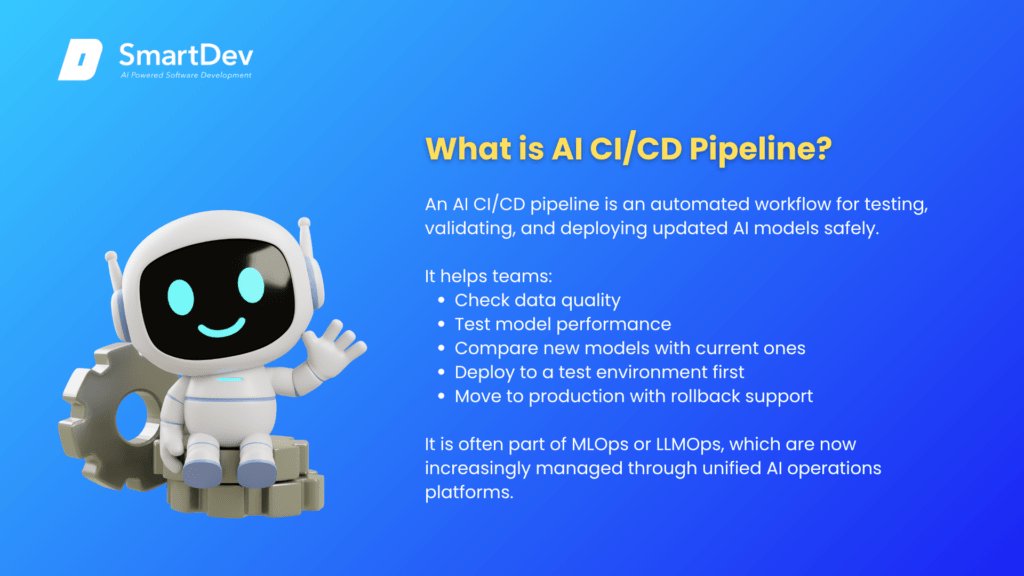
In practice, an AI CI/CD pipeline is a series of automated steps that trigger whenever a model is retrained, updated, or modified. The pipeline typically includes data validation checks to ensure training data meets quality standards, automated model testing to verify performance against defined accuracy thresholds, comparison against the current production model to ensure the new version is genuinely an improvement, staged deployment to a test environment for live validation, and final promotion to production with rollback capabilities if issues emerge.
This discipline is sometimes called MLOps when applied to traditional machine learning models and LLMOps when applied to large language models. In 2026, the distinction between these terms is blurring as enterprises adopt unified AI operations platforms that handle both.
비즈니스에 중요한 이유
Without a CI/CD pipeline, deploying updated AI models is a manual, error-prone, and slow process. Teams that update models by hand without automated testing have no reliable way to know whether a new model version will perform better or worse in production until it is already serving real users. By that point, a degraded model may have already harmed customer experience or business outcomes.
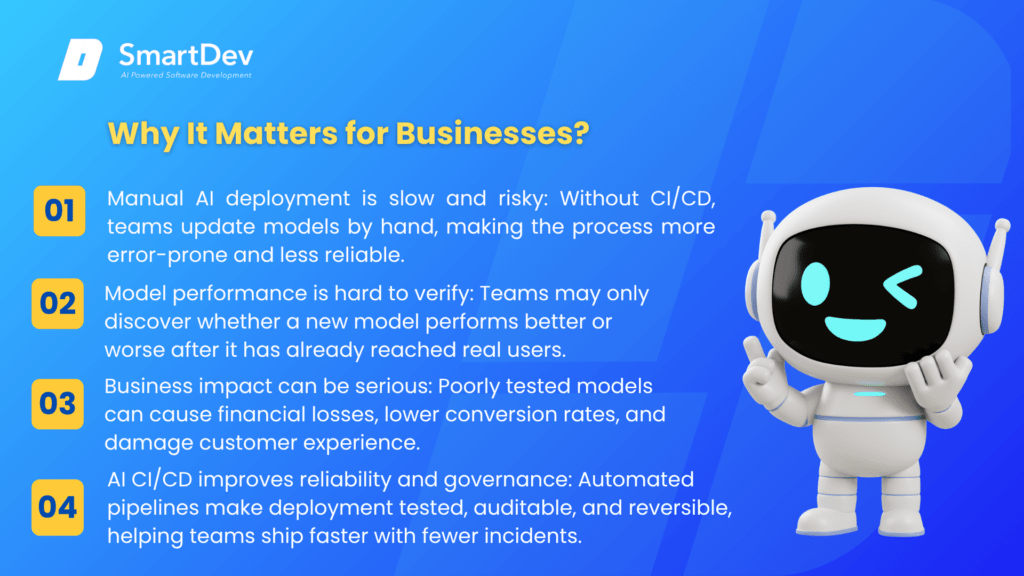
The business impact of unreliable AI deployment is substantial. A fraud detection model that fails silently after a manual update can expose an organization to financial losses before anyone notices the problem. A recommendation engine deployed with insufficient testing may reduce conversion rates for days or weeks before degradation is detected.
Automated CI/CD pipelines address this by making every deployment a validated, tracked event. The MLOps market was projected to reach $4.38 billion in 2026, growing at 39.8 percent annually, reflecting how urgently enterprises are investing in reliable AI delivery infrastructure. Organizations with mature AI CI/CD practices ship model improvements faster, with fewer incidents, and with clearer audit trails for compliance purposes.
How Does an AI CI/CD Pipeline Work?
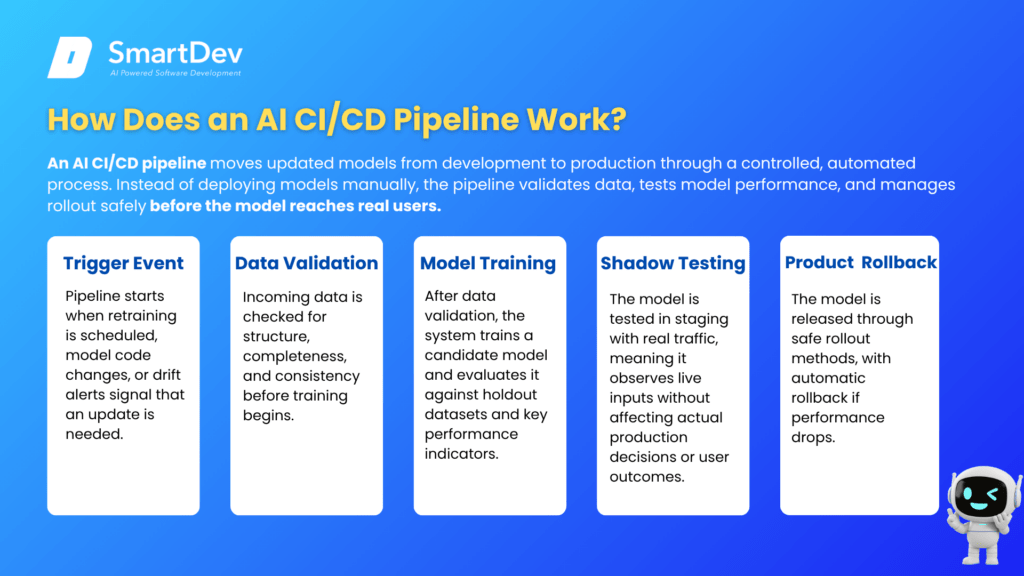
The pipeline begins when a trigger event occurs, typically a scheduled retraining run, a code change to model training logic, or a drift alert indicating the current model needs replacement. The pipeline then executes a sequence of automated stages.
Data validation checks incoming training data for schema correctness, statistical distribution alignment with expected ranges, and completeness. Model training runs on validated data and produces a candidate model artifact. Automated evaluation compares the candidate against the existing production model using holdout datasets and key performance indicators. If the candidate passes, it is deployed to a staging environment for shadow testing against real traffic without affecting production results.
Once staging validation passes, the model is promoted to production using deployment strategies such as canary releases, where a small percentage of traffic shifts to the new model before full rollout, or blue-green deployments, where the old and new models run in parallel and traffic is switched cleanly. Rollback mechanisms ensure that if the new model underperforms, the previous version is restored automatically.
Who Needs an AI CI/CD Pipeline?
Any organization that runs AI models in production and updates them regularly needs a CI/CD pipeline. This is essentially any enterprise that has moved beyond AI experimentation into operational AI that affects real business outcomes.
Industries with rapidly changing data patterns, such as financial services monitoring fraud, retail platforms managing recommendations, and logistics companies optimizing routing, need frequent model updates and therefore benefit most from automated pipelines that make those updates safe and fast. A financial fraud team that updates its detection model monthly without automated validation is taking on significant risk with every deployment.
IT outsourcing providers building and managing AI systems on behalf of clients have a particular obligation to implement AI CI/CD pipelines. Clients are trusting an ITO partner to maintain AI systems that affect their business operations. Demonstrating structured, automated deployment practices with clear audit trails is both a quality assurance measure and a competitive differentiator in enterprise AI service delivery.
기타 관련 용어
- Multi-Agent System is an AI architecture where multiple autonomous agents collaborate to complete complex tasks. In an AI CI/CD pipeline, multi-agent systems can coordinate separate agents for testing, security scanning, and deployment — running in parallel to accelerate the entire delivery workflow.
- IDE Integration connects AI tools directly into developers’ coding environments.In an AI CI/CD pipeline, it brings AI assistance earlier, before code reaches build and deployment stages.
- Model Drift happens when an AI model becomes less accurate as real-world data changes. It can cause outdated predictions, weaker automation, and unreliable outputs. In an AI CI/CD pipeline, drift monitoring triggers retraining, testing, or rollback.
- Oversight Layer is a control system that monitors AI decisions, outputs, risks, and approvals. It ensures humans or governance rules can review important AI actions. In an AI CI/CD pipeline, it keeps deployments safe, auditable, and compliant.