TL;DR:
- AI code refactoring uses artificial intelligence to automatically improve the internal structure of software code without changing what the code actually does for end users.
- It dramatically accelerates the process of eliminating technical debt, modernizing legacy systems, and maintaining code quality as development teams scale.
- Businesses using AI refactoring report shorter development cycles, lower maintenance costs, and development teams that spend more time building new capabilities instead of cleaning up old ones.
Every software system accumulates clutter over time. Functions get duplicated, logic becomes tangled, and shortcuts taken under deadline pressure turn into permanent fixtures. AI code refactoring gives organizations a practical tool to reverse that drift systematically, without the enormous manual effort that code cleanup traditionally requires.
What is AI Code Refactoring?
AI code refactoring is the process of using artificial intelligence to improve the internal structure of software code while preserving its external behavior and functionality. The AI analyzes existing code and identifies opportunities to simplify logic, eliminate duplication, rename variables for clarity, restructure functions or classes, and remove unnecessary complexity, all without altering what the software actually does from the user’s perspective.
Traditional code refactoring has always been a recognized best practice in software development, but it has historically required significant developer time and deep familiarity with the codebase. AI changes this by automating the analysis and generation phases, allowing refactoring work to be completed at a speed and scale that manual effort cannot match.
The AI applies machine learning and natural language processing techniques to understand code semantics, not just syntax. It recognizes patterns associated with poor structure, such as overly long functions, excessive nesting, repeated code blocks, and unclear naming conventions, and generates improved versions that achieve the same results more cleanly and efficiently.
Importantly, AI code refactoring tools include automated testing integration to verify that the restructured code behaves identically to the original. This verification step is essential: refactoring that inadvertently changes behavior introduces new bugs, so the AI’s ability to validate its own output is a critical safeguard for production systems.
비즈니스에 중요한 이유
Technical debt is one of the most underappreciated financial liabilities in technology organizations. When code quality degrades over time, every subsequent change to that system takes longer, introduces more risk, and requires more testing. The cumulative effect is a slowdown in development velocity that compounds year over year, ultimately costing far more than a proactive refactoring investment would have.
AI code refactoring provides a way to address technical debt continuously rather than through painful, resource-intensive cleanup projects. Development teams can maintain high code quality even as the codebase grows and the original authors of various components move on. This continuity of quality is especially valuable for businesses that depend on ongoing software development to stay competitive.
 The global software development outsourcing market is projected to reach approximately USD 618 billion in 2026. In this environment, outsourced development teams augmented by AI refactoring tools deliver measurably better output. Entire modules can be refactored, tested, and documented with a fraction of the manual effort previously required, translating into shorter delivery timelines and lower revision rates for clients.
For businesses managing legacy systems, AI refactoring opens the door to modernization that would otherwise be prohibitively expensive. Migrating an aging system from one architecture or programming framework to another is a task that traditionally required months of specialist work. AI-assisted refactoring compresses that timeline significantly, making modernization feasible for organizations that previously had to simply live with outdated infrastructure.
How Does AI Code Refactoring Work?
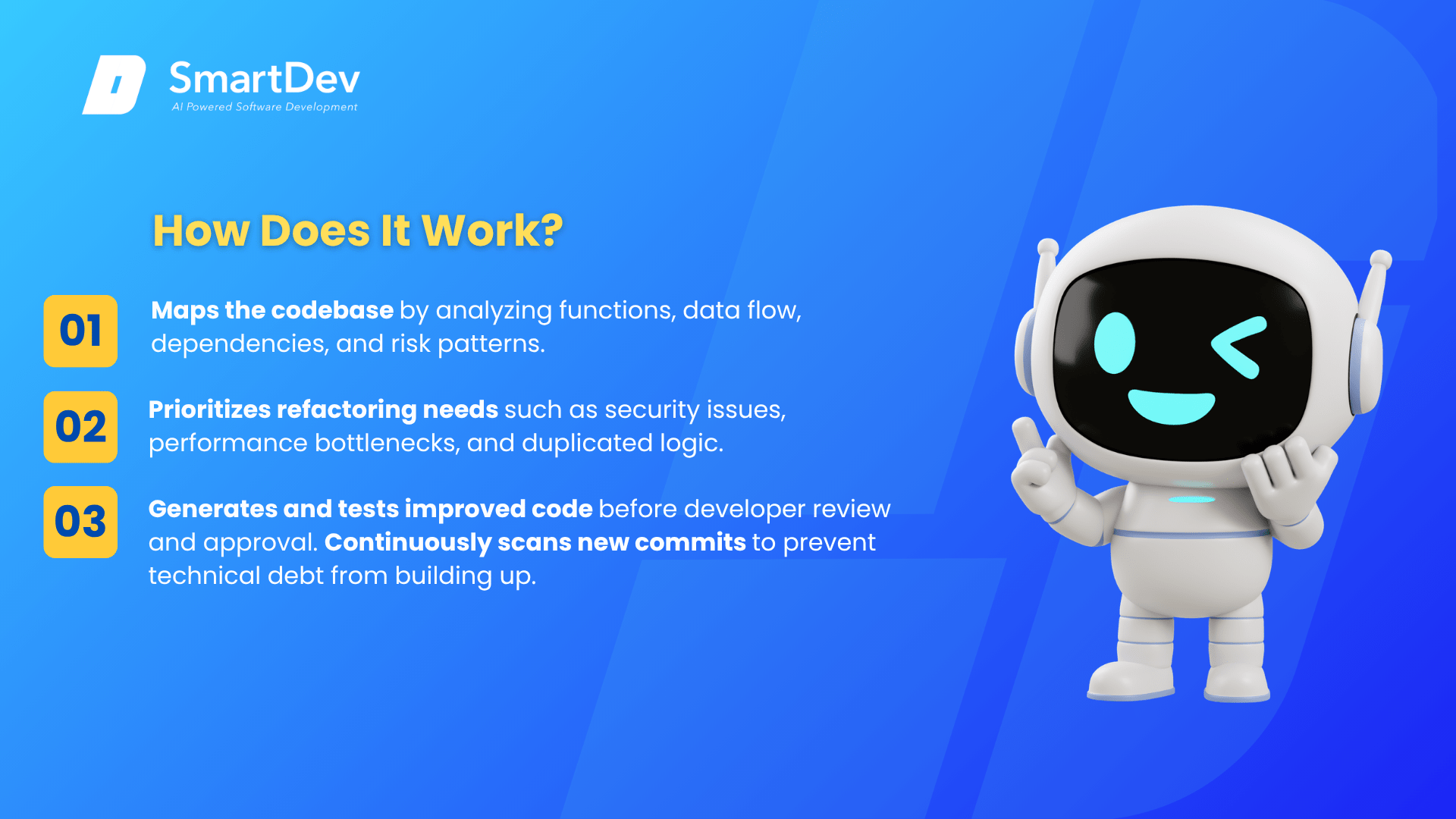
AI code refactoring tools begin by performing a comprehensive analysis of the codebase to build a structural map of the software. This includes identifying all functions and classes, tracing the flow of data through the system, cataloging dependencies between components, and detecting patterns associated with poor code quality or maintenance risk.
Once the analysis is complete, the AI generates a prioritized list of refactoring opportunities. High-priority items typically include security-relevant issues such as hard-coded credentials or unsafe input handling, performance bottlenecks such as inefficient database queries or redundant computations, and structural problems such as duplicated logic that creates maintenance inconsistency across the codebase.
For each identified opportunity, the AI produces a refactored version of the code and runs automated tests to confirm behavioral equivalence. The developer reviews the proposed change, accepts or modifies it, and the refactored code is merged into the codebase. This human review step keeps developers in control while eliminating the most time-consuming analytical work from the process.
Advanced AI refactoring systems operate continuously, scanning code as it is committed and flagging new issues before they accumulate into significant debt. This proactive approach keeps code quality stable over time rather than allowing decline between periodic cleanup efforts.
When Should You Use AI Code Refactoring?
The most impactful times to apply AI code refactoring are before a major feature addition, before a system migration, and when onboarding a new development team to an existing codebase. In each scenario, cleaning up the code first reduces the complexity that the subsequent work must navigate, lowering risk and improving predictability.
Legacy system modernization is one of the highest-value use cases. Systems built on outdated frameworks or in languages that are difficult to find current expertise for represent a growing operational risk. AI refactoring can systematically update these systems, replacing deprecated patterns and aligning the code with current standards while minimizing the chance of introducing regressions.
Ongoing maintenance is another strong candidate. Rather than scheduling periodic cleanup sprints, organizations can embed AI refactoring tools in their standard development workflow so that code quality is maintained incrementally with each commit. This approach prevents the accumulation of debt that makes periodic cleanup so expensive.
Immediately after an acquisition is also a strategic moment. When one organization absorbs another’s technology assets, the acquired codebase is often unfamiliar, inconsistently documented, and built to different standards. AI refactoring tools can quickly bring the acquired code up to the acquiring organization’s standards, reducing integration risk and accelerating the realization of technology synergies.
기타 관련 용어
Technical Debt: The accumulated cost of shortcuts, outdated code, and structural problems in a software system that makes future changes slower and riskier, which AI code refactoring directly addresses.
Oversight Layer: The governance component in an AI system that monitors, controls, and audits AI behavior in real time. Without it, AI systems can make unchecked decisions that expose your business to compliance failures, financial loss, and reputational damage.
AI Code Explanation: AI code explanation uses artificial intelligence to automatically describe what code does in plain language, without requiring deep technical knowledge.