
TL;DR:
- AI grounding anchors AI responses to verified, real-world data sources so the model cannot invent facts on its own.
- It directly solves the hallucination problem, one of the biggest barriers to deploying AI in business-critical contexts.
- Any organization using AI for customer support, compliance, or internal knowledge management should implement grounding before going live.
AI models can generate confident, fluent answers that are simply wrong. In enterprise environments, a wrong answer can mean a compliance breach, a lost sale, or damaged customer trust. AI grounding is the practice that prevents this. This article explains what grounding is, how it works, and why it belongs in any serious AI deployment.
What is AI Grounding?
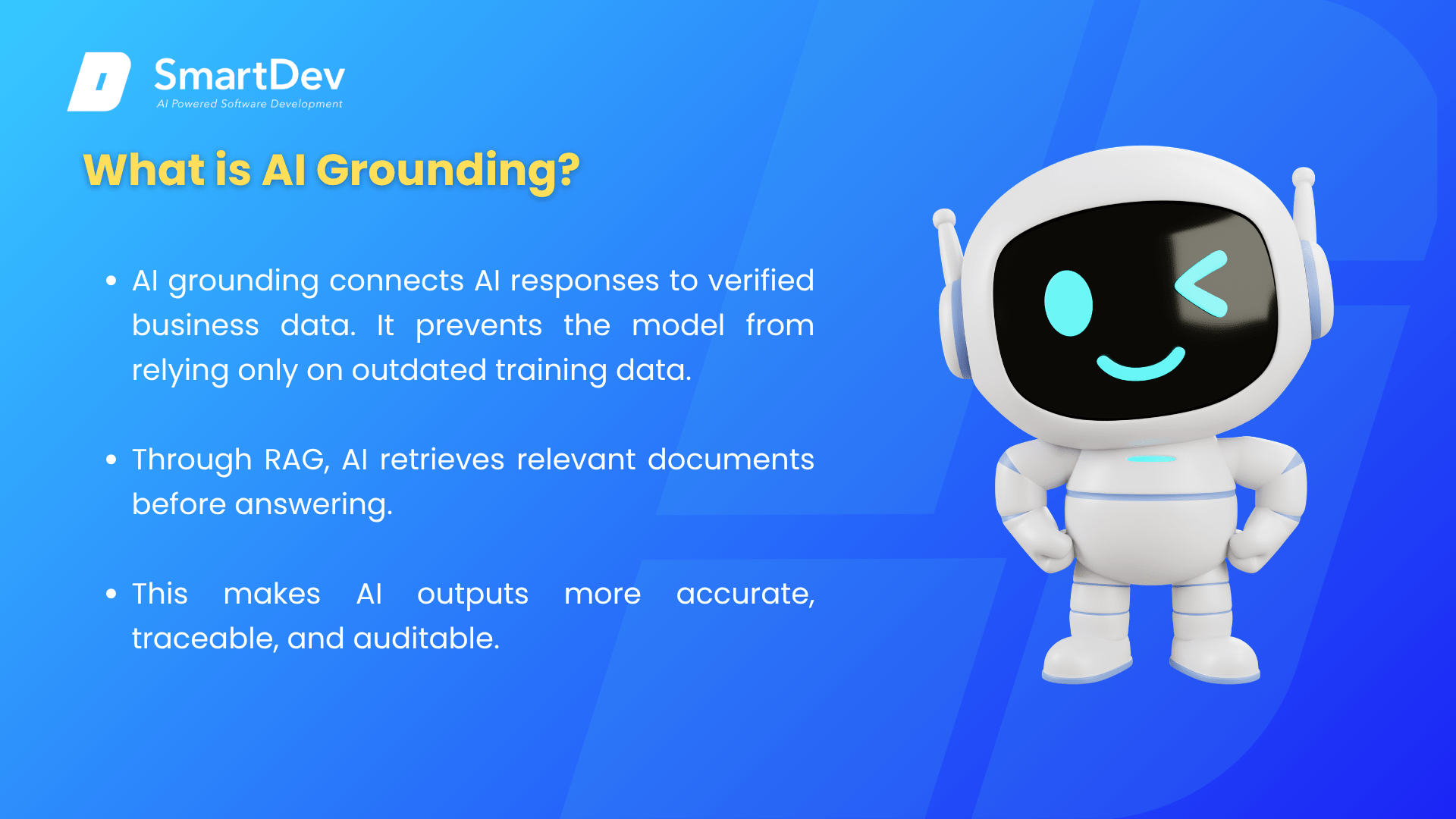
AI grounding is the practice of anchoring an AI model’s responses to specific, verified external data sources so that every output is traceable and factually supported. Without grounding, language models generate answers from their training data alone, which is static, potentially outdated, and not specific to your business. With grounding, the model is constrained to use only the information you provide as context before it responds.
Grounding is most commonly implemented through RAG (Retrieval-Augmented Generation), which retrieves relevant documents from your knowledge base and injects them into the model’s prompt. The model uses those documents to form its answer rather than guessing. When implemented correctly, grounding transforms an AI system from a confident guesser into a verifiable, auditable business tool. It is the core architectural decision that separates reliable enterprise AI from consumer chatbots.
비즈니스에 중요한 이유
Hallucination, when an AI model produces a confident but factually incorrect response, is not a theoretical risk. Research shows that 47% of enterprise AI users have made at least one significant business decision based on potentially inaccurate AI-generated content.
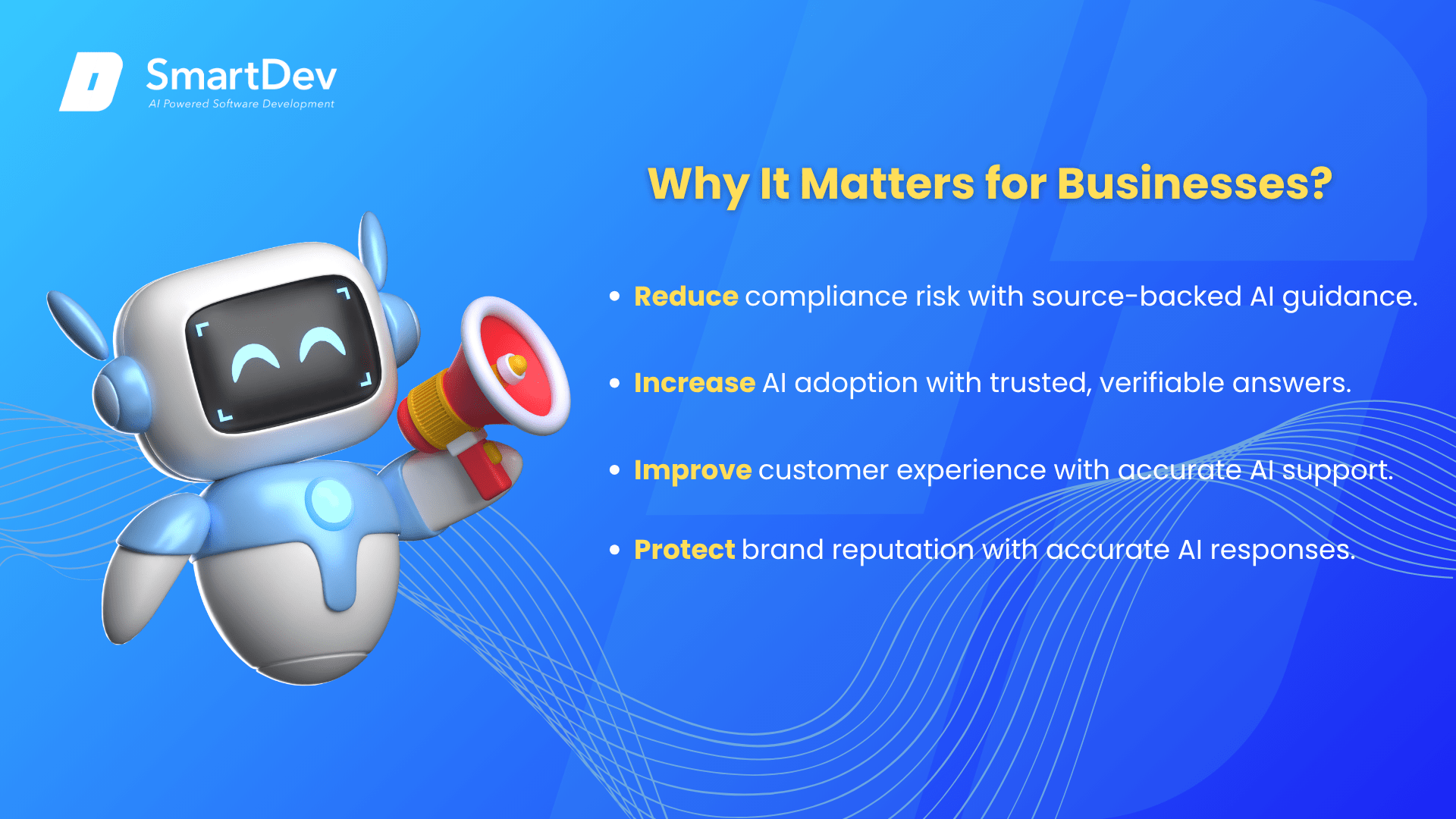
- 줄이다 compliance risk by ensuring AI-generated guidance cites actual internal policies, regulations, or verified sources rather than the model’s training data.
- 증가시키다 employee trust in AI tools, making adoption faster and reducing the manual fact-checking burden that slows down AI-assisted workflows.
- 개선하다 customer experience by ensuring support chatbots deliver accurate, up-to-date product and policy information on every interaction.
- Protect your brand reputation by preventing AI from generating incorrect statements about your products, prices, or operational procedures.
For example, a mid-sized professional services firm deployed a grounded AI assistant for contract review. By anchoring the model to their verified legal clause library, the firm reduced review errors by 52% compared to an ungrounded general AI tool, and auditors could trace every AI recommendation to a specific source document.
How Does AI Grounding Work?
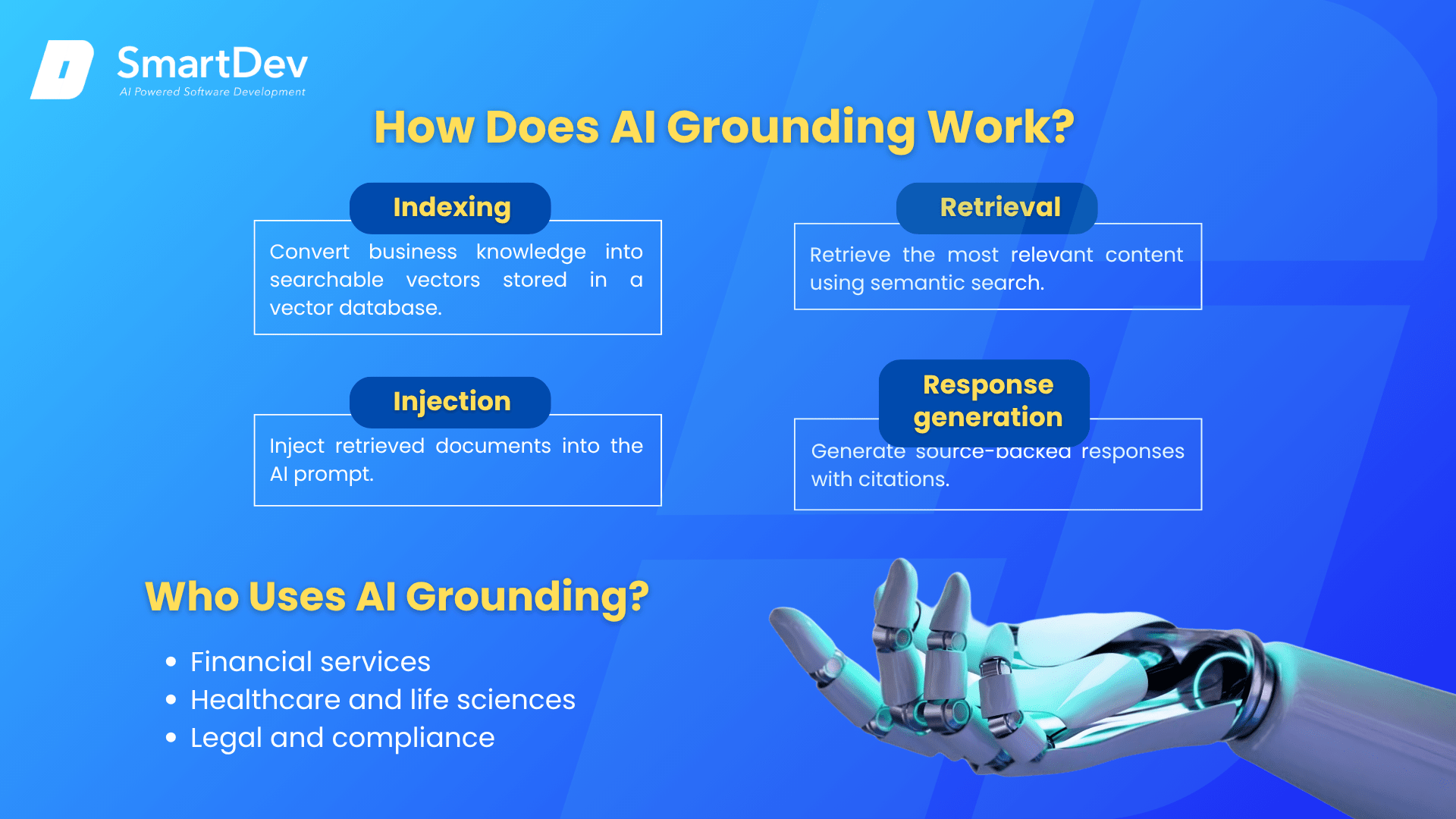
Grounding follows a structured four-step process:
- Indexing. Your business documents, policies, databases, and knowledge bases are converted to numerical vectors using an embedding model and stored in a vector database. This creates your trusted information layer.
- Retrieval. When a user submits a query, the system searches the indexed data for the most relevant documents or passages, using semantic similarity rather than keyword matching to find what the user actually needs.
- Injection. The retrieved documents are placed into the AI model’s context window alongside the user’s question. The model is instructed to answer only from the provided documents, not from its training data.
- Response generation. The model generates a response grounded in the retrieved content. Optionally, the system displays citations so users can verify the source of every claim independently.
The result is an AI output that is accurate, auditable, and aligned with your actual business data, not what the model learned from the internet years ago.
Who Uses AI Grounding?
AI grounding is used across industries wherever accuracy, compliance, or trust is non-negotiable.
Financial services: Banks and insurance companies use grounding to ensure AI-generated customer communications and internal guidance reflect current regulatory requirements and product terms, not outdated training data.
Healthcare and life sciences: Clinical AI tools require grounding to ensure recommendations reference verified medical literature or internal clinical protocols, reducing the risk of AI-generated misinformation reaching clinicians or patients.
Legal and compliance: Law firms and compliance teams use grounding to bind AI review tools to their contract libraries and regulatory databases, producing outputs that can be audited and defended in front of regulators.
Buyer roles that drive grounding adoption include Chief Information Officers, Chief Risk Officers, and IT Directors responsible for AI governance frameworks. For these leaders, grounding is not optional. It is the technical prerequisite for responsible AI deployment at scale.
기타 관련 용어
AI Fine-Tuning is the process of training a pre-built AI model on domain-specific data to improve its accuracy and relevance. While grounding connects AI outputs to real-time or external knowledge sources, fine-tuning adjusts the model’s core behavior — together, they are the two primary methods businesses use to make general-purpose AI models reliable for specialized use cases.
Deterministic Output is the ability of an AI system to produce consistent, predictable results given the same input. AI grounding directly supports deterministic output — by anchoring model responses to verified, structured data sources, grounding reduces the hallucinations and variability that make AI outputs unpredictable in production environments.
Probabilistic Output: Is one of the most important concepts for any business leader adopting AI tools. It explains why AI does not always give the same answer twice, and why that is both a feature and a management challenge.
AI Code Explanation: AI code explanation uses artificial intelligence to analyze code and describe its behavior in plain, readable language.
Vector Database: The storage layer that makes grounding possible by indexing your business content as numerical vectors, enabling fast, semantically accurate retrieval at the moment a query is submitted.