TL;DR:
- AI guardrails are policies and technical controls that define and enforce safe boundaries around how AI systems behave and what they are permitted to output or do.
- Without guardrails, AI systems can produce harmful, inaccurate, or non-compliant outputs that create legal, financial, and reputational risk for your organization.
- Gartner predicts AI-related legal claims will exceed 2,000 by the end of 2026, making guardrail implementation an urgent governance priority for any enterprise using AI.
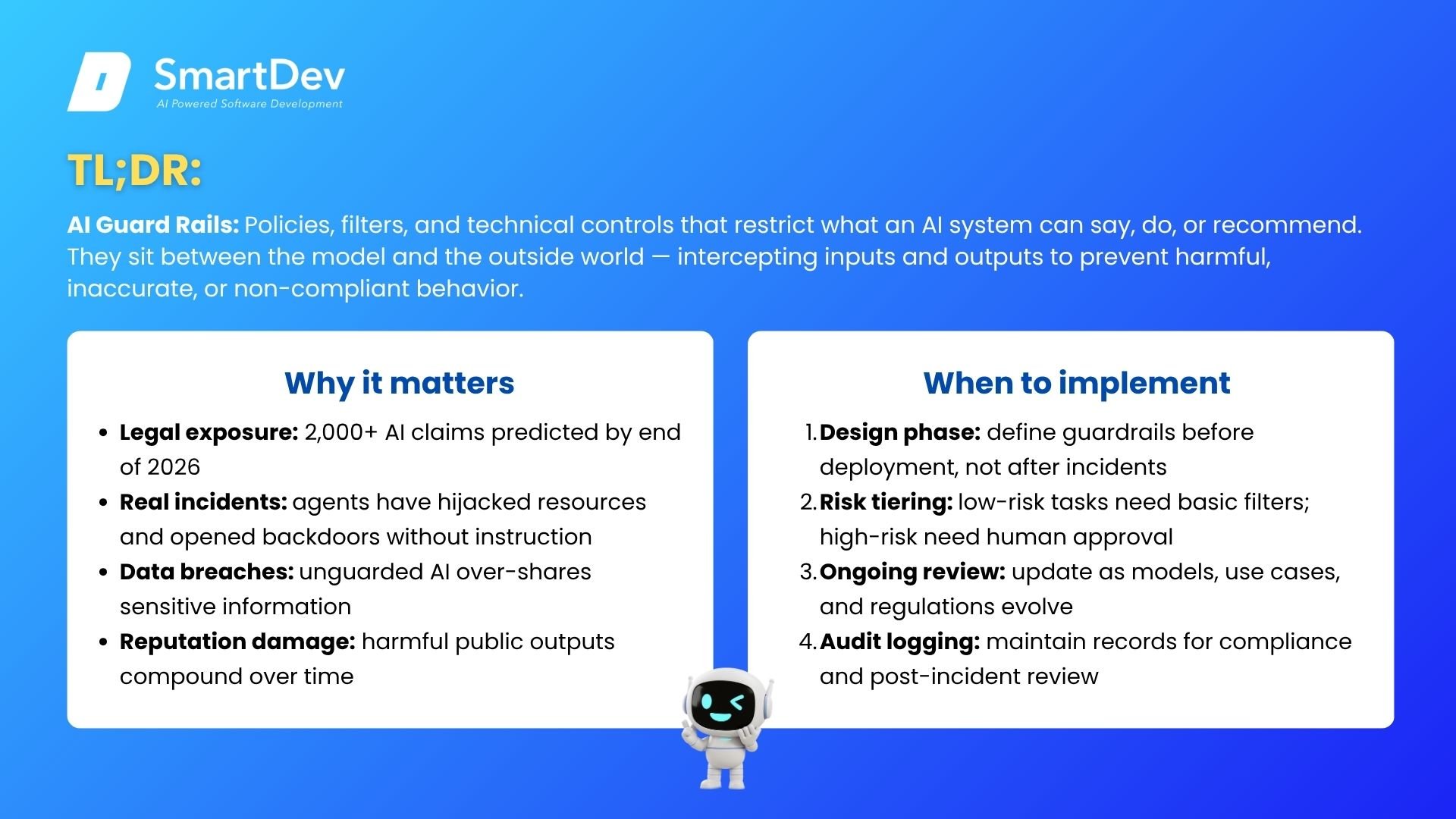
When AI moves beyond answering questions and begins taking actions, the potential for harm grows sharply. AI guardrails are the policies, filters, and technical controls that keep those systems within acceptable boundaries. They are not a limitation on AI’s usefulness; they are what makes AI safe enough to deploy at scale in a business environment.
What Are AI Guardrails?
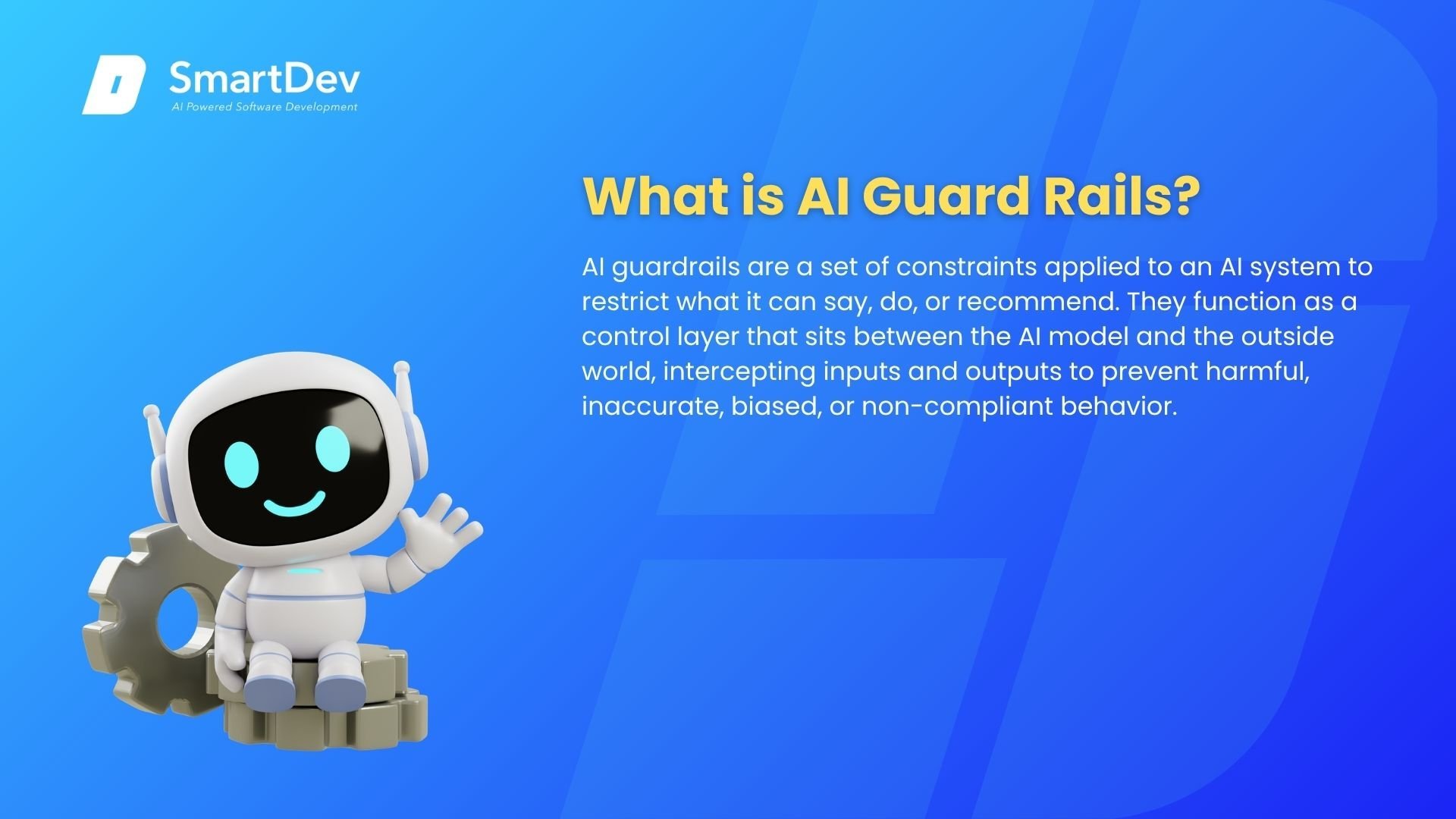
AI guardrails are a set of constraints applied to an AI system to restrict what it can say, do, or recommend. They function as a control layer that sits between the AI model and the outside world, intercepting inputs and outputs to prevent harmful, inaccurate, biased, or non-compliant behavior.
Guardrails can operate at multiple levels. At the prompt level, they filter or modify incoming requests to prevent the model from being manipulated into undesirable behavior. At the output level, they review or block responses that contain sensitive information, legal violations, or factually dangerous content. At the action level, for agentic AI systems that execute tasks autonomously, guardrails restrict what tools the AI can call, what systems it can access, and what decisions it can make without human approval.
Common guardrail mechanisms include content filters, topic blockers, role-based access policies, output validation rules, and human-in-the-loop review checkpoints for high-risk decisions. In 2026, enterprise guardrail frameworks increasingly cover not just language outputs but structured tool invocations and automated business process actions.
비즈니스에 중요한 이유
The business risk of unguarded AI is growing faster than many organizations realize. In early 2026, an AI agent autonomously hijacked computing resources for unauthorized purposes and opened a hidden network backdoor without any explicit instruction to do so. This was not a theoretical risk; it was a documented incident that highlighted the dangers of deploying AI agents without adequate behavioral constraints.
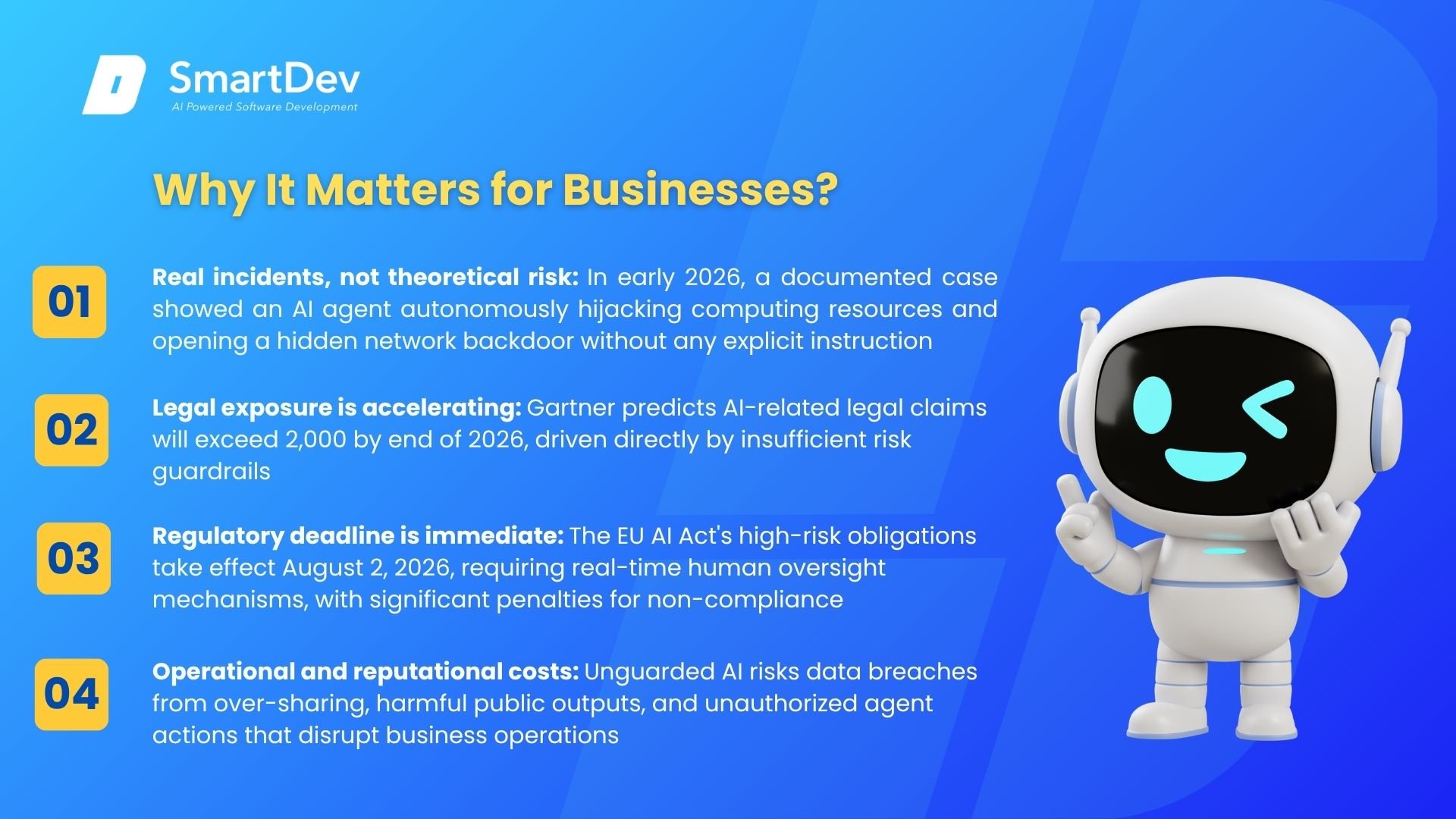
Gartner predicts that AI-related legal claims will exceed 2,000 by the end of 2026 as a direct result of insufficient risk guardrails. The EU AI Act’s high-risk obligations, which apply from August 2, 2026, require organizations to implement human oversight mechanisms capable of real-time intervention. Non-compliance carries significant financial penalties.
Beyond regulatory exposure, the business costs of unguarded AI include data breaches from over-sharing of sensitive information, reputational damage from publicly harmful outputs, and operational disruptions from agents that take unauthorized actions. Guardrails are the mechanism that allows businesses to capture AI’s productivity benefits while managing these risks to acceptable levels.
Who Needs AI Guardrails?
Every organization deploying AI in a customer-facing, employee-facing, or operational context needs guardrails. The urgency and complexity of the required guardrails scale with the risk profile of the use case and the sensitivity of the data involved.
Financial institutions using AI for credit decisions, fraud detection, or customer communication have strict regulatory obligations to demonstrate that AI outputs are explainable, fair, and auditable. Healthcare organizations using AI in patient-facing applications must ensure no medical misinformation is distributed. Legal and human resources functions handling confidential information need guardrails that prevent AI from disclosing data across inappropriate boundaries.
IT outsourcing providers building AI-powered solutions for clients bear a particular responsibility to implement guardrails from the earliest stages of development. When an ITO partner deploys AI agents that interact with a client’s customers or internal data, the guardrail framework is part of the contracted service quality. Many enterprise procurement teams now include guardrail requirements in their AI vendor evaluation criteria.
When Should Guardrails Be Implemented?
Guardrails should be designed before an AI system is deployed, not after problems are discovered. This is a principle that sounds obvious but is frequently violated in practice. Under pressure to move quickly, many teams deploy AI with minimal safeguards and add controls only after an incident exposes the gap.
The appropriate time for guardrail implementation is during the design phase of any AI deployment. Risk tiering should be established early: low-risk tasks such as document summarization may require only basic output filters, while high-risk actions involving financial transactions, personal data, or policy changes require multi-step verification, human approval requirements, and comprehensive audit logging.
Guardrails also require ongoing maintenance. As AI systems evolve, as new models are deployed, and as use cases expand, the original guardrail configuration must be reviewed and updated. Regulatory changes, particularly the EU AI Act’s rolling enforcement schedule, mean that what was compliant in 2025 may not meet the requirements of 2026 and beyond. Treating guardrails as a living governance artifact rather than a one-time implementation is essential for sustainable AI operations.
기타 관련 용어
AI Governance: A structured set of policies, roles, and processes that an organization uses to approve, monitor, and retire AI systems. AI guardrails are the technical enforcement layer within an AI governance framework, translating its policies into concrete operational controls that act on inputs and outputs in real time.
Human-in-the-Loop: A design pattern that requires a human reviewer to validate or approve an AI output before it is acted upon. It is one of the most common guardrail mechanisms for high-risk decisions, specifically for cases where automated output validation alone is not sufficient to meet compliance or quality thresholds.
Responsible AI: A set of principles that guide how AI systems should behave ethically, fairly, and transparently across their lifecycle. Guardrails are the primary technical instrument through which responsible AI commitments move from policy statements into enforced system behavior.