
요약
- Application Maintenance is the ongoing work of keeping your software systems running reliably, securely, and up to date after they go live.
- Without it, applications accumulate bugs, security gaps, and performance issues that can disrupt operations and cost far more to fix later.
- Many companies outsource application maintenance to cut costs and free internal teams to focus on building new products and capabilities.
Application Maintenance is a critical but often underestimated part of software ownership. Deploying an application is not the end of the journey; it is the beginning of an ongoing responsibility to keep it stable, secure, and aligned with changing business needs. This article explains what application maintenance covers and why it matters.
What is Application Maintenance?
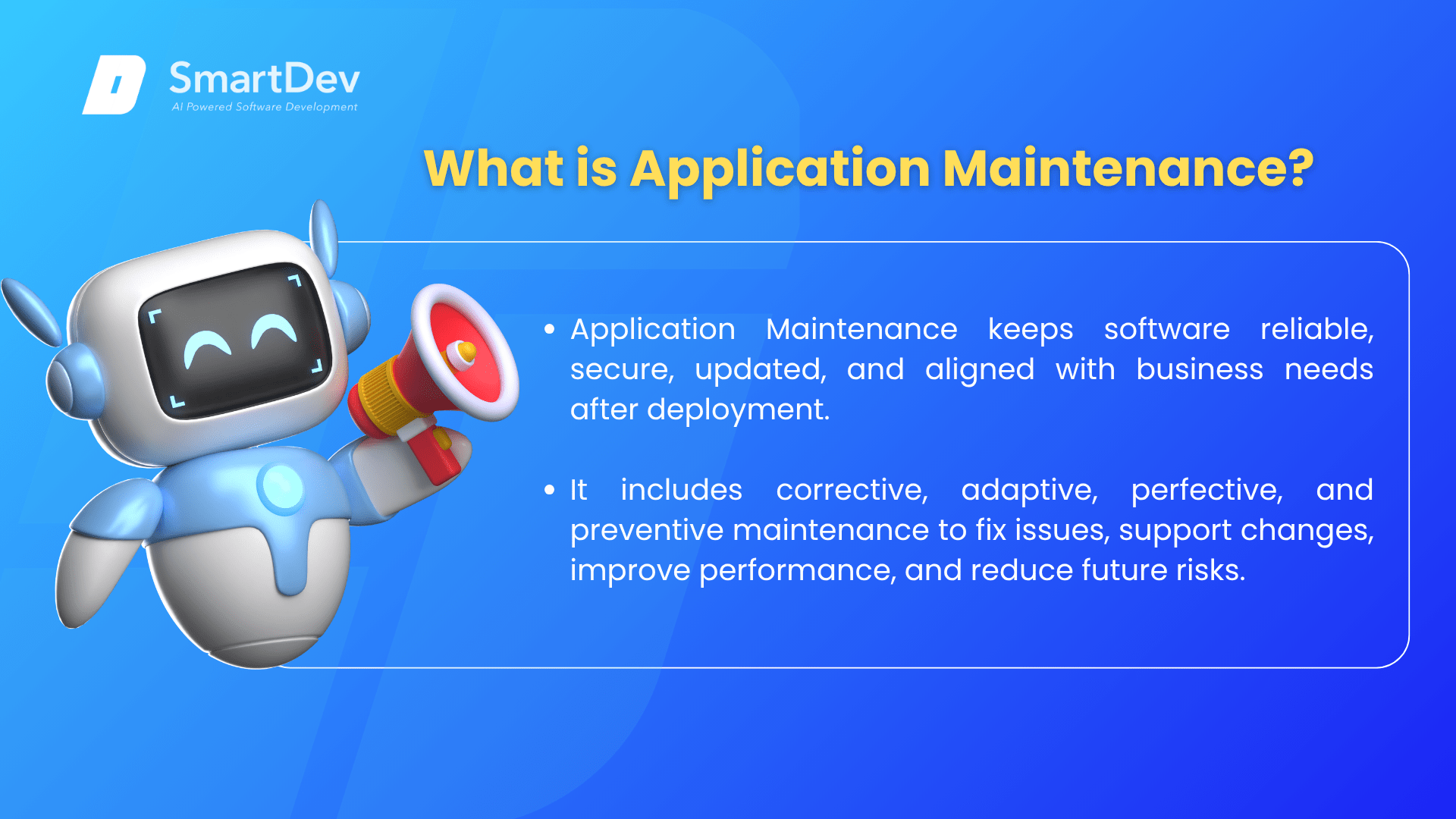
Application Maintenance is the ongoing process of monitoring, updating, fixing, and improving a software application after it has been deployed to ensure it continues to perform reliably and meet business requirements. It covers everything from fixing bugs reported by users to applying security patches, upgrading third-party components, and adapting the software to new operating environments or regulations.
There are four main types of application maintenance:
- Corrective: Fixing bugs, errors, and defects discovered after deployment
- Adaptive: Updating the application to work with new operating systems, browsers, or infrastructure changes
- Perfective: Enhancing performance, usability, or functionality based on user feedback
- Preventive: Proactively refactoring code and addressing technical debt before problems occur
비즈니스에 중요한 이유
Every software application degrades over time without active maintenance. Libraries become outdated, security vulnerabilities emerge, and new user demands stretch the system beyond its original design. Neglecting maintenance leads to system downtime, security breaches, and costly emergency fixes that interrupt business operations.
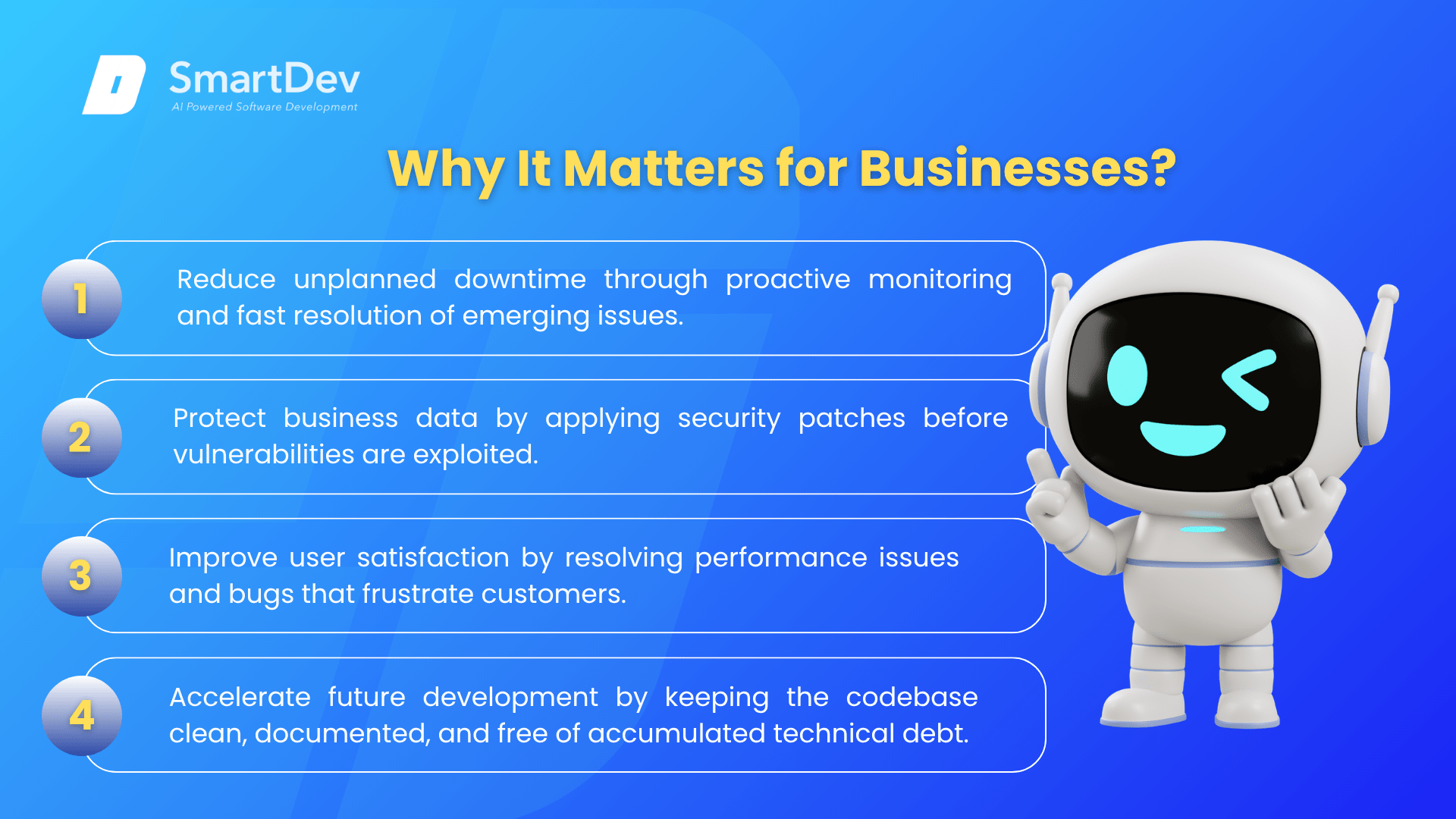
- Reduce unplanned downtime through proactive monitoring and fast resolution of emerging issues.
- Protect business data by applying security patches before vulnerabilities are exploited.
- Improve user satisfaction by resolving performance issues and bugs that frustrate customers.
- Accelerate future development by keeping the codebase clean, documented, and free of accumulated technical debt.
For example, a retail company with a customer-facing web application that skipped routine maintenance for 18 months faced a critical security breach that cost three times more to remediate than a year of regular maintenance would have cost. Proactive maintenance is an investment, not an expense.
How Does Application Maintenance Work?
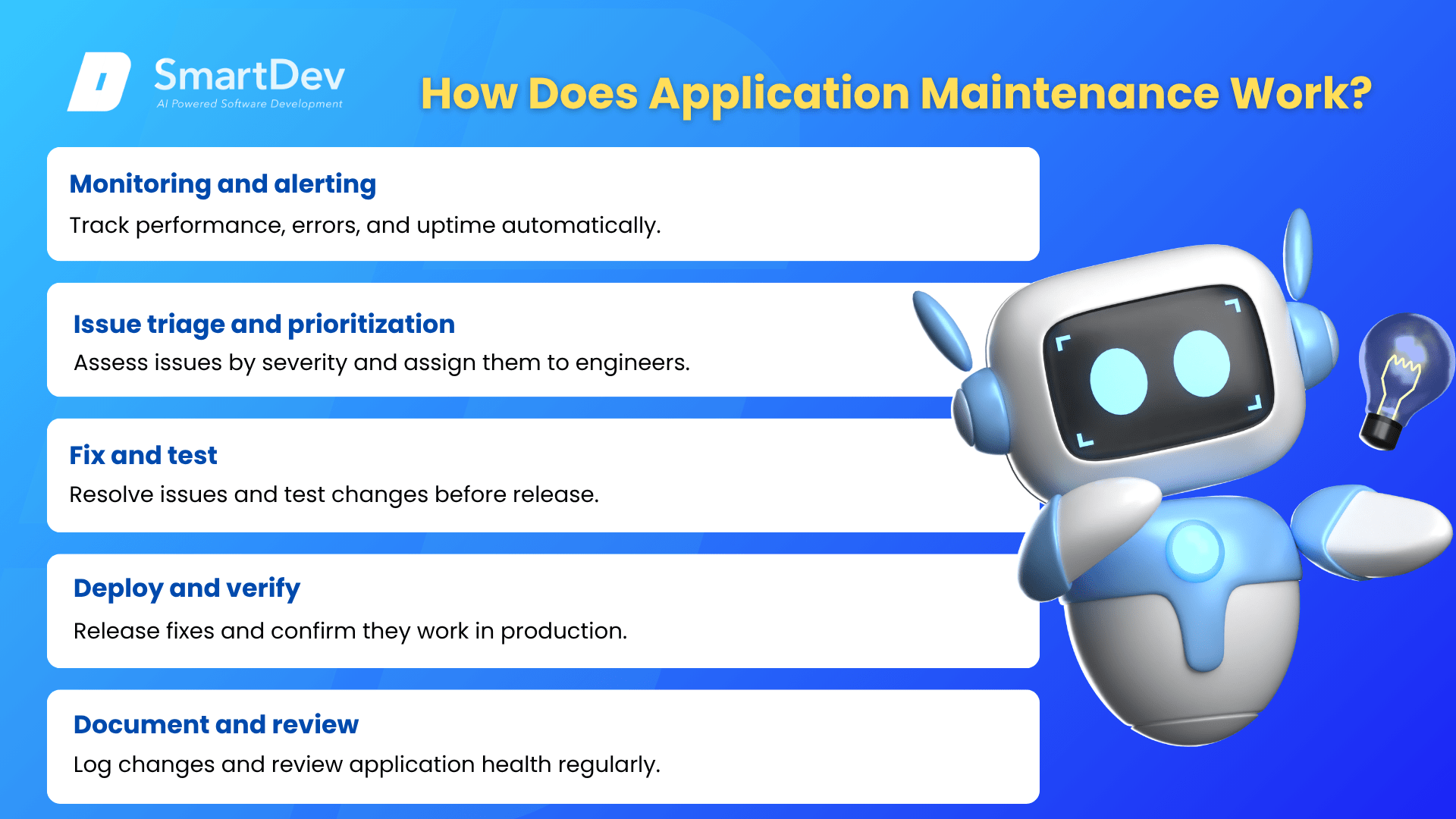
- Monitoring and alerting: Automated tools track application performance, error rates, and uptime around the clock. Alerts are triggered when thresholds are breached.
- Issue triage and prioritization: Incoming bugs, performance alerts, and change requests are logged, assessed by severity, and assigned to the appropriate engineering resource.
- Fix and test: Developers resolve the issue in a staging environment, run regression tests to confirm nothing else is broken, and prepare the fix for deployment.
- Deploy and verify: The fix is released to production during a maintenance window or via automated CI/CD pipelines (Continuous Integration and Continuous Delivery), then verified live.
- Document and review: Each change is logged, and periodic reviews assess overall application health, upcoming risks, and maintenance priorities for the next cycle.
The result is an application that stays stable, secure, and aligned with business needs over its full operational life.
How Much Does Application Maintenance Cost?
Application maintenance typically costs between 15% and 25% of the original development cost per year. For a system that cost $500,000 to build, you can expect annual maintenance costs of $75,000 to $125,000, depending on complexity and support level required.
Three factors that affect maintenance cost:
- Application complexity: Systems with many integrations, large user bases, or frequent regulatory updates require more maintenance effort
- Support coverage: 24/7 monitoring and response SLAs (Service Level Agreements) cost more than business-hours-only coverage
- Age of the technology stack: Older systems built on legacy frameworks are harder and more expensive to maintain than modern cloud-native applications
Outsourcing application maintenance to a managed services provider is typically 30 to 50% cheaper than maintaining a dedicated in-house team, especially for companies in higher-wage markets.
기타 관련 용어
Kanban Workflow: A visual workflow management system that helps teams organize, track, and complete tasks using boards, columns, and cards. It enables teams to clearly see work progress and identify bottlenecks in real time.
Client Onboarding: The process of guiding new clients or customers through the initial stages of working with a business or service provider. responsibility for maintaining and managing a company’s IT systems and applications on an ongoing basis.