
요약
- Application Modernization is the process of updating or rebuilding legacy software systems to make them faster, more secure, and ready for cloud and AI integration.
- Outdated applications increase maintenance costs, slow down teams, and create security risks that put the entire business at risk.
- Most companies choose to modernize in stages rather than rebuilding everything at once, reducing risk and delivering value incrementally.
Application Modernization is a top priority for businesses carrying aging software systems that can no longer keep up with current demands. Legacy applications slow down innovation, drain IT budgets, and make it harder to adopt new technology. This article explains what modernization involves and how to approach it strategically.
What is Application Modernization?
Application Modernization is the process of updating, re-architecting, or rebuilding outdated software systems to improve their performance, scalability, security, and compatibility with modern infrastructure such as cloud platforms, APIs, and AI tools. It addresses the gap between what aging systems can do and what the business now requires.
Common modernization approaches include:
- Rehost (Lift and Shift): Move the application to a cloud server without changing its code, the fastest and lowest-risk option
- Replatform: Make targeted adjustments to take advantage of cloud capabilities without a full rebuild
- Refactor: Restructure and clean up the existing code to improve maintainability without changing its external behavior
- Re-architect: Break a monolithic system into microservices (smaller, independent components) for better scalability
비즈니스에 중요한 이유
Outdated applications are not just a technology problem. They are a business problem. Legacy systems are expensive to maintain, difficult to integrate with modern tools, and often run on unsupported platforms that carry security risks. As competitors adopt cloud-native systems and AI-powered workflows, companies stuck on legacy technology fall further behind.
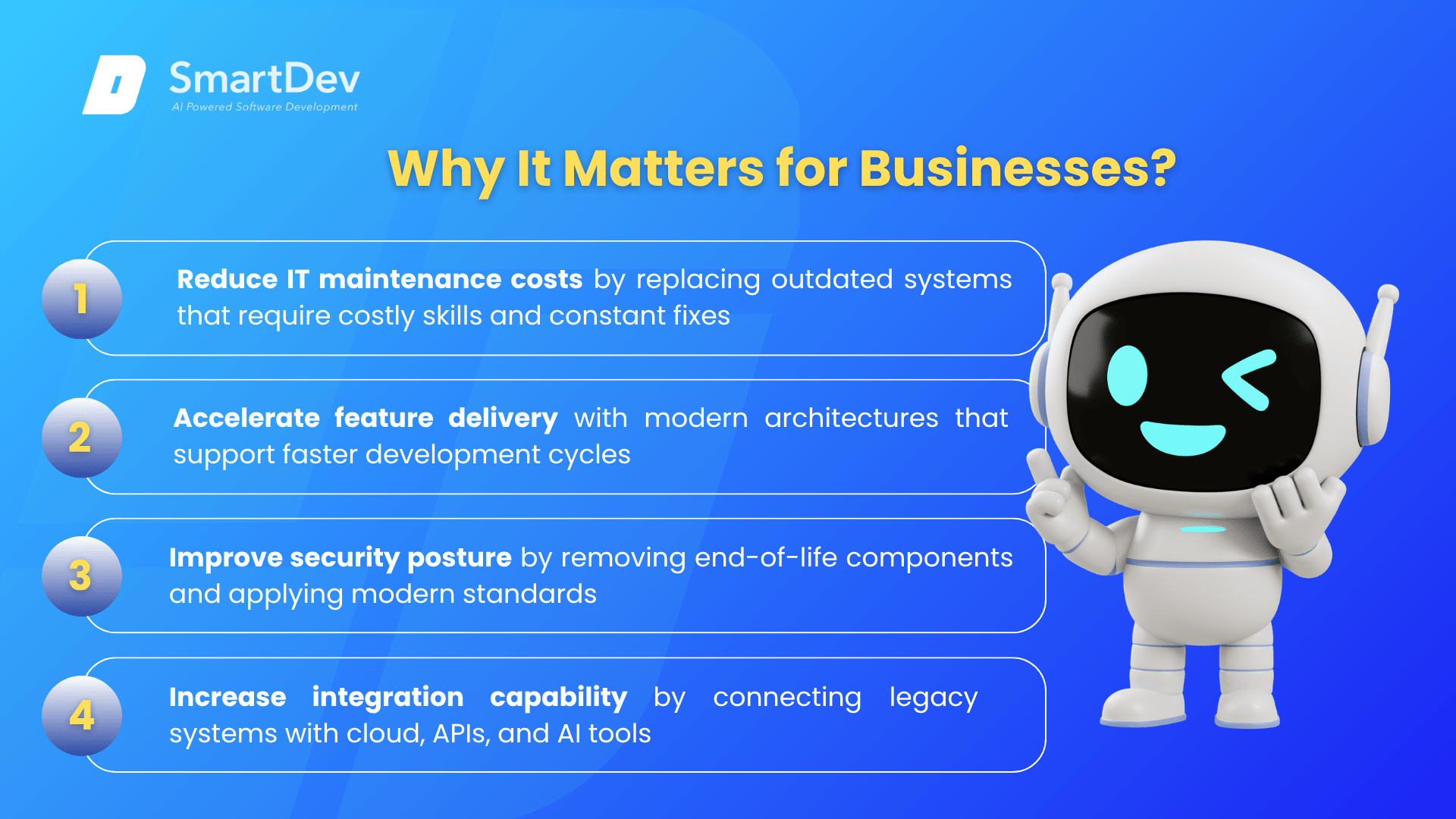
- Reduce IT maintenance costs by replacing systems that require expensive specialized skills and constant patching
- Accelerate feature delivery by moving to modern architectures that support faster development and deployment cycles
- Improve security posture by eliminating end-of-life components and applying modern security standards
- Increase integration capability by enabling legacy systems to connect with cloud services, APIs, and AI tools that drive competitive advantage
For example, a financial services company that migrated its core customer portal from an on-premise legacy system to a cloud-native architecture reduced its monthly infrastructure costs by 35% and cut new feature deployment time from six weeks to three days.
How Does Application Modernization Work?
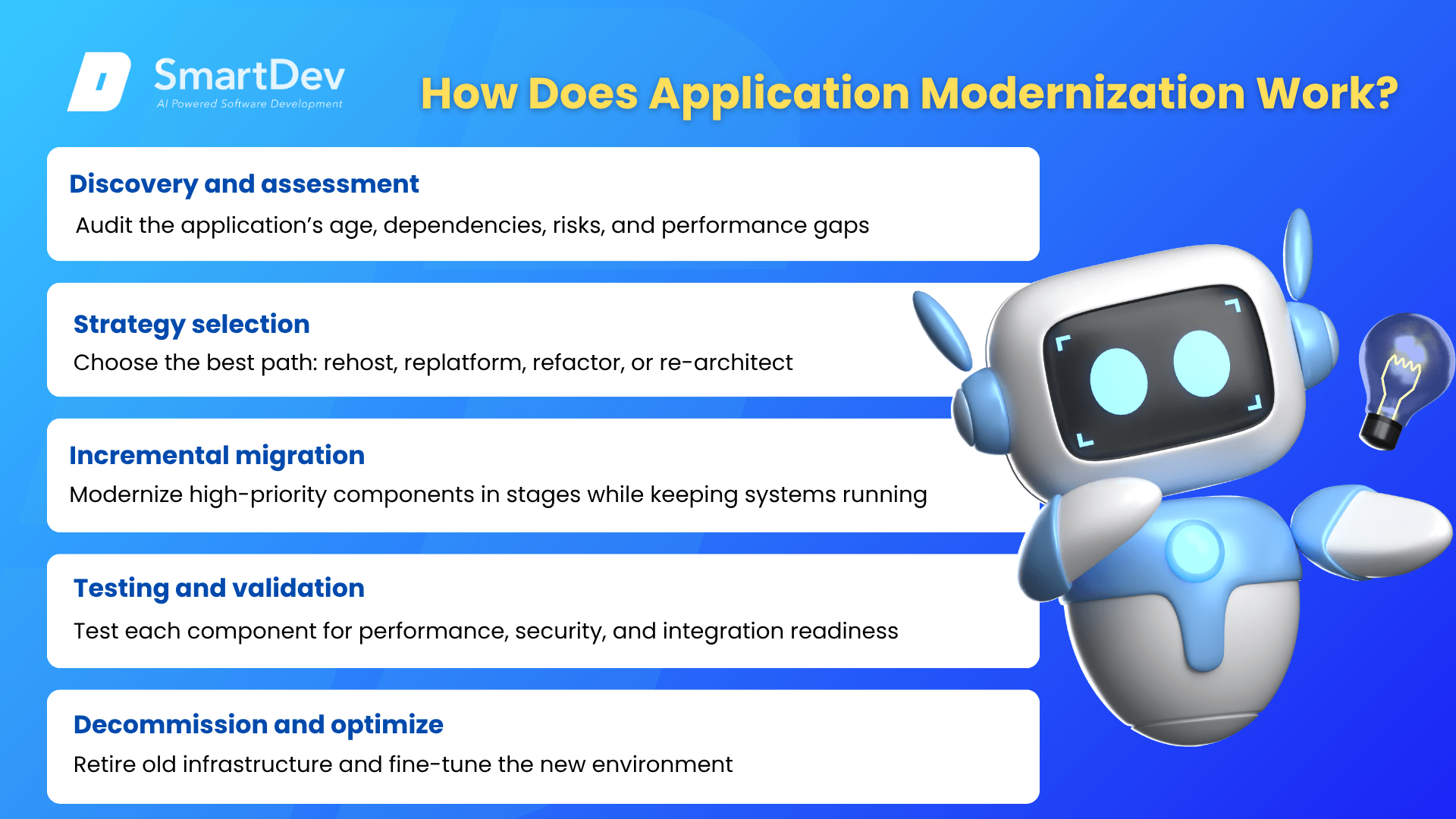
- Discovery and assessment: The current application is audited for technology age, business dependencies, security risks, and performance gaps to determine the most suitable modernization approach.
- Strategy selection: Based on the assessment, the team chooses the right path: rehost, replatform, refactor, or re-architect. Cost, risk, and business priority all factor into this decision.
- Incremental migration: Rather than replacing everything at once, systems are modernized in stages, starting with the highest-priority components while the rest continue running in parallel.
- Testing and validation: Each modernized component is rigorously tested before it goes live to confirm it meets performance, security, and integration requirements.
- Decommission and optimize: Once the modernized system is stable, the old infrastructure is retired, and the new environment is tuned for optimal cost and performance.
The result is a system that is faster, cheaper to run, and ready to support the next wave of business and technology requirements.
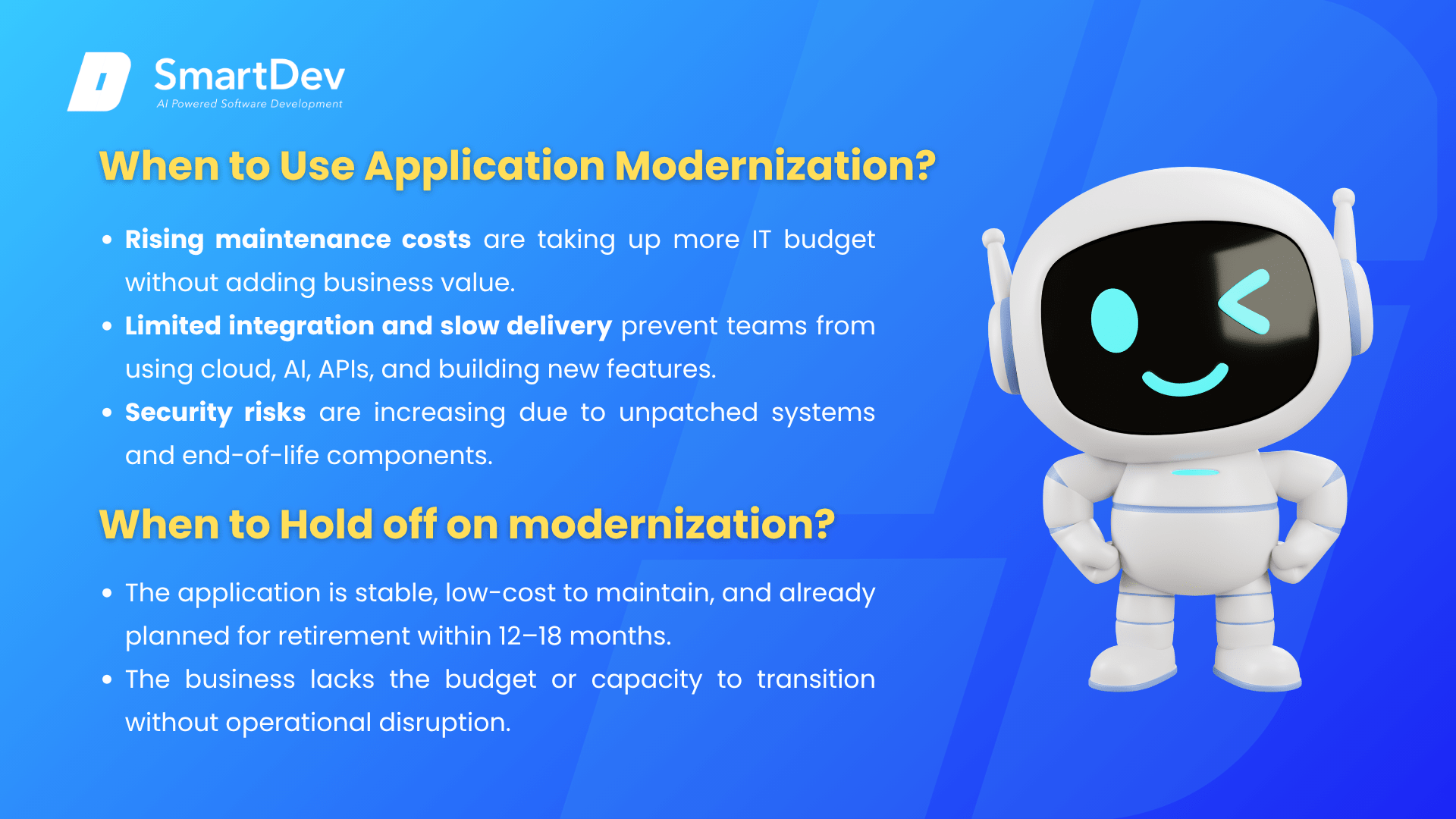
When to Use Application Modernization?
Modernization makes strategic sense in these situations:
- Your maintenance costs are consuming a growing share of your IT budget with no corresponding business value
- You cannot integrate your current systems with cloud platforms, AI tools, or partner APIs that competitors are already using
- Your development team spends more time keeping the lights on than building new features
- Security audits are flagging your legacy systems as unpatched or running on end-of-life components
When to hold off on modernization:
- The application is stable, inexpensive to maintain, and scheduled for retirement within 12 to 18 months anyway
- Your business does not have the budget or internal capacity to manage a transition without disrupting operations
기타 관련 용어
- Technical Debt: The accumulated cost of shortcuts and outdated decisions in a codebase that must eventually be addressed through refactoring or modernization.
- 클라우드 마이그레이션: The process of moving applications, data, or workloads from on-premise infrastructure to a cloud environment, often the first step in a modernization program.
- Agile Development: A project management approach that prioritizes people and collaboration over rigid processes and tools.