
요약
- Business Analysis is the practice of identifying business needs and translating them into clear requirements that technology teams can build against.
- Without it, IT projects frequently miss the mark, delivering software that does not solve the actual business problem.
- A skilled Business Analyst bridges the gap between business stakeholders and development teams, reducing costly miscommunication and rework.
Business Analysis is one of the most valuable but least understood roles in IT projects. When it is done well, development teams build exactly what the business needs. When it is skipped or rushed, projects run over budget, miss deadlines, and deliver software that nobody uses. This article explains what business analysis involves and why investing in it pays off.
What is Business Analysis?
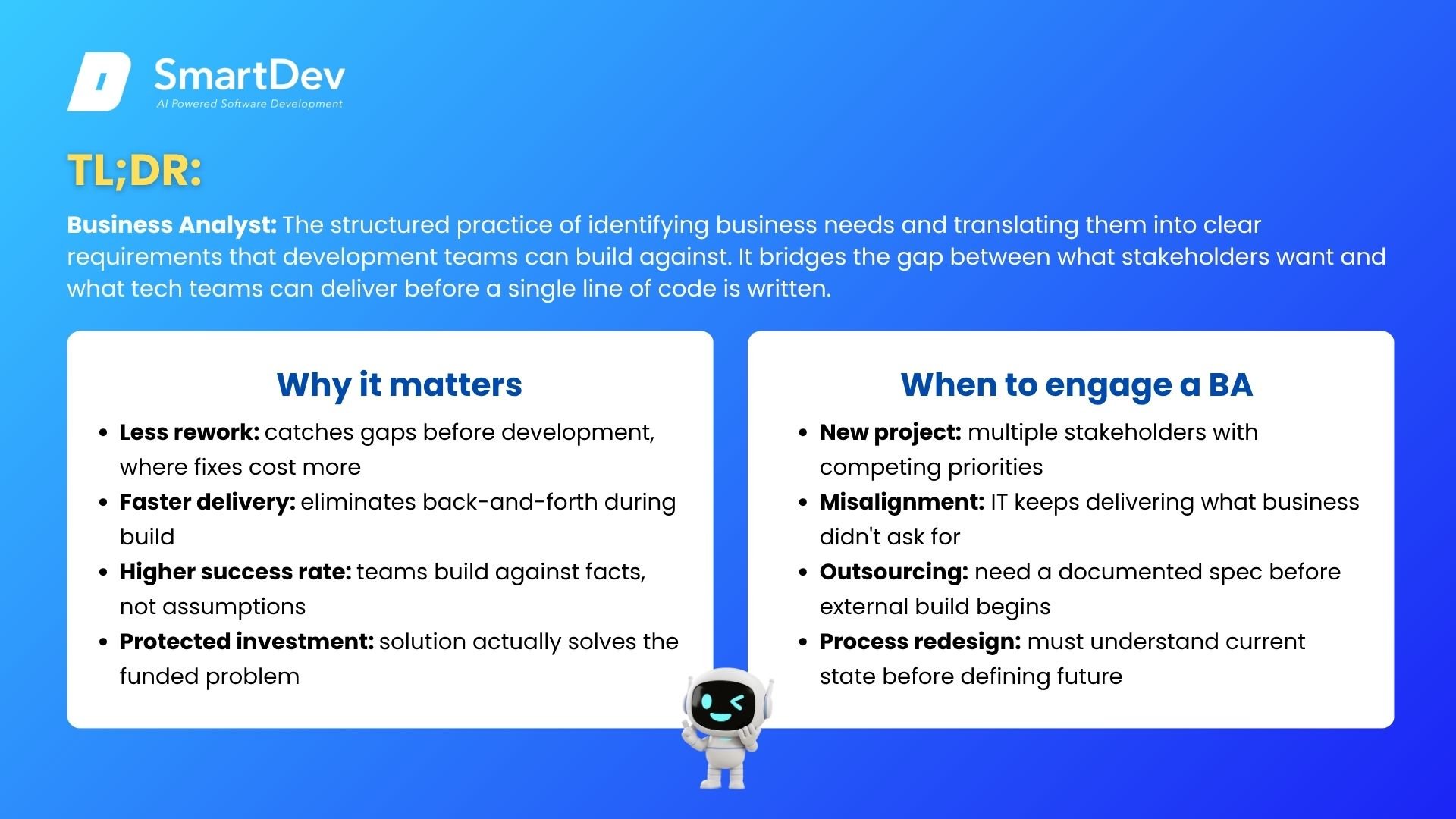
Business Analysis is the structured practice of identifying business problems, opportunities, and needs, and defining the requirements that a technology solution must meet to address them. It bridges the gap between what business stakeholders want and what the technical team can deliver, ensuring both sides are aligned before development begins.
Business Analysis activities typically cover:
- Requirements elicitation: Conducting interviews, workshops, and reviews to surface what users and stakeholders actually need
- Process mapping: Documenting current business workflows to identify inefficiencies or gaps the new system must address
- Requirements documentation: Writing clear, testable specifications that developers, designers, and QA teams can work from
- Stakeholder management: Keeping all parties aligned on scope, priorities, and trade-offs throughout the project lifecycle
비즈니스에 중요한 이유
Studies consistently show that poor requirements are one of the top causes of IT project failure. When what the business needs is not clearly defined, development teams build the wrong thing. By the time the mismatch is discovered, significant budget and time have already been spent.
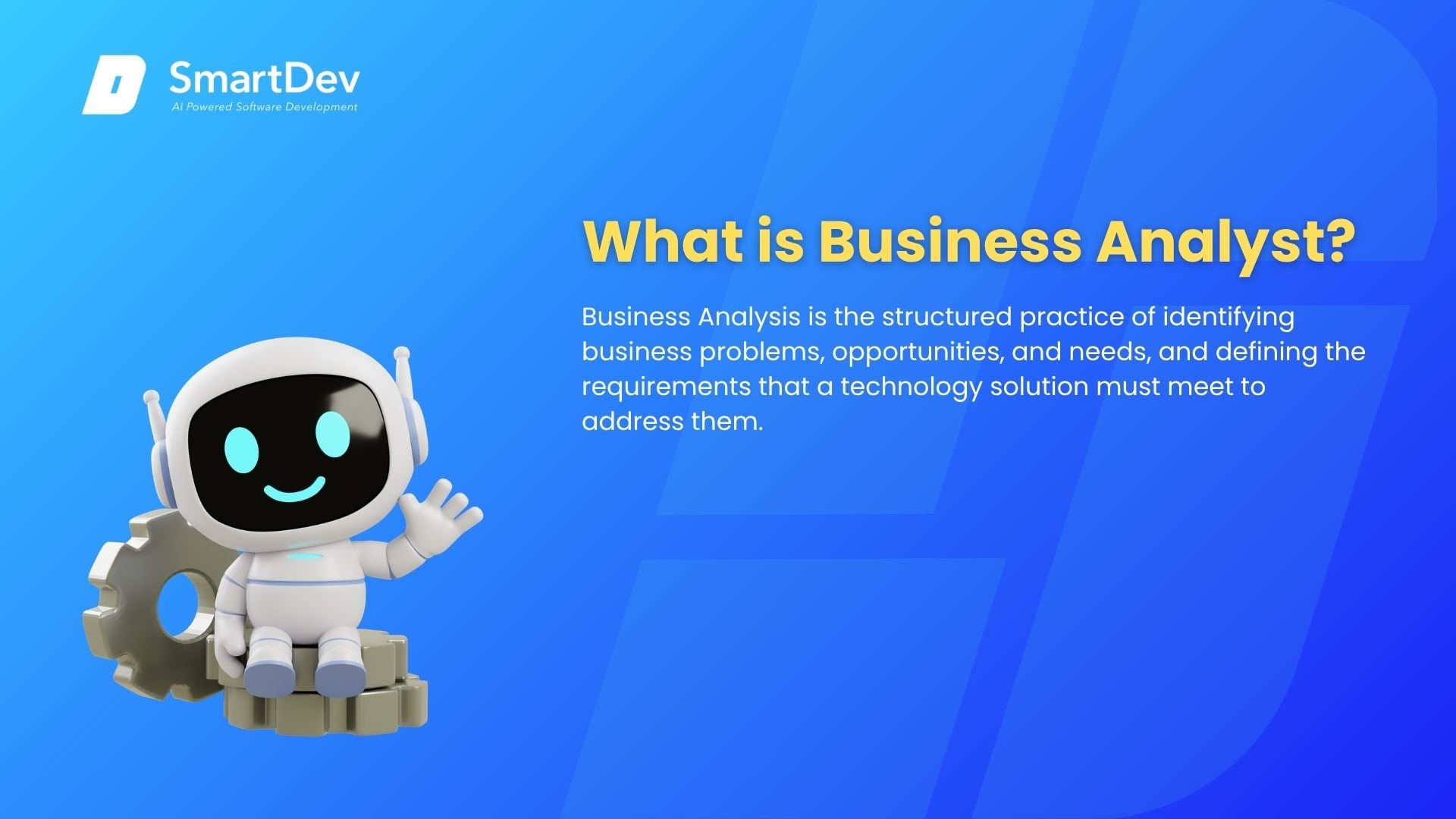
- Reduce rework costs by catching misunderstandings and gaps before they reach development, where changes are far more expensive
- Improve project success rates by ensuring developers are building against clear, agreed-upon requirements rather than assumptions
- Accelerate delivery timelines by eliminating back-and-forth between business and technical teams during development
- Protect stakeholder investment by ensuring the delivered solution actually solves the problem it was funded to address
For example, a healthcare company that invested in a dedicated Business Analyst at the start of a patient portal project reduced change requests during development by 45%. The team launched on time and within budget, while a comparable project without a BA role ran three months late and required significant post-launch rework.
Who Uses Business Analysis?
Business Analysis is used across virtually every industry that runs IT projects:
- Financial services and insurance rely on Business Analysts to translate complex regulatory requirements and product rules into system specifications that development teams can implement accurately
- Healthcare and pharma use business analysis to ensure patient management systems, compliance tools, and clinical platforms meet both clinical and regulatory requirements
- Retail and e-commerce engage Business Analysts to map customer journeys, define platform requirements, and align digital investments with revenue goals
The primary roles that drive or consume business analysis include CTOs, IT Directors, Product Managers, and Project Managers, all of whom depend on clear requirements to plan, budget, and deliver IT initiatives successfully.
When to Use Business Analysis?
Engage a Business Analyst in these situations:
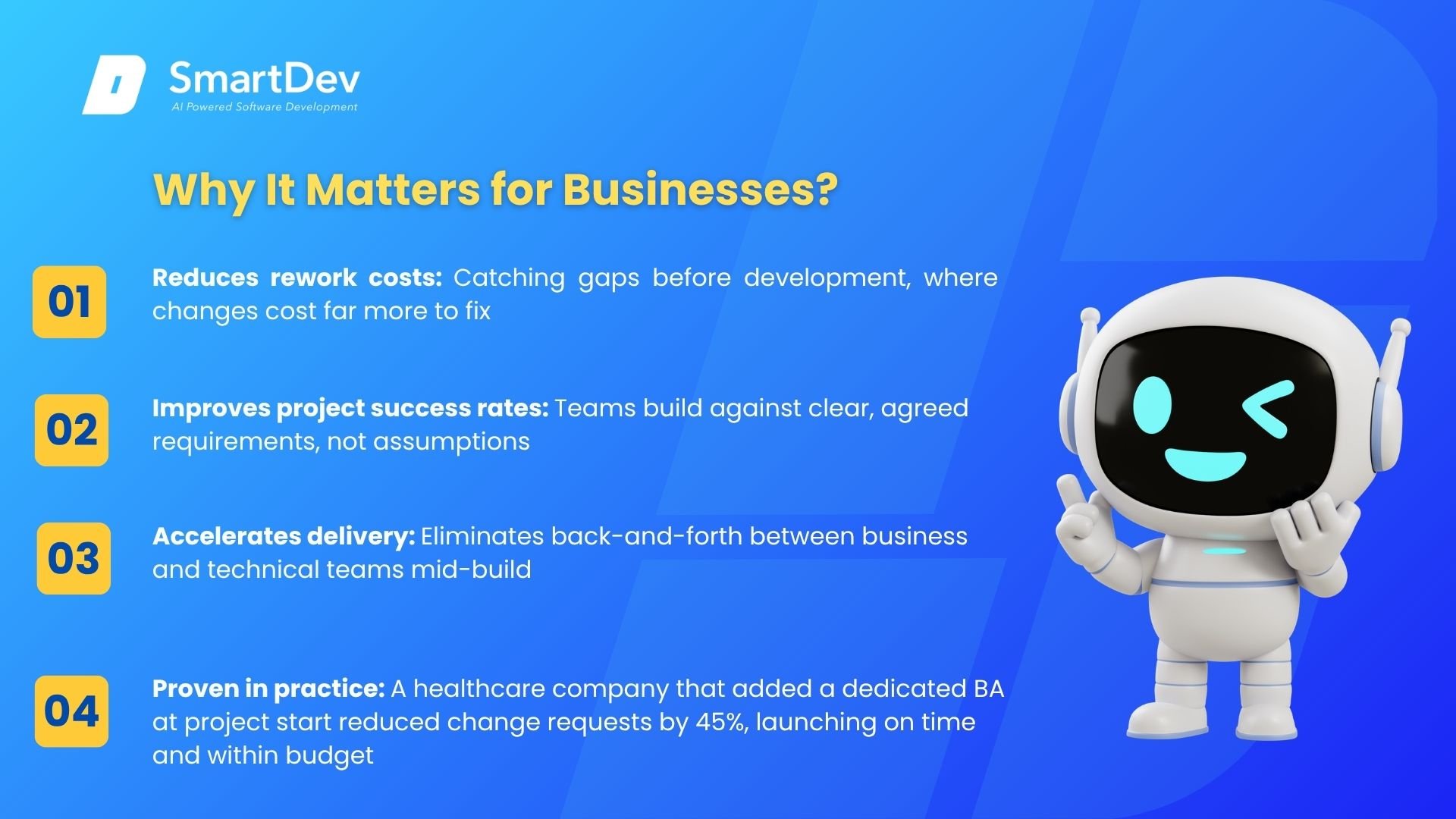
- You are starting a new software development project and need to capture requirements from multiple stakeholders with different priorities
- Your IT team and business teams are misaligned and projects keep delivering output that does not match expectations
- You are outsourcing development to an external team and need a clear, well-documented specification before work begins
- You are redesigning or improving an existing process and need to understand the current state before defining the future state
When to reconsider:
- The project is very small (a single feature with one clear stakeholder), where the overhead of formal analysis may exceed the benefit
- The team is using rapid prototyping and can iterate directly with users, reducing the need for upfront written specifications
기타 관련 용어
Agile Development: The application of Agile principles to software development, organizing work into short sprints with frequent client touchpoints. Business Analysis feeds directly into Agile Development by producing the user stories and acceptance criteria that define what each sprint must deliver, ensuring the team builds against real business needs rather than assumptions.
Agile Methodology: A flexible, iterative approach to project delivery that prioritizes collaboration, continuous feedback, and incremental progress. Business Analysis supports Agile Methodology by maintaining a well-groomed backlog of requirements that reflects evolving stakeholder priorities, giving the delivery team clarity on what to build next at every iteration.
Client Onboarding: The structured process of integrating a new client into an organization’s systems, workflows, and service delivery model. Business Analysis is a critical early activity within Client Onboarding for IT outsourcing engagements. It captures the client’s existing processes, pain points, and success criteria before any development work begins, reducing the risk of building the wrong solution.