
TL;DR:
- Code migration is the process of moving software applications from one platform, language, or infrastructure to another to improve performance, security, or maintainability.
- At enterprise scale, code migration projects routinely require million-dollar budgets and year-long timelines, making planning and expert support essential.
- Businesses that successfully migrate legacy systems free up 40 to 60% of their IT budget, previously spent on maintenance, for growth and innovation instead.
Code migration is the process of transferring a software application’s codebase from one operating environment, programming language, or infrastructure platform to another. It is one of the most consequential IT projects a business can undertake, with significant implications for cost, performance, and risk. This article explains what code migration involves, when your business needs it, what it costs, and what related terms you should understand.
What is Code Migration?
Code migration is the structured process of moving software from its current technical environment to a new one, including changes to the programming language, operating system, cloud platform, database, or application framework.
It goes beyond simply copying files. A true migration preserves business logic, validates that the new environment produces identical outputs, and ensures the new system is stable before the old one is decommissioned.
Code migration is often confused with data migration, which only moves data from one storage system to another. Code migration is significantly more complex because it requires restructuring the application itself, not just its data.
Common migration types include:
- Platform migration: Moving from on-premises servers to cloud infrastructure such as AWS, Azure, or Google Cloud.
- Language migration: Rewriting or translating code from a legacy language to a modern one, such as VB6 to .NET or COBOL to Java.
- Framework migration: Updating an application to run on a newer framework or runtime version.
Database migration: Changing the underlying database system, which often requires changes to application-layer code as well
비즈니스에 중요한 이유
Most organizations that delay code migration end up paying for it through rising maintenance costs, security vulnerabilities, and an inability to integrate with modern systems.
Research consistently shows that legacy-heavy organizations spend 75 to 85% of their IT budgets simply keeping old systems running. That leaves almost nothing for building new capabilities or responding to competitive pressure.
Successful code migration changes the equation:
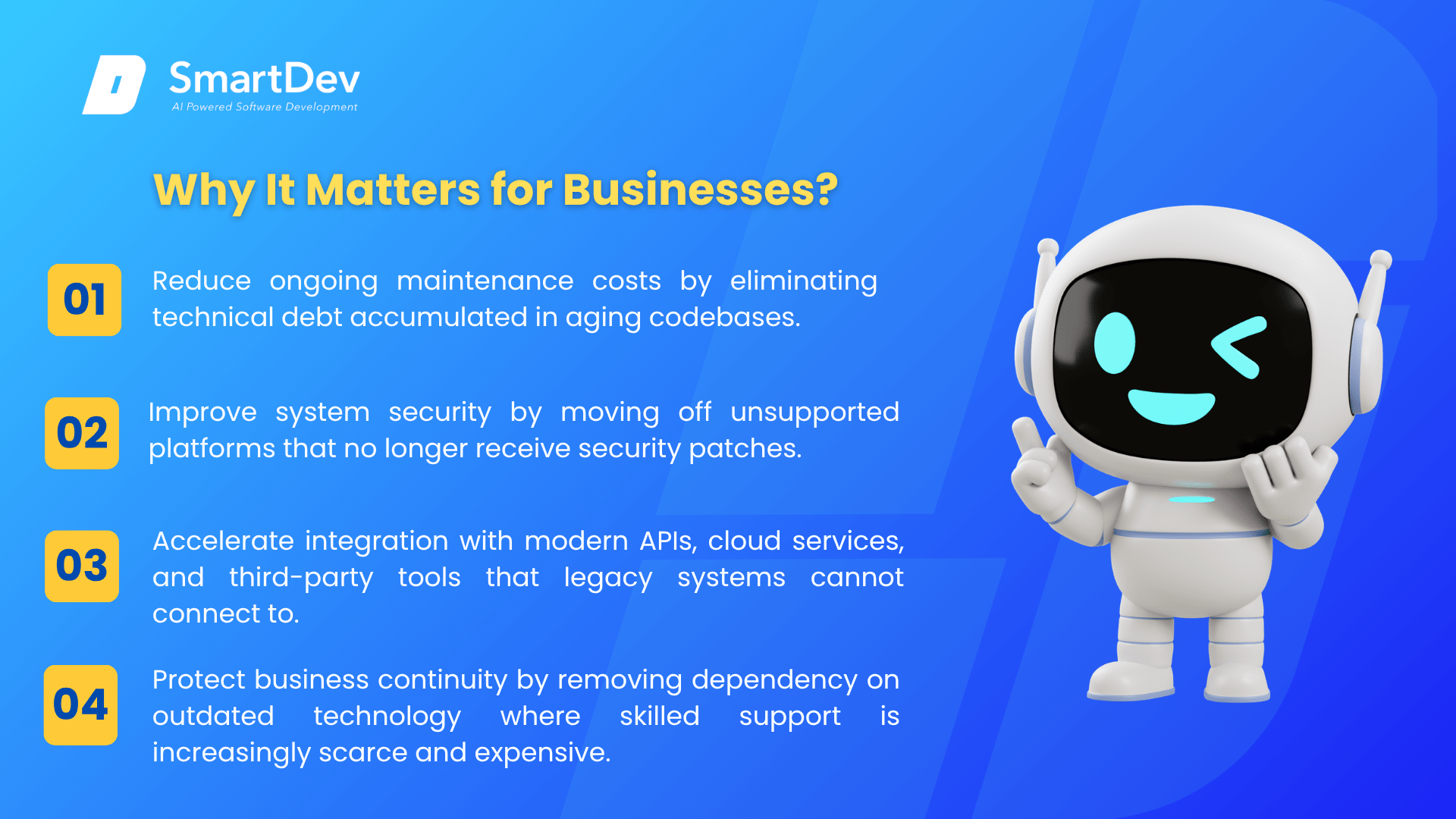
- Reduce ongoing maintenance costs by eliminating technical debt accumulated in aging codebases.
- Improve system security by moving off unsupported platforms that no longer receive security patches.
- Accelerate integration with modern APIs, cloud services, and third-party tools that legacy systems cannot connect to.
- Protect business continuity by removing dependency on outdated technology where skilled support is increasingly scarce and expensive.
For example, a logistics company that migrated its operations platform from a decade-old monolithic system to a cloud-native architecture reduced its annual IT maintenance spend by 42% in the first year post-migration, while also cutting application downtime by 60%.
When to Use Code Migration?
Understanding when code migration is necessary helps leadership make the right investment decision at the right time.
Consider code migration when:
- Your current software platform is no longer supported by its vendor, meaning security patches and updates have stopped.
- Your system cannot integrate with modern tools your business needs, such as cloud services, analytics platforms, or new APIs.
- Maintenance costs are consuming more than 60% of your IT budget, limiting your ability to invest in new development.
- Hiring developers to maintain your legacy stack is becoming difficult or expensive due to a shrinking talent pool for outdated languages.
Code migration may not be the right choice when:
- The existing system is stable, well-documented, and your team has strong in-house expertise to maintain it cost-effectively.
- The migration would require rebuilding core business logic from scratch with no clear cost-benefit advantage over a phased modernization approach.
How Much Does It Cost?
Code migration costs are substantial at enterprise scale and should be evaluated carefully against the long-term cost of maintaining legacy systems.
- Small application migrations (single module or service): $50,000 to $200,000.
- Mid-scale platform migrations: $300,000 to $1,500,000, typically spanning 6 to 18 months.
- Full enterprise migrations: $1,500,000 and above, with timelines of 1 to 3 years depending on codebase complexity.
Three primary cost factors include the size and complexity of the codebase being migrated, the number of dependent systems and integrations that must be preserved or rebuilt, and whether the project is handled by in-house teams or an outsourced IT services partner.
Outsourcing code migration to an experienced IT partner often reduces total cost by 20 to 35%, because external teams bring pre-built tooling, proven migration frameworks, and specialists who have completed similar projects before.
기타 관련 용어
Code Translation: The process of converting source code from one programming language to another; it is often a key step within a broader code migration project.
Technical Debt: The accumulated cost of shortcuts and outdated design choices in a codebase; code translation is one of the primary ways organizations reduce technical debt systematically.
AI-assisted Engineering: The practice of using artificial intelligence tools to support software developers throughout the entire development process, from writing code and reviewing logic to generating tests, identifying bugs, and preparing releases.