
TL;DR:
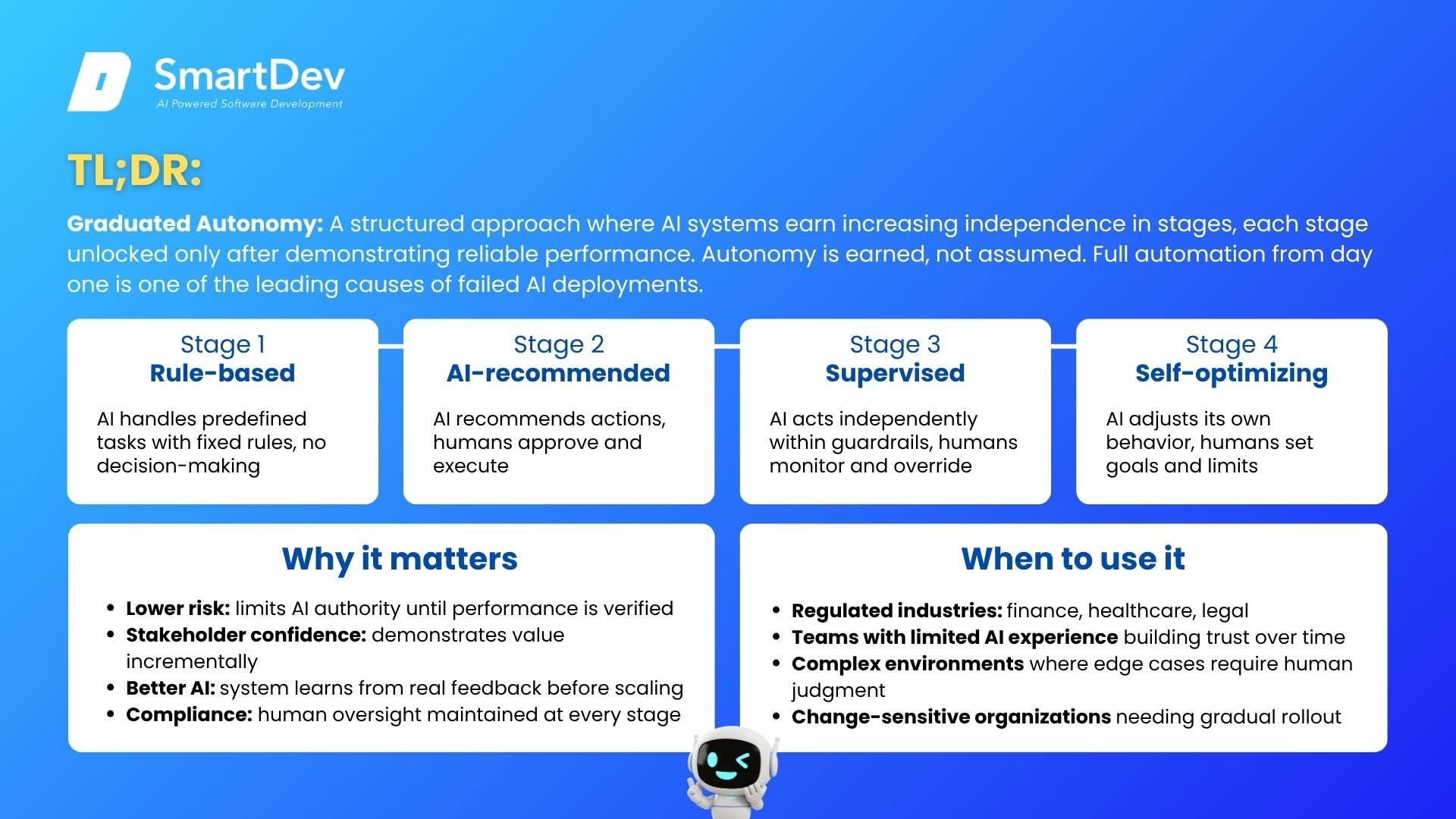
- Graduated Autonomy is a phased approach to AI automation where systems gain increasing independence as performance and trust are established.
- It reduces the risk of AI errors at scale by ensuring human oversight remains strong in early stages and is relaxed only as confidence builds.
- Most enterprises benefit from starting at Stage 1 or 2 and expanding AI independence based on measured outcomes, not arbitrary timelines.
Graduated Autonomy is the strategic framework that separates successful enterprise AI programs from costly failures. Rather than flipping a switch to full automation, organizations expand AI independence step by step, building trust through demonstrated performance. This article explains what Graduated Autonomy is, why it matters, and how to implement it in your organization.
What is Graduated Autonomy?
Graduated Autonomy is a structured approach to AI deployment in which artificial intelligence systems are granted increasing levels of operational independence in stages, with each stage unlocked only after the system demonstrates reliable performance within defined guardrails.
The core idea is that autonomy is earned, not assumed. Rather than deploying a fully autonomous AI system from day one, Graduated Autonomy starts with AI in a purely advisory role and progressively expands its authority as trust is established through real-world results.
The four stages of Graduated Autonomy are:
- Stage 1 (Rule-based automation): AI handles simple, predefined tasks with no decision-making involved, following fixed rules without variation.
- Stage 2 (AI-recommended actions): AI recommends actions for humans to approve and execute, providing decision support without acting independently.
- Stage 3 (Supervised autonomy): AI acts independently within strict guardrails, with humans monitoring outcomes and retaining the ability to override at any time.
- Stage 4 (Self-optimizing systems): AI adjusts its own behavior based on feedback loops, with humans setting goals and limits rather than reviewing individual decisions.
비즈니스에 중요한 이유
Full automation without a graduated approach is one of the leading causes of failed AI deployments. When systems are given too much autonomy before they have proven reliable, errors compound at scale, organizational trust collapses, and expensive rollbacks follow.
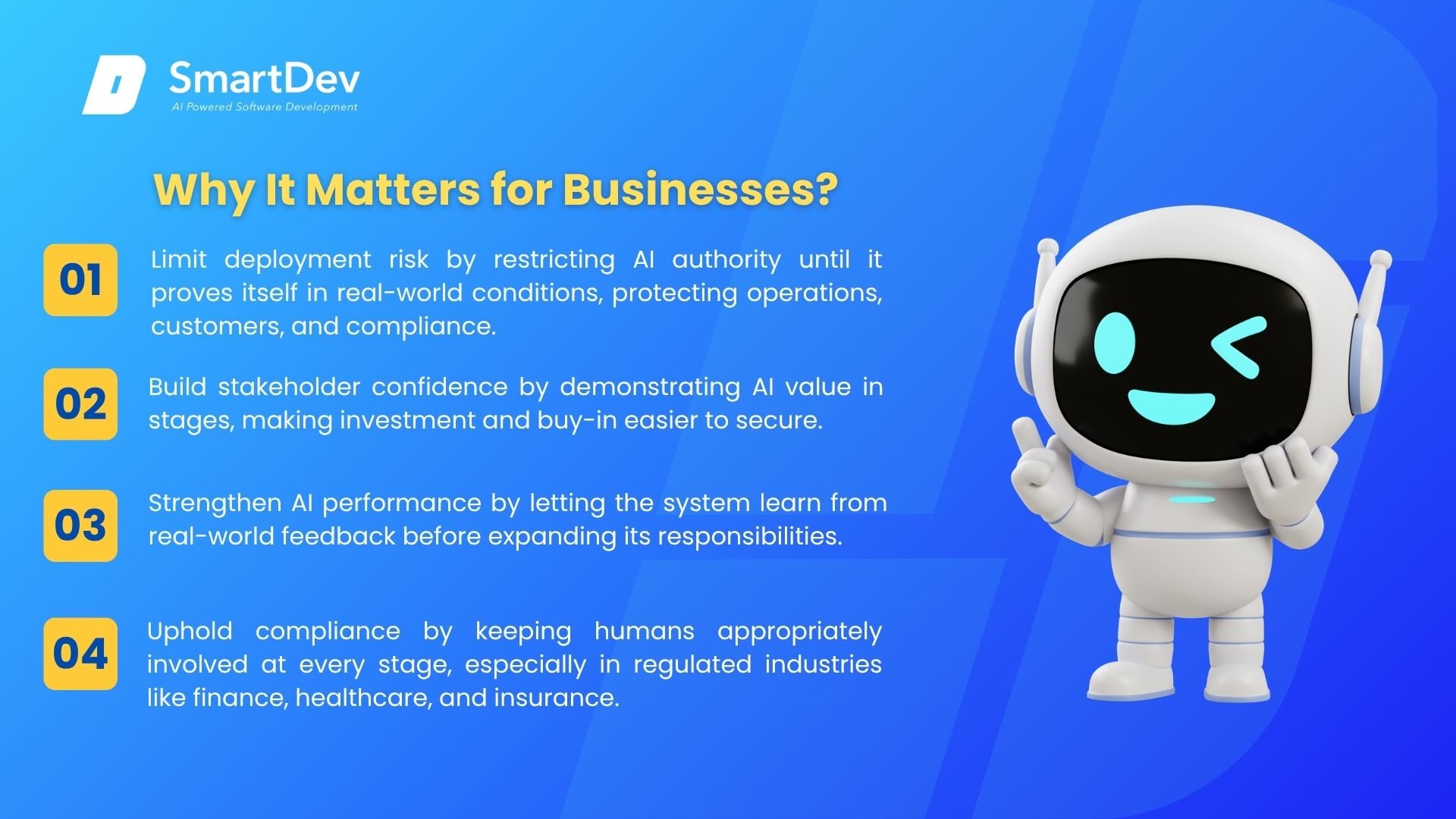
- Reduce deployment risk by limiting AI authority until performance in real-world conditions is verified, protecting operations from unexpected failures that could affect customers or compliance.
- Increase stakeholder confidence by demonstrating AI value incrementally, making it easier to secure ongoing investment and organizational buy-in from leadership.
- Improve AI performance over time as the system learns from real-world feedback at each stage before taking on greater responsibility in the next.
- Protect compliance standards by maintaining appropriate human oversight at each stage, particularly important in regulated industries such as finance, healthcare, and insurance.
For example, a healthcare network implementing AI-assisted scheduling started at Stage 2, where the AI recommended appointment slots and human coordinators approved each one. After three months of near-perfect recommendations, the system advanced to Stage 3, handling routine scheduling autonomously with coordinators reviewing only exceptions. Staff time on scheduling dropped by 60% with no reduction in patient satisfaction scores.
How Does Graduated Autonomy Work?
- Define the scope: Identify the specific process or workflow you want to automate. The more clearly defined the task, the easier it is to set measurable performance criteria for each autonomy stage.
- Set stage criteria: Establish what success looks like before advancing to the next stage. This might be an accuracy threshold, a sustained performance period, or a specific error rate target that must be held for 30 or 60 days.
- Deploy at Stage 1 or 2: Begin with the AI in an advisory or rule-based role. This creates a data record of AI performance and builds team familiarity with the system without introducing operational risk.
- Review and advance: At defined intervals (typically monthly or quarterly), review performance data against your stage criteria. Advance only when thresholds are consistently met.
- Maintain override capability: At every stage, including Stage 4, ensure humans retain the ability to override or pause the AI system. Graduated Autonomy is not about removing human control; it is about deploying that control where it adds the most value.
The result is an AI deployment that earns its authority through demonstrated results, reducing risk while maximizing the long-term impact of your automation investment.
When to Use Graduated Autonomy?
Graduated Autonomy is the appropriate framework for virtually any significant AI deployment, but it is especially valuable in specific situations:
- When deploying AI in regulated industries such as finance, healthcare, or legal services, where human oversight requirements are strict and AI errors carry serious legal or reputational consequences.
- When your team has limited AI experience and needs time to build trust in the system before granting it operational authority over important workflows.
- When the AI operates in a complex or variable environment where edge cases are common and require human judgment to resolve correctly.
- When organizational change management is a concern, as gradual expansion of AI authority gives employees time to adapt without feeling displaced or bypassed overnight.
Graduated Autonomy is less suited to simple, fully predictable tasks where there is no meaningful risk in moving directly to full automation. For document format conversion or routine data transfers with no exception handling required, a staged approach adds process overhead without real benefit.
기타 관련 용어
AI Agent: A software system that uses artificial intelligence to analyze data, make decisions, and perform tasks automatically to achieve a specific goal. In the context of Graduated Autonomy, AI Agents are what organizations deploy through each stage, starting in an advisory role and progressing toward independent action as trust is established.
AI Governance: The policies, processes, and accountability structures that organizations put in place to ensure AI systems operate safely and ethically. AI Governance defines the guardrails within which each stage of Graduated Autonomy operates, making it a critical foundation for any responsible AI deployment program.
Agentic Engineering: The discipline of designing, building, and managing AI agents capable of taking autonomous actions within defined boundaries. Agentic Engineering directly shapes how well an AI system performs at each autonomy stage, determining whether and when it earns the right to advance to greater independence.