
요약
- Monolithic architecture is a traditional software design where the entire application is built and deployed as a single, unified unit.
- It is simpler to build and manage at small scale but becomes a bottleneck as the application grows and teams expand.
- Many enterprises are migrating away from monolithic systems toward microservices, but monoliths remain valid for early-stage products and smaller teams.
Monolithic architecture is one of the oldest and most common approaches to building enterprise software. Despite the growing popularity of microservices, many mission-critical business systems still run on monolithic designs. Understanding this architecture helps decision-makers know when it is appropriate, when it becomes a liability, and what modernization looks like.
What is Monolithic Architecture?
Monolithic architecture is a software design approach where all components of an application, including the user interface, business logic, and data access layer, are tightly coupled and deployed together as a single executable unit.
In a monolithic system, all features are part of the same codebase. When you update one module, you must test and redeploy the entire application. The three primary layers of a monolith are the presentation layer (what users see), the business logic layer (the rules and workflows that power the application), and the data layer (the centralized database that stores everything).
Classic examples of monolithic applications include legacy ERP systems, older banking platforms, and early-generation e-commerce platforms built before cloud-native development became standard practice.
비즈니스에 중요한 이유
Many businesses are running on monolithic systems without realizing the impact this has on their ability to innovate, scale, and recover from incidents. Recognizing the trade-offs is the first step to making an informed modernization decision.
- 줄이다 initial development complexity, since all code lives in one place and is easier to build and test early on.
- 증가시키다 deployment risk as the application grows, because any change requires redeploying the entire system.
- 개선하다 simplicity for small teams, as monoliths require less infrastructure expertise than distributed architectures.
- 가속하다 early delivery timelines, as monoliths have less overhead than microservices during initial product development.
For example, a retail company running its entire platform on a ten-year-old monolithic system found that adding a new payment method required six weeks of testing and a full system freeze during the deployment window, creating real business risk during peak shopping seasons. This type of constraint is what drives many enterprises toward architectural modernization.
When to Use Monolithic Architecture?
- Use monolithic architecture when you are building an early-stage product and need to launch quickly without complex infrastructure.
- Use a monolith when your team has fewer than eight developers, as the coordination benefits of microservices outweigh the benefits at small team sizes.
- Use a monolith when your application has stable requirements and low-frequency releases.
- Avoid monolithic architecture when your system needs to scale specific components independently due to varying traffic loads.
- Avoid a monolith when you have multiple large teams working simultaneously on the same codebase, as merge conflicts and coordination overhead become a major drag on productivity.
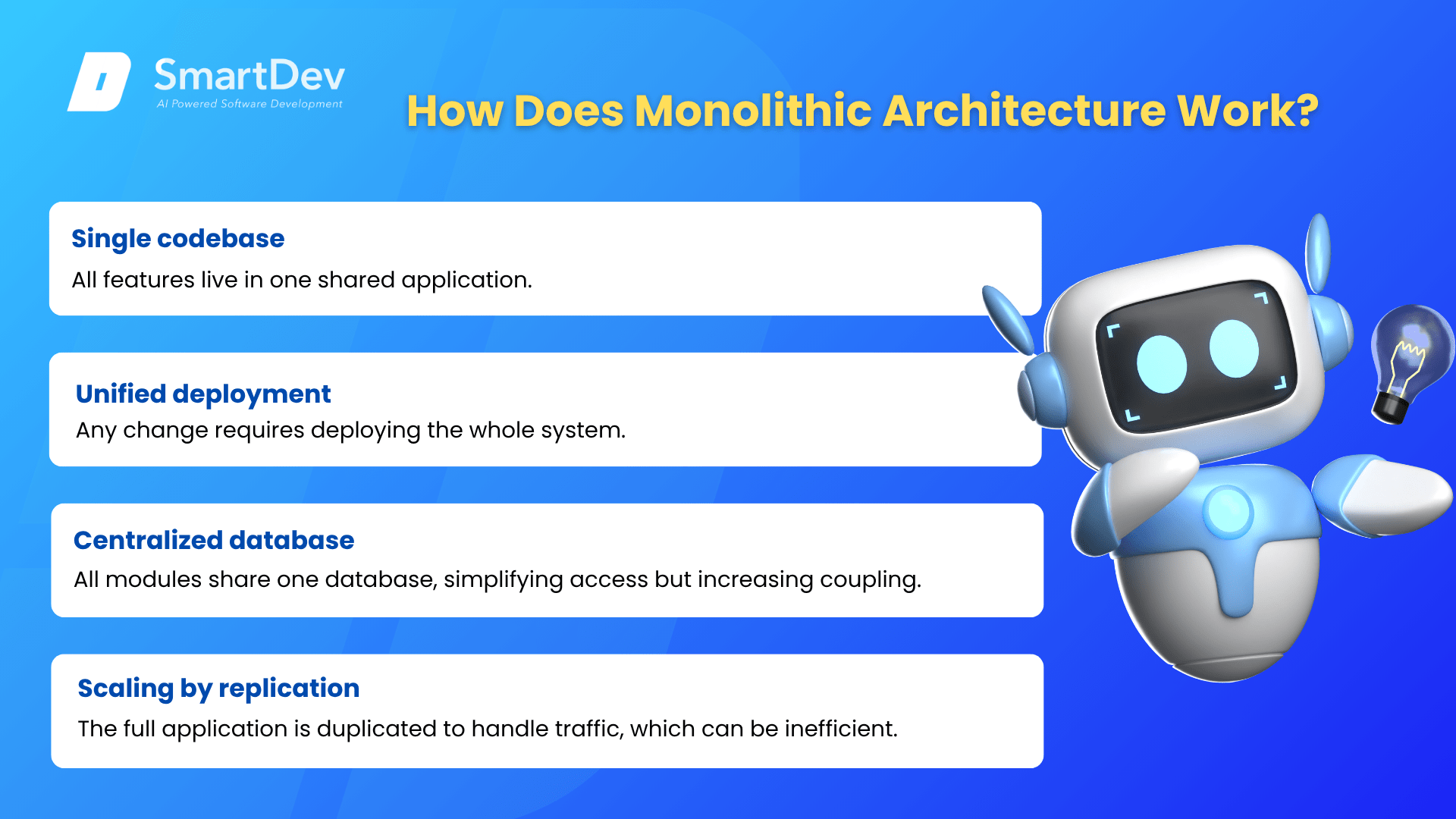
How Does Monolithic Architecture Work?
- Single Codebase: All features, from the login screen to the reporting dashboard, exist within one shared codebase managed by the development team.
- Unified Deployment: When any part of the code changes, the entire application is compiled, tested, and deployed as one unit to a single server or cluster.
- Centralized Database: All modules share one database. This simplifies data access but creates tight coupling between different parts of the system.
- Scaling by Replication: To handle more traffic, the entire application is replicated rather than scaling specific high-demand components, which can be expensive and inefficient.
The result is a system that is straightforward to manage at small scale but increasingly brittle and expensive to operate as complexity and team size grow.
기타 관련 용어
Milestone-Based Contract: A formal agreement between a client and a service provider where compensation is released only when specific, measurable project milestones are completed and accepted.
Technical Debt: The accumulated cost of shortcuts and outdated decisions in a codebase, which monolithic systems often accumulate over time and which drives modernization efforts.
API Integration: The process of connecting different software systems using an Application Programming Interface (API) so they can communicate and exchange data automatically