
요약
- Regression testing verifies that existing software functionality still works correctly after new code changes, bug fixes, or feature additions are introduced.
- Without regression testing, every new release risks silently breaking features that previously worked, often in parts of the system far from where the change was made.
- Automated regression testing is essential at scale, as manually verifying an entire application after every change becomes impossible as systems grow.
Every time a developer changes code, there is a risk of unintentionally breaking something that worked before. Regression testing is the safety net that catches those unintended breakages before they reach your customers. For any business running software in production, regression testing is not optional — it is what makes continuous delivery possible without continuous incidents.
What is Regression Testing?
Regression testing is the process of re-testing existing software functionality after code changes have been made, to verify that previously working features have not been broken by new development, bug fixes, configuration changes, or system upgrades.
The term “regression” refers to a return to a worse state. A regression bug is one that causes software to behave incorrectly in an area that previously worked. These bugs are particularly dangerous because they are unexpected — they appear in functionality the team was not actively working on, often going undetected until a customer reports the problem.
Regression testing can be performed at multiple levels: unit tests verify individual code components, integration tests verify interactions between system modules, and end-to-end tests verify complete user workflows. In modern engineering teams, all three levels of regression testing are typically automated and run as part of the CI/CD pipeline on every code commit.
비즈니스에 중요한 이유
Software complexity grows over time. A change made to the payment module might break the reporting system. An upgrade to a third-party library might alter the behavior of an unrelated feature. Regression testing is the only systematic way to detect these dependencies before they cause production incidents.
- Protect product stability by ensuring new releases do not introduce unexpected failures in previously verified functionality.
- 줄이다 the cost and urgency of production hotfixes by catching regressions in the testing phase, where they can be fixed without incident response overhead.
- 증가시키다 release confidence for engineering teams, enabling faster and more frequent deployments without increased risk.
- 개선하다 customer trust by delivering consistent, reliable software experiences with every release.
For example, a healthcare software company that introduced automated regression testing across its patient portal reduced its post-release defect rate by 75% in six months. Before automation, manual regression testing was taking two weeks per release cycle. Automation cut that to under four hours, allowing the team to release biweekly instead of monthly.
How Does Regression Testing Work?
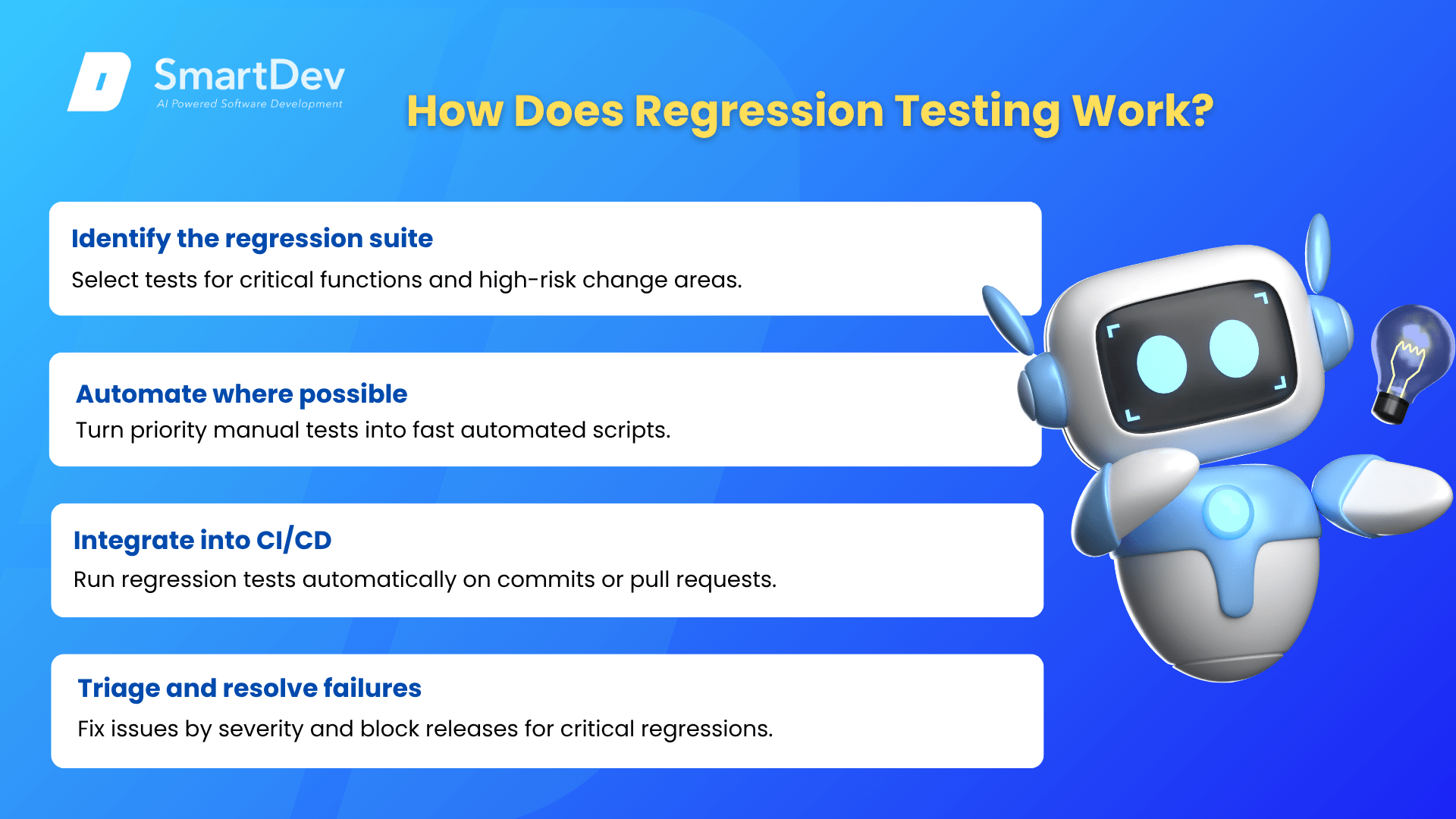
- Identify the Regression Test Suite: Select the test cases that cover critical business functionality and areas most likely to be affected by code changes. Prioritize tests by business impact and historical failure frequency.
- Automate Where Possible: Convert high-priority manual test cases into automated scripts using testing frameworks appropriate to your technology stack. Automated tests run in seconds or minutes; manual equivalents take hours or days.
- Integrate into the CI/CD Pipeline: Configure the automated regression suite to run automatically on every code commit or pull request, so regressions are detected immediately rather than at the end of the sprint.
- Triage and Resolve Failures: When a regression is detected, prioritize investigation and fix based on severity and business impact. Block the release if critical regressions are identified; allow release to proceed if failures are minor and low-risk.
The result is a development process where code changes are validated against the full scope of existing functionality automatically, removing human error and time constraints from the regression verification process.
When to Use Regression Testing?
- Run regression tests after every code change that touches existing functionality, not just after major releases.
- Run a full regression suite before every production deployment, regardless of how small the change appears.
- Expand your regression suite whenever a new bug is found in production. Every production defect is evidence of a missing test case.
- Avoid relying solely on manual regression testing for any system with more than a few dozen test cases, as the human effort required quickly becomes a delivery bottleneck.

기타 관련 용어
Hybrid Delivery Model: An IT outsourcing structure that combines resources from two or more delivery locations – typically an onshore team in the client’s country and an offshore or nearshore team in a lower-cost location – working together on the same engagement.
End-to-End Testing: A type of regression testing that validates complete user workflows from start to finish, simulating real user behavior across the entire system.
CI/CD Pipeline: The automated software delivery infrastructure within which regression test suites run automatically on every code change, enabling fast and reliable release cycles.