요약
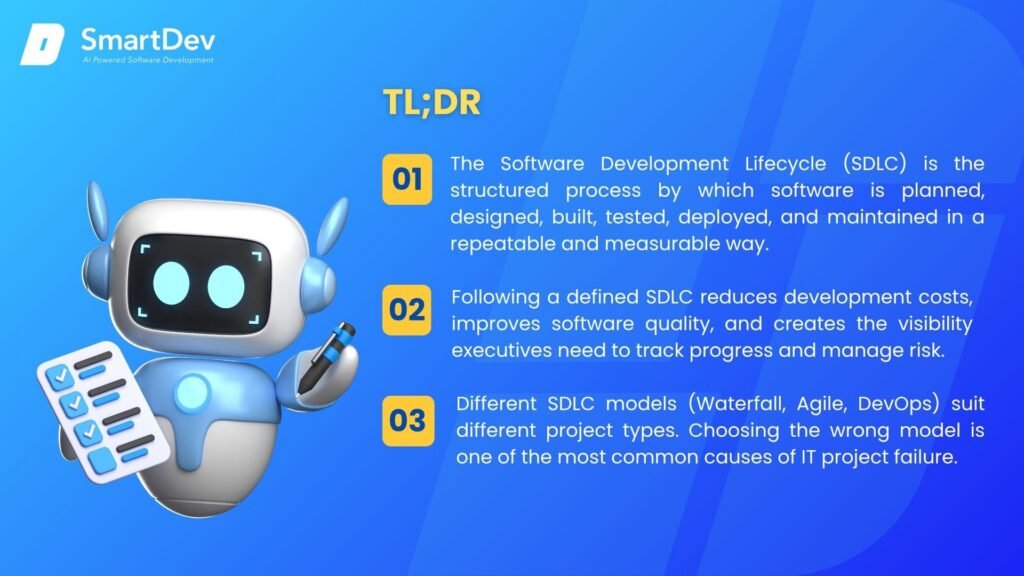
- The Software Development Lifecycle (SDLC) is the structured process by which software is planned, designed, built, tested, deployed, and maintained in a repeatable and measurable way.
- Following a defined SDLC reduces development costs, improves software quality, and creates the visibility executives need to track progress and manage risk.
- Different SDLC models (Waterfall, Agile, DevOps) suit different project types. Choosing the wrong model is one of the most common causes of IT project failure.
Software development without a defined process is an expensive gamble. Requirements get misunderstood, defects go undetected, and teams lose sight of scope. The Software Development Lifecycle is the framework that prevents this by structuring how software is built from initial idea through ongoing maintenance, with clear phases, defined outputs, and measurable quality gates at each stage.
What is the Software Development Lifecycle (SDLC)?
The Software Development Lifecycle (SDLC) is a structured framework that defines the phases, processes, and outputs involved in planning, creating, testing, deploying, and maintaining software, providing teams with a repeatable methodology to deliver quality software predictably and on budget.
The SDLC encompasses all work from the moment a software need is identified to the point when the resulting system is decommissioned. Different SDLC models sequence and weight these phases differently. The Waterfall model completes each phase fully before the next begins, delivering software in a single release at the end of the project. The Agile model iterates through phases in short cycles, delivering working software incrementally. DevOps extends Agile further by integrating continuous delivery, automating testing and deployment to enable releases at any time.
비즈니스에 중요한 이유
Without a defined SDLC, software projects operate without consistent process, making quality unpredictable, costs difficult to estimate, and progress impossible to measure against a standard baseline. This is particularly costly in IT outsourcing, where the client relies on the vendor’s process discipline to protect delivery quality.
- 줄이다 defects and rework costs by embedding quality gates at each phase rather than discovering problems at the end after significant investment.
- 개선하다 budget predictability through structured planning phases that produce realistic estimates before significant build investment begins.
- 증가시키다 delivery consistency by giving teams a repeatable process rather than reinventing the approach for every project.
- Protect business requirements by ensuring that what was agreed in planning is what gets built, tested, and delivered.
For example, a retail company that asked its outsourcing partner to adopt a structured SDLC with formal requirements sign-off and test completion criteria before each release reduced its post-release defect rate by 45% in the first year. The change was entirely process-driven: the same team, applying the same technical skill, but with structured quality gates that caught issues earlier in the cycle rather than in production.
How Does the SDLC Work?
- Planning: Define the project scope, objectives, timeline, budget, and resource requirements. Assess feasibility and identify major risks before any design or build work begins. This phase produces the project charter and delivery plan.
- Requirements Analysis: Gather and document detailed functional and non-functional requirements from stakeholders. Requirements are reviewed, agreed, and signed off by business and technical leads to establish a baseline for what will be built.
- System Design: Translate requirements into technical architecture and design specifications. Define the system structure, database schema, interface design, and technology stack. Design documents are reviewed before build begins.
- Development: Engineers build the software according to the approved design specifications. Code is reviewed by peers and validated against coding standards and the design baseline.
- Testing: QA teams verify that the built software meets the defined requirements through functional testing, integration testing, performance testing, and security testing. Defects are tracked, resolved, and retested.
- Deployment and Maintenance: The validated software is released to production. Ongoing monitoring, user support, bug fixing, and enhancement work sustains the system through its operational life.
The result is software that meets business requirements, has been validated for quality and security, and has been delivered through a process that can be repeated, measured, and improved over time.
When to Use Each SDLC Model?
- Use Waterfall when requirements are fully defined, stable, and unlikely to change, such as regulatory compliance systems or fixed-scope infrastructure projects.
- Use Agile when requirements are likely to evolve, business priorities may shift, or early delivery of working software provides direct value to users and stakeholders.
- Use DevOps when speed of deployment and continuous delivery are business priorities, particularly for cloud-native applications where automated testing and deployment pipelines can support multiple releases per day.
- Avoid choosing a model based on convention alone. The wrong SDLC model for the project type is a structural risk that persists for the entire engagement.
기타 관련 용어
Agile Methodology: The iterative SDLC approach that structures development into short cycles called sprints, enabling teams to deliver working software incrementally and adapt to changing requirements throughout the project.
품질 보증: The set of systematic activities within the SDLC that verify software meets defined requirements and quality standards, typically structured as a dedicated phase between development and deployment.
DevOps: An evolution of the SDLC that integrates development and operations workflows and automates the testing and deployment phases to enable continuous delivery of software updates to production.