
요약
- Stakeholder management is the process of identifying everyone with an interest in a project, understanding what they need, and keeping them appropriately engaged and informed throughout delivery.
- Stakeholder misalignment is one of the leading causes of IT project failure. Projects that deliver technically correct software but fail to bring stakeholders along rarely succeed.
- Effective stakeholder management is proactive and structured, not reactive. It requires a deliberate communication strategy maintained from project start to finish.
Technology projects do not fail only because of technical problems. They fail when the wrong requirements are built because key stakeholders were not consulted. They fail when executives withdraw support because they felt uninformed. They fail when end users reject a finished system because they were never involved in shaping it. Stakeholder management is the discipline that prevents these outcomes.
What is Stakeholder Management?

Stakeholder management is the systematic process of identifying all individuals and groups who have an interest in or influence over a project, assessing their expectations, concerns, and levels of influence, and designing and executing a communication and engagement strategy that keeps them appropriately informed and aligned throughout the project lifecycle.
Stakeholders in an IT project include more than the obvious executive sponsors. They include end users who will operate the system, department heads whose teams will be affected by it, IT infrastructure and security teams who must support it, finance teams who control the budget, compliance teams who must sign off on the design, and external parties such as vendors and regulators who have a stake in the outcome.
Stakeholder management does not mean giving everyone everything they ask for. It means understanding each stakeholder’s interests and concerns, communicating with them at the right frequency and level of detail, and actively managing expectations when scope, timeline, or cost assumptions need to change.
비즈니스에 중요한 이유

Research by PMI consistently shows that inadequate stakeholder engagement is one of the top contributors to project failure. Projects that keep stakeholders engaged are measurably more likely to be delivered on time, within budget, and with the functionality stakeholders actually needed.
- 줄이다 late-stage requirement changes by engaging stakeholders early, when discovering misaligned expectations is inexpensive to correct rather than costly to rebuild.
- Protect project continuity by maintaining executive sponsorship and political support, which are vulnerable when leaders feel uninformed or excluded from key decisions.
- 개선하다 user adoption by involving end users in design and testing, making them partners in shaping the system they will use rather than recipients of a solution built without their input.
- 가속하다 approvals and sign-offs by giving decision-makers a consistent, accurate picture of project status that allows them to act quickly and confidently.
For example, a government agency implementing a new case management system spent three months building a solution that met its stated technical requirements, only to face rejection from frontline staff during user acceptance testing. The staff had not been consulted during requirements gathering and the system’s workflow did not match how they actually processed cases. A three-week redesign and two months of delay followed. A stakeholder engagement plan that included frontline workers from day one would have prevented the entire episode.
How Does Stakeholder Management Work?
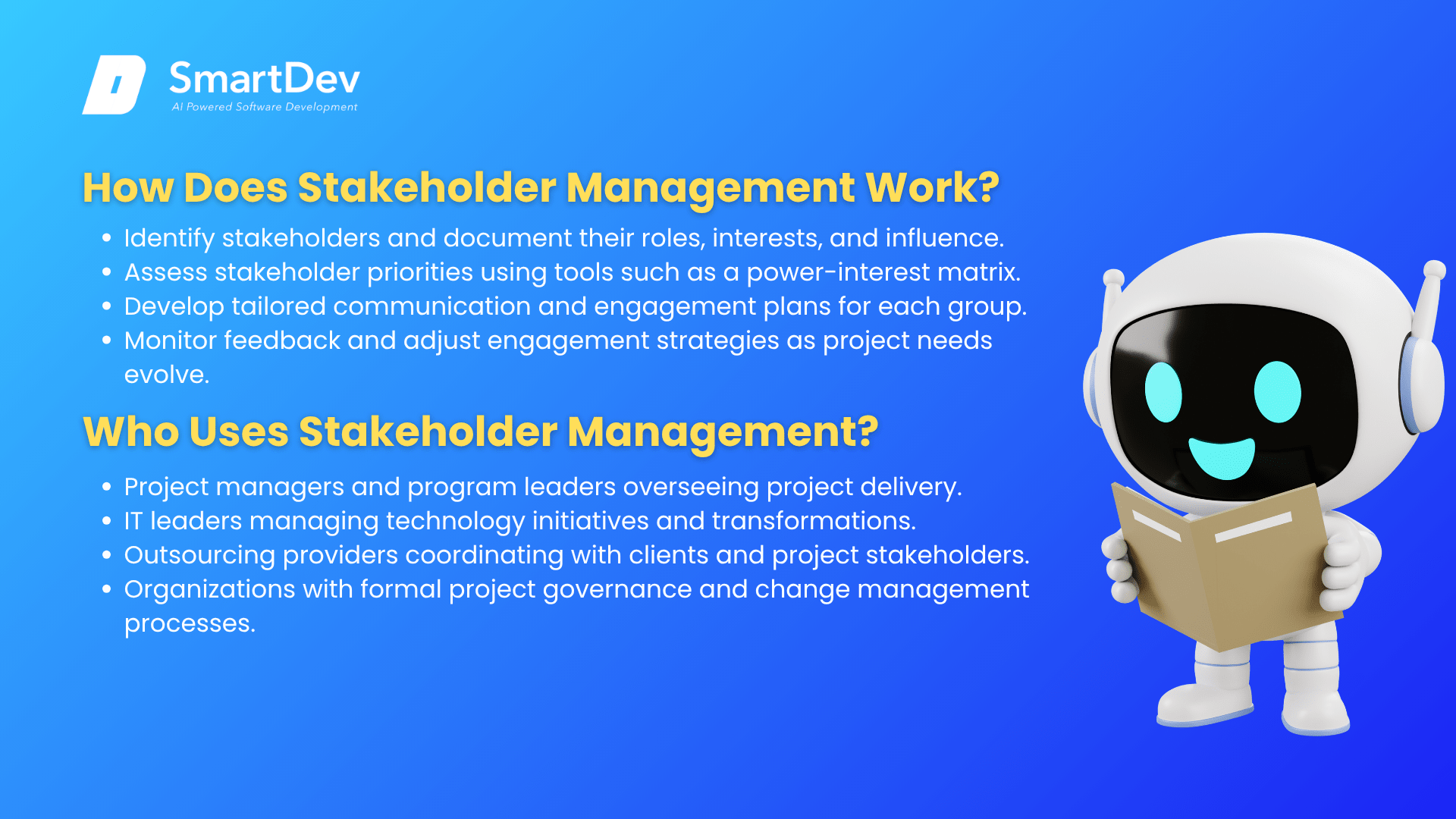
- Identify All Stakeholders: Create a comprehensive stakeholder register listing every individual and group with an interest in or influence over the project. Cast a wide net at this stage. Missed stakeholders discovered later cause more disruption than those identified early.
- Assess Interest and Influence: For each stakeholder, assess how much they care about the project (interest) and how much power they have to affect its outcome (influence). A power-interest matrix helps prioritize engagement effort: high influence, high interest stakeholders require deep, frequent engagement; low influence, low interest stakeholders need only routine updates.
- Develop an Engagement Strategy: Define how and when you will engage each stakeholder group. Document communication frequency, format, and content for each audience. Executives may need monthly steering reports. End users may need hands-on workshops. Technical teams may need detailed architecture reviews.
- Execute and Adapt: Run the communication plan consistently throughout the project. Monitor stakeholder sentiment and adjust engagement when attitudes shift or new concerns emerge. Proactively address concerns before they become escalations.
The result is a project where the people whose support it needs are informed, engaged, and aligned, giving delivery teams the organizational conditions they need to succeed.
Who Uses Stakeholder Management?
Stakeholder management is used by project managers, program directors, and IT leaders on any project with multiple affected parties, which covers virtually all significant IT initiatives. In IT outsourcing, stakeholder management spans organizational boundaries: the client must manage its own internal stakeholders while the vendor manages communication with the client team and, in some cases, end users. Organizations with mature project governance frameworks embed stakeholder management plans as a required deliverable for any project above a defined budget threshold.
기타 관련 용어
Project Governance: The framework of oversight structures and decision-making processes within which stakeholder management operates, defining who has authority to approve changes, resolve disputes, and escalate issues.
Solution Pitch: a tailored presentation that frames a vendor’s offering as the specific answer to a client’s defined business problem.
Project Charter: The foundational project document that identifies key stakeholders and their roles, establishing the basis for the stakeholder management plan that follows.