
Logistics operations are no longer judged only by their ability to move goods from point A to point B. Today, they are evaluated on accuracy, speed, and cost efficiency, all at once, and at scale. Customers expect faster deliveries, businesses demand lower operational costs, and supply chains must remain resilient despite volatility in demand, labor availability, and transportation networks.
Traditional logistics systems were never designed for this level of complexity. Rule-based planning, manual decision-making, and static optimization models struggle to keep pace with the volume of data and the frequency of decisions required in modern logistics environments.
This is where AI recommendation and matching systems, powered by intelligent AI agents, are reshaping logistics operations. Instead of automating isolated tasks, these systems introduce an intelligent decision layer that continuously learns from operational data and recommends the best possible actions in real time. The result is logistics that becomes not only faster and cheaper, but also more accurate, adaptive, and resilient.
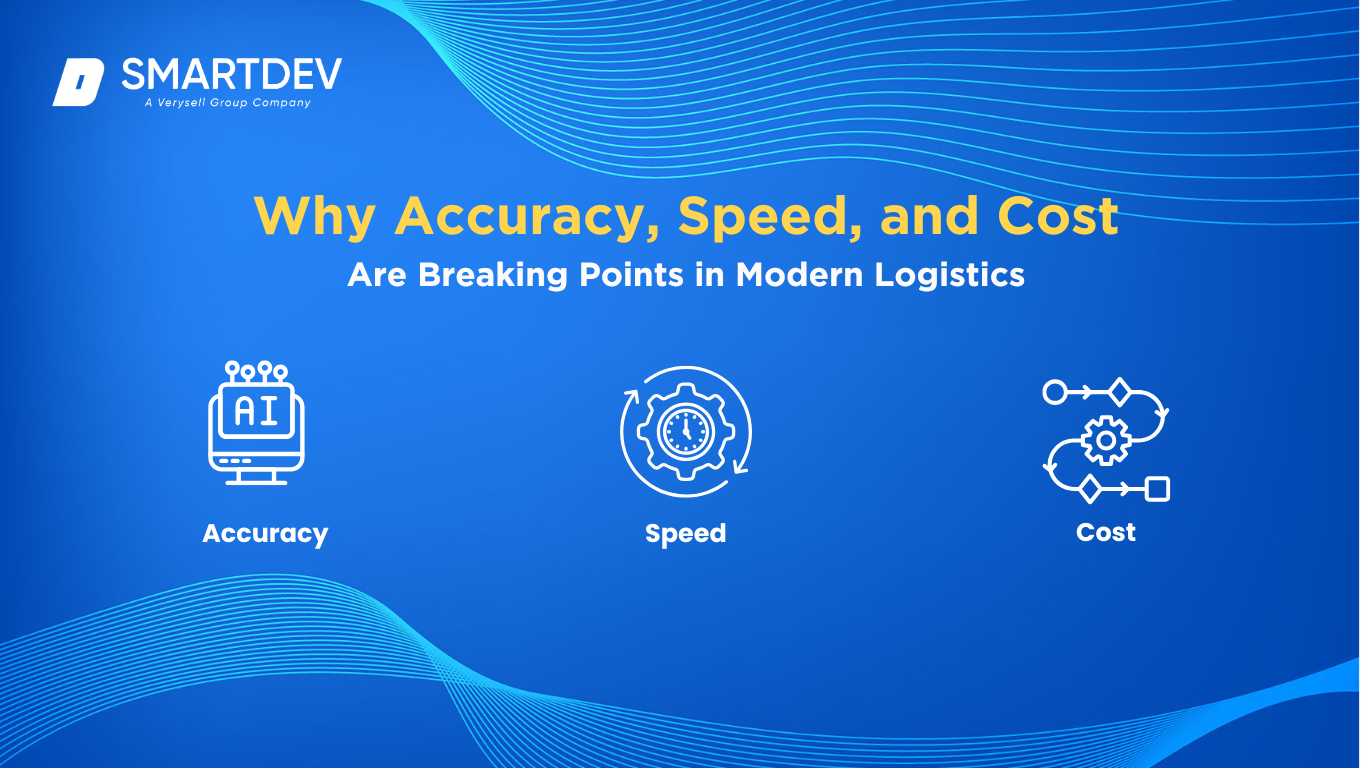
1. Why Accuracy, Speed, and Cost Are Breaking Points in Modern Logistics
Global logistics has evolved from a static process into a dynamic network of interconnected systems. The rise of e-commerce, unpredictable demand spikes, and complex multi-node transportation routes have made traditional optimization methods insufficient.
For example, the global AI in logistics market is projected to reach $20.8 billion in 2025, growing at a 45.6% compound annual growth rate (CAGR) since 2020, showing the rapid shift toward data-driven logistics systems.
Today’s logistics leaders face three core pressures:
- Accuracy: Errors in SKU classification, inventory visibility, picking, or routing ripple across the entire supply chain. A single picking mistake can trigger rework, delayed shipments, and customer dissatisfaction. As order volumes grow, even small error rates quickly translate into large financial losses.
- Speed: Customers increasingly expect same-day or next-day delivery, along with real-time tracking and precise delivery windows. These expectations leave little room for manual planning or delayed decision-making.
- Cost: Logistics costs continue to rise due to labor shortages, fuel volatility, and inefficient asset utilization. Transportation and warehousing remain among the largest operational cost centers for most enterprises.
These pressures make logistics a prime use case for intelligent systems that can operate at scale while learning from every interaction.
2. What AI Recommendation & Matching Systems Mean for Logistics Operations
At the heart of modern intelligence in logistics are AI recommendation and matching systems – advanced platforms that go well beyond basic automation. These systems are built to understand patterns, intent, and context using machine learning and semantic understanding instead of relying on static rules.
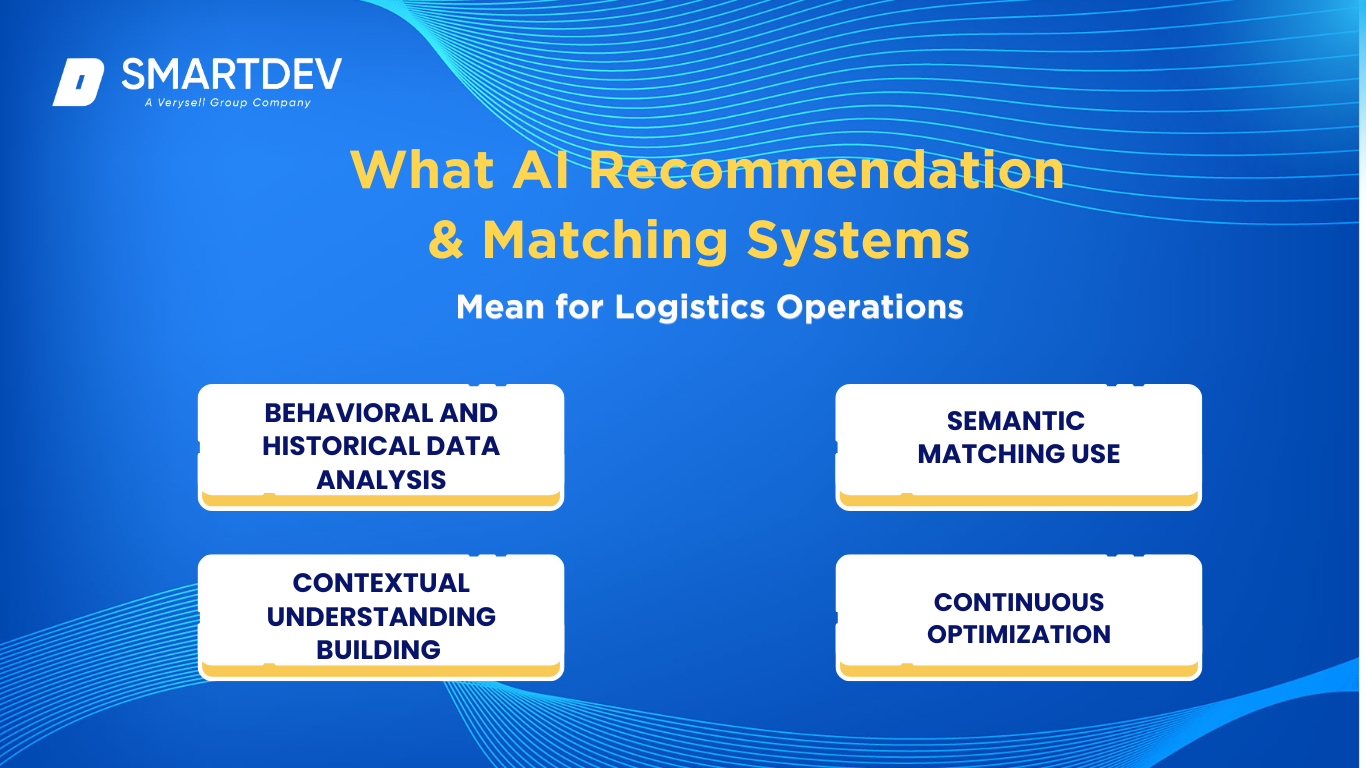
An AI recommendation and matching system:
- Analyzes behavioral and historical data – such as fulfillment patterns, picking outcomes, and shipment histories – to learn what works best.
- Builds contextual understanding by indexing operational catalogs, route options, warehouse capacities, and delivery priorities.
- Uses semantic matching (via vector search and embeddings) to surface the most relevant decisions in real time.
- Continuously optimizes based on outcomes, learning from clicks, conversions, and operational performance.
This makes AI recommendation systems fundamentally different from traditional optimization engines. Rather than outputting a single “optimal” plan, they generate ranked recommendations that adapt to changing conditions and uncertainty.
In logistics environments where conditions shift by the hour, recommendation-driven decision support often proves more resilient than rigid automation.
3. Where Logistics Operations Lose Efficiency Without Intelligent Matching
Inefficiencies in logistics often stem from poor decision support, especially in complex operational areas like catalog management, picking sequencing, and routing.
- Catalog inefficiencies: Warehouses often struggle with inconsistent SKU definitions, fragmented catalogs, and poorly indexed item data. Without intelligent indexing, searching and matching items becomes slow and error-prone, especially when dealing with substitutions, variants, or bundled items.
- Picking inefficiencies: Picking accounts for a significant share of warehouse labor costs. When pick paths are poorly sequenced or tasks are assigned without considering real-time context, workers spend excessive time traveling rather than picking. This reduces productivity and increases fatigue-related errors.
- Routing inefficiencies: Similarly, routing decisions made on old data or static rules lead to unnecessary fuel costs and delivery delays. In fact, last-mile delivery alone can account for up to 53% of total logistics costs due to its complexity and fragmentation.
These inefficiencies add up. They manifest as:
- Higher labor costs due to manual planning
- Longer cycle times from picking errors
- Missed delivery windows and increased customer complaints
Traditional Warehouse Management Systems (WMS) and Transportation Management Systems (TMS) lack the intelligence layer needed to optimize these decisions in real time, especially as demand patterns become more volatile.
4. How AI Recommendation Systems Actually Work Inside Logistics Operations
To understand their value, it is important to understand how AI recommendation and matching systems work under the hood in logistics environments.
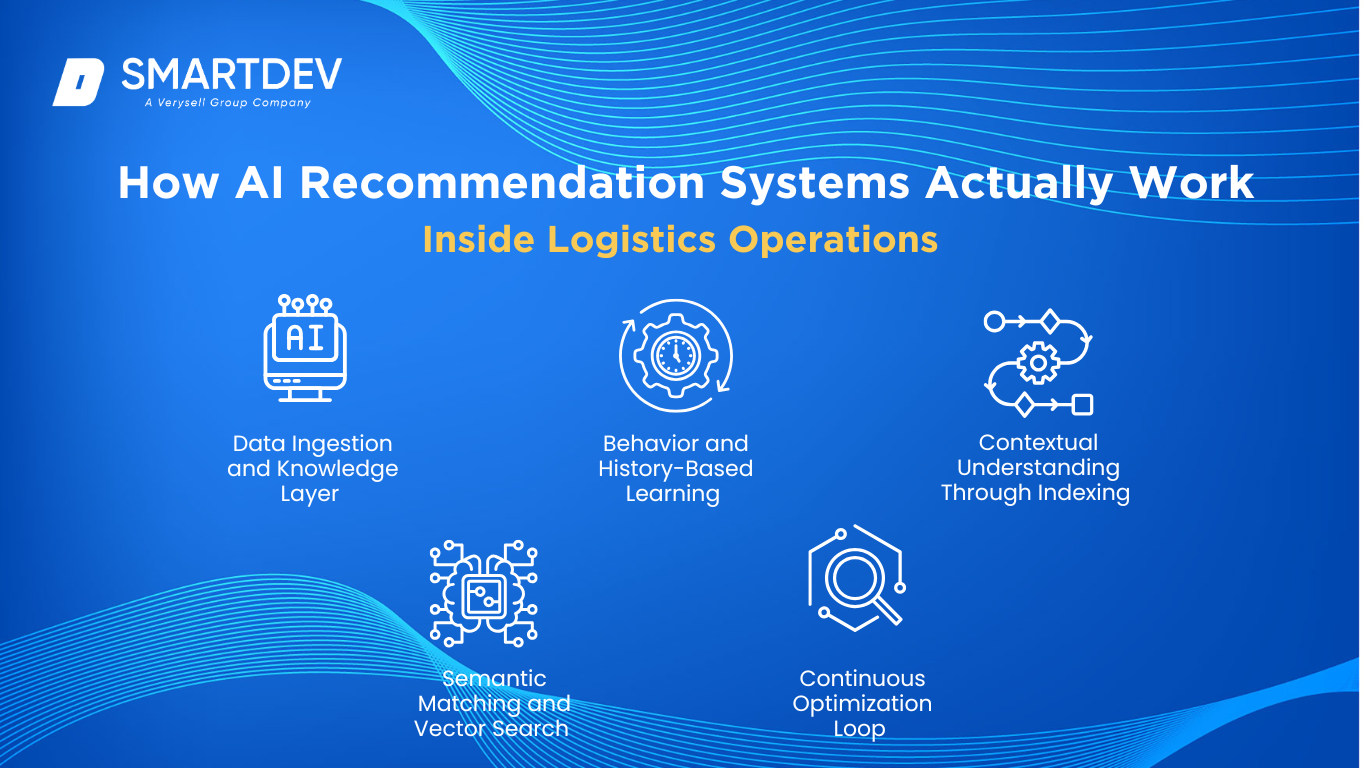
- Data Ingestion and Knowledge Layer
AI systems ingest data from WMS, TMS, ERP systems, IoT sensors, and historical operational logs. This data is synchronized into a central knowledge layer that reflects the current and historical state of operations.
- Behavior and History-Based Learning
Machine learning models analyze past outcomes to understand which decisions led to faster fulfillment, fewer errors, or lower costs. Over time, the system learns operational patterns that are difficult for humans to detect manually.
- Contextual Understanding Through Indexing
Products, routes, warehouses, and resources are indexed so they can be compared based on multiple dimensions, such as demand, capacity, proximity, and performance history.
- Semantic Matching and Vector Search
Structured and unstructured data is converted into vector embeddings, allowing the system to identify similarity and relevance beyond simple keywords. This enables more nuanced matching, such as finding substitute items or optimal routing options under constraints.
- Continuous Optimization Loop
Every recommendation outcome feeds back into the system. As conditions change, the system adapts, refining future recommendations based on real-world performance rather than assumptions.
This architecture enables AI agents to operate as decision intelligence systems, not just automation tools.
5. How SmartDev Helps Logistics Businesses Apply AI Recommendation Systems
SmartDev’s AI recommendation and matching system offers logistics businesses a practical way to bring intelligent decision support into day-to-day operations. Built on a modular architecture, the system integrates seamlessly with existing platforms like WMS, TMS, and ERP, enabling step-by-step deployment that minimizes disruption.
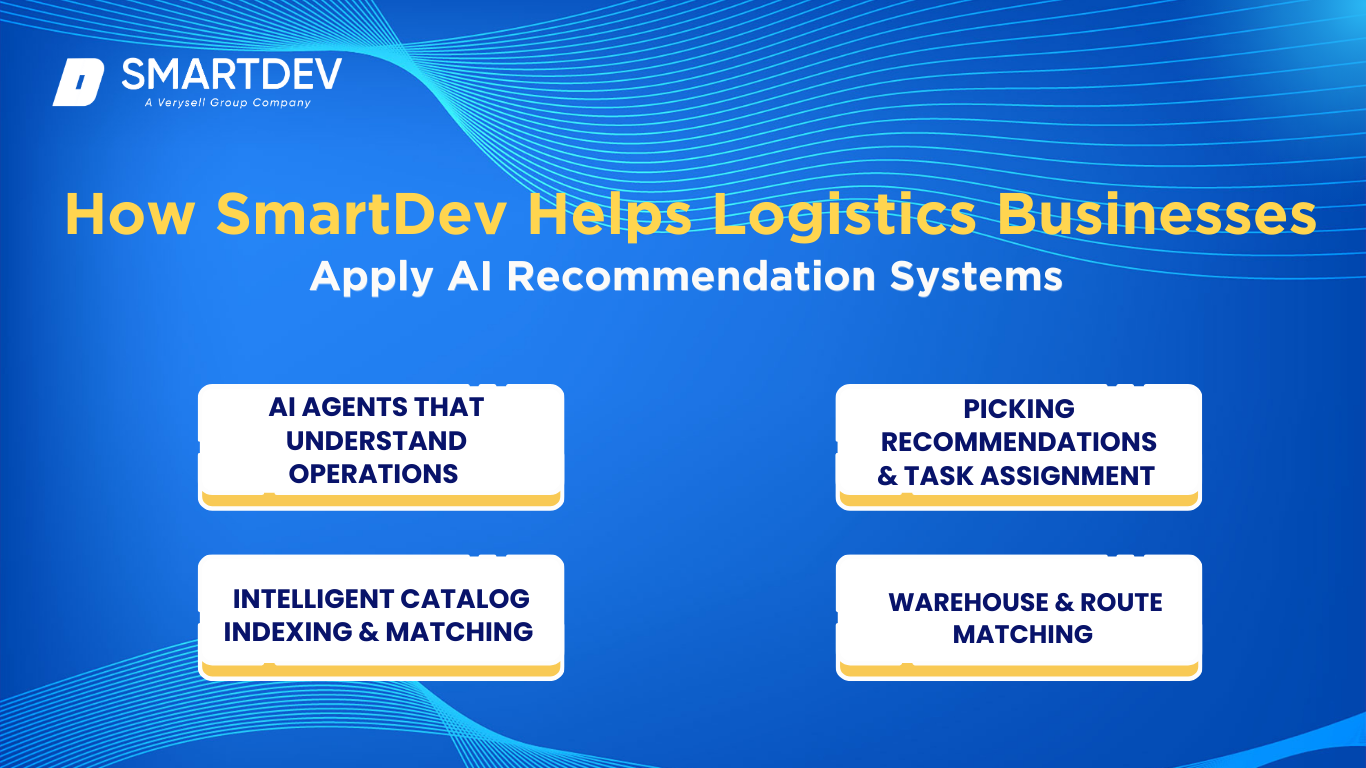
AI Agents That Understand Operations
SmartDev’s system uses data from every corner of logistics operations:
- Warehouse catalogs
- Historical picking and packing records
- Transportation and route data
- Time-series demand signals
This data feeds into machine learning models and semantic engines that understand both structure and context.
Intelligent Catalog Indexing & Matching
Instead of relying on static SKU lists, SmartDev builds a searchable, indexed catalog where items are organized based on similarity, demand patterns, and operational context. This reduces errors in search and helps systems match items more effectively for picking and sorting.
Picking Recommendations & Task Assignment
AI recommendation agents suggest:
- Which orders to pick first
- The optimal sequence of picks
- Task assignments to operators
These recommendations are not based on simple rules but on learned patterns from past operations, leading to higher picking accuracy and less idle travel time.
Warehouse & Route Matching
For logistics involving multiple warehouses, AI agents recommend:
- Which order to fulfill from which warehouse
- Which routes to use based on traffic, delivery urgency, and capacity
- Optimal load matching for vehicles
SmartDev’s system blends historical data, real-time context, and pattern detection to match operational options with expected outcomes.
6. What Changes Operationally When AI Recommendations Guide Decisions
When AI recommendation systems are applied, the impact is significant and measurable across key logistics metrics:
- Higher Accuracy & Fewer Errors
AI-driven recommendations reduce mistakes in picking, sorting, and routing by anticipating the best decisions based on learned patterns. Research shows that AI-enabled logistics systems can improve forecasting accuracy by 20–30% compared to traditional methods, translating into fewer mismatches and better resource allocation.
- Faster Fulfillment & Higher Throughput
By providing task-level recommendations and dynamic routing decisions, AI systems significantly speed up operations. Experts forecast that productivity in logistics could improve by 40% by 2035 with widespread AI adoption.
- Lower Operational Costs
AI reduces the need for manual planning and repetitive adjustments. According to industry stats, around 38% of logistics companies using AI report they can cut operating costs by up to half.
These changes help logistics operate more predictably and responsively. Warehouse workers spend less time on redundant tasks, deliveries happen more reliably, and overall throughput increases without a proportional rise in labor or infrastructure investment.
7. Data Readiness and Organizational Challenges in Adopting AI for Logistics
A common misconception is that AI requires perfect data. In reality, modern recommendation systems are designed to work with imperfect, unannotated, and fragmented data.
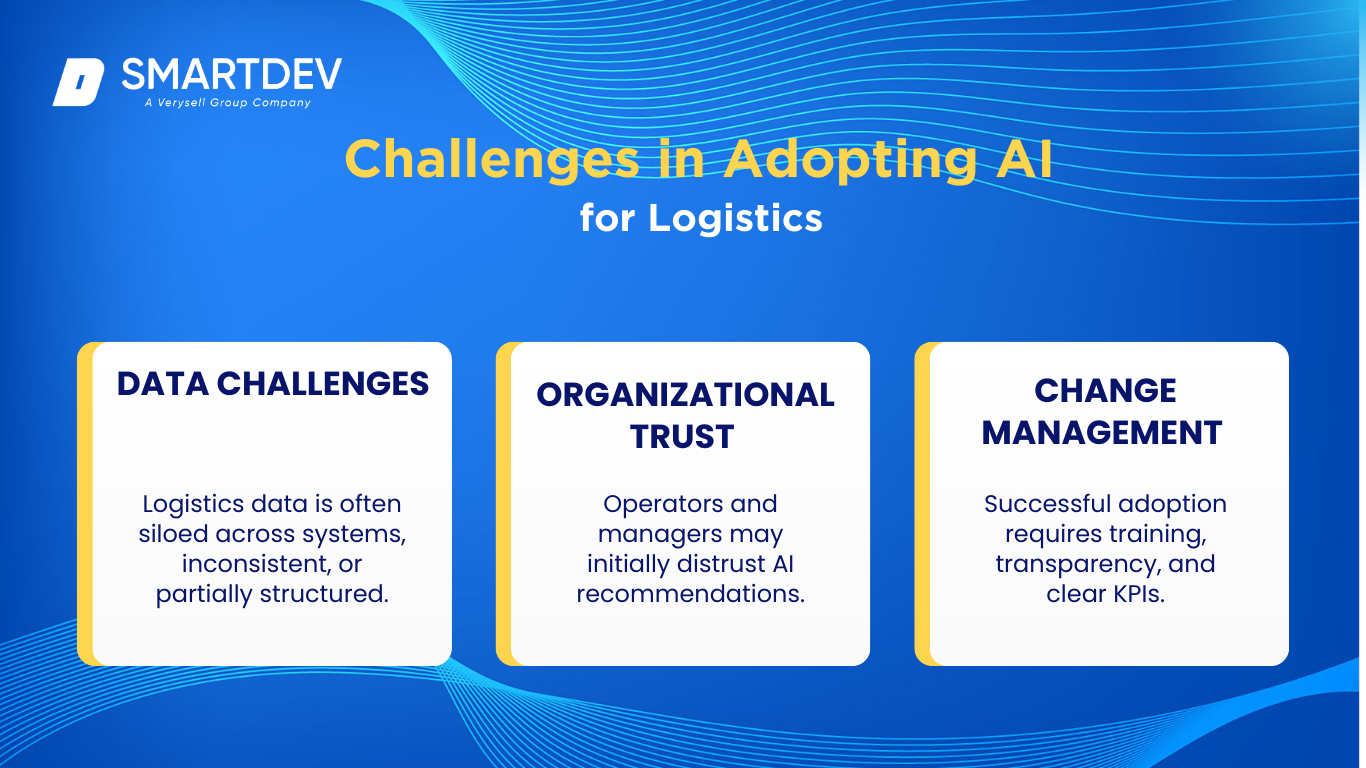
- Data challenges
Logistics data is often siloed across systems, inconsistent, or partially structured. AI recommendation systems overcome this by learning from patterns rather than relying solely on manual labeling.
- Organizational trust
Operators and managers may initially distrust AI recommendations. Human-in-the-loop approaches help build trust by keeping humans in control while allowing AI to prove its value over time.
- Change management
Successful adoption requires training, transparency, and clear KPIs. AI must be positioned as a support tool, not a replacement for expertise.
8. Deploying Smart AI Recommendation Systems Without Disrupting Operations
One common fear among logistics leaders is that advanced AI implementation will require costly overhauls or painful system migrations. SmartDev’s approach directly addresses this concern.
Modular and Incremental Deployment
SmartDev’s AI system can be rolled out in modules, such as:
- Catalog intelligence module
- Picking recommendation module
- Routing optimization module
This means businesses can start with high-impact areas – such as picking accuracy or route matching – and expand gradually based on results and KPIs.
Integration with Existing Platforms
Rather than replace WMS or TMS, SmartDev’s system sits alongside them, ingesting data and outputting recommendations that enhance existing processes. This minimizes disruption and preserves existing investments.
Human-in-the-Loop Support
SmartDev’s AI operates as an assistant, not a replacement for human expertise. Logistics managers still retain control, using AI recommendations to inform decisions while providing oversight and feedback that help the system learn over time.
Security, Governance & Enterprise Readiness
SmartDev structures AI inputs and outputs with robust security protocols, ensuring sensitive operational data remains protected and compliant with industry standards – a critical requirement for logistics enterprises handling confidential information.
9. The Future of Logistics Operations Powered by AI Agents
As AI matures, logistics operations will increasingly rely on multi-agent systems coordinating decisions across warehouses, fleets, and inventory.
The future points toward:
- Predictive and prescriptive logistics
- Autonomous decision support across the supply chain
- AI recommendation systems acting as the control layer of logistics operations
Organizations that adopt these systems early will be better positioned to handle volatility and scale efficiently.
Conclusion
AI recommendation and matching systems are reshaping how logistics operations make critical decisions – from catalog management to order picking, warehouse selection, and routing. These systems elevate logistics from reactive and labor-intensive processes to intelligent, data-driven operations.
Companies that adopt AI see improvements in accuracy, speed, and cost efficiency – with measurable benefits that include enhanced throughput, lower operational costs, and more reliable fulfillment.
SmartDev’s AI-powered recommendation and matching systems help logistics and warehouse organizations overcome operational complexity by enabling intelligent decision-making at scale. With seamless integration into existing WMS, TMS, and ERP platforms, SmartDev delivers real-time data synchronization, context-aware recommendations, and AI agents that continuously learn from operational outcomes. This allows logistics teams to improve accuracy, accelerate fulfillment, and reduce costs without disrupting ongoing operations.
As AI continues to reshape the future of logistics, staying competitive requires more than adopting new technology. It demands a strategic approach to data, continuous optimization, and a partner that understands how to deploy AI reliably in complex, real-world environments.
Ready to leverage AI to optimize your logistics and warehouse operations?
Contact SmartDev today to explore how our AI recommendation and matching systems can help you build faster, smarter, and more cost-efficient logistics operations.