

Most product teams do not fail because they lack ideas. They fail because they commit too early to the wrong ones. Roadmaps tend to grow faster than clarity. Feature requests arrive from sales, marketing, leadership, customers, and sometimes competitors. Each request sounds reasonable in isolation. Over time, however, products become overloaded with capabilities that are expensive to build, harder to maintain, and increasingly disconnected from real business outcomes.
This is why value-based feature prioritization is not a tactical exercise at SmartDev. It is a strategic discipline. We treat prioritization as the mechanism that determines whether a product will deliver measurable business value—or quietly accumulate technical debt and organizational friction.
What follows is how SmartDev prioritizes features in practice, starting from business objectives, applying a structured three-week discovery process, validating decisions through industry-relevant success metrics, and grounding everything in real delivery experience.
Business Objectives before Discovery
Discovery is often described as the phase where teams “figure out what to build.” In reality, discovery only works when it begins one step earlier: by agreeing on what success means for the business.
SmartDev does not begin discovery with features, wireframes, or architecture discussions. We begin by clarifying the business objective the product must serve. This is where many initiatives quietly derail. Teams frequently align around abstract goals such as “better engagement,” “smarter automation,” or “greater scalability,” without defining what tangible change would justify the investment.
At SmartDev, business objectives are not inspirational statements. They are decision constraints. An objective must be specific enough to shape trade-offs, because prioritization is fundamentally about deciding what not to build. When objectives are vague, every feature can claim importance. When objectives are explicit, prioritization becomes disciplined.
This framing also creates early alignment across roles. Business leaders, product owners, designers, and engineers operate from the same definition of value. That alignment matters because prioritization does not end once development starts. It is tested continuously as new ideas emerge, constraints surface, and timelines evolve.
Only after business objectives are clear does discovery become productive. At that point, discovery is no longer open-ended exploration. It becomes a structured effort to identify which problems are worth solving and which solutions can realistically deliver value under real-world conditions.
Why Follow the 3-week Discovery Program
SmartDev’s three-week discovery program exists to compress uncertainty before it turns into cost. It is intentionally time-boxed and structured to force clarity, alignment, and prioritization without drifting into analysis paralysis. Each week serves a distinct business purpose, progressively reducing ambiguity while increasing confidence.
Week 1: Business context, users, and constraints
The first week establishes the foundation for every prioritization decision that follows. SmartDev works closely with stakeholders to understand the business context, user realities, and organizational constraints shaping the product.
Through stakeholder interviews and workshops, we surface goals, pain points, assumptions, and dependencies that are often implicit or misaligned. In parallel, we review existing systems, processes, and data landscapes to ensure ideas are grounded in operational reality rather than aspiration.
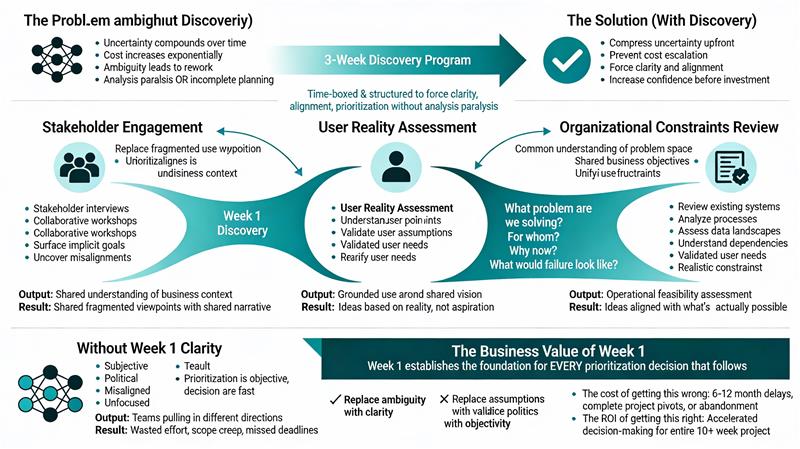
From a business perspective, this week replaces fragmented viewpoints with a shared narrative. It answers fundamental questions: What problem are we solving? For whom? Why now? And what would failure look like? Without this clarity, feature discussions remain subjective and political. With it, features can be evaluated against a common understanding of the problem space.
Week 2: Value-based evaluation and prioritization
The second week moves from understanding to judgment. Insights gathered in Week 1 are consolidated into structured use cases and requirements, which are then evaluated through the lens of value, effort, risk, and dependency.
This is where feature prioritization for business value becomes explicit. Features are no longer compared based on perceived importance or stakeholder influence. They are assessed based on how directly they contribute to the agreed business objective, how complex they are to deliver, and what risks they introduce.
Architectural options and data considerations are explored alongside prioritization to ensure that decisions reflect technical feasibility as well as business ambition. For AI-enabled products, this stage is particularly critical. AI is not treated as a default enhancement. It is evaluated as a tool whose inclusion must be justified by measurable impact, data readiness, and long-term operability.
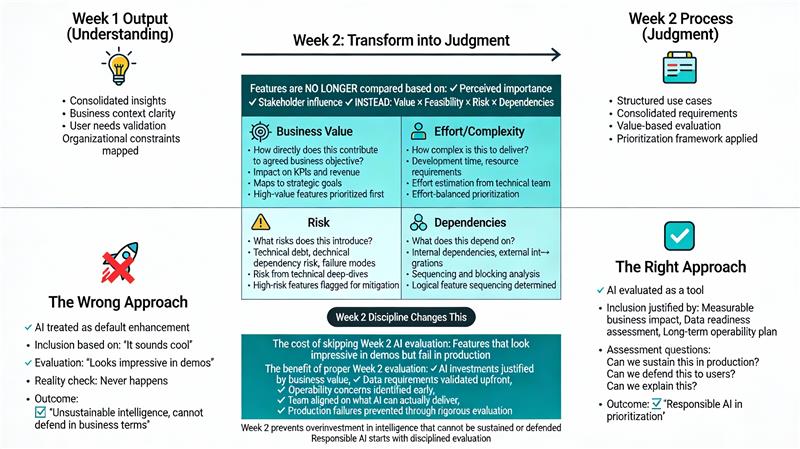
This discipline is what enables responsible AI in feature prioritization. It prevents teams from overinvesting in intelligence that looks impressive in demos but cannot be sustained in production or defended in business terms.
Week 3: Synthesis, MVP definition, and execution readiness
The third week translates analysis into commitment. Insights from earlier weeks are synthesized into a clear solution vision, a defined MVP scope, and a phased roadmap that reflects real delivery constraints.
Rather than producing an exhaustive wish list, SmartDev focuses on sequencing. Which features must come first to validate value? Which can wait without undermining the core objective? What dependencies must be resolved early to avoid rework later?
From a business standpoint, this week turns prioritization into execution readiness. Leadership leaves discovery not with abstract ideas, but with a roadmap that explains why certain features come first, what outcomes they are expected to drive, and how future phases build on validated value rather than speculation.
Success Metrics: How Prioritization Solves Real Business Problems
Prioritization only delivers value if success is measurable. Without metrics, “value-based” becomes a label rather than a discipline. At SmartDev, success metrics are defined during discovery because they directly influence feature decisions. Metrics act as a bridge between business objectives and prioritization, clarifying how the organization will know whether its choices were correct.
In consumer and digital products, metrics such as activation rates, repeat usage, and retention curves address the problem of short-lived engagement. These metrics push teams to prioritize features that change user behavior, rather than features that generate momentary attention but fail to build habits.
In enterprise and B2B platforms, success metrics often focus on task completion time, workflow adoption, and operational efficiency. These metrics solve the problem of shelfware—systems that are technically complete but rarely used. Prioritization favors features that reduce friction and replace manual processes, ensuring the product becomes embedded in daily operations.
In revenue-driven products, metrics such as conversion rates, deal velocity, and churn reduction help teams avoid building features that generate interest without influencing buying decisions. Prioritization becomes tightly linked to commercial outcomes rather than feature volume.
In regulated or high-risk environments, metrics related to error reduction, compliance adherence, and system reliability take precedence. These metrics solve the problem of hidden risk by ensuring stability and governance features are not deferred in favor of more visible enhancements.
Across industries, metrics also protect teams from scope creep. When new feature ideas arise, the conversation shifts from opinion to evidence: which metric does this improve, and how does it compare to existing priorities? If the answer is unclear, the feature does not outrank those already tied to measurable outcomes. For AI-enabled products, this discipline is essential. Technical performance alone is insufficient. AI-related features must demonstrate business impact and operational sustainability, not just algorithmic sophistication.
Consulting & Discovery in Practice
SmartDev’s consulting and discovery approach is designed to produce decisions, not just insights. The goal is to leave discovery with a shared understanding of value, a defensible prioritization rationale, and a roadmap that teams can execute without constant renegotiation.
Discovery outputs are not treated as static documents. They become reference points that guide development, stakeholder communication, and future prioritization as the product evolves. When teams move into delivery, the value logic established during discovery continues to shape trade-offs and iteration decisions.
This continuity is critical. Prioritization does not stop once development begins; it is validated through prototyping, user feedback, and operational testing. SmartDev’s delivery models are structured to preserve this alignment between strategy and execution.
A clear example of this can be seen in how the Next-Gen Countdown App was shaped through the three-week discovery process.
A Successful Case Study: Next-Gen Countdown App
The Next-Gen Countdown App began not as a feature-driven idea, but as a response to a clear business challenge: sustaining user engagement in a market saturated with utility-based reminder apps. The goal was not to build “a better countdown,” but to create a product that helped users maintain meaningful personal connections over time.
During Week 1 of discovery, SmartDev worked with stakeholders to clarify this objective and examine user behavior. Interviews and early analysis revealed that traditional reminder apps failed not because they lacked functionality, but because they lacked emotional relevance. Users received notifications, but those interactions felt transactional and forgettable. This insight reframed the problem from “add more features” to “make interactions feel personal and meaningful.”
In Week 2, potential features were evaluated against this clarified objective. AI-generated content, personalized greetings, and digital avatars emerged as high-value capabilities because they directly supported emotional engagement. Other ideas that did not clearly contribute to this goal were deliberately deprioritized, even if they were technically feasible or commonly found in competing products. Architecture discussions ensured these features could scale reliably and integrate smoothly with contact management, notifications, and backend services.
By Week 3, these decisions were synthesized into a focused MVP scope and phased roadmap. The initial release prioritized features that could validate the engagement hypothesis quickly, while establishing a scalable foundation for future enhancements. AI was applied where it amplified relevance and personalization, not where it would add unnecessary complexity.
The outcome demonstrated the effectiveness of discovery-driven prioritization. Development progressed faster, quality improved, and defects were reduced—not because the team worked harder, but because early decisions eliminated rework and misalignment. Most importantly, the final product delivered a coherent value proposition rather than a collection of disconnected features.
This case illustrates how a structured three-week discovery process turns business objectives into a prioritized roadmap that can be executed with confidence.
From Prioritization to Sustained Value
Feature prioritization is often treated as a one-time activity. In reality, it is an ongoing discipline that must withstand changing market conditions, user feedback, and organizational pressure.
SmartDev’s approach works because it anchors prioritization in business objectives, reinforces it through structured discovery, and protects it with measurable success metrics. This creates a product feature strategy that is resilient rather than fragile.
When priorities are clear, teams move faster because they argue less. When metrics are defined, stakeholders align because outcomes are visible. When discovery is disciplined, innovation becomes purposeful rather than experimental for its own sake.
This is the difference between a roadmap that looks busy and a product that actually delivers business value.
Conclusion
Value-based feature prioritization is not about saying yes to fewer ideas. It is about saying yes with confidence. By starting with business objectives, structuring discovery to force alignment and trade-offs, defining success metrics that solve real business problems, and carrying those decisions through delivery, SmartDev helps teams build products that justify their existence in measurable terms.
If your roadmap feels full but unfocused, the problem is rarely execution. It is prioritization. SmartDev’s discovery and consulting approach exists to solve that problem before cost, complexity, and compromise become permanent.
If you are planning a product or rethinking an existing one and want prioritization decisions grounded in real business outcomes rather than opinion, SmartDev is ready to help you start with clarity and build with purpose.
Speed without prioritization leads to products that ship fast but deliver little