
Introduction
Every missing paper receipt, illegible signature, or delayed delivery update isn’t just an administrative headache – it is a direct hit to your bottom line. In today’s hyper-connected market, relying on manual paperwork to verify shipments is the fastest way to bottleneck your operations.
In high-volume logistics and supply chain management, operational velocity is directly tied to cash flow. Organizations spend significant capital optimizing warehouse management and route efficiency, yet many still experience a critical bottleneck at the final step of the supply chain: The point of delivery.
Paper-based validation and fragmented legacy systems present a severe threat to operational efficiency. Disconnected workflows invariably cause administrative delays, misplaced documentation, and prolonged billing cycles. When delivery confirmation relies on manual data entry, the resulting friction strains customer support, complicates dispute resolution, and defers revenue recognition. For scaling enterprises, manual validation is a costly liability.
To eliminate these inefficiencies, forward-thinking organizations are integrating Proof of Delivery automation directly into their workflow automation processes. Digitizing the last mile enables enterprises to remove friction at the point of delivery, accelerate the Order-to-Cash (O2C) cycle, and achieve the end-to-end visibility required to sustain long-term business growth.
Common Types of Proof of Delivery Systems
Proof of Delivery (POD) is a confirmation process used in logistics and supply chain operations to verify that a shipment or package has been successfully delivered to the intended recipient. It serves as official evidence that the delivery was completed accurately, at the correct location, and within the expected timeframe.
Modern logistics operations use several types of POD methods depending on the industry, delivery environment, and operational requirements:
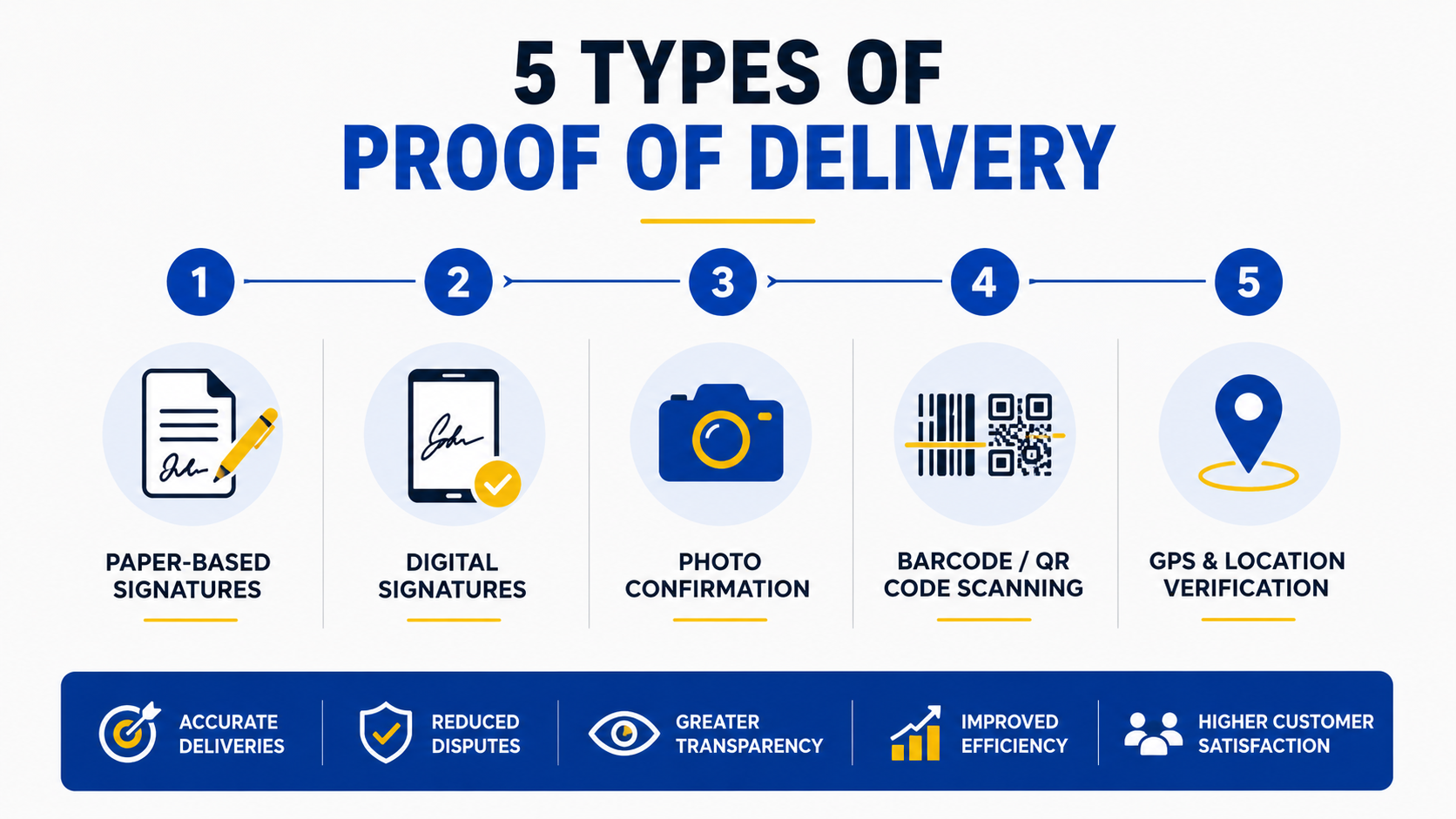
1. Paper-Based Signatures
Paper-based signatures represent the most traditional and widely recognized form of Proof of Delivery (POD). In this process, customers physically sign printed delivery receipts or shipping documents at the time goods are received. The signed paperwork is then returned to logistics offices or warehouses, where employees manually verify, archive, and reconcile the documents with delivery records and invoices.
While still used in some industries, paper-based processes are often slow, difficult to track, and highly dependent on manual handling. Delivery confirmations are often delayed because paperwork may only be submitted after drivers complete their routes or return to a central location. Furthermore, physical documents can easily be lost, damaged, misfiled, or delayed during transportation between operational teams.
2. Digital Signatures
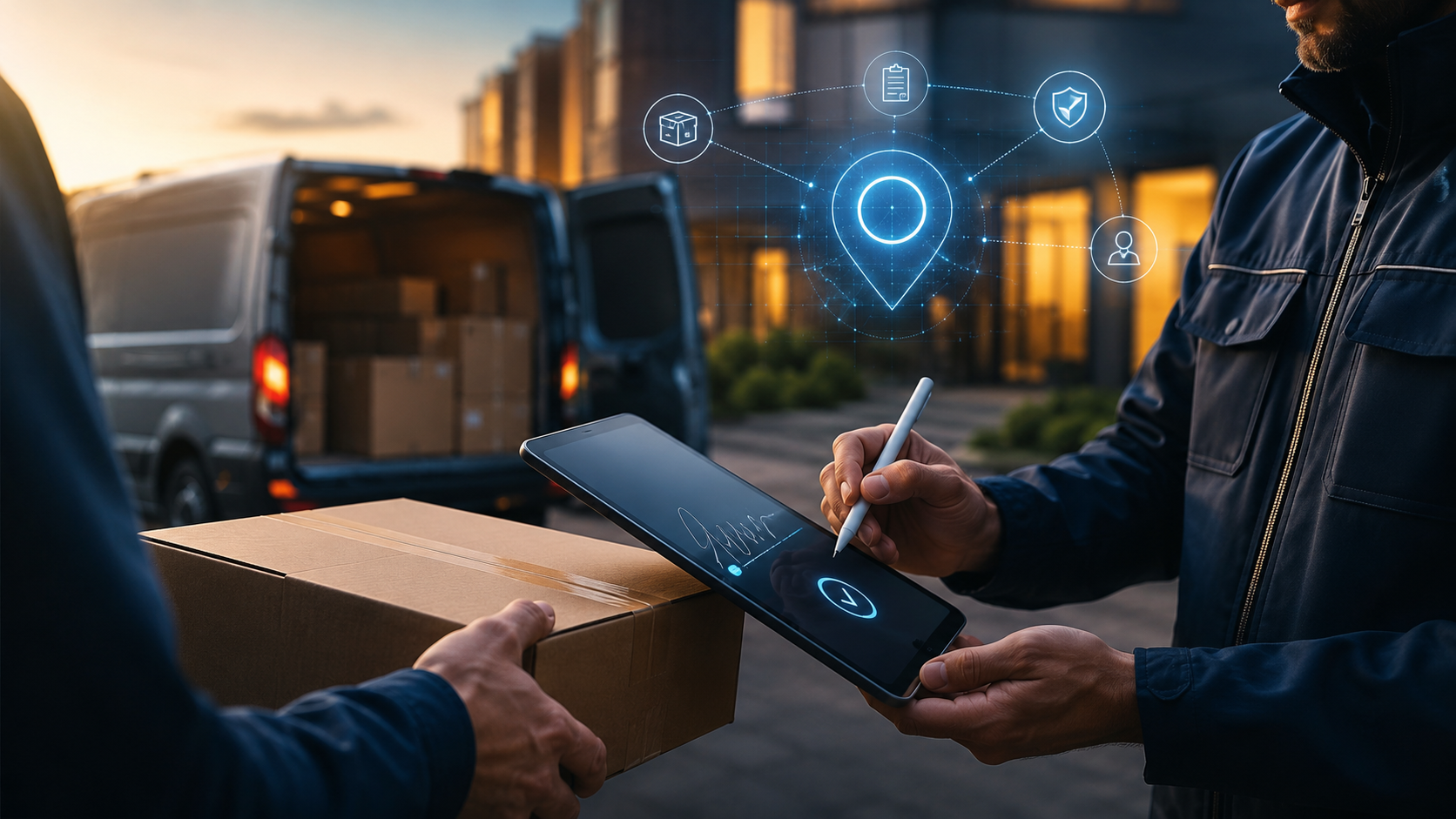
Digital signatures modernize the proof of delivery process by allowing customers to sign electronically through mobile devices, tablets, or handheld delivery applications. Instead of relying on physical paperwork, signatures are captured digitally at the point of delivery and automatically uploaded into centralized logistics or enterprise systems.
In addition, digital signature solutions often integrate directly with transportation management systems (TMS), warehouse management systems (WMS), and enterprise resource planning (ERP) platforms. This enables organizations to automate downstream processes such as invoicing, order reconciliation, and customer notifications. Compared to paper-based methods, digital signatures reduce administrative overhead, minimize documentation errors, and create a more scalable delivery verification process.
3. Photo Confirmation
Drivers can capture photos of delivered packages as visual evidence of successful delivery. This method is commonly used in e-commerce and contactless delivery operations to reduce disputes and improve transparency.
This method has become increasingly important in e-commerce, last-mile delivery, and contactless logistics environments, where businesses need stronger delivery verification without requiring direct customer interaction. Visual evidence helps reduce disputes related to missing packages, damaged shipments, or incorrect delivery claims by providing clear documentation of delivery conditions and locations.
4. Barcode or QR Code Scanning
Packages are scanned at different stages of the delivery journey using barcode or QR code technology. Each package is assigned a unique barcode or QR code that can be scanned during warehouse processing, transportation, loading, unloading, and final delivery confirmation.
When drivers scan packages upon delivery, shipment status is updated automatically in real time across connected systems. This reduces reliance on manual data entry and provides continuous shipment visibility for logistics teams, customers, and business stakeholders.
5. GPS and Location Verification
Modern delivery applications can capture GPS coordinates at the moment of delivery. This helps businesses verify that deliveries were completed at the correct destination and provides additional operational visibility.
Real-time location tracking also strengthens operational visibility and customer communication. Logistics teams can monitor delivery progress dynamically, while customers receive more accurate delivery updates and estimated arrival times. In industries with strict compliance, security, or service-level requirements, GPS verification helps organizations maintain reliable delivery records and improve audit traceability.
The Hidden Costs of Manual Proof of Delivery Processes
While proof of delivery plays a critical role in logistics operations, many businesses still rely on manual and paper-based workflows to manage POD documentation. As delivery volumes increase and supply chains become more complex, these traditional processes often create operational inefficiencies that slow down business performance.
From delayed invoicing to compliance risks, manual POD handling can introduce significant bottlenecks across logistics, finance, and customer service operations.
This is exactly the gap that NORA – SmartDev’s AI adoption accelerator – is designed to solve. Rather than treating AI as a chatbot, NORA helps enterprises embed cognitive automation directly into their existing logistics infrastructure. Instead of requiring human operators to manually verify thousands of digital delivery receipts, photos, and signatures, NORA acts as an intelligent orchestrator.
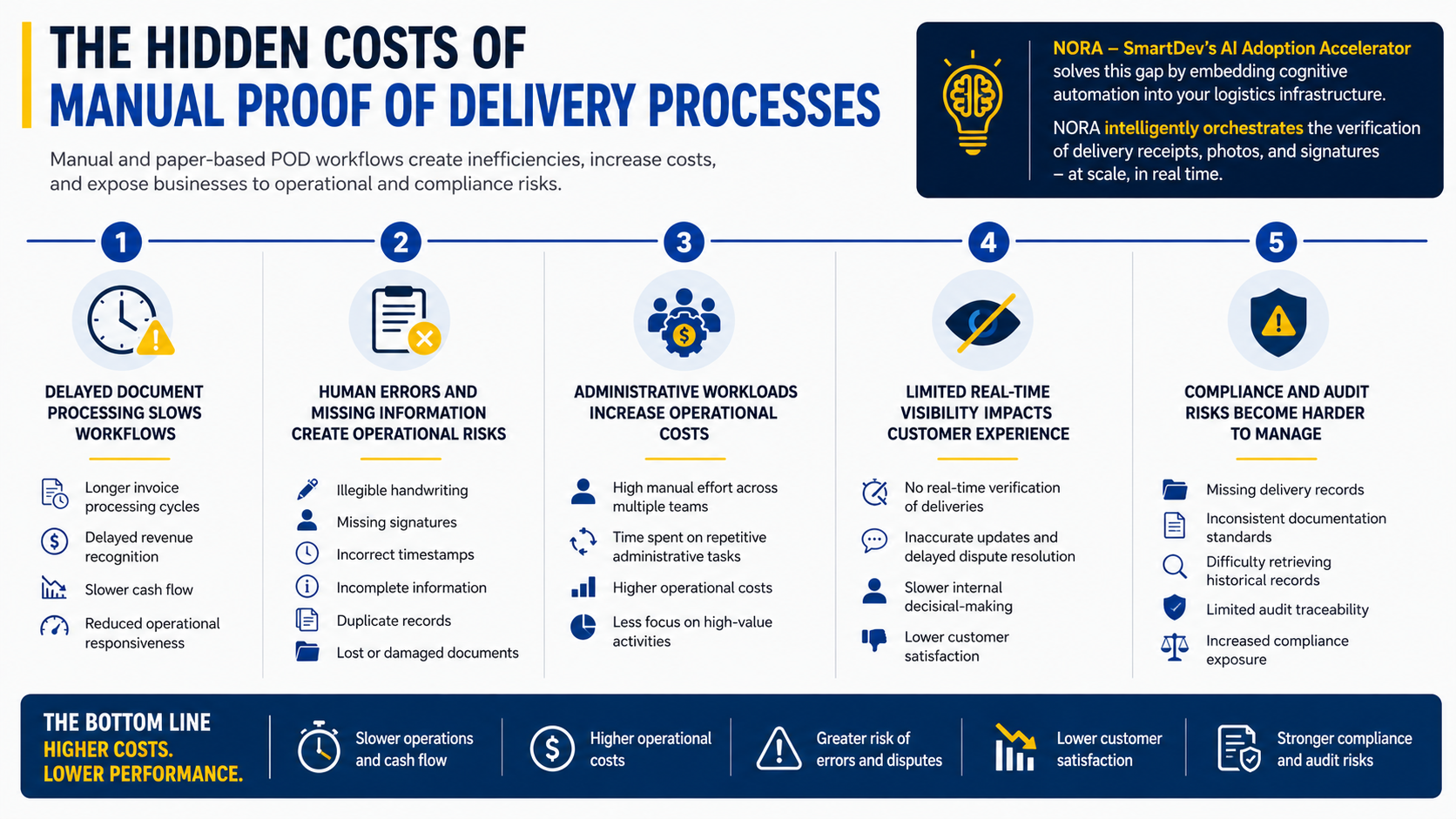
1. Delayed Document Processing Slows Operational Workflows
One of the most common challenges in manual proof of delivery processes is delayed document handling. In traditional workflows, drivers often submit signed delivery documents at the end of a shift or after returning to a warehouse or office location. This creates a lag between the actual delivery event and the moment the information becomes available to internal teams.
In many cases, POD documents must then be manually scanned, uploaded, emailed, or entered into business systems. These additional administrative steps create operational bottlenecks that slow down downstream processes such as order verification, invoicing, and payment collection. As a result, businesses may experience: Longer invoice processing cycles, delayed revenue recognition, slower cash flow and reduced operational responsiveness.
2. Human Errors and Missing Information Create Operational Risks
Manual workflows are highly vulnerable to human error, especially when delivery documentation depends on paper forms and repetitive data entry. Common issues include:
- Illegible handwriting
- Missing customer signatures
- Incorrect delivery timestamps
- Incomplete delivery information
- Duplicate records
- Lost or damaged documents
These errors can create disputes between customers, logistics providers, and finance teams. Inaccurate or incomplete POD records may also delay invoice approvals and increase the time required to resolve customer complaints. In high-volume logistics environments, even minor documentation mistakes can quickly scale into costly operational problems.
3. Administrative Workloads Increase Operational Costs
Manual proof of delivery workflows often require significant administrative effort across multiple departments.Operations teams may spend hours collecting delivery receipts, while finance teams manually reconcile invoices against delivery confirmations. Customer service teams may also need to coordinate with drivers and warehouses to retrieve missing documentation.
Instead of focusing on higher-value operational activities, employees become occupied with repetitive administrative tasks that could otherwise be automated. Over time, these repeated manual tasks create hidden labor costs that scale directly with delivery volume.
4. Limited Real-Time Visibility Impacts Customer Experience
Modern customers increasingly expect real-time updates and faster communication regarding delivery status. However, manual POD workflows often prevent businesses from accessing delivery information immediately. In competitive logistics environments, slow communication can easily turn a minor delivery issue into a poor customer experience.
Without real-time visibility, operations teams cannot instantly verify completed deliveries. Furthermore, customer service teams struggle to provide accurate updates as delivery disputes take longer to resolve. As a result, internal decision-making becomes slower. The lack of centralized, real-time delivery data can negatively impact both operational efficiency and customer satisfaction.
5. Compliance and Audit Risks Become More Difficult to Manage
Proof of delivery documents are not only operational records – they are also important compliance and audit assets. When documentation is stored manually across paper files, emails, spreadsheets, or disconnected systems, businesses may face: Missing delivery records, inconsistent documentation standards, difficulty in retrieving historical records, limited audit traceability or increased compliance exposure.
Industries with strict regulatory or contractual requirements may face even greater risks if delivery evidence cannot be retrieved quickly or validated accurately. As organizations scale, maintaining compliance through manual documentation processes becomes increasingly difficult and unsustainable.
The Strategic Shift from Basic Digitization to Intelligent POD Automation
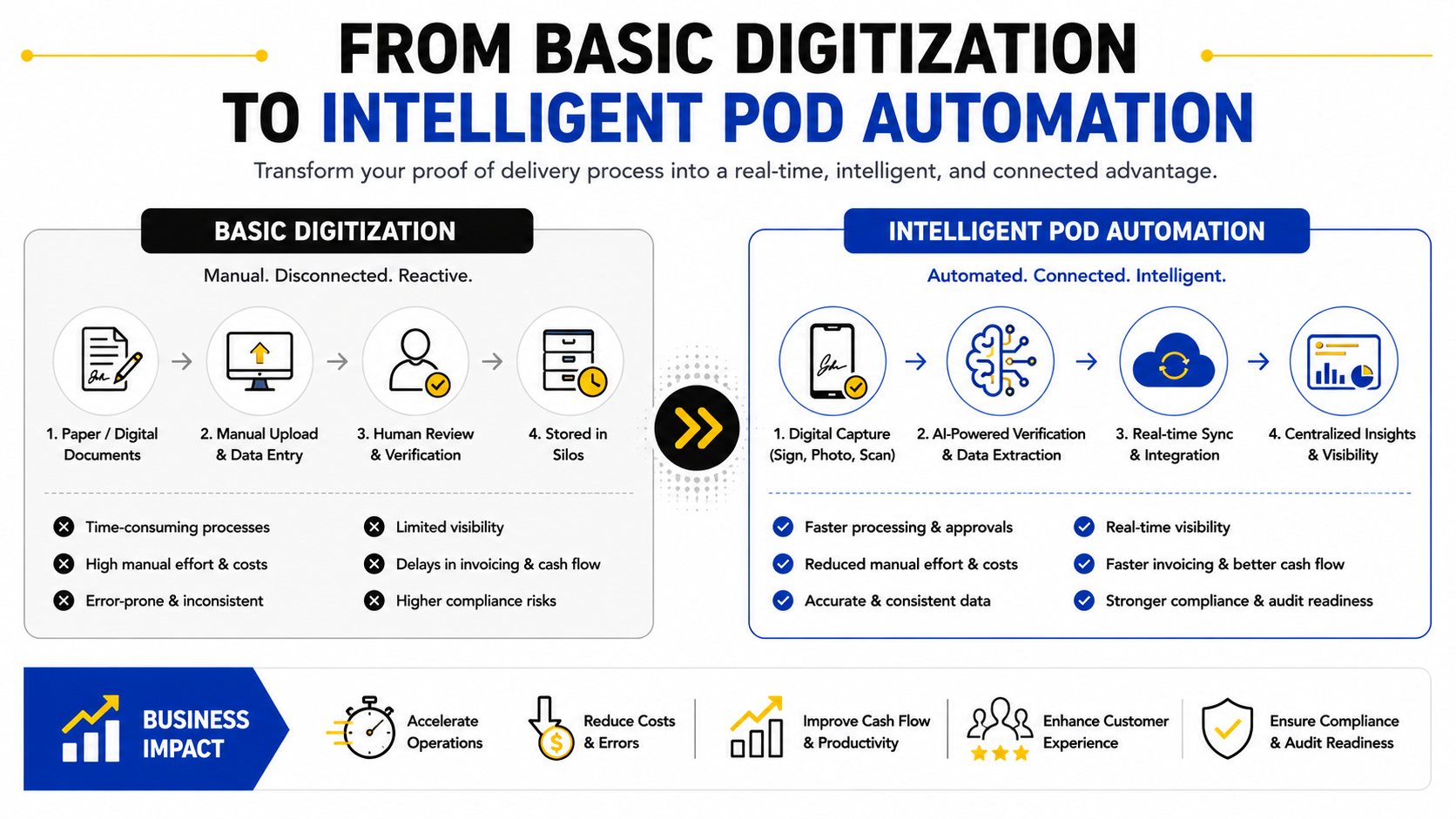
Proof of Delivery (POD) automation uses workflow automation technologies to digitize, process, validate, and manage delivery confirmations in real time. Instead of relying on paper documents, manual uploads, and disconnected communication between teams, automated workflows create a centralized operational system that moves delivery data seamlessly across logistics, finance, and compliance functions.
More importantly, proof of delivery automation does not simply convert paper documents into digital files. It automates the entire operational process surrounding delivery verification, invoicing, reporting, and record management.
This distinction is important because many organizations still confuse basic digitization with true workflow automation. In traditional digitization, delivery receipts may be scanned and stored digitally, but employees still need to upload files manually, validate information, update ERP systems, and coordinate approvals across departments.
Regarding this shift, NORA transforms Proof of Delivery (POD) from a passive paper trail into a proactive, real-time automation engine. Moving far beyond basic digitization – which still relies on manual uploads and disconnected cross-department emailing – NORA deploys an intelligent, multi-layered framework that automates the entire operational lifecycle surrounding delivery verification, invoicing, and compliance.
1. Real-Time Delivery Data Capture
Instead of collecting paper receipts that must later be returned, scanned, or manually entered into systems, drivers use mobile applications or handheld devices to capture delivery information instantly. This information may include electronic signatures, barcode scans, delivery photos, GPS verification, and timestamp data. Because the data is captured digitally at the source, delivery confirmations become immediately accessible across the organization.
This real-time capture capability eliminates one of the biggest inefficiencies in traditional POD workflows: delayed document submission. In manual environments, finance and operations teams often wait hours or even days for delivery records to arrive before downstream processes can begin.
The process begins at NORA’s Autonomous Layer, which continuously monitors live data streams at the point of delivery. Instead of waiting days for drivers to return paper receipts, drivers capture electronic signatures, photos, barcodes, and GPS timestamps via mobile devices.
NORA instantly ingests these digital touchpoints as automated triggers. By eliminating delayed document submissions, downstream financial and operational workflows are kicked off the second a delivery is completed, drastically shortening cash-flow cycles.
2. Automated Document Processing and AI Validation
Once delivery data is submitted, workflow automation systems automatically process and validate the information using OCR and AI-powered verification technologies.
OCR technology extracts delivery details from uploaded forms, receipts, and images, while AI engines analyze whether the information is complete, accurate, and consistent. Instead of manually reviewing every POD document, employees only need to focus on records that are flagged as exceptions. At the same time, automated validation improves data consistency and operational accuracy.
In the same way, NORA can read, extract, and integrate cross-references data from unstructured delivery forms and receipts. Once data enters the system, NORA’s Reasoning Layer takes over to handle document processing and semantic understanding. Instead of human operators manually checking every file, NORA’s AI analyzes contextual completeness – instantly flagging anomalies like missing signatures, mismatched PO numbers, or duplicate records. This cuts administrative overhead and shifts human focus strictly to exception management.
3. Automated Workflow Routing and Approval Management
After validation, the workflow automation platform routes delivery records automatically to the appropriate departments based on predefined business rules.
Validated POD documents may be sent directly to finance teams for invoice processing, while exception cases can be forwarded to operations or compliance teams for further review. Approval workflows can also be configured to ensure that delivery confirmations move through the correct operational checkpoints before invoicing or reporting actions are triggered.
Following validation, NORA autonomously routes records based on predefined business logic and confidence scores. With NORA, validated clean PODs are immediately funneled to finance for instant billing, while flagged discrepancies are routed to operations or compliance teams for rapid resolution. By replacing fragmented email threads and spreadsheets with automated background orchestration, NORA eliminates communication bottlenecks, speeds up approval cycles, and reduces coordination overhead.
4. Real-Time Visibility, Reporting, and Audit Readiness
Operations teams can monitor live delivery statuses, identify processing bottlenecks, track SLA performance, and respond to delivery exceptions much faster than in manual environments. This visibility improves operational decision-making while also enabling customer service teams to provide more accurate and timely updates to customers.
At the same time, centralized cloud-based document storage creates a searchable repository of delivery records and audit trails. Instead of searching through paper files, emails, or disconnected systems, organizations can retrieve delivery evidence instantly whenever needed.
Concurrently, NORA’s built-in Managed Service & Governance layer maintains an unalterable audit trail of every AI action while ensuring strict data compliance with GDPR and ISO 27001 standards. Operations teams can monitor live SLA performance and resolve delivery exceptions instantly. Organizations achieve permanent audit readiness and scale their logistics smoothly without needing to add administrative headcount.
Conclusion
As logistics operations become increasingly complex, long-term operational efficiency depends not only on digitizing delivery workflows but also on building intelligent systems that can scale sustainably over time. Businesses are now moving beyond fragmented manual processes toward integrated automation ecosystems capable of accelerating delivery validation, improving visibility, and reducing operational friction across the entire supply chain.

AI-powered workflow automation solutions like NORA support this transition by combining real-time data capture, intelligent document processing, automated workflow orchestration, and compliance-ready governance into a unified operational framework. Rather than functioning as a standalone automation tool, NORA enables enterprises to transform Proof of Delivery processes into scalable, connected operational capabilities that continuously optimize alongside business growth.
Ultimately, modern Proof of Delivery automation is no longer just about replacing paper-based workflows. It is about creating resilient, intelligent operations that improve accuracy and support long-term scalability. If your organization is looking to modernize delivery operations through AI-powered automation, connect with SmartDev to explore how NORA can accelerate your operational transformation journey.






