

1. Introduction: The Evolving Role of Influencers in Retail Marketing
The rise of influencer marketing in retail has been nothing short of revolutionary. Over the past few years, social media influencers have evolved from content creators to essential marketing partners. Influencers are now integral to the retail and e-commerce landscape, helping brands connect with a highly targeted audience and drive real results. These influencers, often seen as more authentic and relatable than traditional celebrities, have cultivated loyal, engaged followings on platforms like Instagram, TikTok, and YouTube.
As more and more brands turn to influencers to boost brand awareness, increase sales, and build trust, the challenge of selecting the right influencers has become more complex. AI-powered influencer matching systems have emerged as a powerful solution, enabling retail brands to find influencers that align with their audience demographics, values, and content style – leading to better campaign outcomes.
1.1 The Surge of Influencer Marketing in E-Commerce
The growth of social media-driven purchasing has been astronomical in recent years. Consumers are now more likely to discover products through social media posts or recommendations from influencers than through traditional advertising. The impact of influencer marketing is undeniable: studies show that 70% of consumers are more likely to purchase products they see promoted by an influencer on platforms like Instagram and TikTok.
Retailers are taking note of this shift. According to Influencer Marketing Hub, the global influencer marketing industry has grown from $1.7 billion in 2016 to an estimated $13.8 billion in 2021, with continued growth projected for the future. The ROI on influencer marketing campaigns is also notable: a recent study showed that for every $1 spent on influencer marketing, brands are seeing an average return of $5.78.
Given this growth, e-commerce has benefited significantly from influencer partnerships. 83% of marketers report that influencer marketing is effective, particularly for driving sales conversions and creating authentic customer connections. E-commerce brands now see influencers as a key component of their digital marketing strategy, helping to reach untapped audiences and cultivate more trustworthy relationships with consumers.
1.2 Challenges in Selecting the Right Influencers for Retail Campaigns
While influencer marketing holds immense potential, selecting the right influencers for retail campaigns is no simple task. Retail brands are now faced with an abundance of influencers across platforms, each with varying levels of engagement, audience demographics, and content style. This has created several challenges:
Managing Large Volumes of Influencers
With the increasing number of influencers available, retailers often face difficulty in managing and evaluating a growing list of potential partners. The volume of influencers in the market can be overwhelming, making it hard for marketing teams to identify the ones who truly align with their brand. This challenge becomes even more pronounced when retailers are looking to scale campaigns across multiple regions or product categories.
Ensuring the Best Fit Between Brand and Influencer
In order for influencer marketing to be effective, there must be alignment between the influencer and the brand’s values, tone, and messaging. Simply selecting an influencer with a large following is no longer enough. The content style of the influencer must match the brand’s identity, and their audience must align with the retailer’s target market. Failure to align with the right influencers can lead to poor engagement and even damage the brand’s reputation.
Avoiding Misalignment with Audience Demographics
A critical factor for success is ensuring that an influencer’s audience matches the target demographics of the brand. Audience segmentation is key. If an influencer promotes a fashion brand to an audience that is primarily interested in tech gadgets, the mismatch can be obvious – and detrimental. As the digital space becomes more segmented and specialized, understanding audience demographics is crucial for effective influencer marketing. Retailers need tools that can evaluate not just the influencer’s follower count but the quality and relevance of their engagement.
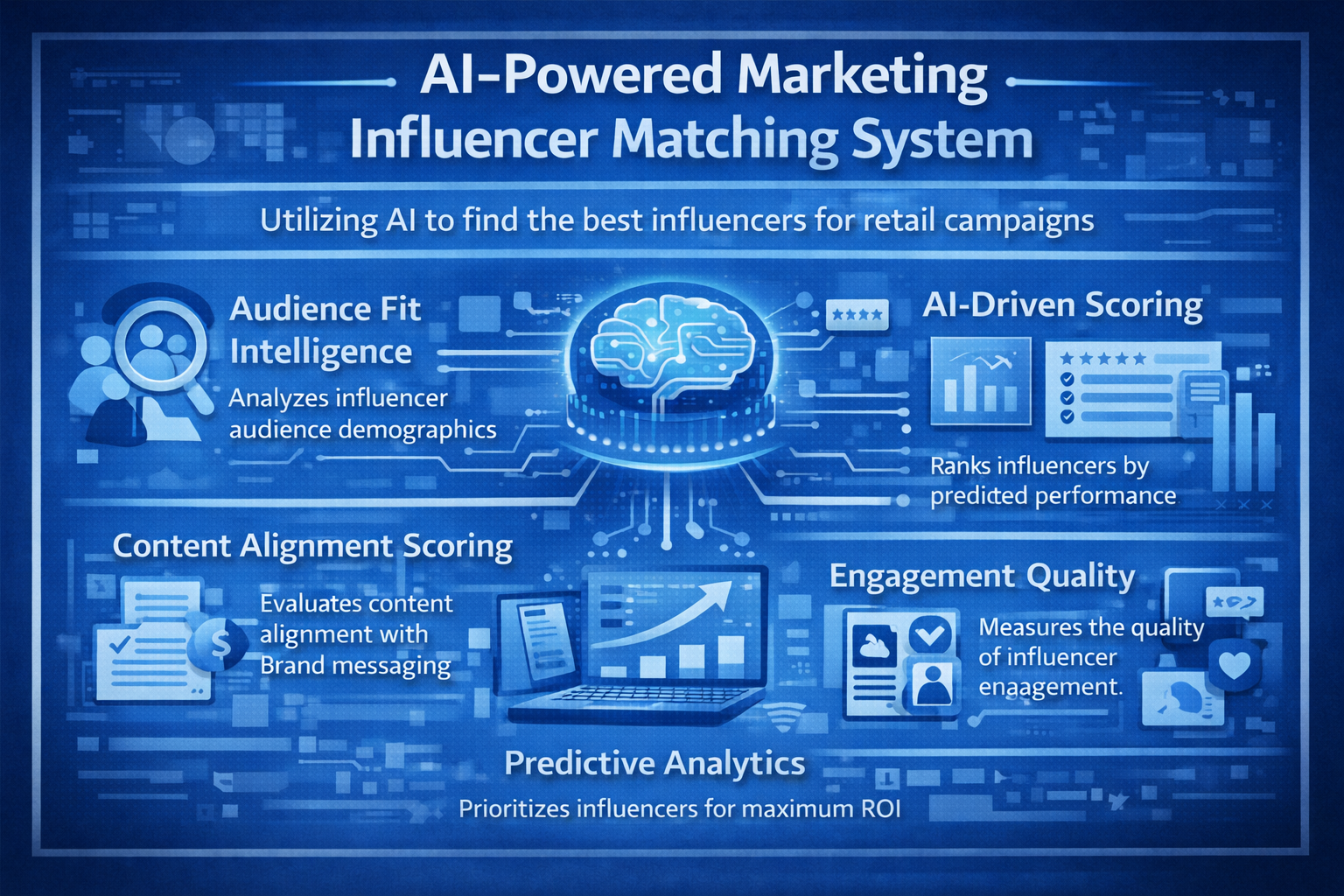
2. Understanding the AI-Powered Marketing Influencer Matching System
Given the complexity of selecting the right influencer, retailers are turning to AI-powered influencer matching systems to streamline the process and ensure better campaign results. These systems leverage machine learning, natural language processing (NLP), and performance data to automate the influencer discovery and selection process. By analyzing large datasets, these systems can match campaigns with influencers whose audience demographics, content style, and engagement align with brand objectives.
2.1 What is the AI-Powered Influencer Matching System?
The AI-powered Marketing Influencer Matching System is an advanced solution designed to help retail marketers quickly identify the best-fit influencers for their campaigns. The system takes a data-driven approach, leveraging a variety of factors to determine influencer suitability. Key features of this system include:
- Audience Fit Intelligence: The AI analyzes the influencer’s audience demographics, ensuring they align with the target market of the campaign. It looks at factors such as age, gender, interests, and geographic location.
- Content Alignment Scoring: The system evaluates the tone, style, and themes of the influencer’s content to ensure it resonates with the brand’s messaging and values. It checks if the influencer’s content fits within the campaign’s goals and aligns with the overall brand narrative.
- Engagement Quality: Beyond follower count, the system measures the quality of engagement an influencer receives. This includes likes, comments, shares, and overall sentiment, ensuring that the influencer’s followers are actively engaging with the content.
This system takes the guesswork out of the influencer selection process, ensuring that the brand is partnered with influencers who genuinely match the campaign’s goals and objectives.
2.2 How Does the System Analyze and Rank Influencers?
SmartDev’s AI-driven influencer matching system doesn’t just list influencers — it ranks them based on their predicted performance for a campaign. By using machine learning models and historical performance data, the system can predict which influencers are likely to produce the best results. Here’s how it works:
- Machine Learning & Performance Data: The system ingests past campaign data, looking at how various influencers have performed in similar campaigns. It analyzes which influencers have historically achieved the best engagement rates, conversions, and brand fit.
- AI-Driven Scoring: Influencers are scored based on multiple factors, including:
- Audience relevance
- Engagement quality
- Content alignment with brand goals
- Historical performance metrics
- Predictive Analytics: The AI ranks influencers by predicted ROI and performance, ensuring that retail brands are selecting those most likely to drive results.
This automated approach saves time and resources while improving decision-making, allowing marketers to confidently choose the influencers who will deliver the best results for their campaigns.
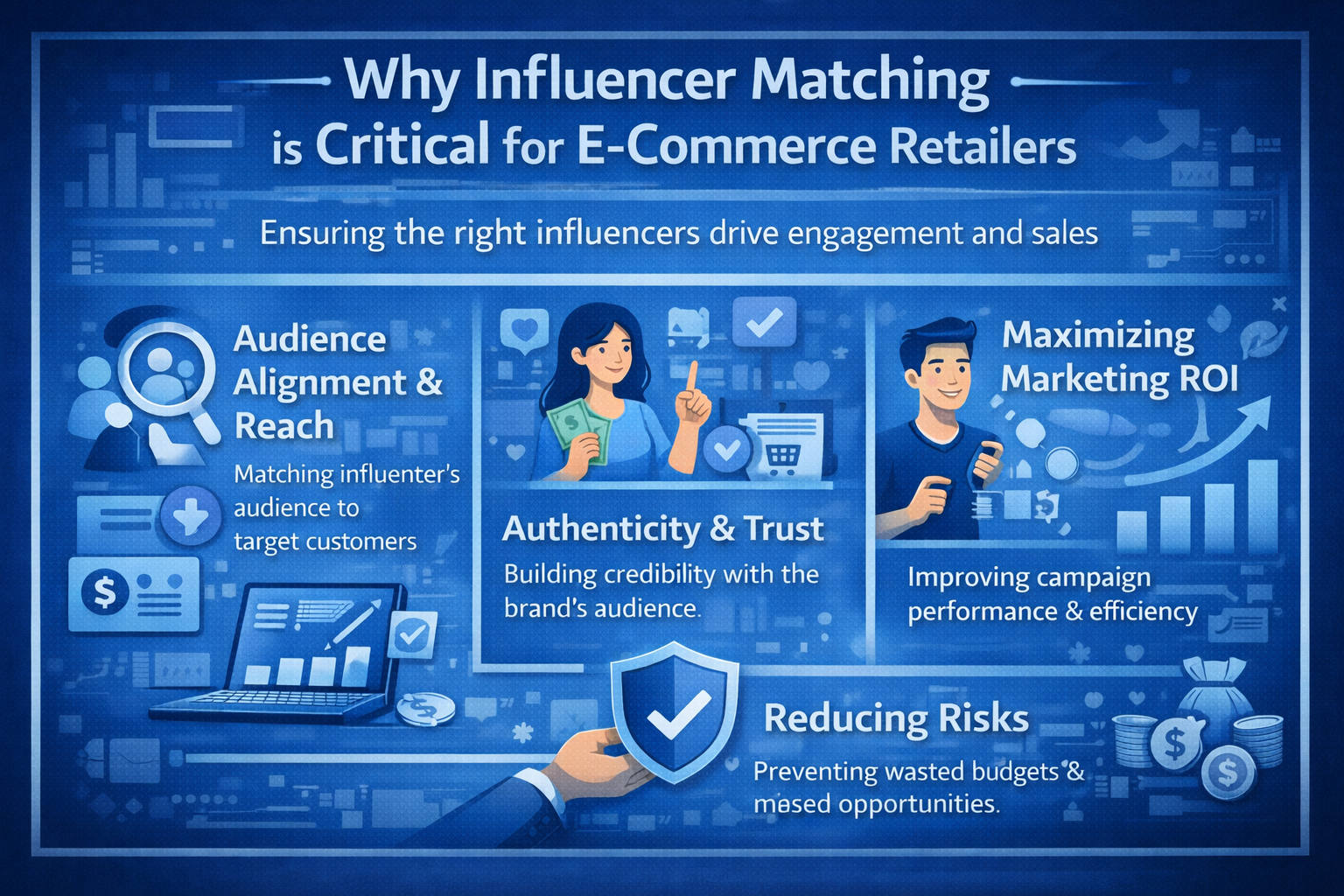
3. Why Influencer Matching is Critical for E-Commerce Retailers
In the world of e-commerce, influencer marketing has gone beyond being a trendy marketing tactic. It’s now an essential strategy for building brand awareness, driving conversions, and fostering customer loyalty. However, the key to success lies in choosing the right influencer who aligns with both the brand’s goals and the target audience.
Without a reliable method of matching influencers to campaigns, retailers risk poor performance, wasted budgets, and missed opportunities. With AI-powered influencer matching, e-commerce retailers can ensure they are connecting with influencers whose audience demographics and engagement align with their objectives, providing a significant competitive edge.
3.1 The Impact of Choosing the Right Influencer on Campaign Success
Audience Alignment and Reach
The most important factor in influencer marketing is the audience fit. Even if an influencer has millions of followers, if their audience demographics do not align with the brand’s target market, the campaign is likely to fall flat.
An AI-powered influencer matching system helps ensure that an influencer’s followers are the right match for the retailer’s product. It analyzes audience data – such as age, location, gender, interests, and purchase behaviors – to ensure there is a perfect match between the brand’s target audience and the influencer’s followers.
For example, a beauty brand targeting millennial women would perform best by collaborating with an influencer whose followers are predominantly women in that age group. This audience alignment results in better engagement and a higher likelihood of conversions. According to SproutSocial, 87% of Gen Z consumers are more willing to buy from brands that partner with influencers outside of just social media content, giving influencers the opportunity to expand into brand spokesperson roles that have typically been held by actors, athletes, and celebrities..
Authenticity and Trust in the Influencer-Brand Relationship
Consumers increasingly crave authenticity in the brands they engage with. The days of overt advertising are long gone. Consumers prefer brands that feel genuine and relatable, which is why influencer authenticity is so important. When the right influencer aligns with a brand, their endorsement feels authentic, and their followers trust their recommendations.
The AI influencer matching system evaluates not only the size of the influencer’s audience but also the engagement quality. High engagement rates, like comments and shares, indicate that an influencer’s followers are genuinely interested in the content. When an influencer aligns with a brand, their recommendation feels natural, leading to higher trust, engagement, and ultimately, conversion rates.
3.2 Why Traditional Methods of Influencer Selection Don’t Scale
Manual Search Inefficiencies
Traditional methods of selecting influencers often rely on manual search, spreadsheet tracking, or personal networks. This process is time-consuming, inefficient, and prone to human error. With the growing volume of influencers in the marketplace, manual curation becomes unsustainable.
According to Gartner, 65% of marketers report that influencer marketing is too manual and labor-intensive to scale effectively, especially as their campaigns grow.
Relying on manual processes not only reduces efficiency but also makes it harder for marketing teams to scale and manage multiple campaigns across different platforms.
Risks of Relying on Intuition Over Data-Driven Approaches
When choosing influencers without data, brands often rely on intuition or past experience to identify who they believe will be the best fit. While intuition can sometimes lead to successful campaigns, it’s an unreliable approach in today’s complex digital landscape.
An AI-powered system, on the other hand, uses data-driven insights to objectively select influencers based on audience compatibility, engagement patterns, and historical campaign performance. This leads to better decision-making and increased ROI for e-commerce brands. In fact, 64% of marketers say that data-driven decision making is one of the biggest advantages of using AI in marketing (Forrester).
By using AI technology, brands can eliminate bias, avoid overpaying for ineffective influencers, and ensure a higher likelihood of campaign success.
3.3 The Importance of Long-Term Influencer Relationships
One-off influencer partnerships may deliver short-term benefits, but long-term relationships between influencers and brands lead to sustained growth and loyalty. Influencers who consistently represent a brand build credibility and trust with their audience, making their endorsements feel more genuine and impactful.
Building Credibility and Repeat Partnerships
AI-powered matching systems not only identify influencers for one-time campaigns but also help brands identify influencers who can build long-term partnerships. For example, a fashion brand working with an influencer over time can develop a deeper relationship, where the influencer becomes an ambassador for the brand. This builds brand credibility and fosters an ongoing, authentic connection with the influencer’s audience.
Driving Brand Loyalty Through Consistency
When a brand and influencer work together repeatedly, they can create consistency in messaging, tone, and values. This consistency is vital for brand loyalty because followers begin to associate the influencer’s content with the brand’s values and quality.
A long-term relationship with an influencer can create a sense of community around the brand, leading to repeat purchases and brand loyalty from customers who follow the influencer.
As e-commerce continues to evolve, the need for long-term, strategic influencer partnerships will become even more crucial. Brands that focus on sustained collaboration rather than short-term campaigns will see stronger, more loyal customer bases.
Explore how SmartDev partners with BFSI teams through a focused AI sprint to validate use cases, align stakeholders, and define a clear path forward before AI development begins.
SmartDev helps BFSI organizations clarify AI use cases and assess feasibility, enabling confident decisions and reducing risks before committing to AI development.
Learn how SmartDev accelerates AI initiatives, ensuring rapid deployment and reduced time to market.
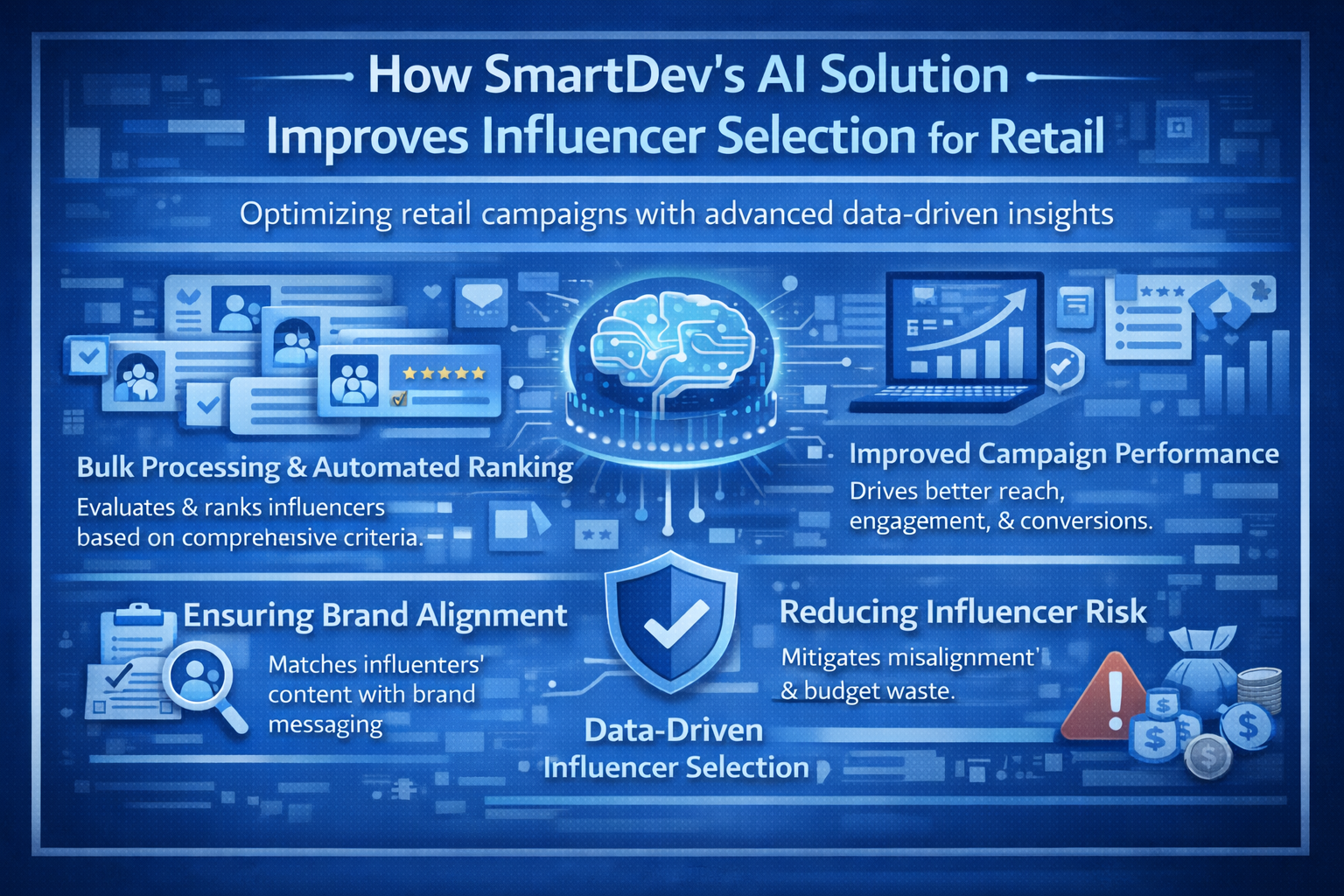
Build Your AI Chatbot With Us4. How SmartDev’s AI Solution Improves Influencer Selection for Retail
As e-commerce brands increasingly rely on influencer marketing, the need for precise influencer selection has never been greater. SmartDev’s AI-powered Marketing Influencer Matching System is designed to help retail brands select the right influencers based on data-driven insights, ensuring better campaign outcomes and higher return on investment (ROI). By automating the influencer selection process and continually learning from past campaigns, SmartDev’s solution provides brands with an intelligent, scalable system for influencer marketing.
In this section, we will look at how SmartDev’s AI solution streamlines influencer selection, enhances campaign performance, and mitigates the risk of poor influencer-brand alignment.
4.1 Streamlining the Influencer Selection Process
Bulk Processing and Automated Ranking
One of the biggest challenges in influencer marketing is the sheer volume of influencers available across social media platforms. Retail brands often struggle to manually sift through countless profiles to find the right ones. SmartDev’s AI solution addresses this challenge by automating the influencer selection process and enabling bulk processing of influencer profiles.
Instead of manually reviewing hundreds or thousands of influencers, marketers can now upload large datasets of potential influencers into the system. The AI will automatically rank influencers based on a variety of criteria including audience fit, engagement quality, and content alignment with the brand’s messaging. By automating this process, SmartDev’s solution significantly reduces the time spent on influencer selection and ensures that only the most relevant influencers are selected.
This automation not only increases the speed of influencer selection but also enhances the accuracy of the matches. Since the AI system is constantly learning from past campaign outcomes, it becomes better at predicting which influencers will deliver the best results, improving the matching process over time.
Increased Speed and Accuracy in Matching Influencers
The ability to process and rank influencers quickly allows marketing teams to respond faster to campaigns and adapt to changing trends. As market dynamics evolve, retailers need to be agile in adapting their influencer marketing strategies. AI-powered systems like SmartDev’s allow retail brands to identify top-performing influencers in real-time, enabling immediate implementation of campaigns, particularly for time-sensitive product launches, seasonal promotions, or flash sales.
In essence, SmartDev’s AI solution allows retailers to accelerate campaign timelines while improving the precision of influencer selection – something that was extremely difficult to achieve manually.
4.2 Enhancing Campaign Performance with Data-Driven Insights
Improved Reach, Engagement, and Conversion Outcomes
One of the key benefits of using SmartDev’s AI-powered influencer matching system is its ability to optimize campaigns based on data-driven insights. Instead of relying on intuition or guesswork, the system analyzes influencers based on their historical performance in campaigns, including metrics like engagement rates, conversion rates, and audience interaction quality.
By leveraging this performance data, SmartDev’s AI system ensures that retail brands are selecting influencers who have demonstrated success in driving engagement and sales for similar campaigns. As a result, retailers see improved reach, higher engagement, and better conversion outcomes.
For example, a fashion brand might use the system to identify influencers who have a proven track record of driving sales conversions during product launch campaigns, ensuring that the brand’s marketing efforts are highly targeted and likely to yield strong results. The system’s ability to recommend influencers who are statistically more likely to drive sales makes influencer marketing a more predictable and efficient process for e-commerce retailers.
Continuous Optimization Using Campaign Results
SmartDev’s AI system doesn’t just match influencers to campaigns at the start. It also continuously optimizes influencer performance throughout the campaign lifecycle. The system tracks the performance of each influencer based on key metrics such as engagement, conversions, and audience feedback, and adjusts its recommendations accordingly. This feedback loop helps brands refine their influencer selection in real-time, making future campaigns even more efficient.
For example, if the system notices that a particular influencer’s audience is engaging more with a specific type of product, it can adjust future campaigns to target influencers who have a similar audience or align with that product category. This continuous optimization ensures that retail brands get the best possible performance from their influencer marketing campaigns, even as they scale.
4.3 Reducing the Risk of Poor Influencer-Brand Alignment
AI Ensures Content and Tone Match with Brand Messaging
One of the most important aspects of successful influencer marketing is ensuring that an influencer’s content aligns with the brand’s messaging and values. A mismatch between an influencer’s style and tone and a brand’s identity can lead to a disjointed campaign that fails to resonate with the target audience. SmartDev’s AI solution helps reduce this risk by evaluating content for tone, themes, and brand fit before influencers are selected.
Using Natural Language Processing (NLP), SmartDev’s AI analyzes the language and themes in an influencer’s posts to ensure they align with the brand’s values. For example, a brand that emphasizes sustainability and ethical practices would need to partner with influencers whose content reflects these values. The AI ensures that only influencers whose tone and content fit naturally with the brand are chosen, thus improving the authenticity of the partnership.
Ensuring Authenticity and Credibility in Partnerships
One of the most significant challenges for retail brands is maintaining the authenticity of influencer partnerships. Consumers have become adept at spotting inauthentic brand endorsements, which can lead to a loss of trust and engagement. SmartDev’s AI solution helps mitigate this risk by ensuring that the influencers selected for campaigns have a genuine connection to the brand’s core values.
Through AI-driven analysis of influencers’ content and audience interactions, the system ensures that the influencer’s followers trust them and view their endorsements as credible. This credibility is essential for driving higher engagement and customer loyalty, ultimately leading to a more successful campaign.
With SmartDev’s AI-powered influencer matching system, retail brands no longer have to rely on manual searches, subjective intuition, or guesswork when selecting influencers. The system’s ability to automate the selection process, optimize campaigns in real-time, and ensure authenticity leads to more effective and scalable influencer marketing campaigns.
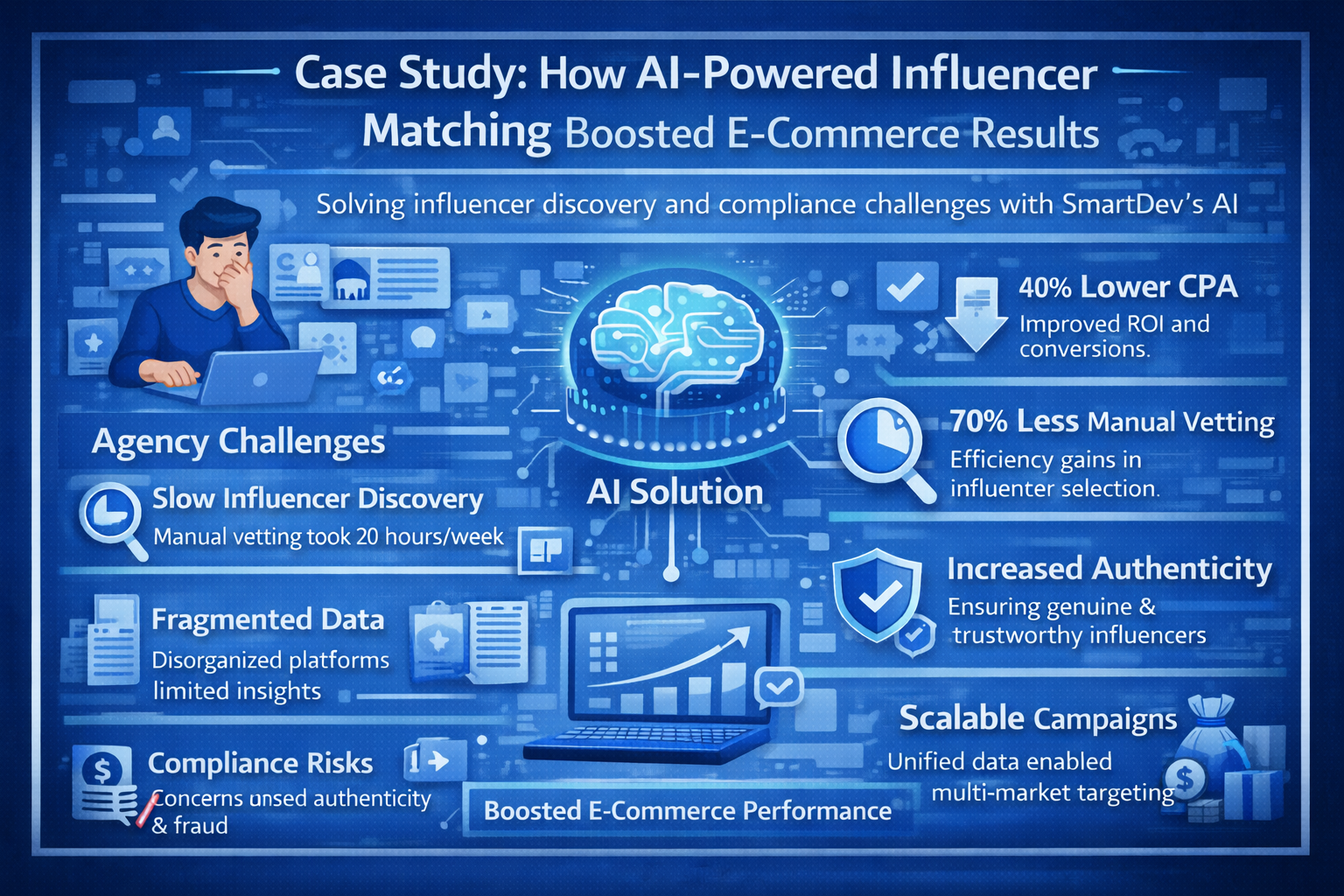
5. Case Study: How AI-Powered Influencer Matching Boosted E-Commerce Results
5.1 Campaign Overview: A Performance Marketing Agency’s Struggles with Compliance in Influencer Marketing
A fast-growing marketing team at a performance marketing agency in England was facing several significant hurdles in its influencer marketing strategy. The agency specializes in data-led growth strategies, focusing on measurable business outcomes for retail, e-commerce, and consumer brands. Despite their success, the team was overwhelmed by the manual influencer discovery process, which was proving to be slow, inaccurate, and labor-intensive.
Problem: Slow Influencer Discovery, Mismatched Brand Collaborations, and Fragmented Data
- Manual Discovery: Vetting influencers manually was taking up to 20 hours per week, and even then, the team was often missing out on the best fits for campaigns. With thousands of influencers to sift through, the process was too slow, and the results were frequently misaligned, wasting valuable marketing budgets.
- Fragmented Data: Influencer data was spread across multiple platforms, making it difficult for the team to view campaign performance holistically. With inconsistent data, the agency had limited visibility into ROI, which hindered their ability to make informed, data-driven decisions.
- Authenticity and Compliance Risks: With influencer fraud becoming a major concern in the industry, the agency faced significant risks. The marketing team was unable to verify the authenticity of influencers’ followers and engagement, which led to potential issues with brand credibility and compliance.
To address these challenges and improve the overall efficiency and accuracy of their influencer selection process, the agency implemented SmartDev’s AI-powered Influencer Matching System.
5.2 Results: Improved Compliance and Campaign Outcomes
After implementing SmartDev’s AI system, the agency experienced a transformative impact on their influencer marketing campaigns. The AI solution helped them solve the key challenges they faced, resulting in significant improvements across several key performance metrics:
Boosted ROI and Conversions
- The AI-driven influencer selection process resulted in improved campaign returns, with CPA (Cost Per Acquisition) reduced by up to 40%. The more accurate audience matching and engagement quality analysis helped the agency select influencers who were more likely to drive conversions.
- Engagement increased by 20%, as influencers were now selected based on data-driven insights that aligned with the brand’s target market, leading to more authentic interactions and stronger engagement from followers.
- Overall ROI improved by 15% as the system optimized influencer selection based on audience alignment and predicted performance, ensuring that marketing spend was more effective.
Efficiency Gains
- The AI-powered system reduced manual influencer research by up to 70%, replacing time-consuming manual vetting with instant, data-driven recommendations. This allowed the team to focus on higher-value tasks like campaign strategy and creative optimization, instead of spending hours sifting through influencer profiles.
- By automating the entire influencer selection process, the agency could move faster and make smarter decisions in real time, increasing the overall efficiency of their campaigns.
Greater Authenticity and Trust
- One of the standout features of the AI solution was its ability to ensure that the selected influencers were authentic and aligned with the brand’s values. The system analyzed engagement patterns and detected fake followers, ensuring that the influencers the agency partnered with had genuine reach and influence.
- This authenticity helped foster stronger trust between the brand and its audience, leading to higher purchase intent and increased brand loyalty.
Scalable Across Markets
- The unified cross-platform data enabled the agency to run multi-market campaigns with localized targeting, reaching specific audiences in different regions. The AI system’s ability to analyze audience demographics across multiple platforms allowed for more precise targeting and localized influencer selection, enabling the agency to scale their campaigns efficiently without losing performance quality.
5.3 Key Takeaways: Lessons for Retail & E-Commerce Marketers
The success of this case study provides several key lessons for retail & e-commerce marketers looking to enhance their influencer marketing strategies:
- AI-Powered Influencer Matching is a Game-Changer: The use of AI in influencer selection not only saves time but also ensures data-driven, accurate matches with influencers whose audiences truly align with campaign goals. Retail brands can significantly benefit from this approach by improving both the efficiency and effectiveness of their campaigns.
- Authenticity and Trust Matter: The AI system’s ability to detect fake followers and ensure audience authenticity is critical for retail & e-commerce brands that rely heavily on trust. Partnering with influencers whose followers engage genuinely with their content can boost brand credibility and reduce the risk of reputation damage.
- Optimizing ROI: With predictive analytics and audience fit intelligence, fintech marketers can ensure that every dollar spent on influencer marketing is generating real results. By selecting influencers who are more likely to drive conversions, AI systems like SmartDev’s increase ROI and reduce wasted budget.
- Scalability: As retail companies grow and expand into new markets, AI-powered influencer matching systems can scale with them, helping to select the best influencers across multiple regions and platforms without additional overhead.

6. How Retailers Can Leverage SmartDev’s AI Solution to Scale Influencer Marketing
With the proven success of SmartDev’s AI influencer matching system, it’s clear that this technology is a game-changer for retailers looking to optimize their influencer marketing efforts. But how can retail brands integrate this solution into their existing marketing strategies and workflows?
6.1 Integrating AI Matching Systems with Existing Marketing Platforms
The beauty of SmartDev’s AI-powered influencer matching system is that it seamlessly integrates with existing marketing platforms, CRM systems, and e-commerce platforms. Retailers can easily connect the AI system with:
- Customer relationship management (CRM) tools to ensure influencer data is synced with customer insights.
- Social media tracking tools to measure influencer performance in real-time.
- E-commerce platforms to track sales generated through influencer campaigns and optimize future campaigns accordingly.
This integration ensures that retailers can leverage AI-driven insights without disrupting their current workflows or systems. With real-time data synchronization, influencers are always matched with the most up-to-date information.
6.2 Training Teams and Building Trust in AI-Powered Decisions
While the AI system can significantly improve efficiency, it’s important for retail teams to understand and trust the AI recommendations. Here’s how to build adoption across your team:
- Training: Educate marketing teams on how the system works, its capabilities, and how to interpret AI-driven insights.
- Collaborative Adoption: Position the system as a support tool, not a replacement for human expertise. The AI system helps identify best-fit influencers, but the marketing team still has control over final decision-making.
- Continuous Feedback: Encourage teams to provide feedback on AI recommendations to further improve accuracy and relevance. Over time, the system will learn and optimize influencer matches based on campaign outcomes.
By involving the team in the adoption process and emphasizing AI as a complementary tool, brands can ensure that they maximize the potential of this technology.
6.3 The Future of Influencer Marketing: Scaling with AI
The future of influencer marketing is undeniably intertwined with AI technology. As e-commerce continues to grow and influencer marketing becomes more complex, AI will play a central role in helping retailers scale their campaigns, reach more precise audiences, and drive better results.
Retailers must prepare for the following:
- Increased Automation: As more brands adopt AI-powered influencer matching, the automation of influencer selection will become standard across the industry.
- Personalized Experiences: With AI-driven insights, marketers will be able to craft more personalized and targeted campaigns, driving deeper connections with customers.
- Evolving Consumer Behavior: AI systems will adapt to changing consumer behavior, helping brands stay ahead of trends and influencer preferences.
Retailers who adopt AI-powered solutions today will not only improve their immediate marketing results but also future-proof their marketing strategies as the industry continues to evolve.
Conclusion: Empowering Retailers to Take Control of Their Influencer Marketing Strategy
The AI-powered influencer matching system is transforming the way retail brands approach influencer marketing. By streamlining the process of influencer selection, improving campaign performance with data-driven insights, and reducing the risk of poor brand-influencer alignment, SmartDev’s solution offers a powerful way for retailers to optimize their influencer campaigns.
In today’s competitive retail landscape, AI is no longer a luxury – it’s a necessity for brands that want to stay ahead of the curve. SmartDev’s solution empowers retailers to make smarter, more efficient decisions, ultimately leading to higher engagement, better conversions, and improved ROI.
Ready to take your influencer marketing strategy to the next level?
Contact SmartDev today to explore how our AI-powered influencer matching system can help you select the right influencers, improve campaign performance, and scale your marketing efforts with confidence.