

Most teams don’t fail because they can’t plan. They fail because they confuse planning with readiness. A good product plan can be compelling. It aligns stakeholders, secures budget, and communicates intent. It explains why a product should exist and where it should go. But when that plan reaches engineering, reality often intervenes. Clarifying questions multiply. Scope shifts. Estimates expand. Delivery slows. What looked solid in strategy becomes fragile in execution.
This is the core tension behind product plan vs build blueprint. A plan creates direction. A blueprint creates certainty. And without a build-ready blueprint, even the most thoughtful product plan risks collapsing under the weight of real-world delivery.
At SmartDev, we see this pattern repeatedly. Teams arrive with strong ideas, validated market signals, and leadership buy-in, yet still struggle to move cleanly from discovery to development. The problem is rarely ambition. It is a translation, plans persuade and blueprints ship.
Why Good Product Plans Still Break in Delivery
A product plan is designed to align people. A build-ready blueprint is designed to align systems. That difference sounds subtle until you watch a project bleed week.
The failure chain usually starts with plan-level abstraction. Plans speak in strategic language because they need to: “improve onboarding,” “increase engagement,” “add personalization,” “support enterprise-grade compliance.” These are valuable directions, but they are not buildable instructions. Engineering cannot implement “improve onboarding.” Engineering implements flow steps, copy states, validations, error handling, identity checks, permissions, latency constraints, and instrumentation.
When a plan reaches delivery with unresolved abstraction, the team is forced to translate it under pressure. That translation introduces three compounding effects.
First, ambiguity turns into parallel interpretations. Product, engineering, design, QA, and stakeholders each fill in gaps differently. The same phrase “personalized experience” can mean rule-based segmentation to one person, an ML-driven ranking system to another, and LLM-generated messaging to a third. Everyone believes they are aligned because they share the words, but they are not aligned because they do not share the decisions. The first measurable outcome is time: discovery work quietly reappears inside delivery. Sprints become partially spent on clarification, rework, and re-alignment rather than progress.
Then, ambiguity turns into hidden scope. A plan rarely specifies edge cases, operational constraints, integration realities, or non-functional requirements. Those details don’t disappear; they surface later. When they surface late, they arrive as scope expansion. “We need audit logs.” “We need role-based permissions.” “We need to handle offline mode.” “We need to support multiple regions.” “We need to redact or moderate generated content.” Each item is legitimate. The damage comes from timing. Late scope forces either timeline extension or quality reduction, and both outcomes are measurable: delivery slows, defect rates rise, and roadmap confidence collapses.
Afterwards, ambiguity breaks prioritization. A plan can prioritize themes, but delivery requires sequencing that survives trade-offs. When the blueprint is missing, teams prioritize by what is easiest, loudest, or most politically defensible. That creates a measurable business outcome problem: even if the team ships feature, the product does not reliably move the intended metrics. Execution becomes efficient output, not effective impact.
Agile does not fix this. Agile assumes transparency and shared understanding. Without a blueprint, teams don’t iterate faster; they iterate in wider circles. The Scrum Guide itself emphasizes that backlog refinement requires clarity and shared understanding of what is being built and why, otherwise the backlog becomes unstable, and delivery becomes unpredictable. A good product plan is necessary. But if it remains abstract, it does not reduce risk. It relocates risk into the most expensive phase: delivery.
Product Plan vs Build Blueprint – Where the Real Difference Lies
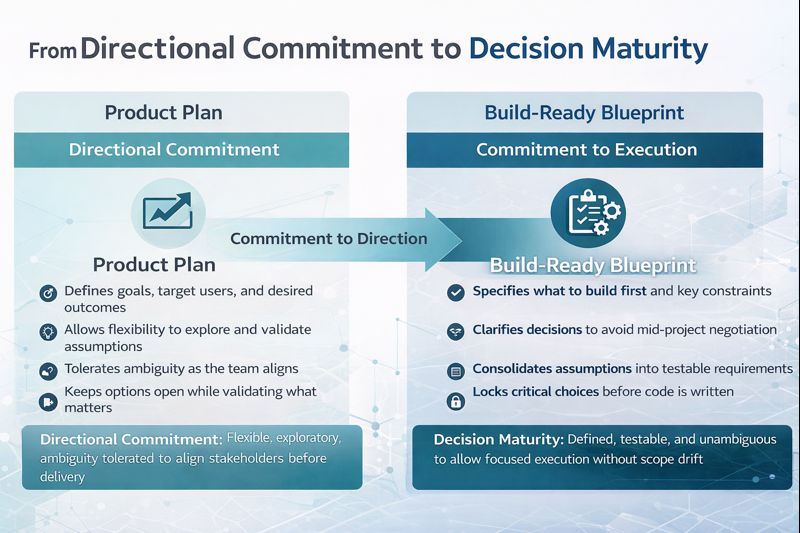
From Directional Commitment to Decision Maturity
A product plan is a commitment to direction. It answers whether the product is worth pursuing, who it serves, and what outcomes it should aim for. It is intentionally flexible because it is designed to align stakeholders when information is still incomplete. At this stage, uncertainty is tolerated because the organization is still validating what matters.
A build-ready blueprint is a commitment to execution. It is what happens when uncertainty is narrowed enough that the team can build without constantly renegotiating meaning. Decision maturity means the most consequential choices have been made early, before code is written, so the delivery team is not forced to invent the product while implementing it.
Blueprints as Resolved Uncertainty, Not More Documentation
In practice, decision maturity is visible in how the work behaves. When decisions are immature, progress depends on continuous clarification: every sprint includes “let’s confirm,” “we need alignment,” and “we’ll decide later.” When decisions are mature, progress depends on delivery effort, not interpretation effort. The same requirement reads the same way to product, design, engineering, and QA. The scope is bounded, not elastic. Dependencies are known, not discovered accidentally. Acceptance criteria are testable, not subjective. The product is not just desired; it is defined.
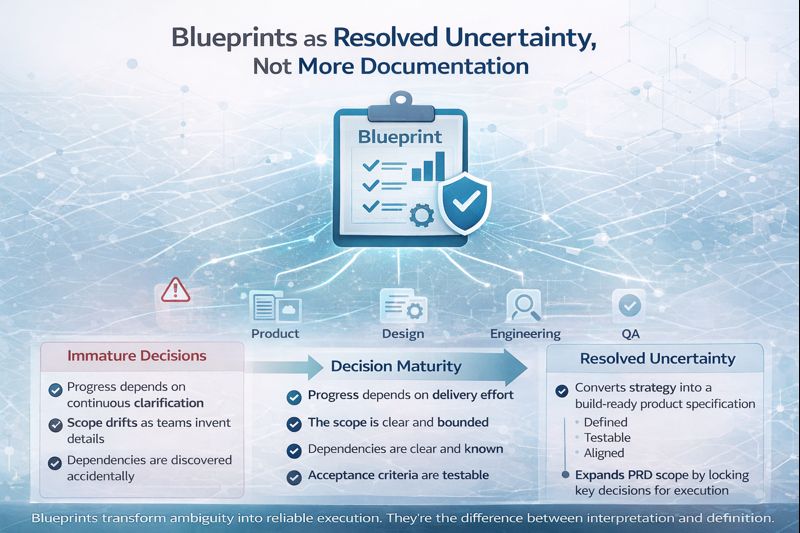
This is why a blueprint is not “more documentation.” It is a higher degree of resolved uncertainty. It converts strategy into a build-ready product specification that engineering can estimate credibly, and QA can validate without guessing.
This is also where product requirements documentation becomes meaningful. A PRD is meant to create shared understanding of what is being built and why. Atlassian frames it as a document that clarifies purpose, features, functionality, and behaviour so teams can align before implementation. A blueprint goes further. It doesn’t just describe the product; it locks the decisions that prevent delivery from becoming an expensive debate.
What Makes a Blueprint Truly Build-ready
A build-ready blueprint is not a single artifact. It is a coherent system of aligned decisions. It begins with a problem framing tied directly to business outcomes. Instead of “build a dashboard,” the blueprint defines a measurable objective such as reducing processing time, improving conversion, or lowering operational risk. This framing shapes every downstream decision.
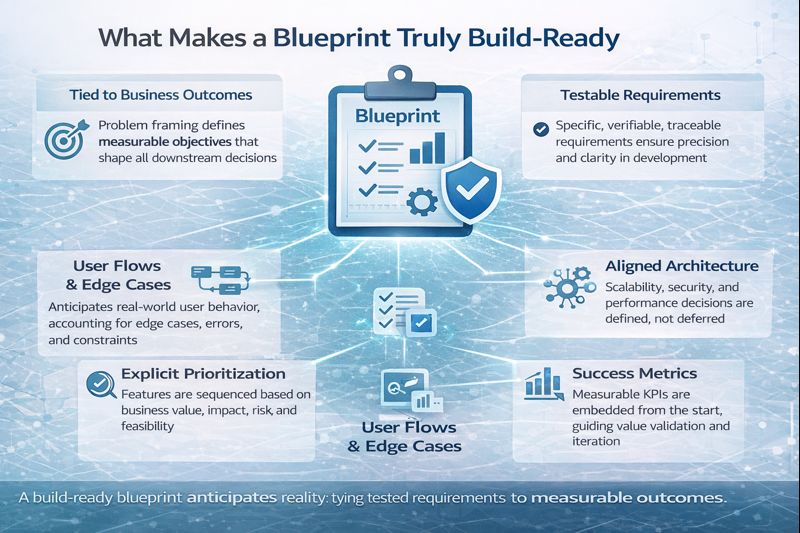
Requirements are then expressed in a way that is testable and unambiguous. High-quality requirements are specific, verifiable, feasible, and traceable. This is not theory. Requirements engineering research consistently shows that unclear requirements are one of the leading causes of cost overruns and project failure
User flows and edge cases are addressed early. A blueprint anticipates how the product behaves under real conditions, not just ideal scenarios. This includes error handling, permissions, unusual inputs, and operational constraints.
Prioritization is explicit and defensible. Features are sequenced based on business impact, risk, and feasibility, not on who requested them. Acceptance criteria are defined so “done” is measurable, not subjective.
Architecture and non-functional requirements are aligned with scope. Decisions around scalability, security, performance, and integration are not postponed. They are part of readiness.
Finally, success metrics are embedded into the blueprint. The team agrees upfront on how value will be measured, what data will be collected, and how learning will inform future iterations. When these elements are missing, delivery becomes discovery by accident. When they are present, delivery becomes execution with intent.
From product plan to blueprint: SmartDev’s 3-week Discovery approach
SmartDev’s 3-week Discovery process exists to close the gap between strategy and execution. It is not exploratory for its own sake. It is a structured conversion process, from product plan to build-ready blueprint. The goal is simple: remove uncertainty before it becomes cost.
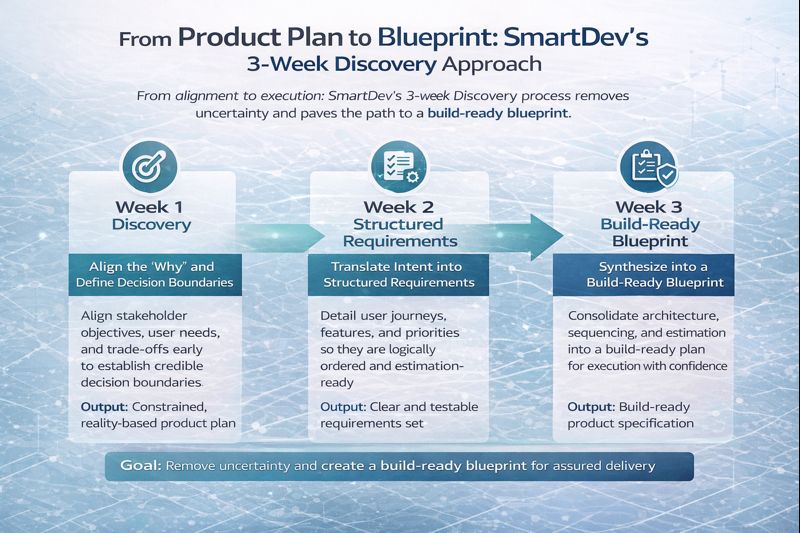
Week 1: Align the “why” and define decision boundaries
The first week focuses on business alignment. SmartDev works with stakeholders to clarify objectives, user needs, and constraints that will shape the product. This is where teams confront trade-offs early. What matters more: speed or flexibility? Scalability or time to market? Compliance or experimentation? These decisions define boundaries within which the product must operate. By the end of Week 1, the product plan is no longer aspirational. It is constrained by reality and therefore more credible.
Week 2: Translate intent into structured requirements
High-level ideas are translated into user journeys, functional requirements, and early prototypes that reflect real behaviour. This is where transitioning discovery to delivery begins in earnest. Requirements are shaped so engineering can estimate meaningfully, and QA can understand how quality will be assessed. Importantly, prioritization becomes rational. Features are evaluated against business value and feasibility, not personal preference. If a feature cannot be justified in terms of impact, it does not make the blueprint.
Week 3: Synthesize into a build-ready blueprint
The final week converts analysis into commitment. Architecture direction, integration approach, delivery sequencing, and estimation are consolidated into a blueprint that engineering teams can build against with confidence. At this point, the product is not just planned. It is ready. The output is a build-ready product specification that minimizes reinterpretation and protects delivery momentum once development begins.
Why Success Metrics Are part of the Blueprint, Not An Afterthought
One of the most common mistakes teams make is treating success metrics as a reporting concern rather than a design input.
- In a build-ready blueprint, metrics shape prioritization decisions from the start.
- In BFSI, metrics such as processing time, error rates, and compliance adherence address operational risk and cost. Features are prioritized based on their ability to reduce friction without increasing exposure.
- In retail and e-commerce, conversion rates, drop-off points, and repeat purchase metrics ensure that features drive revenue rather than superficial engagement.
- In manufacturing and logistics, throughput, downtime, and predictability metrics focus the blueprint on removing bottlenecks rather than adding visibility without action.
- In healthcare and regulated environments, quality, safety, and auditability metrics ensure that scale does not come at the expense of trust.
Across industries, metrics solve the same fundamental problem: they prevent teams from mistaking activity for progress. They anchor delivery to outcomes, not output.
How Metrics influence Design Choices, Not Just Evaluation
Metrics should not only validate a product after release. When used correctly, they reshape the product’s design decisions before a single line of code is written. If the metric is retention, the blueprint will prioritize reducing “time-to-first-value,” simplifying onboarding steps, and designing habit-forming loops that encourage return behaviour. If the metric is operational cost reduction, the blueprint will emphasize automation points, exception handling workflows, and system integrations that eliminate manual work rather than merely digitizing it. If the metric is compliance reliability, the blueprint will design audit trails, permissioning, and data governance as core features, not later enhancements. If the metric is conversion, design choices will focus on minimizing friction, clarifying decision points, and instrumenting drop-off at the most sensitive steps.
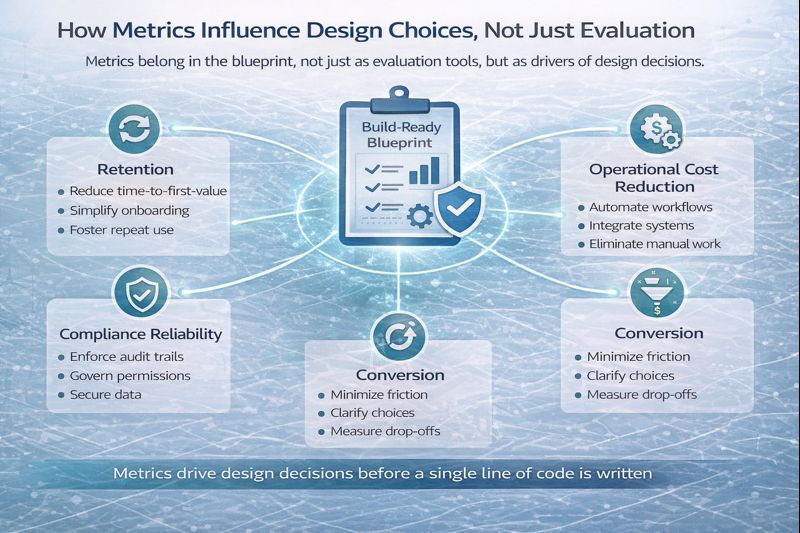
This is why metrics belong inside the blueprint. They don’t just measure success; they define what the product must optimize for. Without that clarity, teams risk building features that look complete yet fail to influence what the business actually cares about.
Consulting and Discovery that supports delivery
The most expensive gap in product development is the handoff between discovery and delivery. Beautiful documents that engineering cannot use are a liability, not an asset.
SmartDev’s consulting and Discovery approach is designed to avoid that gap. The blueprint produced is directly consumable by delivery teams. It reflects feasibility, constraints, and real-world conditions. This is what enables a smooth transition into development without losing context or momentum. The blueprint becomes the shared contract that aligns product, engineering, QA, and stakeholders around what is being built, and why.
Conclusion: plans persuade, blueprints ship
A good product plan is essential. It creates direction, alignment, and momentum. But direction alone does not deliver value. A build-ready blueprint does. It removes ambiguity before it becomes rework. It turns prioritization into a defensible discipline. It allows teams to move faster because they decide better early. If your product plan feels strong but delivery feels fragile, the issue is rarely effort or talent. It is readiness.
That is the difference between a good product plan and a build-ready blueprint, and why SmartDev treats the blueprint as the true starting point of successful product delivery.
Plans create alignment. Blueprints create certainty.