

TL;DR
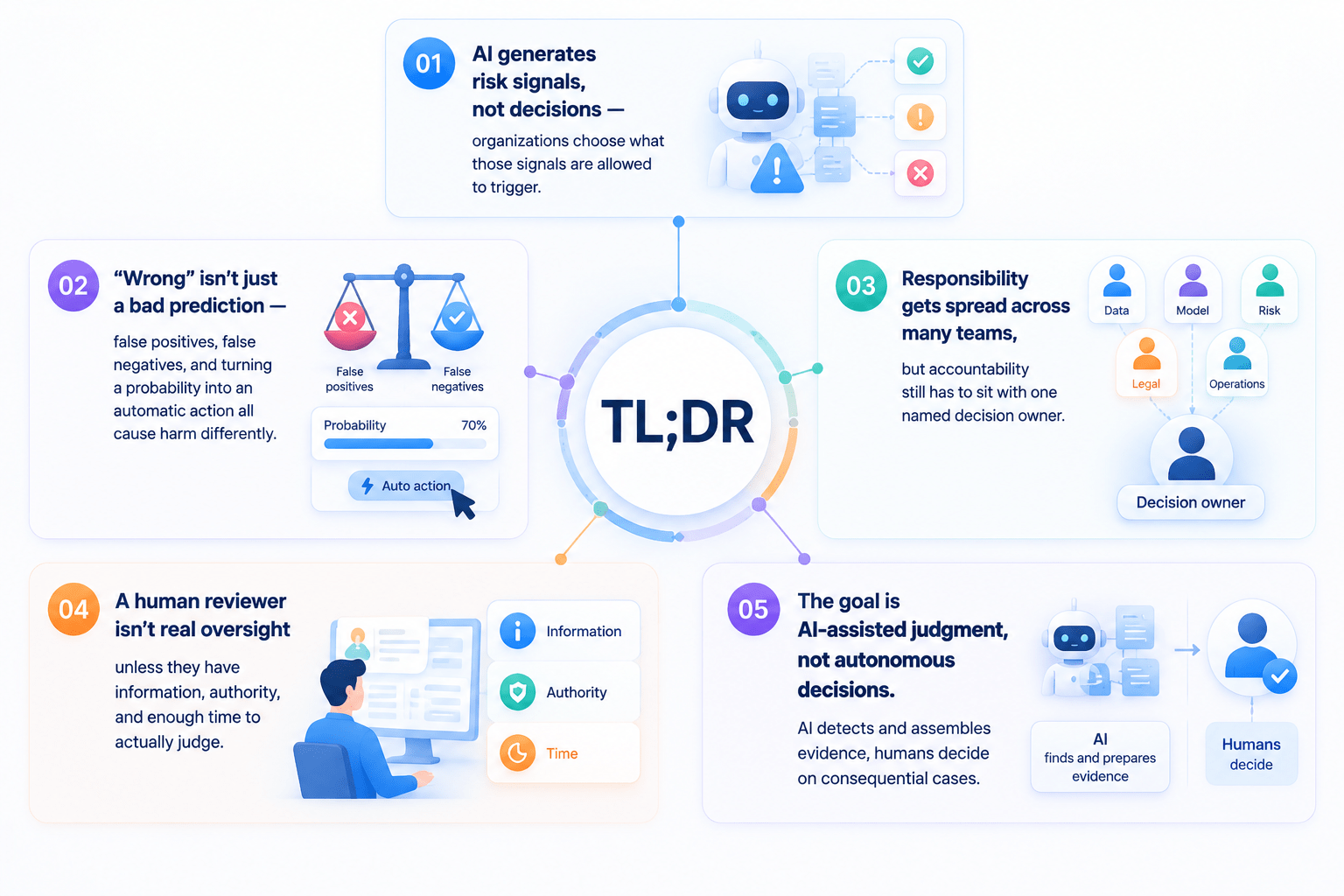
- AI generates risk signals, not decisions – organizations choose what those signals are allowed to trigger.
- “Wrong” isn’t just a bad prediction: false positives, false negatives, and turning a probability into an automatic action all cause harm differently.
- Responsibility gets spread across many teams, but accountability still has to sit with one named decision owner.
- A human reviewer in the workflow isn’t real oversight unless they have information, authority, and enough time to actually judge.
- The goal is AI-assisted judgment, not autonomous decisions: AI detects and assembles evidence, humans decide on consequential cases.
Introduction
Across AI use cases in finance, fraud detection is one of the areas where machine learning has moved fastest from pilot to production. AI now helps fraud teams handle a scale and speed of data that humans simply can’t match on their own.
The numbers explain why. By 2025, Thomson Reuters Institute found that 71% of financial services firms were already using AI for risk assessment and reporting, second only to document summarization. The pressure to adopt AI is real. Global fraud losses reached an estimated £1.03 trillion in 2024. Close to half the world’s population reported encountering at least one scam per week during that same period.
Still, speed and scale aren’t the whole story. Consider what happens when an AI-driven decision causes real harm: blocking a transaction, freezing an account, or holding back a seller’s payout. Or consider the opposite failure, where the system lets a genuine fraud slip through. In either case, the question isn’t just “was the model accurate?” The bigger question is:
When AI influences a fraud decision, who owns the outcome?
The thesis of this piece is simple: AI can automate detection, but accountability cannot be automated away.
What Does It Mean for AI to “Get Fraud Detection Wrong”?
Before talking about accountability, it helps to define what “wrong” actually means. As the next section shows, the failure rarely sits with the model alone.
This pattern isn’t unique to fraud, either. It shows up wherever teams treat AI outputs as final answers rather than inputs to a decision. We’ve explored the same dynamic in the context of compliance hallucination, where a confidently wrong AI output can pass for a verified fact.
“Wrong” is not just a wrong prediction
Three distinct types of failure are worth separating.
False positive – legitimate behavior gets classified as fraud. The consequences here are not trivial. Systems block legitimate transactions. Accounts get frozen. Customers get forced through unnecessary verification steps. Trust and conversion take a hit. This isn’t a theoretical risk, either. A 2025 global survey found that roughly 6 in 10 ecommerce merchants reported false-positive rates between 2% and 10% on disputed orders. Global losses from false declines – legitimate orders wrongly rejected – reached an estimated
$201 billion in 2025. That’s roughly 1.51% of annual ecommerce revenue lost purely to over-cautious systems. Even more telling, 33% of consumers who experienced a false decline said they would not shop with that business again. In other words, a false positive isn’t just an operational cost. It’s a trust cost.
False negative – fraudulent activity passes through undetected. Here, the consequences show up as direct financial losses, chargebacks, compliance exposure, and repeat fraud. In ecommerce specifically, friendly fraud and account takeover together account for 64% of all recorded fraud cases in 2026. This signals a shift: more sophisticated, harder-to-catch fraud types now dominate over the crude patterns that rule-based systems were originally built to catch.
A wrong action taken from an uncertain prediction. This is the failure mode most worth digging into, because teams overlook it most often. AI rarely states outright, “this transaction is fraud.” Instead, it produces a probability, something like: “There is an 82% probability this transaction is suspicious.”
The real problem lives in the next step. Crucially, humans decide this step, not the model:
82% risk score → automatically block the transaction
That business rule turns a probabilistic signal into a definitive action. As a result, the system can “get it wrong” even when the model, technically, does exactly what its designers built it to do.
Why these failures happen
Rather than listing ten scattered causes, it helps to name three underlying ones.
- Reality keeps changing. Fraud tactics, customer behavior, and transaction patterns shift constantly. This causes model drift: a model trained on past data gradually loses accuracy as the world it models moves on.
- AI sees patterns, not full context. An anomaly might signal fraud. Or it might just reflect unusual but entirely legitimate behavior, like a customer using their card abroad right after booking a flight online.
- Prediction turns into action too quickly. The biggest mistake often has nothing to do with the model. Instead, it lies in how an organization converts Signal → Decision → Action, frequently without a real checkpoint in between.
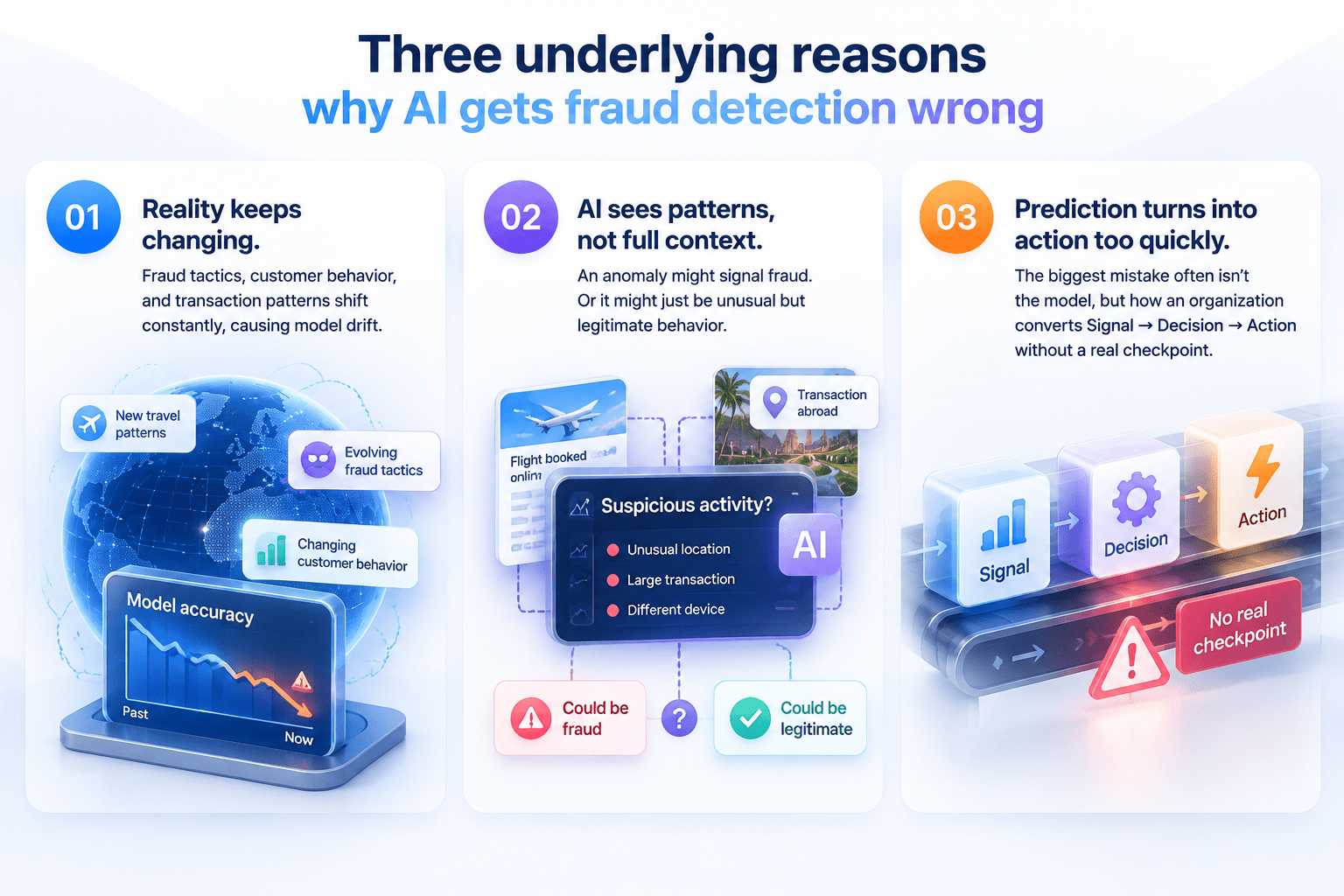
Together, these three causes point to the core insight of this piece:
Fraud detection models generate risk signals. Organizations decide what those signals are allowed to trigger. This insight is also the bridge into accountability.
The Accountability Gap: Everyone Touches the System, But Who Owns the Decision?
In practice, an AI fraud system involves a wide cast of stakeholders, and each one touches only a slice of the outcome. AI and Data Science teams build the model, tune it, and retrain it as new fraud patterns emerge. Fraud Operations teams work the alerts day to day, deciding in the moment which cases deserve escalation. Product and Engineering teams ship the system, wire it into checkout flows or account-management dashboards, and decide how alerts surface to reviewers.
Risk and Compliance teams, meanwhile, set the governance framework: acceptable risk appetite, regulatory obligations, and escalation policy. Management approves strategy and signs off on budget and scope. Often, a third-party vendor supplies the underlying model, the training data, or both. That vendor’s own design choices – which the buying organization rarely audits line by line – end up shaping outcomes just as much as any internal decision does.
Herein lies the problem: many hands share responsibility, yet accountability blurs across all of them. Everyone plays a role, and everyone can point to someone else’s piece of the system when something goes wrong. The data scientist can say the model performed within expected tolerances. The analyst can say they followed the alert as presented. The product team can say they built what compliance specified. Compliance can say the vendor’s model made the call. Each statement can be true on its own, and the customer whose account got frozen still has no clear answer to “who decided this?”
To untangle this, it helps to separate four distinct layers of responsibility, since collapsing them into one vague notion of “the AI team” is exactly what lets accountability slip through the cracks:
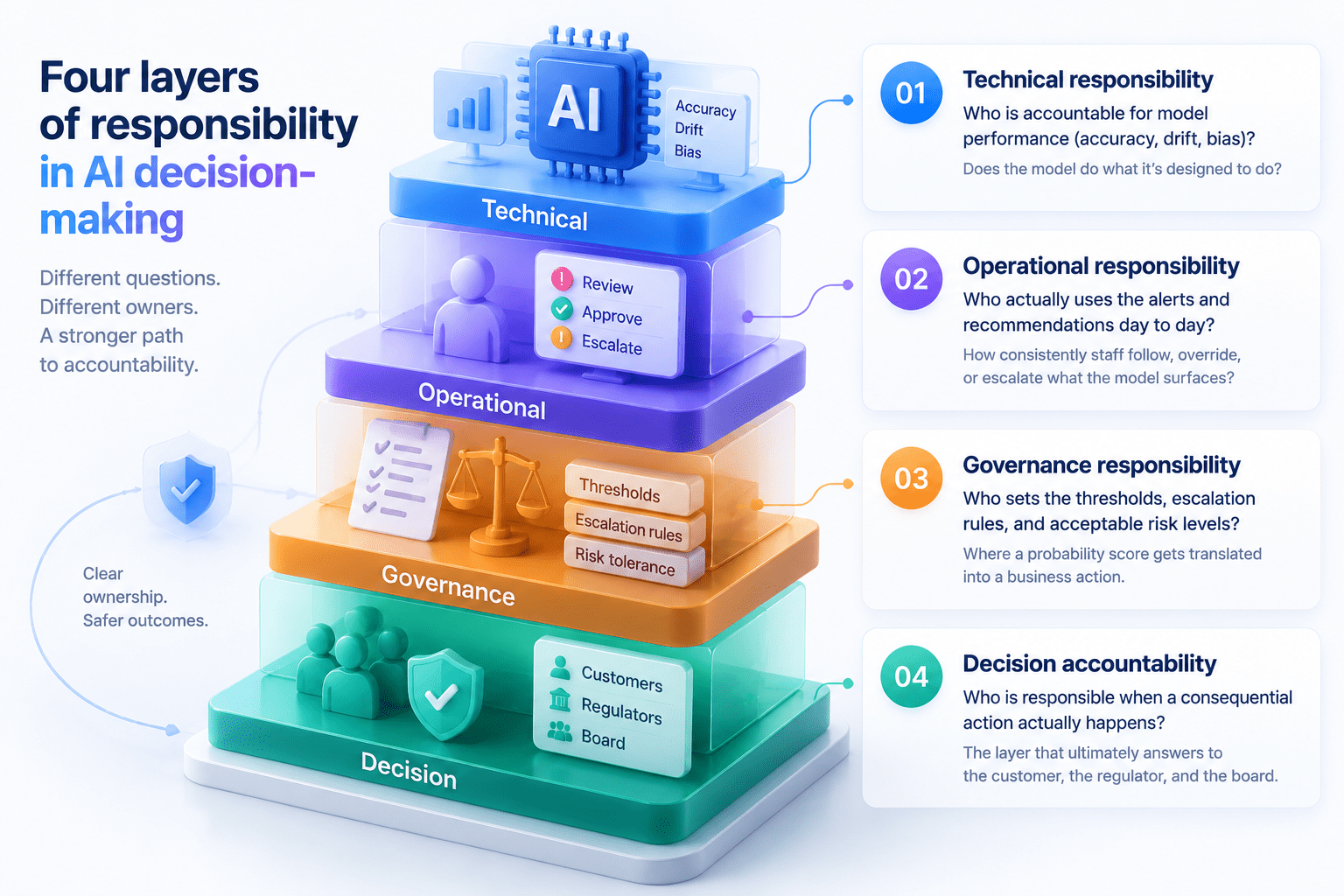
- Technical responsibility – Who is accountable for model performance (accuracy, drift, bias)? This covers whether the model does what it was designed to do, at the level of precision and recall the organization agreed to accept.
- Operational responsibility – Who actually uses the alerts and recommendations day to day? This covers how consistently staff follow, override, or escalate what the model surfaces.
- Governance responsibility – Who sets the thresholds, escalation rules, and acceptable risk levels? This is where a probability score gets translated into a business action, and where most of the real risk actually lives.
- Decision accountability – Who is responsible when a consequential action actually happens? This is the layer that ultimately answers to the customer, the regulator, and the board.
Mapping a single incident against these four layers usually reveals the gap immediately. A model might perform exactly as validated (layer 1 is clean). An analyst might also follow the alert as designed (layer 2 is clean).
Yet, the threshold that turned an 82% risk score into an automatic account freeze might never have gone through a formal risk review (layer 3 fails). No single role might have signed off on “we will auto-freeze accounts at this confidence level” (layer 4 never existed).
In cases like this, no individual technically did anything wrong. Yet the organization still produced a harmful and unaccountable outcome.
The point to land on:
The model cannot be the accountable party. Accountability stays with the organization deploying it.
This isn’t just an internal best practice. It’s becoming an industry standard. As NHI Management Group notes, accountability does not shift to the model, platform, or data science team when AI enters fraud detection. It remains with the organization using the system to make or influence decisions. Regulators increasingly expect evidence of this accountability, not just a policy statement. Frameworks like NIST’s AI Risk Management Framework and NIST SP 800-53 now treat named ownership and audit logging as core governance controls. They are no longer optional extras. These frameworks also require separation of duties. Model builders, case reviewers, and approvers should not control the entire decision chain alone. Put simply, “who is accountable” is no longer just a philosophical question. It is becoming a compliance requirement.
This gap often widens when AI systems move beyond passive scoring and start making autonomous decisions. The progression goes from “flag this transaction” to “hold this payout” and increasingly to “close this account” without human involvement. We explore this shift in Your AI Agent Has Access, But Does It Have Any Identity?. The article examines what happens when an AI agent can take action without a clearly attributable identity. When an action cannot be traced back to a specific person, policy, or approval, organizations lose the ability to determine who – or what – is accountable.
The same gap tends to open up during the transition from pilot to production, and for a similar reason. Pilots run under close supervision, with small case volumes and engineers monitoring every output. Production is different. It runs at scale, with less supervision, and affects real customers. As From AI Pilot to Controlled Production explains, deciding what your team must own internally versus what it can safely outsource is a critical governance decision. It determines who becomes accountable later. Teams that skip this step while rushing to scale often discover the accountability gap only after a customer, journalist, or regulator asks the question first.
This principle applies especially to high-consequence actions: account suspension, transaction rejection, payout freezing, seller termination, and escalating suspicious activity reports to regulators. Each action needs a clearly defined decision owner – a named role, not a team. It should never be assumed that “the system decided.” Ownership at the department level dilutes accountability just as much as blaming “the algorithm.”
Human-in-the-Loop Is Not the Same as Human Accountability
This is the second major argument of this piece, and also the one most organizations get wrong – often while believing they’ve already solved it, simply because a human sits somewhere in the workflow.
A process that includes a human reviewer doesn’t automatically guarantee meaningful oversight. Consider a common flow:
AI flags → Human approves → System acts
At first glance, it sounds safe. It even satisfies most internal audit checklists, since “human-in-the-loop” appears as a control on paper. Look closely at the quality of that “human approves” step, though, and the picture changes. Suppose the reviewer:
- Doesn’t understand the evidence behind the alert, and simply sees a risk score with no supporting detail,
- Can’t see the model’s confidence level, so an 82%-confidence flag looks identical to a 51%-confidence flag,
- Has no real authority to override the decision, because the workflow only lets them confirm or pass the case along, or
- Juggles too many alerts to think carefully about any single one, and works under a quota that rewards speed over judgment.
In any of these cases, the “human approval” step becomes purely procedural. It turns into procedural theatre – a ritual that creates the appearance of oversight without real substance. Worse, it can make things more dangerous by giving the organization false confidence that a person has already reviewed the decision.
This isn’t a hypothetical risk. Alert fatigue remains a well-documented problem across fraud and AML operations. When most alerts become false positives, analysts’ attention to genuinely suspicious cases degrades sharply. Picture a team processing 500 alerts a day with a high false-positive rate. They are searching for a few dozen real cases buried under hundreds of noise cases. Under sustained pressure, reviewers develop shortcuts as a survival mechanism. They rely on surface patterns, clear familiar cases quickly, and reserve deeper scrutiny for only the most unusual alerts. This is a rational response to an unreasonable workload. However, it quietly weakens the oversight the process was designed to provide. Under these conditions, “a human signed off” no longer represents meaningful oversight. It is simply a signature passing through.
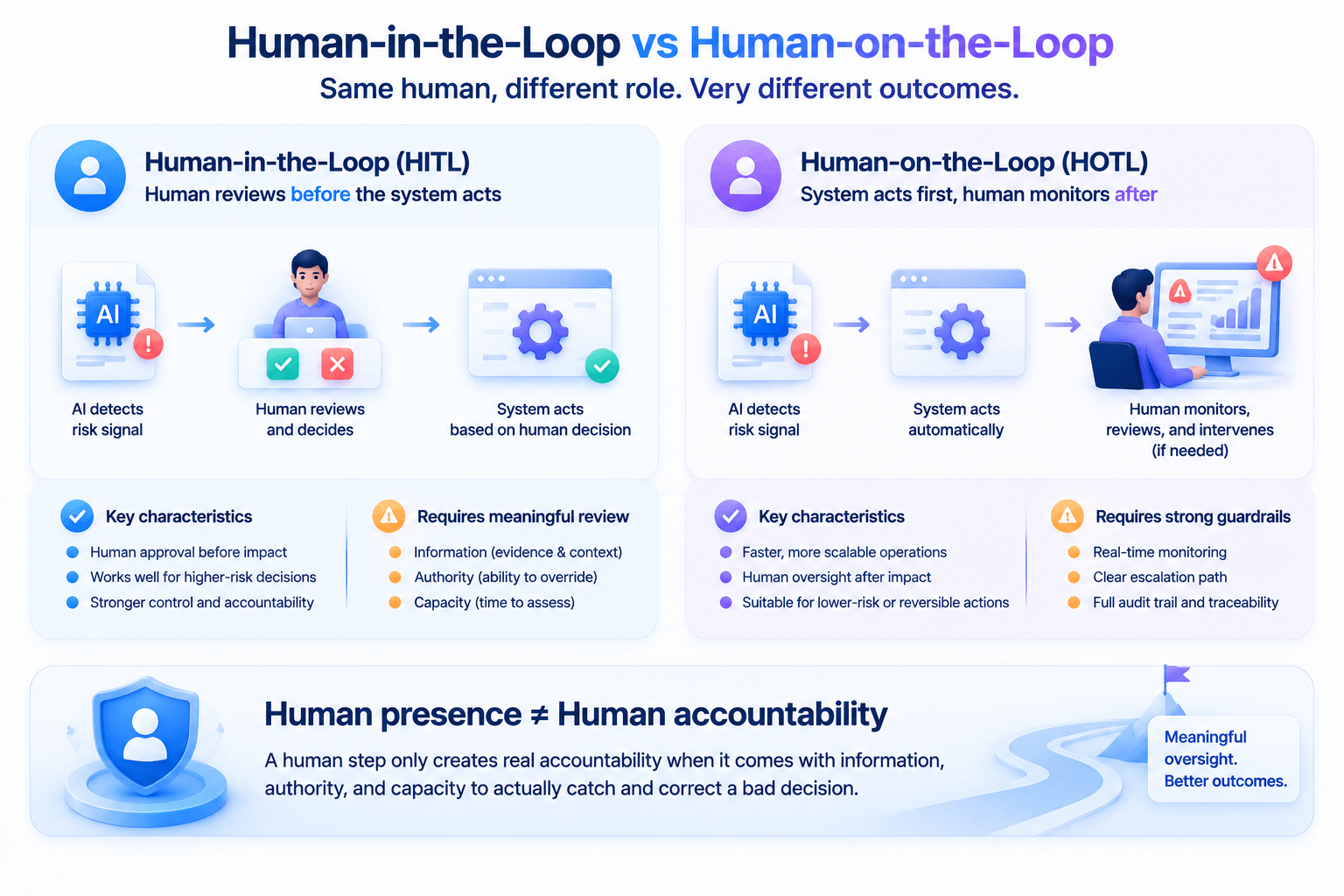
So what does meaningful human oversight actually require? Three conditions need to hold at once, and all three have to be present simultaneously – having two out of three still leaves a gap wide enough for bad decisions to slip through unchallenged.
- Information – enough evidence to actually understand and challenge the AI’s conclusion. This means seeing not just a score, but the features and context that produced it: which signals fired, how they compare to the customer’s normal behavior, and what similar past cases resolved to.
- Authority – the actual power to override or escalate, not just the ability to click “approve.” A reviewer who can only confirm the system’s recommendation, and never reverse it, isn’t exercising authority; they’re rubber-stamping a decision the system already made.
- Capacity – enough time and a reasonable workload to genuinely exercise judgment, rather than rubber-stamping to hit a quota. An organization that measures reviewer performance purely by throughput is quietly optimizing away the judgment it claims to want.
Miss any one of these three conditions, and human-in-the-loop risks becoming a thin layer of legitimacy wrapped around a decision the machine still effectively makes on its own. Compliance teams have lived through the exact same shift. As From Processing Alerts to Making Decisions shows, AI only delivers real value once teams stop treating it as an alert generator and start giving reviewers the context and the authority to actually decide.
Given all this, a risk-based escalation model offers a more sensible path forward than either full automation or reviewing every single case by hand:
- Low risk + high confidence → safe to automate, freeing reviewers to focus where judgment actually adds value.
- Ambiguous cases – moderate confidence, conflicting signals, or unfamiliar patterns → mandatory human review, with enough context supplied to make that review meaningful rather than nominal.
- High-impact decisions (account closure, seller suspension, freezing large sums) → mandatory human oversight, no exceptions, regardless of how confident the model is. The size of the potential harm, not the model’s confidence score, should set the bar for when a human must be involved.
It’s also worth distinguishing between two models of oversight that often get treated as interchangeable. NHI Management Group draws a useful line between “human-in-the-loop,” where a person reviews and approves before the system acts, and “human-on-the-loop,” where the system acts first and a person monitors and reviews after the fact. Neither model is inherently better; the right choice depends on the organization’s risk appetite, how much harm a wrong action could cause, and how mature its audit trail is. What both models share, though, is the same non-negotiable requirement: someone has to be positioned – with the information, authority, and capacity described above – to actually catch and correct a bad decision, whether that happens before or after the system acts.
What Accountable AI Fraud Detection Should Look Like
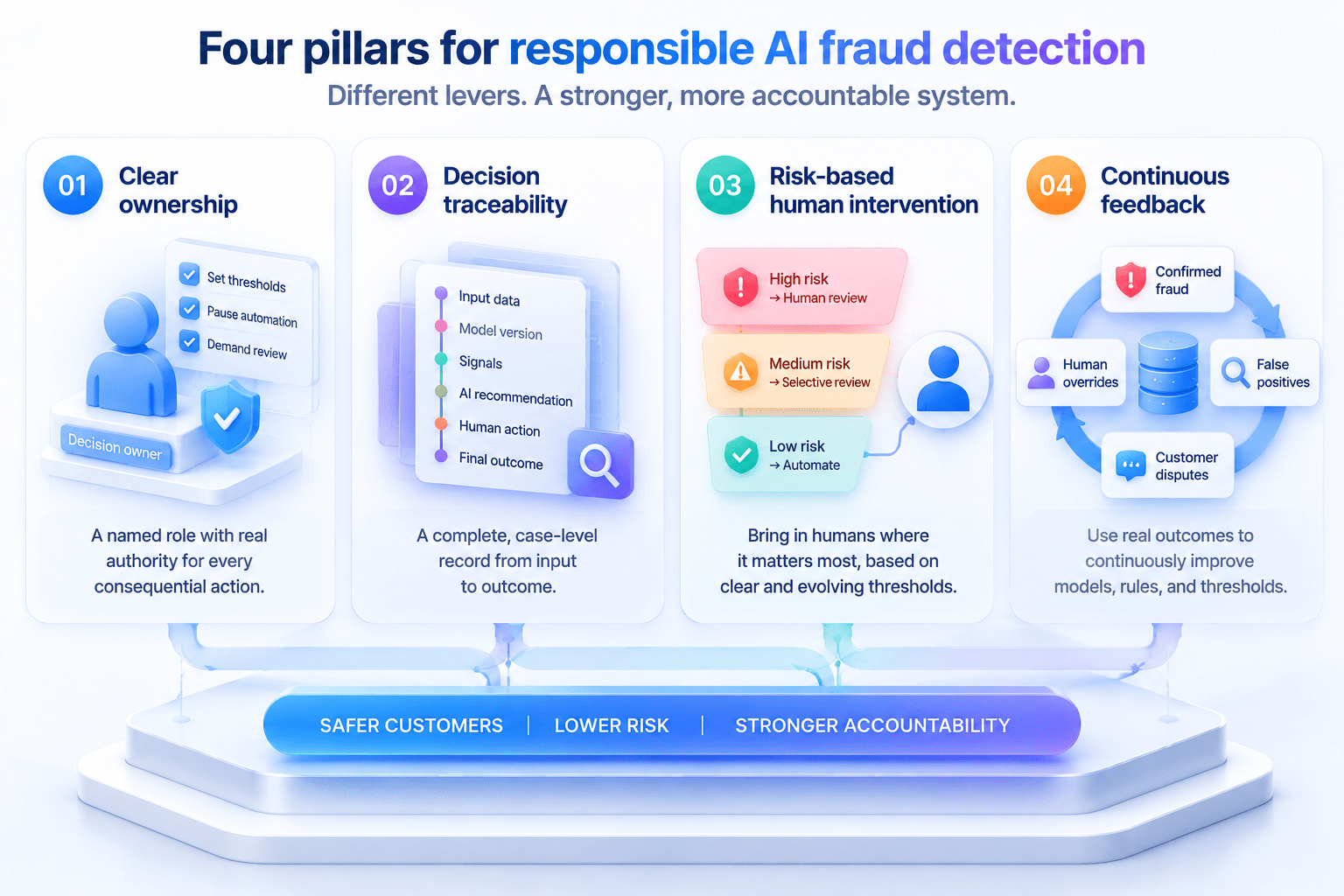
Rather than a long checklist, four core pillars matter most – and each one addresses a specific failure mode already covered above.
- Clear ownership.
The question shouldn’t stop at “who owns the model?” It needs to go further: who owns the decision the model triggers? That distinction separates technical responsibility from decision-making responsibility, and it directly answers the accountability gap described earlier. In practice, this means naming a specific role – not a department – for every category of consequential action a fraud system can take, with the authority to change thresholds, pause automation, or demand a review. Without a named owner, “the model did it” quietly becomes an acceptable answer inside the organization, even though it’s never acceptable to a regulator or a harmed customer.
- Decision traceability
An organization must be able to reconstruct the full path leading to any action: what data existed at the time, which model version the team used, which signals fired, what recommendation the system produced, whether a human intervened, and what final action followed. This record needs to exist at the level of the individual case, not just in aggregate – a monthly accuracy report says nothing about why one specific customer’s account got frozen last Tuesday. Without case-level traceability, an organization can’t learn from its mistakes, can’t tell a one-off error from a systemic pattern, and can’t demonstrate it acted reasonably when challenged. This principle underlies a defensible AI compliance audit trail: every AI-assisted decision needs a reconstructable record that survives long after the case itself is closed.
- Risk-based human intervention
Teams should base the decision to bring in a human on concrete factors: the model’s confidence level, the potential financial exposure, the customer impact, and the regulatory sensitivity of the case. Crucially, these thresholds shouldn’t be set once and left alone – fraud patterns evolve, and a threshold calibrated for last year’s fraud mix can quietly become miscalibrated for this year’s. A regular review cadence keeps human intervention pointed at the cases that actually carry the most risk today.
- Continuous feedback
Confirmed fraud cases, false positives, human overrides, and customer disputes should all feed back into improving the model, the thresholds, the business rules, and the escalation logic. A well-designed feedback loop treats every human override as a signal worth investigating: if analysts routinely override the model on the same type of case, that’s a sign the threshold – not the analyst – needs adjusting. Without this loop, a system will keep repeating the same false positives and false negatives indefinitely, since nothing in the process ever flags that something went wrong.
The Better Goal: AI-Assisted Fraud Judgment, Not Autonomous Fraud Decisions
This is the strategic takeaway of the whole piece.
AI excels at pattern recognition, anomaly detection, prioritization, and aggregating evidence at scale. Humans, meanwhile, excel at the things AI still struggles with: understanding context, navigating ambiguity, weighing proportionality between the level of suspicion and the severity of the action taken, and exercising final judgment.
Given these complementary strengths, the operating model worth aiming for looks like this:
AI detects → AI assembles evidence → Humans judge consequential cases → Outcomes feed back to improve the system
Not this:
AI detects → AI decides → Human signs off
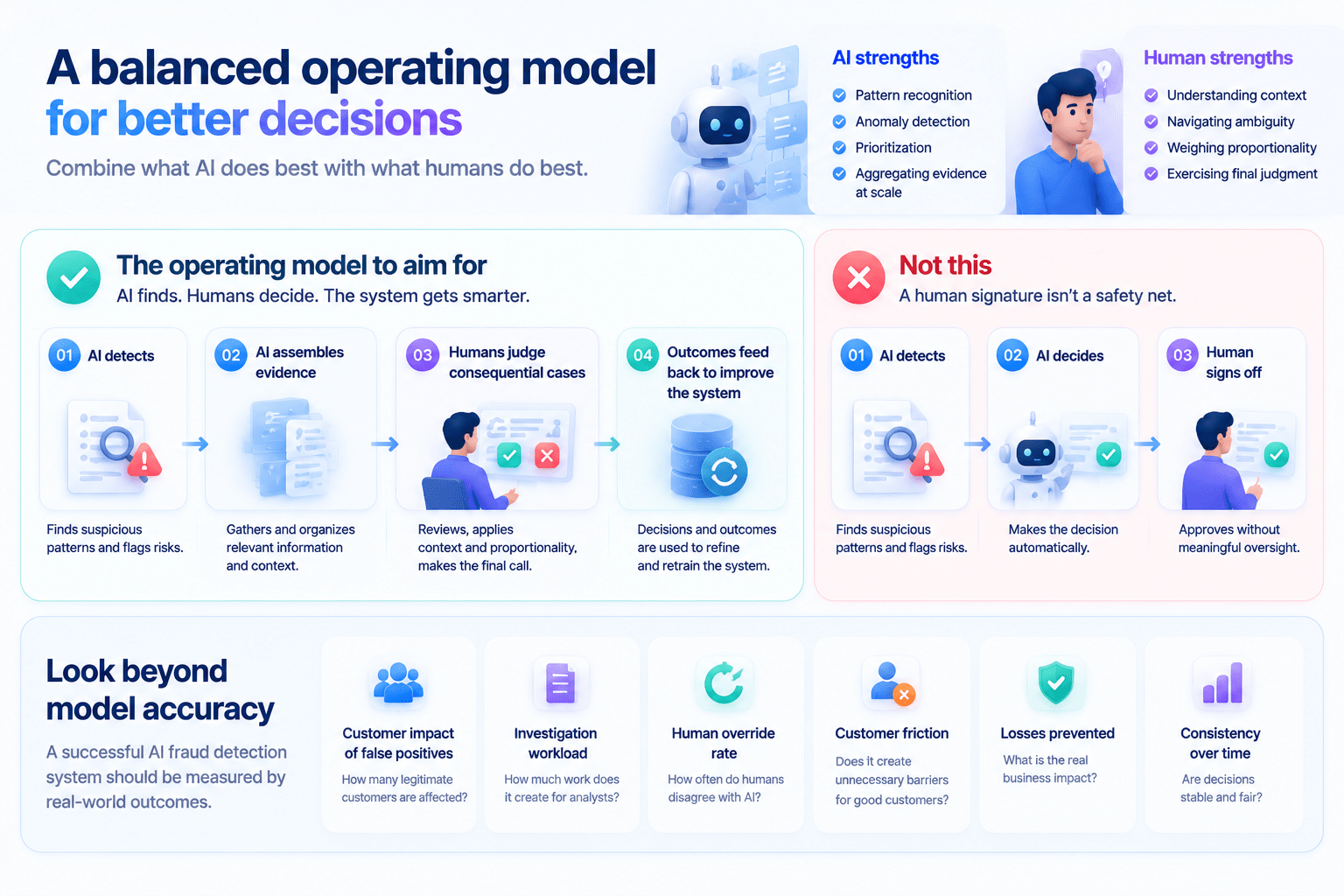
It’s also worth noting that teams shouldn’t measure success by model accuracy alone. Several other metrics deserve equal attention: the customer impact of false positives, the investigation workload the system creates, the rate at which humans override AI decisions, the friction imposed on customers, the losses actually prevented, and the consistency of decisions over time. After all, a model can post high accuracy on paper while it quietly burns out analysts through alert fatigue, or drives away a third of the customers it wrongly declines. Neither outcome counts as success by any meaningful business measure.
Conclusion – Accountability Cannot Be Outsourced to an Algorithm
AI can process more data than humans, spot patterns faster, and prioritize suspicious cases more effectively. Even so, it still operates inside a decision system that humans designed.
Humans set the thresholds. The organization approves the rules. The business chooses the boundaries of automation; the model never decides them on its own.
So when AI gets fraud detection wrong, the answer can’t simply be “the model made a mistake.” Ultimately, accountability has to sit with the organization, and with the people who designed, governed, and operated that system.
AI can generate the fraud signal. It can even recommend the action. But accountability for the decision must remain human.
Getting this right rarely comes down to picking a better model. It comes down to designing the governance around it: clear ownership, traceable decisions, and human review that actually has teeth. That’s the kind of work our team at SmartDev spends most of its time on with fraud and compliance teams building AI into consequential decisions — less about shipping a smarter classifier, more about making sure the system it feeds into can stand behind every decision it makes. If you’re wrestling with where to draw that line in your own fraud stack, we’re happy to talk it through.