
Artificial intelligence is rapidly reshaping how organizations attract, evaluate, and hire top talent in competitive labor markets. Companies adopting AI in talent acquisition are reducing time-to-hire, improving candidate experience, and increasing hiring accuracy through data-driven insights. As skills shortages intensify globally, AI-powered recruitment strategies help businesses scale hiring efficiently while maintaining quality and compliance.
AI in talent acquisition also empowers organizations to shift from reactive hiring to proactive workforce planning by leveraging predictive analytics and intelligent automation. Modern AI-driven recruitment platforms enable HR leaders to identify high-potential candidates earlier, personalize engagement strategies, and optimize hiring pipelines with measurable precision. As digital transformation accelerates across industries, AI is becoming a strategic enabler for building resilient, future-ready talent ecosystems.
What is AI and Why Does It Matter in Talent Acquisition?
Understanding AI Technologies Powering Modern Recruitment
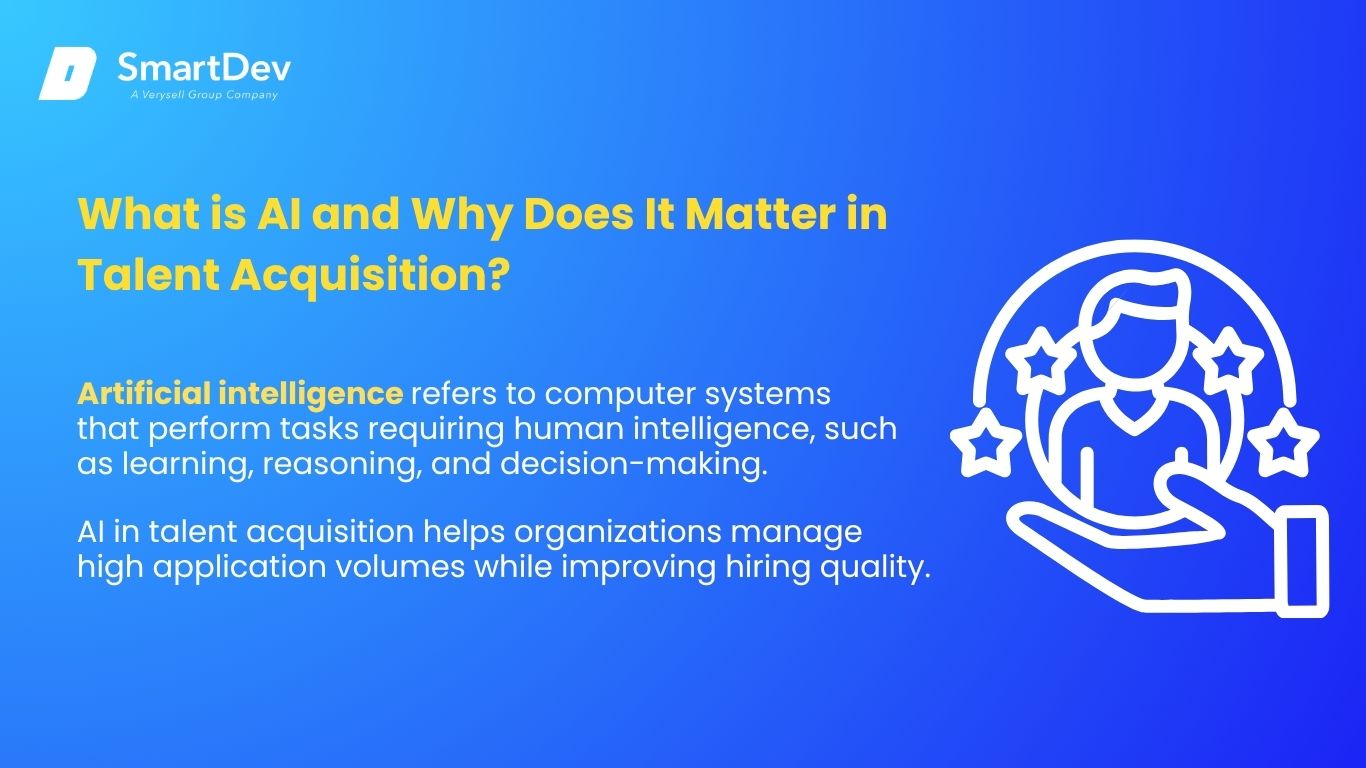 Artificial intelligence refers to computer systems that perform tasks requiring human intelligence, such as learning, reasoning, and decision-making. Key technologies include machine learning, natural language processing (NLP), predictive analytics, and computer vision, which allow systems to process large volumes of recruitment data efficiently. In hiring, AI helps automate repetitive processes, analyze candidate profiles, and improve workforce planning, as explained in SAP’s guide to talent acquisition.
Core AI technologies used in talent acquisition:
- Machine Learning (ML): Improves candidate-job matching accuracy
- Natural Language Processing (NLP): Understands resumes and job descriptions
- Predictive Analytics: Forecasts hiring success and retention
- Computer Vision: Supports video interview evaluation
AI tools integrate with applicant tracking systems and HR platforms to streamline hiring workflows. These systems continuously improve accuracy as more recruitment data becomes available. As a result, recruiters can make faster and more informed decisions.
Growing Importance of AI in Talent Acquisition Strategy
AI in talent acquisition helps organizations manage high application volumes while improving hiring quality. According to IBM’s AI in talent acquisition overview, AI can reduce hiring costs and improve candidate matching efficiency. AI also supports diversity hiring by standardizing evaluation criteria and reducing bias.
Key strategic benefits of AI in talent acquisition:
- Faster resume screening
- Better quality-of-hire
- Improved diversity hiring outcomes
- Stronger workforce planning insights
- Reduced manual administrative tasks
Research from BCG’s analysis of AI in recruitment shows AI improves recruiter productivity and decision-making accuracy. AI analytics platforms enable organizations to align hiring strategies with long-term business needs. Companies increasingly rely on data-driven recruitment to remain competitive.
As highlighted in Humand’s explanation of talent acquisition, modern hiring focuses on building long-term talent pipelines. AI helps companies identify future skill needs and source candidates proactively. This approach strengthens workforce resilience and adaptability.
Business Benefits of AI in Talent Acquisition
AI in talent acquisition delivers measurable improvements in efficiency, hiring accuracy, and strategic workforce planning. Organizations use AI-powered tools to automate repetitive tasks, enhance candidate evaluation, and improve collaboration between recruiters and hiring managers. These capabilities allow companies to scale recruitment operations effectively while maintaining hiring quality.
Below are the most impactful business benefits of AI in talent acquisition, along with concise explanations for each advantage.
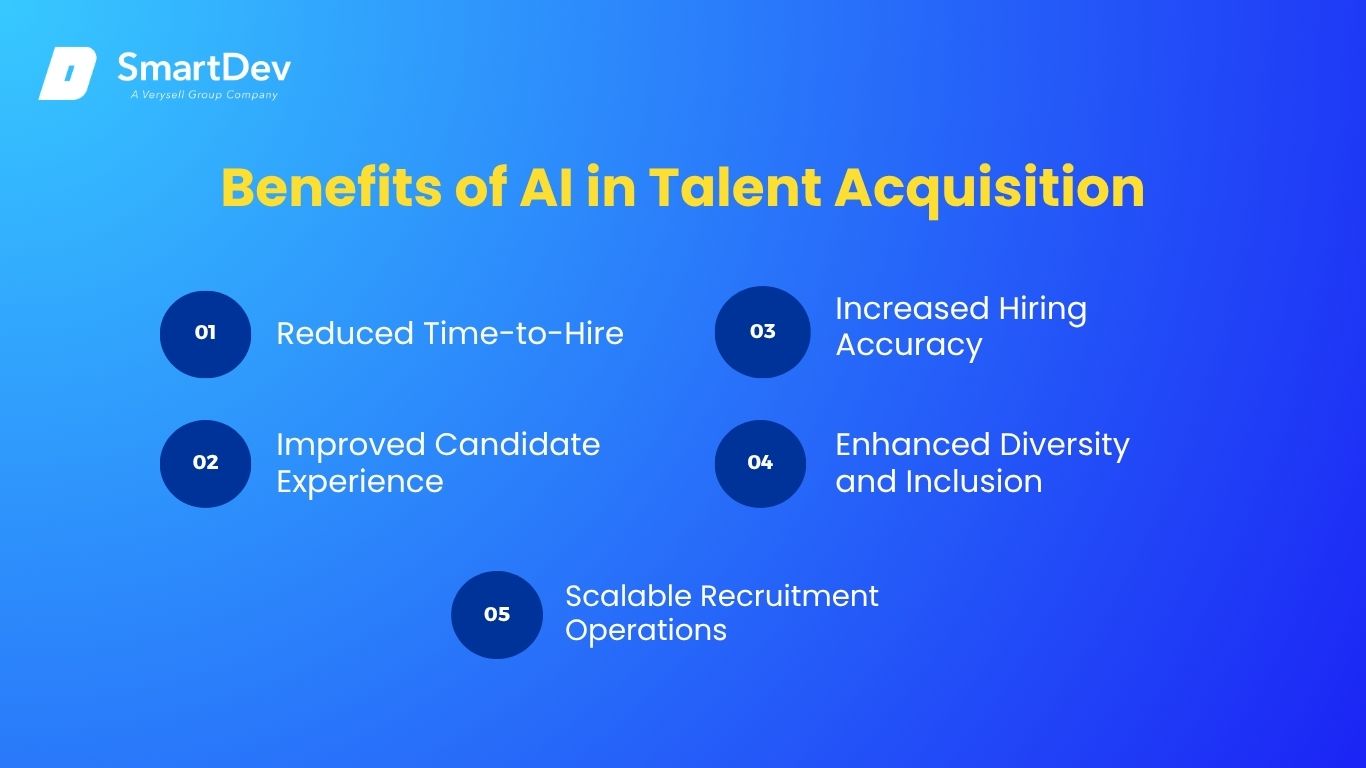 1. Reduced Time-to-Hire
AI significantly accelerates recruitment timelines by automating resume screening, interview scheduling, and candidate shortlisting processes. Machine learning algorithms quickly identify qualified candidates based on predefined criteria, allowing recruiters to focus on high-value interactions. Faster hiring cycles help organizations secure top talent before competitors do.
2. Improved Candidate Experience
AI-powered chatbots and personalized communication tools provide candidates with real-time updates throughout the recruitment process. Automated messaging ensures consistent engagement, reducing uncertainty and improving employer brand perception. A smoother candidate journey increases offer acceptance rates and strengthens long-term talent relationships.
3. Increased Hiring Accuracy
Predictive analytics improves hiring decisions by identifying patterns associated with employee performance and retention. AI systems evaluate skills, experience, and behavioral indicators to recommend candidates with the highest success potential. Data-driven hiring reduces costly mismatches and improves overall workforce productivity.
4. Enhanced Diversity and Inclusion
AI supports diversity hiring initiatives by standardizing candidate evaluation criteria and minimizing unconscious bias. Skills-based matching models prioritize qualifications and competencies rather than demographic characteristics. Organizations benefit from more inclusive hiring practices and stronger workplace innovation.
5. Scalable Recruitment Operations
AI enables organizations to manage large hiring volumes efficiently during periods of business growth or expansion. Automated workflows allow HR teams to handle multiple open roles simultaneously without compromising evaluation quality. Scalable recruitment infrastructure supports global hiring strategies and distributed workforce development.
Challenges Facing AI Adoption in Talent Acquisition
While AI in talent acquisition delivers significant benefits, organizations must address several operational, ethical, and technical challenges to ensure successful implementation. Companies need clear governance frameworks, reliable data infrastructure, and transparent AI practices to build trust among stakeholders. Understanding these challenges early helps organizations mitigate risks and maximize long-term value from AI-powered hiring solutions.
Below are the most common challenges facing AI adoption in talent acquisition, along with concise explanations for each.
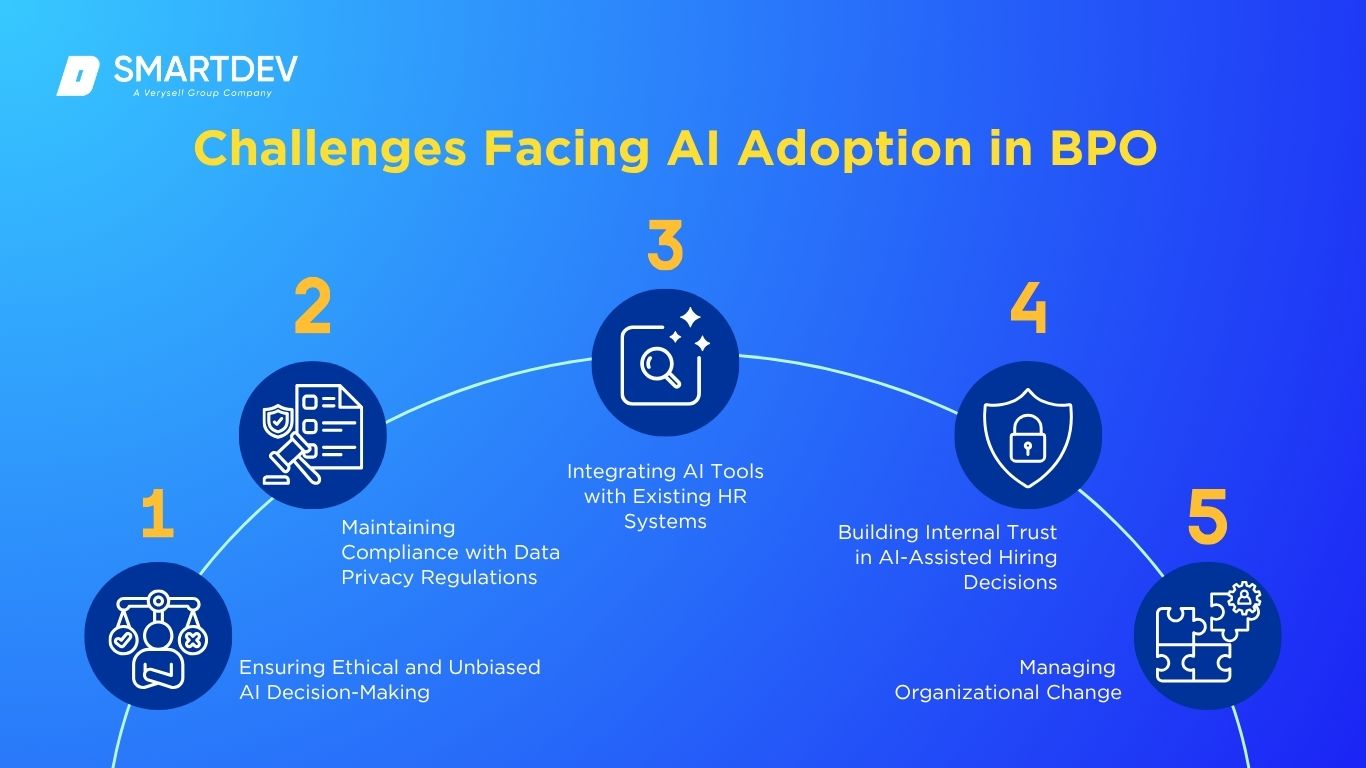 1. Ensuring Ethical and Unbiased AI Decision-Making
AI models can unintentionally replicate historical hiring biases if training data reflects past inequalities. Without careful design and monitoring, algorithms may favor certain educational backgrounds, career paths, or demographic groups. Organizations must regularly audit AI systems and implement fairness checks to ensure equitable candidate evaluation.
2. Maintaining Compliance with Data Privacy Regulations
AI recruitment tools process sensitive candidate data, including resumes, assessments, and behavioral insights. Companies must comply with data protection regulations such as GDPR and other regional privacy laws when collecting and storing personal information. Strong data governance policies help ensure responsible handling of candidate data and reduce legal risks.
3. Integrating AI Tools with Existing HR Systems
Many organizations rely on legacy HR systems such as applicant tracking systems (ATS) and HR information systems (HRIS). Integrating AI solutions with existing platforms can require technical customization and careful data synchronization. Ensuring interoperability between systems improves workflow efficiency and prevents data silos.
4. Building Internal Trust in AI-Assisted Hiring Decisions
Recruiters and hiring managers may initially hesitate to rely on AI recommendations for candidate selection. Concerns about transparency and accuracy can slow adoption if teams do not understand how AI models generate insights. Providing training and clear explanations of AI decision logic helps build confidence in AI-supported hiring.
5. Managing Organizational Change
Introducing AI into recruitment processes requires adjustments to workflows, skill sets, and collaboration methods. HR teams may need training to effectively use AI-powered tools and interpret data-driven insights. Strong change management strategies ensure smooth adoption and encourage cross-functional collaboration between HR, IT, and leadership teams.
Specific Applications of AI in Talent Acquisition
AI technologies are transforming hiring workflows by improving efficiency, accuracy, and decision-making quality. Below are the most impactful use cases showing how AI helps in talent acquisition, structured into clear subpoints for easy understanding.
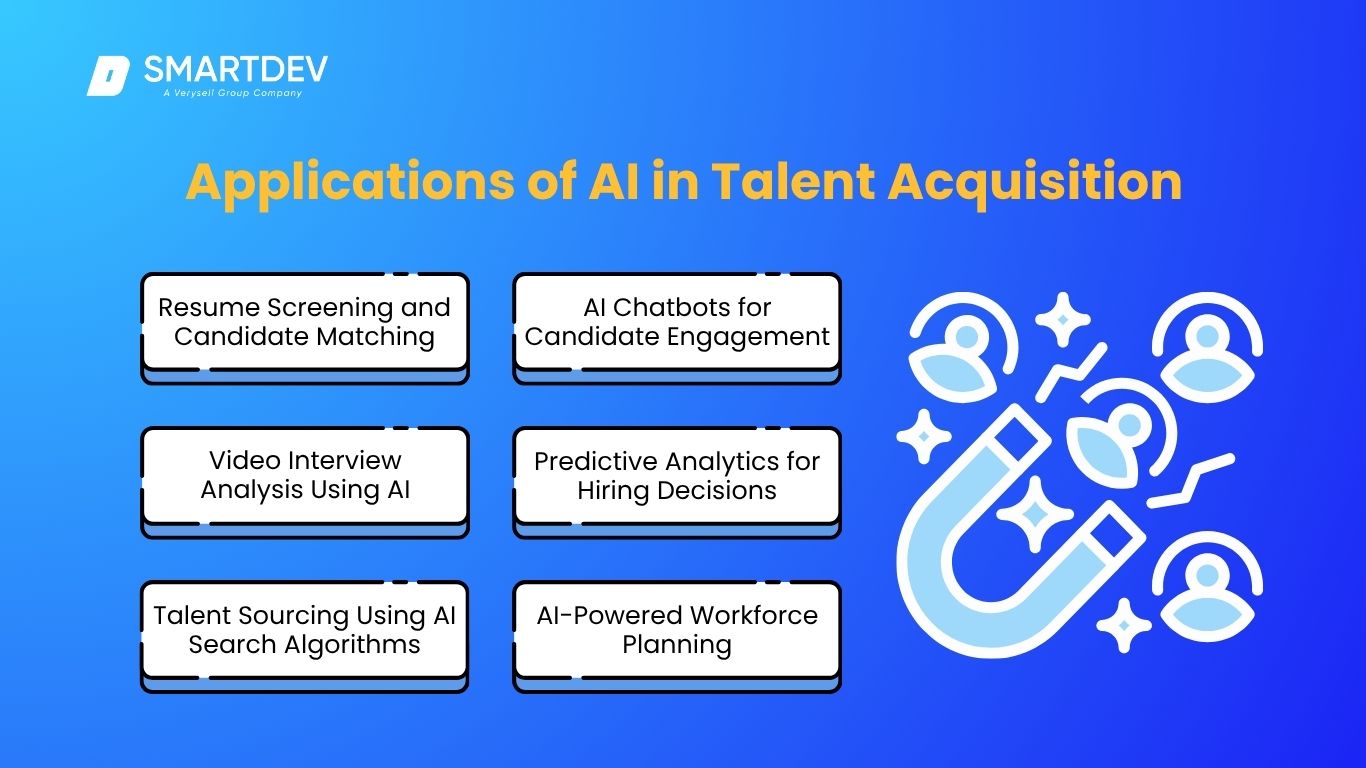 1. Resume Screening and Candidate Matching
AI-powered resume screening helps recruiters quickly identify qualified candidates from large applicant pools. Natural language processing (NLP) analyzes resumes to extract skills, experience, and qualifications automatically. Machine learning models then rank candidates based on job fit and predicted performance.
How AI helps talent acquisition:
- Screens thousands of resumes in minutes
- Identifies best-fit candidates based on skills data
- Reduces manual workload for recruiters
- Improves consistency in candidate evaluation
Unilever used AI tools such as Pymetrics and HireVue to screen graduate applicants efficiently. The company reduced hiring time by 75% while improving diversity in shortlisted candidates. AI-driven screening enabled faster and more objective hiring decisions.
2. AI Chatbots for Candidate Engagement
AI chatbots support continuous communication with candidates throughout the recruitment process. These tools answer questions, provide application updates, and guide candidates through each hiring stage. Chatbots improve responsiveness while reducing repetitive work for recruiters.
How AI helps talent acquisition:
- Provides instant responses to candidate inquiries
- Improves candidate experience and engagement
- Reduces recruiter workload in early hiring stages
- Supports 24/7 communication across global markets
L’Oréal implemented an AI chatbot to streamline communication with job applicants worldwide. The chatbot provided real-time updates and answered frequently asked questions. This improved response speed and candidate satisfaction rates.
3. Predictive Analytics for Hiring Decisions
Predictive analytics uses historical hiring and performance data to forecast candidate success. AI models identify patterns linked to strong job performance, retention, and cultural fit. Recruiters can make more informed decisions using data-driven insights.
How AI helps talent acquisition:
- Predicts candidate performance potential
- Reduces employee turnover risk
- Improves long-term workforce planning
- Supports strategic hiring decisions
IBM uses predictive analytics tools to evaluate candidate suitability across technical roles. AI-driven insights help hiring teams prioritize high-potential applicants. This approach improves retention rates and hiring accuracy.
4. Video Interview Analysis Using AI
AI-powered interview platforms analyze candidate responses, speech patterns, and communication behaviors. Computer vision and NLP technologies evaluate both verbal and non-verbal signals during interviews. These tools provide structured insights that help recruiters assess soft skills consistently.
How AI helps talent acquisition:
- Standardizes candidate evaluation criteria
- Identifies communication and behavioral strengths
- Reduces bias in interview assessments
- Accelerates interview review processes
HireVue provides AI-based video interview analysis used by companies such as Hilton and Vodafone. The platform evaluates candidate responses and behavioral indicators. Organizations report faster hiring cycles and more consistent candidate evaluation.
5. Talent Sourcing Using AI Search Algorithms
AI sourcing tools scan online platforms, professional networks, and databases to identify potential candidates. Machine learning algorithms analyze profiles to find candidates who match job requirements. AI expands talent pools by identifying passive candidates who are not actively applying.
How AI helps talent acquisition:
- Identifies qualified candidates across global markets
- Expands access to passive talent pools
- Improves sourcing speed and efficiency
- Enhances talent pipeline quality
LinkedIn Recruiter uses AI algorithms to recommend candidates based on skills and experience data. Recruiters receive intelligent suggestions aligned with job requirements. This improves candidate discovery and sourcing productivity.
6. AI-Powered Workforce Planning
AI workforce planning tools analyze internal data and labor market trends to predict hiring needs. Predictive models forecast future skill demands and workforce gaps. These insights help organizations plan recruitment strategies proactively.
How AI helps talent acquisition:
- Forecasts future hiring requirements
- Identifies emerging skill gaps
- Supports long-term workforce strategy
- Improves hiring budget allocation
Microsoft uses AI-driven workforce analytics to anticipate talent needs across global teams. Predictive insights help align hiring strategies with business growth objectives. This enables proactive talent acquisition planning.
Examples of AI in Talent Acquisition
Real-World Case Studies
IBM: AI-powered talent analytics for workforce planning
IBM applies artificial intelligence to workforce analytics, helping organizations better understand internal skills and future hiring needs. AI systems analyze employee data, job performance patterns, and market skill demand to identify capability gaps. These insights enable HR teams to develop proactive hiring strategies aligned with long-term business goals.
AI facilitates talent acquisition by improving hiring accuracy and reducing workforce planning uncertainty. Instead of reacting to talent shortages, organizations can forecast skill demand and build targeted recruitment pipelines. AI-powered internal mobility tools also recommend existing employees for new roles, reducing hiring costs and improving retention through career development opportunities.
Morgan McKinley: AI automation improving recruiter productivity
 Morgan McKinley highlights how AI automation reduces repetitive recruitment tasks such as resume screening and interview coordination. Machine learning algorithms quickly analyze large volumes of applications and rank candidates based on skills and relevance. Recruiters can focus on high-value activities such as relationship building and candidate evaluation.
AI facilitates talent acquisition by accelerating hiring cycles and improving communication efficiency. Chatbots answer candidate questions in real time, improving engagement and reducing drop-off rates. Automation also allows recruitment teams to manage higher hiring volumes without compromising evaluation quality.
Intelligent automation transforming talent strategy
Josh Bersin explains that AI is transforming recruitment into a more strategic business function. Workforce intelligence platforms analyze labor market trends, candidate behavior, and skill demand patterns. These insights help organizations design long-term talent acquisition strategies instead of relying on reactive hiring approaches.
AI facilitates talent acquisition by enabling skill-based hiring models. Algorithms identify transferable competencies rather than focusing only on degrees or job titles. This expands access to diverse talent pools and improves hiring inclusivity. Predictive analytics also help organizations anticipate future workforce requirements and adjust recruitment strategies accordingly.
AI platforms enabling scalable hiring during rapid growth
 AI-powered hiring platforms allow organizations to scale recruitment efficiently when hiring demand increases. Machine learning algorithms screen resumes and rank candidates based on predefined criteria. This reduces manual workload and shortens time-to-hire during periods of rapid business expansion.
AI facilitates talent acquisition by maintaining consistent evaluation standards across large applicant pools. Automated workflows streamline candidate communication and interview coordination. HR teams gain real-time insights into pipeline performance, allowing continuous optimization of recruitment strategies.
Need Expert Help Turning Ideas Into Scalable Products?
Partner with SmartDev to accelerate your software development journey — from MVPs to enterprise systems.
Book a free consultation with our tech experts today.
Let’s Build TogetherInnovative AI Solutions Transforming Hiring

Generative AI improving recruitment content and communication
Generative AI tools create optimized job descriptions, employer branding content, and candidate communication messages. These systems analyze successful recruitment campaigns and generate content aligned with industry standards and candidate expectations.
AI facilitates talent acquisition by improving content quality and reducing time required to publish job openings. Personalized communication enhances candidate engagement and strengthens employer brand perception. Multilingual AI tools also support global recruitment strategies by enabling communication across different languages.
AI recommendation engines improving candidate-job matching
AI recommendation engines analyze candidate profiles and job requirements using multidimensional matching algorithms. These systems identify relevant skills, experience patterns, and career preferences. Recruiters receive data-driven candidate suggestions that improve hiring efficiency.
AI facilitates talent acquisition by uncovering qualified candidates who may not match traditional keyword searches. Recommendation engines also enable talent rediscovery by identifying previous applicants suitable for new roles. Personalized job suggestions improve candidate satisfaction and application relevance.
Automated interview scheduling reducing hiring delays
AI-powered scheduling tools automatically coordinate interviews by syncing calendars and identifying suitable meeting times. Candidates can choose available slots without manual coordination, reducing communication delays.
AI facilitates talent acquisition by improving workflow efficiency and reducing scheduling conflicts. Automated reminders increase interview attendance rates and ensure consistent communication throughout the recruitment process. These tools are especially valuable for global hiring across multiple time zones.
Workforce analytics identifying future skill requirements
AI workforce analytics platforms evaluate internal HR data and external labor market trends to identify emerging skill demands. Predictive insights allow organizations to prepare for future hiring needs before talent shortages occur.
AI facilitates talent acquisition by enabling proactive recruitment planning and targeted sourcing strategies. Organizations can prioritize hiring for critical roles and develop training programs to close skill gaps. Predictive analytics improves resource allocation and supports long-term workforce development strategies.
Emerging Technologies in AI for Recruitment
Artificial intelligence is enabling a new generation of recruitment tools that combine automation with advanced data intelligence. These technologies help organizations identify qualified candidates faster, improve hiring accuracy, and support long-term workforce strategy.
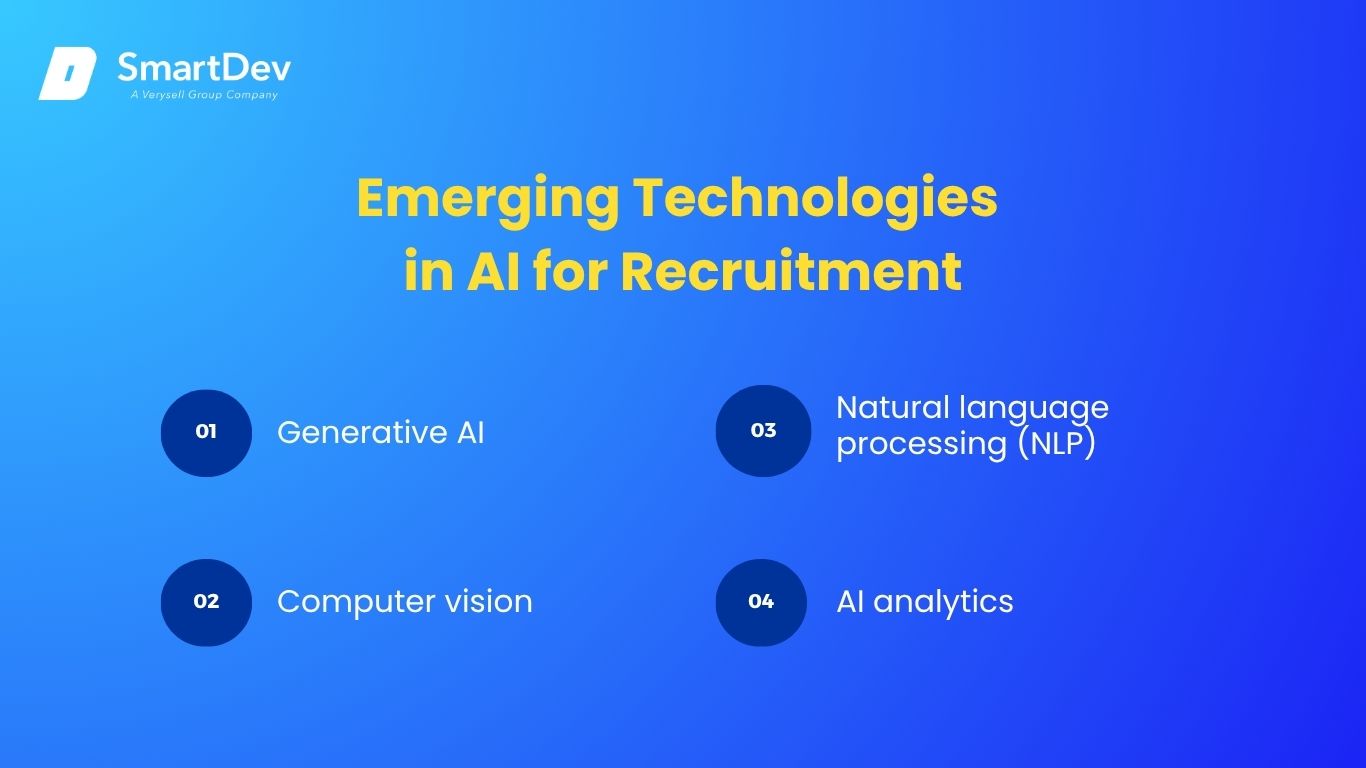 Generative AI for recruitment content creation
Generative AI enables HR teams to automatically create job descriptions, career page content, and candidate communication messages. AI tools analyze high-performing job posts and suggest optimized wording that improves clarity and inclusiveness. This ensures consistent employer branding across multiple recruitment channels.
Generative AI also personalizes communication with candidates by adapting tone and messaging based on role requirements and candidate profiles. Recruiters can quickly produce interview invitations, follow-up emails, and onboarding documentation. This improves candidate engagement while reducing manual writing workload.
Computer vision for video interview intelligence
Computer vision technology enhances video interview platforms by analyzing visual and behavioral signals. AI tools evaluate facial expressions, speech patterns, and engagement levels to provide structured insights into communication skills. Recruiters gain additional context when assessing candidate soft skills such as confidence and professionalism.
These insights improve evaluation consistency across interview panels. While AI does not replace human judgment, it provides standardized indicators that support fairer candidate comparisons and reduce subjective bias.
Natural language processing for resume parsing and skill extraction
Natural language processing improves resume screening by interpreting context rather than relying only on keywords. AI systems analyze candidate experience descriptions and identify relevant skills even when terminology differs across industries.
NLP enables semantic skill extraction, helping recruiters identify transferable competencies. For example, project management experience in one industry may be relevant to roles in another. Improved resume parsing accuracy helps organizations discover high-potential candidates more efficiently.
AI analytics for labor market intelligence
AI-powered analytics platforms collect and analyze data from job boards, professional networks, and labor market databases. These tools provide insights into salary benchmarks, skill demand trends, and talent availability across regions.
Recruiters can use this information to refine sourcing strategies and remain competitive in attracting talent. Labor market intelligence also supports strategic workforce planning by identifying emerging skill gaps before they become critical.
These emerging technologies allow organizations to transition from reactive hiring practices to proactive talent acquisition strategies.
AI’s Role in Sustainability Efforts
AI contributes to more sustainable recruitment practices by reducing inefficiencies and optimizing resource allocation. Intelligent automation helps organizations minimize unnecessary hiring processes and reduce environmental impact associated with traditional recruitment activities.
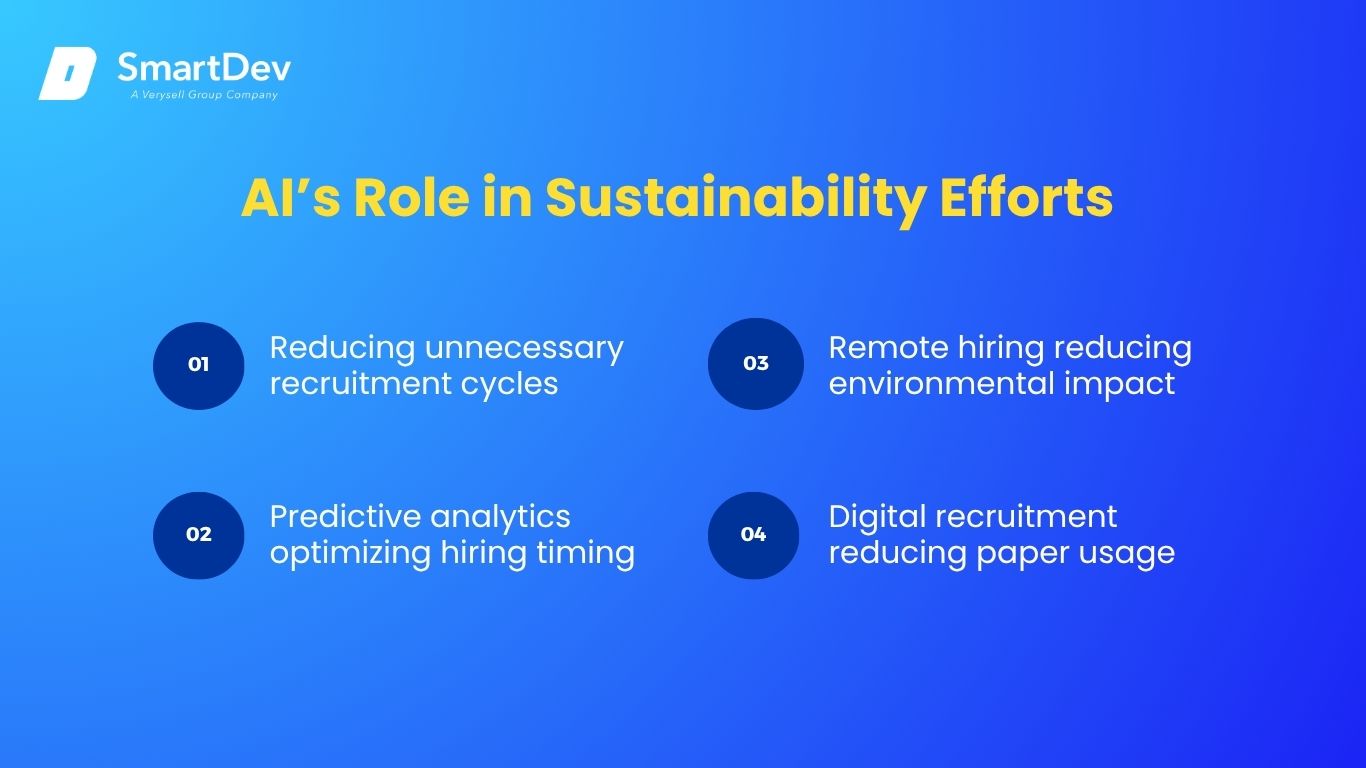 Reducing unnecessary recruitment cycles
AI improves workforce planning accuracy by predicting hiring needs based on business demand and historical workforce data. Organizations can avoid over-hiring or repeated recruitment cycles caused by poor hiring decisions.
More precise hiring forecasts reduce administrative workload and improve productivity. HR teams can focus resources on strategic hiring initiatives instead of constantly replacing employees.
Predictive analytics optimizing hiring timing
Predictive analytics models evaluate business growth trends, project pipelines, and workforce capacity data. AI identifies the most appropriate timing for recruitment activities, ensuring organizations hire talent when demand is highest.
Better hiring timing improves onboarding effectiveness and reduces the risk of underutilized employees. Organizations benefit from more efficient workforce allocation and improved operational performance.
Remote hiring reducing environmental impact
AI-powered virtual hiring tools reduce the need for travel during recruitment processes. Video interviews, digital assessments, and online onboarding platforms enable organizations to evaluate candidates globally without requiring physical meetings.
Reducing travel lowers carbon emissions and decreases logistical costs. Remote hiring technologies also allow organizations to access broader talent pools without geographic limitations.
Digital recruitment reducing paper usage
Digital recruitment platforms eliminate the need for paper-based documentation by enabling electronic contracts and cloud-based candidate management systems. Automation improves data accuracy while reducing administrative overhead.
Paperless HR workflows support environmentally responsible business practices. Organizations adopting digital recruitment tools contribute to sustainability goals while improving operational efficiency.
AI supports sustainable talent acquisition strategies by combining efficiency improvements with environmentally responsible processes. Businesses adopting AI-driven recruitment technologies benefit from both economic and sustainability advantages.
How to Implement AI in Talent Acquisition
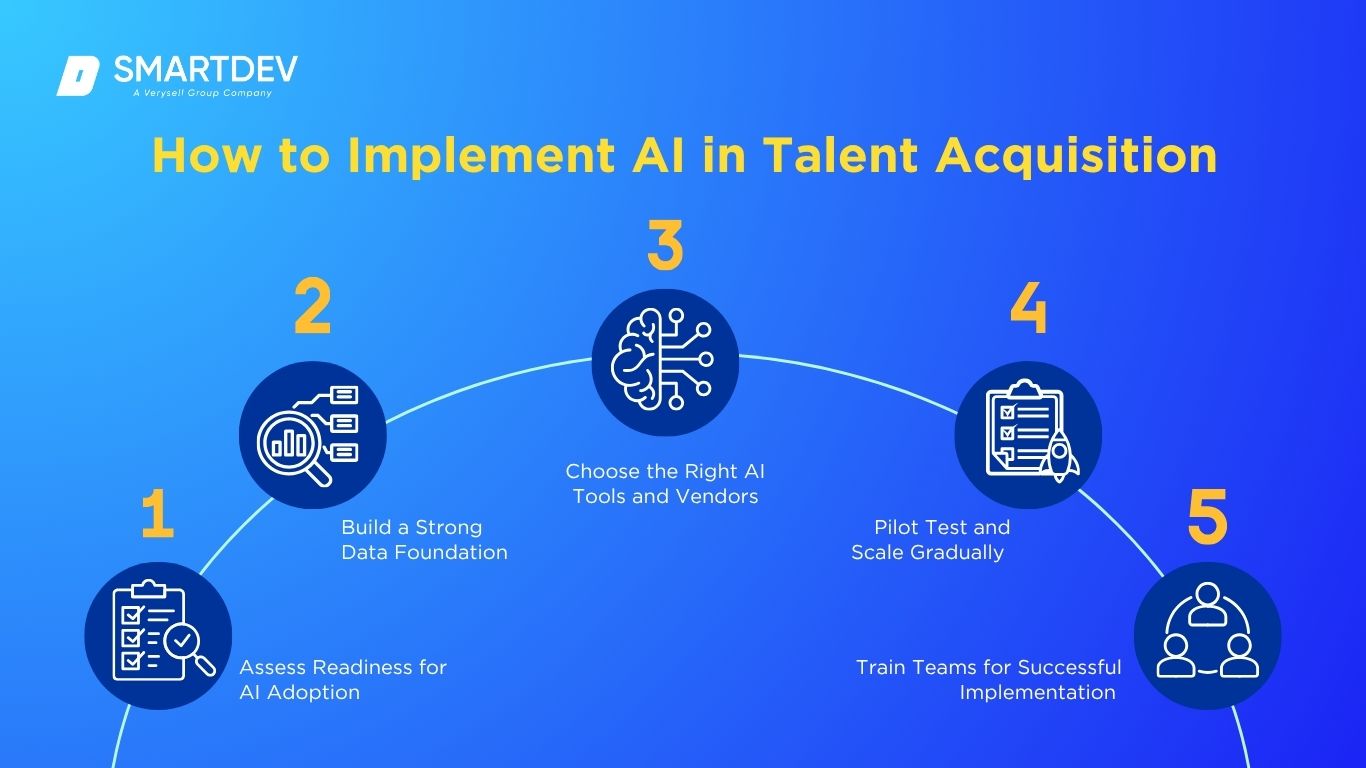 Step 1. Assess Readiness for AI Adoption
Organizations should first evaluate current recruitment workflows to identify repetitive and high-volume tasks that can benefit from automation, such as resume screening or interview scheduling. Aligning stakeholders on clear goals like reducing time-to-hire or improving candidate quality ensures AI adoption focuses on measurable business impact and provides a clear implementation direction.
Step 2. Build a Strong Data Foundation
AI systems rely on structured and consistent candidate data to deliver accurate insights. Standardizing data collection, cleaning incomplete records, and implementing clear governance policies improve algorithm performance while ensuring compliance with data privacy regulations.
Step 3. Choose the Right AI Tools and Vendors
Selecting AI tools that integrate smoothly with existing HR systems helps reduce technical complexity and ensures scalability. Organizations should prioritize vendors that offer customization flexibility, strong compliance features, and reliable technical support to ensure long-term performance.
Step 4. Pilot Test and Scale Gradually
Starting with a small pilot allows organizations to test AI tools in real recruitment scenarios and refine workflows before wider adoption. Gradually scaling implementation helps maintain consistent performance and reduces operational risks across departments.
Step 5. Train Teams for Successful Implementation
HR teams should be trained to understand how AI supports decision-making and improves hiring outcomes. Continuous learning ensures employees can effectively use evolving AI tools, increasing adoption success and maximizing long-term value.
Measuring the ROI of AI in Talent Acquisition
Key Metrics to Track Success
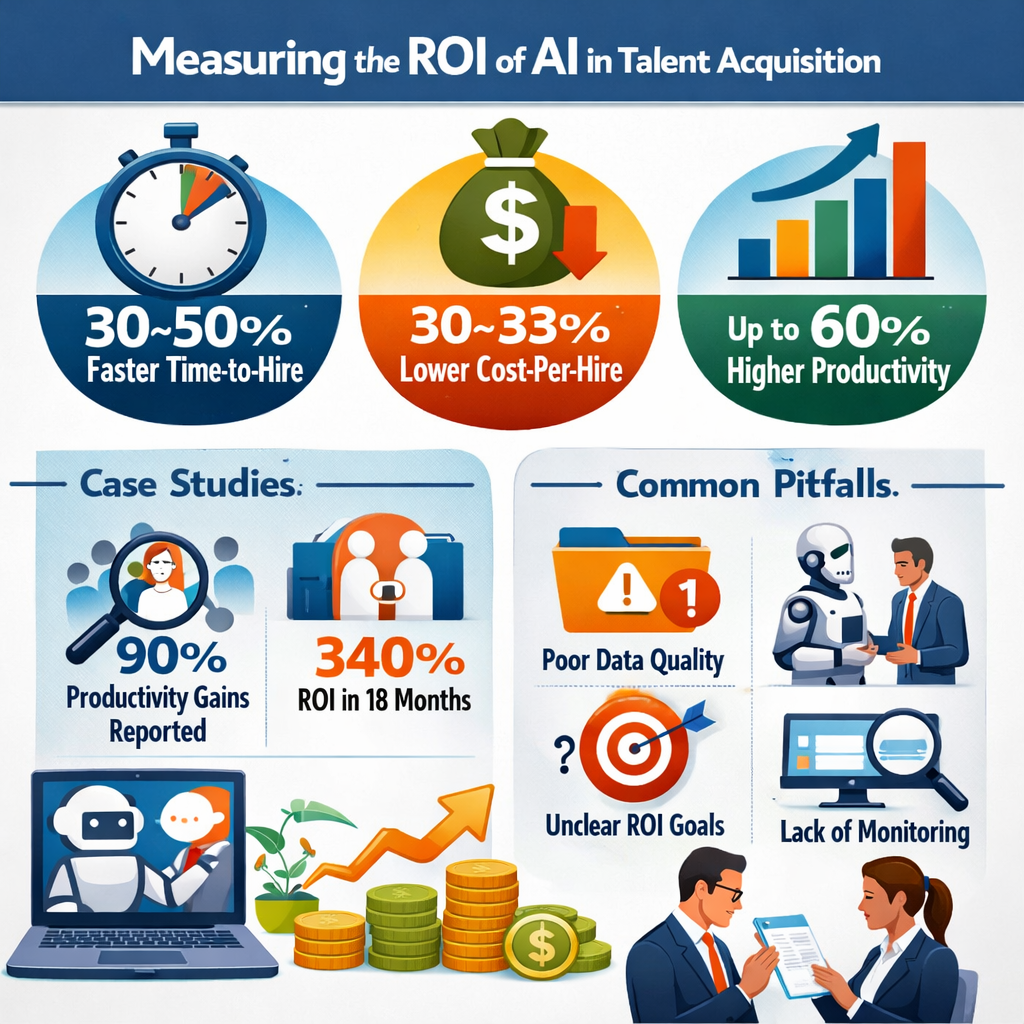
Organizations measure the ROI of AI in talent acquisition through improvements in speed, cost efficiency, and hiring quality. AI-powered automation can reduce time-to-hire by 30–50% by accelerating resume screening and interview scheduling. Faster hiring helps companies secure top candidates earlier and reduce productivity loss from prolonged vacancies.
Cost-per-hire can decrease by 30–33% as AI reduces manual administrative work and reliance on external recruitment services. Recruiter productivity also improves significantly, increasing by up to 60% when repetitive tasks such as candidate communication and resume screening are automated. AI chatbots enhance candidate experience by reducing response time from 7 days to less than 24 hours, helping maintain engagement throughout the hiring process.
Together, these metrics demonstrate how AI contributes to faster hiring cycles, improved candidate satisfaction, and more efficient use of HR resources.
Case Studies Demonstrating ROI
Research shows strong financial and operational impact from AI adoption in recruitment. According to BCG, more than 90% of organizations implementing AI in HR report measurable productivity improvements, with some achieving efficiency gains above 30%. These improvements occur because AI allows recruiters to focus more on strategic activities such as talent engagement and workforce planning.
AI sourcing platforms also improve candidate pipeline quality by identifying up to 60% more relevant candidates compared to traditional search methods. Organizations adopting AI recruiting technology report an average ROI of 340% within 18 months, highlighting strong long-term business value.
These results demonstrate that AI not only improves recruitment efficiency but also contributes directly to measurable financial returns.
Common Pitfalls and How to Avoid Them
- Poor data quality: Inconsistent or incomplete recruitment data reduces AI accuracy. Standardizing candidate data improves algorithm performance and hiring reliability.
- Over-automation of decision-making: AI should support rather than replace human judgment. Studies show 67% of candidates prefer human involvement in final hiring decisions.
- Unclear ROI expectations: Organizations focusing on targeted AI use cases achieve up to 2.1x higher ROI compared to companies attempting large-scale transformation without clear priorities.
- Lack of continuous monitoring: AI performance should be evaluated regularly to ensure models remain aligned with business goals and evolving hiring needs.
By tracking relevant metrics and avoiding common pitfalls, organizations can maximize the financial and strategic value of AI in talent acquisition.
Future Trends of AI in Talent Acquisition
Predictions for the Next Decade
Over the next decade, AI will continue transforming talent acquisition through advancements in deep learning, generative AI, and predictive analytics. Future recruitment platforms are expected to deliver end-to-end talent lifecycle intelligence, enabling organizations to manage sourcing, screening, hiring, and employee development within a unified system. AI-driven insights will help companies anticipate workforce needs earlier, identify emerging skill gaps, and build proactive hiring strategies aligned with business growth objectives.
Skill-based hiring models will increasingly replace traditional role-based evaluation frameworks, allowing organizations to assess candidates based on capabilities rather than job titles or degrees. AI-powered labor market analytics will provide real-time insights into talent availability, salary benchmarks, and evolving skill demands. As intelligent automation becomes more sophisticated, companies will rely on AI to streamline workforce planning, improve hiring accuracy, and reduce operational inefficiencies across the recruitment lifecycle.
How Businesses Can Stay Ahead of the Curve
To remain competitive, organizations should invest in AI literacy and workforce upskilling so HR teams can effectively interpret data insights and collaborate with intelligent systems. Strategic partnerships with technology providers can accelerate innovation by giving businesses access to advanced AI capabilities without requiring extensive in-house development. Continuous experimentation with AI tools allows companies to identify high-impact use cases and adapt recruitment strategies as technology evolves.
Organizations that adopt AI early often gain long-term advantages in attracting high-quality talent and improving hiring efficiency. Future talent acquisition strategies will rely heavily on data-driven insights to support faster decision-making, improve candidate experience, and build more agile workforce planning models. Companies that integrate AI strategically today will be better positioned to respond to evolving labor market dynamics in the years ahead.
Conclusion
Artificial intelligence is reshaping talent acquisition by enabling faster, more accurate, and more strategic hiring decisions. From automated resume screening and intelligent candidate matching to predictive workforce analytics, AI helps organizations improve efficiency while enhancing candidate experience. By leveraging data-driven insights, businesses can reduce hiring costs, identify high-potential talent earlier, and build stronger long-term workforce strategies aligned with evolving market demands.
As AI technologies continue to advance, organizations that invest in strong data foundations, employee upskilling, and responsible implementation strategies will gain a significant competitive advantage. Companies that adopt AI early are better positioned to adapt to changing skill requirements, improve hiring outcomes, and create more agile talent acquisition processes. Embracing AI today enables businesses to build resilient, future-ready workforces capable of sustaining long-term growth.