
TL;DR:
- AI model testing evaluates data quality, model behavior, system integration, and production performance – with tests tailored to the model type, deployment context, and risk level.
- Testing should follow the full lifecycle: define purpose and risk, set acceptance criteria, build representative test data, validate before release, and monitor continuously.
- Production readiness requires layered evidence, targeted tests for issues and clear ownership at every release gate.
- Governance frameworks such as the NIST AI Risk Management Framework, ISO/IEC 42001, and the EU AI Act increasingly expect testing evidence to be documented before and after deployment
- Monitoring is testing final stage, not a separate task – the same standards a model is release against should govern how it is watched in production.

Introduction
Most AI failures are not model failures in isolation — they are testing gaps. As organizations move AI from pilots into revenue-critical workflows, the cost of an untested assumption stops being theoretical: it appears as a wrong credit decision, a biased shortlist, or a service outage during peak traffic.
AI model testing differs from conventional software QA because the system’s behavior is learned from data rather than fully specified in code. Testing must therefore cover the data pipeline, the model itself, the surrounding system, and the way real users interact with it — not just a pass/fail check at build time.
Teams building this capability internally often pair rigorous testing practices with structured AI development services and dedicated MLOps services so that testing, deployment, and monitoring share the same pipeline instead of living in separate tools.
1. AI Model Testing and Why Does It Matter?
AI model testing is the systematic evaluation of a model’s data, behavior, and system integration to confirm it performs as intended before and after deployment.
Unlike conventional software testing — which checks whether code meets a fixed specification — AI model testing checks whether a system’s learned behavior remains accurate, fair, and stable across data.
This distinction matters because two identical codebases trained on different data can behave very differently. A model that passes evaluation today can degrade tomorrow as real-world inputs change.

1.1 The business, technical, and governance risks of untested models
Untested models create three overlapping categories of exposure:
- Technical: inaccurate predictions, silent degradation, or failure when input data shifts away from the training distribution.
- Commercial: lost revenue, damaged customer trust, and costly post-release rework.
- Governance: regulators and auditors expect documented evidence that a model was tested for fairness, safety, and robustness — a requirement formalized in frameworks such as the NIST AI Risk Management Framework.
Treating testing as optional shifts these risks downstream, where they are more visible and more expensive to fix.
1.2 What effective AI model testing must evaluate
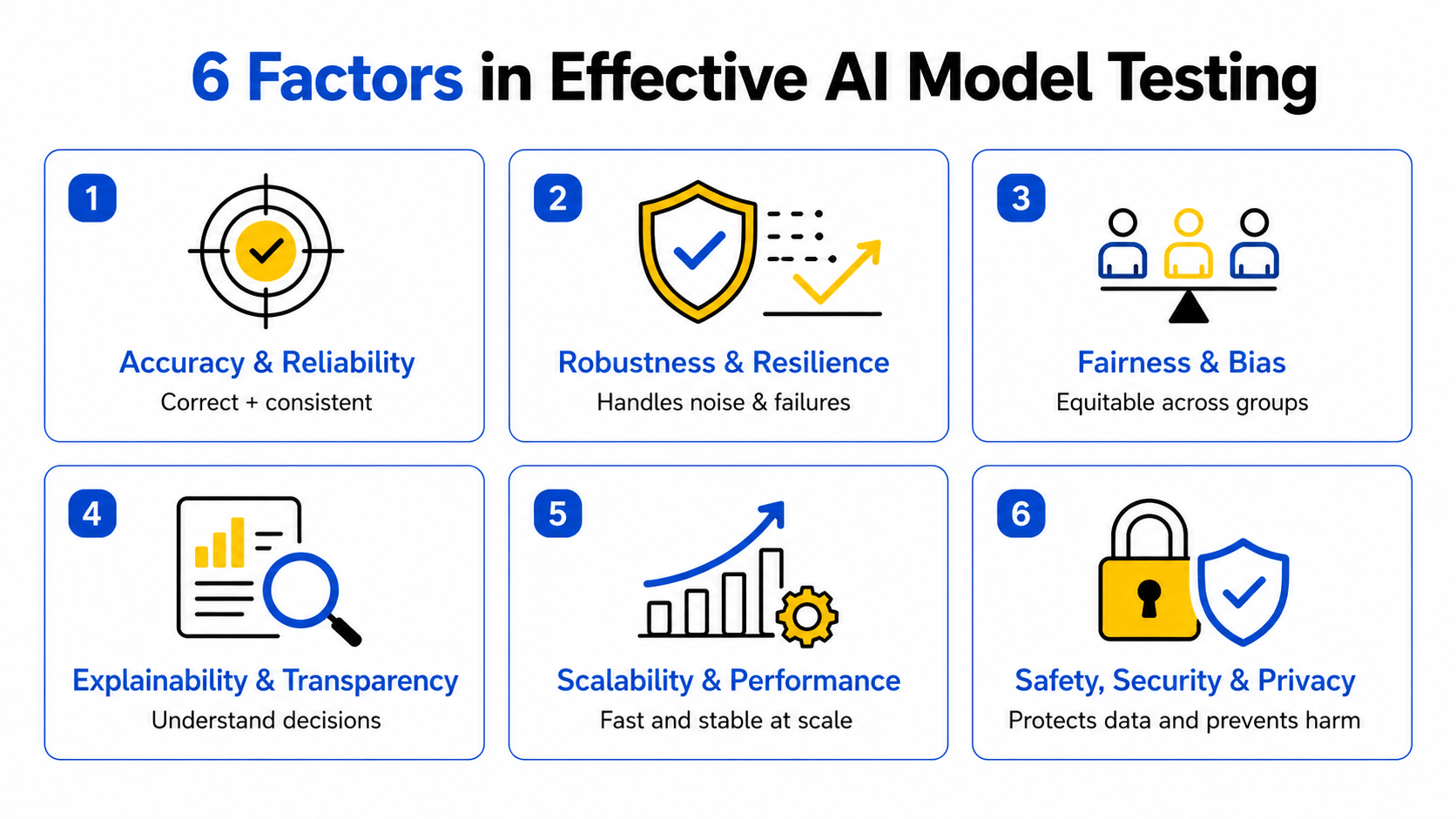
Accuracy and Reliability
Accuracy refers to an AI model’s ability to produce correct outputs, while reliability pertains to its consistency across different datasets and scenarios. Evaluating these aspects involves metrics like precision, recall, and F1 scores to ensure the model meets performance expectations.
Robustness and Resilience
Robustness and resilience test how the model behaves under noisy, adversarial, or unexpected inputs rather than only clean benchmark data. They may include corrupted data, unusual edge cases, distribution shifts, deliberate prompt manipulation, or temporary system failures.
Fairness and Bias Detection
AI models should generate fair results on different classes of users. The testing of models shall be done in a way that it could detect and remove biases to avoid unfair treatment/discrimination. Disparate impact analysis and some fairness-aware algorithms are in use to test the fairness of the models for improvement.
Explainability and Transparency
Understanding how an AI model makes decisions is vital for building trust and ensuring compliance with ethical standards. Explainability involves making the model’s internal mechanics interpretable, often through methods like SHAP (SHapley Additive exPlanations) and LIME (Local Interpretable Model-agnostic Explanations).
Scalability and Performance
AI models should maintain consistent performance and operational efficiency as they scale to handle larger datasets, higher request volumes, and more complex tasks. Scalability testing evaluates whether the model can process increasing workloads without unacceptable degradation in speed, accuracy, latency, or reliability.
Safety, Security and Privacy
Safety, security, and privacy testing evaluates whether an AI model can prevent data leakage, resist adversarial manipulation, protect sensitive information, and avoid generating harmful or unsafe outputs. No single testing dimension can replace the others, as a highly accurate model may still be biased, insecure, privacy-invasive, or too expensive to operate reliably at scale.
2. The AI Model Testing Framework: From Risk Definition to Continuous Monitoring
A practical AI testing framework should connect business risk to technical evidence. The six stages below are sequential for planning, but iterative in execution: teams may revisit risk assumptions, test data, or thresholds when evaluation reveals new failure modes.
This framework organizes AI testing into six sequential stages that connect planning directly to production outcomes, aligned with the Govern-Map-Measure-Manage structure described in the NIST AI RMF 1.0. It begins with defining the model’s purpose and risk profile, then moves through acceptance criteria, representative test data, pre-deployment testing, release gates, and continuous monitoring.
2.1 Define the model’s purpose, users, and risk profile
Before any test is written, teams should document what the model decides, who is affected by that decision, and how severe a wrong output would be.
A recommendation engine and a credit-scoring model warrant fundamentally different testing depth — the consequences of error differ by orders of magnitude. This step also identifies which regulations apply, since risk classification under the EU AI Act depends on the model’s application, not its architecture.
2.2 Establish test objectives, acceptance criteria, and ownership
Translate each risk profile into measurable acceptance criteria: target accuracy, maximum acceptable bias gap, latency ceiling. These must be agreed before evaluation begins, not after results are in.
Assign ownership explicitly: who signs off on release, who owns monitoring after launch, and who is accountable if a threshold is breached. Without named owners, borderline results produce disputes rather than decisions.
2.3 Build representative datasets and test scenarios
Test data must reflect the population and conditions the model will actually encounter — including edge cases, minority subgroups, and adversarial inputs — not just the distribution used for training.
Gaps here are among the most common reasons a model performs well in evaluation but degrades in production.
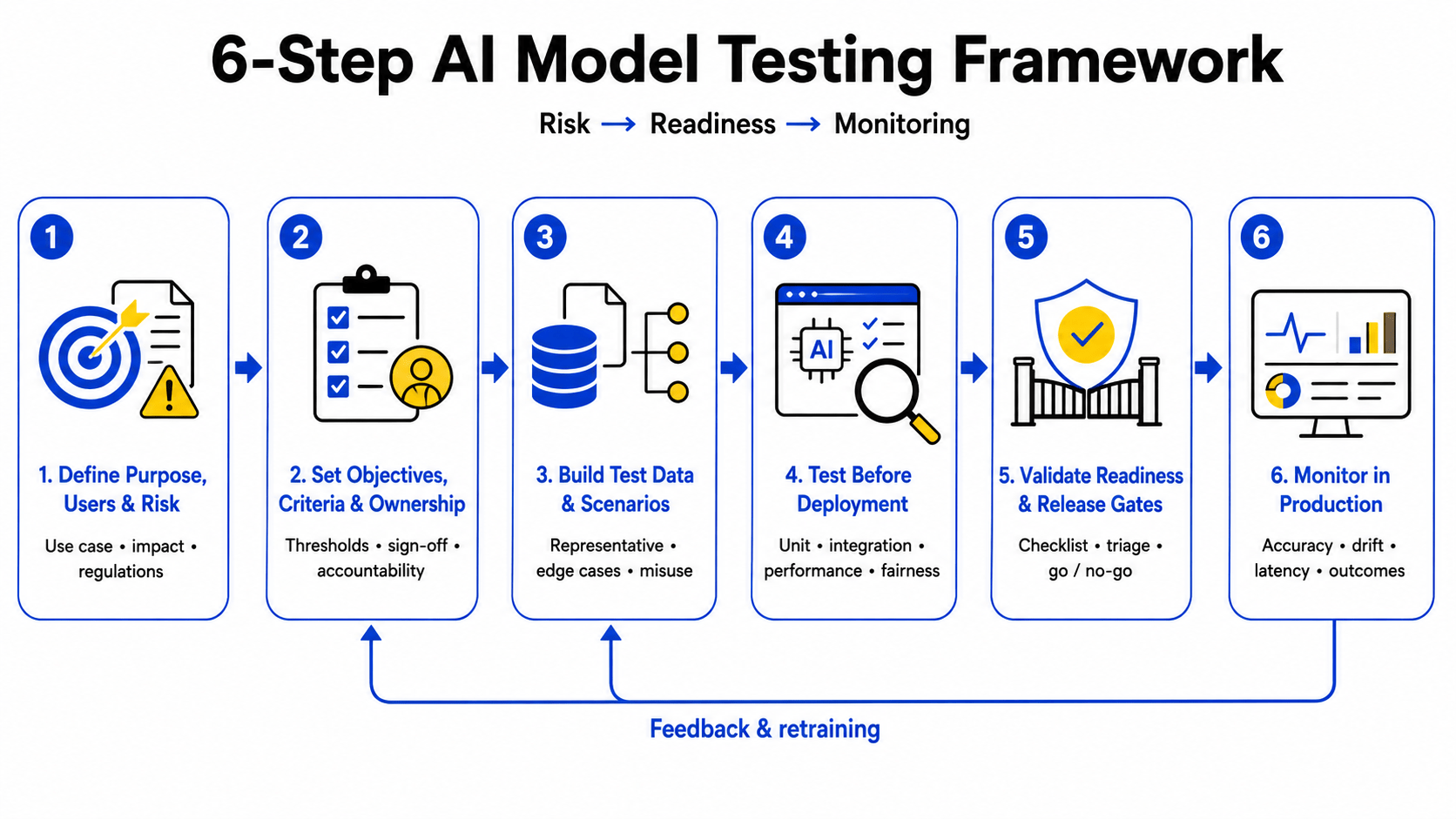
2.4 Test the model before deployment
Pre-deployment testing combines the methods covered in Section 5 — unit, integration, scenario, performance, and fairness testing — applied against the acceptance criteria set in 2.2.
The goal is not a single pass/fail verdict but a documented evidence set that shows how the model performed against each defined criterion.
2.5 Validate production readiness and release gates
Release gates formalize the go/no-go decision: a checklist confirming every required test has run, every threshold has been checked, and every open issue has been triaged.
Gates should be calibrated to the risk profile from 2.1, so a high-stakes model faces stricter gates than an internal productivity tool.
2.6 Monitor performance, drift, and real-world outcomes after launch
Testing does not end at deployment. Continuous monitoring tracks accuracy, latency, and fairness metrics in production, watches for data and model drift, and feeds real-world outcomes back into retraining decisions.
Treating monitoring as the final stage of testing — not a separate operational task — keeps the model accountable to the same standards it was released against.
AI Model Testing Lifecycle
The framework above defines management decisions; the lifecycle below defines the technical and operational activities performed at each phase.. The lifecycle begins before training with data and design controls, continues through model development and system validation, and extends into production monitoring and incident response.
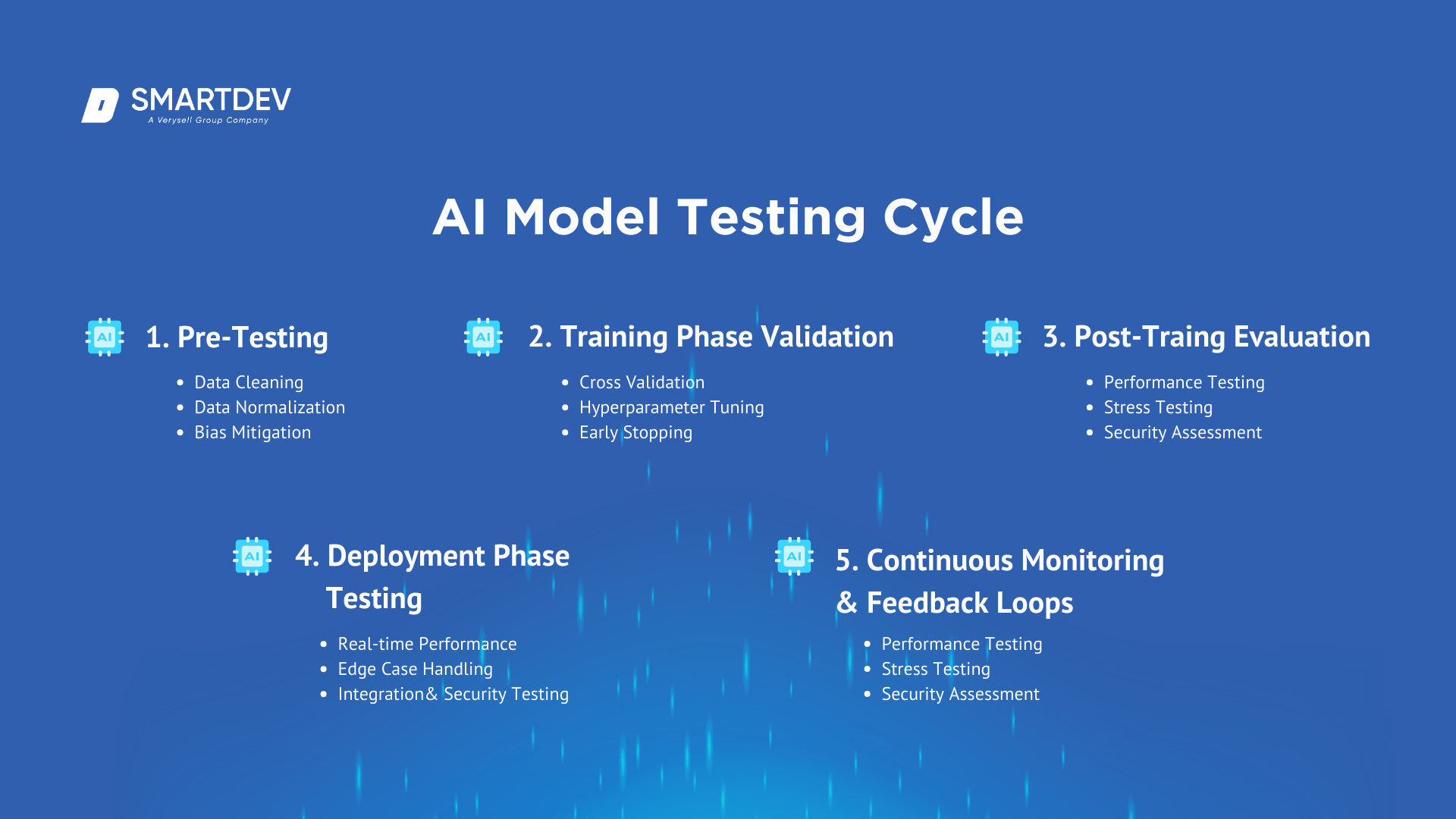
3.1 Data readiness: quality, preprocessing, representativeness, and bias checks
Data readiness testing — often supported by dedicated data analytics services — checks for missing values, labeling errors, duplicate records, and representativeness gaps before a model ever trains on the data.
Bias checks at this stage look for skewed class distributions or underrepresented subgroups that would otherwise surface later as unfair outcomes.
Preprocessing steps — normalization, encoding, deduplication — should themselves be tested. A bug introduced here propagates silently through every later stage.
Teams that treat data testing as a one-time gate rather than a recurring check often miss drift introduced by new data sources added after launch.
3.2 Training-phase validation: cross-validation, tuning, and overfitting detection
Cross-validation splits data into multiple folds to confirm the model generalizes rather than memorizes a single split.
Hyperparameter tuning is validated against a held-out set to avoid optimizing for the test data itself.
Overfitting detection compares training and validation performance curves. A widening gap is a common sign the model is learning noise rather than transferable patterns. Early stopping halts training before that gap compounds into a fragile production model.
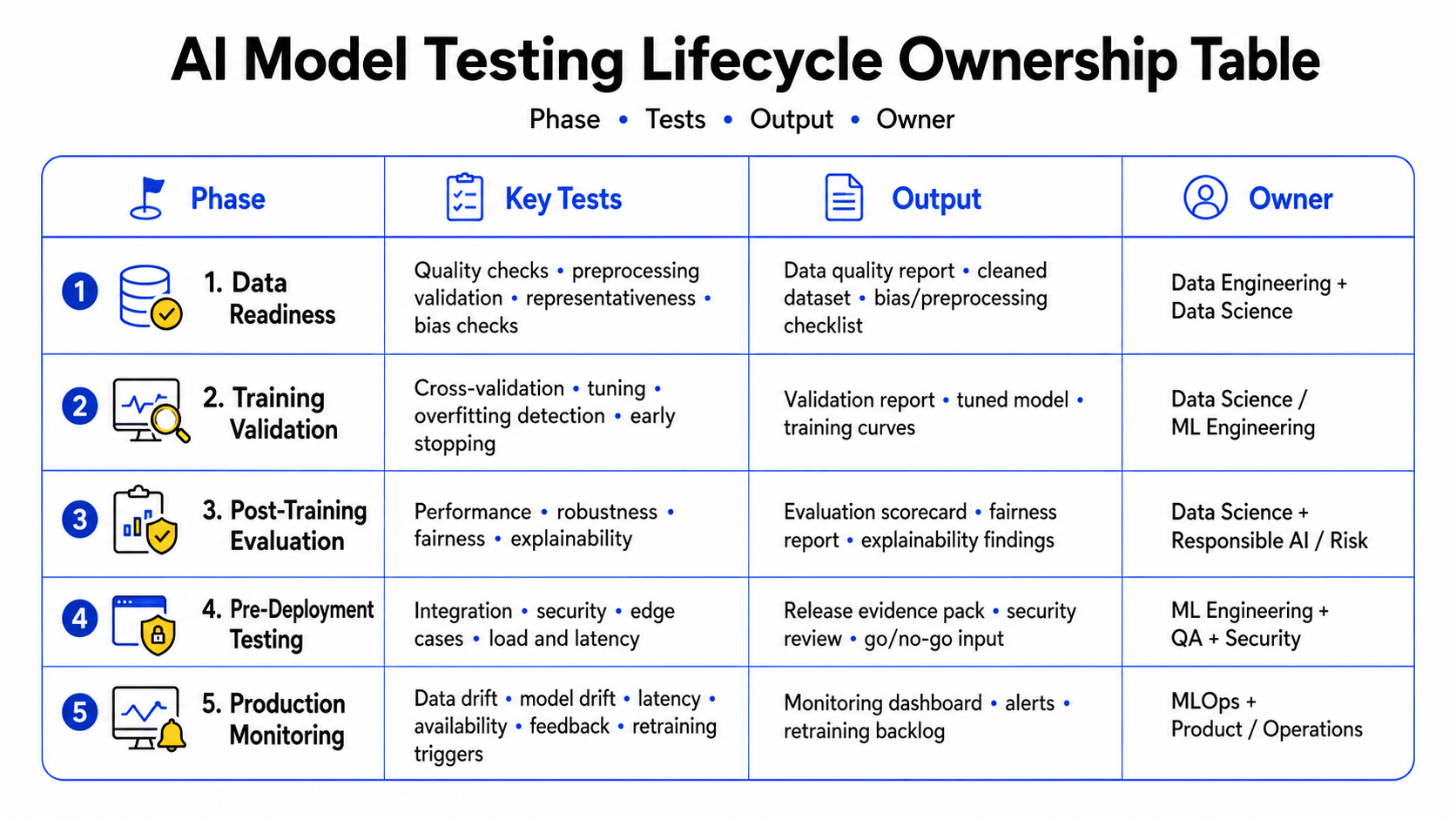
3.3 Post-training evaluation: performance, robustness, fairness, and explainability
Once training is complete, model evaluation should extend beyond aggregate accuracy. Post-training testing typically covers:
- Performance: Precision, recall, F1 score, calibration, and error rates.
- Robustness: Stability under noisy, incomplete, unusual, or adversarial inputs.
- Fairness: Differences in error rates or outcomes across sensitive or protected groups.
- Explainability: Whether the factors influencing predictions are reasonable and aligned with the intended use case.
3.4 Pre-deployment testing: integration, security, edge cases, and load conditions
Before release, the model must be validated as part of the full system, not in isolation.
Integration testing confirms it interacts correctly with upstream data pipelines and downstream applications. Security testing checks for vulnerabilities to adversarial manipulation, data poisoning, or unauthorized access, particularly relevant for models exposed through public APIs. E
Edge-case testing probes rare or unusual inputs the model is likely to encounter but was not directly trained on. Load testing confirms the system holds acceptable latency and throughput at expected — and peak — traffic levels.
3.5 Production monitoring: data drift, model drift, feedback loops, and retraining triggers
After launch, monitoring tracks two distinct phenomena: data drift (incoming data no longer matches the training distribution) and model drift (predictive performance declining over time).
The two often occur together but require different diagnostic evidence. Data drift shows up in input statistics. Model drift shows up in outcome accuracy compared against ground truth collected after deployment.
Monitoring should also capture operational performance (latency, availability, cost), user feedback (corrected predictions, reported errors), and downstream business outcomes that serve as ground truth for retraining decisions.
4. How to Choose the Right Tests for Your AI Model
The right test plan depends on the use case, not on a fixed “AI testing checklist.” Start with five factors: the decision impact, user exposure, model type, degree of autonomy, and operating environment.
4.1 Testing needs by model type
Different model families surface different failure modes, so test selection should start with model type. Supervised, unsupervised, and reinforcement-learning models each require distinct validation.
Supervised models are checked against labeled ground truth, unsupervised models against the coherence of discovered patterns, and reinforcement-learning models against reward-optimization behavior over time.
NLP models, LLMs, chatbots, and other generative-AI systems need language-understanding and contextual-relevance testing, extended with output-quality, hallucination, and guardrail testing given how these systems are typically deployed with direct user exposure and tool access.
4.2 Testing needs by deployment context
Where a model runs changes what “sufficient testing” means, independent of the model’s architecture. Customer-facing applications need heavier usability, safety, and tone testing since users interact with outputs directly.
High-stakes or regulated decisions — credit, hiring, healthcare — require stricter fairness, explainability, and audit-trail testing, often under external compliance obligations. Internal productivity and workflow systems can typically tolerate a higher error rate given human review downstream, but still need integration and reliability testing.
4.3 Risk-based test prioritization
With model type and deployment context established, teams can prioritize testing effort by combining the two: a generative model deployed in a regulated, customer-facing context (say, a chatbot handling financial advice) warrants the deepest and broadest test coverage, while an internal supervised model with human review needs a lighter, faster cycle.
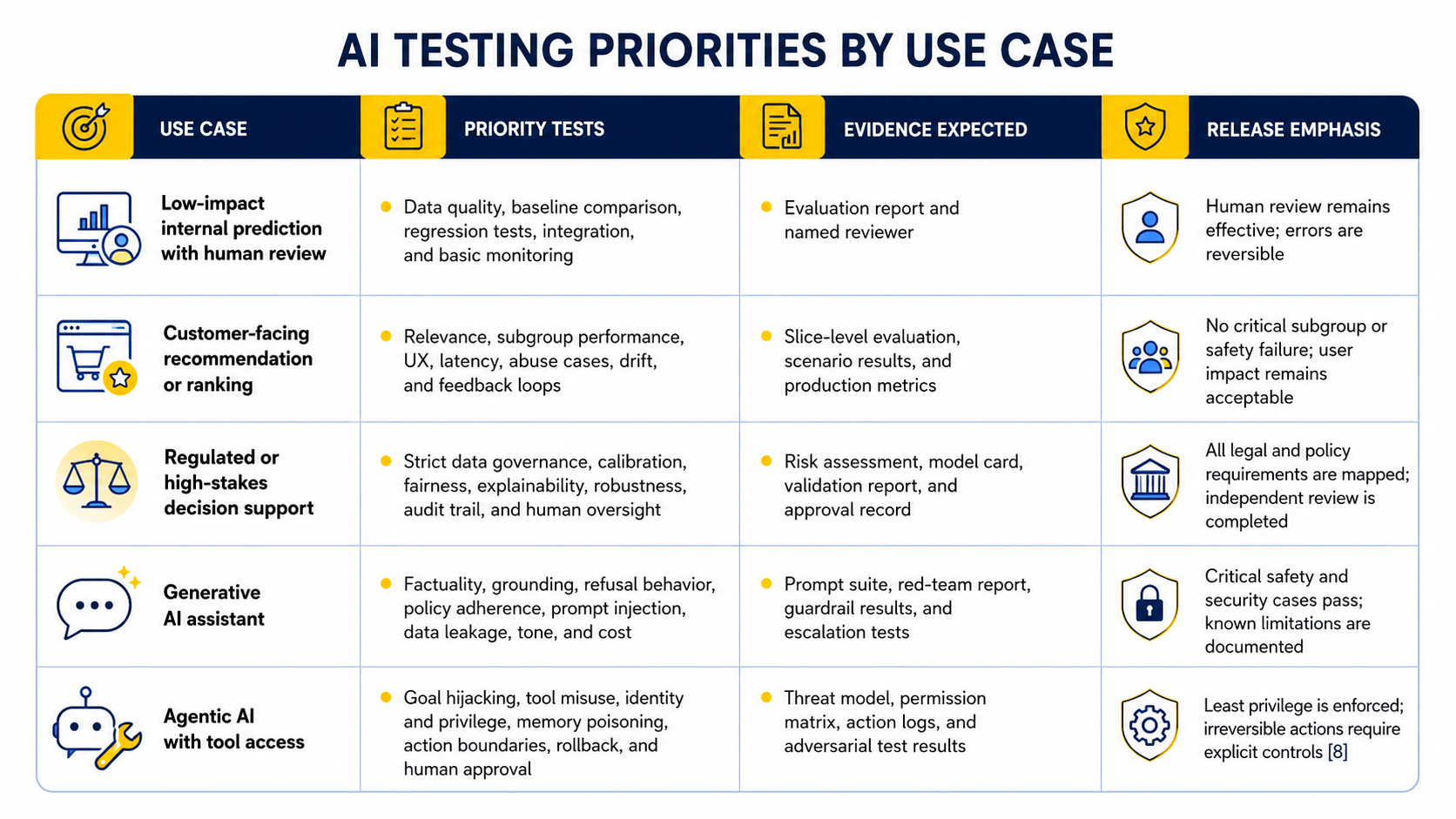
4.4 Risk-To-Test Selection Metrix
| Use case | Priority tests | Evidence expected | Release emphasis |
|---|---|---|---|
| Low-impact internal prediction with human review | Data quality, baseline comparison, regression tests, integration, and basic monitoring | Evaluation report and named reviewer | Human review remains effective; errors are reversible |
| Customer-facing recommendation or ranking | Relevance, subgroup performance, UX, latency, abuse cases, drift, and feedback loops | Slice-level evaluation, scenario results, and production metrics | No critical subgroup or safety failure; user impact remains acceptable |
| Regulated or high-stakes decision support | Strict data governance, calibration, fairness, explainability, robustness, audit trail, and human oversight | Risk assessment, model card, validation report, and approval record | All legal and policy requirements are mapped; independent review is completed |
| Generative AI assistant | Factuality, grounding, refusal behavior, policy adherence, prompt injection, data leakage, tone, and cost | Prompt suite, red-team report, guardrail results, and escalation tests | Critical safety and security cases pass; known limitations are documented |
| Agentic AI with tool access | Goal hijacking, tool misuse, identity and privilege, memory poisoning, action boundaries, rollback, and human approval | Threat model, permission matrix, action logs, and adversarial test results | Least privilege is enforced; irreversible actions require explicit controls |
5. Core Testing Methods and Strategies
No single test method proves an AI system is reliable; effective testing layers coverage from individual data and code components up through end-to-end, real-world behavior. The table below maps each method to the failure type it is best positioned to catch.
| Test type | When to use | What it reveals | Evidence produced |
|---|---|---|---|
| Data and dataset testing | Before training, before scoring, and whenever data sources change | Missing values, invalid schemas, label errors, leakage, duplicate records, and representation gaps | Validation results, dataset version, and failed-row samples |
| Unit testing | For transformations, feature logic, scoring functions, prompt templates, and guardrail functions | Local logic errors and malformed-input handling | Automated test results linked to the code version |
| Integration and end-to-end testing | Before deployment and after architecture changes | Boundary failures across ingestion, models, retrieval, APIs, UI, logs, and downstream actions | Scenario results, traces, and defect log |
| Model evaluation and regression testing | For every candidate model, prompt, policy, or data revision | Performance against ground truth or a defined rubric, and degradation against the baseline | Metric report by dataset and slice |
| Scenario, exploratory, and edge-case testing | When behavior depends on context or rare conditions | Unanticipated outputs, ambiguity handling, and boundary failures | Scenario catalogue, observed outcomes, and reviewer notes |
| Performance, load, and resilience testing | For real-time, high-volume, or critical services | Latency, throughput, saturation, recovery, fallback behavior, and cost limits | Load profile, SLO results, and failure-recovery record |
| Robustness, adversarial, and security testing | For exposed, safety-sensitive, generative, or agentic systems | Evasion, prompt injection, poisoning, leakage, tool misuse, and guardrail bypass | Threat model, red-team report, and remediation evidence |
| Fairness and explainability testing | When outcomes affect people, access, ranking, or service quality | Disaggregated performance, outcome disparities, implausible explanations, and hidden dependencies | Fairness report, explanation review, and model card |
5.1 Data and dataset testing
Dataset testing checks the inputs a model learns from and later scores against — completeness, schema consistency, label accuracy, and representativeness.
Tools built for this purpose flag anomalies such as unexpected null rates or category drift between training and serving data before they reach the model. Because so many downstream failures trace back to data problems, this layer is often the highest-leverage place to invest testing effort.
5.2 Unit testing for model components and data pipelines
Unit testing validates individual functions — a feature transformation, a preprocessing step, a scoring function — in isolation, the same way conventional software unit tests isolate a function’s logic.
In AI pipelines, this extends to testing that a data-loading function handles malformed records gracefully and that a feature engineering step produces the expected output shape.
5.3 Integration and end-to-end system testing
Integration testing confirms that individual components — data ingestion, the model, business logic, the serving layer — work correctly together. End-to-end system testing goes further, validating the complete application against real usage patterns, including how the AI component interacts with authentication, logging, and other non-AI infrastructure.
This layer catches the class of bugs that only appear when components interact, not when tested independently.
5.4 Scenario, exploratory, and edge-case testing
Scenario testing evaluates model behavior against specific, realistic situations the model is expected to handle, while exploratory testing takes a more open-ended approach, actively probing for unexpected behavior without a predefined script.
Edge-case testing deliberately targets rare or boundary conditions — unusual input formats, extreme values, conflicting signals — since AI systems frequently behave unpredictably exactly at the edges of their training distribution rather than within it.
5.5 Performance, load, latency, and scalability testing
Performance testing measures whether a model meets response-time and throughput requirements under expected production conditions. Load testing pushes the system toward and beyond expected peak traffic to identify where latency degrades or the system fails outright.
Scalability testing confirms the infrastructure can grow with demand without a proportional loss in accuracy or responsiveness, which matters especially for models serving real-time, high-volume traffic.
5.6 Robustness, adversarial, and security testing
Robustness testing exposes a model to noisy, corrupted, or slightly perturbed inputs to measure whether small changes cause disproportionately large output swings. Adversarial testing goes further, deliberately crafting inputs designed to fool the model, revealing exploitable weaknesses before an attacker does.
For generative and agentic systems specifically, security testing increasingly follows frameworks like the OWASP Top 10 for LLM Applications, which catalogs risks such as prompt injection and data leakage.
5.7 Fairness, bias, explainability, and transparency testing
Fairness testing measures whether outcomes differ systematically across protected or sensitive groups, often using disparate-impact ratios or statistical parity checks. Bias testing extends this to the training data itself, looking for skewed representation that could propagate into the model.
Explainability and transparency testing verifies that tools like SHAP and LIME produce interpretations consistent with the model’s actual decision path, a distinction from simply generating a plausible-looking explanation.
6. Metrics, Evaluation Criteria, and Release Decisions
Metrics are useful only when they are connected to the intended use, error cost, affected groups, and operating constraints. Accuracy, precision, recall, and F1 measure different aspects of predictive quality; calibration measures whether predicted probabilities correspond to observed frequencies.
6.1 Model-quality metrics: accuracy, precision, recall, F1, and calibration
Model-quality metrics quantify how well predictions match ground truth. Accuracy measures overall correctness but can mislead on imbalanced datasets, which is why precision, recall, and F1 score are typically reported alongside it to capture false positives and false negatives separately.
6.2 Operational metrics: latency, throughput, reliability, and cost
Operational metrics determine whether a model is viable to run in production, independent of its predictive quality. Latency measures response time per request, throughput measures requests handled per unit of time, and reliability tracks uptime and error rates under sustained load.
Cost per inference — compute, API, and infrastructure spend — increasingly factors into release decisions as generative models scale, since a model that is accurate but prohibitively expensive to run at volume is not production-ready in a practical sense.
6.3 Fairness and explainability measures
Fairness measures quantify outcome differences across groups using metrics such as demographic parity, equalized odds, or disparate-impact ratio, each suited to different notions of fairness depending on the use case.
Explainability measures evaluate how consistently and completely a model’s stated reasoning — via SHAP values, LIME approximations, or attention weights — reflects its actual decision process, drawing on frameworks such as NIST’s four principles of explainable AI. Neither category has a universally correct threshold; both require context-specific interpretation tied to the model’s application and affected population.
6.4 Defining pass/fail thresholds and release criteria
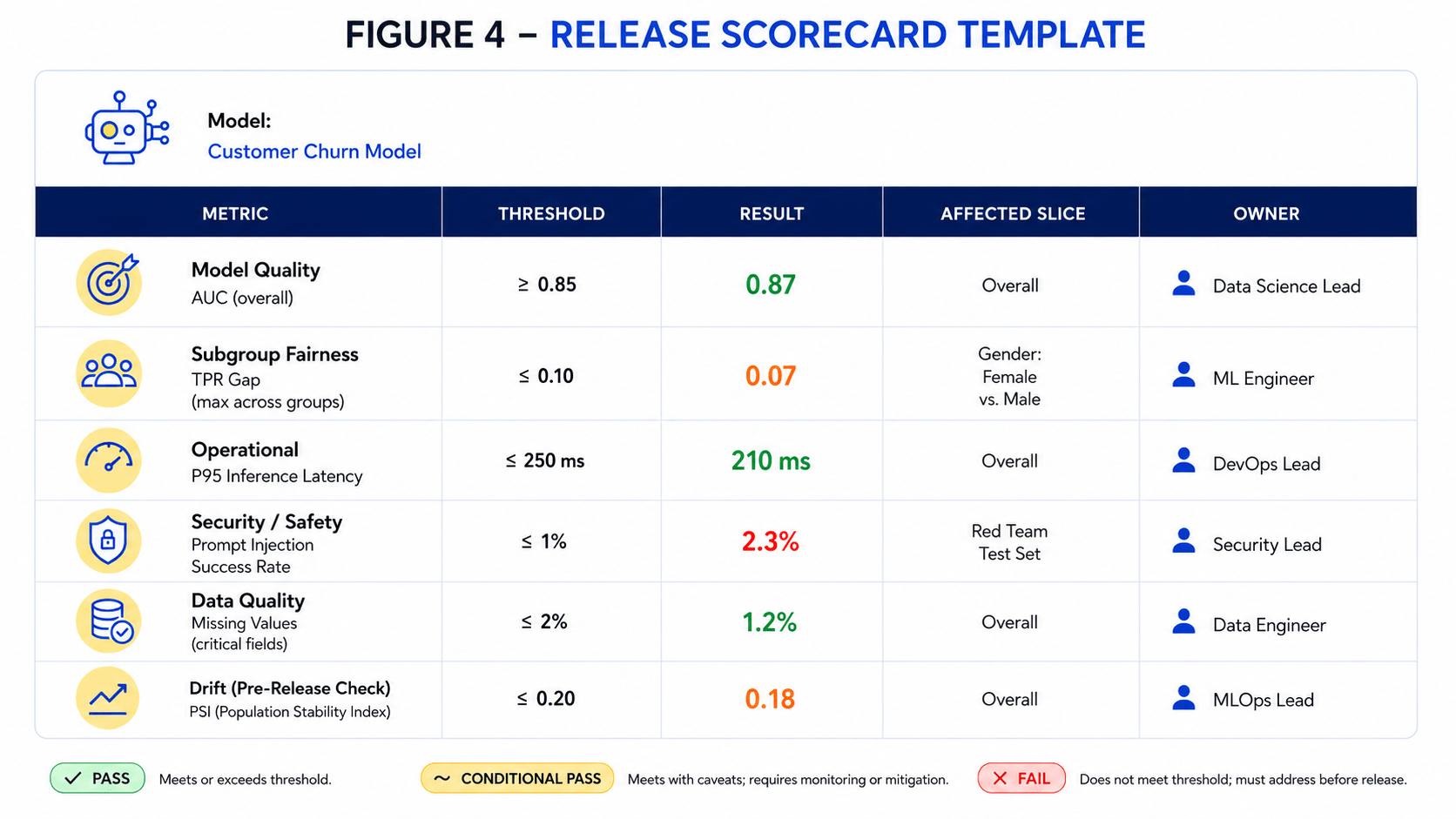
A useful evaluation scorecard records each metric, its threshold, the actual result, the evidence supporting it, and who is accountable for the release call. Rather than a single global bar, thresholds typically vary by subgroup and by deployment context — a threshold acceptable for an internal tool would likely be too permissive for a regulated, customer-facing decision.
6.5 When a model should be retrained, rolled back, or retired
A model’s operational status should be determined by predefined evidence and thresholds rather than ad hoc judgment. Teams should:
- Retrain the model when monitoring detects sustained data drift, model drift, or performance degradation beyond agreed limits.
- Roll back a new version when it performs worse than its predecessor against the same acceptance criteria.
- Retire the model when its use case, data source, technical environment, or regulatory context no longer supports safe and reliable operation.
7. Common AI Testing Failures—and How to Investigate Them
Testing AI models presents several challenges that can impact their effectiveness and reliability. Key issues include:
7.1 Data imbalance, poor data quality, and distribution shifts
Data imbalance occurs when certain classes or subgroups are underrepresented in training data, causing the model to perform worse for those groups in production. Poor data quality — mislabeled records, missing values, duplicate entries — compounds this by teaching the model incorrect patterns outright.
Distribution shift happens when the real-world data a model encounters diverges from what it was trained on, whether gradually through changing user behavior or abruptly through an external event.
7.2 Overfitting, underfitting, and weak generalization
Overfitting shows up as strong training performance paired with weak production performance, indicating the model memorized noise specific to its training set rather than learning transferable patterns. Underfitting is the opposite failure: the model performs poorly even on training data because it is too simple to capture the underlying relationship.
Weak generalization sits between the two, where a model performs adequately on data similar to training but degrades meaningfully on new, related scenarios. Comparing training, validation, and production performance side by side is the fastest way to distinguish between these three.
7.3 Model drift and performance degradation in production
Model drift refers to a decline in predictive performance over time even without any code change, typically because the real-world relationship between inputs and outcomes has shifted since training.
It differs from data drift, which describes a shift in the input distribution itself; the two often occur together but require different diagnostic evidence — data drift shows up in input statistics, model drift shows up in outcome accuracy. Investigating drift requires comparing current predictions against ground-truth outcomes collected after deployment.
7.4 Bias, unsafe outputs, and explainability gaps
Bias in production often surfaces as a pattern of complaints or metric divergence across specific user groups rather than a single dramatic failure. Unsafe outputs — harmful, misleading, or policy-violating content, particularly from generative models — require content-level review alongside statistical metrics, since standard accuracy scores do not capture this failure mode.
7.5 Scalability, integration, and computational constraints
Scalability failures appear as degraded latency or dropped requests once traffic exceeds levels tested pre-launch, often because load testing used unrealistic traffic patterns. Computational constraints show up as unexpectedly high infrastructure cost or resource exhaustion, frequently traced back to a mismatch between the model’s compute profile and the environment it was deployed into.
7.6 Testing-framework and governance gaps
Some failures are not caused by the model at all but by gaps in the testing process itself: missing acceptance criteria, undocumented thresholds, or no clear owner for a release decision. These gaps tend to surface only in hindsight, after an incident prompts a review of what was actually tested versus what should have been.
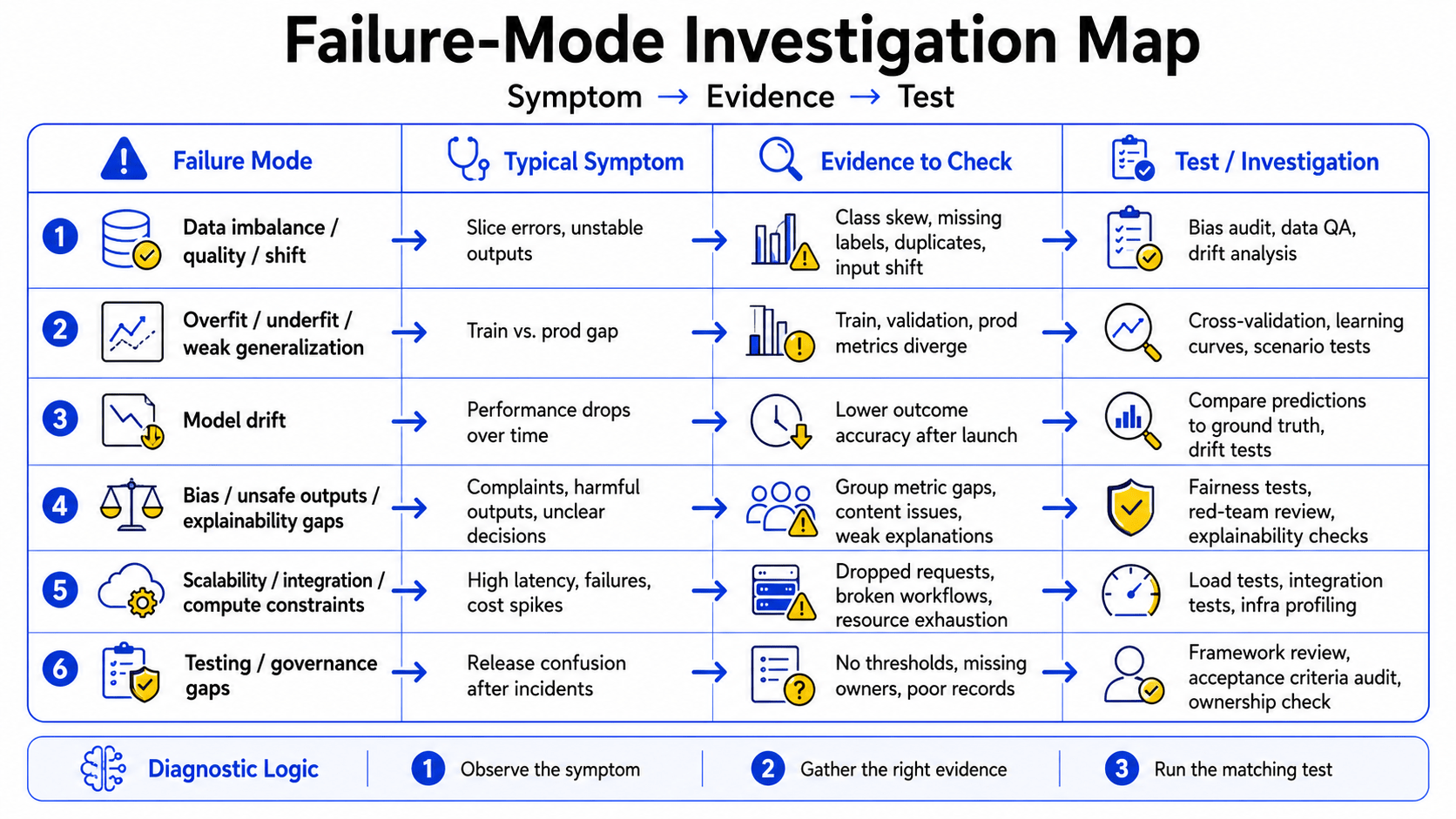
| Symptom | Possible evidence | Validation test | Owner |
|---|---|---|---|
| Performance is weaker for certain groups or recent data | Class imbalance, label errors, missing values, feature-distribution changes | Check data quality, subgroup metrics, and training-versus-production distributions | Data Engineer / Data Scientist |
| Strong training results but weak validation or production results | Large performance gap, unstable cross-validation, poor results on new scenarios | Compare training, validation, test, and production metrics; run out-of-sample tests | Data Scientist / ML Engineer |
| Performance declines over time without code changes | Input drift, falling accuracy, calibration errors, changing outcomes | Compare current data with the training baseline and predictions with recent ground truth | MLOps Engineer / Data Scientist |
| Biased, unsafe, or unexplained outputs | Subgroup disparities, complaints, flagged outputs, inconsistent explanations | Run fairness tests, safety scenarios, adversarial testing, and expert review | Responsible AI / Security / Domain Expert |
| High latency, failures, or unexpected infrastructure cost | Timeouts, dropped requests, resource saturation, rising cost per request | Run load, stress, recovery, and resource-usage tests | Platform Engineer / MLOps Engineer |
| Critical risks were not tested or approved | Missing criteria, thresholds, evidence, or decision owner | Audit test coverage, traceability, approvals, and release responsibilities | QA Lead / Product Owner / Governance Lead |
8. Tools and Frameworks for AI Model Testing
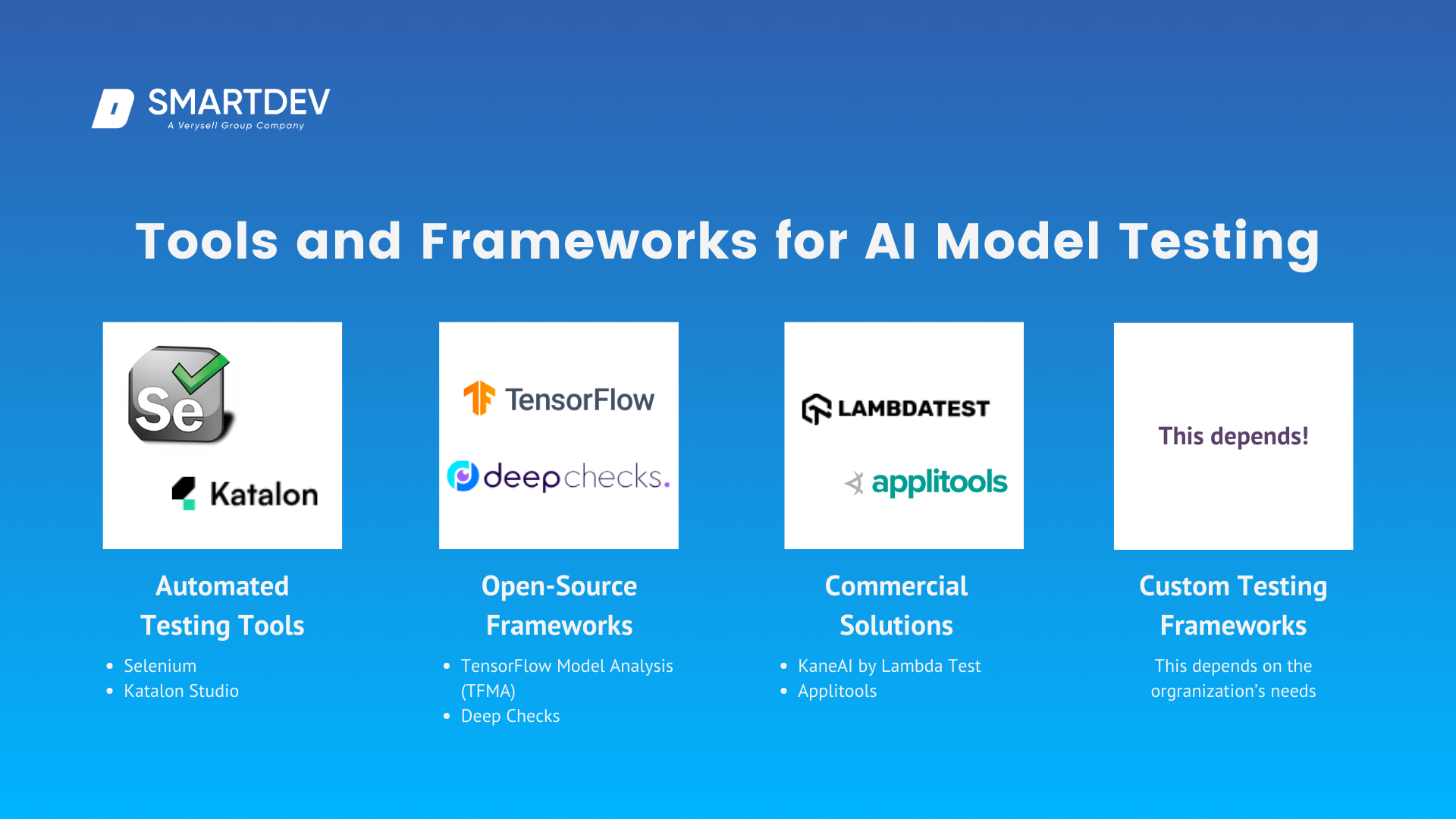
Selecting the appropriate tools and frameworks is essential for effective AI model testing, ensuring accuracy, reliability, and efficiency. Below is an overview of various solutions:
8.1 What to evaluate when selecting testing tools
Tool selection should start from testing needs, not product marketing. Relevant criteria include which lifecycle stage a tool covers (data checks, evaluation, monitoring, automation), compatibility with the existing ML stack, governance and audit-trail features, and the internal skills required to operate it.
A tool that fits a small team’s data-validation needs may be entirely wrong for an enterprise’s monitoring and compliance requirements, so this evaluation should happen before any product is shortlisted, not after.
8.2 Open-Source Frameworks
Open-source frameworks provide flexibility and community-driven development. Verify current capabilities and licensing against official project documentation before adoption. Notable options:
- TensorFlow Model Analysis (TFMA): evaluates model performance across slices of data; supports classification, regression, and ranking metrics.
- DeepChecks: covers data integrity checks, train-test comparisons, and model performance evaluation.
- Evidently AI: produces reports and monitors data and model drift, quality, and fairness; integrates with MLflow.
- Great Expectations: data validation and documentation framework for pipeline testing before data reaches a model.
8.3 Commercial platforms and managed capabilities
Commercial platforms add dedicated support, managed infrastructure, and broader integration coverage. They suit teams that need faster time-to-value or lack capacity to maintain an open-source stack — at the cost of licensing spend and, in some cases, reduced flexibility to customize checks.
Options include AI-assisted test authoring platforms, end-to-end MLOps suites with built-in monitoring, and visual UI testing tools.
8.4 Custom testing frameworks and MLOps integration
Teams with unique testing scenarios or strict internal requirements often build custom frameworks rather than adapting an off-the-shelf tool.
This approach allows tests to be tailored precisely to the organization’s risk profile and integrated directly into existing MLOps services and CI/CD pipelines, so model testing runs automatically alongside every code and data change rather than as a manual gate. The tradeoff is ongoing engineering investment to build and maintain the framework as models and requirements evolve.
8.5 Building a practical toolchain for your team
Most teams land on a combination of open-source and commercial tools rather than a single platform: open-source for data and model evaluation, commercial or custom tooling for monitoring and governance evidence.
The right combination depends on project requirements, budget, and model complexity, so tool selection should be revisited periodically as the AI program matures rather than fixed permanently at the first purchase decision.
9. Advanced Testing for Modern AI Systems
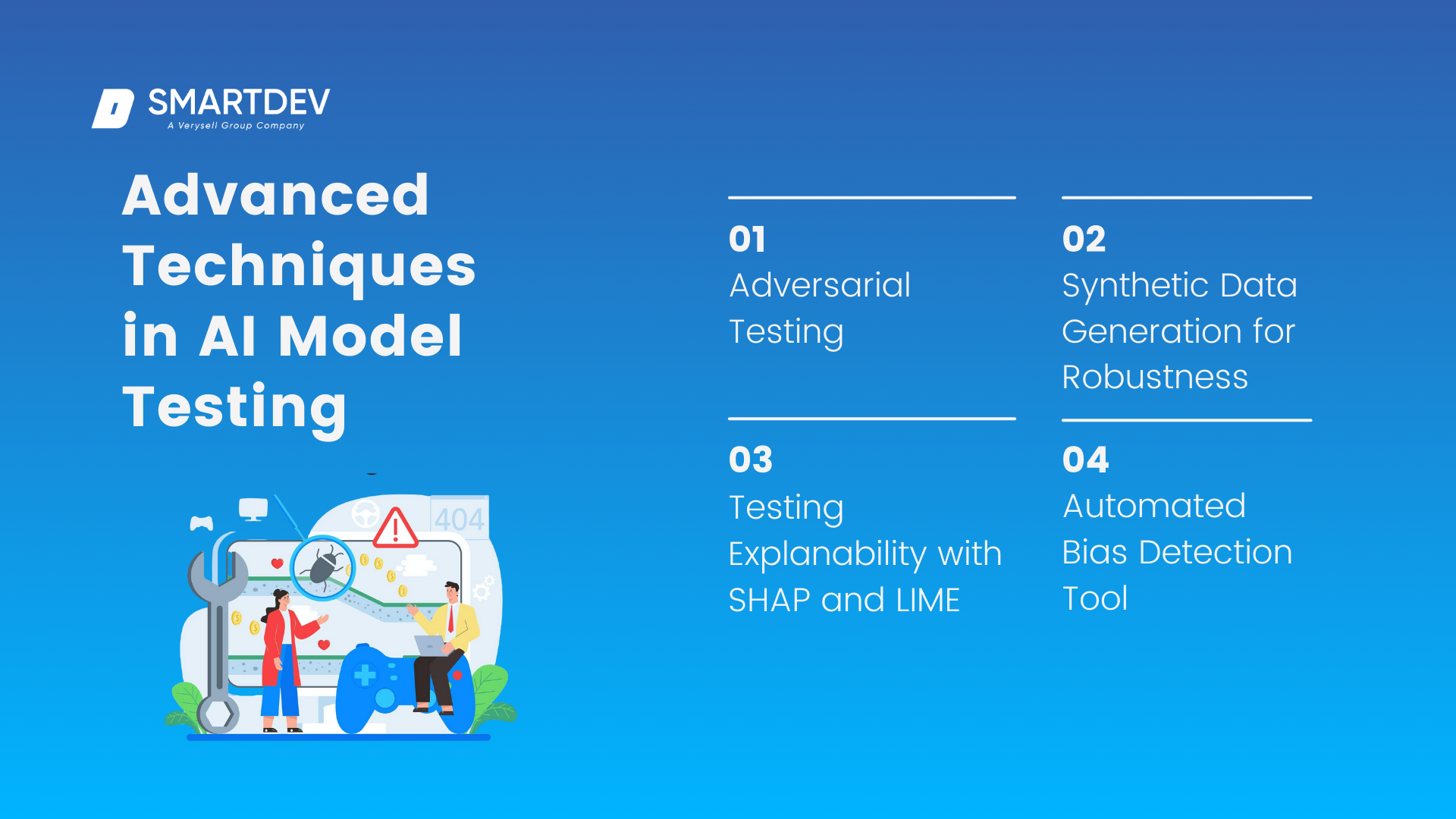
Implementing advanced techniques in AI model testing is essential to enhance robustness, transparency, and fairness. Key methodologies include:
| Advanced testing method | Primary purpose | Key testing activities | Main risks addressed |
|---|---|---|---|
| Adversarial Testing and Red Teaming | Identify exploitable weaknesses by intentionally attempting to trigger incorrect, unsafe, or harmful behavior. | Test malicious inputs, prompt injection, jailbreaks, guardrail bypasses, and excessive agent permissions through structured attack simulations. | Security vulnerabilities, unsafe outputs, prompt injection, excessive agency, and guardrail failure. |
| Synthetic Data and Simulation | Test scenarios where real data is limited, sensitive, rare, expensive, or unsafe to collect. | Generate statistically representative data using techniques such as GANs or variational autoencoders, and simulate rare or high-risk operating conditions. | Privacy exposure, insufficient test coverage, rare edge cases, and unsafe real-world experimentation. |
| Explainability Validation | Confirm that model explanations accurately reflect the factors driving predictions. | Use SHAP, LIME, or comparable methods, then validate explanations through domain review, ground-truth comparisons, and targeted spot checks. | Misleading explanations, hidden model dependencies, weak auditability, and incorrect decision rationales. |
| Automated Bias Detection and Ongoing Evaluation | Detect unfair outcomes as data patterns and model behavior change after deployment. | Continuously compare model performance across relevant subgroups and conduct recurring fairness audits using consistent metrics and thresholds. | Emerging bias, unequal error rates, distribution shifts, and inconsistent outcomes across user groups. |
| Generative AI, Guardrail, and Human Oversight Testing | Evaluate the reliability and safety of generative and agentic AI systems beyond traditional performance metrics. | Test hallucinations, policy adherence, tone, jailbreak resistance, content filters, output validators, rate limits, and human review workflows. | Hallucinations, harmful content, policy violations, guardrail failure, delayed escalation, and ineffective human oversight. |
10. Ethical, Regulatory, and Governance Considerations
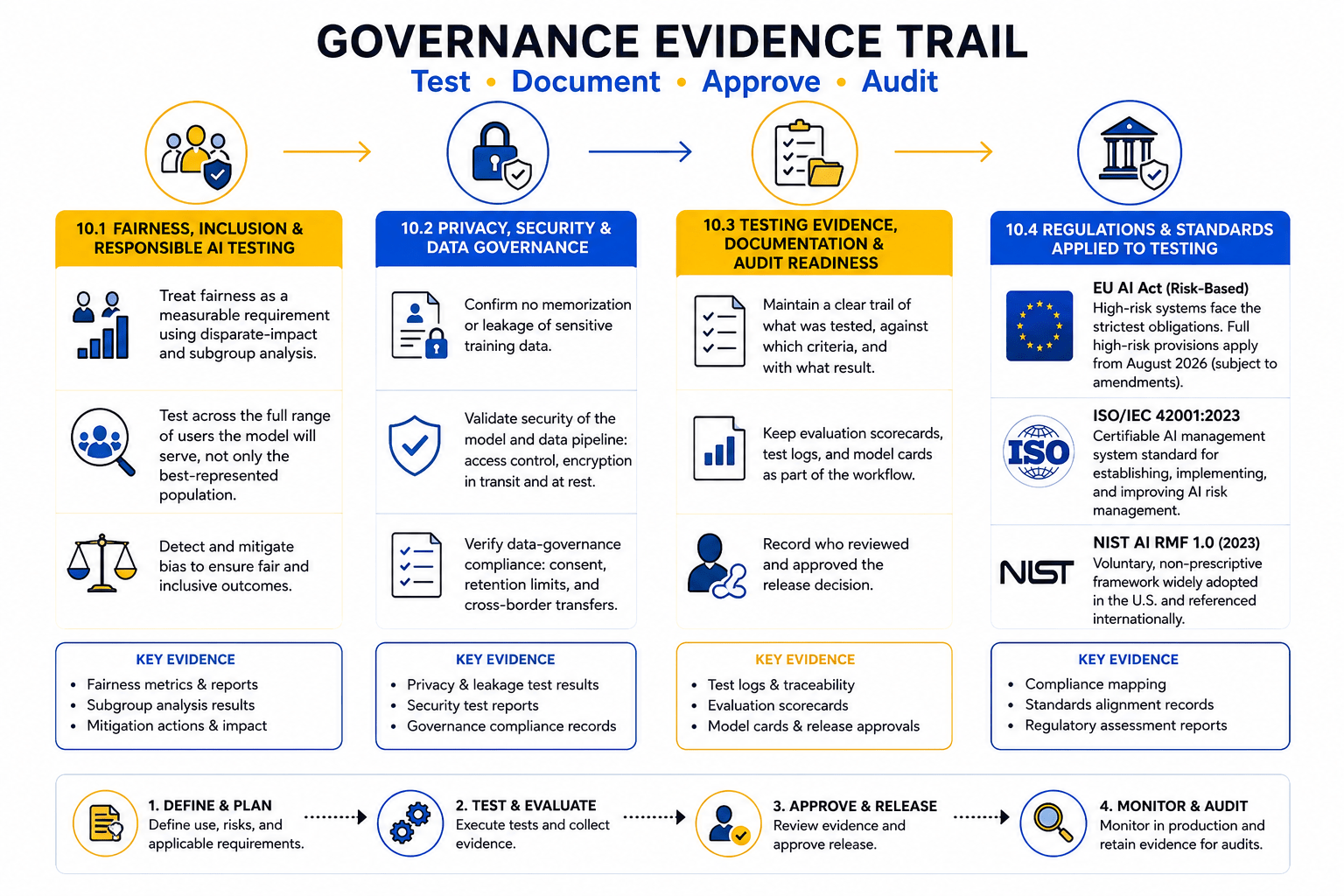
10.1 Fairness, inclusion, and responsible AI testing
Responsible AI testing treats fairness and inclusion as measurable requirements rather than aspirational values, using the disparate-impact and subgroup analysis covered earlier in this guide.
Building genuinely inclusive AI systems requires testing against the full range of users a model will actually serve, not only the population best represented in available training data, a distinction well documented in research on fairness and bias in AI systems.
10.2 Privacy, security, and data-governance requirements
Privacy testing confirms a model does not memorize or leak sensitive training data — a documented risk for large language models trained on broad datasets.
Security testing extends beyond the model to the surrounding data pipeline: access controls and encryption at rest and in transit. Data-governance requirements — consent documentation, retention limits, and cross-border transfer rules — should be validated as part of the testing plan, not left to a separate legal review.
10.3 Testing evidence, documentation, and audit readiness
Regulators and internal auditors expect a documented trail: what was tested, against which criteria, with what result, and who approved release.
Maintaining this evidence — test logs, evaluation scorecards, model cards — as a standard part of the testing workflow is what makes audit readiness realistic, rather than a scramble triggered by an external request.
10.4 Applying relevant regulations and standards to the testing process
The EU AI Act applies a risk-based structure where high-risk systems — covering employment decisions, credit scoring, and critical infrastructure — face the strictest obligations. Full high-risk provisions are currently scheduled to apply from August 2026, pending ongoing simplification amendments. Teams should monitor the official EU publication record, as implementation details continue to evolve.
ISO/IEC 42001:2023 provides a certifiable AI management system standard that many organizations use as an operational backbone for governance obligations. It specifies requirements for establishing, implementing, and continually improving AI risk management.
The voluntary NIST AI RMF 1.0 (2023) offers a complementary, non-prescriptive framework widely adopted in the United States and referenced internationally.
11. Building an AI Testing Operating Model
A testing framework without clear ownership produces the same gaps as no framework at all. Roles must be defined before the first test runs, not assigned after an incident.
11.1 Roles and collaboration: data science, QA, engineering, security, and governance
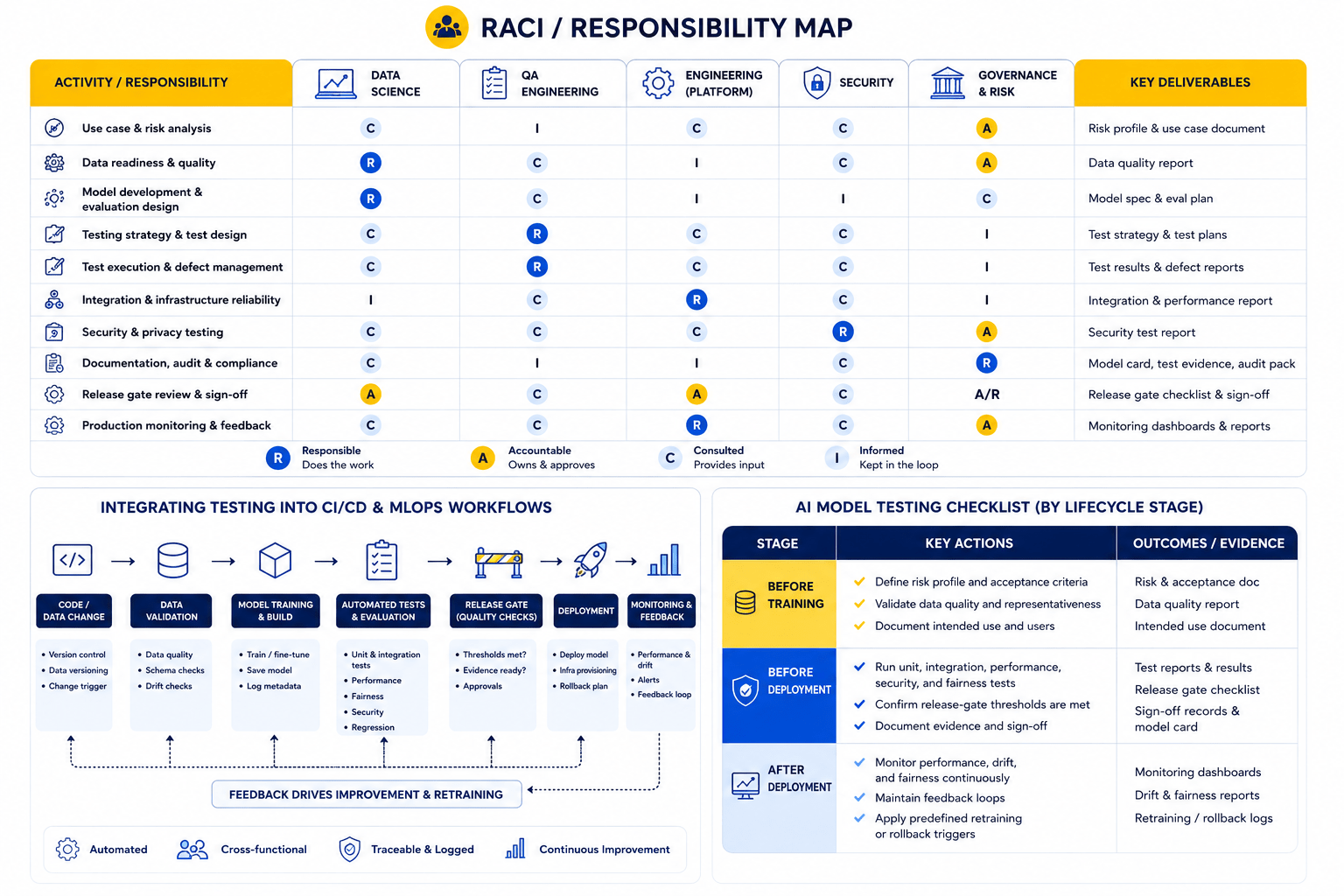
Durable AI testing quality depends on defined ownership across functions rather than one team absorbing the entire responsibility. Data scientists own model development and evaluation design; QA engineers contribute testing methodology and defect management discipline; engineering owns integration and infrastructure reliability; security owns adversarial and data-protection testing; governance owns documentation, audit readiness, and regulatory mapping. Cross-functional review at each release gate — not just sign-off from a single function — catches issues that a siloed process misses.
11.2 Integrating testing into CI/CD and MLOps workflows
Embedding testing into CI/CD means data validation, model evaluation, and regression checks run automatically on every pipeline change, not manually before a scheduled release. This shortens the feedback loop between introducing an issue and catching it. Organizations building this out often extend existing DevOps and automation testing services rather than starting from scratch.
11.3 A practical AI model testing checklist
The checklist below organizes the minimum practical actions by lifecycle stage, useful as a working reference rather than a substitute for the full framework in Section 2.
| Stage | Key actions |
|---|---|
| Before training | Define risk profile and acceptance criteria; validate data quality and representativeness; document intended use and users |
| Before deployment | Run unit, integration, performance, security, and fairness tests; confirm release-gate thresholds are met; document evidence and sign-off |
| After deployment | Monitor performance, drift, and fairness continuously; maintain feedback loops; apply predefined retraining or rollback triggers |
12. Lessons from Real-World AI Testing
High-profile public failures offer some of the clearest evidence for why data validation and real-world scenario testing cannot be skipped — even when a model performs well on a benchmark.
12.1 IBM Watson for Oncology: the cost of insufficient real-world validation
IBM’s Watson for Oncology illustrates the risk of training on synthetic rather than fully representative real-patient data.
Internal documents reviewed by STAT News (2018) showed the system had produced unsafe and inaccurate cancer treatment recommendations. The investigation traced the problem in part to a training process that did not adequately reflect the diversity and complexity of real clinical cases.
12.2 Amazon’s recruiting tool: bias baked in at the data stage
Amazon’s experimental recruiting tool shows how bias embedded in training data propagates directly into model behavior.
As reported by Reuters (2018), the system learned to systematically downgrade female candidates because it was trained predominantly on resumes submitted over the prior decade — most of which came from men. The tool was discontinued before deployment at scale.
Both cases point to the same root cause: data assumptions that were not caught before the model reached evaluation. Benchmark performance does not surface this class of failure. Only representative data validation and real-world scenario testing can.
13. What’s Next for AI Model Testing
13.1 Continuous evaluation and automated testing
As models are updated more frequently — sometimes continuously through online learning or frequent fine-tuning — point-in-time testing before a single release becomes less sufficient on its own. Continuous evaluation, where test suites run automatically against every model or data change, is becoming a baseline operational capability rather than an advanced practice, particularly for teams running frequent iteration cycles.
13.2 Evolving standards, governance, and assurance practices
Governance and assurance practices are still maturing alongside the technology they oversee. Frameworks such as the NIST AI RMF and ISO/IEC 42001 are gaining adoption as reference points, and regulatory timelines such as the EU AI Act’s high-risk provisions continue to shift as implementation details are finalized. Teams should expect these standards to keep evolving and plan testing documentation practices that can adapt rather than assuming any single framework is final.
13.3 Preparing for more autonomous and generative AI systems
As AI systems gain more autonomy — agents that take actions, not just generate outputs — testing must extend further into behavioral and safety boundaries: what actions a system is permitted to take, how it handles ambiguous instructions, and how reliably its guardrails hold under adversarial pressure. Preparing for this now means building the monitoring, human-oversight, and escalation infrastructure described in Sections 9 and 11 before autonomous systems reach production, not after an incident forces the issue.
FAQ: AI Model Testing
What is AI model testing? AI model testing is the systematic evaluation of an AI system’s data, model behavior, and production performance to confirm it is accurate, fair, robust, explainable, and safe before and after deployment.
How do you test an AI model before deployment? Pre-deployment testing combines unit, integration, performance, security, and fairness testing against acceptance criteria defined during risk and objective planning, with results documented as evidence for a release-gate decision.
What metrics should you use to evaluate an AI model? Relevant metrics depend on the use case, but typically include model-quality measures (accuracy, precision, recall, F1, calibration), operational measures (latency, throughput, cost), and fairness and explainability measures, each with context-specific thresholds rather than universal targets.
How is testing an LLM different from testing a traditional machine-learning model? LLM testing adds evaluation of factual accuracy, tone, guardrail effectiveness, and resistance to prompt injection and jailbreaks, extending beyond the accuracy and fairness metrics typically sufficient for traditional classification or regression models.
What is the difference between model validation, monitoring, and testing? Testing evaluates a model against defined criteria at a point in time, often before release; validation confirms a model meets its intended purpose and requirements; monitoring continuously tracks performance, drift, and fairness after deployment. All three are part of one lifecycle rather than separate disciplines.
How often should an AI model be retested or retrained? Retesting and retraining frequency should be driven by monitoring evidence — sustained drift or performance decay past an agreed threshold — rather than a fixed calendar schedule, though many teams also run scheduled reviews as a baseline safeguard between drift-triggered events.
Conclusion
Reliable AI does not come from a single accuracy score or a one-time pre-launch check.
It comes from testing data, model behavior, system integration, and production performance as one continuous discipline — with clear ownership and documented evidence at every stage.
No test suite, tool, or framework guarantees fairness, safety, or compliance outright. What they provide is a repeatable, evidence-based way to catch problems before they reach users and to respond quickly when production conditions change.
Treating monitoring as testing’s final stage — not a separate operational task — is what keeps a model accountable long after its initial release.
Assessing where your current testing practice has gaps is a practical starting point regardless of how mature your program already is. Teams building this out can explore SmartDev’s AI consulting services to structure a testing framework around their specific risk profile. To discuss your testing maturity with the team, get in touch.
—
References
- AI Risk Management Framework (AI RMF 1.0) | NIST
- Four Principles of Explainable Artificial Intelligence (NIST IR 8312) | NIST
- ISO/IEC 42001:2023 — Artificial Intelligence — Management Systems | ISO
- EU AI Act — High-Level Summary | artificialintelligenceact.eu
- OWASP Top 10 for LLM Applications (2025) | OWASP Foundation
- SHAP: A Game Theoretic Approach to Explain the Output of Any Machine Learning Model | SHAP Documentation
- LIME: Local Interpretable Model-Agnostic Explanations | GitHub
- IBM’s Watson Supercomputer Recommended ‘Unsafe and Incorrect’ Cancer Treatments | STAT News
- Amazon Scraps Secret AI Recruiting Tool That Showed Bias Against Women | CNBC
- Fairness and Bias in Artificial Intelligence | GeeksforGeeks